
Delhi's Quiet Alarm: What China's Bangladesh Port Deal and Teesta Gambit Really Mean for India
Executive Summary
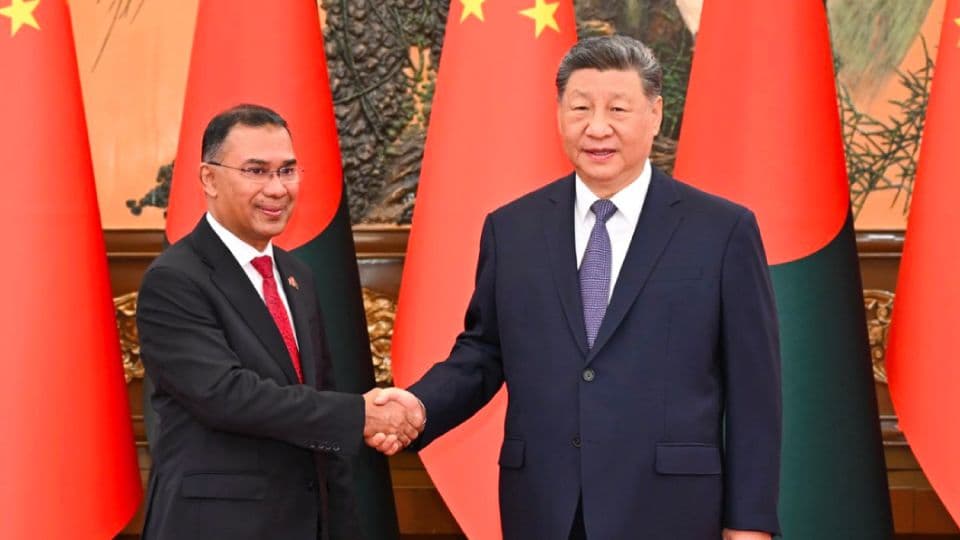
When Tarique Rahman touched down in Beijing on 22 June 2026 for his first overseas visit as Bangladesh's Prime Minister, the symbolism was unmistakable. India had extended an invitation. Rahman went to China first. Over four days, his government signed 15 memoranda of understanding and two formal agreements, produced a joint communiqué, received a pledge of approximately $300 million in Chinese grant assistance, and opened discussions on one of the most sensitive infrastructure questions in the subcontinent: Chinese management of the Teesta River, which flows through the strategic corridor connecting India's northeastern states to the rest of the country.
The Mongla Port economic zone decision crystallised what the visit signified. The Bangladesh Economic Zones Authority signed a memorandum with China Civil Engineering Construction Corporation to develop a 110-acre economic zone adjacent to Mongla Port - Bangladesh's second-largest seaport, sitting 188 kilometres from Kolkata and roughly 80 kilometres from the Indian border. The site had been reserved for Indian investment since 2015 under a bilateral initiative launched during Prime Minister Narendra Modi's visit to Dhaka. India's nominated developer, the Hiranandani Group's subsidiary Evita Constructions, failed to begin work within the stipulated timeframe. China moved in. The economic zone India did not build is now China's project.
Taken individually, each of these developments - Mongla, the Teesta feasibility study, the proposed 2+2 defence dialogue, the reported negotiations for 24 J-10CE fighter jets - has strategic explanations that are plausible and, in Dhaka's telling, primarily economic. Taken together, they describe a Bangladesh that is systematically replacing delayed or frustrated Indian infrastructure commitments with Chinese ones, deepening its military supply relationship with Beijing, and creating conditions under which Chinese physical and logistical presence in the Bay of Bengal will be structurally embedded rather than incidental.
India's response has been muted in its public expression and measured in its actions. That restraint reflects a genuine strategic complexity: India cannot afford to push Bangladesh further toward China by overreacting, cannot deliver on commitments it has already failed to execute, and cannot resolve the Teesta water-sharing deadlock - driven by West Bengal's domestic politics - quickly enough to preempt Chinese involvement. Delhi's alarm is real. Its options are constrained.
Strategic Background: How India Lost Ground in Bangladesh
The fall of Sheikh Hasina in August 2024, driven by student-led protests against a quota system for government jobs and later against the government itself, removed India's most reliable partner in Dhaka. The Awami League's relationship with New Delhi was deep and durable. Hasina had prioritised Indian connectivity projects, resisted Chinese overtures on sensitive infrastructure, and maintained a regional orientation that kept Beijing's footprint in Bangladesh limited relative to its ambitions.
The Muhammad Yunus-led interim government that followed was different in character and in strategic preferences. Yunus himself had a complicated relationship with the Hasina government and, by extension, with New Delhi, which was perceived in Dhaka as having backed Hasina. The interim period saw the cancellation of Indian project allocations, including a Special Economic Zone in Chittagong that was reassigned to a Chinese drone manufacturing facility. India's India Ports Global Ltd had secured operational rights to a Mongla Port terminal in a deal finalised in May 2024; following Hasina's fall, that project did not advance.
Tarique Rahman's BNP won Bangladesh's elections in February 2026. The BNP has historically maintained a different strategic orientation from the Awami League - closer to China and the United States and more assertive toward India. General Ziaur Rahman, Tarique's father and the BNP's founder, built the party's political identity partly in opposition to the India-aligned Awami League. Rahman's first overseas destination as prime minister - China, not India - was consistent with that historical pattern, even as his government insisted it reflected economic pragmatism rather than geopolitical preference.
India received Rahman's election with outward warmth. Prime Minister Modi wrote a congratulatory letter and invited Rahman to visit India. The invitation was accepted in principle but not acted on before the Beijing visit. India-Bangladesh relations remain formally functional but operationally strained: Bangladesh has repeatedly protested against Indian push-in policies on the border, including statements by Assam Chief Minister Himanta Biswa Sarma; the Teesta water-sharing agreement, promised and deferred since 2011, remains undelivered; and Dhaka's demand for the extradition of Sheikh Hasina - sheltered in India after her ouster - creates a bilateral irritant that New Delhi has shown no willingness to address.
The Mongla Deal: Geography as the Core Issue
Mongla is not merely Bangladesh's second port. Its geography makes it the most strategically sensitive piece of infrastructure China could acquire an operational role in along India's eastern coast.
The port sits in Bagerhat district in Bangladesh's southwest, near the Sundarbans delta, approximately 188 kilometres from Kolkata by road. India's border is roughly 80 kilometres away. The port provides access to the Bay of Bengal and, through Bangladesh's inland waterway network, potential connectivity to India's northeastern states via the Brahmaputra-connected river system. Since 2018, India has held the right to transit cargo through both Mongla and Chittagong under a bilateral protocol - an arrangement that was integral to India's strategy for supplying its landlocked northeast using Bangladesh's port infrastructure rather than the circuitous land route through the Siliguri Corridor.
With the 110-acre economic zone now allocated to China Civil Engineering Construction Corporation, and with the joint statement from Rahman's Beijing visit committing both sides to also advance the Mongla Port Facilities Modernisation and Expansion Project alongside a Chinese Economic and Industrial Zone in Chittagong, Beijing is constructing a distributed logistics architecture across the northern Bay of Bengal. The strategic logic is layered. For China, access to Mongla and Chittagong reduces its Malacca Strait dependence by providing Bay of Bengal access for trade from Yunnan and other southwestern provinces through the proposed China-Myanmar-Bangladesh Economic Corridor. For India, the prospect of Chinese companies managing the operational and industrial ecosystem of ports adjacent to its border raises dual-use concerns that go well beyond trade flows.
The dual-use concern is not purely speculative. China's pattern at Hambantota in Sri Lanka, at Gwadar in Pakistan, and at its Djibouti facility - commercial port investment that subsequently acquired security or intelligence dimensions - is the reference case that Indian strategic planners use when assessing what Chinese civil engineering corporations building economic zones adjacent to naval-accessible ports actually mean in practice. There is no confirmed evidence that Mongla is intended for military use. The concern is structural: the infrastructure, once built, creates capability that did not previously exist.
India's ability to use Mongla and Chittagong for transit to its northeast depends on bilateral arrangements with Dhaka. If Chinese companies are managing the port's industrial ecosystem, Delhi's practical ability to use that transit route without Chinese visibility into its supply chains becomes a relevant security question. The proximity to the Sundarbans - a terrain that offers natural cover and limited Indian surveillance depth - adds to the sensitivity.
The Teesta Dimension: A 15-Year Failure That China Exploited
The Teesta River enters Bangladesh from India's West Bengal, having originated in Sikkim, and is critical to irrigation and livelihoods in Bangladesh's northern districts, particularly during the dry season between December and March. Bangladesh has sought a formal water-sharing agreement with India since the 1990s. In 2011, the Manmohan Singh government agreed to a framework that would allocate 37.5 percent of the river's flow to Bangladesh during the lean season. West Bengal Chief Minister Mamata Banerjee withdrew from the delegation at the last moment, killing the agreement. A virtually identical pattern repeated itself in subsequent years: central government willingness, state-level veto.
Bangladesh's Ministry of Water Resources sought a $983 million Chinese loan for a Teesta River Comprehensive Management and Restoration Project in 2020. Beijing agreed in principle. The project was not advanced under Hasina - she preferred to keep Indian involvement in the Teesta question and did not want Chinese infrastructure workers in the upper northern Bangladesh region near the Siliguri Corridor. When her government fell, that constraint fell with it.
During Rahman's Beijing visit, the two countries agreed to commission a feasibility study for the Teesta River Comprehensive Management and Restoration Project. China's water resources minister Li Guoying met with Rahman and committed to fast-track the technical feasibility work. Prime Minister Rahman subsequently vowed to implement the project "at any cost," regardless of the absence of a formal water-sharing arrangement with India. Bangladesh's Water Resources Ministry adviser Syeda Rizwana Hasan signalled in August 2026 that Dhaka would not allow the Teesta dispute to damage bilateral ties with India, but added that Bangladesh urgently needed the project implemented under whatever framework was necessary.
The Teesta project's geographic sensitivity to India is specific and serious. The lower Teesta basin in Bangladesh lies in close proximity to the Siliguri Corridor - the 22-kilometre-wide strip of land, known colloquially as the Chicken's Neck, that connects the Indian mainland to the eight northeastern states. Chinese infrastructure workers, hydrological monitoring equipment, and data collection systems operating in this basin would have surveillance proximity to one of India's most strategically vulnerable geographic features. The river's hydrology is also a leverage instrument: the feasibility study will determine extraction, storage, and flow management designs. China's experience managing transboundary water infrastructure - particularly on the Brahmaputra, where Chinese upstream dams have generated profound Indian anxiety - makes Dhaka's invitation for Chinese hydrological management in the Teesta basin a qualitatively different development than routine infrastructure assistance.
India's Ministry of External Affairs has stated that it has conveyed its position to Bangladesh and will continue factoring developments into its policy approach. The MEA noted that India has also offered to support the Teesta project. That offer comes fifteen years late and without a resolution to the water-sharing deadlock that created Bangladesh's frustration in the first place. As Asia Times put it, the real significance of the Teesta move was that Dhaka stopped waiting for New Delhi to sort out its domestic politics and invited Beijing instead.
The Defence Dimension: J-10CE Jets and the 2+2 Mechanism
The military component of the June 2026 Bangladesh-China package is as consequential as the infrastructure deals, and less discussed in India's public discourse.
Bangladesh's air force operates ageing F-7 aircraft, the Chinese export variant of the Soviet MiG-21, which require replacement. Under its Forces Goal 2030 programme, Bangladesh has been seeking a credible fourth-generation fighter. In January 2026, Bangladesh's air force signed a deal with China Electronics Technology Group Corporation for drone technology transfer. Global Times reported Dhaka's intention to acquire 24 J-10CE fighter jets - China's most capable single-engine multirole aircraft, the same model Pakistan deployed against India in the May 2025 four-day air conflict - at a reported package value of approximately $2.2 billion including training, logistics, and sustainment. Negotiations were expected to be finalised by August 2026, according to defence analysis sources.
The J-10CE acquisition carries specific strategic implications for India. The aircraft's range and payload, combined with Bangladesh's geography, extend China's radar and strike envelope toward India's eastern seaboard and the Bay of Bengal in ways that no previous Bangladeshi air force aircraft could. India and Bangladesh fought no wars; the concern is not Bangladeshi offensive intent but the configuration of Chinese-supplied, Chinese-trained, and Chinese-maintained air power on India's eastern border during a period when India-China military tensions elsewhere - the Line of Actual Control, the Taiwan Strait environment - remain elevated.
The proposed 2+2 dialogue mechanism, which would involve both countries' foreign and defence ministries meeting in a structured institutional format, would make Bangladesh one of only a handful of countries to have such a mechanism with China. For Beijing, this represents a significant upgrading of the defence relationship from transactional arms supply to institutional strategic consultation. For India, it represents Chinese strategic discourse machinery operating in a country on India's eastern border, adjacent to its most geographically fragile territorial corridor.
Power Center Analysis
China: Long-Term Infrastructure, Short-Term Leverage
China's Bangladesh strategy is not primarily about Bangladesh. It is about access to the Bay of Bengal, supply chain diversification away from the Malacca Strait vulnerability, leverage over India through its periphery, and the demonstration that the Belt and Road Initiative continues to generate strategic returns even as Western countries attempt to constrain it.
The China-Myanmar-Bangladesh Economic Corridor - a framework that would connect Yunnan province through Myanmar to Bangladesh's Bay of Bengal ports - has faced serious obstacles from Myanmar's ongoing civil conflict. By deepening its direct engagement with Bangladesh on port infrastructure, Beijing partially hedges the Myanmar route risk: even if the corridor through Myanmar remains disrupted, Chinese-developed port facilities in Mongla and Chittagong retain strategic and commercial value as standalone assets.
China's $300 million grant pledge and its willingness to fast-track the Teesta feasibility study are investments in Bangladesh's dependency, not just its development. Each project creates Chinese contractors, Chinese workers, Chinese data systems, and Chinese institutional relationships that generate ongoing presence. This is the infrastructure diplomacy model refined across Africa, Southeast Asia, and Sri Lanka - and it is operating now in a country that shares a 4,156-kilometre land border with India.
Bangladesh: Leverage Through Strategic Ambiguity
Dhaka's strategy is more nuanced than a simple pivot to Beijing. The NUS Institute of South Asian Studies, analyzing the visit, noted that Bangladesh simultaneously maintains its relationship with the United States - a trade deal with Washington was under active negotiation at the time of the China visit - and has diversified its defence procurement beyond China toward Turkey and other suppliers. Rahman's adviser described the visit as establishing Bangladesh as a "competitive and profitable partner" for China, not as an alignment.
The more accurate framing, consistent with statements by Bangladeshi analysts and officials, is strategic ambiguity deployed deliberately as leverage. Bangladesh cannot resolve the Teesta dispute alone. It cannot compel India to deliver on infrastructure commitments. What it can do is demonstrate to Delhi that Chinese alternatives exist and are advancing. Whether or not the Teesta project or the J-10CE deal ultimately materialises exactly as announced, the demonstration effect - that Bangladesh has options - changes its bargaining position with India.
The Ganga Water Sharing Treaty between India and Bangladesh, signed in 1996, is due for renewal by December 2026. Dhaka's engagement with China on the Teesta may be partly designed to create pressure on that renegotiation - to signal to New Delhi that delayed water diplomacy carries real strategic costs. Whether this calculation succeeds depends on whether India can overcome the West Bengal domestic political obstacle that has blocked Teesta progress for fifteen years.
India: Constrained by Its Own Failures
India's strategic position in Bangladesh has eroded for identifiable reasons, and most of them are self-inflicted. The Hiranandani Group's failure to begin work at Mongla within the stipulated two years was not a geopolitical conspiracy - it was a project management failure that gave Bangladesh legitimate grounds to cancel and reallocate. India Ports Global's Mongla terminal deal, announced with considerable fanfare in May 2024, was not followed through after Hasina's fall because India did not move quickly enough to lock in the arrangement before the political transition. The Teesta water-sharing agreement has been blocked by West Bengal for fifteen years despite successive central government commitments, damaging India's credibility with every Bangladeshi government regardless of its orientation.
India's National Maritime Security Strategy 2026, released in April 2026, acknowledges the competitive environment in the Bay of Bengal and commits to enhanced maritime engagement, expanded naval cooperation with partners, and deeper investment in the BIMSTEC maritime framework. India has expanded its MILAN naval exercise, hosted Myanmar's newly elected president in May 2026 with an explicit agenda to accelerate the Kaladan Multi-Modal Transit Transport Project, and is investing in its own port development along the eastern seaboard.
These are responses to a problem that is advancing faster than the countermeasures. The India-Myanmar-Thailand Trilateral Highway and the Kaladan project have been under development for over a decade and remain incomplete. BIMSTEC's connectivity agenda has produced forums and conclaves but limited physical infrastructure. China's construction timelines are typically faster than India's - and Bangladesh now has direct evidence of what prompt Chinese execution looks like, having watched China propose, negotiate, and sign the Mongla economic zone deal within months of India's nomination being cancelled.
The Siliguri Corridor: India's Strategic Vulnerability
The Siliguri Corridor deserves extended analysis as the through-line connecting every element of India's Bangladesh-China concern. The corridor is approximately 22 kilometres wide at its narrowest point between Nepal to the north and Bangladesh to the south, connecting the Indian state of West Bengal to the seven northeastern states - Arunachal Pradesh, Assam, Manipur, Meghalaya, Mizoram, Nagaland, and Tripura - which are home to approximately 45 million people and border China, Myanmar, and Bangladesh. A military threat to the Siliguri Corridor would effectively sever India's northeastern states from the rest of the country.
Chinese military doctrine has identified the corridor as a potential pressure point in any India-China conflict. China's presence in Nepal through infrastructure investment, its military posture in Tibet, and its deepening relationships in Bangladesh create a three-directional geographic pressure on the corridor that Indian military planners describe, using their own terminology, as potential encirclement. The corridor is not a specific military target in the immediate sense - but every Chinese infrastructure project in northern Bangladesh reduces India's comfortable assumption that the geography south of the corridor is strategic rear rather than contested space.
The Teesta River project area is not directly on the Siliguri Corridor, but its basin encompasses the region immediately adjacent to Bangladesh's northern border with West Bengal and Assam - terrain that overlaps functionally with the corridor's strategic environs. Chinese hydrological and construction workers with mapping, surveying, and data collection equipment in this terrain create intelligence proximity to India's most sensitive geographic feature, regardless of their stated mission.
Second- and Third-Order Consequences
The second-order consequences of the Bangladesh-China convergence are visible in the regional strategic calculus. India's Act East Policy, which seeks to use Bangladesh as a connectivity bridge to Southeast Asia, is directly undermined if Bangladesh's port infrastructure is integrated into Chinese-built and Chinese-operated economic ecosystems. Indian exporters and logistics planners who had been counting on Mongla as a cost-efficient alternative route to Northeast India's markets now face uncertainty about whether that route's operators will be Chinese entities with different commercial and data-sharing relationships.
The Chittagong SEZ that was reassigned to a Chinese drone manufacturing facility in February 2026 is a second-order consequence in itself: Chinese drone manufacturing in Bangladesh means Chinese technology transfer, Chinese engineers and technicians, and potentially Chinese components in the Bangladesh military's drone inventory. Given that Bangladesh has a 4,156-kilometre border with India and that drones have become the primary surveillance and strike instrument in modern conflicts - as both the May 2025 India-Pakistan skirmish and the Ukraine war demonstrated - Chinese-origin drone technology operating adjacent to India's eastern border and the Siliguri Corridor is a qualitatively different concern than a commercial port project.
The third-order consequence that Indian planners are most concerned about is precedent. If China successfully uses Bangladesh to establish a template - economic zone plus port modernisation plus defence cooperation plus river management - it will replicate that template in Nepal, where it is already advancing, and in Sri Lanka, where Chinese port involvement at Hambantota and Colombo Lotus Tower remains operationally sensitive. India's Neighbourhood First policy is not simply a soft-power preference. It is India's attempt to maintain strategic depth in its immediate geography. Each Chinese infrastructure footprint in that geography erodes that depth.
India's Strategic Options
India's responses are constrained by its own execution failures but not without content. Three parallel tracks appear to be underway, though none is moving at sufficient speed to reverse the current trajectory.
On water diplomacy, India's MEA signalled in August 2026 that it is actively monitoring the Teesta situation and engaging Bangladesh. The Ganga treaty renewal by December 2026 creates a structural deadline that may - if India manages it well - provide the occasion to demonstrate water-sharing seriousness. A Teesta framework, if India could deliver one, would remove the primary political justification for Chinese involvement in Bangladeshi river management. This requires overcoming West Bengal's political veto, which has resisted central government pressure for fifteen years and is structurally difficult absent either a change of government in the state or a constitutional manoeuvre that neither the Modi government nor its successors have been willing to attempt.
On connectivity, India's acceleration of the Kaladan Multimodal project and the Myanmar bilateral engagement signal a desire to develop alternative routes to the northeast that do not depend on Bangladesh. The strategic limitation is that Myanmar's civil conflict makes these routes less reliable than Mongla or Chittagong. India cannot simply replace Bangladesh-dependent connectivity with Myanmar-dependent connectivity when Myanmar is in the middle of an armed insurgency.
On diplomatic engagement, Prime Minister Modi's invitation to Rahman and India's signalling of willingness to stabilise relations are genuine but have not yet produced a Rahman visit to Delhi, a substantive bilateral deliverable, or a resolution of the Hasina extradition demand from Dhaka's side. The diplomatic relationship is functional but not productive. Until India can offer Bangladesh something concrete - on water, on trade, on economic zone investment that actually gets built - the asymmetry between Indian promises and Chinese deliverables will continue to work against Delhi.
Scenario Analysis
Base Scenario: Managed Competition, Entrenched Chinese Presence (Probability: High)
The Mongla economic zone is developed by CCECC over three to five years. The Teesta feasibility study is completed, producing a Chinese technical framework for river management that gives Beijing legitimate grounds to deepen its water infrastructure involvement in northern Bangladesh. J-10CE negotiations are finalised and aircraft deliveries begin in 2027. India and Bangladesh maintain a functional bilateral relationship and India regains transit access to Mongla, but Chinese companies are the economic zone's primary operators, Chinese systems are embedded in Bangladesh's air force, and Chinese hydrological data infrastructure is installed near the Siliguri Corridor's adjacent terrain. India does not resolve the Teesta water-sharing dispute. The strategic geometry of the Bay of Bengal shifts incrementally toward Chinese presence without a single dramatic confrontation.
Key assumptions: Bangladesh maintains its "Bangladesh First" hedging posture, avoiding exclusive alignment with either China or India; India fails to deliver alternative infrastructure within Dhaka's decision timeline; China executes the economic zone project on schedule.
Bull Scenario: India Responds with Deliverable Diplomacy (Probability: Low-Medium)
India's December 2026 Ganga treaty renewal becomes the occasion for a comprehensive water diplomacy package with Bangladesh that includes a meaningful Teesta framework - perhaps a temporary arrangement short of a full treaty - removing Dhaka's primary political justification for Chinese Teesta involvement. This is followed by a Rahman state visit to Delhi that produces a specific investment commitment, with a construction-start date, at a replacement site in Bangladesh. India's private sector, with government support, begins demonstrable infrastructure activity that competes with Chinese execution speed. The J-10CE negotiations are delayed or reduced in scope as India offers a defence cooperation alternative. Bangladesh's strategic ambiguity shifts marginally back toward India without rupturing its Chinese economic relationships.
Key assumptions: West Bengal's political constraint on Teesta is overcome, at least partially; India's Exim Bank and private sector can mobilise faster than historical patterns suggest; Bangladesh's government is willing to use Chinese progress as leverage to extract Indian concessions rather than simply replacing India with China.
Bear Scenario: Structural Encirclement Through Cumulative Infrastructure (Probability: Low-Medium)
Chinese construction at Mongla and Chittagong economic zones advances simultaneously. A formal China-Bangladesh-Myanmar Economic Corridor framework is announced, linking the two Bangladeshi ports to Yunnan through whatever functional Myanmar route is available. The J-10CE acquisition proceeds, the 2+2 dialogue mechanism is formalised, and Chinese military advisory presence arrives in Bangladesh under the defence cooperation framework. A third Pacific ICBM test, or an escalation in the Taiwan Strait, triggers US-China tensions that force Bangladesh - still pursuing strategic ambiguity - toward a more explicit Chinese alignment as Beijing increases pressure on non-aligned states to take sides. India's northeast is operationally isolated from both its Bangladesh connectivity and its Myanmar route simultaneously during a period of elevated security threat on the Line of Actual Control.
Key assumptions: Global US-China tensions force a binary alignment pressure on Bangladesh; India's connectivity alternatives to the northeast remain non-operational; Chinese infrastructure at Mongla and Chittagong acquires logistical or intelligence characteristics beyond the commercial.
Intelligence Forecast
6 months: The Ganga Water Sharing Treaty renewal by December 2026 will be India's most important bilateral deliverable with Bangladesh within the near horizon. If India manages the renewal as an opportunity to signal genuine water diplomacy momentum - including any meaningful commitment on Teesta, however partial - it changes the psychological and political environment for Bangladesh-China Teesta engagement. If the treaty is renewed on minimally altered terms with no Teesta dimension, China's feasibility study will proceed without counterpressure. The J-10CE negotiations are likely to conclude by year-end; a signed deal before the December Ganga renewal would constitute a significant Bangladesh-China defence milestone.
12 months: CCECC's Mongla economic zone project will move from MoU to initial construction planning. India's ability to maintain its transit rights through Mongla while Chinese companies operate the adjacent economic zone will be tested in practical negotiations. The Teesta feasibility study is likely to produce preliminary technical findings that Beijing will publicly commend, creating further political pressure for implementation. Bangladesh's fiscal position - it faces significant external debt pressures - will influence whether Chinese grant and loan terms become more attractive relative to Indian and multilateral alternatives.
18-24 months: The structural question is whether Bangladesh's strategic ambiguity is sustainable as Chinese infrastructure presence deepens. Vietnam's model - close US security ties alongside substantial Chinese investment - is cited by Bangladeshi analysts as the preferred frame. Vietnam, however, has a defined military and political doctrine of independence that Bangladesh's BNP government has not articulated with equal clarity. As Chinese contractors, workers, and data systems become embedded in Mongla, Chittagong, and the Teesta basin, the reversibility of the current trajectory decreases. India's window to create countervailing economic and diplomatic facts on the ground is narrowing.
Global Chanakya Assessment
The dominant Indian reading of the Bangladesh-China portfolio frames it as Chinese strategic aggression exploiting a temporary rupture in India-Bangladesh relations. This reading is accurate in its description of Chinese intent but wrong in its implication that the solution is primarily diplomatic repair. The deeper problem is Indian execution failure, and no amount of diplomatic warm-up between Modi and Rahman resolves the Hiranandani Group's construction delay, the fifteen-year Teesta impasse, or India Ports Global's failure to consolidate the Mongla terminal deal before the political transition created vulnerability.
China did not create Bangladesh's grievances with India. It found them - fully formed, with a decade of history and a specific list of undelivered commitments - and offered alternatives. The lesson is not that China is an aggressive actor, which is already well understood. The lesson is that in infrastructure diplomacy, showing up matters more than promising to show up. India's private sector and public agencies have a documented pattern of winning strategic port and infrastructure deals in South Asia and then failing to execute within agreed timelines. This pattern has cost India strategic position in Sri Lanka, in Myanmar, and now in Bangladesh.
The variable most underweighted in the current analysis is the Ganga treaty. The expiry of the 1996 treaty in December 2026 gives India a concrete diplomatic moment - with a real deadline, a real negotiation, and a real opportunity to demonstrate that it can deliver on water agreements - that does not require resolving the West Bengal domestic political problem on Teesta. A generous Ganga renewal combined with a credible Teesta process commitment would not reverse the Mongla MoU or the feasibility study. But it would change Bangladesh's political environment for making further Chinese-aligned decisions, and it would complicate Beijing's narrative that India chronically fails to deliver while China consistently executes.
The indicator that would most significantly change this assessment is whether India can break the West Bengal political constraint on Teesta at any level - central government override, a court framework, or a negotiated arrangement with Chief Minister Banerjee that provides Bangladesh meaningful dry-season water guarantee. Everything else India does in Bangladesh - diplomatic visits, connectivity investments, trade offers - is structurally secondary to the water issue, because water is what Dhaka's farmers need and what China is now positioned to help deliver.
Indicators to Monitor
- Ganga Water Sharing Treaty renewal by December 2026 - substance of India's offer, particularly any Teesta-linked commitment, will indicate India's seriousness in Bangladesh water diplomacy
- Teesta River Comprehensive Management and Restoration Project feasibility study timeline - pace of Chinese technical engagement will signal how fast the project is being operationalised
- CCECC construction activity at Mongla economic zone - ground-breaking or contractor mobilisation dates indicate project seriousness
- J-10CE fighter jet deal finalisation - any signed contract and delivery timeline signals the depth of Bangladesh-China defence realignment
- Bangladesh-China 2+2 dialogue first meeting - scheduling and agenda will reveal whether the mechanism addresses strategic coordination or remains a framework document
- India's transit rights through Mongla Port under the 2018 bilateral protocol - any renegotiation or restriction would directly affect India's northeast connectivity options
- Tarique Rahman visit to India - if and when it occurs, the substantive outcomes of that visit will indicate whether India-Bangladesh relations have produced any concrete deliverables
- China-Myanmar-Bangladesh Economic Corridor announcements - any formal corridor framework that includes Mongla would represent a significant escalation in Chinese strategic reach
- Bangladesh defence procurement diversification - purchases from Turkey, the UK, or other non-Chinese suppliers would signal genuine hedging rather than China alignment
- West Bengal political developments on Teesta - any shift in Chief Minister Banerjee's position, or central government steps to work around the state-level constraint, would fundamentally alter India's options
- Chinese personnel deployment at Teesta project sites - commencement of survey, construction, or monitoring activities in northern Bangladesh near the Siliguri Corridor's environs
- Indian Exim Bank or private sector commitments to Bangladesh infrastructure projects with signed construction timelines, not merely MoUs
Frequently Asked Questions
Why did Bangladesh give the Mongla Port economic zone to China when it was originally India's project?
India's nominated developer, Evita Constructions, a subsidiary of the Hiranandani Group, received the allocation under a 2015 bilateral initiative but failed to begin construction within the stipulated two-year timeframe. Bangladesh's Economic Zones Authority delisted the project in late 2025 after the Yunus-led interim government reviewed it. China had approached Bangladesh about the same zone in June 2025 - the same month the Indian allocation was being cancelled. The sequence suggests Bangladesh was simultaneously managing India's exit and China's entry, accelerated by the overall deterioration in India-Bangladesh relations following Sheikh Hasina's ouster in August 2024.
What is the Teesta River project and why does it matter strategically for India?
The Teesta River flows from India's Sikkim through West Bengal before entering Bangladesh, where it is critical for irrigation in the country's northern districts. Bangladesh has sought a formal water-sharing agreement with India since the 1990s; a draft framework agreed in 2011 was blocked by West Bengal's Chief Minister. Bangladesh subsequently approached China for financing and management of a $983 million river restoration project. India's concern is geographic: the Teesta's lower basin in Bangladesh lies adjacent to the Siliguri Corridor, the narrow land strip connecting India's mainland to its eight northeastern states. Chinese infrastructure, hydrological monitoring, and data collection in this basin creates intelligence proximity to one of India's most strategically sensitive geographic features.
Does the Mongla deal mean China will have a military base in Bangladesh?
No confirmed evidence of Chinese military basing intentions at Mongla exists. The agreement is for a 110-acre economic zone to be developed by China Civil Engineering Construction Corporation - a civilian infrastructure project. India's concern is not that Mongla is a military base but that commercial Chinese port infrastructure has historically been developed in ways that create dual-use capability and intelligence proximity. The pattern at Hambantota in Sri Lanka, where a Chinese-operated port on a 99-year lease gave Beijing operational access in the Indian Ocean, is the reference model that Indian strategic planners apply when assessing Chinese commercial port investments in geographically sensitive locations.
What is Bangladesh's official position on the India-China competition in its territory?
Bangladesh's government has consistently framed its Chinese engagement as economic pragmatism under a "Bangladesh First" foreign policy - not strategic alignment with Beijing against India. Prime Minister Rahman's adviser described the China visit as reflecting Bangladesh's urgent economic needs: investment, trade, connectivity, and water management. Bangladesh's Foreign Secretary has indicated that the Teesta engagement with China concerns the project's feasibility, not its financing as a first step. Bangladesh has simultaneously maintained its US trade discussions and sought to stabilise relations with India. The official framing is multi-alignment, not exclusive partnership. Whether that framing survives the deepening of Chinese infrastructure, defence, and institutional relationships is the central strategic question.