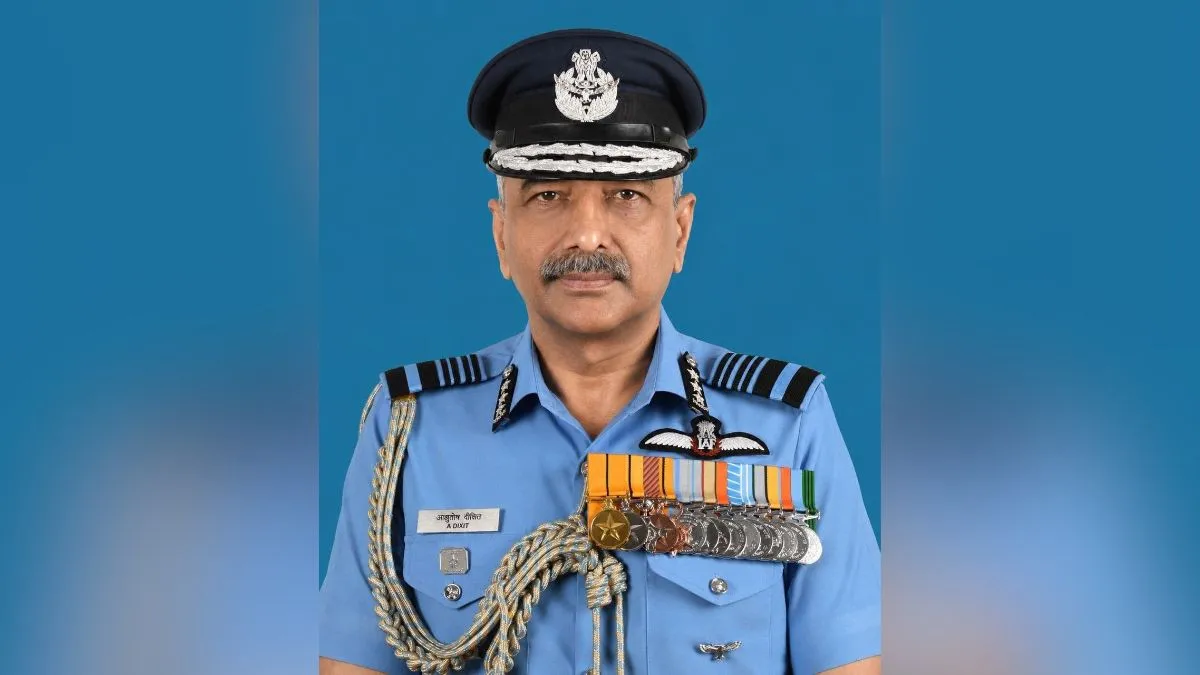
New IAF Chief Ashutosh Dixit and the Fighter Gap: Tejas, Rafale and AMCA
Air Marshal Ashutosh Dixit becomes Chief of the Air Staff on the afternoon of 31 October, taking over from Air Chief Marshal Amar Preet Singh. The government's notification gives him a tenure up to 31 December 2028. On the same day, the Aeronautical Development Agency is scheduled to open bids for the Advanced Medium Combat Aircraft (AMCA), after pushing the date back from August.
The overlap is chance, but it describes his position well. The force he takes over is reported at 29 fighter squadrons against 42 sanctioned, and the three programmes meant to rebuild it sit at three different points. The Tejas Mk1A is built but not delivered. The 114-Rafale deal is cleared but not signed. The AMCA prototype contract has not been awarded. The useful question is which of these a Chief can influence from his chair, and which he can only wait on.
The number, and what Singh said about it
At his last annual press conference on 3 October, Singh framed the squadron count in terms of what it takes to stop the slide. The IAF, he said, has to induct two squadrons a year, which he put at 36 to 40 aircraft, just to stop falling from the current level and start climbing back toward 42. He added that the real need is higher. The figure of 29 comes from reports of that briefing; in the PTI account, his own words referred to about 30. Some accounts give the sanctioned strength as 42.5. When the last MiG-21s retired in September 2025, ThePrint described 29 as the lowest level since the 1960s.
Reports of the briefing add that three MiG-29 squadrons and six Jaguar squadrons are due to leave service toward the end of the decade. Singh was careful about how he described the force. "We have less numbers, but we are not weak," he said.
His recovery arithmetic was specific. Around 20 Tejas Mk1A a year, about 12 aircraft a year from the Rafale buy, and a share of 12 additional Su-30MKI already on order would together bring in 35 to 40 fighters annually. That is a sum of three streams running at once. Today the Mk1A stream has delivered no aircraft and the Rafale deal has no signature, so the sum describes a target year, not a trajectory.
Tejas Mk1A: the engines are arriving, the aircraft are not
The first Mk1A contract was signed in February 2021 for 83 aircraft, 73 fighters and 10 trainers, at about ₹48,000 crore. The first was due in March 2024. A second contract worth ₹62,370 crore followed in September 2025 for 97 more, which makes 180 in total. As of Singh's briefing, PTI reported, not one had been handed to the IAF. He said the extra delay "is going to hurt us." He also said HAL has spoken of up to 24 aircraft a year, and that even 20 would be material.
For most of two years the explanation was the General Electric F404 engine. That explanation is weaker now. Idrw.org reported that GE delivered four F404-IN20 engines in September, bringing the total to 14 against 99 ordered, with eight more targeted by the end of the year. Earlier reporting put the number of airframes built or part-built at about 30. The open items cited in recent reporting are radar, weapons integration and software validation, and the IAF's position that the jets must meet the contracted specifications at handover. ThePrint reported in September that work still remained on the first aircraft and that a formal delivery before Singh's retirement looked unlikely. Defence Minister Rajnath Singh used a HAL handover event that month to ask public sector firms to set realistic timelines, warning that delays create capability gaps and risk obsolescence.
This moves the decision point. In May, reports said the IAF was prepared to accept Mk1As with some concessions, provided the sensor, weapons and electronic-warfare capabilities were in place at delivery. ThePrint reported that the Defence Ministry and the IAF had agreed some exemptions for HAL while holding to the must-have capabilities. The acceptance standard for the first batch is a call the IAF makes. Dixit is an experimental test pilot who has flown the Tejas, and the first handover, whenever it comes, will happen on his watch. How he treats it will likely become the reference for the rest of the order.
114 Rafale: cleared, under evaluation, not signed
The 114-Rafale proposal was cleared in February 2026 under a government-to-government framework with France. According to one aviation outlet, Dassault Aviation handed over its formal proposal on 6 August. On 1 October, Defence Secretary Rajesh Kumar Singh told ANI that the bids were being evaluated and that India should reach a conclusion before the end of the year. He described the programme as buy-and-make, with the bulk of the aircraft assembled in India and Indian weapons integrated. Two days later the Air Chief said he hoped to sign within this financial year, which ends in March 2027, and added that negotiation runs both ways. PTI noted that price negotiations and other issues were still being finalised.
Singh's figure of about 12 Rafale a year, part flown out from France and the rest built in India, is a rate for when production is running. None of the reporting on the briefing gives a date for first deliveries. A signature starts a clock. It does not change the squadron count in the near term.
AMCA: bids open the day he takes over
The Defence Ministry issued the AMCA request for proposals on 27 May 2026 to three bidders: Tata Advanced Systems on its own, a group of Larsen & Toubro, Bharat Electronics and Dynamatic Technologies, and a group of Bharat Forge, BEML and Data Patterns. The names are not new. The shortlist was reported in February, when Hindustan Aeronautics was left off it. What is new is the calendar. A corrigendum dated 27 August moved the submission deadline to 30 October and the opening to 31 October, according to reporting on the tender notice, after earlier dates in July and August had passed. Selection is expected four to five months after submission, and the first prototype is meant to fly within 30 months of signing.
Put those two reported terms together and the arithmetic is plain. A contract around March 2027 would put a first flight in the second half of 2029 at the earliest. That is an inference from reported terms, not an official date, and the tender has already moved more than once.
Singh said that if the AMCA is delayed the IAF may need to look at other options, and that Russia has offered the Su-57 but no decision has been taken. Reports of the Defence Secretary's remarks two days earlier say India has not decided to buy any foreign fifth-generation fighter. Singh also called Pakistan's reported work with China on a fifth-generation fighter a cause for worry. Reports on the J-35 for Pakistan disagree on timing, ranging from 2026-27 to not before 2032, and one aviation outlet noted that neither side has confirmed a binding contract or a delivery calendar. So the Su-57 question is open on the Indian side, and the threat that would motivate it is itself uncertain.
What the chair controls
Dixit does not control GE, HAL's test schedule, the French negotiation or ADA's evaluation. The Chief's influence runs through three things: how firmly the IAF holds its acceptance standard on the Mk1A, how hard it argues for an interim fighter if the AMCA slips, and how it handles theatre commands.
On theatre commands, Singh said the IAF is not against them and that, since Operation Sindoor, the discussion has taken a slightly different direction. The government, he said, will decide the structure and the sequence. Dixit's previous post matters here. He was Chief of Integrated Defence Staff from 1 May 2025 to 30 June 2026, the tri-service planning job. Anchit Gupta, a military aviation historian, argued in ThePrint on 24 October that the IAF has few natural institutional allies: the Army and Navy want more air capability of their own, and the IAF's concern about splitting aircraft among commands can read as reluctance to share control. That is one analyst's reading. It fits the fact that the question is still undecided seven years after the government announced theaterisation in 2019.
On drones, Singh ruled out a separate drone force. He called drones an evolution rather than a revolution for the IAF and said they should operate together with other weapons.
Global Chanakya Assessment
The evidence supports a narrower reading than "new chief, new direction." Squadron numbers follow delivery dates that sit outside the Air Force. The Chief's chair mostly sets the terms on which the IAF accepts aircraft and argues for stopgaps. Of the three programmes, the Mk1A is the only one where a decision inside the IAF changes when aircraft reach squadrons.
Two things are easy to misread. Opening bids on 31 October starts an evaluation and adds no aircraft to any squadron. A Rafale signature is a milestone for production capacity, not for the current count.
One assumption deserves caution. Singh's 35 to 40 a year needs the Mk1A, Rafale and Su-30MKI streams all running at once. With the Mk1A at 20 a year and no Rafale line yet producing, the total would still fall short of 35 even if all 12 Su-30MKI arrive in the same year.
The assessment would change on four events: a first Mk1A handover on terms the IAF publicly accepts, a Rafale price agreement, AMCA bids that open on schedule, or a formal step on the Su-57.
Intelligence Forecast
This forecast runs to March 2027, the end of the financial year both the Air Chief and the Defence Ministry have used as their reference. It is conditional and rests on the reporting above.
The squadron count is unlikely to move much by then. The reported retirements fall toward the end of the decade, but no Mk1A is in service and no Rafale order exists. A first Mk1A handover before March 2027 is plausible given the engine deliveries, though HAL's own August-September target has already passed and the open issues reported are integration and certification, which engines do not fix.
A Rafale signature by March 2027 is what both officials say they hope for. It depends on price talks that PTI described as still being finalised. On the AMCA, an award in early 2027 is the reported expectation, and a further extension of the bid date would push the 2029 first-flight arithmetic to the right.
Indicators to Monitor
- Whether ADA opens the AMCA bids on 31 October or issues another corrigendum, and how many of the three bidders submit.
- The first formal handover of a Tejas Mk1A to the IAF, and any public statement on the terms of acceptance.
- GE Aerospace delivery tallies for F404-IN20 engines against the 99 ordered.
- Completion of Rafale price negotiations and any Cabinet Committee on Security approval.
- Any formal Indian step on the Su-57 offer, such as a request for information or a Defence Acquisition Council item.
- The squadron figure Dixit uses in his first public statements, and whether it is 29 or 30.
- Confirmation or denial of a signed J-35 contract between China and Pakistan, and first visible deliveries.
- Any government announcement on the structure and sequence of theatre commands.