India's Akash Missile Reaches Central Asia, but Not a Chinese Air Defence Network
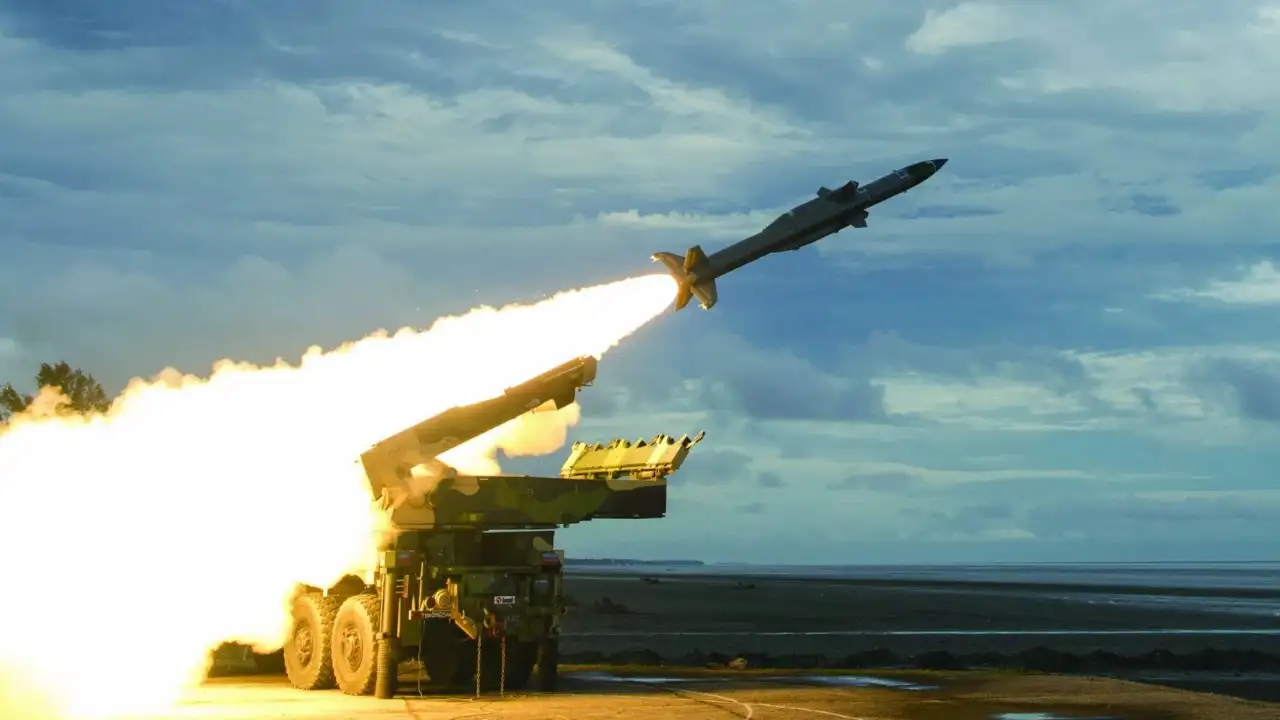
Several headlines this week say India's Akash missile has "joined" a Chinese-built air defence network in Central Asia. The first half of that claim is now on the record. The second half is not. Having Indian and Chinese launchers in the same country is a fact about procurement. A network is a fact about engineering, and no public evidence yet shows that engineering exists.
The distinction matters because it changes what the story is. A mixed inventory means two buyers are hedging between suppliers. A mixed network would mean Indian and Chinese military systems exchanging live targeting data, which would be a far larger claim.
What has actually been confirmed
On 1 October 2026, speaking at the 13th PAFI Annual Forum, Defence Secretary Rajesh Kumar Singh said: "The first customer was Armenia, which has taken multiple batteries." He added that Akash had also been exported to Tajikistan and Turkmenistan, and that production had stabilised. That is the first time a serving senior official has named the two Central Asian buyers on the record.
Earlier reporting rested on Samir Kamat, a former DRDO chairman, who had made the same claim. Before that, reports in August described both countries as negotiating purchases of the Mk 1S variant without signed contracts. It is not clear whether the exports Singh described are those same deals reaching completion or separate transactions.
The list of what is undisclosed is longer than the list of what is confirmed. Neither India nor the buyers have published the number of batteries, the variant, the contract value, the delivery dates, or the radar and command suite supplied. No public statement from either Central Asian government has been identified. Akash is a mobile system, produced by Bharat Dynamics Limited and Bharat Electronics Limited, with a stated engagement range of roughly 25 to 30 kilometres. The Mk 1S adds an indigenous active seeker for terminal guidance. Whether Turkmenistan or Tajikistan received that version has not been confirmed.
Why "network" is the wrong word
Turkmenistan's Chinese inventory is the stronger half of the headline. Indian defence outlet idrw, which reported on 4 October, lists the FM-90 short-range system, the KS-1A and the FD-2000, the export version of the HQ-9 family. It also reports that the FK-2000 missile-gun system appeared at Turkmenistan's 27 September parade. That is a layered set of Chinese systems, from point defence up to long range.
Tajikistan's picture is thinner. It displayed Chinese HQ-17AE short-range systems in 2025, reportedly replacing or supplementing older Soviet-era systems. Published inventories of what else it fields are inconsistent, so any claim that Tajikistan runs a Chinese-built air defence network is not supported by the sources available.
Even in Turkmenistan, the move from a layered inventory to an integrated network requires specific things: a shared air picture, track handoff between batteries, and software that decides which interceptor takes which target. Akash operates through its own group control centre and battery control centres, built around Indian radars. Chinese export systems arrive with their own command vehicles and data standards. Joining them would need interface specifications from both manufacturers and a willingness on both sides to cooperate. Nothing public indicates either exists. Even idrw, whose headline uses the word "network," states in its text that the integration question has not been disclosed and that operating several foreign-origin systems does not make them interoperable.
The more defensible reading is separate layers. Akash would protect air bases, command posts or other fixed assets within its own envelope, while Chinese systems cover other tiers, with coordination by human operators rather than machine-to-machine links. That is an inference, not a reported fact. It also costs the buyer something: more training pipelines, more spare-parts chains, and no automatic gain in effectiveness from owning more types.
Two buyers, two different logics
Treating Turkmenistan and Tajikistan as one market hides how differently they are placed.
Turkmenistan holds permanent neutrality status, stays outside the Russian-led CSTO, and buys from several suppliers. A third supplier adds little strategic risk for Ashgabat, and a short-range system from a source with no basing ambitions in the region is easy to justify.
Tajikistan is more entangled. Russia's 201st Military Base remains on its territory, and the two defence ministries signed a cooperation programme in 2025 covering 2026 to 2030. China has reportedly kept security facilities near the Afghan border for years, though both governments have historically denied that. China also agreed in May 2026 to supply the Interior Ministry with equipment worth more than 7.6 million dollars. Tajikistan's Afghan border is its main security concern, and an Indian air defence battery addresses a threat set (drones, helicopters, aircraft at low altitude) that does not obviously match a Taliban-led Afghanistan's air capability. The purchase may therefore be as much about diversification and signalling as about a defined threat. That is a judgment from the pattern, since Dushanbe has said nothing about its reasoning.
What India gains, and what limits it
For New Delhi the attraction is partly commercial. India's defence exports reached a record ₹38,424 crore in 2025-26, and the Ministry of Defence is aiming for ₹50,000 crore within two years. Akash is one of the few indigenous systems with a credible export record.
The Armenian precedent shows the larger prize. According to reporting, Armenia's initial missile purchase was followed by orders for Indian radar, artillery, rocket systems and vehicles. An air defence battery brings training, maintenance and recurring contact between militaries. If Tajikistan and Turkmenistan follow the Armenian pattern, the missile matters less than the relationship around it.
The limits are real. India has no direct land route to either country, and the logistics of delivery and sustainment have not been disclosed. Akash's combat reputation rests largely on Indian official accounts of its performance in the May 2025 conflict with Pakistan, which Pakistan disputes and which has limited independent public verification. Volumes appear small. And there is an exposure question that Indian planners will have considered: hardware sold into a region where Chinese technical and security presence is substantial. Nothing public shows any compromise, and end-user conditions are not public. But anyone assessing the sale should note that the buyers' other suppliers include India's principal strategic rival.
What Moscow and Beijing are likely to make of it
The "Russia's backyard" framing common in Indian coverage overstates the displacement. Russia keeps a base and a five-year defence programme in Tajikistan, and Soviet-origin systems still anchor both countries' inventories. A few Indian batteries do not change that.
China is the supplier that has gained most in recent Central Asian air defence purchases, and a small Indian addition does not threaten that position either. The precedent is what both capitals will watch. Central Asian buyers are widening their sourcing, with Brazilian transport aircraft in Uzbekistan and an Iranian-linked drone factory in Tajikistan among other examples. India is now one more option on that list.
Global Chanakya Assessment
The evidence supports a narrow conclusion. India has sold Akash to two Central Asian states, which is a real expansion of its defence export footprint. The evidence does not support the claim that Akash has become part of a Chinese-built air defence network, and it does not show that India has displaced either Moscow or Beijing.
The mechanism worth watching is follow-on business. Armenia suggests that one air defence sale opens room for radars, vehicles and training. If that pattern repeats, India builds institutional presence without needing bases or alliances. If it does not, Akash in Central Asia stays a one-off export, useful for export statistics but marginal strategically.
One assumption deserves caution: that these sales reflect a shift of allegiance away from Russia. Both buyers are adding suppliers, not replacing them. The more accurate description is multi-vendor hedging, in which India is a new entrant rather than a successor.
A different reading becomes plausible if either buyer announces integration with Indian command systems or orders further Indian radars and sensors. That would signal a deeper commitment than a stand-alone missile purchase.
Scenario Analysis
Base scenario: parallel layers. Akash batteries operate alongside Chinese and Soviet-origin systems without a shared data network. Coordination stays manual. Follow-on Indian sales are limited to spares and training. This fits the current public evidence best, though the evidence is thin.
Alternative scenario: widening Indian package. Following the Armenian pattern, Turkmenistan or Tajikistan orders Indian radars, additional batteries or the newer Akash variants. India becomes a standing supplier with a training and maintenance presence. The indicator would be contract or delivery announcements beyond the missile itself.
High-risk scenario: technology exposure. Indian-origin components become accessible to third parties through a buyer's security cooperation with China or Russia. This is a risk case, not an observed development. It would be reflected in changed Indian export conditions or restrictions on follow-on sales.
Intelligence Forecast
Over the next 6 to 24 months, the most probable outcome is incremental. India will likely cite Central Asia in its export push, and further announcements are plausible given Singh's statement that more orders may come. Whether the buyers publicly acknowledge the systems is less certain. Both governments have been silent so far, and Turkmenistan in particular rarely discloses defence procurement.
A move from separate systems to genuine integration across Indian and Chinese equipment looks unlikely in this window, because it would require cooperation between two rival suppliers and political willingness in the buyer states. If integration does occur, it would more likely be built by the buyer's own engineers than by either supplier. Delivery of a newer Akash variant to any Central Asian customer would be a stronger sign of confidence in the platform than the current sales.
Indicators to Monitor
- Official Turkmen or Tajik statements, or parade displays, showing Akash launchers, radars or command vehicles in service
- Indian Ministry of Defence or Bharat Dynamics and Bharat Electronics disclosures of contract values, battery counts or variants for the two buyers
- Follow-on orders for Indian radars, vehicles, training or maintenance support from Turkmenistan or Tajikistan
- Any announcement of command-and-control integration involving Akash and Chinese systems
- Further Chinese air defence deliveries to Turkmenistan or Tajikistan, including additional FK-2000 or HQ-17 systems
- Changes in the Russia-Tajikistan defence cooperation programme or the status of the 201st Military Base
- Akash-NG export progress, including the reported talks with African and South American customers
- India's annual defence export figures against the ₹50,000 crore target