
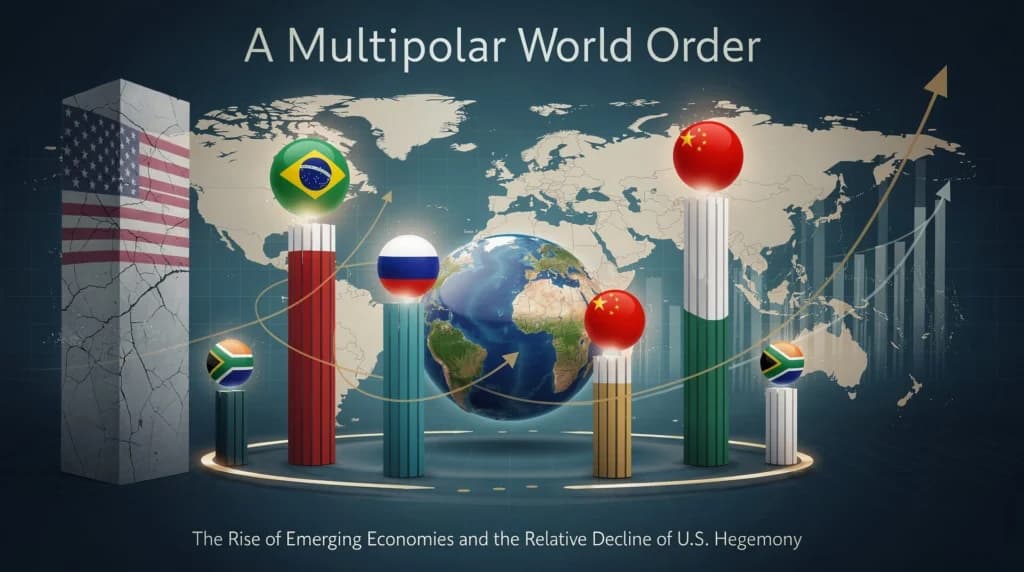
The Decline of Unipolarity: Is American Dominance Really Fading in 2026?
Executive Summary
For the first time in a generation, the question of whether American dominance is fading is no longer being asked primarily by Washington's rivals or by academic theorists. It is being asked, with striking candor, by the United States government itself. In May 2025, Vice President JD Vance stood before the Naval Academy and told graduating officers that "the era of uncontested US dominance is over." Secretary of State Marco Rubio has built an entire framework around the premise that unipolarity was a post-Cold War anomaly rather than a natural or permanent state of affairs, and that the multipolar world now emerging requires Washington to prioritize narrow national interests over the costly maintenance of the liberal international order it spent eighty years constructing.
This is not decline by stealth. It is decline acknowledged, in some quarters even embraced, as a starting premise for a new American grand strategy. The 2026 National Security Strategy, released under the Trump administration, abandons the great-power-competition framework that defined American strategic thinking since at least 2017 in favor of a highly ideological document that elevates the Western Hemisphere as America's highest priority, invokes a "Trump Corollary" to the Monroe Doctrine, and reserves its sharpest criticism not for China or Russia but for European allies and the foreign policy establishment Trump considers responsible for America's strategic overextension.
Yet the picture is more complicated than a simple narrative of collapse. The United States retains the world's largest economy, its most powerful military by a wide margin, the deepest and most liquid capital markets on earth, and a technological edge in artificial intelligence and advanced computing that no rival has matched. What is genuinely declining is not American capability but American willingness to convert that capability into global public goods - security guarantees, open markets, multilateral leadership - without direct, often transactional, compensation. This distinction between hegemonic capacity and hegemonic will is the single most important analytical key to understanding what is actually happening to American power in 2026, and it has consequences that will outlast any single administration.
Background: The Long Arc From Unipolar Moment to Multipolar Reality
The phrase "unipolar moment" was coined by columnist Charles Krauthammer in a 1990 essay, written even before the Soviet Union's formal dissolution, anticipating a world in which American power would face no peer competitor. For roughly a decade and a half, that prediction held with striking accuracy. The 1990s saw the United States preside over NATO expansion, the Gulf War coalition, the Balkans interventions, and the early architecture of post-Cold War globalization, largely on its own terms.
The first serious cracks appeared not from external challenge but from self-inflicted strategic overextension. The 2003 invasion of Iraq, conducted over the objections of key allies and without UN Security Council authorization, revealed both the extent of American military power and the limits of what that power could accomplish absent broader international legitimacy and sound strategic judgment. The subsequent insurgency, the 2008 financial crisis that originated in American mortgage markets and metastasized globally, and the protracted, ultimately unsuccessful nation-building efforts in Afghanistan collectively eroded both American material capacity and, more importantly, the global perception of American competence and reliability that unipolarity had depended upon as much as raw power.
China's economic rise during this same period transformed the structural foundation of the international system more thoroughly than any single American policy failure. Beijing's economy grew from roughly one-tenth the size of America's in 1990 to near-parity on a purchasing power parity basis by the mid-2020s. This growth funded military modernization, the Belt and Road Initiative's global infrastructure footprint, and a foreign policy posture under Xi Jinping that increasingly positioned China as a legitimate alternative pole of global power rather than merely a regional actor managing its own development.
Russia's trajectory has been different but complementary to this multipolar drift. Stripped of much of its Soviet-era economic weight, Moscow under Vladimir Putin has pursued a strategy of asymmetric disruption - using energy leverage over Europe, military intervention in Georgia, Syria, and Ukraine, and active measures against Western democratic processes to demonstrate that American-led order could be contested and degraded even by a power with a GDP smaller than Italy's. Russia's full-scale invasion of Ukraine in February 2022 became, paradoxically, both a demonstration of the costs major powers will still bear to challenge the post-Cold War settlement and a catalyst that accelerated exactly the kind of multipolar coalition-building - between Russia, China, Iran, and North Korea - that American strategists had spent decades trying to prevent.
By the time Trump returned to office in January 2025, the structural conditions for declining American unipolarity were already firmly established. What changed with his return was something different and, in important respects, more consequential: an American president and administration willing to explicitly acknowledge and, in some respects, accelerate that decline rather than resist it.
Current Situation: Washington's Own Acknowledgment of a Changed World
The Rhetorical Turn: Multipolarity as Official Doctrine
What distinguishes 2025-2026 from previous periods of debate about American decline is the degree to which senior US officials have stopped contesting the premise and started building policy around it. Secretary of State Rubio's framing - that unipolarity was a "post-Cold War anomaly" rather than a natural state, and that the world has simply returned to its historically normal multipolar condition - represents a genuine doctrinal shift. This is not the language of an administration in denial about declining relative power. It is the language of an administration that has concluded resistance to multipolarity is futile and that American interests are better served by managing the transition on favorable terms than by exhausting national resources trying to prevent it.
Vice President Vance's Naval Academy speech in May 2025 made this explicit in front of the next generation of American military officers: the United States was a superpower without peer for a brief historical window following the Soviet collapse, but that window has closed, and American strategy must now operate in a world with genuine competitors. This is a remarkable thing for a sitting vice president to tell military graduates - not a warning about future risk, but a statement of present reality that fundamentally reframes what American military power is meant to accomplish.
The 2026 National Security Strategy: Abandoning Great-Power Competition for Hemispheric Primacy
The clearest institutional expression of this shift is the 2026 National Security Strategy itself, which the Council on Foreign Relations has characterized as a striking departure from every predecessor document since the concept of great-power competition became the organizing framework of American strategic thinking. Rather than centering China and Russia as the primary threats requiring sustained, resourced global engagement, the 2026 NSS elevates the Western Hemisphere as America's highest strategic priority, framed around stopping migration, combating drug trafficking networks the document labels "narco-terrorists," and securing what the strategy calls a "Trump Corollary" to the nineteenth-century Monroe Doctrine.
This represents a fundamental reordering of strategic priorities with profound implications. A National Security Strategy that elevates hemispheric primacy above global great-power competition is, definitionally, a document that accepts reduced American engagement and resource commitment in the Indo-Pacific, Europe, and the Middle East relative to the framework that has governed American strategy since at least the Obama administration's "pivot to Asia." The CFR's assessment that the document reserves its sharpest criticism for European allies and domestic foreign policy elites - rather than for China or Russia, the traditionally identified strategic competitors - is perhaps the most telling detail of all. An American security strategy more animated by grievance against its own allies than concern about its adversaries is a document describing a superpower turning inward.
The Institutional Withdrawal: Counting the Departures
The Trump administration's institutional disengagement from the architecture of American-led global order has been systematic and extensive. The United States formally withdrew from the World Health Organization and the Paris Peace Accords framework, shut down the United States Agency for International Development entirely, and substantially reduced funding for numerous United Nations agencies. The Chicago Council on Global Affairs' assessment of 2025 as "highly disruptive, tumultuous, and chaotic" for the international order, with the United States as "a major, if not the only, driver" of that disruption, reflects a consensus among foreign policy analysts across the ideological spectrum that something qualitatively different is occurring compared to previous episodes of American skepticism toward multilateralism.
The international trade order has been thrown into comparable disarray. Trade relationships built over decades have been explicitly subordinated to national security framing, with tariffs deployed not as part of coordinated, congressionally consulted strategy but - in the Center for American Progress's characterization - as blunt instruments wielded impulsively, damaging long-standing partnerships in ways that are proving difficult to repair even when individual disputes are eventually resolved. Nearly 70% of Americans, according to polling cited by domestic policy analysts, now believe 2026 will be a year of economic difficulty - a remarkable erosion of public confidence that constrains the administration's room to pursue costly global commitments even if its strategic preferences shifted.
The State Department itself has undergone significant internal transformation, with career diplomats and national security professionals replaced or sidelined in favor of personnel selected primarily for political loyalty rather than regional expertise or institutional continuity. This matters enormously for the practical exercise of American global influence: diplomatic effectiveness depends substantially on accumulated relationships, country-specific knowledge, and institutional memory that cannot be rebuilt quickly once dispersed.
NATO and the Unresolved Question of European Security
Nowhere is the ambiguity of American retrenchment more consequential than in the alliance architecture governing European security. The Stiftung Wissenschaft und Politik's February 2026 analysis identifies the core contradiction precisely: the 2026 National Defense Strategy provides no details about the size, orientation, deployment, or stationing of US troops and equipment in Europe, leaving allies in a state of structural uncertainty about Washington's actual alliance commitments even as official documents continue to affirm NATO's importance in general terms.
This is not simple abandonment - American forces remain in Europe, and the administration has not formally signaled NATO withdrawal. But the security strategy documents simultaneously contain what SWP's analysts describe as a sweeping verbal attack on liberal Europe, directed primarily at the European Union but implicitly questioning the values underpinning NATO itself. The practical message to Berlin, Paris, and other European capitals is unmistakable: the alliance commitments that defined transatlantic security since 1949 can no longer be assumed to operate on the predictable, broadly bipartisan basis that characterized even periods of American skepticism toward European burden-sharing in previous decades. German and European decision-makers, the analysis concludes bluntly, should not fall victim to the false hope that NATO in its current form survives Trump's second term unchanged.
This uncertainty has already produced concrete behavioral changes among European allies, as documented across multiple analyses: NATO European members and Canada increased defense spending by 20% in 2025, and alliance members have agreed to move toward a 5% of GDP defense spending framework by 2035. These are not the actions of allies confident in unconditional American protection - they are the actions of governments hedging against a genuine possibility of reduced American commitment, accelerating precisely the kind of European strategic autonomy that successive American administrations have rhetorically encouraged but rarely actually wanted to see fully realized, since a genuinely autonomous Europe is also a Europe less dependent on American leadership and more capable of pursuing its own, sometimes divergent, strategic preferences.
Strategic Analysis: Capability Versus Will - The Central Distinction
What Hasn't Declined: The Hard Power Foundations
Before accepting any narrative of American collapse, the analytical discipline required of serious strategic assessment demands an honest accounting of what remains extraordinarily, even overwhelmingly, in America's favor. The United States retains defense spending exceeding the next several highest-spending nations combined, a global network of military bases and access agreements that no rival power can replicate, and decisive technological advantages in critical domains including artificial intelligence model development, advanced semiconductor design (even where manufacturing has shifted overseas), aerospace, and biotechnology.
American capital markets remain unmatched in depth, liquidity, and legal predictability - features that continue to attract global investment even amid policy uncertainty, because the alternative options (Chinese capital markets with capital controls and political risk, European markets fragmented across national jurisdictions, emerging market alternatives lacking comparable scale) simply do not offer comparable characteristics. The dollar, despite genuine erosion at the margins documented in BRICS de-dollarization efforts, remains the dominant global reserve currency by an enormous margin, with no credible alternative positioned to displace it within any realistic medium-term horizon.
The United States also retains something less tangible but strategically significant: a network of alliance relationships built over eight decades that, even under current strain, represents an asset no rival power possesses at comparable scale. China's alliance network is essentially limited to North Korea and an increasingly dependent Russia. Even a damaged American alliance system - with allies hedging, diversifying, and increasingly skeptical - still vastly outweighs anything Beijing or Moscow can claim.
What Has Genuinely Declined: Strategic Will and Institutional Coherence
What is declining, and declining sharply, is not American capability but American strategic coherence and the political will to deploy capability in the sustained, predictable, costly manner that genuine global leadership requires. This distinction is not merely semantic - it has profound practical consequences, because allies and adversaries alike calibrate their behavior based on perceived reliability and predictability, not merely raw capability that might or might not be deployed.
The internal contradictions documented across multiple 2026 strategic assessments are not incidental flaws in otherwise coherent policy - they reflect a deeper, unresolved tension within American strategic thinking about what role the United States should play in a world it can no longer unilaterally dominate. The administration's own strategy documents affirm alliance importance in general terms while simultaneously attacking allies rhetorically and providing no operational clarity about force posture commitments. This is not strategic ambiguity deployed deliberately as a tool of statecraft, in the manner Washington has historically used calculated ambiguity over Taiwan, for instance. It is, per SWP's assessment, the product of an unresolved internal debate about how the United States should deal with the loss of global dominance - a debate that has been ongoing for a quarter century but has never been definitively resolved by any administration, Democratic or Republican.
The result is what Foreign Policy magazine's January 2026 cover essay described starkly as "The World Minus One" - a global order increasingly forced to function and adapt around the assumption that American participation and leadership cannot be reliably counted upon, even as the United States remains far too powerful and consequential to simply be excluded from global affairs. This is an unprecedented condition in the post-1945 international system: not American absence, but American unpredictability functioning as a structural feature that the rest of the world must now plan around.
The Paradox of Self-Inflicted Decline
Perhaps the most analytically significant feature of America's current trajectory is how much of the erosion in global influence appears self-inflicted rather than imposed by external competitors. China's military modernization and economic rise are real and consequential, but the acceleration of skepticism toward American reliability among traditional allies - in Europe, in parts of the Indo-Pacific, even within the Western Hemisphere the 2026 NSS prioritizes - stems substantially from Washington's own policy choices rather than from any single Chinese or Russian action.
The SAIS Review's analysis of the relationship between Trump's foreign policy and Russia's multipolar vision identifies a genuinely troubling dynamic: Washington's implicit recognition of Russian dominance in its "near abroad," pursued seemingly in service of disentangling America from costly European security commitments, has not secured reciprocal American advantages elsewhere in Europe. Instead, this asymmetric concession risks reshaping international power configurations in favor of precisely the rival powers - a Sino-Russian strategic partnership well-positioned to challenge American-led order even from within structures like NATO that were originally built to contain such challenges. In other words, American retrenchment pursued in the name of prioritizing narrow national interest may be inadvertently accelerating the very multipolar erosion of American influence that more sustained engagement might have better managed, even if at higher near-term cost.
This is the central strategic question hanging over the entire decline-of-unipolarity debate: is the United States adapting intelligently to genuinely changed structural conditions that made the unipolar moment unsustainable regardless of policy choices, or is it accelerating and mismanaging a transition that more skillful, less domestically-driven statecraft could have navigated with substantially better outcomes for long-term American interests? The honest answer, based on the available evidence, leans toward the latter - the structural drivers of multipolarity (Chinese economic rise, the diffusion of military technology, the limits of unilateral power projection) were real and would have eroded American unipolarity under any administration. But the speed, manner, and self-inflicted institutional damage of the current transition reflects policy choices, not strategic inevitability.
Global Impact: How the World Is Adapting to American Unpredictability
Allied Hedging Becomes the Default Strategic Posture
The defining global response to declining confidence in American reliability has been a broad-based, geographically dispersed turn toward strategic hedging among traditional American allies and partners. This is not formal realignment away from the United States - most allies retain no viable, comparably attractive alternative security guarantor - but a systematic diversification of relationships designed to reduce vulnerability to any single point of American policy volatility.
Europe's defense spending acceleration, discussed earlier, represents the most visible manifestation of this hedging. But the pattern extends globally: Indo-Pacific allies deepening minilateral arrangements like the QUAD and trilateral frameworks that do not depend exclusively on bilateral American guarantees; Gulf states diversifying economic and security relationships across Washington, Beijing, and Moscow simultaneously; even traditionally America-aligned Latin American governments exploring expanded engagement with China's Belt and Road Initiative and BRICS-adjacent financial architecture, despite the 2026 NSS's explicit prioritization of hemispheric primacy designed specifically to prevent exactly this kind of regional drift.
China and Russia: Calibrated Exploitation Rather Than Triumphant Advance
Both Beijing and Moscow have responded to perceived American retrenchment with calibrated, often cautious exploitation rather than the kind of triumphant, accelerated advance that simpler declinist narratives might predict. China's restraint, as documented extensively in Indo-Pacific analysis, reflects Beijing's own domestic economic constraints and a calculated judgment that overextension risks accelerating exactly the kind of broad coalition-building against Chinese interests that more patient strategy can avoid. Russia, deeply enmeshed in its costly Ukraine war and structurally dependent on Chinese economic and diplomatic support, lacks the independent capacity to rapidly exploit American retrenchment even where opportunities present themselves.
The Sino-Russian strategic partnership, formalized further through the May 2026 Xi-Putin joint declaration on multipolarity, represents the most coherent organized response to American retrenchment - but even this partnership operates more as parallel, mutually reinforcing pressure on American-led order than as a unified bloc with fully aligned strategic objectives. Russia's interest in disrupting the post-Cold War European settlement and China's interest in establishing regional preeminence in the Indo-Pacific are complementary but distinct projects, unified primarily by shared opposition to American-led constraints rather than by a genuinely common positive vision of global order.
Risk Assessment
The Predictability Deficit as Systemic Risk
The single greatest risk emerging from America's current strategic posture is not decline itself but the unpredictability accompanying it. Alliance systems, deterrence architecture, and international economic stability all depend substantially on predictable behavior patterns that allow other actors to calibrate their own decisions with reasonable confidence. An America that retains overwhelming capability but exercises it unpredictably - sometimes disengaging, sometimes asserting hemispheric primacy aggressively, sometimes threatening tariffs against allies and adversaries alike without clear strategic logic - creates exactly the kind of miscalculation risk that stable deterrence architecture is designed to prevent.
The Domestic Political Sustainability Question
With nearly 70% of Americans anticipating economic difficulty in 2026 and bipartisan congressional checks on executive foreign policy action notably diminished compared to Trump's first term, the domestic political sustainability of current American strategic posture remains genuinely uncertain. The 2026 midterm elections represent a significant variable: a substantial shift in congressional composition could reintroduce institutional friction that has been largely absent, while continued alignment would further entrench the current trajectory's institutional momentum.
Future Scenarios
Scenario Analysis: American Power Through 2030
Scenario One: Managed Adaptation (Probability: 30%)
The United States successfully transitions from unipolar hegemon to "first among equals" within a managed multipolar order, retaining decisive influence in critical domains (technology, finance, military power projection) while accepting reduced direct management of regional security architectures in Europe and parts of the Indo-Pacific. This requires the current strategic incoherence to resolve into a more consistent doctrine - whether through 2026 midterm-driven institutional correction or through the administration's own strategic learning - that allows allies to rebuild confidence in calibrated, if reduced, American commitments.
Scenario Two: Continued Strategic Drift (Probability: 45%)
The most probable trajectory involves continued internal contradiction between rhetorical multipolar acceptance and episodic assertions of primacy, producing an extended period of allied hedging, gradual institutional erosion, and incremental loss of American agenda-setting capacity across multiple regions simultaneously. The United States remains the single most powerful country in the world throughout this period but increasingly operates as one significant actor among several rather than as the organizing center of the international system.
Scenario Three: Sharp Correction (Probability: 25%)
A significant external shock - a Taiwan crisis demonstrating the costs of accumulated ambiguity, a European security crisis exposing the consequences of NATO uncertainty, or a domestic political shift following the 2026 midterms - forces a more decisive American strategic recalibration in either direction: either a renewed, more coherently resourced commitment to global leadership, or an accelerated, more deliberate embrace of restrained hemispheric primacy. Either outcome would resolve current ambiguity but carries its own substantial risks and adjustment costs for the broader international system.
Intelligence Forecast
- American strategic incoherence will likely persist through 2026 absent a major external shock, with continued gaps between rhetorical alliance affirmation and operational force posture clarity, particularly regarding European troop levels and Indo-Pacific commitment depth.
- European defense autonomy will continue accelerating regardless of any partial American course correction, as the credibility damage from 2025-2026 uncertainty has already triggered structural European investment decisions that will not reverse even if Washington's posture moderates.
- China and Russia will continue calibrated, cautious exploitation of American retrenchment rather than aggressive advance, constrained by their own domestic economic limitations and the risk of triggering broader counter-coalition responses.
- The 2026 midterm elections will be a critical inflection variable, with outcomes shaping whether institutional checks on executive foreign policy authority meaningfully reassert themselves or whether current trajectory continues largely unconstrained through the remainder of the administration's term.
- Dollar dominance and core American financial primacy will persist through this period despite continued marginal erosion from BRICS de-dollarization efforts, as no credible alternative reserve currency architecture exists at comparable scale and liquidity.
Final Strategic Takeaway
The decline of American unipolarity is not a hypothesis requiring further proof in 2026 - it is an acknowledged reality, stated openly by the vice president of the United States and embedded explicitly in the nation's own strategic doctrine. What remains genuinely contested, and what will determine the actual trajectory of American global influence over the coming decade, is not whether unipolarity has ended but how skillfully or chaotically the transition away from it is managed.
The evidence assembled across America's own strategic documents, allied behavior, and rival power responses points toward a sobering conclusion: the United States retains, by a considerable margin, more raw capability than any other single power on earth, but is currently deploying that capability with a degree of strategic incoherence that is actively accelerating the erosion of the predictability, institutional leadership, and alliance cohesion that translated raw capability into durable global influence for eight decades. Capability without coherent strategic will does not produce hegemony - it produces exactly the kind of "world minus one" condition that allies and adversaries alike are now learning to navigate around rather than depend upon.
This need not be a permanent condition. American institutions retain significant capacity for self-correction, and the structural advantages underpinning American power - its economy, its technology base, its demographic and innovation ecosystem relative to an aging China - remain genuinely formidable. But the window for managing this transition skillfully, rather than chaotically, is not unlimited. Every month of continued strategic ambiguity further entrenches allied hedging behaviors and rival power confidence that, once established, prove difficult to reverse even if Washington's posture eventually stabilizes. The question that will define the next phase of global power is not whether American dominance is fading - it plainly is - but whether the United States can still shape the multipolar order succeeding it, or whether it has already ceded that shaping role to the very dynamics of fragmentation its own retrenchment has helped unleash.
Global Chanakya Intelligence Assessment: The United States has not lost its power - it has lost its strategic clarity about how to use it. That distinction, more than any single policy decision, will determine whether America remains the indispensable anchor of a reformed global order or becomes merely its largest, most unpredictable participant.