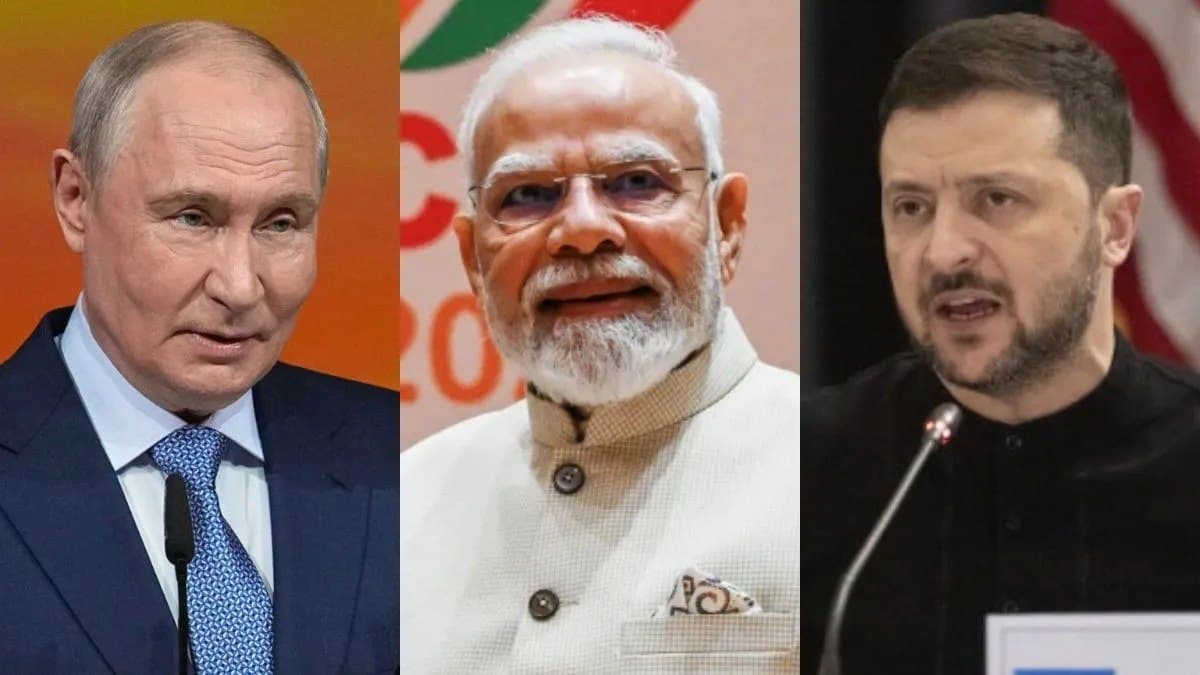
India's Ukraine Peace Proposal Is Now the Most Comprehensive on the Table - Here's What That Actually Means
On October 1, 2026, at the annual Valdai Discussion Club meeting in Moscow, Russian President Vladimir Putin said that Prime Minister Narendra Modi raises the Ukraine conflict at "every meeting" and has "very good ideas aimed at finding mutually acceptable solutions." The same day, Ukrainian Foreign Minister Andrii Sybiha told a press briefing that of the four peace proposals now formally under Kyiv's consideration - from India, the United States, Turkey, and Egypt - India's is the "most comprehensive." The convergence of those two endorsements, from opposite sides of a four-and-a-half-year war, is not coincidental. It is the direct result of a deliberate Indian diplomatic strategy that has been building since 2022 and has now, for the first time, produced a concrete deliverable.
The question worth examining is not simply whether India's proposal is the best on offer. It is what the proposal actually contains, why both Moscow and Kyiv find it credible enough to welcome, what it leaves unresolved, and what it would take to convert diplomatic endorsement into a functioning agreement.
What India Has Actually Proposed
The full text of India's peace proposal has not been made public. What is known comes from Sybiha's description at the October 1 briefing, confirmed by External Affairs Minister S. Jaishankar on October 5, and corroborated by reporting from RBC Ukraine and European Pravda.
According to those accounts, India's proposal is a three-element package. The first element is an energy truce: a complete halt to strikes on energy infrastructure on both sides, covering power plants, fuel storage, refineries, and port energy facilities. The second element is a Black Sea agricultural truce: cessation of attacks on civilian shipping in the Black Sea, allowing resumed grain and agricultural exports through the corridor that collapsed after Russia withdrew from the UN-brokered Black Sea Grain Initiative in July 2023. The third element is an unconditional ceasefire along the current line of contact.
What distinguishes India's proposal structurally is that it treats these three elements as an interconnected package rather than separate tracks. Egypt and Turkey have put forward proposals focused narrowly on the Black Sea agricultural dimension. The American proposal, which emerged from the Trump-Putin phone call framework of March 2025 and subsequent Riyadh negotiations, has centered primarily on energy. India's package links both domains to a broader ceasefire, making it more ambitious in scope.
Jaishankar's October 5 formulation is worth noting precisely. He said India is "going beyond advocacy to cover some immediate concerns which both of them have on grain exports, energy exports, non-attack possibilities." He described India as "trying to be helpful, starting with the Black Sea safety of shipping issue." This signals that New Delhi is positioning its proposal as a confidence-building package - addressing tangible economic and humanitarian concerns that both parties have acknowledged - rather than attempting to resolve the fundamental territorial dispute, which remains the central impasse in every major negotiation track.
The Diplomatic Architecture Behind the Proposal
India's ability to present a credible proposal to both sides rests on a relationship structure that no other major power currently holds. New Delhi has maintained continuous working dialogue with Moscow throughout the war. It has purchased Russian oil at discounted rates, sustained defence cooperation, and abstained repeatedly at the UN Security Council and General Assembly on resolutions critical of Russia. At the same time, Modi visited Kyiv in August 2024, the first Indian prime minister to do so since the 1991 independence of Ukraine, and Indian National Security Advisor Ajit Doval conveyed the substance of those Kyiv discussions directly to Putin in September 2024. Jaishankar has met Sybiha multiple times, including on the sidelines of the Munich Security Conference in February 2025 and again through phone consultations in September 2025.
The September 2026 BRICS Summit in New Delhi added another dimension. Putin attended in person - his first such visit to a BRICS summit outside Russia since the start of the full-scale war - and held bilateral talks with Modi. During those talks, Modi raised the safety of Indian seafarers in the Black Sea and reiterated readiness to support any peace initiative. The BRICS meeting was not incidental to the current peace proposal; it provided the last in-person opportunity for India to test Moscow's appetite before formalising an offer.
Russian Foreign Minister Sergei Lavrov had floated the idea of India as a potential mediator as early as April 2022. Putin formally named India - alongside China and Brazil - as potential mediators at the Eastern Economic Forum in Vladivostok in September 2024. Ukraine moved more slowly. Zelenskyy had been reluctant to extend formal invitation status to India, partly because New Delhi had refused to sign the concluding declaration at the June 2024 Switzerland peace summit. But Sybiha's October 1 statement represents a meaningful shift: Kyiv is now publicly treating India not as a sympathetic bystander but as a legitimate diplomatic interlocutor with an active proposal.
Why the Proposal Holds Appeal on Both Sides
The three elements of India's package address real vulnerabilities for both parties in a way that most other proposals do not.
For Ukraine, the energy truce matters acutely. Russia's sustained drone and missile campaign against Ukrainian energy infrastructure has caused serious economic damage, particularly through the winter months. Zelenskyy has said Ukraine would increase attacks on Russian refineries if Moscow continued striking Ukrainian energy assets. A mutual halt would reduce civilian suffering in Ukraine while also reducing the economic cost to Russia - particularly relevant given that Ukraine's drone strikes on Russian refining capacity had, by Putin's own acknowledgment at Valdai, cost Russia approximately one percent of GDP. Both parties thus have a concrete economic interest in the energy element, separate from their territorial positions.
For Russia, the Black Sea agricultural element matters for a different reason. The collapse of the Grain Initiative in 2023 drew significant international criticism of Moscow, particularly from African and Asian states that depend on Ukrainian and Russian grain exports. A restored agricultural corridor would allow Russia to present itself internationally as having facilitated humanitarian relief while also benefiting Russian agricultural export interests. Kremlin spokesperson Dmitry Peskov had said before the BRICS summit that Russia's approach "aligns closely" with India's position on resolution through dialogue and diplomacy - a signal that Moscow sees the Indian framework as broadly compatible with its interests.
The unconditional ceasefire along the line of contact is the most significant and most contested element. Ukraine's acceptance of a ceasefire at current contact lines is not unconditional in any deeper political sense: Kyiv has been clear that it does not accept Russian sovereignty over occupied Ukrainian territory, and that any ceasefire would need to be accompanied by credible security guarantees. On the Russian side, Putin ruled out a ceasefire on long-range strikes at the same Valdai session where he praised Modi's ideas, saying it was "ridiculous" to expect Russia to halt strikes while Ukraine continued hitting Russian refineries. He has also maintained that any settlement must include Ukrainian neutrality and limits on Ukraine's armed forces.
There is therefore a gap between the diplomatic welcome India's proposal has received and what Moscow and Kyiv would each actually require for a ceasefire to hold. The proposal has been welcomed precisely because it is specific enough to be taken seriously and general enough not to force either party to concede on the hardest questions.
India's Strategic Calculation
India's decision to move from advocacy to active proposal is not primarily altruistic. It serves a set of specific Indian interests that have become increasingly difficult to manage as the war extends.
The most immediate concern is the Russia-China proximity. As Western sanctions have pushed Russia toward China for trade, technology, and financial support, India watches the deepening of a partnership between its two most complex relationships. A war that continues indefinitely strengthens the structural incentives for Moscow-Beijing alignment in ways that constrain India's own strategic space. India does not need Russia to "win" the war. It needs the war to end in a way that leaves Russia as a manageable partner rather than a state wholly absorbed into the China-led economic and security orbit.
Second, India has concrete economic interests in the Black Sea domain. Indian seafarers operate on vessels transiting the region. Indian grain imports and pharmaceutical export corridors are affected by Black Sea instability. Modi raised the seafarer issue directly with Putin at the BRICS bilateral. These are not abstract diplomatic talking points; they reflect real Indian commercial exposure.
Third, the proposal advances India's standing in the Global South. Much of Africa, South and Southeast Asia, and Latin America has experienced the war primarily as an energy and food price shock. A peace framework that specifically addresses grain exports and energy infrastructure speaks to those interests. India presenting itself as the country that brought those concerns to the table reinforces its claim to Global South leadership - a claim it has invested significantly in through the G20 presidency, BRICS chairmanship, and the Voice of the Global South summits.
Finally, there is the straightforward strategic payoff of being trusted by both sides. As Jaishankar put it, India is "going beyond advocacy" - and doing so publicly, on a conflict where every other major power is clearly aligned with one side. That positioning creates diplomatic capital that India can deploy across multiple relationships, including with the European Union, the United States, and Gulf states that have their own interests in how the war ends.
The Limits of the Proposal
The proposal's strength - that it addresses immediate, tangible concerns without touching the core territorial dispute - is also its central limitation.
The fundamental impasse in the Russia-Ukraine war has not changed. Russia entered the negotiations, and continues to operate, on the basis that its annexation of four Ukrainian oblasts - Donetsk, Luhansk, Zaporizhzhia, and Kherson - plus Crimea, represents a settled territorial fact. Ukraine, and the Western coalition backing it, treats those annexations as illegal under international law and non-negotiable as a basis for any settlement. The gap between those two positions has not narrowed materially despite more than a year of Trump administration diplomacy, Riyadh negotiations, and partial ceasefire arrangements.
India's proposal deliberately avoids that fault line. The ceasefire-along-the-line-of-contact element does not specify whether the line is permanent, temporary, or subject to future revision. That ambiguity is necessary for both parties to be able to accept it without formally conceding their core positions - but it is also the reason the proposal cannot, by itself, produce a durable peace. A ceasefire without agreed security guarantees for Ukraine and without clarity on territorial status would face severe implementation risks, as temporary halts in the Russia-Ukraine conflict have consistently demonstrated.
Putin's October 1 Valdai remarks on the ceasefire question illustrate the constraint precisely. On the same day he praised Modi's peace ideas, he ruled out a ceasefire on long-range strikes and issued nuclear warnings regarding Kaliningrad. He described Russia's preference for a settlement through talks while actively escalating aerial operations - strikes on Kyiv's bridges on October 2 closed two crossings and killed one person. The gap between Russia's stated diplomatic openness and its operational conduct remains wide.
There is also an open question about Russia's actual response to the specifics of India's proposal. Sybiha confirmed on October 1 that "the details of India's proposal have not been publicly released in full" and that it was "not yet clear how Moscow has responded to the specific framework." Moscow's rhetorical welcome of India's mediating role does not constitute acceptance of a specific energy-plus-Black Sea-plus-ceasefire package. Those are different things.
Where This Sits in the Broader Negotiating Landscape
The current negotiating landscape involves multiple parallel tracks, none of which has produced a stable agreement.
The US track produced a partial energy and Black Sea ceasefire agreement in March 2025, announced by the Trump administration and accepted by both Kyiv and Moscow, but implementation has been contested. Russia and Ukraine have continued striking each other's energy infrastructure and naval assets in the Black Sea. The US is now reported to be seeking a trilateral meeting with Russia and Ukraine by the end of October 2026 - according to Zelenskyy, Washington is proposing a technical-level meeting, with the venue expected to be in the Middle East.
The European track, centered on security guarantees for Ukraine and the possible deployment of European reassurance forces, has made limited progress. Russia has explicitly rejected a European security guarantee framework as incompatible with its demands for Ukrainian neutrality.
Turkey and Egypt, which have focused on the Black Sea agricultural dimension, have influence in the domain of shipping corridors but lack the comprehensive access to both parties that India claims.
In this landscape, India's proposal occupies a specific niche: it is the only framework put forward by a power that Russia explicitly trusts, that Ukraine has publicly welcomed, and that addresses the energy and agricultural dimensions as a linked package rather than separate negotiations. That is a genuine structural advantage. It does not resolve the fundamental disagreements, but it may offer a pathway to partial stabilization - a de-escalation of attacks on energy infrastructure and Black Sea shipping - that could create conditions for broader negotiation.
Whether India can convert that niche into actual mediation depends on whether Moscow is genuinely prepared to accept a ceasefire on energy and Black Sea operations, and whether Kyiv can secure any credible commitment on the security guarantee question in parallel. The US-Russia-Ukraine trilateral track that Washington is now pursuing by end-October will be the most direct test of whether partial ceasefire arrangements are achievable before any comprehensive settlement.
Global Chanakya Assessment
India's peace proposal is real. It is not a diplomatic gesture or a public relations positioning exercise. The evidence - Sybiha's direct characterization of it as the "most comprehensive" proposal, Jaishankar's specific description of its elements on October 5, and the sustained back-channel engagement with both Moscow and Kyiv - supports the conclusion that New Delhi has moved from symbolic advocacy to active intermediation.
The more important question is whether this constitutes a genuine path to resolution, or a sophisticated management of an insoluble conflict. The balance of evidence suggests the latter, at least in the near term. The three elements India has proposed are all achievable in principle and have genuine support from both parties in the abstract. The implementation record of comparable partial arrangements in this war is poor. The March 2025 energy and Black Sea agreement announced by the Trump administration was accepted by both sides and immediately contested. Temporary arrangements in this conflict have consistently been used by both parties as operational pauses rather than building blocks for broader settlement.
The deeper issue is that India's proposal is structured to avoid the territorial question entirely. That is precisely why both Moscow and Kyiv can welcome it - neither has to concede anything fundamental by doing so. But it also means that even a successful Indian-brokered partial ceasefire would leave the core dispute - who controls 20 percent of Ukrainian territory - unresolved. A frozen conflict, managed through energy and shipping arrangements, is a better outcome than continued escalation but a very different thing from a peace settlement.
India's real strategic gain from this episode may be less about Ukraine than about its own international positioning. The country that refused to condemn Russia's invasion, purchased Russian oil at scale, and abstained at the UN is now publicly identified by Kyiv as the author of the most comprehensive peace proposal on the table. That is a remarkable diplomatic repositioning, accomplished without India having to alter any of its fundamental relationships. Whether India can sustain that positioning as the war continues - and whether it will be willing to absorb the political costs if a partial arrangement it brokers subsequently collapses - remains to be tested.
Scenario Analysis
Base Scenario: Partial Stabilization, Incomplete Settlement
India brokers an agreement on energy non-attack provisions and resumption of Black Sea grain shipments, potentially in coordination with the US-led October trilateral track. A formal ceasefire along the line of contact proves harder to sustain - Russia continues ground pressure and selective drone operations while complying with the energy and Black Sea elements. India claims a partial diplomatic success. The territorial dispute remains frozen. This scenario is consistent with the current trajectory of the negotiations and the historical pattern of partial arrangements in this conflict.
Alternative Scenario: India as Sustained Channel
The energy and Black Sea arrangement holds sufficiently to create diplomatic momentum. India, backed by the structural trust both parties have expressed, becomes a sustained communication channel for more comprehensive negotiations - potentially facilitating the US-Russia-Ukraine trilateral format or hosting separate consultations in New Delhi. India's role becomes institutionalized rather than episodic. This would require both parties to demonstrate greater willingness to implement partial agreements than they have shown in 2025 and early 2026.
High-Risk Scenario: Escalation Derails the Track
A major escalation - a significant Russian strike on civilian infrastructure, a Ukrainian long-range strike on Russian territory that triggers a disproportionate response, or a breakdown in the US-Russia bilateral channel - disrupts the current diplomatic environment before any Indian-proposed arrangement can be formalized. The October 2 Russian strikes on Kyiv bridges and the continuing pattern of mutual infrastructure attacks illustrate that both parties are conducting ongoing operations even as diplomatic channels remain open. A serious escalation could collapse the current multi-track format and return the conflict to a purely military logic.
Intelligence Forecast: 6-24 Months
The October-November 2026 period will determine whether India's proposal moves from diplomatic welcome to operational negotiation. The US is seeking a trilateral technical meeting by end-October. If that meeting occurs and produces even a limited energy non-attack arrangement, India's linked package becomes the natural reference framework for subsequent discussions. If the trilateral fails or is postponed, the current momentum will dissipate and the negotiating landscape will revert to its pre-October state.
Over a 12-18 month horizon, a comprehensive peace settlement involving territorial resolution remains unlikely. The fundamental incompatibility of Russian territorial claims and Ukrainian refusal to formally cede occupied territory has not narrowed. What is more plausible is a durable partial arrangement - an energy and Black Sea non-attack regime with monitoring - that reduces civilian harm and allows some economic normalisation without resolving the underlying political conflict. India's proposal, if implemented even partially, would represent the first functioning multilateral arrangement involving both Moscow and Kyiv's active participation since the collapse of the Grain Initiative in 2023.
India's diplomatic role in this conflict will grow whether or not the current proposal succeeds. The structural fact of India being trusted by both sides is not diminished by a failed negotiation. It may be reinforced by continued engagement. The question for New Delhi is how actively it is willing to invest political capital in a process where it controls none of the core variables - Russia's territorial ambitions, Ukraine's security requirements, or the United States' ultimate willingness to sustain Kyiv's bargaining position.
Indicators to Monitor
- Whether a US-Russia-Ukraine trilateral technical meeting is convened in October 2026, as reported by Zelenskyy, and whether India participates or is formally consulted
- Whether Russia halts or reduces drone and missile strikes on Ukrainian energy infrastructure following the current diplomatic activity
- Whether Ukraine reduces attacks on Russian oil refineries in response to any energy non-attack arrangement
- Whether Black Sea commercial shipping volumes recover, indicating that a Black Sea agricultural arrangement is being observed in practice
- Any formal Russian government statement characterizing India's proposal as acceptable or unacceptable rather than generally praising Modi's "ideas"
- Whether Jaishankar visits Kyiv - reported as a possibility - and what framework is formally agreed in any meeting with Sybiha
- Russia's conduct at the October-November frontline: significant offensive advances or withdrawals would signal Moscow's real negotiating posture
- European response to India's mediating role - whether the EU treats India's framework as complementary to or competitive with European security guarantee discussions
- India's domestic political handling of any arrangement that could be interpreted as formalizing Russian occupation of Ukrainian territory