The New Delhi Declaration: What BRICS Actually Built, Not What It's Fighting Against
Executive Summary
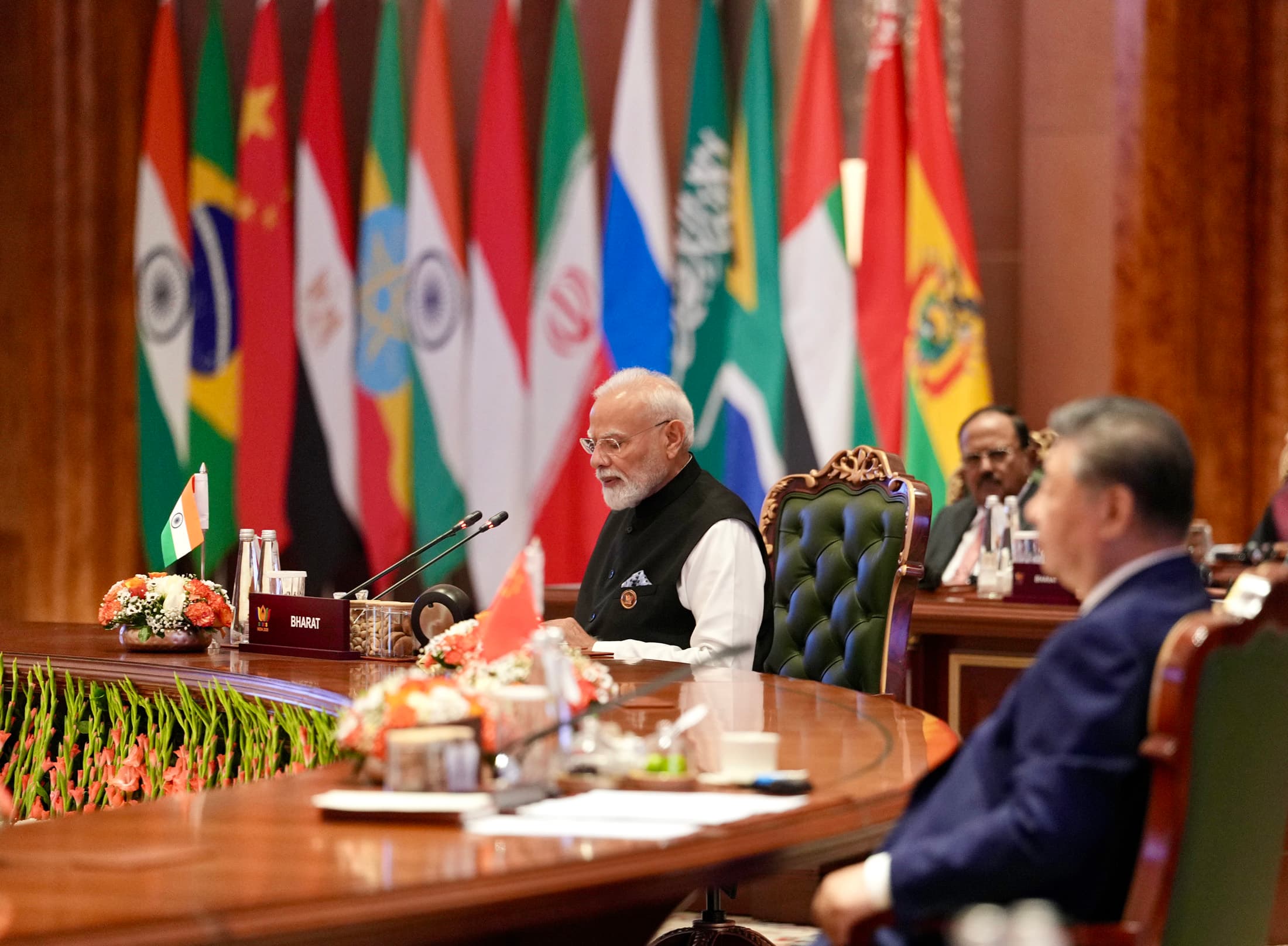
The 18th BRICS Summit, held at Bharat Mandapam in New Delhi on September 12-13, 2026, concluded with 11 member states unanimously adopting the New Delhi Declaration - a 140-paragraph document that is the most operationally specific in the bloc's twenty-year history. India's chairship produced more than 50 concrete outcomes across agriculture, health, digital infrastructure, trade finance, energy, artificial intelligence governance, and institutional reform. Prime Minister Narendra Modi conducted fifteen formal bilateral meetings alongside the summit, including with Chinese President Xi Jinping and Russian President Vladimir Putin. China will assume the chairship in 2027.
The coverage of this summit has been dominated by two competing narratives - BRICS as an anti-Western bloc, or BRICS as a paper tiger - both of which miss the more significant and harder-to-track story. India's chairship was explicitly oriented toward building cooperative mechanisms with practical uses: a BRICS Grain Exchange, a BRICS Incubator Network, agro-ecology centres, a digital agriculture network, cross-border payment task force work, and a proposal for a Continuity and Implementation Mechanism to prevent annual chairship turnover from erasing institutional momentum.
None of these are fully operational. Several remain at the feasibility or proposal stage. But the trajectory is toward a functional cooperative architecture that would give BRICS meaningful economic and institutional weight independent of whether it confronts the West. That distinction - building versus fighting - is the correct frame for assessing what happened in New Delhi and what comes next under China's leadership.
Strategic Background
BRICS began as a Goldman Sachs analyst's label for four emerging economies with high growth trajectories. Jim O'Neill coined the BRIC acronym in 2001. The countries converted it into a political forum in 2006 and held their first formal summit in Yekaterinburg in 2009. South Africa joined in 2010-11, creating the five-country configuration that held for more than a decade. The 2023 Johannesburg summit approved a historic expansion: Egypt, Ethiopia, Iran, Saudi Arabia, the UAE, and Indonesia joined as full members in January 2024, taking the bloc to 11 members. Ten additional partner countries - Belarus, Bolivia, Cuba, Kazakhstan, Malaysia, Nigeria, Thailand, Uganda, Uzbekistan, and Vietnam - joined a formal engagement framework in 2025.
The expansion brought significant internal diversity. BRICS now contains a NATO member candidate (Turkey has observer status in some forums), two countries under Western sanctions (Russia and Iran), and major US security partners (Saudi Arabia, UAE, Indonesia). Reaching consensus in any declaration across this membership is a diplomatic achievement in itself, independent of what the declaration actually says.
India's 2026 chairship was its fourth since the bloc formed, and came at a moment of compressed geopolitical stress: the Russia-Ukraine war ongoing, escalating US-China trade and technology friction, continued conflict in Gaza, and a global trade environment disrupted by tariff escalation. Against this backdrop, India chose a constructive institutional agenda rather than a confrontational posture - explicitly presenting BRICS as a platform "moving forward with the approach of taking everyone along," in Modi's framing, rather than a counterweight to anyone.
Historical Context: What BRICS Has Actually Built Before
Skeptics of BRICS declarations have one legitimate point: the bloc has produced ambitious language for years with limited institutional follow-through. But this criticism misreads the record when applied wholesale. Two institutions created under BRICS do exist and function.
The New Development Bank, established during India's 2012 chairship at the fourth BRICS summit in New Delhi, began operations in 2015 and has since approved more than $33 billion in financing across member countries. The Contingent Reserve Arrangement, a $100-billion currency swap facility finalized in 2014, provides a liquidity backstop for members facing balance-of-payments pressure. Both represent durable institutional outcomes from BRICS summits, not paper commitments.
India's 2026 chairship convened more than 400 meetings and engagements across 30 Indian cities - including ministerial-level meetings on agriculture, health, energy, trade, transport, education, and women's affairs. Most of these produced their own declarations and working documents, many of which fed into the final New Delhi Declaration. The summit was therefore less a negotiation and more a ratification event: the heavy lifting had already occurred through the year-long ministerial process.
What makes the 2026 declaration substantively different from earlier ones is density. Previous BRICS leaders' declarations ran 30-50 paragraphs. The New Delhi Declaration runs 140 paragraphs and covers specific mechanisms, named working groups, and institutional proposals with defined mandates. The shift from aspirational language to operational specificity is the headline change, even if implementation remains incomplete.
Current Situation Assessment: The Four Pillars and What Each Produced
India organized its chairship around four pillars: Resilience, Innovation, Cooperation, and Sustainability. Each generated substantive outcomes in the declaration.
Resilience
Under resilience, the most consequential outcomes concern food security and financial architecture. BRICS members collectively account for a major share of global agricultural output, and the declaration advanced work toward a BRICS Grain Exchange to stabilize agricultural trade and counter food-price volatility. The initiative is still in a "further discussion" phase - the declaration acknowledges ongoing work on modalities, not a completed institution. But it also endorsed BRICS AGRIN, a farmer-centric network covering agro-inputs, genetic resources, and agricultural information, and established Centres of Excellence on Agroecology and Regenerative Agriculture, with coordination initially assigned to an Indian agricultural research institute.
On financial resilience, the Contingent Reserve Arrangement is undergoing treaty amendments to make it more responsive during crises, with a ninth test run pending completion. The declaration also advanced the BRICS Multilateral Guarantees initiative, designed to de-risk development projects by mobilizing private capital alongside multilateral financing.
Innovation
The New Delhi Declaration gave significant space to artificial intelligence governance - a new priority relative to previous summits. BRICS members committed to implementing the BRICS Leaders' Statement on the Global Governance of Artificial Intelligence, endorsed India's AI Impact Summit from February 2026, and called for international cooperation on AI accessibility, safety, reliability, and energy efficiency. India framed AI governance as a Global South priority: ensuring that developing nations participate in setting norms rather than receiving them from advanced economy institutions.
On digital infrastructure, the declaration noted a proposal to launch a digital public infrastructure repository for BRICS countries, advanced work on a feasibility study for a high-speed submarine cable network linking BRICS members, and established a Digital Centre of Excellence for Smart Grids and Energy Storage. The BRICS Incubator Network was formally welcomed, and further consideration was given to a BRICS Startup Innovation Fund. A BRICS MSME Cooperation Portal was also established under India's chairship, aimed at improving access to trade finance for small and medium enterprises - one of the clearer institutional deliverables from the summit.
Cooperation
In health, BRICS established a dedicated Sub-Working Group for an Integrated Early Warning System for mass infectious diseases, launched a mental wellness network coordinated by India's National Institute of Mental Health and Neuro Sciences, and advanced a compendium on digital health architecture for remote care. The BRICS Mission for Healthy Lifestyle and a roadmap for 2026-2029 were also formally endorsed.
On trade and economic cooperation, the declaration advanced the Strategy for BRICS Economic Partnership 2030 and the BRICS Global Value Chains Action Plan for 2026-2030. It endorsed the Jaipur Consensus on MSME credit and formally welcomed an invoice discounting mechanism to improve working capital access for small businesses in intra-BRICS trade. A BRICS Logistics Supply-Chain Cooperation Framework was also established.
Sustainability
The declaration reaffirmed BRICS commitments under the Paris Agreement and acknowledged that BRICS members face differentiated vulnerabilities to climate change. It established a BRICS Climate Research Platform, advanced work on carbon market cooperation, and endorsed the BRICS Voluntary Principles for Climate-Resilient Urban Infrastructure. On energy, the declaration emphasized technological neutrality - acknowledging a role for fossil fuels in developing-economy energy transitions alongside renewables, nuclear, hydrogen, and storage technologies - a position that reflects the interests of oil-producing members alongside energy-importing ones.
Power Center Analysis: Who Wanted What in New Delhi
The 11-member BRICS is not a unified bloc with a single strategic objective. Understanding what each major actor sought from the New Delhi summit matters for assessing what was genuinely achieved versus what was diplomatically managed.
India sought to demonstrate it could lead a globally diverse grouping without subordinating its own interests, while using the chairship to advance specific policy priorities: UN Security Council reform, counter-terrorism language directly relevant to Pakistan-linked violence, Global South representation in financial institutions, and AI governance norms that reflect developing-country perspectives. India also sought a controlled diplomatic thaw with China and the domestic legitimacy that comes from hosting world leaders in New Delhi. On all four counts, New Delhi delivered at least partially.
China entered the summit with a different set of objectives. Beijing wants BRICS to accelerate the erosion of dollar dominance in trade settlement, build alternative multilateral financial architecture, and provide institutional cover for its Belt and Road partners. China also benefits from BRICS as a venue where India is a cooperative partner rather than a rival, reducing the risk of BRICS becoming a China-containment instrument. Xi Jinping's personal presence in New Delhi - his first visit to India in seven years - signaled the importance Beijing attached to maintaining the bilateral relationship within bounds that allow the summit to function. Xi described the India-China relationship from a "strategic and long-term perspective" and argued that the two countries are partners rather than rivals. India's official position acknowledged the meeting without endorsing that framing.
Russia needs BRICS as an international legitimacy platform while under Western sanctions over Ukraine. Putin's presence at the summit served that function. Russia also benefits from the declaration's language condemning unilateral coercive measures and opposing secondary sanctions - language directed at the West's sanctions architecture. Moscow's interests broadly align with Beijing's on financial architecture reform but diverge from India's on the pace and ambition of institutional alternatives to Western-led systems.
The new members - Saudi Arabia, UAE, Egypt, Indonesia, Ethiopia, and Iran - bring distinct interests. The Gulf members want diversified diplomatic relationships and reduced dependence on any single great power. Indonesia wants ASEAN to retain strategic centrality and approached BRICS membership as an economic opportunity rather than a geopolitical commitment. Ethiopia and Egypt bring specific priorities around African voice in global institutions. Iran's membership serves Russia and China more than it serves BRICS coherence, since it complicates the bloc's relationships with Gulf members and with the West.
The Declaration's Most Significant Commitments
Three areas of the New Delhi Declaration stand out for strategic importance beyond their procedural language.
Terrorism. The declaration condemned in the strongest terms the terrorist attack in Jammu and Kashmir on April 22, 2025, in which 26 people were killed. BRICS called for accountability for those involved in terrorist activities and their support networks, for action against the cross-border movement of terrorists, and for zero tolerance for terrorism without double standards. This language - adopted unanimously by a group including China, which has historically shielded Pakistan from UN Security Council designation procedures - represents a meaningful diplomatic outcome for India, however uncomfortable it may have been for Beijing to accept.
Gaza. The declaration called for implementation of the UN Security Council Resolution 2803, for continuation of the October 2025 ceasefire, for full humanitarian access to Gaza, and for opposition to forced displacement of Palestinians. It explicitly supported a two-state solution with an independent Palestinian state within the 1967 borders, with East Jerusalem as its capital. It also called on Israel to respect the ceasefire agreed with the Lebanese government and to withdraw occupying forces from Lebanese territory. This is among the most specific diplomatic language BRICS has produced on the Middle East and reflects the positions of members from across the grouping.
International financial architecture reform. The declaration reaffirmed the BRICS Rio de Janeiro Vision for IMF Quota and Governance Reform - endorsed at the 2025 Brazilian chairship - and called urgently for implementation of quota increases agreed under the 16th General Review, a process that has been delayed by the United States as the IMF's largest shareholder. It also endorsed the 2025 World Bank Shareholding Review and called for increased voice and representation for emerging markets and developing economies. These are established BRICS positions, but their reiteration in the context of current US unilateralism on trade carries more weight than in previous years.
The Payments Question: What Was Not Decided
The single most important misconception about BRICS financial strategy is that the bloc is working toward a common currency or an imminent replacement for the dollar. The New Delhi Declaration explicitly addresses payment system reform and does not support either interpretation.
The BRICS Payment Task Force is studying interoperability between payment and messaging systems across members - comparable to how India's Unified Payments Interface operates domestically, but applied to cross-border transactions. The declaration acknowledged work on promoting trade settlements and investments using national currencies, with deliberately flexible language recognizing that "there is no one-size-fits-all approach." Each country retains its own monetary framework, regulations, and financial priorities.
The strategic logic is more limited and more realistic: reducing transaction costs and third-party currency dependence in intra-BRICS trade, not displacing the dollar in global markets. The distinction matters because the first objective is achievable with existing technology and political will; the second would require replacing the dollar's role in global commodity pricing, correspondent banking, and reserve management - a transformation that no BRICS mechanism currently under discussion would accomplish.
The New Development Bank's push toward local currency financing is the more substantive structural change. With a mandate to provide an increasing share of its lending in member currencies - rather than dollars - the NDB reduces exchange-rate risk for project-level borrowing. Over time, a larger NDB loan book in local currencies could meaningfully reduce dollar dependency for infrastructure financing in BRICS economies. This is incremental but real.
India's Strategic Gains: An Honest Assessment
India's chairship produced genuine diplomatic achievements that go beyond the summit's formal outcomes.
Modi conducted fifteen bilateral meetings, including with leaders from Kazakhstan, Egypt, Indonesia, the Philippines, South Africa, Burundi, Nigeria, and Uganda - relationships that serve India's G20 legacy interests, its Act East and African engagement strategies, and its push for permanent UN Security Council membership. The summit also facilitated a meeting between Iranian and UAE leaders - two countries with strained bilateral ties - which India's hosting enabled without sponsoring directly.
The Modi-Xi meeting was the most watched bilateral at the summit. India-China relations had been effectively frozen after the 2020 Galwan Valley clashes and have been recovering gradually since 2024. The BRICS setting provided a structured, multilateral context for a bilateral meeting that lowered the political cost for both sides. Xi's visit to India - the first in seven years - was itself significant. It does not resolve the border dispute, the underlying strategic competition, or China's relationships with Pakistan. But it lowers the risk of miscalculation and keeps communication channels open at the highest level. India's border de-escalation process with China, including senior commander-level talks, needs to continue moving forward - political visibility at the summit does not substitute for military disengagement at the Line of Actual Control.
India's chairship was explicit that BRICS is "not working against anyone." This formulation is strategically important for New Delhi's diplomatic positioning: it allows India to participate in reform-oriented multilateralism without being read as joining a China-Russia alliance against the West. India's relationships with the United States, Japan, Australia, and European partners - critical to its security and economic interests - remain intact and are not threatened by India's BRICS leadership, precisely because India shaped the chairship around constructive agenda items rather than confrontational postures.
The Implementation Problem
The most honest critique of the New Delhi Declaration is not about what it says but about what happens to it next.
BRICS has no permanent secretariat. The bloc coordinates through the rotating chairship, the NDB, and a network of working groups. When the chairship passes to a new country, the institutional momentum of the previous year's initiatives is not automatically preserved. Previous summits have produced working groups, roadmaps, and cooperation frameworks that lost momentum when the hosting country changed. India's response to this structural problem was Modi's proposal for a BRICS Continuity and Implementation Mechanism - a Troika-based system that would track commitments, assign responsibilities, and monitor implementation across presidencies.
That mechanism has been proposed. It has not been established. Its operationalization is itself an item for the 2027 Chinese chairship to take up.
The handover to China is therefore the most consequential variable for the New Delhi Declaration's legacy. Several of India's priority initiatives - the AI governance framework, digital public infrastructure cooperation, the agro-ecology centres, the MSME portal, the Continuity Mechanism itself - require sustained follow-through. China's priorities for its 2027 chairship will likely emphasize economic integration, AI cooperation, and financial architecture, which aligns with some of India's 2026 agenda. But Beijing's appetite for counter-terrorism language targeting Pakistan-linked groups, or for strengthening India-originated institutions, is considerably lower than New Delhi's.
The transition also tests whether BRICS's two largest members can sustain cooperative engagement within the bloc while managing bilateral tensions outside it. The Modi-Xi summit meeting reduced the immediate risk of BRICS becoming a theater for India-China competition. It did not resolve the structural conditions that make such competition likely to persist.
Economic and Trade Implications
The New Delhi Declaration's economic agenda is more substantial than in previous summits, but significant gaps remain between political endorsement and operational delivery.
The BRICS Economic Partnership Strategy 2030, advanced during India's chairship, provides a framework for intra-BRICS trade and investment growth. The GVC Action Plan for 2026-2030 specifically addresses how BRICS members can participate in higher-value manufacturing and production. The Jaipur Consensus on MSME credit and the invoice discounting mechanism are designed to close a major gap in intra-BRICS trade finance: small and medium enterprises in developing economies often cannot access international trade finance at competitive rates, limiting their participation in global value chains.
The declaration also endorsed stronger WTO-centered multilateralism while explicitly criticizing unilateral tariff measures inconsistent with WTO rules - language directed at recent US trade actions without naming the United States. This positions BRICS as an advocate for the rules-based trading system on matters where Washington is itself deviating from WTO norms, which is strategically useful for members who would rather not be seen as simply anti-American.
China's acknowledgment of expanding zero-tariff treatment to 53 African countries with which it has diplomatic ties was noted in the declaration. For African BRICS members and partner countries, this is a concrete trade liberalization measure rather than a declaratory commitment.
Regional Fallout: The Global South Lens
The New Delhi Declaration's most consequential long-term effect may be on developing countries that are not BRICS members but whose interests the bloc has increasingly positioned itself to represent.
The ten partner countries - Belarus, Bolivia, Cuba, Kazakhstan, Malaysia, Nigeria, Thailand, Uganda, Uzbekistan, and Vietnam - create a new tier of structured BRICS engagement that extends the bloc's network without requiring full membership. BRICS's advocacy for IMF quota reform, WTO dispute settlement restoration, UN Security Council expansion to include African and Asian nations, and increased multilateral development financing directly addresses the governance complaints of the broader Global South.
The declaration explicitly opposed what it called unilateral coercive measures contrary to international law, including non-UN-authorized sanctions. It also condemned protectionist measures inconsistent with WTO rules, including carbon border adjustment mechanisms - an explicit challenge to the European Union's Carbon Border Adjustment Mechanism, which developing country exporters have criticized as disguised protectionism. These positions resonate in Africa, Latin America, and Southeast Asia regardless of whether those regions are BRICS members.
For India, the BRICS platform amplifies its voice as an advocate for the Global South in ways that bilateral diplomacy alone cannot. India's G20 presidency in 2023 admitted the African Union as a full member; its BRICS chairship in 2026 advanced the partner country framework and the Declaration's UN reform language. These are cumulative gains in multilateral positioning.
Scenario Analysis
Base Scenario (High Probability): China's 2027 chairship advances some elements of the New Delhi agenda - particularly AI cooperation, digital infrastructure, and financial architecture reform - while de-emphasizing counter-terrorism language and Indian-originated institutional initiatives. The BRICS Continuity Mechanism is formalized in principle under China's chairship but implementation varies by initiative. The NDB continues expanding its local currency financing mandate incrementally. Intra-BRICS payment interoperability advances in specific corridors. The BRICS Grain Exchange and agro-ecology networks develop slowly, with ICAR and IIT Delhi coordination continuing on Indian soil regardless of chairship rotation. BRICS remains a platform for positioning rather than a transformation of the global financial order, but its institutional architecture grows meaningfully.
Bull Scenario (Medium-Low Probability): India-China border relations stabilize, reducing the bilateral tension that complicates BRICS governance. Under China's chairship, the Continuity Mechanism becomes operational and preserves India's 2026 agenda. Payment interoperability across BRICS economies accelerates, reducing dollar-denominated transaction costs in intra-BRICS trade. The NDB's local currency lending reaches 30% of its loan book. New member integration deepens as Saudi Arabia and UAE bring significant capital and institutional capacity. BRICS becomes a credible alternative venue for development finance in Africa and Southeast Asia. India benefits from both the NDB architecture and its bilateral standing in the bloc.
Bear Scenario (Low-Medium Probability): India-China tensions escalate on the border or in the Indo-Pacific, making BRICS chairship dynamics increasingly contentious. China uses its 2027 presidency to reshape the bloc in ways that disadvantage India's interests - subordinating counter-terrorism commitments, framing BRICS more explicitly as an anti-Western vehicle, and using the agenda to advance Chinese institutional preferences. New BRICS members fragment further on Middle East issues, trade disputes, and financial architecture, making consensus increasingly difficult. The declaration's operational outcomes dissolve into the same implementation gap that has undermined previous summits. BRICS expands further but cannot agree on anything substantive, losing relevance to its own members.
Intelligence Forecast: 6-24 Months
Over the next six to twelve months, the most visible indicator of the New Delhi Declaration's durability will be China's initial actions as the incoming BRICS chair. Beijing is expected to organize its chairship around economic integration themes - AI cooperation, manufacturing supply chains, and development finance - which are broadly compatible with the 2026 agenda. The framing will likely shift from India's people-centric development language toward a more explicit emphasis on financial architecture and technology governance.
The BRICS Payment Task Force will continue its technical work on payment interoperability. Progress is likely to be incremental - specific bilateral corridors (India-UAE, China-Russia, Brazil-China) are more likely to see early implementation than a BRICS-wide system. The feasibility study for a submarine cable network connecting BRICS members is expected to proceed, with China likely to play a central role given its existing cable infrastructure investments under the Digital Silk Road.
The New Development Bank is expected to announce further expansion of its local currency lending through 2027. The CRA's treaty amendments, if completed, would make the facility more practically usable during financial stress - a test that real currency crises, not drill exercises, will eventually provide.
India-China relations will remain a critical variable. The 2025 border agreement and the Modi-Xi meeting in New Delhi create diplomatic space, but structural competition in the Indo-Pacific, over Pakistan, and in third-country markets will continue. India's engagement with QUAD and its security relationships with the United States, Japan, and Australia will create periodic friction with BRICS partners, particularly Russia and China. India's management of this tension - maintaining strategic autonomy without triggering a BRICS rupture - will be a continuing test of New Delhi's foreign policy sophistication.
Over a twelve- to twenty-four-month horizon, the Gaza situation and its aftermath will test BRICS solidarity. The declaration's language on Palestine is specific; implementation on the ground depends on actors outside the bloc. If the humanitarian situation in Gaza deteriorates further, pressure on BRICS members to move beyond declarations toward concrete action - sanctions, financial isolation of Israel, or formal recognition of Palestinian statehood - will intensify. BRICS has historically been unwilling to enforce its positions. This test is approaching.
For India specifically, the post-chairship period presents both an opportunity and a risk. Having demonstrated convening power and agenda-setting capacity, India will need to ensure that its priority institutions - the agro-ecology centres, the mental wellness network, the MSME portal, the Continuity Mechanism - survive the transition to Chinese leadership. The degree to which India invests diplomatic capital in this maintenance work will determine whether 2026 is remembered as a turning point or another ambitious summit that faded on handover.
Global Chanakya Assessment
The reflexive framing of BRICS - either as an emerging counter-hegemonic power or as a talking shop producing recyclable declarations - misses the more important and less dramatic reality: the bloc is incrementally building functional institutions in specific sectors, and those institutions will matter precisely because they are not the headline story.
The New Development Bank exists and lends. The Contingent Reserve Arrangement exists and has been tested. The agro-ecology centres being coordinated from India are concrete institutional nodes. The MSME portal is live. Payment interoperability work is technical and ongoing. None of this dismantles the Bretton Woods system. All of it creates alternatives, alternatives that reduce the absolute dependence of developing economies on institutions designed when their combined economic weight was a fraction of what it is today.
India's particular strategic challenge within BRICS is managing the gap between its institutional ambitions and China's structural dominance. China is the largest economy in the bloc by a significant margin. Its financial capacity, its technology infrastructure investments, and its existing bilateral relationships with most BRICS members give it disproportionate influence over what actually gets built and how. India can set the agenda, as it did effectively in 2026, but agenda-setting power is not the same as implementation power.
The terrorism language on Pahalgam is symbolically important and should not be analytically dismissed - BRICS unanimously condemning an attack that India links to Pakistan-based groups is meaningful in a forum where China sits. But it is a declaratory achievement. The structural conditions in Pakistan, and Beijing's relationship with Islamabad, remain unchanged. India needs to avoid interpreting the declaration's language as a strategic shift in China's regional posture.
The overlooked variable in the New Delhi Declaration is the partner country framework. Ten countries now have structured engagement with BRICS without full membership. If this framework expands and deepens, BRICS acquires a political constituency across Central Asia, Southeast Asia, Africa, and Latin America that gives its positions in multilateral forums - on IMF reform, WTO dispute settlement, UN Security Council expansion - considerably more weight than the eleven formal members alone would generate. India helped architect this expansion logic. Its strategic interest is in ensuring that the partner framework develops substance, not just symbolism.
On the payments question, clarity is needed: the most likely trajectory is not de-dollarization but dollar complementation. BRICS is building parallel systems that reduce the cost and friction of intra-bloc transactions without challenging the dollar's role in global commodity markets, correspondent banking, or reserve management. This is strategically significant for development finance and trade costs, but it does not represent an imminent restructuring of global monetary order. Investors, policymakers, and analysts who treat every BRICS payments announcement as a dollar collapse signal are misreading the pace and scope of what is actually happening.
Finally, the handover to China in 2027 is genuinely consequential, not merely procedural. China has chaired BRICS three times before and has strong institutional knowledge of how to use the presidency. Under Beijing's leadership, BRICS will likely move faster on financial architecture and technology governance, and slower on the people-centric development language that India emphasized. Whether China uses its chairship to advance genuinely multilateral outcomes or primarily Chinese bilateral interests within a BRICS wrapper will be the defining question of the bloc's next phase.
Indicators to Monitor
- Operationalization of the BRICS Continuity and Implementation Mechanism under China's 2027 chairship
- NDB loan book composition: whether local currency financing reaches or approaches 30% of total lending
- BRICS Payment Task Force technical outputs on payment system interoperability, particularly in India-UAE and China-Russia bilateral corridors
- Feasibility study results for the BRICS high-speed submarine cable network
- India-China Line of Actual Control: progress or regression on military disengagement at remaining friction points
- BRICS Grain Exchange: whether modality discussions produce an operational framework under China's chairship
- Chinese chairship agenda priorities for the 2027 summit: whether India's 2026 institutional initiatives appear in China's programmatic calendar
- Partner country engagement depth: whether BRICS-plus interactions with the ten partner nations gain policy substance or remain ceremonial
- Gaza ceasefire compliance and humanitarian access: BRICS members' collective and individual responses if the situation deteriorates
- Contingent Reserve Arrangement treaty amendment completion and ninth test run outcomes
- WTO dispute settlement restoration: whether BRICS coordination in Geneva produces any movement on Appellate Body appointments
- US response to BRICS financial architecture work: whether payment interoperability developments trigger secondary sanction concerns or diplomatic pressure on BRICS members
- India's bilateral trade and investment flows with major BRICS members post-chairship: whether summit outcomes translate into measurable economic outcomes
Frequently Asked Questions
Did BRICS agree on a common currency at the New Delhi summit?
No. The New Delhi Declaration explicitly addressed cross-border payment mechanisms and local currency trade settlement, but there was no agreement on, proposal for, or movement toward a common BRICS currency. The BRICS Payment Task Force is studying interoperability between existing national payment systems.
What is the BRICS partner country framework?
Ten countries - Belarus, Bolivia, Cuba, Kazakhstan, Malaysia, Nigeria, Thailand, Uganda, Uzbekistan, and Vietnam - joined a partner country engagement framework in 2025. This is a structured tier below full membership, allowing wider participation in BRICS engagements and practical cooperation without the commitments of full membership.
Why does India's BRICS chairship matter strategically?
India shaped the 2026 agenda around constructive institution-building and Global South representation rather than confrontational posturing. This allowed New Delhi to advance specific interests - UN Security Council reform, counter-terrorism language, digital governance - while preserving its strategic autonomy and its relationships with Western partners.
What happens to India's 2026 initiatives under China's 2027 chairship?
This is the central implementation question. Some initiatives, particularly in AI governance and digital infrastructure, align with Chinese priorities and are likely to continue. Others, particularly the counter-terrorism language and Indian-coordinated agricultural institutions, may receive less emphasis. Modi's proposed Continuity Mechanism, if operationalized, would help preserve momentum across the transition.
What did BRICS actually say about the Pahalgam attack?
The New Delhi Declaration condemned in the strongest terms the terrorist attack in Jammu and Kashmir on April 22, 2025, in which 26 people were killed, and called for accountability for those involved and their support networks. China signed onto this language unanimously with the other ten members.