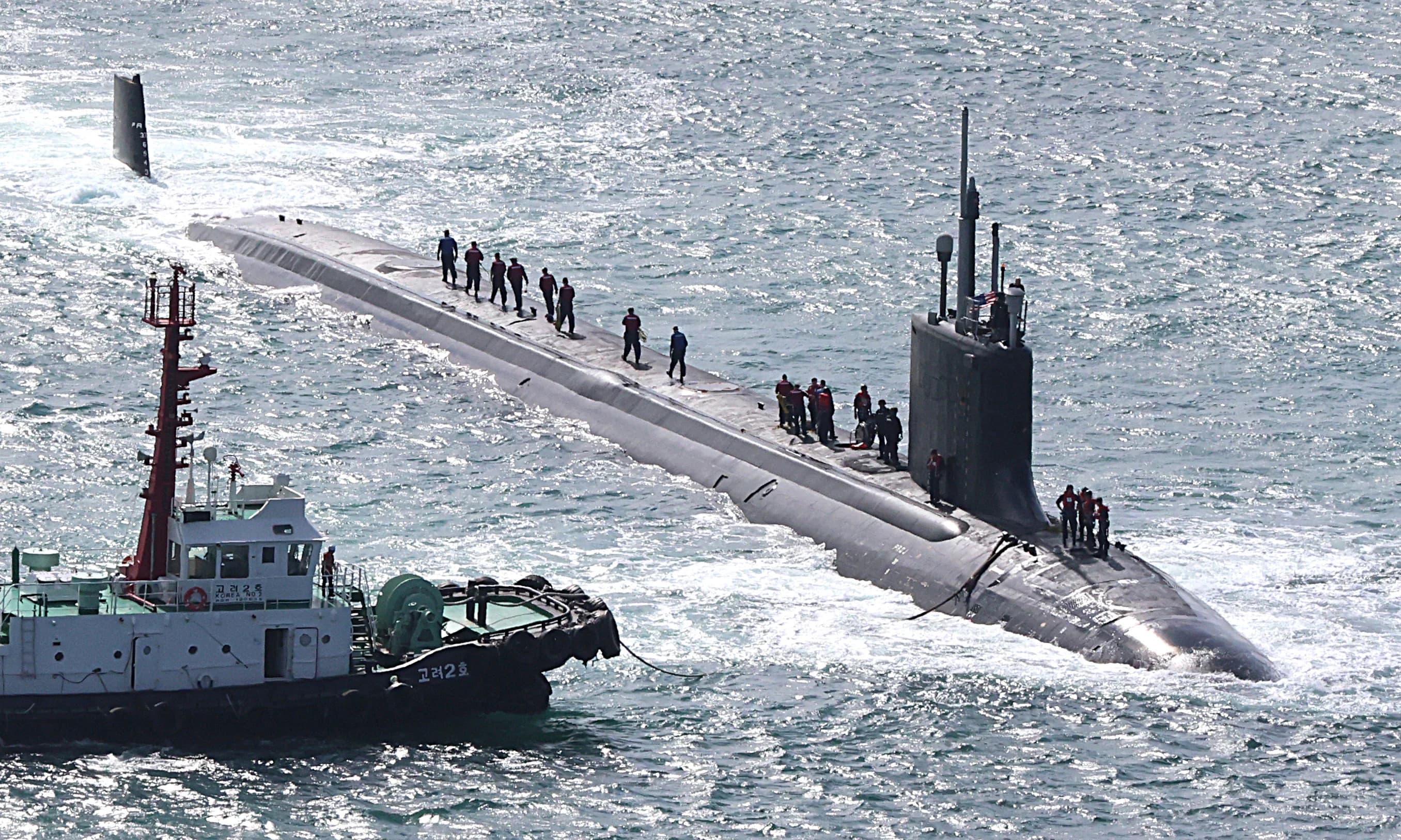
South Korea's Nuclear Submarine Gambit: How Jangbogo-N Is Reshaping Northeast Asia's Undersea Balance
Executive Summary
On May 26, 2026, South Korea's Ministry of National Defense unveiled the Basic Plan for the Development of the Republic of Korea Nuclear-Powered Submarine - formally launching a program that has been sought, blocked, and debated for more than three decades. Named the Jangbogo-N Project, the initiative commits Seoul to designing, building, and operating its first nuclear-powered attack submarine (SSN) by the mid-2030s, with operational deployment expected in the latter half of that decade. The submarines will use low-enriched uranium fuel produced under safeguards cooperation with the International Atomic Energy Agency and be built domestically by South Korea's world-class shipbuilders, Hanwha Ocean and HD Hyundai Heavy Industries.
The announcement did not arrive in a strategic vacuum. North Korea's Kim Jong Un had spent December 2025 touring a shipyard where an 8,700-ton nuclear-powered ballistic missile submarine was under construction - and had called South Korea's submarine ambitions an "offensive act." By June 2026, Kim himself had stepped forward to personally denounce the Jangbogo-N program, warning that tensions on the Korean Peninsula were worsening. By August, North Korea's First Vice Foreign Minister Jang Kum Chol had issued a formal KCNA statement warning that Seoul's program could trigger "nuclear dominoes" across Asia-Pacific. By September 2, a more formal KCNA condemnation warned of a "second AUKUS" forming in Northeast Asia.
This article assesses what the Jangbogo-N program actually represents - what it will and will not give South Korea militarily, why Washington reversed two decades of opposition to approve it, how North Korea's response reveals as much about Pyongyang's own vulnerabilities as about Seoul's capabilities, and what the program means for the broader undersea arms competition now openly acknowledged to be underway across Northeast Asia.
Historical Context: Three Decades of Blocked Ambition
South Korea's desire for nuclear-powered submarines did not begin in 2026. The requirement first became concrete under President Roh Moo-hyun in 2003, when Seoul sought to develop an SSN as part of a broader defense independence push. Washington blocked the effort, citing proliferation concerns, the constraints of the bilateral US-South Korea nuclear cooperation agreement, and the risk that a South Korean SSN program would accelerate arms competition with China and Japan and undermine denuclearization diplomacy with North Korea.
The pattern repeated through the following two decades. South Korea developed impressive conventional submarine capabilities - the domestically built Jangbogo-class and the more capable Dosan Ahn Changho KSS-III class, which is uniquely equipped with vertical launch systems capable of firing Hyunmoo-4-4 conventionally armed ballistic missiles. The KSS-III demonstrated its range and capability in a landmark 14,000-kilometer endurance deployment from South Korea to Canadian Forces Base Esquimalt in British Columbia as part of Seoul's pitch for Canada's Patrol Submarine Project, estimated at 60 trillion Korean won. But a nuclear-powered submarine - with the unlimited submerged endurance, speed, and operational reach that nuclear propulsion provides - remained politically inaccessible under the existing US-South Korea nuclear cooperation framework.
What changed was American political will, specifically tied to the October 29, 2025 summit between President Trump and South Korean President Lee Jae Myung in Gyeongju. At that meeting, Washington reversed its longstanding opposition and accepted South Korea's plan to develop conventionally armed nuclear-powered submarines, agreeing to work with Seoul on the requirements including nuclear fuel sourcing. Trump initially indicated the submarines would be constructed at Hanwha Philly Shipyard in Philadelphia - but Seoul subsequently clarified that domestic construction in South Korea remained the firm intent, a position the Blue House confirmed in June 2026 with the statement that "there is no significant change to the premise that nuclear-powered submarines will be built in Korea."
The Trump administration's reversal reflected several converging calculations. Washington needed South Korean participation in maintaining the Indo-Pacific undersea order, particularly in light of North Korea's advancing submarine-launched ballistic missile program. US defense officials and Congress were acutely aware of the US Navy's shipbuilding capacity constraints. South Korea's offer to provide maintenance, repair, and overhaul services for US combat vessels - confirmed at the Security Consultative Meeting - creates industrial interdependence that makes the SSN cooperation politically durable in both capitals. And Trump's broader view that US allies should shoulder more of their own defense costs aligned with giving South Korea the tools to do exactly that.
The Jangbogo-N Program: What Has Actually Been Decided
The Basic Plan released on May 26, 2026 is a comprehensive national commitment document rather than a preliminary expression of interest. South Korea's Defense Minister Ahn Gyu-back presented it at a defense strategy meeting chaired by President Lee at a naval base in Changwon and confirmed the first submarine launch target as the mid-2030s with operational deployment in the latter half of the 2030s - a development cycle of approximately ten years from program authorization to first hull delivery.
Several elements of the Basic Plan deserve particular attention for what they reveal about the program's strategic ambitions:
The plan commits South Korea to "establish a safeguards system applicable to nuclear-powered submarines in cooperation" with the IAEA - an unprecedented requirement for an SSN program, since existing nuclear-armed states with SSNs have operated under their own nuclear safeguards frameworks rather than NPT civilian arrangements. South Korea's decision to work with the IAEA on a specific naval propulsion safeguard mechanism reflects its commitment to maintaining NPT compliance while managing the concern - raised explicitly by North Korea and watched closely by China - that an SSN program provides cover for nuclear materials accumulation outside civilian oversight.
The fuel specification is LEU below 20 percent enrichment - materially different from the high-enriched uranium used by American, British, and French SSNs, and from the uranium enrichment level originally considered by South Korean planners (reported to have been contemplated at between 20 and 45 percent). The choice of sub-20 percent LEU reflects both nonproliferation pressure from Washington and Seoul's determination to maintain its international credibility as an NPT-compliant state. It also means the reactor design will differ from existing SSN propulsion systems, requiring South Korea to develop or adapt reactor technology suited to LEU fuel - a significant engineering challenge that adds to the program's complexity.
The program formally designates Hanwha Ocean and HD Hyundai Heavy Industries as domestic construction leads. Share prices for both companies surged 10.2 percent and 9.6 percent respectively on the day of the announcement, reflecting the market's assessment of a decades-long industrial program with national strategic backing. The program is expected to generate more than 40,000 jobs and create a sustained demand signal for South Korea's nuclear, shipbuilding, and defense industrial sectors.
The South Korea-US nuclear cooperation agreement - last comprehensively revised in 2015 - does not currently cover naval propulsion. Formal amendment of the agreement is required to enable US cooperation on LEU fuel sourcing. Those consultations are underway as of mid-2026 but have not been concluded. This is the program's most significant near-term dependency: Seoul has described its shipbuilding and nuclear technology as sufficient for domestic construction, but explicitly identifies nuclear fuel as "the only thing we lack." The pace of the US-South Korea nuclear cooperation agreement revision will largely determine whether the mid-2030s launch timeline is achievable or aspirational.
On August 18, 2026, President Lee ordered the Defense Ministry to further accelerate the Jangbogo-N program - a directive that followed the launch of a pan-government task force involving ten ministries to advance the project. The August acceleration order also came alongside Lee's reaffirmation that South Korea intends to complete the transfer of wartime operational control (OPCON) from the United States before the end of his term in 2030. These two developments - Jangbogo-N and OPCON transfer - are strategically linked: both represent South Korea's determination to develop genuine operational sovereignty within a deepened alliance framework rather than perpetual dependency on American strategic capabilities.
North Korea's Response: Public Fury, Private Calculation
Pyongyang's reaction to the Jangbogo-N program has been unusually escalatory in form but strategically revealing in substance. The progression from Kim Yo-jong's initial criticisms through Kim Jong Un's personal June 2026 condemnation to the formal KCNA vice foreign ministerial statement of August and the September 2 "second AUKUS" warning represents a systematic public campaign designed to achieve specific goals simultaneously.
Kim Jong Un's decision in June 2026 to personally address the submarine issue - rather than delegating it to his sister as had been the previous pattern - was flagged by Hong Min, a senior research fellow at the Korea Institute for National Unification, as a deliberate signal that North Korea had elevated the issue to leadership-level concern. Kim's accompanying statement reiterating North Korea's status as a "nuclear-armed state" and his pledge to maintain a "hard-line stance of struggle against the enemy" toward South Korea and the United States were not incidental framing - they were the substantive message. The submarine issue became the occasion for Pyongyang to reassert its nuclear identity at a moment when that identity was being challenged by a rival capital's own nuclear-industrial program.
North Korea's August 12 statement, delivered through First Vice Foreign Minister Jang Kum Chol, accused South Korea of creating "conditions for nuclear armament" and warned of "unparalleled power" to neutralize threats. The "nuclear domino" language deployed by Pyongyang - warning that Jangbogo-N could trigger cascading nuclear-submarine acquisitions across Asia-Pacific - reflects an awareness that the program's most significant second-order effect may be on Japan rather than on North Korea itself.
The strategic irony of North Korea's posture is considerable. Kim Jong Un was touring a shipyard inspecting his own 8,700-ton nuclear-powered strategic guided missile submarine - what analysts assess as a potential SSBN capable of carrying approximately 10 submarine-launched ballistic missiles - at the very same moment he was denouncing South Korea's SSN ambitions. Pyongyang is simultaneously building nuclear-powered submarines and condemning the concept of nuclear-powered submarines. The contradiction is not accidental. Kim is deploying the nuclear domino argument to constrain South Korea's program diplomatically while advancing his own program operationally - a standard feature of North Korean coercive diplomacy that is most effective when observers focus on the rhetorical content rather than the revealed strategic intent.
There is a hidden dimension to Kim's concern that goes beyond the military competition. South Korea's Jangbogo-N program, by developing the industrial capacity to enrich uranium for naval propulsion under IAEA safeguards, simultaneously expands Seoul's technical capabilities in ways that feed the domestic South Korean debate about indigenous nuclear weapons. That debate has been vocal in South Korean conservative circles for years, with polling showing majority public support for South Korean nuclear weapons. Washington has consistently opposed South Korean nuclear weapons development, and Seoul's government has consistently maintained its non-nuclear commitment. But a civilian uranium enrichment capability linked to a naval propulsion program sits closer to nuclear weapons relevance than anything South Korea has previously possessed - and Pyongyang is acutely aware of that dimension even if it cannot say so publicly without appearing to validate rather than undermine Seoul's deterrence argument.
North Korea's Own Submarine Program: Technical Reality vs. Strategic Posture
North Korea's December 2025 reveal of its nuclear-powered submarine under construction at an undisclosed shipyard - an 8,700-ton hull that state media calls a "nuclear-powered strategic guided missile submarine" or "strategic nuclear attack submarine" - deserves careful analytical treatment before it is taken as evidence of operational capability.
Several things are confirmed. The hull exists and is large: submarine expert H I Sutton of Naval News assessed the vessel as exceeding 100 meters in length, with an estimated displacement compatible with a 6,000 to 7,000 ton range in the view of Seoul-based analyst Moon Keun-sik. The images released by North Korean state media show the hull in red primer at a construction facility, with Kim Jong Un inspecting it alongside his daughter. North Korea claims the vessel will carry nuclear-armed SLBMs in a sail-mounted configuration - an unusual arrangement not found on any other SSBN in service globally.
What is not confirmed and remains analytically contested: whether North Korea actually possesses viable nuclear propulsion technology for a submarine. North Korea's shipbuilding capacity has expanded significantly since deepening military ties with Russia after 2022, but indigenous nuclear reactor miniaturization for submarine use is one of the most technically demanding achievements in naval engineering. No credible public assessment from South Korean, American, or Japanese intelligence has confirmed that Pyongyang has achieved or is near achieving working nuclear propulsion. Kim's visit in March 2025 and the December 2025 hull reveal are consistent with a program that is aspirational and partially constructed, not one nearing operational capability. Asia Times' April 2026 analysis noted that North Korea's introduction of the Choe Hyon class destroyer - commissioned June 23, 2026 as a surface nuclear-capable platform - may serve as an "interim sea-based nuclear deterrent" precisely because the nuclear submarine program is assessed as technically immature.
The Choe Hyon destroyer itself is significant. Commissioned in June 2026 at Nampho port, the 5,000-plus ton vessel has been assessed as a transitional design combining Russian-style surface armament with North Korean nuclear and missile platform concepts. Kim Jong Un himself noted at the commissioning ceremony that North Korea lacks sufficient naval bases for large surface combatants - an unusually candid admission of a structural limitation in his naval modernization program. The North Korean navy is building a sea-based nuclear deterrent force, but it is doing so from an industrial and technical baseline that makes the Choe Hyon a meaningful capability while its submarine ambitions remain works in progress.
The OPCON Transfer Connection: Sovereignty and the Alliance Architecture
The Jangbogo-N program cannot be fully understood outside the context of South Korea's simultaneous push to complete the transfer of wartime operational control. Both initiatives are expressions of the same underlying strategic objective: South Korea developing the capabilities and command authority to conduct independent military operations while maintaining the US alliance as a force multiplier rather than a dependency.
Wartime OPCON - the authority to command US and South Korean forces during a conflict - has rested with the US-led Combined Forces Command since the Korean War. South Korea maintains peacetime OPCON of its own forces but has no command authority in a wartime scenario. Defense Minister Ahn Gyu-back called OPCON transfer "a historic task that can no longer be delayed" and pointed out that South Korea is "the only country among UN member states that does not have OPCON" - a remarkable statement for a country with the world's fifth-largest military power and a top-10 economy.
The connection to Jangbogo-N is structural. A nuclear-powered submarine is what Defense Minister Ahn described as "an opportunity for South Korea to leap from a tactical nation to a strategic one" - a platform capable of independent long-range deterrence operations that do not require American strategic command to execute. OPCON transfer without independent strategic capability would give South Korea command authority over conventional forces while remaining dependent on American strategic assets for deterrence. Jangbogo-N, combined with OPCON transfer, gives South Korea something it has never had: a sovereign strategic deterrent and the command authority to employ it.
The US assessment of South Korea's OPCON readiness was reported as positive in June 2026, with Defense Minister Ahn saying Washington "evaluated that South Korea is preparing for OPCON transfer with great sincerity." The Security Consultative Meeting in November is expected to be the venue for recommending a specific OPCON transfer target year. US Forces Korea commander had told Congress in April 2026 that the target year for transfer was the first quarter of 2029, creating a potential tension with Lee's preference for completion before his term ends in 2030.
Regional Strategic Implications: The Undersea Arms Race Is Already Here
When Defense News analyst Gregg Richey was asked whether South Korea's Jangbogo-N announcement was the harbinger of a subsurface arms race in Northeast Asia, his answer was unambiguous: "We are already there." That assessment reflects a regional reality that the Jangbogo-N announcement made publicly explicit rather than newly created.
China operates the most capable SSN and SSBN fleet in the region outside the United States, and has been expanding its nuclear-powered submarine force as part of a sustained naval modernization program. North Korea is building a nuclear-powered submarine - technically uncertain but politically committed. South Korea has now formally launched its SSN program. Japan, which operates one of the most capable conventional submarine fleets in the world with a force of 22 diesel-electric boats, has explicitly declined to rule out nuclear submarine consideration in the current environment. Japan's defense minister told reporters in December 2025 that Tokyo "will not rule out any options and will consider necessary measures to enhance deterrence and response capabilities" when asked about nuclear submarines - a formulation that is not an announcement but is deliberately not a denial.
The analyst Kim Sun-young of Chonnam National University, quoted by Defense News, noted that Jangbogo-N "presents a valid alternative to nuclear armaments, which have been strongly demanded in Korea for the past several years in response to growing threats of nuclear weapons by the Pyongyang regime." This framing - the SSN as a substitute for, rather than a step toward, nuclear weapons - is the political argument Seoul is making to Washington and to international non-proliferation audiences. It works as long as Seoul's non-nuclear commitment is credible. The structural question that cannot be fully resolved is whether expanded uranium enrichment capability for naval propulsion remains cleanly separable from nuclear weapons relevance over a multi-decade program.
The Jangbogo-N program also carries explicit implications for Taiwan Strait contingency planning. One analyst cited by Taiwan News noted that Trump's approval of the program was motivated in part by the hope that South Korean SSNs would be "a valuable asset" if a crisis erupted over the Taiwan Strait and Washington sought allied contributions. A South Korean SSN with the range and endurance of a nuclear-powered boat could patrol far beyond the Korean Peninsula. That capability expansion changes not only the Korean Peninsula's strategic balance but South Korea's broader role in the Indo-Pacific security architecture.
India's Strategic Interest
India's relationship to the South Korean SSN program is not direct but is analytically significant on two dimensions. First, India is one of the six countries that currently operates nuclear-powered submarines - including the INS Arihant SSBN, which achieved operational deterrence patrol status, and nuclear-powered attack submarines leased from Russia. South Korea's entry into this club, if successful, would add a seventh member and would demonstrate that a non-nuclear-weapons state under NPT can successfully develop an indigenous SSN program under LEU fuel constraints with IAEA safeguards - a precedent relevant to how India's own nuclear submarine program is viewed internationally.
Second, and more broadly, the Northeast Asian undersea arms race has direct implications for China's naval strategy, which in turn affects the Indian Ocean theater where India has its most direct strategic interests. A China forced to allocate more SSN and SSBN resources to Northeast Asian contingencies - tracking South Korean SSNs, responding to a potential Japanese SSN program, monitoring American nuclear submarine forward positioning - is a China with somewhat constrained capacity to contest Indian Ocean maritime access simultaneously. This is not the primary driver of the Jangbogo-N program, but it is a genuine second-order strategic consideration for Indian planners.
Risk Matrix
Nuclear cooperation agreement timeline risk: The 2015 US-South Korea nuclear cooperation agreement does not cover naval propulsion. Its amendment is necessary before the US can formally cooperate on LEU fuel sourcing. This negotiation involves the US Department of Energy, the State Department, the Nuclear Regulatory Commission, and the Korean side. Given the complexity of similar negotiations - the US-UAE 123 Agreement and the AUKUS nuclear fuel arrangements have both involved multi-year processes - the fuel question represents the most likely source of schedule slippage in the mid-2030s timeline.
Proliferation perception risk: Any South Korean uranium enrichment development - even explicitly for naval propulsion and under IAEA safeguards - will be interpreted by China and North Korea as advancing South Korea's latent nuclear weapons capability. This perception affects Chinese willingness to constrain North Korean nuclear activity through Sino-North Korean channels, and it affects the broader Northeast Asian security environment in ways that Seoul does not fully control.
Japan cascade risk: If Japan formally decides to develop SSNs in response to the combination of North Korean, Chinese, and now South Korean nuclear submarine programs, the regional proliferation dynamic becomes significantly more complex. A Japanese SSN program would likely involve different fuel arrangements from the South Korean LEU model, given Japan's existing civilian plutonium stockpile and the political sensitivity of its nuclear materials posture.
OPCON transfer complication risk: The intersection of OPCON transfer and Jangbogo-N creates a scenario where South Korea could achieve command sovereignty before it possesses independent strategic deterrence capability - a potentially unstable interval during which Seoul has operational authority but not yet the strategic platforms to back it independently. Managing this gap will require careful alliance architecture work that has not yet been fully designed.
North Korean provocation escalation risk: Pyongyang has historically responded to South Korean military capability milestones with provocations calibrated to demonstrate that North Korea can threaten consequences even if it cannot prevent the capability development. Jangbogo-N is a decade-long program - North Korea has years in which to time demonstrations of its own naval capabilities to maximum rhetorical effect at key program milestones.
Scenario Analysis
Base Scenario - High Probability: The US-South Korea nuclear cooperation agreement is successfully amended by 2028-2029, resolving the fuel sourcing question. The Jangbogo-N program proceeds on the announced schedule, with the first SSN launched between 2034 and 2036 and entering operational service in the late 2030s. North Korea continues rhetorical condemnation while pursuing its own SSBN program, which achieves limited operational capability - a nuclear-armed diesel-converted boat or a partially functional nuclear-powered hull - before South Korea's SSN reaches operational status. Japan does not formally launch a nuclear submarine program but maintains the option through continued political language about "not ruling out any options." The Northeast Asian undersea competition deepens without a direct military confrontation triggered by submarine-related incidents.
Key assumptions: The LEU fuel question is resolved without the US requiring South Korea to use only American-supplied fuel; South Korea's domestic reactor engineering for LEU propulsion succeeds on a reasonable timeline; domestic South Korean political support for the program holds across one or two presidential election cycles; the US-South Korea alliance remains the foundational security architecture during the development period.
Bull Scenario - Low-to-Moderate Probability: The Jangbogo-N program becomes the centerpiece of a broader US-South Korea-Japan undersea cooperation framework. South Korean SSNs, potentially supplemented by eventual Japanese SSN development, create a multilateral Indo-Pacific undersea network that meaningfully constrains both North Korean sea-based nuclear operations and Chinese submarine activity in the region. South Korea's successful SSN completion demonstrates that a non-nuclear-weapons state can operate an SSN under IAEA safeguards - establishing a precedent that reduces global proliferation concerns about the model. The Jangbogo-N program's industrial success strengthens South Korea's naval export position and deepens its role as a critical defense industrial partner for the United States in the Indo-Pacific.
Key assumptions: Japan makes a formal decision to develop SSNs within the next 5-7 years; the IAEA develops and adopts a workable safeguards methodology for naval propulsion that other non-nuclear-weapons states can follow; South Korea successfully exports its KSS-III platform to Canada, creating the financial base and alliance entrenchment that accelerates the Jangbogo-N development cycle.
Bear Scenario - Low Probability: The US-South Korea nuclear cooperation agreement revision stalls over disagreements about uranium enrichment scope, creating a 3-5 year delay in the Jangbogo-N timeline. North Korea achieves functional nuclear propulsion for a submarine before South Korea's program recovers from the fuel delay, framing Pyongyang as the first Korean nuclear submarine power and giving Kim Jong Un a propaganda windfall that reshapes the peninsula's strategic narrative. China, disturbed by the pace of South Korean nuclear-industrial development, strengthens its support for North Korean conventional and nuclear programs as a counterbalancing measure. South Korean domestic politics - in a country where the left-right divide on defense policy is sharp - produces a successor government to Lee that deprioritizes or restructures the program, creating further delay. Japan, facing this combination of North Korean nuclear advances and South Korean program uncertainty, decides to develop its own SSN outside any coordinated alliance framework, triggering a Chinese naval response that makes the entire Northeast Asian security environment substantially more unstable.
Key assumptions: US domestic politics or technology export restrictions create barriers to the nuclear cooperation agreement revision; North Korea receives meaningful Russian nuclear submarine technology transfer (not confirmed but assessed as a risk given post-2022 Russia-North Korea military cooperation); South Korean domestic political support for the program is more fragile than current polling suggests.
Intelligence Forecast
Over the next 6 to 24 months, the following developments are assessed as most likely based on available evidence:
The US-South Korea nuclear cooperation agreement revision will advance but is unlikely to be concluded before late 2027 at the earliest. The complexity of the negotiation, the involvement of multiple American agencies, and the politically sensitive nature of agreeing to South Korean uranium enrichment for naval purposes all point to a multi-year process. Formal conclusion before the first anniversary of the May 2026 Basic Plan launch would be faster than comparable negotiations have historically proceeded.
The Jangbogo-N program will remain politically durable across the November 2026 US midterms and the South Korean political cycle. The program enjoys bipartisan support in Seoul and has been embedded in the defense budget proposal as a funded line item. Defense Secretary Hegseth's public support for the program adds American political insulation.
North Korea will conduct at least one naval provocation calibrated to the Jangbogo-N program's milestone schedule within the next 12 months. This could involve a test of a Pukguksong-series SLBM from the Hero Kim Kun Ok submarine, an announced sea trial of the SSBN under construction, or an ICBM test timed to coincide with a Jangbogo-N program milestone. The goal will be to demonstrate that Pyongyang's sea-based nuclear deterrent is operational before Seoul's is even launched.
Japan will not make a formal decision on nuclear submarine development within the 6-to-24 month forecast window, but official statements will continue to decline to rule it out. The Japanese debate will accelerate if North Korea achieves a visible sea trial of its SSBN or if South Korea's program advances to the detailed design phase with visible industrial momentum.
China will not formally respond to Jangbogo-N through diplomatic protest at the level of North Korea's condemnation, but will factor South Korean SSN development into its own submarine force planning and will likely quietly encourage North Korean naval demonstrations as a form of indirect pressure on Seoul's program timeline. Chinese naval vessel activity in waters adjacent to South Korea's training areas may increase as a form of ambient pressure.
India will monitor the LEU SSN model carefully as a potential template for how non-nuclear-weapons states manage the nuclear-propulsion-non-proliferation intersection. Indian defense planners are alert to any precedent that constrains or expands options for the country's own submarine program and enrichment policy.
Global Chanakya Assessment
The strategic significance of the Jangbogo-N program is being systematically underestimated in commentary that focuses on the mid-2030s operational timeline and concludes that the program is too distant to matter now. This misreads how strategic capability development works. The program matters today not because South Korea has a nuclear submarine - it does not - but because the political decision to build one has already altered the strategic calculations of every major actor in Northeast Asia.
The most important overlooked variable is the OPCON-Jangbogo-N nexus. These two initiatives together, if both are completed on or near their announced timelines, would represent the most significant restructuring of the US-South Korea alliance since the Korean War armistice. A South Korea with wartime command sovereignty and an indigenous nuclear-powered submarine force is a qualitatively different ally than the one Washington has managed for seven decades - more capable, more autonomous, and more expensive to replace if the relationship deteriorates. That structural shift serves both Washington's interest in allied burden-sharing and Seoul's interest in strategic sovereignty, but it also creates a new kind of relationship whose management norms have not yet been established.
North Korea's "nuclear domino" warning, stripped of its propaganda intent, contains a genuine strategic insight: the Jangbogo-N program, by demonstrating that a technologically capable non-nuclear-weapons state can develop an SSN under IAEA safeguards using LEU fuel, does create a potential template for other countries in the Indo-Pacific. Australia's AUKUS SSN program involves weapons-grade HEU fuel under a bespoke arrangement that is not replicable for most NPT members. South Korea's LEU model, if it succeeds, could be cited by other countries - including some that may have less benign intentions - as justification for parallel programs. This is not a reason for Seoul not to proceed; it is a reason for the IAEA to develop clear, workable safeguards guidance for naval propulsion that can be applied consistently.
The contrarian view on North Korea's own program deserves acknowledgment: Kim Jong Un's public campaign against Jangbogo-N appears designed partly to legitimize his own nuclear submarine program by establishing South Korea as the provocateur. If Pyongyang can characterize its SSBN as a defensive response to South Korean aggression rather than an independent nuclear escalation, it manages the framing on multiple international audiences simultaneously. The indicator that would invalidate this interpretation: North Korea achieving a successful sea trial of its nuclear-powered submarine before South Korea reaches the detailed design phase of Jangbogo-N, at which point Pyongyang's framing of South Korea as the driver of the arms race becomes factually untenable regardless of the chronological sequence of political decisions.
Indicators to Monitor
- Progress on revision of the 2015 US-South Korea nuclear cooperation agreement - specifically language on uranium enrichment and naval fuel sourcing
- IAEA formal engagement with South Korea on naval propulsion safeguards methodology
- Jangbogo-N program budget allocations in South Korea's annual defense budgets
- Selection of reactor design and fuel specification for South Korean SSN propulsion
- North Korean SSBN sea trial announcements or satellite imagery showing submarine activity at Sinpo shipyard
- North Korean SLBM tests from submarine or near-submarine platforms
- Japan's official statements on nuclear submarine consideration - escalating language signals program assessment
- South Korea-Canada Patrol Submarine Project preferred bidder announcement - KSS-III export success would accelerate Jangbogo-N industrial base
- OPCON transfer target year recommendation at November Security Consultative Meeting
- Full Materiel Capability evaluation start date for OPCON conditions assessment
- Chinese naval vessel activity in proximity to South Korean submarine training areas
- Hanwha Ocean and HD Hyundai Heavy Industries capital expenditure on nuclear submarine-related facilities
- Choe Hyon class destroyer operational status and missile integration testing
- Kim Jong Un statements on North Korea's naval strategy and nuclear deterrence posture
- US Congress Armed Services Committee hearings on South Korean SSN cooperation - support or resistance from key committee members
FAQ
What is the Jangbogo-N Project? Jangbogo-N is South Korea's formal program to develop and build its first nuclear-powered attack submarine. The Basic Plan was unveiled on May 26, 2026 by Defense Minister Ahn Gyu-back at a meeting chaired by President Lee Jae Myung. The program targets launching the first submarine in the mid-2030s with operational deployment in the latter half of that decade. Submarines will use low-enriched uranium fuel under IAEA safeguards and be built domestically by Hanwha Ocean and HD Hyundai Heavy Industries.
Why did the United States approve this after blocking it for 20 years? Washington reversed its opposition following the October 29, 2025 Trump-Lee summit in Gyeongju. Key factors in the reversal include: North Korea's advancing submarine-launched ballistic missile capability, US naval shipbuilding capacity constraints that make South Korean industrial cooperation valuable, Trump's broader preference for allied defense burden-sharing, and strategic interest in having South Korean SSN capability available for potential Taiwan Strait contingencies.
What is North Korea's submarine program? In December 2025, North Korean state media released images of an 8,700-ton nuclear-powered ballistic missile submarine under construction, which Kim Jong Un inspected alongside his daughter. The vessel is estimated by outside analysts as potentially carrying around 10 SLBMs in a sail-mounted configuration. Whether North Korea has achieved working nuclear propulsion technology is not confirmed. The Choe Hyon class destroyer, commissioned June 2026, is assessed as a transitional surface platform for sea-based nuclear deterrence while the submarine program matures.
Does South Korea's SSN program mean South Korea is developing nuclear weapons? No. South Korea's government has explicitly committed to NPT compliance and non-nuclear-weapons status. The Jangbogo-N submarines will be conventionally armed - their nuclear aspect is propulsion only, not warheads. Seoul is working with the IAEA on specific safeguards for naval propulsion. That said, uranium enrichment capability for naval fuel does expand South Korea's latent technical options - a point that critics, including North Korea, regularly make.
What is OPCON transfer and why does it matter? Wartime Operational Control refers to command authority over US and South Korean forces during a conflict. It currently rests with the US-led Combined Forces Command, not South Korea. President Lee has pledged to complete the transfer before his term ends in 2030, with the US assessment of OPCON readiness conditions pointing toward 2029. Combined with Jangbogo-N, OPCON transfer would give South Korea both the command authority and the strategic platforms for meaningful defense sovereignty within the US alliance framework.