
South Korea's Gulf Gambit: Inside Seoul's Bid to Solve the Middle East's Air-Defense Problem
Executive Summary
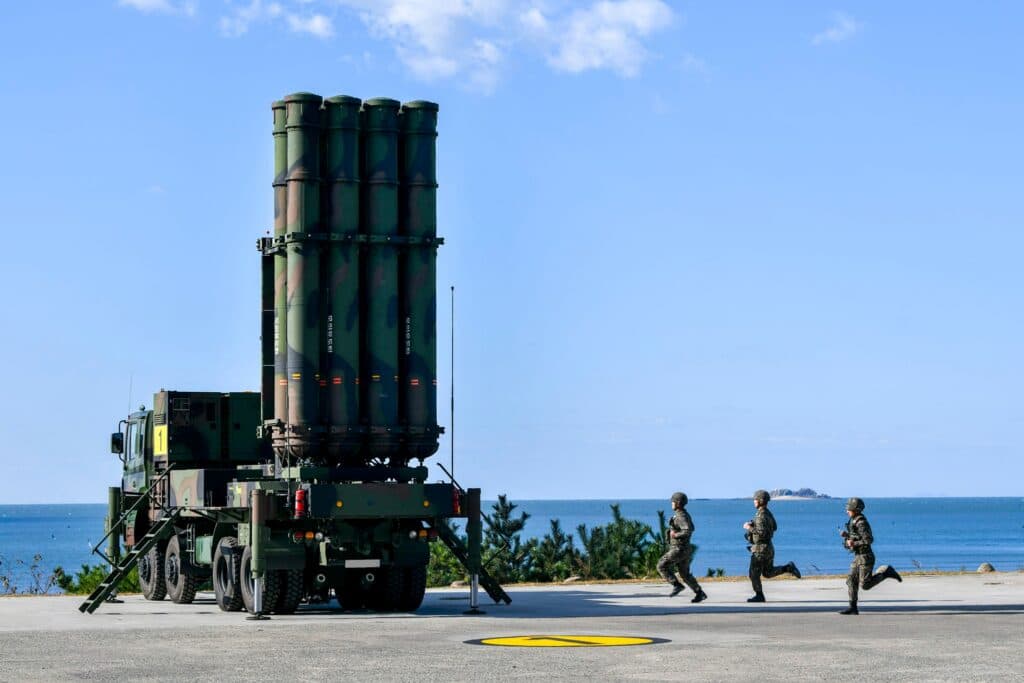
In February 2026, a South Korean-built Cheongung-II air defense battery operated by a Gulf state intercepted 29 of 30 incoming Iranian missiles and drones during a regional escalation - a 96 percent success rate that the New York Times and Financial Times both reported, and that instantly rewrote the international narrative around Korean missile defense technology. Within weeks, Saudi Arabia was pushing to accelerate delivery timelines on its own 3.2-billion-dollar Cheongung-II contract, the UAE was requesting emergency interceptor resupply from South Korea's own operational stockpiles rather than waiting for scheduled production, and Iraq had opened talks on a 2.6-billion-dollar procurement of the same system. On February 26, just two days before the Iran war's most severe escalation began, Seoul and Abu Dhabi signed a sweeping 65-billion-dollar bilateral agreement including 35 billion dollars in defense cooperation - one of the largest defense-linked packages any Gulf state has signed with a non-Western supplier.
This is South Korea's Gulf gambit: a deliberate, increasingly successful bid to position itself as the alternative supplier that oil-rich Gulf monarchies turn to when American systems come bundled with political strings, delivery delays, and export restrictions that leave buyers unable to operate their own weapons during an actual emergency. The Cheongung-II's combat debut against real Iranian missiles and drones - not a test range, not a simulation, but live interception during sustained 40-day attack campaigns against Saudi Arabia, the UAE, and Qatar - has done more to validate Korean defense technology in a single season than decades of marketing could have achieved. This report decodes why Gulf states are turning to Seoul, what structural advantages Korean systems offer over their American and Russian competitors, and whether South Korea's own defense industrial base can actually keep pace with demand that is now outstripping production capacity.
Strategic Background
The Gulf's air-defense diversification reflects a structural vulnerability the 2026 Iran war exposed with brutal clarity: over roughly 40 days of sustained Iranian missile, cruise missile, and drone attacks, Saudi Arabia, the UAE, and Qatar were pushed into a high-tempo defensive posture that revealed both the strengths and the structural limits of air-defense architectures built overwhelmingly around American Patriot and THAAD systems, supplemented by Russian Pantsir-S1 batteries. The core problem Gulf buyers have identified is not American technology's performance but its political conditionality - as one Korean defense industry executive put it, Middle Eastern buyers repeatedly ask whether Korean systems are ITAR-free, because American-made weapons systems can be blocked or restricted by Washington during precisely the emergencies when buyers most need them operational.
Historical Context
South Korea's Gulf defense relationship traces to the UAE's landmark January 2022 contract for ten Cheongung-II medium-range surface-to-air missile batteries worth 3.5 billion dollars - at the time, South Korea's largest single weapons export ever. Saudi Arabia followed with its own 3.2-billion-dollar deal, signed confidentially in November 2024 and publicly announced in early 2025 amid Defense Minister Shin Won-sik's tour of the UAE, Saudi Arabia, and Qatar. Between 2021 and 2025, Seoul secured a broader portfolio of Gulf contracts spanning K9 self-propelled howitzers for Egypt, K239 Chunmoo rocket launchers for the UAE and Saudi Arabia, and T-50 trainer aircraft for Iraq - with the UAE alone accounting for 9.5 percent of South Korea's total arms exports during this period, its third-largest destination globally.
Current Situation Assessment
The Cheongung-II's live combat performance against actual Iranian attacks has transformed South Korea's Gulf sales pipeline from steady growth into urgent, capacity-constrained demand. Following the system's 96 percent interception rate, the UAE requested immediate emergency resupply of interceptor missiles from South Korea's own reserves rather than waiting for the phased delivery schedule originally set to complete by late 2025 - a request Seoul granted, prioritizing rapid delivery from existing stockpiles. Saudi Arabia has pushed to accelerate its own delivery timeline, while Iraq's parallel interest in a comparable 2.6-billion-dollar procurement reflects the system's widening regional appeal beyond its original Gulf clientele. South Korea's total 2025 arms exports exceeded 17 billion dollars, with 2026 projections reaching as high as 37.7 billion dollars according to DB Investment and Securities - a trajectory anchored substantially by the Middle East pipeline atop South Korea's separately expanding European sales to Poland and Northern Europe.
Power Center Analysis
South Korea's Defense Industrial Complex: Racing Capacity Against Demand
The Cheongung-II is manufactured through a three-company consortium - LIG Nex1 as prime contractor, Hanwha Aerospace producing launchers, and Hanwha Systems providing radar components - whose combined production capacity is now genuinely strained. The Korea Times reported LIG Defense and Aerospace's factories operating at 78.1 percent utilization, a level industry analysts describe as leaving limited room for rapid output increases given defense manufacturing's specialized component and testing-cycle requirements. This creates what analysts term an export-readiness trade-off: immediate Gulf demand colliding with supply expansion timelines measured in years, forcing Seoul to balance export contracts against its own domestic North Korea-focused force requirements.
The Gulf States: Diversifying Beyond the American Umbrella
Saudi Arabia, the UAE, and Qatar's collective pivot toward Korean systems reflects a broader hedging strategy this publication's coverage of Gulf multipolar positioning has extensively documented - not abandonment of American security partnership, but deliberate diversification that reduces single-supplier dependency and the political leverage that dependency creates, particularly given demonstrated American willingness to restrict system information and operational access during crises.
The United States: The Incumbent Losing Exclusive Ground
Washington's position as the Gulf's traditional primary arms supplier faces genuine erosion, not through any single dramatic loss but through the accumulating pattern of Gulf states adding Korean, and in other domains Chinese, systems alongside rather than instead of American platforms - a layered rather than substitutive diversification that nonetheless represents a meaningful reduction in exclusive American market position.
Military and Security Implications
The Cheongung-II's demonstrated performance against saturation-style Iranian drone and missile attacks provides genuine operational validation of a kind that peacetime testing cannot replicate, directly informing how Gulf states now weight interceptor cost-effectiveness against volume-based drone and missile threats - a lesson with direct relevance to this publication's broader coverage of the Iran war's demonstrated drone and missile saturation tactics.
Economic and Trade Impact
The February 2026 UAE-South Korea 65-billion-dollar agreement, including 35 billion dollars in defense cooperation, represents one of the largest bilateral defense-linked economic packages any Gulf state has concluded with an Asian supplier, reflecting how thoroughly defense sales have become intertwined with Seoul's broader economic diplomacy strategy.
Diplomatic Positioning
South Korea's ITAR-free positioning - emphasizing that Korean systems carry none of the American re-export and end-use restrictions that can leave buyers unable to operate their own purchased equipment during emergencies - has become its most effective marketing argument among Gulf defense procurement officials specifically burned by prior American technology-access friction.
Regional Fallout
Iraq's parallel interest in Cheongung-II procurement illustrates the system's expanding regional appeal beyond its original UAE-Saudi Arabia client base, suggesting South Korea's Gulf gambit may extend into a broader Middle Eastern air-defense market share shift over the coming years.
Global Strategic Consequences
South Korea's Gulf success offers a genuine template for middle-power defense industrial strategy - demonstrated combat performance, explicit political-restriction-free positioning, and rapid emergency-response capability collectively proving more commercially decisive than raw technological sophistication alone, a lesson other rising defense exporters, examined in this publication's broader coverage of global arms competition, are likely to study closely.
Risk Matrix
- Risk Level: High - South Korea's production capacity constraints, evidenced by LIG D&A's 78.1 percent utilization rate, prevent Seoul from meeting accelerating Gulf demand timelines, risking reputational damage to the ITAR-free value proposition itself.
- Risk Level: Medium - Continued Iranian missile and drone threats against the Gulf sustain elevated interceptor demand beyond South Korea's near-term production capacity, forcing difficult allocation choices between export contracts and domestic defense needs.
- Risk Level: Low-Medium - South Korea successfully expands production capacity and captures durable long-term Gulf market share, positioning K-Defense as a permanent fixture in regional air-defense architecture.
Scenario Analysis
Base Scenario (High Probability): South Korea continues expanding Gulf air-defense sales while gradually scaling production capacity, maintaining its position as a credible secondary supplier alongside continued American Patriot and THAAD presence.
Bull Scenario (Medium Probability): Sustained combat validation and capacity expansion establish Cheongung-II as the Gulf's preferred medium-range interceptor system, with South Korea capturing durable market leadership in this specific category.
Bear Scenario (Low-Medium Probability): Production bottlenecks and delivery delays erode the reliability advantage that initially attracted Gulf buyers, pushing them back toward expanded American procurement despite political friction.
Intelligence Forecast (6-24 Months)
Watch Saudi and UAE delivery timeline acceleration progress, Iraq's Cheongung-II procurement decision, South Korea's production capacity expansion investments, and any further emergency interceptor resupply requests during continued regional tensions.
Final Strategic Takeaway
South Korea did not win the Gulf air-defense market through diplomacy or discount pricing - it won through combat performance and a simple promise American suppliers cannot always keep: that the weapons Gulf states buy will actually work when Washington's own political calculus says otherwise.
A missile that intercepts 29 of 30 real incoming threats sells itself faster than any defense attaché ever could - and Seoul is now racing to build enough of them before the moment passes.
Global Chanakya Assessment
Hidden driver: The ITAR-free positioning matters more than raw performance statistics - Gulf buyers explicitly cite fear of American operational restrictions as their primary diversification motivation, not dissatisfaction with US technology itself.
Contrarian view: South Korea's capacity constraints may prove self-limiting - if Seoul cannot scale production fast enough, Gulf states could conclude Korean diversification offers reliability risk of its own kind rather than genuine independence from supply bottlenecks.
Indicators to Monitor
- Cheongung-II delivery timeline progress for Saudi Arabia and UAE
- Iraq's procurement decision status
- LIG Nex1 and Hanwha production capacity expansion investments
- Continued Iranian missile and drone activity against Gulf states
- South Korea's total 2026 defense export figures
Frequently Asked Questions
What is the Cheongung-II system?
The Cheongung-II, also known as KM-SAM, is a South Korean-developed medium-range surface-to-air missile system designed to intercept threats at altitudes between roughly 9 and 25 miles, manufactured by LIG Nex1, Hanwha Aerospace, and Hanwha Systems.
How did the system perform in actual combat?
In February 2026, a Gulf-operated Cheongung-II battery intercepted 29 of 30 incoming Iranian missiles and drones, a 96 percent success rate reported by international outlets including the New York Times and Financial Times.
Why are Gulf states turning to South Korea over the US?
Gulf buyers cite concerns that American systems carry ITAR export restrictions that can limit operational access during emergencies, whereas Korean systems come without these political conditions, making them attractive as a diversification option alongside continued American procurement.