
Azerbaijan's Quiet Leverage: Why the World's Smallest Big Player Matters to Putin, Zelenskyy, and Everyone Between
Executive Summary
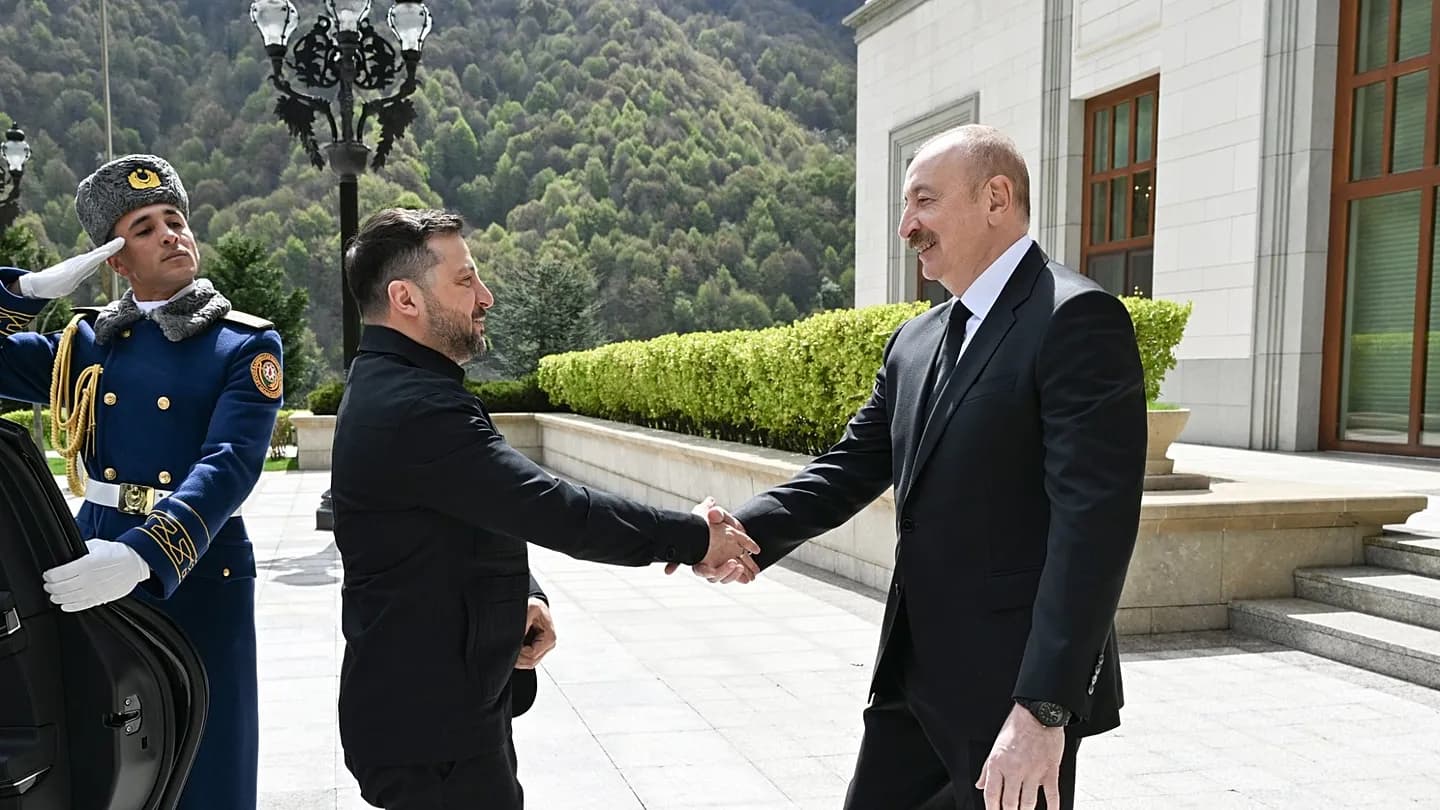
In the spring of 2026, a sequence of events unfolded in and around Azerbaijan that would have seemed implausible just four years earlier. In early March, Israeli special operations forces and Mossad personnel were operating from positions in southern Azerbaijan, some within 60 miles of the Iranian city of Tabriz, conducting intelligence-gathering missions and drone operations that included what sources described to CNN as the killing of Rahman Moghaddam, head of the IRGC's intelligence division. The day after that killing, Iranian drones struck Nakhchivan International Airport - an Azerbaijani exclave that borders Iran - injuring civilians and damaging a terminal building. President Ilham Aliyev called it "an act of terror," summoned Iran's ambassador, and placed his military on full alert along the southern border. Two months later, Ukrainian President Volodymyr Zelenskyy arrived in Gabala, Azerbaijan, signing six bilateral agreements that prioritised defence-industrial cooperation and counter-drone technology. Days after that, Azerbaijan's Foreign Minister Jeyhun Bayramov was in Moscow beside Sergei Lavrov, signing a two-year Consultations Plan between the two foreign ministries. Around the same time, construction formally began on the Rasht-Astara railway - a project in which Azerbaijan plays the indispensable role of northern endpoint, connecting Russia and Iran's $1.6 billion rail investment to the wider world.
No other country on earth was simultaneously hosting Israeli intelligence operations, receiving Ukraine's president, normalising relations with Russia after a diplomatic rupture, signing a US Strategic Partnership Charter with Vice President JD Vance, expanding gas exports to sixteen countries including eleven NATO members, and providing the keystone infrastructure without which Russia and Iran's primary sanctions-evasion logistics corridor cannot function. For a detailed timeline of how the war has evolved, see our Russia-Ukraine war timeline and 2026 analysis.
This is Azerbaijan in 2026: a state of approximately ten million people and 86,600 square kilometres that has, through a combination of deliberate strategic calculation, geographic luck, and Aliyev's particular brand of authoritarian pragmatism, positioned itself at the intersection of every consequential geopolitical axis operating in Eurasia. It is the smallest big player in the world - and it has never mattered more.
The Geography of Indispensability
Azerbaijan's leverage begins with geography that no diplomatic manoeuvre can replicate or substitute. Situated at the crossroads of the South Caucasus, the Caspian Sea, and the Iranian plateau, it occupies the single most strategically irreplaceable position in the entire Eurasian connectivity architecture.
Consider what passes through or adjacent to Azerbaijani territory or decision-making in 2026. The Baku-Tbilisi-Ceyhan pipeline - carrying Azerbaijani and Kazakhstani crude oil to Turkey's Mediterranean coast - supplies a significant proportion of Israel's oil imports while providing Europe with an alternative to Russian energy. The Baku-Tbilisi-Kars railway is the primary rail artery of the Middle Corridor, connecting Central Asia and China to Turkish and European markets. The Southern Gas Corridor, including the Trans-Adriatic Pipeline, carries Azerbaijani natural gas to sixteen countries, eleven of them NATO members. The western branch of the INSTC - Russia and Iran's preferred route for sanctioned trade - runs from Russia's Caspian ports through Azerbaijan's rail network at Astara into northern Iran, and is commercially viable only with Azerbaijani cooperation at the northern junction. The Nakhchivan exclave, separated from mainland Azerbaijan by Armenian territory, is the anchor of the TRIPP corridor - the US-brokered Trump Route for International Peace and Prosperity that forms the South Caucasus link of the Middle Corridor, now under active development with USTDA support and JD Vance's personal political investment.
Each of these infrastructure arteries is controlled, transited through, or critically dependent upon decisions made in Baku. Each of them is also wanted simultaneously by actors who are themselves in direct conflict with each other. This is not coincidence. It is the structural foundation of Azerbaijani leverage, and Aliyev has spent the better part of two decades learning how to extract maximum value from it.
The Corridor at the Centre: Why Azerbaijan Holds the INSTC's Master Key
The International North-South Transport Corridor's western branch - the route that connects Russian Caspian ports through Azerbaijan into northern Iran - is the one corridor that Russia needs most urgently and can control least independently. The geometry is stark. Russia and Iran signed a €1.6 billion agreement to build the 162-kilometre Rasht-Astara railway inside Iran in May 2023, with Russia providing an intergovernmental loan of €1.3 billion. Construction formally began in 2026. The line connects the Iranian city of Rasht, near the Caspian, to Astara on the Iranian-Azerbaijani border.
But the railway dead-ends at the border without Azerbaijani cooperation. The Astara border crossing, the Azerbaijani rail system extending northward from Astara through Baku, and the connection to Georgia's Black Sea ports and the Baku-Tbilisi-Kars line are all Azerbaijani infrastructure. In the presence of Azerbaijani participation, the western branch of the INSTC becomes a functioning corridor stretching from the Persian Gulf through two sanctioned states to Russia's rail network, with onward connections to European markets. In the absence of that participation, the corridor terminates at an unconnected rail station on the Iranian side of a border post. Azerbaijan's state railway authority ADY has itself noted that the INSTC "further strengthens Azerbaijan's strategic role" - which is a diplomatic way of acknowledging that Baku controls whether the corridor works at all.
This leverage is enormous. Russia's freight volumes along the INSTC's western branch rose 87 percent in the first four months of 2026 alone, driven by the effective closure of the Strait of Hormuz and Red Sea disruptions caused by the Iran war - conditions that made Caspian-route connectivity more valuable than at any point in the corridor's history. Russia-Iran cargo turnover through the Caspian was projected to reach 10 million tonnes in 2026. Every tonne of that traffic - military or commercial - that uses the western branch requires that Azerbaijan's railway infrastructure at Astara remains open, that Azerbaijani customs do not disrupt transshipment, and that Baku does not apply Western pressure to interfere with the cargo flow. Azerbaijan has chosen not to disrupt that traffic. That choice alone is worth more to Putin than any formal alliance treaty.
Aliyev has been careful about how he publicly frames this. Azerbaijan's official position is that the INSTC serves Azerbaijan's own connectivity interests - and this is genuinely true. The western branch provides Baku with leverage over Russia and Iran simultaneously with the commercial benefit of transit revenue. Aliyev told Putin in August 2024 that "the railway and automobile segments of the North-South corridor have been fully implemented and are successfully operating on the territory of Azerbaijan," while noting ongoing modernisation to increase throughput. What he did not say - but Moscow understands perfectly - is that what Azerbaijan builds, Azerbaijan can also close.
The Iran Dimension: Fire and Commerce Simultaneously
Azerbaijan's relationship with Iran is perhaps the most acrobatic of all its simultaneous diplomatic performances. The two states share a 700-kilometre border, a complicated ethnic overlap - Iran contains a substantial Azerbaijani Turkic population concentrated in its northwestern provinces, a demographic sensitivity Tehran has long feared could be weaponised by Baku - and a trade relationship that makes each economically dependent on the other in ways that neither finds comfortable to acknowledge publicly.
In 2026, Iran provides Azerbaijan's Nakhchivan exclave with its primary overland transit route to the rest of the world - a dependence that Tehran has historically used as a source of pressure on Baku. Iran simultaneously has no feasible INSTC western branch without Azerbaijan's railway infrastructure at Astara. The two states need each other across multiple dimensions even as they operate, functionally, as adversaries in almost every geopolitical dimension that actually matters.
The Iran war brought this contradiction into violent relief. Israeli forces operated from southern Azerbaijani territory - a fact that Baku officially denied but that four intelligence sources confirmed to CNN. The IRGC killed the head of its own intelligence division's elimination was reportedly launched from Azerbaijan. On 5 March 2026, Iran responded with drone strikes on Nakhchivan International Airport. The IRGC's associated Telegram channel framed the strike as a warning: it had identified the cooperation with Israel, it knew about the sites from which operations against Iran were being prepared. Aliyev's public response was sharp and unambiguous - he called the attack "ugly, cowardly and shameless," summoned Iran's ambassador, recalled his own, and closed his southern border to cargo trucks for twelve hours. He did not, however, close the Astara rail crossing permanently. Trade resumed. The INSTC western branch continued to function. The lines of commercial and strategic interdependence that make Azerbaijan and Iran mutually dependent were preserved even as the political relationship reached its most acute crisis point.
This is Aliyev's signature manoeuvre: absorb the insult, demonstrate military resolve, signal red lines clearly, and then preserve the economic architecture that gives him leverage over the party that just crossed those lines. It is a profoundly difficult balance to maintain and it has so far held.
The Russian Dimension: Alliance on Paper, Leverage in Practice
Azerbaijan's relationship with Russia defies the conventional vocabulary of post-Soviet politics. It is neither alignment nor opposition, neither subordination nor confrontation. The Declaration on Allied Interaction signed on 22 February 2022 - two days before Russia's full-scale invasion of Ukraine - elevated the bilateral relationship to the level of an "alliance" in formal treaty language. Both sides meant different things by the word. Russia wanted the political cover of Baku's nominal alignment during the period of maximum international exposure following the invasion. Azerbaijan wanted the security relationship formalised in a way that reduced Russian pressure without requiring Azerbaijani endorsement of Russian actions in Ukraine.
The subsequent four years tested those different meanings repeatedly. Russia's air defences shot down an Azerbaijani civilian airliner in December 2024 - an act that produced a diplomatic rupture of unusual public acrimony. Aliyev demanded accountability publicly and persistently in a manner that no other nominally Russia-aligned state dared replicate. Russia eventually issued a formal acknowledgement of responsibility and agreed to compensation in April 2026. The normalisation was rapid after that. Within weeks of the settlement, Azerbaijan's foreign minister was in Moscow signing the 2026-2027 Consultations Plan - institutionalising the bilateral diplomatic relationship for the next two years.
The rapprochement served both sides. Russia, having lost the INSTC western branch's reliability as a given during the diplomatic rupture, needed to restore the stable relationship that keeps Azerbaijan's rail infrastructure open. Putin and Aliyev reaffirmed their "commitment to expanding mutually beneficial cooperation" at the end of July 2026, with bilateral trade turnover at $4.3 billion and Russian direct investments in Azerbaijan exceeding $4 billion. For Aliyev, the settlement removed the public humiliation of an unresolved incident while extracting a formal Russian concession - an accountability that no Russian ally in the post-Soviet space had managed to extract from Moscow since 2022.
The relationship's structural asymmetry has been inverted by the war's consequences. Russia needs Azerbaijan's corridor cooperation more than Azerbaijan needs Russia's political approval. Moscow's dependence on Baku's INSTC participation, its desire for Azerbaijan to expand rather than constrain transit capacity, and its inability to compel Azerbaijani compliance through either military threat (a post-2020 Azerbaijan that defeated Armenia comprehensively is a different military proposition than the pre-Karabakh Baku) or economic leverage (Azerbaijan's energy independence makes Russian gas leverage inapplicable) gives Aliyev a structural upper hand that he deploys through studied calm rather than confrontation.
The Western Dimension: US Strategic Partner, EU Energy Supplier
If Azerbaijan's Russia and Iran relationships are defined by leveraged coexistence with adversaries it cannot afford to confront directly, its Western relationships represent a genuine alignment of interest that goes considerably beyond the diplomatic courtesies of a small state seeking external validation. The US-Azerbaijan Strategic Partnership Charter signed by JD Vance in Baku on 10 February 2026 is not merely a ceremony. It represents a formal American declaration that Azerbaijan is Washington's primary strategic partner in the South Caucasus - the anchor state of the TRIPP corridor that Trump personally brokered at the August 2025 White House Summit with Armenia and Azerbaijan, and the energy partner supplying gas to eleven NATO members.
The USTDA's subsequent engagement - exploring projects across liquefied natural gas, civil nuclear energy, electricity transmission, AI infrastructure, cybersecurity, and digital connectivity - represents the concrete implementation of that strategic partnership. Vance announced plans to supply Azerbaijan with new patrol boats to protect its territorial waters: a quiet but strategically significant American naval investment in the Caspian, delivered through a partner rather than a direct US presence that the 2018 Convention prohibits. The US has effectively extended its strategic presence into the Caspian through Azerbaijan as proxy.
Azerbaijan's energy role in Europe has similarly expanded beyond its historical importance. As the Iran war disrupted Gulf energy supplies and the Strait of Hormuz closure reshuffled global energy markets, Azerbaijan increased its natural gas deliveries to Europe - the Euronews Global Baku Forum in March 2026 featured Aliyev's chief foreign policy advisor explicitly confirming that Baku was "increasing deliveries to fill the gap from the shutdown of the shipments from the Gulf." Azerbaijan supplies sixteen countries with gas, eleven of them NATO members. That dependency gives Baku more leverage over European foreign policy preferences than most European states are comfortable acknowledging publicly.
The Ukraine Dimension: Drone Expertise, Mediation Ambitions, and Russia's Discomfort
Ukraine's relationship with Azerbaijan occupies a particular category: the diplomatically delicate friendship between a state under invasion by a country Azerbaijan formally calls an "alliance" partner, and a state whose pragmatic survival requires it not to take sides militarily while taking clear positions politically. Aliyev has consistently told Zelenskyy what he privately - perhaps publicly - believes: that Ukraine should "never agree to occupation," a phrase that resonates especially in a country that fought two wars to recover its own occupied territory. Azerbaijan's vote in the UN General Assembly has consistently supported resolutions upholding Ukrainian territorial integrity. Zelenskyy has thanked Aliyev for providing eleven energy assistance packages to Ukraine during the war.
Zelenskyy's April 2026 visit to Gabala elevated the relationship to a new level. The six bilateral agreements signed were not disclosed in detail, but both presidents made clear that defence-industrial cooperation and counter-drone technology were the primary subject. Ukrainian military specialists were already embedded in Azerbaijan before the visit. Zelenskyy proposed Azerbaijan as the venue for future Ukraine-Russia peace negotiations - a suggestion that serves Ukraine's interest in demonstrating that the post-war diplomatic framework it envisions runs through a neutral Caucasian mediator rather than Turkish or Chinese interlocutors. Aliyev accepted the implicit compliment without formally endorsing the proposal.
Days after Zelenskyy left, Bayramov was in Moscow. Carnegie Endowment for International Peace noted the deliberate signal: "Azerbaijan's backing for Ukraine is less about confronting Russia than about quietly broadening the mix of partners it relies on." Russia watches the Ukraine-Azerbaijan defence cooperation with visible discomfort but without the leverage to stop it. Azerbaijan's officials have been careful to describe the cooperation as "strictly defensive and not directed against Russia" - the diplomatic framing that allows Baku to deepen a relationship that objectively reduces Russia's freedom of action without providing Moscow with a formal casus belli for retaliation.
The Israel Dimension: Strategic Depth in an Uncomfortable Partnership
Azerbaijan's relationship with Israel predates the Iran war by decades and has always rested on the same complementary interests: Azerbaijan supplies a significant share of Israel's crude oil imports through the BTC pipeline; Israel supplies Azerbaijan with advanced military equipment - including the Harop loitering munitions and Spike anti-tank missiles that proved decisive in the 2020 Nagorno-Karabakh war, and more recently advanced drone systems. The partnership provides Israel with forward intelligence capability near Iran's northern border; it provides Azerbaijan with qualitatively superior weaponry that no other supplier can match in reliability and relevance to its specific threat environment.
The 2026 Iran war elevated that partnership from strategic convenience to active operational cooperation. Israeli forces operated from southern Azerbaijani territory - Mossad personnel, special operations forces, and the elite heliborne unit Unit 669 assembled at positions as close as 60 miles from Tabriz. The operation that killed IRGC intelligence chief Rahman Moghaddam on 4 March was reportedly launched from Azerbaijan. Israeli Foreign Minister Gideon Sa'ar visited Baku and met Aliyev less than two weeks after the operation was exposed publicly. Azerbaijan officially denied everything. Israel declined to comment. Neither side has any incentive to change that posture.
What Iran's Nakhchivan strike on 5 March demonstrated is that Tehran knew, and wanted Baku to know it knew. The IRGC's affiliated Telegram channel was explicit: this was a calibrated warning, not an accident or a rogue unit's freelance action. Tehran was signalling that its awareness of Israeli-Azerbaijani operational cooperation could translate, at its discretion, into escalated pressure on Azerbaijani territory. Aliyev's sharp public response - military readiness, ambassador recall, border closure - was designed to communicate that Azerbaijan's deterrence threshold had been crossed and that further provocations would generate consequences. So far, Iran has not tested that threshold again.
The Limits of Leverage: What Azerbaijan Cannot Do
An honest assessment of Azerbaijan's strategic position requires acknowledging its genuine constraints alongside its extraordinary leverage. Several structural limitations define what Baku can and cannot extract from its balancing act.
First, the balancing act is getting harder as the conflicts around Azerbaijan grow more acute. The Iran war exposed the degree to which Azerbaijan's southern neutrality can be compromised by the operational requirements of partners it cannot publicly acknowledge. The Nakhchivan strike demonstrated that Iran has both the capability and the willingness to impose costs on Azerbaijani territory when its red lines are crossed. A more serious Iranian escalation - strikes on BTC pipeline infrastructure, disruption of gas transit, or conventional military pressure on the 700-kilometre border - would force Baku to make choices it has so far been able to avoid.
Second, Azerbaijan's domestic political environment imposes constraints on its external manoeuvrability that international commentary systematically underweights. The Parliamentary Assembly of the Council of Europe issued a warning in June 2026 about the "silencing of critical voices" in Azerbaijan, citing 328 reported political prisoners as of May 2026. Aliyev presides over an authoritarian system that has suppressed political opposition, independent media, and civil society. This limits the depth of democratic partnership that Western governments can build with Baku, creates human rights conditions that constrain European parliamentary support for closer Azerbaijani integration, and provides Russia with a recurring argumentative resource - pointing to Aliyev's authoritarianism as evidence that Western democratic solidarity with Azerbaijan is purely transactional.
Third, the very indispensability that gives Azerbaijan leverage also creates dependency vulnerabilities. If Russia and Iran's INSTC corridor succeeds - if the Rasht-Astara railway becomes fully operational by 2027-2028 and high traffic volumes are established - Azerbaijan becomes commercially invested in the corridor's continuation in ways that constrain its ability to use the infrastructure as coercive leverage. A partner who derives transit revenue from a corridor cannot easily close it without imposing costs on itself. Leverage and dependency are the same relationship described from different directions.
What This Means for India
India's interest in Azerbaijan has historically been mediated almost entirely through the INSTC - Azerbaijan as the transit state whose northern rail infrastructure connects the corridor's Iranian segment to Russia and onward to Central Asia. That interest remains significant. The western branch of the INSTC, dependent on Azerbaijani cooperation, is the route through which India's Chabahar-based trade to Russia and Central Asia moves. Azerbaijan's choice to keep the Astara crossing open is, directly, a choice that keeps India's INSTC investment commercially viable.
But India's Azerbaijan interest has expanded in 2026 beyond pure logistics. Azerbaijan's Middle Corridor - the TRIPP-anchored route from Central Asia through the South Caucasus to Turkey and Europe - is increasingly relevant to India's connectivity diversification strategy as the INSTC's Caspian segment faces disruption from Ukrainian drone operations. The Middle Corridor offers India an alternative route to European markets that bypasses both Russia and the contested Caspian. India's growing relationship with the UAE, Israel, and the United States - all of which have strong relationships with Baku - creates a natural alignment of interests that could support deeper India-Azerbaijan diplomatic engagement.
India has concerns about specific aspects of Azerbaijan's broader relationships: the warming of Azerbaijan-Pakistan diplomatic ties, the Azerbaijan-China economic relationship, and the potential for Azerbaijan's INSTC participation to be leveraged against India's INSTC interests by Russia or Iran. These concerns do not outweigh the structural alignment of interest around connectivity, energy, and balancing against Pakistani-aligned coalitions. But they counsel active rather than passive Indian engagement with Baku.
Scenario Analysis
Base Scenario: Continued Multi-Alignment, Incremental Leverage Extraction (Probability: High)
Aliyev continues managing Azerbaijan's simultaneous relationships through studied ambiguity, calibrated signalling, and institutional pragmatism. The INSTC western branch remains operational; Azerbaijan extracts transit revenue while Western partners accept that Baku cannot sever logistics that serve its own commercial interests. Defence cooperation with Ukraine deepens incrementally through the cover of "defensive" framing. The US-Azerbaijan Strategic Partnership generates concrete TRIPP infrastructure progress and energy cooperation. Iran and Russia accept Azerbaijani cooperation with their adversaries as a cost of Baku's corridor participation. The balancing act holds without requiring Aliyev to make binary choices between blocs.
Key assumptions: No escalation in the Iran war that compels Baku to take sides; Russia accepts the Azerbaijan-Ukraine defence cooperation as manageable friction; Iran does not escalate beyond the Nakhchivan warning. Indicators: TRIPP construction progress; sustained Astara transit volumes; Azerbaijan foreign ministry meeting frequency with both Moscow and Washington.
Bull Scenario: Azerbaijan Becomes Eurasian Hub, West's South Caucasus Anchor (Probability: Medium)
The TRIPP corridor becomes fully operational, making Nakhchivan-Armenia transit viable and cementing Azerbaijan as the indispensable South Caucasus connectivity state for both the Middle Corridor and the Baku-Tbilisi-Ceyhan energy axis. A post-Iran war regional settlement reduces Tehran's pressure on Baku, allowing the Israel-Azerbaijan security relationship to be maintained with lower political cost. US investment through USTDA projects in LNG, civil nuclear, and digital infrastructure transforms Azerbaijan's economic relationship with Washington from energy-dependent to technologically integrated. European gas dependence on Azerbaijani supply gives Baku formal leverage inside EU foreign policy discussions on the South Caucasus. India deepens its Middle Corridor engagement through Azerbaijan. Aliyev successfully negotiates from a position of genuine multi-polar indispensability.
Indicators: TRIPP formal commissioning; US civil nuclear project announcement; EU-Azerbaijan strategic partnership upgrade; sustained Iranian non-escalation post-war.
Bear Scenario: Forced Choice, Structural Rupture (Probability: Low but Meaningful)
An escalation in the Iran war forces a direct confrontation between Azerbaijan's Israeli intelligence relationship and Iran's willingness to impose serious costs on Azerbaijani territory - a sustained campaign against BTC pipeline infrastructure, significant military pressure along the 700-kilometre border, or a direct Iranian threat to close the Nakhchivan land route. Simultaneously, Russia's impatience with Azerbaijan's Ukraine defence cooperation reaches a threshold where Moscow imposes economic or logistics pressure on the Russian segment of Azerbaijani gas exports or creates political conditions that threaten the corridor relationship. Aliyev faces a genuine binary: align with the West explicitly, or align with Russia and Iran explicitly. The leverage that Azerbaijan's multi-alignment generates disappears when forced choice becomes unavoidable. Both Azerbaijan's Western integration and its INSTC corridor revenues are at risk simultaneously.
Indicators: Iranian military deployment to northern Iran border opposite Azerbaijan; Russian restriction of Azerbaijani gas pipeline flow through Russian territory; Israeli-Azerbaijani military cooperation made publicly undeniable by Iranian retaliation.
Intelligence Forecast: 6-24 Months
The following are analytical assessments, not confirmed facts.
TRIPP Corridor Progress (0-12 months): The TRIPP corridor is assessed as likely to see significant construction and planning progress within this timeframe, driven by sustained US political investment and Armenian domestic political incentives following the June 2026 elections. The full opening of the 42-kilometre rail-road route through Armenian territory is assessed as achievable within 18-24 months if construction begins on schedule. Operationalising TRIPP would cement Azerbaijan's position as the indispensable South Caucasus transit state for both east-west and north-south corridors simultaneously.
INSTC Western Branch (6-18 months): Rasht-Astara railway construction, which formally began in 2026 with a 2027-2028 completion target, is assessed as likely to face delays due to the disruption of Russian specialist access to the Iranian construction zone during the ongoing Iran war. However, the ADB's $2.5 billion Country Partnership Strategy for Azerbaijan and Azerbaijan's continued investment in Astara terminal infrastructure suggest that Baku is investing in corridor capacity regardless of the completion timeline for the Iranian rail segment.
Iran War Aftermath (6-18 months): The post-Iran war diplomatic environment will be critical for Azerbaijan. A settlement that leaves Iran's northern military posture intact but reduces its operational tempo will reduce immediate pressure on Baku. A settlement that produces a weakened Iran unable to maintain its Nakhchivan leverage - or conversely a Iran that emerges more nationalistic and more hostile to Azerbaijani alignment with Israel - will alter the fundamental parameters of Aliyev's balancing act.
Russia-Azerbaijan Relations (6-12 months): The July 2026 normalisation is assessed as durable in the near term, driven by Russia's continued dependence on Azerbaijan's INSTC cooperation and Aliyev's calculated interest in maintaining the relationship's stability. The 2026-2027 foreign ministry consultations plan creates an institutional framework for managed bilateral relations. Any recurrence of a Russian incident affecting Azerbaijani citizens or territory - another downed airliner, military-related border incident - would test the normalisation's resilience.
Azerbaijan-Ukraine Defence Cooperation (6-12 months): The six April 2026 agreements are assessed as likely to generate concrete deliverables within this timeframe, potentially including joint counter-drone system development, technology transfer in drone detection and interception systems, and possibly Ukrainian specialists embedded in Azerbaijani defence institutions. Russia will apply quiet diplomatic pressure to constrain this cooperation; Azerbaijan will manage that pressure through careful public framing while expanding the substantive relationship.
India-Azerbaijan Engagement (12-24 months): India is assessed as likely to increase diplomatic engagement with Baku driven by three converging interests: INSTC corridor management, Middle Corridor diversification, and the shared strategic interest in preventing a cohesive Turkey-Pakistan-Azerbaijan alignment (which Mecca Alliance dynamics make more relevant). A senior Indian ministerial visit to Baku within 12-18 months is assessed as likely.
Final Strategic Takeaway
Azerbaijan has achieved something that most states its size never approach: genuine structural indispensability to all the major powers simultaneously. This is not achieved through military strength - Azerbaijan's armed forces, though considerably improved since 2020, cannot compete with Russia, Iran, or even Turkey. It is achieved through geographic position, infrastructure control, and a leader who has spent two decades learning which levers to pull and which doors to leave carefully ajar.
The world's smallest big player matters to Putin because the INSTC western branch ends at Azerbaijan's border and cannot reach its destination without Baku's cooperation. It matters to Zelenskyy because Ukraine wants drone expertise partnerships, mediation credibility, and the demonstration that Russia's nominal allies will not uniformly oppose Kyiv. It matters to Israel because 60 miles of Azerbaijani territory is the difference between an intelligence operation that can monitor northern Iran and one that cannot. It matters to JD Vance and the Trump administration because TRIPP is their South Caucasus signature achievement and Azerbaijan is its anchor. It matters to the European Union because eleven NATO members depend on Azerbaijani gas. And it matters to Iran because the Nakhchivan route to Azerbaijan is Iran's leverage over Baku - and the Astara crossing is Baku's leverage over Iran.
The question is not whether Azerbaijan's leverage is real. It clearly is. The question is whether a single man's strategic dexterity can maintain it indefinitely as the conflicts around him grow more acute, the forced-choice pressures intensify, and the margin for calibrated ambiguity narrows.
Global Chanakya Assessment
The conventional Western assessment of Azerbaijan treats it as a valuable but essentially passive beneficiary of geographic fortune - a transit state that earns revenue from pipelines it did not build and railways it did not finance. This framing fundamentally misreads the nature of Aliyev's strategic enterprise.
Azerbaijan is not passive. It is an active architect of its own indispensability - deliberately investing in infrastructure that creates dependencies, cultivating bilateral relationships that it then leverages across one another, and using the threat of withheld cooperation more effectively than most states ten times its size use the threat of military force. The INSTC western branch is not simply "happening" through Azerbaijan. Aliyev chose to modernise the Astara crossing, expand rail capacity, and participate in trilateral planning meetings in Moscow with Russia and Iran. These are decisions, not inevitabilities.
The overlooked variable in most analysis of Azerbaijan is the role of Aliyev's personal diplomatic brand in sustaining the balancing act. Multiple leaders have tried multi-alignment as a strategy and failed when their personal relationships with rival-power leaders proved insufficiently robust. Aliyev has cultivated working relationships with Putin, maintained cordial enough exchanges with Iranian leadership to receive condolence calls when Iranian civilians die in Israeli strikes, welcomed Zelenskyy and Vance in the same month, and hosted Israeli intelligence operations without publicly acknowledging their existence. This is not institutional foreign policy. It is the product of decades of personal relationship cultivation by a leader who has been in power since 2003 and has no electoral horizon to constrain his long-term strategic investments.
The hidden risk is generational. Aliyev's balancing act depends on his personal credibility with every actor simultaneously. Succession - when it comes, from whatever cause - will produce a leader who has not cultivated these relationships over twenty-three years, who faces the same structural pressures with less personal capital, and who may be compelled to make the binary choices that Aliyev has so far been able to defer. The geopolitical value of Azerbaijan's position is structural and durable. The strategic dexterity required to extract maximum value from it is personal and mortal.
The indicator that would most directly invalidate this assessment: evidence that Azerbaijan has made a permanent, irreversible commitment to one bloc - either formally joining BRICS and restricting TRIPP development, or permanently closing the Astara crossing and triggering INSTC disruption. Either action would indicate that the multi-alignment strategy has collapsed under pressure it could not absorb. Neither has happened. Until one does, Aliyev's quiet leverage continues to be the most productive small-state strategic investment in the world.
Frequently Asked Questions
Why doesn't Russia simply pressure Azerbaijan to close the TRIPP corridor or its Israeli relationship?
Russia's leverage over Azerbaijan is structurally weaker than it appears. Azerbaijan's energy independence means Russian gas leverage - the primary coercive tool Moscow deploys against post-Soviet states - is simply inapplicable. Azerbaijan's 2020 military victory in Nagorno-Karabakh demonstrated that its armed forces can operate effectively against Russian-equipped opponents; it is no longer the militarily vulnerable state that could be coerced through implied military threat. And Russia's dependence on the INSTC western branch means that disrupting Azerbaijan's cooperation with the West would likely trigger a reciprocal Azerbaijani disruption of the corridor that costs Moscow considerably more than it costs Baku. Azerbaijan is not a state Russia can bully cheaply.
What is the Rasht-Astara railway and why does it matter so much?
The Rasht-Astara railway is a 162-kilometre rail line under construction inside Iran, connecting the city of Rasht near the Caspian to the town of Astara on the Iranian-Azerbaijani border. Russia provided a €1.3 billion loan for the project, which began construction in 2026 and is targeted for completion in 2027-2028. When complete, it closes the final missing link in the western branch of the INSTC's rail network, creating a continuous rail connection from Russia through Azerbaijan and Iran to the Persian Gulf and Indian Ocean. Without this line - and without Azerbaijan's cooperation at the Astara crossing - the western INSTC branch cannot function as a complete rail corridor. It is the physical expression of Azerbaijan's corridor leverage.
How does the Israeli military presence in Azerbaijan affect India's interests?
The Israeli military presence in Azerbaijan is relevant to India's interests in two ways. Positively: it demonstrates the depth of the Israel-Azerbaijan security relationship that India can leverage through its own growing partnership with both Israel and the UAE in the I2U2 framework - Baku's alignment with Jerusalem creates shared strategic ground with New Delhi's post-Operation Sindoor deepening of Israeli ties. More cautiously: the presence contributed to Iranian drone strikes on Azerbaijani territory that raised the risk profile of the INSTC western branch, which India depends on for its Russia-bound trade. Any sustained Iranian military pressure on Azerbaijan directly threatens the corridor infrastructure that India's Chabahar investment is designed to access.
Indicators to Monitor
- TRIPP construction progress: any formal groundbreaking, contract award, or construction timeline announcement for the 42-kilometre Armenian-territory corridor section, as the primary indicator of the US-Azerbaijan strategic partnership's concrete implementation
- Astara crossing traffic volumes: any measurable change in the volume of cargo transiting the Azerbaijani-Iranian rail crossing at Astara - either expansion reflecting INSTC western branch growth or restriction reflecting Baku applying corridor leverage against Russia or Iran
- Rasht-Astara railway completion timeline: progress reports from Russian Railways' design work and eventual construction commencement, which will determine when the INSTC western branch becomes a fully functioning rail corridor and Azerbaijan's leverage calculus changes
- Azerbaijan-Iran border incidents: any military incidents, drone overflights, or escalatory actions along the 700-kilometre border would indicate Iran's assessment of whether its Nakhchivan warning has been internalised by Baku
- Israeli-Azerbaijani defence cooperation disclosures: any further confirmed reporting on the nature and scope of Israeli military presence or operations conducted from Azerbaijani territory, which would affect the Iran-Azerbaijan diplomatic temperature
- Azerbaijan-Ukraine joint production: any announced defence-industrial joint venture or technology transfer product emerging from the April 2026 bilateral agreements, which would indicate the depth of practical cooperation beneath the diplomatic formalities
- Aliyev-Putin bilateral meetings: frequency and content of direct presidential contact, which serves as the primary indicator of whether the July 2026 normalisation is holding under the stress of Azerbaijan-Ukraine cooperation
- Azerbaijani gas supply announcements: any expansion or contraction of Azerbaijani gas exports to European markets, which directly affects European political leverage over Baku and Baku's leverage over European South Caucasus policy
- Azerbaijan-BRICS interaction: any formal expression of interest in BRICS membership or observer status, which would signal a significant tilt in Aliyev's multi-alignment strategy toward the Russia-China axis
- India-Azerbaijan diplomatic contacts: any senior ministerial visit, trade agreement, or connectivity cooperation announcement, as an indicator of whether New Delhi is actively developing its Azerbaijani relationship in response to INSTC disruption and Mecca Alliance pressures
- Post-Iran war settlement terms: how any Iran war ceasefire or peace settlement affects Iran's northern military posture and its ability to pressure Nakhchivan, which directly determines the parameters of Aliyev's future balancing space