
India's Long Arc: Comparing Growth, Defence, and Geopolitical Weight Before and After 2014
Executive Summary
Few comparisons in Indian public discourse generate as much heat as the question of how the country has fared before and after the 2014 change in government. This report deliberately avoids treating that comparison as a verdict on any political party, because the honest analytical answer is that India's trajectory since 1991 has been a continuous, overlapping process, shaped by reforms begun under one government, sustained or altered by successors, and buffeted throughout by global cycles no Indian government fully controls. What can be assessed with reasonable rigor is what changed in pace, composition, and international positioning across the 1991 to 2014 liberalization era and the 2014 to 2026 period, in the economy, in defence modernization, in infrastructure, and in India's geopolitical standing, while being explicit about where credit is genuinely shared, where data is contested, and where independent economists and strategists themselves disagree.
The core finding is that India's growth story is one of broad continuity punctuated by distinct policy emphases rather than a clean before-and-after break. The 1991 reforms under the Congress-led government of P.V. Narasimha Rao, with Manmohan Singh as finance minister, dismantled the license-permit raj and opened India's economy after a balance-of-payments crisis, setting the structural foundation for everything that followed. The post-2014 period under Prime Minister Narendra Modi has been marked by a different policy emphasis, digital public infrastructure, large-scale physical infrastructure investment, a more assertive foreign policy posture, and initiatives like Make in India and Atmanirbhar Bharat, layered on top of that earlier structural foundation rather than replacing it. Independent economists, defence analysts, and international observers offer genuinely divided assessments of the net effect, and this report presents that range rather than resolving it into a single verdict.
Strategic Background
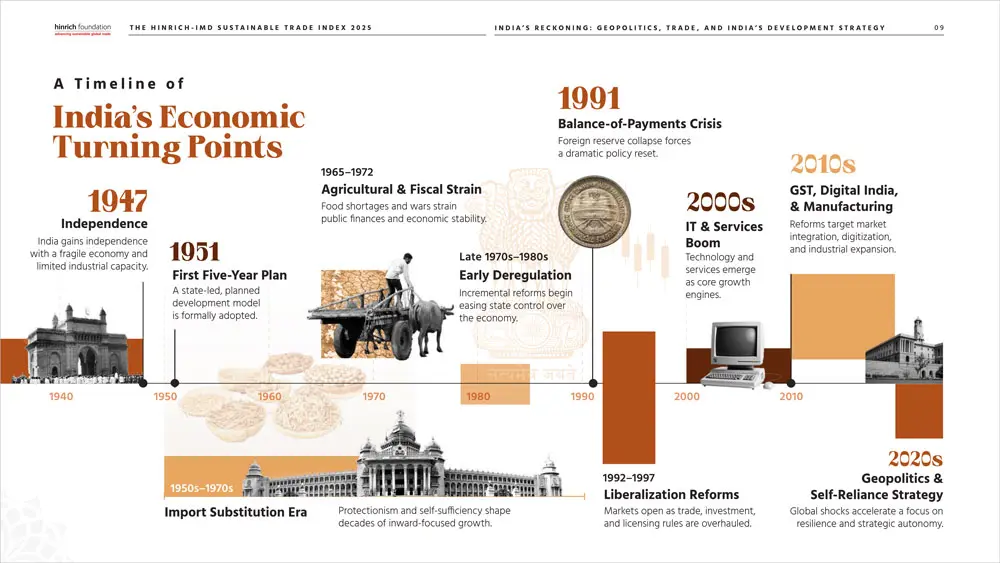
India's economic history since independence divides most usefully into three periods rather than two. The first, from 1947 to 1991, was defined by a state-led, import-substitution model, the license-permit raj, that produced modest average growth, often described as the Hindu rate of growth, of roughly three to four percent annually. The second, from 1991 to 2014, began with a genuine structural rupture: the 1991 balance-of-payments crisis forced the Rao government to liberalize trade, dismantle industrial licensing, and open India to foreign investment, a shift continued with varying intensity by every government of both major coalitions through 2014, including the Vajpayee-led NDA government's own privatization and highway-building push in the early 2000s. The third period, from 2014 onward under Modi, has emphasized digital infrastructure, direct benefit transfers, large-scale physical infrastructure, and a manufacturing-and-exports push under Make in India and later Atmanirbhar Bharat, alongside a demonstrably more assertive and higher-tempo foreign policy posture than most of the preceding decades.
Historical Context
It is analytically important to separate three distinct questions that Indian political discourse often collapses into one: which government initiated a given reform, which government sustained or accelerated it, and which government presided over the resulting growth. The Goods and Services Tax, for instance, was first proposed under the Vajpayee government in the early 2000s, developed further under the Congress-led UPA government, and finally implemented under Modi in 2017, making it a genuinely cross-party, decades-long project rather than the achievement of any single administration. Similarly, India's defence indigenization push traces back to the 1980s Integrated Guided Missile Development Programme and continued through UPA-era platforms like the Arjun tank and Tejas fighter development, before accelerating under the post-2014 Atmanirbhar Bharat defence procurement reforms. Recognizing this continuity does not erase genuine differences in emphasis, pace, and execution between periods, but it does mean that attributing outcomes entirely to whichever government happened to be in office during a given data release is analytically weak, a point emphasized by economists across the political spectrum.
Current Situation Assessment
On raw growth-rate comparison, the data shows both continuity and a modest structural shift rather than a dramatic break. Average annual GDP growth during the UPA decade, roughly 2004 to 2014, is generally estimated in the range of seven to eight percent, buoyed significantly by a favorable global credit and commodity cycle before the 2008 financial crisis and a subsequent recovery. Average annual growth during the Modi decade, 2014 to 2024, has generally run somewhat lower on a like-for-like basis, in the range of six to seven percent, though this period absorbed two major exogenous shocks the earlier decade did not face at comparable scale: the 2016 demonetization and 2017 GST transition disruption, and the 2020-2021 COVID-19 pandemic, which produced a historic 5.8 percent contraction in one quarter before a sharp rebound. As of the 2026 fiscal year, India's GDP grew an estimated 7.6 percent, the fastest pace since the post-pandemic FY2022 rebound, and India has maintained its position as the fastest-growing major economy in the G20 through 2025 and into 2026, doing so despite steep US tariff actions during 2025 and reduced discounted Russian oil flows.
India's nominal GDP has grown substantially in absolute terms across both periods: from roughly one trillion dollars in 2007 to about two trillion dollars by 2014, and from there to over four trillion dollars by 2025, making India the world's fifth-largest economy and, per IMF data, on a trajectory that some projections place ahead of Japan in the coming years. Independent analysts note, however, that per capita income gains, while real, have not resolved India's persistent inequality and informal-sector employment challenges, a critique leveled at economic policy across both eras by economists including those who otherwise credit different administrations for different achievements. On infrastructure, the post-2014 period has seen a marked acceleration in national highway construction, rural electrification completion, digital payments infrastructure through UPI, and direct benefit transfer systems built on the Aadhaar biometric identity platform, itself a UPA-era initiative substantially scaled up after 2014.
Power Center Analysis
Assessing India's growth requires distinguishing the roles of several institutional actors whose influence spans both periods. The Reserve Bank of India has maintained substantial monetary-policy independence across governments, with its inflation-targeting framework, adopted in 2016, representing a genuine post-2014 institutional shift built on groundwork laid earlier. State governments, which control land, labor, and much of the regulatory environment businesses actually navigate, have produced widely varying growth and investment outcomes independent of which party governs at the Centre, with states like Gujarat, Tamil Nadu, and Karnataka consistently outperforming national averages under multiple different state and central government combinations, a pattern that complicates any simple national before-and-after framing. The Election Commission and India's federal structure have ensured that economic policy, while centrally coordinated, has always depended significantly on state-level implementation capacity that varies independent of national political change.
Military and Security Implications
India's defence posture has shown real continuity in strategic orientation, sustained wariness of both China and Pakistan, growing defence ties with the United States and other Quad partners, and continued reliance on Russian-origin legacy platforms, alongside a genuine acceleration in indigenization rhetoric and, more unevenly, indigenization delivery since 2014. The Atmanirbhar Bharat defence procurement reforms have pushed a larger share of India's defence budget toward domestic sourcing, and platforms like the indigenously built aircraft carrier INS Vikrant and the Tejas fighter program, both of which trace development origins to earlier decades, have reached operational milestones during the post-2014 period. Independent defence analysts remain divided on execution: some credit the post-2014 period with meaningfully accelerating indigenization and streamlining procurement bureaucracy, while others point to continued delays in major programs, including fighter jet squadron shortfalls relative to Air Force requirements, as evidence that structural defence-acquisition challenges have proven resistant to reform regardless of which government has attempted it. The 2020 Galwan Valley clash with China and the ongoing Line of Actual Control standoff represent a genuine post-2014 escalation in the China threat's military salience, though analysts differ on how much of that escalation reflects Indian policy choices versus independent Chinese assertiveness under Xi Jinping's leadership.
Economic and Trade Impact
India's trade and investment profile has evolved substantially across both periods, from a UPA-era emphasis on services-sector liberalization and IT-enabled export growth to a post-2014 emphasis on manufacturing localization under Make in India and, since 2020, Production-Linked Incentive schemes targeting electronics, pharmaceuticals, and other strategic sectors. Foreign direct investment inflows have grown substantially in absolute terms since 2014, though as a share of GDP the trend is less dramatically different from the UPA-era trajectory than headline figures sometimes suggest, according to independent economic analysis. The 2016 demonetization and 2017 GST rollout, both post-2014 policy choices, produced short-term disruption that most economists across the political spectrum now treat as a genuine, if debated in magnitude, drag on growth during those specific years, even among analysts who credit GST's longer-term structural benefits for tax formalization and interstate trade efficiency.
Diplomatic Positioning
India's foreign policy posture has shifted in tempo and public visibility more clearly than perhaps any other dimension of this comparison. The pre-2014 period, particularly under UPA, is generally characterized by analysts as cautious multi-alignment, deepening the US-India civil nuclear deal and strategic partnership while maintaining traditional non-aligned instincts and a lower international public profile for the Prime Minister personally. The post-2014 period has seen substantially higher-tempo, personality-driven diplomacy, deeper and more public Quad engagement, an expanded global summit hosting role including the 2023 G20 presidency, and a more assertive rhetorical posture on issues from terrorism to trade. Analysts differ sharply on how to weigh this shift: some view it as a genuine elevation of India's global standing and strategic autonomy, commensurate with its growing economic weight, while others argue the shift has been more rhetorical and personality-centered than structurally transformative, noting that India's core strategic dilemmas, balancing the US relationship against continued Russian defence and energy ties, and managing an increasingly assertive China, remain fundamentally the dilemmas of the pre-2014 period rather than resolved by it.
Regional Fallout
India's relative standing within South Asia has shifted meaningfully across this period, with India's economy now dwarfing every regional neighbor by a wider margin than in 2014, a gap driven as much by other countries' struggles, Pakistan's recurrent economic crises, Sri Lanka's 2022 default, as by India's own acceleration. India's Neighbourhood First policy, articulated with that specific branding after 2014, has produced mixed results, with continued competition against Chinese infrastructure financing across Sri Lanka, the Maldives, Nepal, and Bangladesh yielding no clean, decisive Indian advantage in any of those relationships, a continuity with the pre-2014 pattern of contested regional influence rather than a clear break from it.
Global Strategic Consequences
India's rising global economic weight, now the world's fifth-largest economy and projected by multiple institutions to become the third-largest within the coming years, carries implications for global institutional reform debates, including long-standing Indian aspirations for permanent UN Security Council representation, that predate 2014 but have gained additional plausibility as the economic gap between India and existing permanent members narrows. Whether that economic weight translates into commensurate institutional power remains genuinely unresolved and contested among international relations analysts, with skeptics noting that economic size alone has not historically guaranteed institutional influence absent broader coalition-building and military capability India is still developing.
Risk Matrix
High risk (widely acknowledged across analysts regardless of political perspective): persistent structural challenges including informal-sector employment, agricultural sector productivity lag, and regional development disparities, none of which either period has fully resolved.
Medium risk: continued vulnerability to external shocks, including US trade policy volatility and global energy price swings, given India's growing but still partial integration into global manufacturing supply chains; execution risk on major defence indigenization programs continuing to lag stated targets.
Contested risk (genuinely disputed among economists): whether current growth composition, weighted toward services and consumption rather than broad-based manufacturing employment, is sustainable at the pace required to meet stated long-term development targets, an assessment on which credible economists reach different conclusions depending on methodology and assumptions.
Scenario Analysis
Base Scenario (Medium-High probability): India continues growth in the six-to-eight percent range through the late 2020s under current policy continuity, regardless of which party governs, given the substantial cross-party consensus that has emerged around core liberalization, infrastructure investment, and digital public goods, with periodic disruption from external shocks and domestic policy transitions of the kind seen after 2016 and 2020.
Bull Scenario (Low-Medium probability): Sustained regulatory reform, successful execution of manufacturing localization and defence indigenization programs, and continued favorable demographic dividend utilization combine to push growth toward the higher end of official aspirations, meaningfully narrowing the gap with China's absolute economic and military weight over the following decade.
Bear Scenario (Low but non-trivial probability): Structural bottlenecks, regulatory complexity, informal-sector employment persistence, and external trade or security shocks combine to keep India in a large-but-not-transformed trajectory, in which absolute GDP continues rising while per capita and institutional development lag the pace implied by current official targets, an outcome independent economists across the spectrum flag as a genuine risk regardless of which government is in office when it might materialize.
Intelligence Forecast (6-24 Months)
Over the next six to twelve months, GST implementation refinements, the pace of Production-Linked Incentive scheme disbursement, and US-India trade negotiation outcomes are the clearest near-term indicators of whether current growth momentum, including the 7.6 percent FY2026 rate, is sustained. Over twelve to twenty-four months, the more consequential signal will be whether structural reforms addressing regulatory density and labor-market formalization, areas independent analysts across the political spectrum identify as unresolved regardless of which government has attempted them, show genuine movement, or whether growth continues to rely primarily on consumption and services rather than the broader manufacturing-led employment generation official targets assume. This forecast reflects scenario-based analytical judgment rather than confirmed future developments.
Final Strategic Takeaway
The honest analytical conclusion is that India's growth story since 1991 is one continuous, if unevenly paced, project, structurally enabled by the 1991 reforms, sustained through successive governments of differing political character, and shaped by distinct but overlapping policy emphases before and after 2014. Attempts to render this as a clean partisan verdict, whether crediting one government with a transformation it largely inherited or dismissing another's genuine policy contributions, do not survive contact with the data or with the range of credible independent economic and strategic analysis. What can be said with confidence is that India's absolute economic and diplomatic weight has grown substantially across both periods, that meaningful structural challenges remain unresolved regardless of which government has governed, and that the more useful analytical question is not which era was better, but which specific policy tools, regulatory reform, defence indigenization, infrastructure investment, trade diversification, have proven durable and worth continuing regardless of political change.
Global Chanakya Assessment
The dominant framing of this comparison in Indian public discourse, on both sides, tends toward attribution error: crediting or blaming a single government for outcomes substantially shaped by global economic cycles, multi-decade institutional reform processes, and state-level implementation capacity outside any single central government's control. A more useful contrarian framing is this: India's most consequential structural transformations, the 1991 liberalization, the digital public infrastructure buildout around Aadhaar and UPI, and the ongoing GST implementation, were each initiated under one political dispensation and substantially built out or completed under a different one, suggesting that India's genuine long-run strengths lie less in any single government's signature initiatives than in a rare degree of cross-party policy continuity on core economic architecture, a continuity Indian political discourse rarely acknowledges but that international investors and rating agencies quietly price into their long-term India assessments. The most underreported dynamic in this entire debate is state-level divergence: growth, investment, and governance outcomes vary more dramatically between Indian states than between pre- and post-2014 national averages, meaning that a genuinely rigorous account of "what changed" would need to disaggregate by state and sector far more than most political commentary, on any side, currently does. Key indicators to monitor for a clearer, less politically contested picture include state-level GDP and investment data disaggregated from national averages, independent National Sample Survey and Periodic Labour Force Survey data on informal employment trends across both periods, and long-run defence indigenization delivery timelines measured against original program targets set decades ago rather than against politically convenient shorter benchmarks.
Implications for India: The central domestic risk is continued political incentive to treat economic and strategic policy as zero-sum partisan credit-claiming rather than as the genuinely continuous, cross-party project the data suggests it has largely been; the opportunity is that recognizing this continuity could support more durable, less politically volatile long-term reform commitments. For Indian foreign policy, the case for continuity, rather than dramatic reversal, across future government transitions is strong, given how much of India's post-2014 diplomatic posture builds on pre-2014 foundations. For Indian defence planning, addressing indigenization execution gaps requires institutional reform that has proven resistant to change under multiple different governments, suggesting the binding constraint is bureaucratic and industrial-base capacity rather than primarily political will. For Indian businesses, the clearest actionable signal is that regulatory and infrastructure investment, not political cycle timing, has been the more reliable predictor of sector-specific opportunity across both periods.
Implications for the Global South: India's growth trajectory, regardless of which government's initiatives are credited, continues to offer a closely studied model for large developing democracies attempting economic transformation without the authoritarian state capacity China's growth model has relied upon, a comparison of direct relevance to observers across Africa, Southeast Asia, and Latin America evaluating their own development pathways.
Indicators to Monitor
- State-level GDP and investment growth data disaggregated from national averages
- Periodic Labour Force Survey and informal-sector employment trend data
- Production-Linked Incentive scheme disbursement and manufacturing output growth
- US-India trade negotiation outcomes and tariff developments
- Defence indigenization delivery milestones against original, multi-decade program targets
- GST collection trends and further rate or structural reform announcements
- Foreign direct investment inflows as a share of GDP, not just absolute terms
- India's ranking and trajectory in cross-country institutional and ease-of-doing-business assessments
FAQ
Was India's growth rate higher before or after 2014? Average annual GDP growth during the UPA decade, roughly 2004 to 2014, is generally estimated somewhat higher than the 2014 to 2024 average on a like-for-like basis, though the post-2014 period absorbed two major shocks, demonetization and GST transition disruption, and the COVID-19 pandemic, that the earlier decade did not face at comparable scale. As of FY2026, growth has accelerated to 7.6 percent, the fastest pace since the pandemic recovery.
Which government deserves credit for India's economic transformation? Economists generally describe India's transformation as a continuous, cross-party process: the 1991 reforms under Congress created the structural foundation, and successive governments of different political character, including the Vajpayee-led NDA and the Modi-led NDA, sustained, adapted, or accelerated different elements of that foundation. Attributing the full transformation to any single government does not hold up against the historical record.
How has India's defence posture changed? Indigenization efforts trace back decades but have received renewed emphasis since 2014 under Atmanirbhar Bharat; independent defence analysts are divided on execution, with genuine milestones reached alongside continued delays in major procurement programs that have proven resistant to reform under multiple governments.
Has India's global standing genuinely improved since 2014? India's absolute economic weight and diplomatic visibility have grown substantially, and the country hosted a high-profile G20 presidency in 2023, but analysts differ on whether this reflects structural transformation in India's institutional power or a more visible, personality-driven diplomatic style layered on continuities from the earlier period.
What is the most reliable way to assess this comparison? Independent analysts recommend disaggregating by state, sector, and specific policy area rather than relying on single national headline figures, since state-level variation in India often exceeds the variation between political eras at the national level.