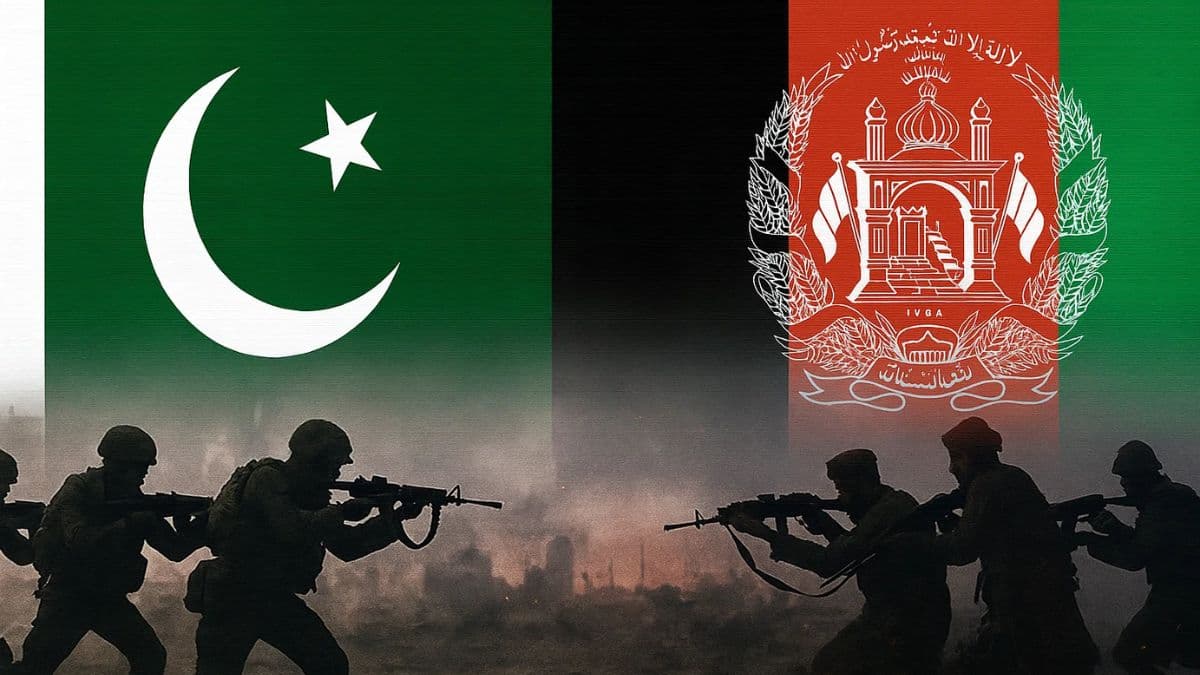
Pakistan-Afghanistan “Open War” Enters Third Week: Why Islamabad Is Now Naming India
The latest Pakistan-Afghanistan confrontation is no longer just a dispute over Tehrik-e-Taliban Pakistan (TTP) sanctuaries. By early October, the fighting had entered its third week, Pakistani airstrikes had hit multiple Afghan provinces, Afghan authorities were accusing Islamabad of supporting anti-Taliban fighters, and Pakistan’s military had expanded its public accusations to include India.
The immediate trigger was a deadly militant assault on September 18 at the Old Police Lines complex in Kohat, Khyber Pakhtunkhwa. The attack was claimed by Ittehad-ul-Mujahideen Pakistan (IMP), a militant alliance that includes the Hafiz Gul Bahadur faction and other groups with roots in the TTP. Pakistani officials said at least 31 people were killed and more than 100 wounded.
Two days later, Pakistan launched airstrikes against alleged militant hideouts in Afghanistan. Islamabad said the strikes killed 28 militants. The Taliban disputed that account and said civilians were killed. A second round of Pakistani strikes followed on September 24 after Islamabad said drones had crossed from Afghanistan into Pakistani airspace. A third round came on September 30 in Kunar and Helmand.
By October 5, the pattern was established: militant attacks inside Pakistan, Pakistani strikes inside Afghanistan, Taliban accusations against Islamabad, and a growing information war over who is supporting whom.
The Conflict Is Entering Its Third Week
The September 18 Kohat attack turned an existing security dispute into another sustained cycle of retaliation.
The assault was unusually damaging because it struck a police complex rather than an isolated checkpoint. According to reporting at the time, an explosives-laden vehicle was used in the attack, followed by armed militants entering the compound and fighting security personnel for many hours. IMP claimed responsibility.
Pakistan then carried the fight across the border. On September 20, Islamabad conducted airstrikes against alleged militant locations in Afghanistan. On September 24, after Pakistan said eight drones had entered its airspace from Afghanistan, its information minister said Pakistani forces carried out precision strikes against ten locations in Kandahar, Paktia and Khost that Islamabad described as connected to drone attacks and militant activity.
The Taliban rejected the allegation that it had launched the drones and warned that Pakistan’s strikes would receive a response.
The September 30 operation in Kunar and Helmand extended the pattern into another week. Pakistan said it had struck terrorist camps and hideouts and killed 22 militants. Taliban authorities disputed the target description and casualty figures.
UNAMA independently confirmed at least 10 civilian deaths from the October 1 reporting on those strikes, most of them children, along with nine injuries. The United Nations also said it had documented more than 1,100 civilian deaths and injuries in Afghanistan from cross-border armed violence during 2026.
The Numbers Are Part of the Conflict
Neither side is operating from a mutually accepted casualty picture.
Pakistan has repeatedly reported militant deaths from its cross-border operations. Afghanistan has disputed many of those figures and has emphasized civilian casualties from Pakistani airstrikes. The result is a familiar but important intelligence problem: the military claims on both sides cannot simply be treated as independently established facts.
The domestic security picture inside Pakistan adds another layer. The Center for Research and Security Studies recorded 385 violence-linked incidents in Pakistan during the third quarter of 2026, with 1,415 fatalities and 558 injuries across civilians, security personnel and militant groups. The organization described the period as a sharp deterioration, particularly in Balochistan.
That data matters because Islamabad does have a genuine internal security problem independent of its dispute with Kabul. Pakistan is confronting attacks linked to TTP factions in the northwest while also dealing with the Baloch insurgency farther southwest.
The political question is whether those separate conflicts are being increasingly presented as one externally supported campaign.
Why Pakistan Is Now Bringing India Into the Story
The most politically sensitive development came on October 1.
Pakistan’s military spokesman, Lt. Gen. Ahmad Sharif Chaudhry, alleged that Mullah Shireen, the Taliban governor of Kandahar, hosted a meeting on August 26 involving representatives of the Baloch Liberation Army, al-Qaida in the Indian Subcontinent and the Hafiz Gul Bahadur group.
Chaudhry further claimed that Indian government support helped arrange the meeting.
That allegation goes beyond Pakistan’s long-standing accusation that Taliban-controlled Afghanistan provides space for TTP militants. It attempts to connect several different militant networks inside one Pakistani national-security narrative and places India inside that alleged network.
There is an important limitation. The Pakistani military did not publicly provide evidence establishing the meeting or the alleged Indian role. An Associated Press report said the intelligence material it reviewed contained the allegation, but the Pakistani military spokesman did not publicly explain how authorities obtained the information. Security experts quoted by AP also questioned whether groups with very different ideological objectives would actually operate in the coordinated manner described.
Mullah Shireen rejected the allegation. The Taliban government has repeatedly denied allowing Afghan territory to be used for attacks against Pakistan.
That means the India component should be treated as an attributed Pakistani allegation, not as an established fact.
This Is More Than a New Accusation
Pakistan has blamed India for militant activity before. The newer development is the way the claim is being integrated into the Afghanistan conflict.
On September 27, Pakistan’s military had already described militant activity in Balochistan as Indian-sponsored. Prime Minister Shehbaz Sharif also told the United Nations General Assembly that the Taliban was providing sanctuary to TTP and Baloch militant groups.
The October 1 allegation therefore does not represent the first public mention of India in the broader confrontation. It represents a more specific narrative: Pakistan is presenting Afghanistan, TTP-linked organisations, Baloch separatists, al-Qaida-linked actors and India as parts of a connected pressure network.
That distinction matters because the political utility of the allegation is broader than the question of whether one meeting actually occurred.
Why This Narrative Is Useful for Islamabad
Pakistan faces a difficult domestic security problem. TTP attacks occur inside Pakistan. Baloch separatist violence occurs in Balochistan. Security forces are conducting counterterrorism operations across several provinces. Islamabad also has to explain why the militant threat remains persistent despite years of military operations.
Connecting those problems to an external network provides a different explanation. Instead of presenting the crisis primarily as a failure to contain domestic militant organisations, the government can frame it as a coordinated external challenge supported by Afghanistan and India.
That does three political things at once.
First, it gives Pakistan a stronger justification for cross-border military action. Striking alleged militant infrastructure in Afghanistan can be presented as self-defence rather than as an open-ended intervention.
Second, it helps unify otherwise separate security threats inside Pakistan. TTP-linked militants and Baloch separatists have different objectives, histories and ideological foundations. Describing them as participants in a common externally supported network simplifies that complexity for the domestic audience.
Third, it puts India into the diplomatic conversation surrounding the conflict. Once India becomes part of Islamabad’s explanation, Pakistan can seek greater regional attention to what it describes as a wider cross-border security problem.
None of this establishes that the allegation is true. It explains why making the allegation can serve a political and diplomatic purpose even before independent evidence is produced.
Afghanistan Is Building Its Own Counter-Narrative
Kabul is responding with an accusation of its own.
On October 2, Taliban officials in Nuristan accused Pakistan of sending hundreds of fighters associated with the Afghanistan Freedom Front into Afghanistan. Pakistan denied the allegation.
The exchange is revealing because both sides are now portraying the other as using non-state armed groups to destabilize the opposing government.
Pakistan says militants operating from Afghan territory are driving terrorist violence inside Pakistan. The Taliban says Islamabad is using anti-Taliban fighters and airstrikes to destabilize Afghanistan.
That creates a dangerous feedback loop. Each government can cite the other side’s allegations as evidence that additional military measures are necessary.
The “Open War” Label Needs Context
Pakistan’s defence minister described the relationship with Afghanistan as an “open war” during a much earlier escalation in February 2026. The label therefore predates the current September-October confrontation.
What is new is the recurrence. After a period of relative calm, violence returned on September 18 and developed into sustained cross-border military activity.
The current round is also different from a single border clash. It contains several layers operating simultaneously: militant attacks inside Pakistan, Pakistani air operations inside Afghanistan, clashes along the border, competing claims about covert support and a diplomatic environment in which previous negotiations have failed to produce a durable security arrangement.
That makes the risk of repetition higher than the risk from one isolated exchange.
Diplomacy Has Not Disappeared, But It Is Not Solving the Security Dispute
The previous Pakistan-Afghanistan negotiations in Istanbul broke down in November 2025 after the two sides failed to resolve disagreements over cross-border militancy and responsibility for Pakistan’s internal security.
There is no comparable bilateral negotiating process currently resolving the September-October confrontation. But diplomatic engagement has not disappeared entirely.
At the October 5 Moscow Format consultations on Afghanistan, Taliban Foreign Minister Amir Khan Muttaqi said problems between Afghanistan and Pakistan could be addressed through diplomacy and dialogue. Pakistan and Afghanistan were both represented at the meeting, alongside India, China, Iran, Russia and Central Asian states.
India used the same forum to reaffirm its support for Afghanistan’s sovereignty, unity and territorial integrity.
The contrast is telling. Military channels are generating accusations and retaliation, while regional diplomatic forums are trying to keep the dispute from becoming permanent.
What This Means for India
India is not a combatant in the Pakistan-Afghanistan confrontation described here. Its exposure is political and diplomatic.
The first risk is narrative escalation. Islamabad’s decision to place India inside the explanation for militant coordination creates a fresh opportunity for Pakistan to push an international claim that India is involved in attacks originating from Afghanistan.
Because the allegation concerns several militant organisations at once, New Delhi’s response has to distinguish between the existence of militant activity and the specific claim of Indian state involvement.
The second risk is diplomatic spillover. India and Afghanistan have developed working channels despite the Taliban government’s unresolved international status. India has continued humanitarian and political engagement with Kabul, while Pakistan views the Taliban government through the lens of cross-border militancy. A deeper Pakistan-Afghanistan rupture could therefore complicate India’s efforts to maintain access and influence in Afghanistan without becoming directly involved in the conflict.
The third risk is information warfare. Claims involving India, TTP, BLA and al-Qaida can spread far faster than evidence can be independently checked. India’s strongest position is therefore likely to depend on keeping the distinction between allegation and verified evidence clear.
What Pakistan Gains and What It Risks
Islamabad gains a simpler explanation for a messy security environment by describing the violence as part of a wider externally supported campaign.
The cost is that every escalation creates a new evidentiary burden. If Pakistan continues to make detailed claims about meetings, intelligence cooperation and foreign sponsorship, those claims will increasingly be judged against independently verifiable evidence.
There is also a military constraint. Airstrikes can disrupt specific targets, but they do not automatically remove the networks that generate militant attacks. The September 18 assault was followed by repeated Pakistani operations, yet attacks inside Pakistan continued.
That suggests the current method can impose costs on militants and Taliban-controlled territory without necessarily solving the underlying security problem.
Scenario Analysis
Base Scenario
Pakistan continues targeted military operations against alleged militant infrastructure in Afghanistan while maintaining pressure on Kabul through diplomatic channels. The Taliban continues to deny responsibility for TTP attacks and rejects Pakistani allegations of Afghan support for anti-Pakistan militants.
Alternative Scenario
The two sides move toward mediated talks after further border clashes or humanitarian pressure. The most likely area of disagreement would remain the same: whether Kabul can or will prevent armed groups from operating against Pakistan from Afghan territory.
High-Risk Scenario
Pakistan widens the geographic scope or frequency of strikes while Afghan forces or allied armed groups conduct increasingly direct attacks against Pakistani positions. If India becomes a repeated subject of official Pakistani allegations during that process, a bilateral India-Pakistan information confrontation could develop alongside the Afghanistan conflict even without India entering the fighting.
Global Chanakya Assessment
The evidence supports describing the September-October episode as a serious renewal of the Pakistan-Afghanistan conflict that has moved beyond sporadic border violence into repeated cross-border strikes and competing accusations of covert support.
The most important development is not the mere appearance of India in Pakistani rhetoric. Islamabad had already accused India of supporting militant activity. The sharper change is the attempt to connect India to a specific alleged militant coordination meeting in Kandahar and to place that allegation inside Pakistan’s explanation for attacks involving TTP-linked and Baloch militant networks.
That claim remains unproven publicly and is explicitly denied by the Taliban side. It should therefore be treated as part of the information war surrounding the conflict rather than as established evidence of Indian involvement.
For India, the practical response is narrower than entering the dispute. New Delhi has an interest in preventing Pakistan-Afghanistan hostilities from turning into a wider regional confrontation, while also protecting its diplomatic position in Afghanistan.
The decisive question now is whether military pressure changes the behaviour of the militant networks Pakistan is targeting. If attacks inside Pakistan continue despite repeated strikes, Islamabad will face a difficult choice between expanding the military campaign and reopening a political channel with Kabul.
Indicators to Monitor
- Further Pakistani airstrikes in Kunar, Kandahar, Helmand, Paktia, Khost or other Afghan provinces.
- New TTP or IMP attacks inside Khyber Pakhtunkhwa and elsewhere in Pakistan.
- Additional Pakistani military statements alleging Indian involvement in militant operations.
- Independent evidence supporting or contradicting the alleged August 26 Kandahar meeting.
- Further Taliban accusations that Pakistan is supporting anti-Taliban armed groups inside Afghanistan.
- Border clashes involving Pakistani and Taliban forces.
- Any new Pakistan-Afghanistan mediation effort involving Russia, Qatar, Türkiye, China or other regional actors.
- Changes in India’s public diplomatic position toward Afghanistan and Pakistan.
- UNAMA updates on civilian casualties from cross-border violence.