
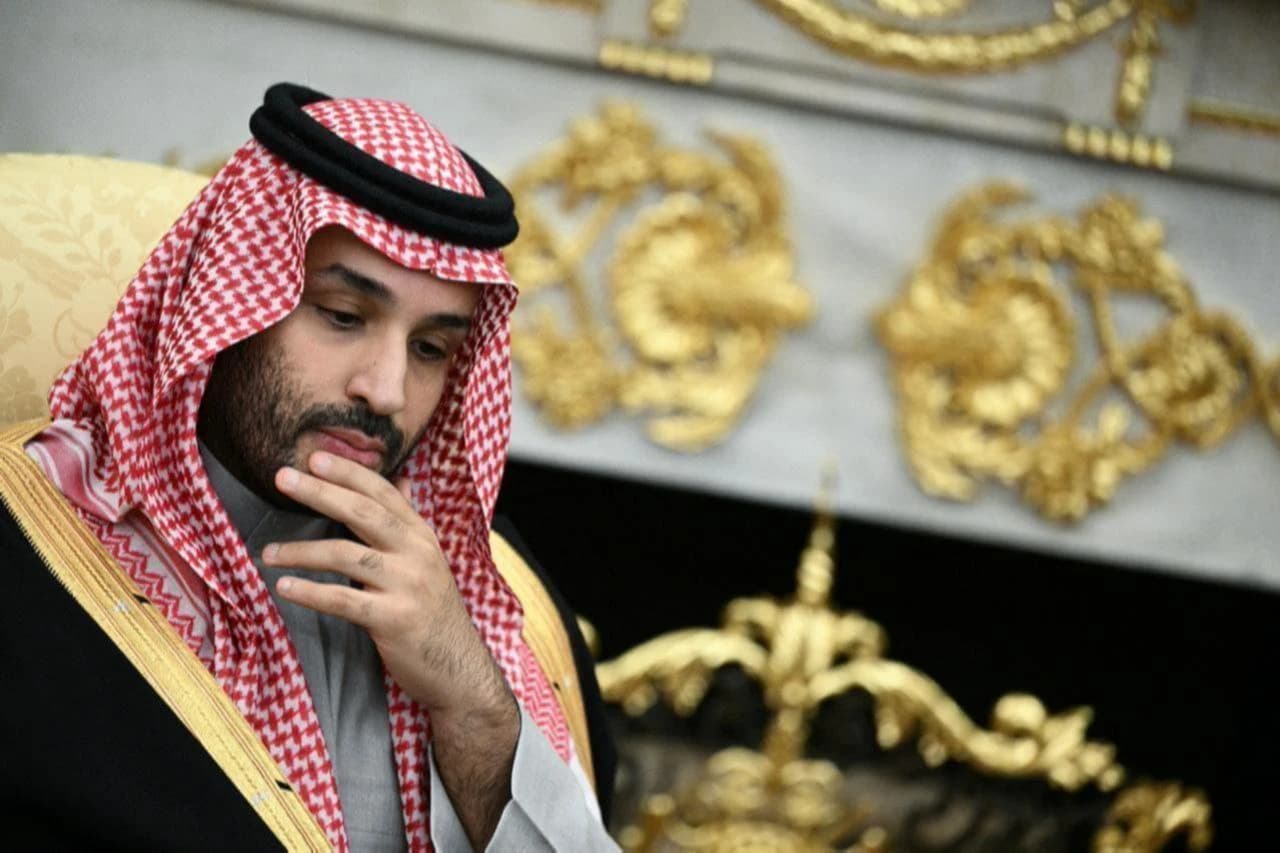
MBS's Vision 2030 Geopolitics: The Reckoning Phase
Ten years ago, Mohammed bin Salman stood before cameras and unveiled a document that promised to remake Saudi Arabia from the ground up: a kingdom that would live without oil, a 105-mile glass city rising from the desert, a $500 billion industrial zone on the Red Sea, an economy and a society transformed in a single generation by sheer force of state will and sovereign wealth. In 2026, Vision 2030 enters what its own architects call its "third and final phase," the period meant to be the culmination of everything the previous decade built toward. Instead, it arrives as a project quietly being rewritten in real time - NEOM omitted entirely from the kingdom's 2026 pre-budget statement, the Line scaled back from 105 miles to a 1.5-mile trial run, a flagship luxury island hotel gone dark after its launch party, and a finance minister now telling the world, without apology, that Riyadh will defer or cancel megaprojects "without blinking" the moment they stop making economic sense.
This is not collapse. Anyone looking for a Saudi reckoning narrative of failure will be disappointed by the actual data: non-oil revenue has more than doubled since 2016, unemployment hit its 2030 target five years early, and the Public Investment Fund's assets have grown toward the trillion-dollar mark. But it is, unmistakably, a recalibration - the moment when a decade of unconstrained ambition meets fiscal arithmetic, regional war, and the much harder, much slower work of building an economy that can genuinely function without oil. Understanding Vision 2030 in 2026 means understanding both halves of this story simultaneously: a genuinely transformed kingdom, and a crown prince now forced to choose, for the first time, which parts of his own vision he is actually willing to pay for.
Executive Summary
Saudi Arabia's Vision 2030, the sweeping economic and social transformation program launched by Crown Prince Mohammed bin Salman in 2016, has entered its third and final implementation phase running from 2026 to 2030, a period Saudi officials describe as the peak window for delivering on the program's most ambitious goals. The kingdom's own most recent annual progress report found that 85 percent of the program's 1,502 total initiatives are completed or on track, with non-oil revenues reaching $137.29 billion, a 113 percent increase over the 2016 baseline, unemployment dropping to 7 percent in late 2024, achieving its 2030 target five years early, and the private sector's contribution to GDP reaching 47 percent.
Despite this genuine progress, 2026 has brought the most significant recalibration in the program's history, driven by a convergence of fiscal pressure, regional security shocks, and the practical limits of construction-scale ambition. The kingdom's most ambitious megaprojects, conceived a decade ago during an era of oil-fueled confidence, are now colliding with fiscal reality and a far more volatile external environment shaped by regional conflict and energy market disruption, producing not the collapse of MBS's diversification agenda but a forced shift away from architectural spectacle toward economic pragmatism. NEOM's conspicuous omission from the kingdom's 2026 pre-budget statement, combined with a projected 2026 fiscal deficit of roughly $44 billion following significant 2025 shortfalls, has forced Saudi officials into a level of public candor about scaling back that would have been unthinkable in the program's earlier, more triumphalist years.
Compounding this fiscal pressure has been the direct economic disruption of the 2026 US-Israel-Iran war, which exposed the physical vulnerability of Saudi energy and transportation infrastructure to regional conflict spillover and forced a pause on ambitious AI investment plans pending greater geopolitical stability. This report examines Vision 2030's full trajectory through its first decade, the specific recalibration now underway across its flagship megaprojects, the broader geopolitical strategy MBS has built around the program - balancing American security dependence against deepening Chinese and Russian economic ties - and the realistic path facing the kingdom's transformation through its decisive final phase.
Background
Vision 2030 debuted as a single white paper in April 2016, conceived by Mohammed bin Salman and his advisors as Saudi Arabia's answer to an uncomfortable structural reality: a kingdom whose entire economic and social model depended on oil revenue that could not be relied upon indefinitely, governing a young, rapidly growing population that needed jobs the oil sector alone could never provide. The Saudi government structured the program around three core pillars - creating a "vibrant society," building a thriving economy, and establishing an ambitious nation - with each pillar encompassing specific goals and initiatives meant to reshape the kingdom's economy, society, and politics simultaneously.
In its initial phase, MBS and his advisors presented the project largely as a set of technocratic changes: improving fiscal health by cutting government subsidies, attracting foreign investment through clearer business regulations, and building new economic sectors such as logistics hubs, with the core policy proposal of this early phase centered on selling shares in state oil company Saudi Aramco as a means of raising investment capital - a measure that, however striking, did not directly challenge the religious establishment's traditional policy prerogatives. The program's scope expanded considerably beyond pure economic policy as MBS consolidated power, incorporating sweeping social liberalization - permitting women to drive, opening cinemas, curtailing the religious police's authority - alongside the economic diversification agenda, all explicitly aimed at decentering religion as the focal point of Saudi national identity in favor of a new state-led nationalism centered on the monarchy and MBS personally.
This social liberalization proceeded alongside, rather than instead of, sustained political repression. Saudi Arabia's social liberalization has been mirrored by stern repression of most forms of public criticism or activism within the kingdom, with waves of arrests beginning in early 2018 targeting prominent independent religious clerics, ostensibly to ward off criticism of new social policies but also to silence figures with prominent followings, while activists who had championed women's right to drive in the pre-MBS era were themselves subjected to arbitrary detention and torture despite their cause having since become official policy. This repression reached its most internationally consequential moment with the 2018 assassination of Saudi journalist Jamal Khashoggi by agents of the Saudi state, an act that demonstrated, in the assessment of regional analysts, the lengths to which MBS would go to stamp out critical views of Vision 2030's ends, means, or ambition.
Geopolitically, Vision 2030's economic ambitions became inseparable from a broader, more assertive Saudi foreign policy under MBS's leadership. In the last decade, Saudi Arabia has shown an increased appetite for risk entirely uncharacteristic of its historically conservative, predictable twentieth-century foreign policy, evidenced by its military intervention in Yemen and its blockade of Qatar, with the kingdom's October 2022 decision to cut OPEC+ oil production despite American objections - read by the Biden administration as both a betrayal and an effort to boost the Russian economy during the Ukraine war - ultimately demonstrating that Saudi Arabia was too economically and geopolitically vital to isolate, freeing MBS to pursue an even more independent foreign policy thereafter.
Current Situation
The Megaproject Recalibration
The most visible and consequential development shaping Vision 2030's 2026 trajectory is the systematic scaling back of the program's signature physical infrastructure projects. Announced in 2017, NEOM, the Red Sea Project, and Qiddiya were presented as the flagship giga-projects of Vision 2030 and as central pillars of Saudi Arabia's post-oil transformation, yet NEOM's omission from the 2026 pre-budget statement, alongside the drying up of new contracts by 2025, speaks considerably louder than official reassurances continue to suggest.
The scale of the original ambition, revealed through internal documentation, helps explain why this recalibration has proven so necessary. A leaked 2023 NEOM board presentation, reported by the Wall Street Journal in March 2025, projected total costs reaching $8.8 trillion by 2080, including $370 billion for Phase 1 alone by 2035 - figures that far exceeded the kingdom's actual fiscal capacity to deliver, helping explain why corrective action arrived only belatedly. The most emblematic individual project cut illustrates the broader pattern precisely. Vision 2030's more extravagant projects have faced years of steady cuts even before the disruptions caused by the 2026 Iran war: the 105-mile-long "Line" city has been scaled back to a 1.5-mile trial run, a luxury island hotel has gone dark following its high-profile launch party, and an Asian Winter Games commitment was ceded entirely to Kazakhstan amid concerns about slow progress toward the desert-mountain ski village it required.
Saudi officials have, notably, abandoned the triumphalist rhetoric that characterized the program's earlier years in favor of a considerably more candid public posture regarding these cuts. Economy Minister Faisal al-Ibrahim has acknowledged that projects may be "shifted, delayed, or rescoped" - a stark departure from Vision 2030's early rhetoric - while Finance Minister Mohammed al-Jadaan confirmed in late 2025 that the kingdom is willing to defer or cancel projects within the program "without blinking" if they no longer make economic sense or fail to deliver value. This recalibration has been institutionalized at the level of the Public Investment Fund's core strategic direction. The PIF's 2026 to 2030 strategy restructures its portfolio around "vision, strategy, and finance," emphasizing investment efficiency, domestic value creation, and competitive national ecosystems - in practice marking a deliberate move away from capital-intensive, long-horizon megaprojects toward assets capable of generating nearer-term returns and reinforcing economic resilience.
The Iran War's Direct Economic Impact
The 2026 US-Israel war with Iran, examined extensively elsewhere on this platform, has imposed direct and substantial new costs on Vision 2030's implementation specifically. After years of explosive growth fueled mainly by wealth transfers from other state entities, the Public Investment Fund's assets under management have seemingly plateaued since 2024, while spending by foreign tourists has also slowed, increasing by only around 4 percent in 2025 after years of double-digit post-pandemic growth, with most international visits remaining concentrated specifically in the holy cities of Mecca and Medina rather than the broader tourism diversification Vision 2030 envisioned.
The war's disruption has reached specifically into the kingdom's most forward-looking technology investment ambitions. Ambitious Saudi plans for domestic AI investments are at best on pause as the kingdom and its Gulf neighbors await a more stable geopolitical outcome than the fraught talks between the United States and Iran have so far produced, illustrating how the war's regional disruption has reached well beyond its immediate combat zone to constrain the kingdom's most strategically significant economic diversification bets. This regional security shock has accelerated the broader megaproject pivot already underway, exposing the physical vulnerability not only of the kingdom's energy and transportation infrastructure specifically, but also of the broader confidence underpinning Vision 2030's most capital-intensive commitments.
Persisting Achievements Amid the Recalibration
Despite this megaproject retrenchment, MBS has maintained that Vision 2030's underlying transformation continues delivering genuine results. Mohammed bin Salman said the kingdom's Vision 2030 has continued to deliver "qualitative achievements" despite global volatility, noting that the program will enter its third and final phase from 2026 to 2030, marking a peak period for implementing national programs and strategies as the tools of transformation reach their highest level of readiness, building on the solid foundations established during the program's first two phases.
The kingdom's own diplomatic and economic engagement with the broader Global South has continued expanding alongside this domestic recalibration. At a New Africa Summit in Riyadh in November 2024, the Saudi finance minister announced plans to raise $41 billion in investments and financing for sub-Saharan African nations, with Gulf development banks separately preparing an additional $50 billion in loans to the region by 2030 - part of a broader, more calculating Saudi approach to building influence in Africa distinct from the faster-moving efforts of Qatar and the UAE, relying instead on the kingdom's size and weight to build partnerships that reinforce reputational projects including hosting Expo 2030 and the 2034 World Cup.
The Multipolar Balancing Act
Vision 2030's economic transformation has proceeded in parallel with a deliberate Saudi recalibration of its great-power relationships, reflecting MBS's broader strategic judgment that the kingdom's economic diversification requires diplomatic diversification as well. Public opinion data captures this shift clearly: according to a 2020 Washington Institute poll, 49 percent of Saudis agreed at least somewhat that the kingdom could not rely on the United States and should look more toward Russia or China as partners, a figure that rose to 61 percent by 2022, the same year in which the Saudi public ranked China and Russia higher than the United States in terms of perceived importance for the first time since these polls began. In response to this broader chill in the relationship with Washington, Saudi Arabia has supplemented its long-standing dependence on the United States with closer bilateral ties to China specifically, which offers the kingdom substantial benefits across the energy, technology, economic, and defense sectors while also serving as the largest single consumer of Saudi oil.
This diversification, crucially, has not displaced the kingdom's continued, substantial commitment to its American relationship, particularly regarding security and major investment commitments. Even amid the broader megaproject retrenchment, the kingdom continues pursuing ambitious external commitments including its $600 billion investment pledge to the United States, even as it simultaneously faces an urgent need to attract inward capital to sustain MBS's broader diversification agenda domestically - illustrating the genuine balancing act between outward diplomatic commitment and inward fiscal necessity that now defines Saudi strategic positioning.
Strategic Analysis
The defining strategic insight regarding Vision 2030's 2026 trajectory is that the program's current recalibration represents disciplined course correction rather than fundamental failure, even as the gap between the project's original rhetoric and its current, more modest execution invites understandable skepticism. What is unfolding is not the collapse of MBS's diversification agenda, but a forced recalibration: a shift away from architectural spectacle toward economic pragmatism, reinforced by tightening fiscal space, institutional reprioritization under the PIF's new strategy, and growing exposure to regional security risks the kingdom's planners did not fully anticipate when NEOM's original cost projections were drawn up.
The deeper structural challenge Vision 2030 faces, distinct from any single megaproject's specific fate, concerns the program's ultimate test: building an economy genuinely capable of generating broad-based prosperity for ordinary Saudi citizens rather than concentrating gains among connected elites and foreign investors. Vision 2030 has made undeniable progress in building a Saudi economy that can "live without oil," but with five years remaining to the program's target date, it remains in genuine danger of enriching elites while overlooking the needs of most Saudi citizens - a tension that explains why employment generation, rather than any single infrastructure project, represents the central, recurring challenge nearly every serious independent analysis of the program identifies.
The political economy underlying MBS's recent willingness to publicly acknowledge megaproject scaling-back deserves attention as a genuinely significant shift in Saudi governance style. A crown prince whose consolidation of power has depended substantially on projecting an image of decisive, visionary, infallible leadership now finds himself in the considerably more uncomfortable position of publicly walking back specific commitments - the 105-mile Line, the Asian Winter Games, individual luxury developments - in ways that, however carefully managed, represent a genuine departure from the triumphalist narrative that has defined Vision 2030's public presentation since 2016. This shift suggests either growing confidence that the broader program's overall success insulates MBS from reputational damage tied to individual project failures, or a recognition that continued denial of fiscal reality would become more costly than candid recalibration.
The Iran war's direct impact on Vision 2030 illustrates a broader, underappreciated vulnerability in the program's entire conception: a development strategy premised on attracting sustained foreign investment, foreign tourism, and foreign technology partnership depends fundamentally on a stable regional security environment that Saudi Arabia, despite its considerable diplomatic weight, cannot fully control given its geographic proximity to Iran, Yemen, and the broader Gulf security architecture. Saudi Arabia's diplomatic efforts toward a permanent Yemen peace agreement, central to securing the kind of stable regional environment Vision 2030's economic ambitions require, have been repeatedly derailed by Houthi activities in the Red Sea linked to the broader Gaza war, jeopardizing Riyadh's immediate goals of ending that conflict and, by extension, achieving the broader economic objectives Vision 2030 depends upon.
MBS's multipolar balancing strategy - deepening Chinese and Russian economic ties while maintaining substantial American security dependence and major investment commitments - reflects a sophisticated reading of the emerging multipolar international order rather than a genuine strategic drift away from Washington. Saudi Arabia's pursuit of a greater multi-aligned multilateral role, engaging more directly over regional security challenges while balancing its preference for a US-focused security relationship against its more eastern-facing economic links, reflects the kingdom's broader strategic judgment that maximizing influence in a multipolar world requires diversified partnerships rather than continued exclusive reliance on any single great power. This positioning mirrors, in important respects, the multi-alignment doctrine India has pursued for decades, suggesting a broader pattern among ambitious middle powers navigating the current period of genuine great-power competition.
Global Impact
Vision 2030's trajectory carries significant implications for global capital markets and the broader sovereign wealth fund ecosystem, given the Public Investment Fund's scale and its demonstrated willingness to recalibrate its global investment posture in response to domestic fiscal pressure. The PIF's confirmed withdrawal of financial support from LIV Golf, the circuit it launched four years ago to challenge the PGA Tour, at the end of the 2026 season underscores this broader shift away from prestige-driven external ventures toward investments more closely aligned with domestic economic returns and strategic needs - a decision with direct implications for global professional golf's competitive landscape and broader questions about the durability of sovereign wealth-funded sports investment more generally.
For the broader Gulf region and OPEC+ dynamics, Saudi Arabia's continued position as the de facto leader of the oil cartel, combined with its demonstrated willingness to act independently of American preferences on production decisions, continues shaping global energy markets in ways extending well beyond Vision 2030's domestic diversification ambitions specifically. The kingdom's calibrated approach to global energy supply - balancing its own fiscal revenue needs against broader market stability considerations and its complex relationships with both Western and Eastern energy consumers - remains a structurally significant variable in global energy security independent of how the broader diversification program ultimately fares.
For China, Saudi Arabia's continued, deepening economic engagement reinforces Beijing's broader strategy of building substantive economic relationships across the Gulf region as a complement to its Belt and Road Initiative ambitions, even as the kingdom carefully avoids the kind of exclusive strategic alignment that would jeopardize its continued American security relationship and the substantial American investment commitments Vision 2030's third phase will require to sustain.
For the broader Middle East and the Global South more generally, Saudi Arabia's evolving approach - combining substantial development financing commitments to Africa, continued mediation efforts across regional conflicts, and hosting major international events like Expo 2030 and the 2034 World Cup - positions the kingdom as an increasingly significant alternative pole of influence and investment, distinct from both traditional Western development financing and China's more infrastructure-centric Belt and Road approach.
Risk Assessment
The most significant near-term risk to Vision 2030's continued implementation involves the durability of Saudi fiscal capacity amid continued regional instability and lower oil price projections. The kingdom projects a deficit of roughly $44 billion for 2026, following significant shortfalls in 2025, with rising debt and ongoing spending commitments further tightening the budgetary vise even as the kingdom continues pursuing major external commitments including its $600 billion investment pledge to the United States. Continued deterioration in this fiscal picture would force even more significant megaproject scaling-back than what has already occurred, with corresponding reputational costs for MBS's broader transformation narrative.
Projects may be shifted, delayed, or rescoped - a stark departure from the triumphalist rhetoric that marked Vision 2030's early years.
A second significant risk involves the unresolved tension between Vision 2030's stated employment and private-sector goals and the kingdom's continued reliance on state-driven job provision. The debate over Saudi labor and education policy reflects the flip side of Vision 2030's high-profile economic "bets": slow progress in winding down state provision of jobs, housing, and basic services such as education in favor of genuine private-sector alternatives - a structural challenge that recent hints of reduced domestic repression, including the release of numerous political prisoners over the past year, suggest even Vision 2030's own architects increasingly recognize requires more open internal debate than the program's earlier years permitted.
A third risk involves continued regional security volatility constraining the kingdom's most forward-looking technology and investment ambitions specifically. The pause on domestic AI investment plans pending greater geopolitical stability illustrates how directly regional conflict can constrain even Saudi Arabia's most diversified, technology-forward diversification bets, suggesting continued Middle Eastern instability - whether through renewed Iran-related tension, Yemen's unresolved conflict, or broader regional spillover - represents an ongoing structural constraint on Vision 2030's most ambitious remaining goals rather than a one-time disruption already fully absorbed.
A fourth risk concerns succession and governance continuity, given Vision 2030's deep personal identification with MBS specifically. Vision 2030's high modernist political ambitions seek enormous changes in Saudi habits, work patterns, moral conduct, and worldview to conform to a preexisting vision of what society should look like - an ambition so closely tied to MBS's personal authority and vision that any future succession or significant shift in his own political position would carry substantial implications for the program's continued trajectory and implementation priorities.
Future Scenarios
Scenario Analysis - the following projections are analytical simulations grounded in current trends, not confirmed intelligence or guaranteed outcomes.
Scenario One: Disciplined Pragmatic Continuation (Most Likely, roughly 50% probability)
Vision 2030's third phase proceeds through 2030 along its current recalibrated trajectory: continued megaproject scaling-back and deferral where fiscal logic demands it, sustained progress on the program's more achievable economic diversification metrics, and continued multipolar diplomatic balancing between Washington, Beijing, and Moscow. The kingdom reaches 2030 having genuinely transformed significant portions of its economy and society, even as flagship projects like NEOM fall well short of their original, more extravagant conception.
Scenario Two: Renewed Regional Security Shock Forces Deeper Retrenchment (Moderate Likelihood, roughly 25% probability)
Continued instability stemming from the Iran war's aftermath, renewed Houthi activity in the Red Sea, or a fresh regional flashpoint forces a more significant Saudi fiscal and strategic retrenchment than currently anticipated, requiring further substantial cuts to Vision 2030's remaining megaproject ambitions and potentially delaying the AI and technology investment plans currently paused pending greater regional stability.
Scenario Three: Oil Price Recovery Provides Renewed Fiscal Space (Lower-Moderate Likelihood, roughly 15% probability)
A combination of sustained Middle Eastern instability supporting elevated energy prices and disciplined OPEC+ production management provides Saudi Arabia renewed fiscal breathing room beyond current projections, allowing a partial reacceleration of select megaproject ambitions, though likely still falling short of the program's original, pre-recalibration scope and timeline.
Scenario Four: Genuine Private-Sector Employment Breakthrough (Lower Likelihood, roughly 10% probability)
Saudi Arabia achieves a genuine, structural breakthrough in transitioning citizen employment from state-dependent provision toward authentic private-sector job creation, addressing the central challenge multiple independent analyses have identified as the true measure of Vision 2030's ultimate success, representing the most favorable plausible outcome for the program's underlying social transformation goals specifically.
Intelligence Forecast
Watch the kingdom's 2026 and subsequent annual Vision 2030 progress reports closely for continued candor regarding megaproject scaling-back, given the genuinely significant shift in public communication style this candor represents relative to the program's earlier triumphalist years. Watch NEOM's status specifically across subsequent budget cycles; its continued omission or further explicit scaling-back would represent the clearest single indicator of how far the broader megaproject recalibration has proceeded.
Watch Saudi fiscal data closely, particularly the kingdom's actual versus projected deficit figures, oil price assumptions underlying budget planning, and any further tax or spending policy adjustments, as the clearest leading indicators of how much additional fiscal pressure the broader Vision 2030 program faces. Watch the pace of any resumption in Saudi AI and technology investment specifically, given its explicit linkage to broader regional geopolitical stability; renewed movement on this front would suggest genuine confidence in regional de-escalation following the Iran war's disruption.
Watch Saudi-China and Saudi-US relationship indicators in parallel, including any further movement on the kingdom's $600 billion US investment pledge alongside continued Chinese economic engagement, as indicators of how successfully MBS's multipolar balancing strategy continues functioning amid the broader fiscal and security pressures examined in this report. Watch domestic Saudi political indicators, including any further prisoner releases or shifts in the kingdom's tolerance for internal policy debate, as potential signals of how Vision 2030's own architects are recalibrating their approach to the program's most persistent structural challenge: genuine, broad-based citizen employment and prosperity.
Final Strategic Takeaway
Vision 2030 enters its decisive final phase as neither the triumphant, world-remaking project its earliest promotional materials promised nor the failed vanity scheme its harshest critics have long predicted, but something considerably more interesting and more instructive: a genuinely transformative national development program forced, for the first time in its decade-long history, to operate within the discipline of actual fiscal constraint rather than unlimited oil-fueled ambition. The kingdom that emerges from this recalibration by 2030 will look measurably different from the Saudi Arabia of 2016 - diversified non-oil revenue, a transformed labor market, a socially liberalized public sphere, and a substantially repositioned role in global energy, investment, and diplomatic architecture. It will also look considerably less like the gleaming, speculative renderings of a 105-mile glass city that first captured global imagination, and that gap between original promise and eventual delivery will likely define how history ultimately judges MBS's signature project.
The deeper geopolitical significance of Vision 2030's 2026 reckoning extends beyond Saudi Arabia's own borders: it offers a clear, real-time case study in the genuine limits facing even the most well-resourced sovereign development ambitions when they collide with regional security volatility and basic fiscal arithmetic, a lesson with direct relevance for other ambitious Gulf and Global South development programs currently being designed in capitals watching Riyadh's recalibration closely. Whether MBS converts this moment of disciplined course correction into the foundation for Vision 2030's genuine long-term success, or whether the gap between rhetoric and delivery continues widening as the 2030 deadline approaches, remains the single most consequential open question shaping not just Saudi Arabia's future, but the broader credibility of state-led megaproject development as a model for national transformation in the post-oil era.