Trump's "Almost Over" vs. Pezeshkian's "No Talks": The Iran War's Diplomatic Deadlock on Day 220
The Statement and What It Followed
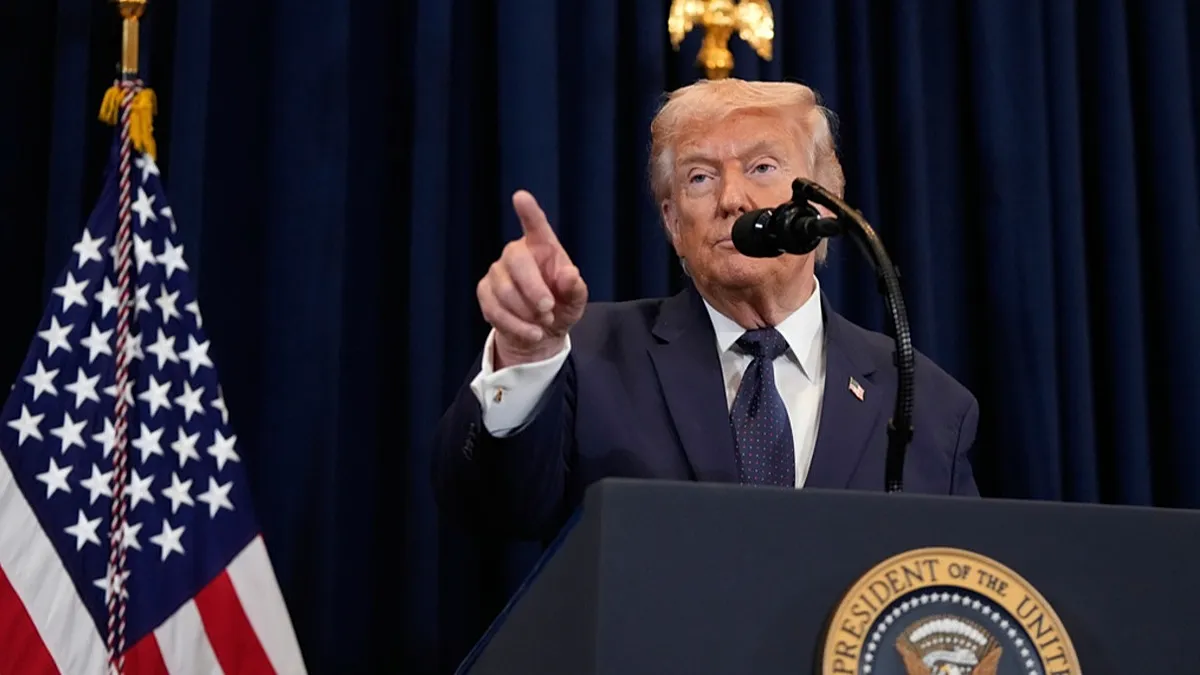
On October 5, 2026, speaking in Grand Island, Nebraska, President Donald Trump told an audience that the war with Iran was "essentially almost over." He called the higher gasoline prices Americans have been paying since February "a small price to pay" to prevent Tehran from obtaining a nuclear weapon. He also said, before departing the White House, that he could not confirm whether Iranian combat drones in Britain - connected to the investigation of the RAF Fairford plot - had prompted the withdrawal of US personnel from the base.
That same day, the United Kingdom Maritime Trade Operations reported that a third tanker had been struck near the Strait of Hormuz in two days. Western Hemisphere governments announced a coordinated pledge to take action against Iranian-linked terrorism. And Iranian President Masoud Pezeshkian, through various channels since his UN General Assembly address on September 23, had for the fourth time in eight days rejected direct US-Iran negotiations - telling audiences at home and at the UN that Iran had "not bent the knee" and would not enter talks conducted under threat.
NBC News reviewed Trump's public statements on the war's near-ending and counted 32 separate instances since March 9 in which Trump declared the war was won, nearly over, essentially finished, or would end "very soon." The first came ten days into Operation Epic Fury. The most recent came on Day 220. In that interval, the Strait of Hormuz has not reopened to normal commercial traffic, Iran's nuclear program remains unresolved, the Islamabad Memorandum collapsed, and the US has negotiated, signed, and renegotiated more ceasefire variations than it has enforced.
The gap between Trump's declared narrative and the war's operational reality is now wide enough to constitute its own strategic problem - independent of what either side intends.
What "Almost Over" Has Meant Before
The pattern is worth documenting precisely, because it matters for how the current statement should be read.
On March 9, ten days into the war, Trump called it a "short-term excursion" and said it would be over "very soon." The US had struck approximately 5,000 targets, Khamenei was dead, and Iran's new Supreme Leader Mojtaba Khamenei had just been confirmed amid continued airstrikes on Iran's nuclear facilities and infrastructure. The IRGC responded by saying Iran "will determine the end of the war."
On March 11, Trump told supporters in Kentucky the war was won "in the first hour." On April 1, after 32 days, he said Iran was "essentially really no longer a threat" and outlined a "next phase." On April 8, a ceasefire was announced. On April 21, Trump seized an Iranian oil tanker and said the ceasefire was nearly expired and the military was "raring to go." On June 17, the Islamabad Memorandum produced another ceasefire. On July 8, Iran struck commercial ships and the MoU collapsed. On August 4, Trump called Iran's leadership "unbelievably duplicitous" after denying that talks he had just announced were actually taking place. On September 27, he rejected Araghchi's seven-day proposal as unacceptable. On October 1, he offered the binary: "We blow them up or make a deal." And on October 5, Day 220, he was in Nebraska telling farmers the war was essentially almost over.
The NBC count of 32 such statements through July is now certainly higher. Each instance has been followed by resumed military activity, a collapsed diplomatic track, or both. The statements are not lies in a simple sense - Trump genuinely appears to believe the war's logic is approaching conclusion at each point - but they have been consistently falsified by events, which creates a credibility problem that Iran has been exploiting systematically.
Pezeshkian's Position and What It Actually Means
Pezeshkian's rejection of US talks requires careful unpacking, because it has been consistent but not monolithic, and the distinction matters for what happens next.
Iran's president has throughout the war maintained two simultaneous positions: that Iran will not negotiate under threat or coercion, and that Iran remains open to fair and equitable negotiations. These positions are not simply contradictory - they are sequencing demands. Pezeshkian has been saying, in various formulations, that talks are possible if the conditions are right, and that the current conditions - US naval blockade, military pressure, frozen assets - are not right. His September 23 UN speech was the starkest version of this: "We did not bend the knee," followed by an implicit offer of dialogue from strength rather than submission.
The WION report that Pezeshkian "rules out US talks" after Trump's October 5 Nebraska statement refers specifically to the format Trump has been describing - a direct meeting, at high level, while the blockade remains in place and while the US continues defining the terms of any nuclear arrangement. That specific format Iran has consistently rejected. What Iran has not rejected, and what the diplomatic record confirms it has been engaging in, are indirect talks through Qatar and Oman - both of which were still proceeding as of late September despite Rubio's expulsion of the Iranian delegation from the US.
The distinction is not academic. It explains why the war keeps producing both ceasefire frameworks and collapsed ceasefire frameworks. The US wants direct talks that produce Iranian acknowledgment of US terms; Iran wants indirect talks that produce American acknowledgment of Iranian conditions for re-engagement. Neither side has accepted the other's framing. Every "almost over" from Trump and every "no talks" from Pezeshkian are both, in part, performances aimed at the other side's domestic audience and the other side's negotiating resolve.
Iran's Internal Fractures and Why They Constrain Any Deal
The specific context of the October 5-6 diplomatic standoff is shaped by a development inside Iran that received less coverage than it deserved. When Iran's parliament - the Majlis, dominated by hardliners led by Speaker Mohammad Bagher Ghalibaf - dropped two members from the National Security Committee who had publicly criticized the indirect talks with the US, it revealed the internal pressure the Pezeshkian government has been operating under. The two removed members, Alireza Salimi and Ezzatollah Zarghami, had accused the foreign ministry of "capitulating" by engaging with American representatives in New York. Their removal from the committee was interpreted by Iranian analysts as a signal that the hardliner faction was disciplining critics of the talks - but in the process made clear that the Pezeshkian government's ability to move toward any deal is constrained at multiple internal levels simultaneously.
Ghalibaf himself has been issuing periodic warnings since late July. His public posture - that Iran will respond to any violation of ceasefire terms with force, and that he views any nuclear concessions as unacceptable - functions as a domestic red line that Pezeshkian cannot visibly cross. The Iranian president who traveled to New York during a war with the United States, already criticized at home as "humiliating," cannot return from that visit having agreed to direct talks that his hardline base characterizes as submission.
This is the deeper structural problem that Trump's "almost over" framing consistently fails to account for. Even if Pezeshkian personally wanted to conclude a deal - and his long-stated preference for reviving something like the 2015 nuclear accord suggests some genuine interest in that direction - he does not have the domestic political authority to sign one that meets US sequencing requirements. The deal Iran can sign is not the deal the US is offering. The deal the US is offering is not one Iran's internal power structure will ratify.
The Tanker War and What It Signals
Three tankers struck near the Strait of Hormuz in two days is not background noise. It is Iran's most consistent coercive instrument - a continuous demonstration that the Strait remains contested, that the US naval presence has not produced the freedom of navigation Washington claims, and that the energy price shock will not resolve until Iran decides it should. Trump's claim to have "total control" of the Strait is contradicted by every UKMTO incident report that follows it.
Iran's Strait strategy is built around a calculation: the sustained economic cost of Hormuz disruption on US allies, global energy markets, and American domestic fuel prices creates cumulative pressure that eventually makes any deal - even one Iran would accept - more attractive to Washington than continued operations. The strategy does not require Iran to win militarily. It requires Iran to impose costs at a rate that exceeds the American political system's tolerance. With 29 percent public support for the war, fuel prices that Trump calls "a small price to pay" in Nebraska but that farm-state Republicans call an electoral emergency, and a midterm election 28 days away, Iran's cost-imposition strategy is running on the most favorable trajectory it has had since April.
The Western Hemisphere pledge against Iranian-linked terrorism - announced October 5, following the RAF Fairford arrests and a month of escalating covert operations in Europe - represents an attempt to build a coalition architecture around the covert dimension of the war that the kinetic campaign alone cannot contain. But coalition pledges against terrorist financing and proxy networks are slow-moving instruments. They do not change the Strait's operational reality within a timeframe that matters for November 3.
The "Small Price to Pay" Framing and Its Political Vulnerability
Trump's Nebraska framing - high gas prices are "a small price to pay" - is a significant political calculation dressed as a moral argument, and it is worth examining what it reveals about where the administration thinks its vulnerability lies.
Before the war, Trump told the Nebraska crowd, he passed a gas station at $1.85 per gallon. The implication is clear: the war's energy cost exists and is acknowledged. Calling it "a small price to pay" is the administration's answer to the economic critique - not that it doesn't exist, but that it is worth it for the strategic goal of preventing Iranian nuclear weapons. That argument works if Americans believe the strategic goal is being achieved. It works less well if Americans believe the war is entering its eighth month without having achieved anything that a seventh-month war at the same cost had not already achieved.
The NBC review of 32 "almost over" statements is relevant here not as partisan criticism but as an information management problem. If the war has been "almost over" since March 9 and it is still "essentially almost over" on October 5, the "small price to pay" framing loses its implicit temporal reassurance. "Small price" carries the unspoken premise that it will be over soon. If "soon" has been redefined 32 times in 220 days, the argument starts to read as "indefinite price," which is politically and economically different.
What the Diplomatic Track Actually Looks Like
Behind the public posturing, the evidence suggests a diplomatic structure that is neither dead nor productive. Qatar's mediation channel remains active. Oman is handling discussions specifically about Strait management - Iran's foreign ministry spokesperson confirmed this in late September, distinguishing Oman talks from any US-Iran political negotiation. Pakistan's involvement, which produced the June Islamabad Memorandum, remains a potential vehicle for future frameworks.
The indirect UNGA-week contacts that Trump called "a very good meeting" and Iran's foreign ministry characterized as "not anything new" are a perfect encapsulation of the entire diplomatic record: both descriptions are true from their respective vantage points. Something happened. It produced no agreement. Both sides claimed it supports their preferred narrative about the other side's intentions.
Secretary of State Rubio's statement on October 5 that Trump remains open to a deal that would make Iran "great and prosperous" - language that echoes Trump's pattern of grand offers to adversaries before or after threatening them - appears calibrated for the Iranian audience as much as the American one. The offer of prosperity gives Pezeshkian something to bring to internal audiences as a potential outcome that is not humiliation. Whether it is sufficient to move the domestic Iranian political calculus enough to enable serious talks remains unestablished.
India in the Strategic Picture
India's exposure to this standoff remains structural and deepening. The Strait remains partially closed; Indian refiners continue operating on Russian crude alternatives; US legislation targeting buyers of Russian oil - including India - creates a medium-term penalty regime for the very diversification strategy India adopted in response to the Gulf energy disruption the US created.
India's parallel diplomatic track on Ukraine - with Kyiv calling India's peace proposal the "most comprehensive" of the four on the table - gives New Delhi a moment of diplomatic visibility that contrasts with its constrained position on Iran. India cannot mediate the Iran war in the way it has been invited to facilitate Ukraine peace: its relationship with Iran, including the Chabahar port access and its Iranian energy purchase history, makes it a potentially useful back-channel but not a neutral broker. And the Russia sanctions legislation that targets Indian energy purchasing prevents Washington from calling on India's good offices while simultaneously penalizing India's economic behavior.
The practical implication is that India's energy and trade exposure to the Iran war will continue through the November 3 midterm period and likely beyond it, regardless of what Trump says in Nebraska about the war being almost over.
Scenario Analysis
Base Scenario - High Probability: The war continues through November 3 in its current pattern: sporadic strikes on Iranian Strait-related targets, continued Iranian harassment of commercial shipping, periodic covert operations in Europe, and diplomatic exchanges through Qatar and Oman that produce no binding agreement. Trump's Nebraska "almost over" statement is followed within two to three weeks by either a resumed strike announcement or another ceasefire proposal. Iran's Pezeshkian continues the dual posture of rejecting direct talks while not closing indirect channels. The Strait remains functionally impaired. After November 3, the diplomatic track either accelerates - if Republicans retain Congress and Trump feels politically secure enough to accept Iranian face-saving language - or stalls further, if a bad midterm result triggers an escalatory response.
Key assumptions: No American service member fatalities from Iranian action before November 3; no successful strike on major Gulf energy infrastructure; the RAF Fairford investigation does not produce a British government decision to revoke the bombing authorization; munitions constraints continue to discourage large-scale resumed bombing.
Alternative Scenario - Medium-Low Probability: Iran's pragmatist faction - with Pezeshkian's backing and reading the November 3 midterm calendar more clearly than Washington assumes - makes a concession on the Strait before the election. Not a full reopening, but a material increase in commercial vessel transits through Iranian-authorized channels, accompanied by a public statement framing it as an Iranian decision rather than American coercion. Trump accepts this as a victory. Gas prices fall. Republicans perform better than expected in midterms. A more comprehensive deal is structured in December with the G20 as backdrop. The nuclear constraint question is deferred to a formal dialogue framework that begins in January 2027.
Key assumptions: Iran's internal power balance shifts enough before November 3 for Pezeshkian to authorize a unilateral Strait gesture; Ghalibaf does not publicly sabotage the move; Trump accepts the framing without demanding formal Iranian acknowledgment of submission.
High-Risk Scenario - Low Probability: The RAF Fairford investigation produces a formal British government confirmation of Iranian state direction. NATO's Article 4 consultation mechanism is triggered. Simultaneously, an Iranian proxy strike kills American service members in the Gulf. Trump, facing a bad midterm, escalates dramatically before November 3 - contrary to the electoral calendar calculation - targeting Iranian civilian energy infrastructure. Iran retaliates against Gulf energy targets. Saudi Arabia's Abqaiq complex is struck. Global oil markets enter a supply shock regime materially worse than anything seen since February. The midterms become a wartime election rather than an anti-war protest vote, scrambling the domestic political calculations of both parties simultaneously.
Key assumptions: The Fairford plot connection is formally confirmed and NATO members treat it as a threshold event; Iranian proxies make a serious tactical error against American forces; Trump's midterm political calculus reverses under domestic pressure from the hawk faction of his coalition.
Intelligence Forecast
The 28 days between today and November 3 are the most consequential period the war has produced since the Islamabad Memorandum collapsed in July. Every significant actor's behavior in that window is shaped by the electoral calendar, which means the period immediately following November 3 is when the structural constraints that have prevented resolution will either relax or harden.
If Republicans retain Congress by comfortable margins, Trump's post-election posture is assessed as moving toward a deal rather than escalation - consistent with his stated expectation that Iran is waiting out the election and consistent with the administration's own analysis that resumed bombing faces munitions constraints and CIA assessments of diminishing returns. The most likely deal architecture in that scenario involves a partial Strait reopening, deferred nuclear constraint negotiations, and phased sanctions relief - essentially a version of the Araghchi proposal that the US has been rejecting but that contains enough face-saving language for both sides.
If Republicans suffer significant losses, the dynamic is harder to predict. The escalation pathway - which Trump has kept available through continued "blow them up" language - becomes more tempting as a political positioning tool, even if the military case for it is unchanged. A weakened Trump facing a hostile Congress may conclude that demonstrating resolve is more valuable than concluding a deal that would primarily benefit Pezeshkian's domestic standing.
Iran's forecast is simpler. Tehran will not make a concession that visibly rewards Republican electoral performance. It will not enter direct talks before November 3. It will continue Strait harassment at a level sufficient to maintain energy price pressure without triggering the specific escalatory thresholds that would force a pre-election American military response. This is a calibrated strategy, and the evidence from the past seven months suggests Iran has executed it with more consistency than either its public statements or Washington's "almost over" framing would suggest.
Global Chanakya Assessment
The most important analytical mistake being made about this war is treating Trump's "almost over" statements and Iran's "no talks" statements as equally uninformative noise. They are not equally uninformative. Iran's position has been structurally consistent: indirect talks, yes; direct talks under coercion, no; Strait reopening in exchange for sanctions relief and blockade lifting, yes; nuclear constraint as precondition, no. That position has not changed materially since March. Trump's position has changed 32 documented times. The asymmetry is analytically important.
What it suggests is that Iran is operating a coherent strategy and the US is not. The US oscillates between "we've won," "we're almost there," "they want a deal," "they're duplicitous," and "blow them up or make a deal" - each statement accurate to the moment of its utterance but collectively producing a policy signal that Iran reads as irresolute. An adversary who receives contradictory signals from a superpower has every reason to wait those signals out rather than respond to any particular one. That is what Iran is doing.
The overlooked variable that could change this assessment is the Iranian economy. Pezeshkian himself has repeatedly "laid bare economic strain" in his domestic communications - describing the toll the war and blockade have taken on Iranian purchasing power, the rial's collapse to record lows, and the pressure on ordinary Iranians. If that economic pain crosses a threshold where internal political stability is threatened - where the population's grievances exceed the regime's capacity to manage them - the "wait until after the midterms" strategy becomes untenable regardless of what Ghalibaf says. The indicator to watch for this is not Pezeshkian's public statements but the rial's exchange rate and the price of basic goods in Tehran's markets. Those are the signals that precede political crises in Iran's recent history, and they are publicly observable even when diplomatic channels are not.
Indicators to Monitor
- Daily UKMTO vessel incident reports near the Strait of Hormuz - frequency and severity of tanker strikes
- Iranian rial exchange rate - a sustained fall below the August 2026 record signals economic threshold being crossed
- Food and fuel prices in Tehran - publicly reported by Iranian media and tracked by external monitoring organizations
- Ghalibaf public statements on ceasefire and talks - any tone shift signals internal Iranian political movement
- Qatar and Oman mediation channel activity - whether working-level contacts continue or pause
- Rubio public statements on Iran talks format - any modification from "direct talks required" to "indirect tracks acceptable" signals a US sequencing shift
- RAF Fairford investigation outcome - formal British determination on Iranian state connection
- Western Hemisphere anti-Iranian terrorism coalition - concrete actions, not just pledges
- November 3 midterm results - House and Senate seat changes as the primary determinant of post-election US Iran policy
- Trump's first public Iran statement within 48 hours of midterm results
- Commercial vessel transits through the Strait - daily counts as a proxy for whether the blockade is softening
- Brent crude oil price - market pricing of diplomatic progress or escalation expectations
- New Mojtaba Khamenei public statements on negotiations - as the most authoritative voice on what Iran's system will allow
- US CENTCOM strike activity - any resumption of large-scale operations signals post-election escalation decision
FAQ
What did Trump say in Nebraska on October 5? Trump told an audience in Grand Island, Nebraska that the Iran war was "essentially almost over" and defended higher gasoline prices as "a small price to pay" to prevent Iran from acquiring a nuclear weapon. He also declined to confirm whether concerns about Iranian combat drones in Britain had prompted the withdrawal of US personnel from RAF Fairford.
What is Pezeshkian's current position on talks? The Iranian president has maintained a consistent dual position throughout the war: Iran will not enter direct negotiations conducted under coercion or threat, but remains open to fair and equitable indirect negotiations free from "unreasonable expectations." He personally rejected direct US talks at the UN General Assembly in September and has reiterated this position through October 6. Iran's foreign ministry spokesperson has confirmed that discussions with Oman over Strait management continue separately from any US political negotiation.
How many times has Trump said the war is "almost over"? NBC News reviewed Trump's public statements and found at least 32 instances as of early July 2026 in which Trump declared the war was won, nearly over, or would end "very soon." The October 5 statement is the most recent of what is now a substantially larger count across 220 days of war.
What happened with the tankers near Hormuz on October 5? The United Kingdom Maritime Trade Operations reported that a third tanker was struck near the Strait of Hormuz within a two-day period. Iran has maintained the right to control commercial shipping through the Strait since March 2026 and has periodically struck vessels attempting to transit without Iranian-authorized permits, a position the US rejects as a blockade rather than a legitimate management authority.
What is the Western Hemisphere pledge against Iranian-linked terrorism? On October 5, 2026, governments from the Western Hemisphere announced a coordinated pledge to take action against Iranian-linked terrorism. The announcement followed the RAF Fairford arrests and a broader pattern of Iranian proxy covert operations targeting Western military infrastructure. No specific enforcement mechanisms or timelines have been publicly announced as of this writing.