
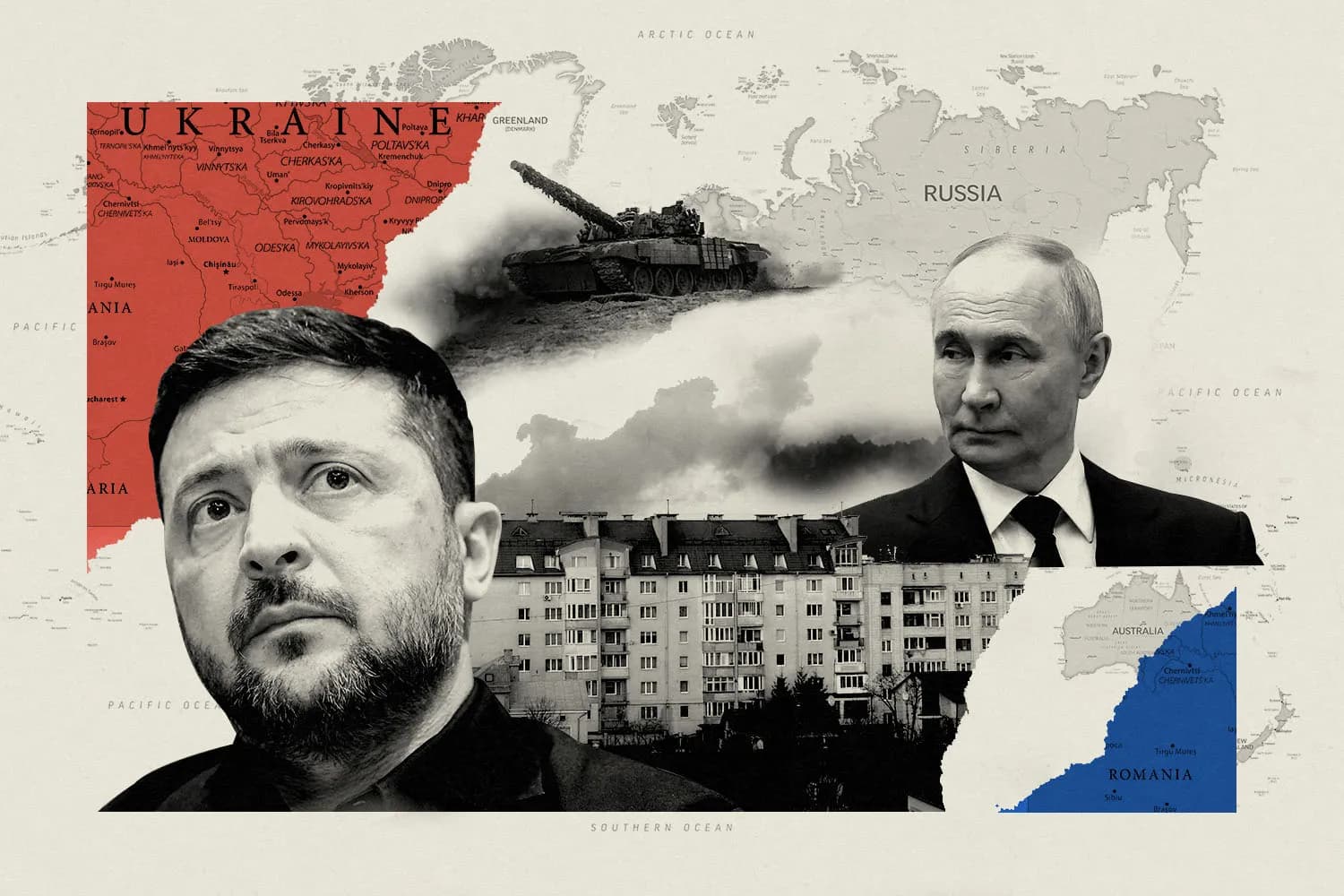
The War Without an Exit: Russia-Ukraine's Next Phase - Frozen Conflict, Negotiated Settlement, or Dangerous Escalation?
Executive Summary
The Russia-Ukraine war has entered its most strategically consequential and analytically challenging phase since the opening months of Vladimir Putin's catastrophically miscalculated February 2022 blitzkrieg collapsed into the grinding attritional warfare that has defined the conflict's character for the majority of its duration. More than four years into the largest land war in Europe since 1945, the conflict has settled into a deeply entrenched pattern of slow, costly territorial contestation in which Russia holds substantial swaths of Ukrainian territory, including approximately twenty percent of Ukraine's internationally recognized sovereign territory, while neither side possesses the military capacity to achieve the decisive operational breakthrough that would fundamentally alter the war's basic dynamic within any near-term planning horizon.
Yet to characterize the current situation as stable stalemate would be strategically misleading. Beneath the surface of positional warfare that dominates the daily operational narrative, several dynamics are in motion simultaneously that will determine the war's next phase with consequences extending far beyond Ukraine's borders and far beyond the immediate military contest. The Trump administration's direct diplomatic engagement with Moscow, conducted through channels that have at various points bypassed both Kyiv and European capitals, has introduced the most significant potential variable in the war's trajectory since Russia's failed 2022 offensive, raising fundamental questions regarding whether American strategic commitment to Ukrainian sovereignty remains sufficiently robust to sustain Kyiv's negotiating position or whether Washington's transactional approach to the conflict creates conditions for an imposed settlement that Ukraine's government and population would likely regard as unacceptable capitulation. Russia's war economy, sustained through the China-Iran axis support mechanisms extensively analyzed in prior intelligence reporting, has demonstrated greater resilience than initial Western assessments anticipated, though at enormous human and economic cost that is progressively straining Russian society in ways that may ultimately prove as consequential as battlefield outcomes. And Europe's strategic position, caught between its genuine commitment to Ukrainian sovereignty and security and its growing concern regarding American reliability that has accelerated its own defence investment agenda, has entered a period of strategic recalibration whose outcomes will shape European security architecture for a generation regardless of how the immediate conflict resolves.
This report provides a doctrine-level assessment of the Russia-Ukraine war's next phase: the current military balance and its likely evolution, the negotiation architectures that various actors are developing and their specific terms, the great power calculations that will ultimately determine the conflict's trajectory, the risk scenarios that could produce dramatic rather than incremental change in the war's dynamics, and the strategic consequences for European security, NATO cohesion, and the broader international order regardless of outcome. The central finding is that the most probable near-term trajectory is neither decisive Ukrainian victory nor comprehensive Russian strategic success but rather a protracted and deeply unstable frozen conflict whose specific terms, boundaries, and security architecture will significantly shape European and global security for decades, and whose mismanagement carries escalation risks that make strategic precision essential at precisely the moment when political pressures on all sides are pushing toward hasty and poorly constructed resolution.
Strategic Background
Understanding the Russia-Ukraine war's current phase requires understanding how the conflict has evolved through several distinct operational phases, each of which has generated its own military lessons, diplomatic responses, and strategic recalibrations among the primary belligerents and the broader international community whose interests are directly engaged.
The war's opening phase, from February 24, 2022, through approximately April 2022, witnessed Russia's failed attempt at a rapid decapitation campaign against Ukrainian governmental and military command structures, including the encirclement of Kyiv, that was premised on a fundamentally flawed intelligence assessment regarding Ukrainian military cohesion, political will, and popular resistance to Russian occupation. The Ukrainian military's successful defence of Kyiv, its destruction of significant Russian armoured formations through a combination of anti-tank missile systems, drone attacks, and effective use of terrain and urban environments that degraded Russia's advantages in firepower and mobility, and the subsequent Russian withdrawal from northern Ukraine represented a strategic failure of the first order for Putin's government, one that established the war's attritional character by demonstrating that Russia could not achieve its maximalist objectives through rapid operational decision while simultaneously revealing that Ukraine could not, without sustained Western military and economic support, generate the offensive power required to recapture occupied territory through its own resources alone.
The conflict's second phase, roughly from mid-2022 through 2023, witnessed Ukraine's partial strategic recovery through the successful Kharkiv counteroffensive of September 2022, which recaptured approximately six thousand square kilometres of territory in northern Ukraine in a rapid manoeuvre operation that briefly raised Western and Ukrainian hopes for more decisive offensive outcomes, and the Kherson counteroffensive of November 2022 that pushed Russian forces east of the Dnipro River from the war's most symbolically significant city after Kyiv. These successes were followed, however, by the 2023 Ukrainian counteroffensive that fell significantly short of its objectives, failing to achieve the breakthrough toward the Azov Sea coast that would have cut the land corridor connecting Russia's mainland to Crimea, instead producing costly advances measured in kilometres against deeply prepared Russian defensive fortifications that had been constructed precisely to blunt the anticipated Ukrainian offensive effort.
The war's current phase, which has been characterized by gradual but costly Russian territorial advances primarily in the Donetsk region, reflects the consequences of these asymmetric attrition dynamics, as Russia's ability to mobilize and absorb casualties at a scale that Ukrainian manpower constraints increasingly cannot match, combined with Ukrainian air defence system degradation through sustained Russian missile and drone strikes and periodic ammunition supply disruptions reflecting Western production and political constraints, has gradually shifted the positional balance in Russia's favour along much of the front line without producing the kind of operational breakthrough that would fundamentally alter the war's strategic character.
Historical Context
The Russia-Ukraine conflict's historical roots extend far deeper than the 2022 invasion or even the 2014 Maidan revolution and subsequent Crimea annexation that initiated the current phase of open military conflict, and understanding these deeper historical dimensions is essential for assessing the conflict's potential resolution trajectories and the durability of any settlement that might emerge from current diplomatic processes.
The specific dynamic of frozen conflict in the post-Soviet space provides the most immediately relevant historical context for assessing the Ukraine conflict's potential trajectory, as Russia has demonstrated across multiple previous instances, including Transnistria in Moldova following the 1992 war, South Ossetia and Abkhazia in Georgia following the 2008 war, and the Donbas following the 2014-2015 conflict that produced the Minsk agreements, a consistent strategic preference for frozen conflicts that maintain Russian leverage over neighbouring states through the presence of unresolved territorial disputes and Russian-backed separatist entities that prevent target nations from achieving the complete territorial sovereignty and Western institutional integration that Russian strategic doctrine regards as incompatible with its security interests in the post-Soviet space.
These historical precedents provide important evidence regarding Russian strategic objectives in the current conflict's potential resolution, suggesting that Moscow's primary long-term objective may not necessarily be the permanent formal annexation and full integration of all currently occupied Ukrainian territory, though the 2022 formal annexation declarations regarding Donetsk, Luhansk, Zaporizhzhia, and Kherson oblasts complicate this analysis, but rather the creation of conditions under which Ukrainian sovereignty remains permanently disputed, Ukrainian NATO membership aspirations remain permanently blocked, and Russian leverage over Ukrainian political and economic development remains sufficient to prevent the kind of decisive Western integration that would represent a permanent loss of influence over the post-Soviet space that Putin's strategic doctrine regards as unacceptable.
The Korean War armistice of 1953 provides another relevant historical analogue, as it established a frozen conflict structure that has now persisted for over seven decades without formal peace treaty, maintaining a heavily militarized demilitarized zone and permanent territorial division that neither side regards as fully legitimate but that both sides, and the major power guarantors, have ultimately found preferable to resumed large-scale military conflict. The Korean precedent suggests that frozen conflicts, while deeply unsatisfying to the parties whose territorial ambitions or sovereignty claims remain unresolved, can be durably maintained when the underlying power balance and deterrence architecture creates sufficient costs for renewed military action that neither side is willing to bear.
Current Situation Assessment
The military situation along the approximately one-thousand-kilometre front line in late 2025 and into 2026 reflects a gradual but continued Russian positional advantage in the Donetsk region, where Russian forces have captured significant population centres including Avdiivka in February 2024 following months of attritional fighting and have continued advancing toward strategically significant cities including Pokrovsk, a critical logistical hub whose fall would substantially complicate Ukrainian defensive positioning across a broad front line sector. Ukrainian defensive lines, while still intact across most of the front, face persistent pressure from Russian numerical advantages in artillery ammunition, improved Russian drone tactics including FPV drone swarms that have substantially complicated Ukrainian troop movements, and the gradual degradation of Ukrainian air defence coverage in forward areas that has reduced the protection available for frontline Ukrainian military positions and critical logistical infrastructure.
Ukraine's military position, while genuinely challenging, retains significant defensive strengths that Russia has failed to overcome across more than four years of intensive warfare. Ukrainian artillery, while constrained by periodic Western ammunition supply disruptions, continues providing effective counter-battery fires that significantly complicate Russian operational planning. Ukrainian drone capability, both for reconnaissance and strike purposes, has developed substantially through domestic production expansion and continues imposing significant costs on Russian military logistics and rear-area operations, including the remarkable long-range drone campaign against Russian oil refinery and energy infrastructure that has imposed direct economic costs on Russia's war economy and demonstrated Ukrainian capability for strategic strike operations well beyond the immediate front line. Ukraine's naval campaign in the Black Sea, including the successful use of maritime drones to constrain Russian Black Sea Fleet operations and effectively reopen a humanitarian shipping corridor despite the collapse of the formal Black Sea Grain Initiative, has demonstrated innovative asymmetric capability development that partially compensates for Ukraine's disadvantages in conventional military resources.
Russia's military position reflects the paradoxical achievement of territorial advance purchased at extraordinary human and material cost that has progressively strained the Russian military's professional core, forcing continued reliance on mobilized forces of variable training and equipment quality alongside the North Korean troop deployments reported by Western intelligence from late 2024, which represent a significant escalatory development that illustrates both Russia's manpower constraints and the practical military dimension of the Russia-China-Iran-North Korea axis extensively analyzed in prior intelligence reporting. Russian missile and drone production, sustained substantially through Iranian Shahed drone licensed production and Chinese dual-use component supply, has maintained a strike campaign against Ukrainian energy infrastructure, civilian areas, and military logistics that has imposed significant costs on Ukrainian society and economic capacity, though the complete destruction of Ukrainian military resistance that Russian strike campaigns have periodically seemed designed to achieve has not materialized despite four years of sustained effort.
The diplomatic dimension of the conflict's current phase has been substantially transformed by the Trump administration's direct engagement with Russian interlocutors, including reported direct communication between Donald Trump and Vladimir Putin and the deployment of American diplomatic emissaries including Steve Witkoff to engage Russian counterparts in negotiations that European allies have at various points characterized as insufficiently coordinated with NATO partners and potentially reflecting American willingness to accept settlement terms that Ukrainian sovereignty and territorial integrity interests would regard as deeply problematic. The specific American diplomatic approaches have included proposals for ceasefire arrangements that would involve recognition of current territorial control lines, deferral of Ukrainian NATO membership aspirations for an extended period, and various security assurance frameworks for the post-conflict Ukrainian state that fall short of the formal collective defence commitments that Kyiv has consistently identified as the minimum acceptable security guarantee.
Power Center Analysis
Vladimir Putin: Strategic Patience and Maximum Leverage
Vladimir Putin's strategic calculation regarding the conflict's trajectory reflects the same fundamental assessment that has governed Russian conduct throughout the war: that time is working in Russia's favour across the most consequential dimensions of the conflict, including Ukrainian manpower and demographic sustainability, Western political will for sustained support, and the domestic economic sustainability of the sanctions regime that has constrained but not fundamentally undermined Russian war-fighting capacity through the China-Iran axis supply mechanisms that have partially compensated for Western market access restrictions. Putin's government has consistently demonstrated willingness to absorb extraordinary costs - human casualties estimated in the hundreds of thousands, substantial economic disruption, and comprehensive international isolation from the Western political community that had previously been treated as at least formally engaged - in pursuit of objectives that Russian strategic doctrine regards as fundamental: preventing Ukrainian NATO membership, maintaining Russian influence over the post-Soviet space, and demonstrating to both domestic and international audiences that Western resolve to defend the rules-based international order through material support for Ukraine is ultimately insufficient to overcome Russian strategic determination.
Putin's specific negotiating position, reflected in the conditions that Russian interlocutors have communicated through various diplomatic channels, includes Ukrainian recognition of Russian sovereignty over the four oblasts formally annexed in September 2022, permanent Ukrainian neutrality and exclusion from NATO, significant constraints on Ukrainian military capability and arms imports, and various political arrangements regarding the Russian-speaking populations of eastern Ukraine that would effectively constrain Ukrainian sovereignty in ways that Moscow could leverage to maintain continued influence. These maximalist positions are unlikely to be fully achieved in any near-term diplomatic settlement given Ukrainian and European resistance, but they establish the outer parameters of Russian negotiating ambitions from which any eventual compromise must represent a departure.
Volodymyr Zelensky: Sovereignty Under Maximum Pressure
Volodymyr Zelensky's strategic position reflects the extraordinary challenge of maintaining Ukrainian political will and Western support for a war whose costs have been catastrophic for Ukrainian society while simultaneously navigating the specific pressure of an American administration that has been more openly transactional regarding settlement terms than its predecessor and more willing to engage Russian interlocutors directly in ways that bypass or minimize Ukrainian participation. Zelensky's consistent insistence on Ukrainian sovereignty over all internationally recognized Ukrainian territory, including Crimea, reflects not merely political positioning but the genuine political constraints imposed by Ukrainian public opinion that would regard territorial concessions to Russia as rewarding unprovoked aggression in ways that would fundamentally compromise Ukrainian democratic legitimacy and future security.
The specific tension between Ukrainian sovereignty maximalism and the practical military and diplomatic constraints limiting what Ukraine can realistically achieve without more comprehensive American and European support than current trajectories provide has created genuine strategic dilemmas for Zelensky's government, including the fundamental question of whether accepting a deeply imperfect ceasefire that halts immediate military losses while preserving Ukrainian sovereignty over a majority of its internationally recognized territory represents a better strategic outcome than continuing warfare that, at current trajectories, may produce further territorial losses without generating the Western military support escalation that would enable a different outcome.
The Trump Administration: Transactional Dealmaker
Donald Trump's approach to the Ukraine conflict reflects a combination of genuine strategic preferences and domestic political calculations that distinguish it sharply from the Biden administration's framework of principled support for Ukrainian sovereignty as a foundational test of the rules-based international order. Trump's preference for rapid dealmaking that prioritizes the cessation of active hostilities over the principled adjudication of sovereignty questions, his expressed respect for Putin's strategic position in ways that the broader American national security establishment regards as insufficiently critical of Russian aggression, and his specific emphasis on the financial costs of American Ukraine support that he regards as inadequately shared by European allies all shape an American diplomatic posture that has created significant uncertainty among European allies regarding the reliability of continued American commitment.
The specific American diplomatic proposals, while evolving through various iterations, have generally reflected a framework in which a ceasefire along approximately current front lines would be stabilized through some form of international monitoring mechanism, Ukrainian NATO membership aspirations would be deferred for a period of years in exchange for security assurances of a character falling short of Article 5 collective defence commitments, and American diplomatic recognition of the settlement would be leveraged to extract Russian commitments regarding the broader relationship that Trump's government values, including potential Russian diplomatic realignment away from China on specific issues and broader geopolitical concessions that reflect American strategic interests beyond the immediate Ukraine question.
Europe: The Strategic Awakening Under Existential Pressure
European governments, collectively and individually, have undergone the most significant strategic reorientation that this conflict has produced outside of Ukraine itself, accelerating defence spending increases, confronting the structural inadequacies of European defence industrial capacity, and developing contingency planning for scenarios involving reduced American commitment to European security that would have seemed implausibly alarmist as recently as 2020. The European re-armament discussed extensively in prior intelligence reporting regarding NATO's future is most directly driven by the Ukraine conflict's demonstration that large-scale conventional warfare on European soil remains a genuine possibility whose deterrence requires military capabilities at a scale and readiness that the post-Cold War defence dividend era completely failed to maintain.
European governments, particularly France and the United Kingdom, have explored various frameworks for maintaining Ukrainian military support even in scenarios where American commitment diminishes, including the potential deployment of European military personnel in monitoring, training, or potentially deterrence roles that would provide Kyiv with a concrete security guarantee whose credibility rests on European rather than American commitment. These discussions, while sensitive and unresolved, reflect a genuine European recognition that the Ukraine conflict's outcome will determine European security for a generation and that European strategic interests require more direct European investment in that outcome than has characterized the period of heavy dependence on American leadership in the conflict's military support architecture.
Military and Security Implications
The military implications of the Russia-Ukraine war's potential next phase operate through several distinct scenarios whose specific military dynamics, weapons requirements, and alliance management challenges differ sufficiently to require separate analysis rather than unified assessment.
In a ceasefire scenario, the immediate military challenges would centre on the creation of a credible monitoring and enforcement mechanism along a front line extending approximately one thousand kilometres through contested territory where both sides maintain heavily armed forces with mutual mistrust of sufficient depth to make compliance verification extraordinarily difficult. The historical precedent of the Minsk agreements, which formally committed both Russia and Ukrainian separatists to ceasefire arrangements that were never meaningfully implemented and were ultimately abandoned entirely, provides the most directly relevant evidence regarding the challenges of ceasefire implementation in this specific conflict, suggesting that any ceasefire arrangement would require a substantially more robust monitoring presence, enforcement mechanism, and political commitment from external guarantors than the Minsk framework provided to have any realistic prospect of durable implementation.
The military dimension of post-ceasefire Ukrainian security architecture represents perhaps the most consequential and most contested question in any settlement framework, as the specific military capabilities and alliance relationships that Ukraine is permitted to maintain under any settlement agreement will directly determine its vulnerability to resumed Russian aggression and the credibility of any security guarantees provided by Western nations. Russian insistence on Ukrainian force limitations and constraints on Western arms imports would, if accepted, create a permanently vulnerable Ukrainian military position that Russia could exploit at a time of its own choosing, while Ukrainian insistence on maintaining full military sovereignty and continued Western arms supply reflects an understanding that any security guarantee lacking genuine military substance provides illusory rather than real protection.
The broader military lesson that the Russia-Ukraine war has generated for every NATO member and aspiring partner - regarding ammunition production requirements for sustained high-intensity conflict, the decisive importance of drone warfare across multiple operational functions, the vulnerability of energy infrastructure to sustained precision strike campaigns, and the critical role of electronic warfare and counter-drone systems in modern combined-arms operations - will continue reshaping European defence planning and investment regardless of how the immediate conflict resolves, representing one of the war's most consequential long-term military legacies for the broader European security environment.
Economic and Trade Impact
The economic dimensions of the Russia-Ukraine war's continuation, potential ceasefire, or escalation carry implications across multiple scales simultaneously, from the immediate Ukrainian economic survival challenge to the broader restructuring of European energy architecture to the global commodity market effects analyzed extensively in prior intelligence reporting regarding global food security.
Ukraine's economic situation has deteriorated substantially across four years of warfare, with GDP losses, infrastructure destruction particularly in the energy sector, population displacement both internal and external, and the diversion of a dominant share of state resources to military expenditure collectively creating an economic emergency whose sustained management depends entirely on continued Western financial support through International Monetary Fund programmes, European Union macro-financial assistance, and American supplemental aid packages whose continuation under the Trump administration's fiscal priorities cannot be assumed with historical confidence. The reconstruction costs for Ukraine, estimated by various international institutions at figures ranging from several hundred billion to over one trillion dollars depending on the conflict's eventual territorial and infrastructure impact, represent one of the most significant international development finance challenges in post-war history and will require substantial and sustained international commitment over decades regardless of when active hostilities conclude.
Russia's economic trajectory, while substantially more resilient than initial Western sanctions impact assessments anticipated, reflects the genuine and accumulating costs of operating a wartime economy under comprehensive sanctions with the specific dependence on Chinese and Iranian support mechanisms that have partially substituted for lost Western market access. Russian defence spending has reached approximately forty percent of the federal budget, crowding out the investment in education, healthcare, and infrastructure that long-term economic development requires, while the brain drain of educated Russians who have emigrated since 2022 represents a human capital loss whose consequences will compound over decades regardless of the conflict's immediate resolution.
Diplomatic Positioning
The diplomatic architecture surrounding potential conflict resolution reflects a complex and still-evolving set of competing frameworks, each reflecting different combinations of achievable objectives and acceptable compromises from the perspectives of the primary belligerents and their respective external supporters and guarantors.
The American diplomatic framework, as described above, emphasizes rapid ceasefire along approximately current control lines, deferred Ukrainian NATO membership aspirations, and security assurances of a character that falls short of Article 5 commitments, reflecting Trump's preference for transactional settlement over principled adjudication of sovereignty questions and his calculation that demonstrating dealmaking capability regarding a high-profile international conflict serves American domestic political interests in ways that prolonged advocacy for Ukrainian sovereignty maximalism does not.
The European diplomatic framework, while necessarily engaged with American diplomatic initiatives given European dependence on American security guarantees and the impossibility of European-only settlement imposition, has sought to maintain stronger insistence on Ukrainian sovereignty principles, robust security guarantees for post-settlement Ukraine, and an eventual Ukrainian NATO membership pathway, reflecting European governments' assessment that a settlement that leaves Ukrainian sovereignty permanently compromised creates precedents for Russian revisionism that directly threaten European security in ways that more distant American strategic planners may insufficiently appreciate.
The Ukrainian diplomatic framework, while constrained by the military realities that limit Kyiv's ability to impose its preferred terms through military means alone, has consistently insisted on security guarantees that provide genuinely credible collective defence commitments rather than the weaker assurance frameworks that great power convenience might prefer, drawing on the deeply painful historical lesson of the 1994 Budapest Memorandum, in which Ukraine surrendered its inherited Soviet nuclear arsenal in exchange for security assurances from Russia, the United States, and the United Kingdom that proved utterly worthless when Russia invaded, creating a Ukrainian political consensus that paper guarantees without military teeth represent dangerous illusions whose repetition Ukrainian public opinion would not accept.
Regional Fallout
Eastern Europe: The Security Anxiety Belt
Poland, the Baltic states, Romania, and other NATO members on the alliance's eastern flank are watching the Ukraine conflict's trajectory with the most acute anxiety of any NATO membership segment, given their direct geographic exposure to Russian military power and their historical experience of Soviet occupation that creates an acute understanding of what Russian strategic success in Ukraine would mean for their own long-term security. Polish defence spending at four percent of GDP, Baltic state defence investments at multiple times their historical levels, and the political determination of eastern NATO members to maintain robust allied presence in their territories regardless of broader NATO consensus dynamics all reflect a calculation that the Ukraine war's outcome directly determines whether the deterrence architecture protecting their own sovereignty is credible or hollow.
Belarus
Belarus, whose territory Russia used as the launching pad for the failed February 2022 Kyiv offensive and which remains under Alexander Lukashenko's Moscow-dependent government following the 2020 electoral fraud and subsequent repression that eliminated the genuine pro-Western democratic movement that had briefly threatened Lukashenko's survival, represents both a direct component of the broader Russia-Belarus security architecture that Ukraine must continuously account for in its northern defensive planning and a potential future flashpoint where the conflict's dynamics could expand if Russian military positioning in Belarus were deployed for renewed offensive operations against Ukrainian northern territories.
The Black Sea Region
The Black Sea has become a critical operational theatre whose control dynamics will significantly shape both the immediate conflict's trajectory and any post-conflict security architecture, given the Sea's importance for Ukrainian grain exports whose disruption has generated the global food security consequences analyzed extensively in prior intelligence reporting, for energy transit through the South Stream and TurkStream pipeline infrastructure, and for the broader naval balance that will determine Russia's ability to project power into the Mediterranean and Turkey's management of its Bosphorus gatekeeper role in any post-conflict security arrangement.
Global Strategic Consequences
The Russia-Ukraine war's eventual outcome, across the full range of possible resolution trajectories from negotiated settlement to frozen conflict to resumed large-scale offensive operations, will carry global strategic consequences whose implications extend across every dimension of international order analyzed throughout this broader intelligence series.
The most fundamental global consequence concerns the precedent that the conflict's resolution establishes for the viability of territorial conquest in the contemporary international system. A settlement that allows Russia to retain permanent control over approximately twenty percent of internationally recognized Ukrainian territory, even if characterized as provisional or contested, would establish that sufficiently determined and sufficiently resource-endowed aggressor states can achieve durable territorial gains through military force against sovereign neighbours despite comprehensive Western opposition, creating a precedent that Chinese strategic planners regarding Taiwan, and potentially other revisionist actors globally, will closely analyze for the lessons it provides regarding the limits of Western deterrence and the achievability of territorial conquest against Western objection.
For China, the specific terms and precedents of any Ukraine settlement will be among the most consequential inputs into its Taiwan policy calculations, as Beijing assesses whether the international community's response to Russian territorial conquest provides evidence that similar Chinese action regarding Taiwan could eventually be absorbed by the international system without producing the kind of permanent, comprehensive, and economically devastating response that Chinese strategic planners must weigh against the benefits of any Taiwan military operation. The more completely the international community accepts Russian territorial gains in Ukraine, the more confidently Chinese strategic planners can assess that the international system's tolerance for great power territorial revision is higher than Western deterrence rhetoric suggests.
For India, the war's resolution will affect its specific relationship management challenge regarding Russia, whose continued strategic partnership India values while being genuinely concerned about the implications of Russian strategic success for broader great power norms regarding territorial sovereignty, given India's own acute interest in the international legal architecture protecting sovereign territorial integrity against larger power coercion in the context of its relationship with China.
Risk Matrix
- Critical Risk - Nuclear Escalation Through Miscalculation: Russian nuclear signaling, including the November 2024 modification of nuclear doctrine to lower stated thresholds for nuclear weapons use and the deployment of tactical nuclear weapons to Belarus, combined with the deep uncertainty regarding Putin's actual escalation thresholds under various conflict scenarios, creates a persistent and genuinely concerning risk of nuclear escalation through miscalculation that represents the most catastrophic potential outcome of the conflict's continuation and the most urgent reason why settlement efforts, even deeply imperfect ones, carry significant strategic value beyond the immediate military contest.
- Critical Risk - Imposed Settlement Creating Permanent Security Vacuum: A hastily constructed settlement that fails to provide Ukraine with credible security guarantees creates the conditions for resumed Russian aggression once Russia has used any ceasefire period to reconstitute its military capacity, potentially producing a worse long-term security outcome than continued conflict by providing Russia with both territorial gains and the military recovery period necessary to pursue further objectives from a strengthened position, analogous to the consequences of the Minsk agreement framework that provided Russia time to strengthen Donbas separatist forces without preventing the larger-scale conflict that Minsk was nominally designed to prevent.
- High Risk - European Defence Investment Undermined by Premature Settlement: A settlement that reduces the perceived immediacy of Russian military threat to European NATO members before European defence industrial capacity has been sufficiently rebuilt and before European military forces have achieved the readiness levels that deterrence of renewed Russian aggression requires risks triggering political pressure in multiple European nations to slow or reverse the defence spending increases that the immediate post-invasion threat environment has generated, potentially recreating within years the structural vulnerability that made the 2022 invasion possible.
- High Risk - Ukrainian State Collapse: Sustained military pressure, continued energy infrastructure degradation, economic deterioration, and population exodus, if combined with reduced Western financial and military support, creates a non-negligible risk of Ukrainian state fragility reaching levels that undermine military cohesion and political legitimacy simultaneously, potentially producing an outcome that is distinctly worse than any negotiated settlement because it removes Ukraine's ability to negotiate from any position of strength.
- Moderate-High Risk - North Korean Escalation into Direct Military Partnership: Continued and potentially deepening North Korean military involvement, including the reported deployment of North Korean troops alongside Russian forces and the ongoing North Korean artillery ammunition supply chain that has been critical to sustaining Russian fire support, risks escalating into a more formal military alliance with significant implications for allied deterrence architecture in Northeast Asia and for the broader axis dynamics analyzed in prior intelligence reporting.
Scenario Analysis
Scenario One - Frozen Conflict Along Current Lines
In this scenario, diplomatic pressure, primarily American, produces a ceasefire agreement that halts active military operations along approximately current front lines without resolving the underlying sovereignty dispute. Ukraine retains control of approximately eighty percent of its internationally recognized territory, including Kyiv, Kharkiv, Odessa, and Dnipro. Russia retains de facto control over the four formally annexed oblasts plus Crimea, though international recognition of these territorial claims remains confined to a small number of Russian-aligned states. Ukrainian NATO membership is deferred for an unspecified period, potentially subject to future negotiation after an extended ceasefire duration. Security assurances are provided to Ukraine through a coalition of European guarantors, potentially including French and British military presence, that falls short of full Article 5 collective defence commitments but provides some credible deterrent value. This scenario avoids the worst immediate outcomes but creates a deeply unstable security architecture that history suggests will not remain frozen indefinitely, as both sides retain claims and grievances that provide motivation for eventual resumption of active conflict under more favourable future circumstances.
Scenario Two - Negotiated Settlement with Security Architecture
In this scenario, a more comprehensive diplomatic process produces a genuine settlement that includes credible security arrangements for Ukraine, potentially including an accelerated NATO membership process for the territories Ukraine controls, substantial economic reconstruction support conditioned on ceasefire durability, international monitoring mechanisms along the armistice line with genuine enforcement capacity, and a phased international legal process for addressing the sovereignty status of occupied territories that preserves Ukrainian legal claims while managing the immediate security priority of halting active hostilities. This scenario requires significantly more sophisticated diplomatic architecture and greater American, European, and Ukrainian political will for genuine compromise than currently observable trends suggest is available, making it a desirable but less probable near-term trajectory.
Scenario Three - Escalation and Expanded Conflict
In this scenario, failed diplomatic efforts, continued Ukrainian military pressure against Russian-controlled territory including within Russia's internationally recognized borders, and Russian response through escalatory means including potential tactical nuclear weapons employment or direct strikes against NATO territory used for Ukrainian support functions produce a dramatic conflict escalation that NATO members cannot continue to characterize as a conflict whose management remains outside the alliance's direct engagement. This scenario carries the most catastrophic potential consequences of any trajectory but reflects genuine risks inherent in the escalation dynamics that the conflict's intensity and the nuclear dimension of Russian strategic posturing create, particularly if miscalculation or domestic Russian political crisis produces decisions that rational deterrence theory would counsel against but that leadership under extreme pressure might nonetheless make.
Intelligence Forecast: 6-24 Months
Over the six-to-twelve-month horizon, the most consequential variable determining the conflict's trajectory will be the pace and substance of American-Russian diplomatic engagement and specifically whether the Trump administration's direct engagement with Putin's government produces a concrete ceasefire proposal that creates sufficient international pressure on both Kyiv and Moscow to accept its terms, or whether initial diplomatic momentum dissipates through disagreement on specific terms, particularly regarding security guarantees for Ukraine and the territorial status of occupied regions, leaving the conflict to continue along its current attritional trajectory.
Military dynamics over this horizon will likely feature continued Russian positional advances in the Donetsk region, ongoing Ukrainian long-range drone strikes against Russian energy and military infrastructure, and continuing Russian missile and drone attacks against Ukrainian energy systems particularly during winter months when such attacks impose maximum civilian hardship and social pressure. The specific trajectory of Western military supply, including the pace of F-16 delivery to Ukraine and the ammunition supply chain sustainability that determines Ukrainian artillery fire capacity, will significantly affect the military balance's evolution and therefore the negotiating positions that military reality supports.
European defence posture decisions over this horizon will include critical industrial investment commitments, force structure planning, and contingency deployments that collectively determine whether Europe is building toward a genuinely credible independent deterrence capacity or whether current defence spending increases remain primarily political signals whose military substance lags their rhetorical ambition by years.
Over the twelve-to-twenty-four-month horizon, the most consequential potential development is whether any ceasefire agreement that may emerge from current diplomatic efforts proves durable or rapidly deteriorates through violation, creeping military action, or the kind of political developments in either Russia or Ukraine that undermine the domestic political sustainability of whatever terms were initially accepted. The Korean War armistice's decades-long durability despite the absence of formal peace treaty suggests that frozen conflicts can be maintained when underlying deterrence architecture creates sufficient costs for renewed aggression, while the Minsk agreements' complete failure demonstrates that ceasefire arrangements lacking genuine enforcement mechanisms and credible external guarantors quickly collapse under the pressure of parties who retain both the capability and motivation to pursue military objectives that the ceasefire nominally constrains.
Final Strategic Takeaway
The Russia-Ukraine war's next phase will be defined by a cruel strategic paradox: the diplomatic pressures driving toward some form of conflict resolution are intensifying precisely as the conditions necessary for a durable and legitimate resolution remain most difficult to achieve. American transactionalism, European anxiety, Russian strategic patience, and Ukrainian demographic and economic exhaustion are all pushing toward an end to active hostilities that none of the primary actors can achieve on fully acceptable terms, creating conditions for the kind of hasty and poorly constructed settlement whose immediate appeal derives precisely from the relief it provides from unsustainable costs while deferring the fundamental unresolved questions whose management will determine whether any ceasefire produces durable peace or merely a pause before resumed conflict.
The historical evidence regarding frozen conflicts and their durability is sobering but not uniformly discouraging. The Korean armistice has maintained the peace it created for over seven decades through a combination of robust deterrence, American security commitment, and the mutual recognition among the parties that resumed large-scale military action would impose unacceptable costs on all sides. A Ukraine settlement could achieve similar durability if it is constructed with comparable attention to the deterrence architecture and security guarantee mechanisms whose specific design details determine whether any ceasefire represents a genuine conflict termination or merely a pause in a longer conflict whose fundamental causes remain unaddressed.
What is entirely clear is that the worst outcomes, both resumed full-scale military conflict with escalation risk and an imposed settlement that leaves Ukraine permanently vulnerable to resumed Russian aggression without credible security guarantees, are avoidable if the major actors, particularly the United States and European powers, invest the diplomatic sophistication, strategic patience, and material commitment that a durable and legitimate resolution requires. The temptation toward premature closure, toward accepting whatever terms are available today to escape the costs of continued engagement, will need to be resisted if the settlement that eventually emerges is to serve not merely the immediate convenience of its architects but the long-term security interests of Ukraine, Europe, and the broader international order whose foundational principles regarding territorial sovereignty and the prohibitions on aggressive use of force are directly and consequentially at stake in the war's ultimate resolution.