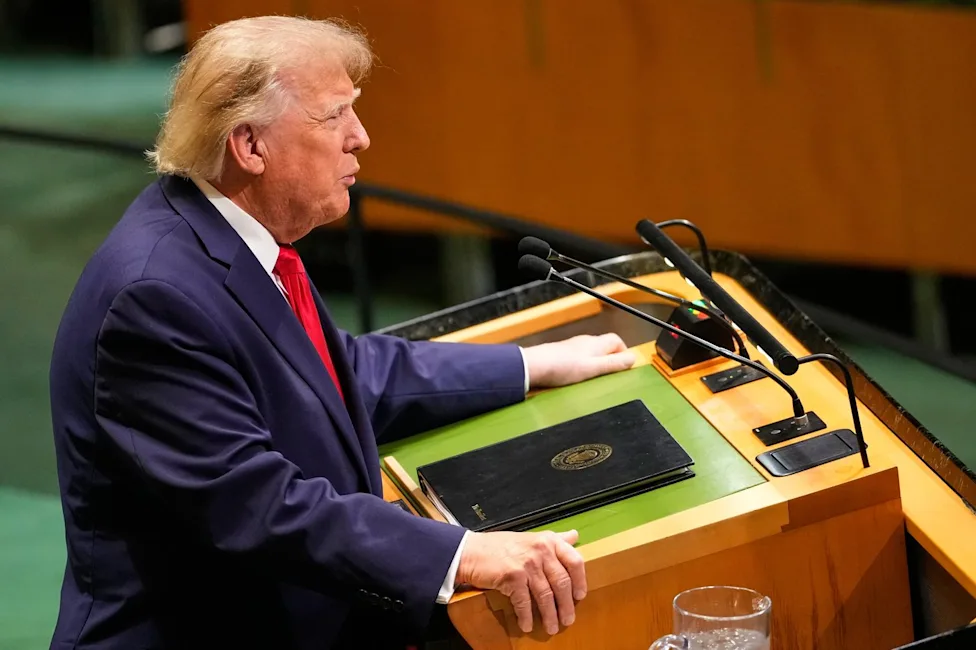
Trump Opens the Door to Iran at the UN - and Oil Responds
Executive Summary
On September 21 and 22, 2026, a convergence of signals from Washington drove oil prices sharply lower for the first time in weeks. President Donald Trump told Fox News he would "probably" be open to meeting Iranian President Masoud Pezeshkian on the sidelines of the United Nations General Assembly in New York. The following day, addressing the full General Assembly, Trump declared he expected to make a deal with Iran "right after the election" - meaning November's midterms - while simultaneously threatening to "annihilate the Islamic Republic" if Tehran failed to come to the table. Markets read the diplomatic signals. Brent crude fell below $100 a barrel for the first time in recent weeks, while WTI dropped to around $95. Saudi Arabia's restart of its East-West Pipeline, which had been shut since drone attacks on September 11, compounded the selling pressure.
The question is whether this constitutes a genuine diplomatic pivot or a performance calibrated to US domestic politics ahead of elections that polls suggest Republicans are in danger of losing. The evidence tilts heavily toward the latter - but the distinction matters less than it seems. Even a performative opening can, under the right conditions, create real negotiating space. Whether Iran and the Trump administration can convert the current moment into a durable settlement remains deeply uncertain. The June 2026 Memorandum of Understanding collapsed within weeks. The war is now seven months old, Khamenei is dead, Iran's military has been degraded, and yet the Islamic Republic is still standing - and still blocking the Strait of Hormuz.
Strategic Background
The 2026 Iran war began on February 28 when US and Israeli forces launched nearly 900 strikes in 12 hours, targeting Iranian missiles, air defenses, military infrastructure, and leadership. The initial wave killed Supreme Leader Ali Khamenei and dozens of other senior officials. Iran responded immediately with retaliatory missile and drone strikes against US embassies, military bases, and oil infrastructure across the Middle East, and began imposing restrictions on the Strait of Hormuz - through which roughly 20 percent of the world's seaborne oil and an equivalent share of liquefied natural gas had passed daily before the war.
The immediate trigger was a breakdown in nuclear negotiations. Three rounds of indirect talks had taken place in the weeks before the strikes. On February 25, Iran's foreign minister Abbas Araghchi described a "historic opportunity" as "within reach." Three days later, US and Israeli aircraft were already in the air. Trump had issued a ten-day deadline on February 20, the third round of talks on February 26 ended without agreement, and the strikes followed within 48 hours.
From that point, the war moved through several overlapping phases: an initial shock campaign, an April ceasefire, a June Memorandum of Understanding that briefly reopened the Strait, its collapse in late July into renewed fighting, a US naval blockade, US demining operations in August, new Iranian mine-laying attempts, retaliatory US strikes on Larak Island, and - most recently - drone attacks attributed to Iranian-backed Iraqi militias that shut Saudi Arabia's East-West Pipeline on September 11. Seven months in, the war is neither won nor ended. The nuclear program has been degraded but not eliminated. The Iranian regime, stripped of Khamenei, has reconstituted under new leadership and continues to function.
Historical Context
The pattern of diplomatic signaling crashing into resumed fighting has been a consistent feature of this conflict since March. Trump has claimed dozens of times that the US is close to a settlement. Each claim has moved markets - briefly - before the gap between Washington's stated terms and Tehran's actual position has reasserted itself.
The June Memorandum of Understanding is the clearest example. After a ceasefire took hold in early April, the US and Iran signed an MOU in June that outlined a 60-day framework for negotiations over Iran's nuclear program and regional security arrangements. The Strait briefly reopened, oil prices fell sharply, and the Trump administration declared it a significant achievement. Within weeks, Iran resumed attacks on commercial shipping. The MOU formally expired in August. Fighting continued.
Every previous attempt to negotiate an end to the conflict has followed a similar arc: Trump signals openness, oil falls, negotiations begin in the margins, fighting resumes, the signal is retracted or superseded. The market has learned this cycle, which is why Tuesday's initial drop of 3-4 percent was partly reversed after Trump's UNGA speech, which contained equal parts diplomatic overture and threat of annihilation. By the close of trading, WTI was trading around $96, having touched a low of $92.40 earlier in the session.
The deeper historical context is the trajectory of US-Iran relations since the 2015 Joint Comprehensive Plan of Action - which Trump withdrew from in his first term in 2018 - through the 2019 maximum pressure campaign, the 2025 Israeli strikes that Khamenei survived, the 12-Day War of June 2025, and finally the full-scale war launched February 28, 2026. Each cycle has tightened the coils of a conflict that has been building for two decades. The current war is not an accident or an anomaly. It is the endpoint of a long trajectory of failed diplomacy and escalating military action.
Current Situation Assessment
As of September 22, 2026, three things happened simultaneously that pushed oil prices lower.
First, Trump signaled diplomatic openness on Sunday, telling Fox News he would "probably" be open to meeting Pezeshkian at the UN. Secretary of State Marco Rubio confirmed Monday that the US was "open to something like that," though no meeting was scheduled. The diplomatic softening - however cautiously framed - was enough to move markets.
Second, on Tuesday at the General Assembly, Trump delivered a speech that tried to hold both options in parallel. He said he expected a deal "right after the election" because Iran was "waiting to see" how Republicans performed in November. He also said he had a "big decision" to make: offer Iran a path to reconstruction, or "annihilate the Islamic Republic and do it quickly." Oil initially dropped sharply on the diplomatic signals, then partially recovered as the annihilation rhetoric registered. The net result was a market below $100 but not dramatically below it.
Third, and independently, Saudi Arabia restarted its East-West Pipeline on September 22. The pipeline had carried around four million barrels per day - roughly 4 percent of global supply - after the Strait of Hormuz became too risky to use reliably. Drone attacks attributed to Iranian-backed Iraqi militias had forced a shutdown on September 11. Its restart, combined with Saudi Arabia loading seven supertankers from Gulf terminals over the weekend in a sign that Hormuz flows are recovering, helped push Brent below $100.
JP Morgan analysts reported that total Middle East oil flows now average around 17 million barrels per day - roughly 6 million below the pre-war baseline but recovering steadily. TD Securities estimated that Hormuz exports had reached about 80 percent of pre-war levels, with Iran appearing to have "lost notable leverage" over the strait absent a major new escalation.
Power Center Analysis
The most important variable in Trump's UNGA posture is not diplomacy. It is the November midterms. The Iran war has become an electoral liability. A CNN poll found that 64 percent of Americans did not believe the US was winning the war. Trump's approval on the economy had fallen to 33 percent in recent surveys - three points below the lowest reading recorded during Biden's most difficult months. Gas prices hit a record average of $4.15 per gallon on Labor Day. Diesel averaged $5.85.
These numbers explain why Trump spent the UNGA week simultaneously threatening to annihilate Iran and promising a deal is coming. The annihilation rhetoric maintains his hawkish credentials and prevents the political right from reading any meeting with Pezeshkian as weakness. The deal-after-the-election framing gives Republican candidates something to offer voters: relief is coming, just not yet. It is a domestic political communication strategy being performed on a global stage.
Tehran is reading all of this correctly. Iranian officials have watched Trump's deal-making claims fail to materialize for seven months. The Islamic Republic's new leadership - operating without Khamenei for the first time since 1989 - has domestic pressures of its own. The war has hit Iran's economy severely. The currency has collapsed. Khamenei's death created a succession crisis that Iranian domestic politics has not fully resolved. The Islamic Revolutionary Guard Corps remains intact and is the center of gravity for both military resistance and political continuity. Any deal that Iran accepts will need IRGC buy-in, which means the terms must not be seen as capitulation.
The United States military has achieved significant tactical objectives: Iran's ballistic missile program has been heavily degraded, its navy has taken serious losses, its nuclear facilities were struck in the 2025 twelve-day war, and Khamenei is dead. But strategic objectives have proven elusive. The nuclear program has not been eliminated. The regime has not fallen. The IRGC continues to fund and direct regional proxies. Hezbollah, Iranian-backed Iraqi militias, and the Houthis remain operational. The US Strategic Petroleum Reserve has fallen below 300 million barrels - its lowest since 1983.
Israel's calculus is distinct from Washington's. Netanyahu pushed hardest for the February strikes. From Israel's perspective, a deal that leaves Iran with meaningful nuclear latency is worse than continued war, because it would legitimize a damaged but surviving Iranian state while Iran retains the capacity to rebuild. Israel will exert pressure against any settlement it regards as insufficiently denuclearizing.
Saudi Arabia occupies an uncomfortable middle position. Riyadh reportedly urged the US not to bomb the Houthis further and is meeting with Gulf Cooperation Council representatives in New York this week as part of a US-Arab diplomatic track that also includes Iraq, Jordan, and Egypt. The Gulf states want the war over, but not on terms that leave Iran intact and emboldened.
Military and Security Implications
The military picture matters for understanding why the diplomatic signals this week, while genuine at some level, have not yet produced a path to settlement.
US forces cleared Iranian mines from the main Hormuz shipping lanes in late August - a significant tactical achievement. Iran attempted to re-mine the strait from Larak Island, a small Iranian island used to monitor and interfere with traffic. US strikes on Larak Island in early September destroyed that capability temporarily, but at the cost of a new round of Iranian retaliation and the drone attacks that shut the Saudi East-West Pipeline on September 11.
The mine-clearing and the pipeline restart represent meaningful military progress. But they also illustrate the nature of the conflict at this stage: a grinding, attritional campaign in which the US and its partners are slowly restoring oil flows under military protection while Iran uses what leverage remains - primarily proxy attacks on regional infrastructure - to impose costs.
The US naval blockade of Iran remains in effect. The Strategic Petroleum Reserve is at historically low levels, a fact that limits Washington's ability to absorb another major price spike. The blockade is creating economic pressure on Iran, but it is also burning through American strategic reserves in ways that carry their own long-term vulnerabilities.
Iran's core military capability - the IRGC, its proxy network, and its residual missile capacity - has not been broken. The war that Netanyahu presented to Trump in February as a near-certain, four-to-six-week campaign is in its seventh month with no clear military end-state in sight.
Economic and Trade Impact
The economic consequences of seven months of disrupted Hormuz flows have been substantial and global. Before the war, the strait carried about 25 percent of the world's seaborne oil and 20 percent of its LNG. Even at 80 percent of pre-war levels, the disruption has been enough to drive sustained price spikes, supply rerouting costs, and inflationary pressure across import-dependent economies.
In the United States, gas prices averaging above $4 per gallon represent a direct hit on household budgets. The political salience of fuel prices in the run-up to November elections is enormous - they are visible, daily, and easy to attribute to policy decisions. The war that was supposed to last weeks has become the single largest driver of American energy prices in over a decade.
Globally, the rerouting of Saudi exports via the East-West Pipeline to Yanbu - bypassing Hormuz - reduced the supply disruption but created new vulnerabilities, as the September drone attacks demonstrated. The pipeline's restart is a positive development, but it has already been shut once. Its vulnerability to proxy attacks is structural, not resolved.
The oil market's reaction to Trump's UNGA remarks illustrates how tightly the geopolitical risk premium is tied to diplomatic signals. Oil fell 4-5 percent on the combination of Trump's opening signals and the pipeline restart. It partially recovered when his speech revealed the deal would come - if it comes at all - only after November. Markets are in a holding pattern, pricing in probability-weighted scenarios rather than any clear settlement trajectory.
Diplomatic Positioning
The UNGA week is producing intensive diplomatic activity that goes beyond the Trump-Iran dimension. The US is meeting with Gulf Cooperation Council leaders Tuesday night. Iraq, Jordan, and Egypt are engaged in the diplomatic margins. These Arab states want a settlement but have their own red lines - none of them wants an Iran that emerges from the war with a functional nuclear program, but they also cannot sustain indefinitely the economic and political costs of a protracted Middle East conflict.
Iran's Pezeshkian is attending the General Assembly in person, addressing the body on Wednesday. His presence in New York while Trump has said he is open to meeting is significant. It signals that Tehran is willing to be seen as available for dialogue, even if no formal meeting is scheduled. Secretary Rubio's confirmation that the US is "open to something" is the closest the two sides have come to a direct diplomatic signal in weeks.
Whether a meeting between Trump and Pezeshkian actually takes place in New York, and whether such a meeting could produce anything substantive, remains uncertain. The structural obstacles have not changed: Washington demands Iran's nuclear program be dismantled, not merely paused; Tehran demands sanctions relief and security guarantees that would require Washington to constrain Israel; Israel will resist any settlement it regards as leaving Iran with nuclear latency. These gaps did not close during the June MOU negotiations. They have not narrowed since.
The European diplomatic track - which played a significant role in the 2015 JCPOA - is largely sidelined in the current war. European governments condemned the February strikes and have pushed for a diplomatic solution, but they lack the leverage or the institutional standing to broker a deal in which both Washington and Tehran have confidence.
Regional Fallout
The secondary effects of the war on regional actors have been significant and in some cases destabilizing.
Iraq is caught between competing pressures: its government is formally aligned with the US, while Iranian-backed militias operating from Iraqi territory have conducted the proxy attacks - including the September 11 drone strikes on the Saudi East-West Pipeline - that complicate regional diplomacy. The Iraqi government's inability or unwillingness to constrain these groups is a persistent complication for any diplomatic settlement.
The Houthis in Yemen have been active throughout the conflict, targeting US assets and regional shipping through the Bab el-Mandeb. Trump reportedly decided against bombing Houthi targets further, despite Saudi Arabian requests. The decision reflects a recognition that expanded operations in Yemen would further stretch US military resources and create additional political liability at home.
Hezbollah has resumed fighting with Israel along the Lebanese border - itself a restart of pre-war hostilities that had been suspended during earlier ceasefire negotiations. This front adds complexity to any comprehensive settlement, since Israel's terms for any deal include constraints on Hezbollah that Iran cannot credibly offer without IRGC acquiescence.
Turkey, which sits in an ambiguous position - a NATO member with independent interests in Middle East stability - has been active in quiet diplomacy between the parties. Qatar, home to a significant US military presence, has been a channel for indirect communication throughout the conflict. Oman, which historically plays a back-channel role between Washington and Tehran, has been active behind the scenes.
India's Strategic Position
India's exposure to this conflict has been among the deepest of any non-belligerent state. The closure of the Strait of Hormuz beginning March 1 hit India with particular force. India imports roughly 90 percent of its crude oil and sources approximately 91 percent of its LPG from the Gulf region. The strait's disruption drove Brent prices from around $80 per barrel in early March to over $120 within days. India's LPG supply was directly affected - shortages erupted in distribution chains, prices spiked, and the government invoked the Essential Commodities Act.
India responded with a diversified supply response: it resumed crude purchases from Iran for the first time since 2019, activated Operation Sankalp to protect energy shipping routes, accepted US Treasury waivers to continue Russian crude purchases while in the middle of negotiating a bilateral trade deal with Washington, and accelerated imports from West Africa, North America, and Fujairah in the UAE - all routes that bypass Hormuz. The rupee came under pressure as the import bill surged.
As Hormuz flows have partially recovered - reaching around 80 percent of pre-war levels according to TD Securities data - and as oil falls back below $100, India's immediate energy pressure is easing. But the structural vulnerability is not resolved. India's dependence on the Strait of Hormuz for the bulk of its energy imports has been exposed as a single-point risk of the first order.
India's diplomatic position through the war has been carefully non-aligned. New Delhi has not condemned the US-Israeli strikes, has not endorsed them, has maintained trade and diplomatic relations with Iran, and has quietly pursued its own supply-security interests through every available channel simultaneously. This is a classic exercise of the strategic autonomy that Indian foreign policy has prized for decades. The war has tested that autonomy under genuine economic stress.
For India, the most important variable in the coming weeks is not whether Trump meets Pezeshkian in New York. It is whether oil remains below $100 through the autumn. Every dollar per barrel below the elevated levels of recent months reduces India's import bill, eases currency pressure, and creates fiscal space for the government ahead of state elections. A durable drop below $90 would represent a material economic improvement. A resumption of fighting that spikes prices back toward $110-120 would reverse all of that.
India also has a longer-term interest in how the war ends. A settlement that leaves Iran economically devastated but politically intact - under new leadership willing to normalize energy exports - would eventually open Iran as a major oil and gas supplier for India at competitive prices. This was the trajectory before 2019 sanctions ended Iranian oil purchases. A settlement that leaves Iran permanently sanctioned, unstable, or fragmented would foreclose that option for years.
Global Strategic Consequences
The 2026 Iran war has produced a series of systemic consequences that will shape the global energy and security architecture well beyond its eventual resolution.
The sustained disruption to Hormuz flows has accelerated investment in alternative routes, alternative suppliers, and alternative energy sources across import-dependent economies in Asia and Europe. Supply chains that relied on the assumption of stable Hormuz transit are being restructured. This is a permanent change, not a temporary adjustment.
The war has also demonstrated that proxy networks can impose disproportionate costs even when a state's conventional military is being degraded. Iranian-backed Iraqi militias shut a 4-million-barrel-per-day pipeline with drone strikes despite seven months of US military operations against Iranian forces. The gap between military capability and political outcome in the 2026 Iran war will be studied by every major strategic actor for years.
The US Strategic Petroleum Reserve falling below 300 million barrels - a 43-year low - represents a real diminution of American energy security leverage. The SPR was designed precisely for supply disruptions of this kind. Its depletion during the conflict limits Washington's ability to absorb further shocks.
For the global south broadly, the economic impact has been severe. Countries that are energy importers - across South Asia, Southeast Asia, Sub-Saharan Africa, and Latin America - have absorbed oil price increases that translate directly into food prices, transportation costs, and inflation. The International Energy Agency warned in July that the conflict will leave lasting scars on global energy security regardless of how it ends.
The UN Human Rights Council released a report last week finding "reasonable grounds to believe" the US had committed war crimes during indiscriminate attacks in February, including a strike that hit a girls' school adjacent to a naval base, killing around 170 people. Trump dismissed the report at the General Assembly. But the institutional and reputational damage to the US position in multilateral bodies will persist.
Risk Matrix
Highest-impact risks:
- Talks collapse again, fighting escalates, and a new Hormuz blockade pushes oil toward $130, triggering a global recession
- Iran makes a demonstrable nuclear advance - or is perceived to be doing so - prompting Israeli military action independent of Washington
- Republican losses in November midterms shift domestic political dynamics in ways that either accelerate a settlement (to reduce political damage) or harden positions (to signal strength)
- A major attack on US forces in the region produces an escalatory response that forecloses diplomatic options
- Saudi Arabia's East-West Pipeline suffers a more serious attack, reducing its capacity for weeks or months
Moderate risks:
- A Trump-Pezeshkian meeting in New York produces a photo opportunity but no substantive progress, and oil recovers above $100 as market disillusionment reasserts itself
- Congressional Republican opposition to any "weak" deal constrains Trump's negotiating space after November
- Israel independently attacks Iranian nuclear reconstruction efforts, triggering a new round of fighting that derails diplomacy
Lower-probability but consequential risks:
- Iran's internal political instability - with Khamenei gone and the succession unresolved - produces a hardliner takeover that takes Iran's willingness to negotiate off the table entirely
- A Russian or Chinese intervention to broker their own diplomatic track, circumventing US-led negotiations, produces a settlement that excludes core American objectives
Scenario Analysis
Base Scenario - Diplomatic Holding Pattern with Post-November Talks (Probability: High)
Trump's UNGA week signals do not produce an immediate breakthrough. No Trump-Pezeshkian meeting takes place in New York, or if it does, it is brief and non-substantive. Oil trades between $90 and $105 through October, reflecting continued uncertainty. The midterms in November produce mixed results for Republicans - enough to prevent a total rout, partly because Trump can credibly tell voters a deal is coming. After November, the administration makes a serious push for a new settlement framework. Iran, under continued economic pressure and with sanctions tightening, enters negotiations. A new MOU is signed in late November or December. Whether it holds - given that the June MOU collapsed - is the central uncertainty in this scenario. Key assumption: Iran's new leadership wants out of the war but needs face-saving terms. Key risk: Israel's red lines on nuclear latency are incompatible with what Iran can accept.
Bull Scenario - A Durable Settlement by Year-End (Probability: Low-Medium)
A Trump-Pezeshkian meeting in New York - or a back-channel agreement reached through intermediaries - produces the skeleton of a genuine settlement framework. The nuclear program is addressed in terms Iran can live with: a comprehensive monitoring regime, verified dismantlement of enrichment capacity beyond a defined threshold, phased sanctions relief. The Strait reopens fully. Brent falls below $80 by December. Gas prices in the US drop below $3 - exactly what Trump has been promising. Republicans stabilize their midterm position. India's economy gets a significant tailwind. Key assumption: Iran's new leadership has the political authority and internal consensus to accept terms that represent a significant rollback of the nuclear program. Key risk: Congressional Republicans label it a worse deal than the JCPOA and publicly attack it, creating a politically damaging domestic narrative for Trump.
Bear Scenario - Escalation and Global Recession (Probability: Low-Medium)
Talks collapse. Iran re-mines the Strait of Hormuz, severely disrupting flows that have been recovering. Saudi infrastructure is attacked again, shutting the East-West Pipeline for an extended period. Brent surges above $130. US inflation spikes. The Federal Reserve faces an impossible choice between fighting inflation and supporting a slowing economy. Global recession follows. Republicans lose both chambers in the midterms. Trump is trapped: neither a military victory nor a negotiated end appears achievable before January 2027. Key assumption: Hardliners in both Washington and Tehran prevent any settlement; each side calculates it can outlast the other. Key risk: The US SPR's depletion limits the administration's ability to cushion the oil shock.
Intelligence Forecast
Forecast Horizon: October 2026 - September 2027
The most analytically defensible forecast for the next six months is continued strategic deadlock punctuated by episodic diplomatic activity and intermittent military escalation - with an elevated but not dominant probability of a post-election settlement attempt.
Trump's UNGA remarks represent the clearest signal yet that the administration is positioning for a post-November diplomatic push. The framing - "deal right after the election" - is both a domestic political message and a genuine signal to Tehran about Washington's timeline. Whether Iran interprets it as a credible opening or as another iteration of Trump's pattern of deal-and-retreat will shape the next phase.
Oil prices are likely to remain range-bound between $90 and $110 through October, barring a major new escalation or a genuine diplomatic breakthrough. The partial recovery of Hormuz flows to around 80 percent of pre-war levels, combined with the Saudi pipeline restart, has removed the most extreme supply disruption risk. But the risk premium will not disappear until a durable settlement is reached - and given the June MOU collapse, markets are unlikely to price out that premium on the basis of another preliminary agreement.
Iran's nuclear program remains the hardest issue. The IAEA has not been able to conduct safeguards since the 2025 strikes. Iran's capacity to rebuild enrichment infrastructure - and the timeline for doing so - is not publicly known with confidence. If Iran makes a demonstrable advance toward weapons-grade enrichment in the coming months, the diplomatic window closes and Israeli independent action becomes significantly more likely.
India's strategic position will be shaped primarily by oil price dynamics. If prices stabilize below $100 through the autumn, New Delhi's fiscal and economic position improves materially. A settlement that produces a sustained drop below $80 would be among the most significant positive economic developments for India since 2020. India will continue to hedge - maintaining quiet relations with Tehran, diversifying supply sources, and avoiding any public position that forecloses either a US trade deal or Iranian energy access.
The 2026 midterm elections are the single largest near-term variable. A Republican rout in November would increase pressure on Trump to settle quickly and on whatever terms are available. A less severe Republican performance - especially if Trump can credibly attribute stabilizing oil prices to his diplomacy - could give the administration more negotiating runway into 2027. Either way, the political calculus in Washington through November will continue to distort the diplomatic signaling.
The 12-18 month outlook depends primarily on whether any post-election settlement can solve three problems simultaneously: nuclear verification adequate for Washington and Jerusalem, sanctions relief adequate for Tehran, and Strait reopening adequate for global energy markets. No previous negotiation has solved all three. The structural conditions have not changed. But the death of Khamenei, Iran's economic deterioration, and Trump's domestic political exposure have created a situation in which both sides have stronger incentives to deal than at any point since February.
Global Chanakya Assessment
The headlines this week have framed Trump's signals as a possible breakthrough - a pivot toward diplomacy after seven months of war. This framing is mostly wrong, and the oil market's partial reversal after Trump's UNGA speech suggests markets are beginning to figure that out too.
The more accurate read is that Trump is engaged in a simultaneous management of three separate audiences: domestic voters worried about gas prices, Republican candidates worried about November, and Tehran, which he wants to pressure into a post-election deal. All three audiences are receiving the same message with different emphases, and none of the audiences fully trusts the others' interpretation of what he means.
The most underanalyzed variable in the current moment is Iran's internal politics. Khamenei's death has created a genuine succession crisis that Western analysts have largely treated as background noise. But it matters enormously for the war's endgame. Any Iranian leader who accepts a settlement that can be characterized as capitulation to a US military campaign will face existential domestic opposition from the IRGC and from hardline political forces. Pezeshkian's authority to make the kind of concessions Washington actually requires - verified nuclear dismantlement, not merely pause - is highly uncertain. A deal Tehran's own power structure cannot accept is not a deal.
The June 2026 MOU is the clearest precedent. It was a real agreement. It collapsed anyway. The reason it collapsed is that the structural gap between US demands and Iranian red lines was not closed - it was papered over with ambiguous language that both sides read differently. A second MOU, rushed through before November for domestic political reasons, risks the same outcome on a more destabilizing timeline.
The strategic opportunity that actually exists - and which most commentary is missing - is not a deal in the next six weeks. It is a deal in the twelve months after the election, structured around a new Iranian leadership that has decided the costs of continued war outweigh the costs of a genuine nuclear settlement, and a Trump administration that has secured enough midterm survival to negotiate from relative political comfort. That window exists. It is not guaranteed. But it is the realistic diplomatic horizon, not this week's sideline meetings in New York.
For India, the critical insight is that the current oil price retreat is tactical, not structural. India should not allow the temporary relief of prices below $100 to delay the structural reforms - strategic LPG reserves, diversified supply contracts outside the Gulf, accelerated renewable capacity - that the crisis has made urgently necessary. The Hormuz vulnerability has been exposed. It will be exploited again.
The war that was supposed to last four to six weeks is in its seventh month. The nuclear program has not been eliminated. The regime has not collapsed. Every major prediction made by the architects of the February strikes has been falsified by the course of the war. The diplomatic moment at the UNGA is real - but it is a product of domestic political pressure more than strategic progress. Markets should treat it accordingly.
Indicators to Monitor
- Whether a formal Trump-Pezeshkian meeting takes place in New York this week, and any readout of its content
- Oil prices: sustained movement below $90 Brent would signal genuine market reassessment of conflict risk; a return above $110 would signal renewed escalation concerns
- Saudi Arabia's East-West Pipeline throughput and export loadings from Yanbu - any renewed disruption signals proxy escalation
- Iranian mine-laying activity in the Strait of Hormuz and US Navy mine-countermeasure operations
- IAEA access to Iranian nuclear facilities and any new declarations by Iran or IAEA regarding enrichment status
- Statements from Iran's new leadership on nuclear red lines and settlement conditions
- Republican polling and early-state midterm results, which will determine Trump's post-November negotiating posture
- Israeli government statements on acceptable settlement terms, particularly regarding nuclear latency
- US Strategic Petroleum Reserve inventory levels - continued drawdown signals sustained supply stress
- Houthi activity in the Red Sea and Bab el-Mandeb, which affects global shipping independently of Hormuz
- Activity by Iranian-backed Iraqi militias targeting Gulf infrastructure
- Status of the US-Iran back-channel communications through Oman or Qatar
- India's crude import mix - any reduction in Iranian oil purchases would signal New Delhi recalibrating toward Washington ahead of the trade deal
- Hezbollah-Israel fighting along the Lebanese border, which can independently trigger broader escalation
- Trump administration announcements on SPR releases or emergency energy measures ahead of November
FAQ
Why did oil fall below $100 this week?
Two simultaneous developments moved markets. Trump signaled diplomatic openness toward Iran on Sunday, saying he would "probably" be open to meeting Pezeshkian at the UN General Assembly. Separately, Saudi Arabia restarted its East-West Pipeline on September 22 after drone attacks had shut it since September 11. The combination of diplomatic signals and supply recovery drove a four-session losing streak for crude that pushed Brent below $100 for the first time in recent weeks.
Is a deal between the US and Iran actually happening?
Not imminently. Trump's UNGA speech predicted a deal "right after the election" in November, while simultaneously threatening to "annihilate" Iran if no deal is reached. Secretary Rubio confirmed the US was "open" to a meeting with Pezeshkian but said nothing was scheduled. The June 2026 Memorandum of Understanding - a real preliminary agreement - collapsed within weeks. The structural gap between US nuclear demands and Iranian red lines has not closed.
What does this mean for India?
India's energy import bill drops meaningfully when oil is below $100 rather than above it. Currency pressure eases and fiscal space improves. However, India's structural vulnerability - nearly 90 percent import dependence on crude, with a historically large share transiting Hormuz - has not changed. The war has exposed this vulnerability at scale. A durable settlement would eventually open Iran as a competitive oil and gas supplier for India. A deal that collapses again would produce another price spike that hits India disproportionately hard.
Could the war end before November's US midterms?
Analytically, this is unlikely. The structural issues - nuclear verification, sanctions removal, Strait security guarantees - require serious negotiating time and political will on both sides. Trump has framed a post-election deal as the expected outcome, suggesting the administration itself does not expect a resolution before November. Iran's new leadership needs domestic political cover for any settlement. A rushed pre-election deal would face intense scrutiny in Washington and would likely lack the architecture to survive.
What happened to Iran's nuclear program?
US and Israeli strikes in June 2025 significantly degraded Iran's nuclear infrastructure. However, the IAEA has been unable to conduct safeguards inspections at Iranian nuclear facilities since those strikes. US Central Command's April 2026 list of target categories did not include Iran's nuclear facilities as a primary objective in the current war. The program's current state - and Iran's ability to rebuild enrichment capacity - is not publicly confirmed. This uncertainty is one of the central drivers of Israel's opposition to any settlement that does not include verified dismantlement.