
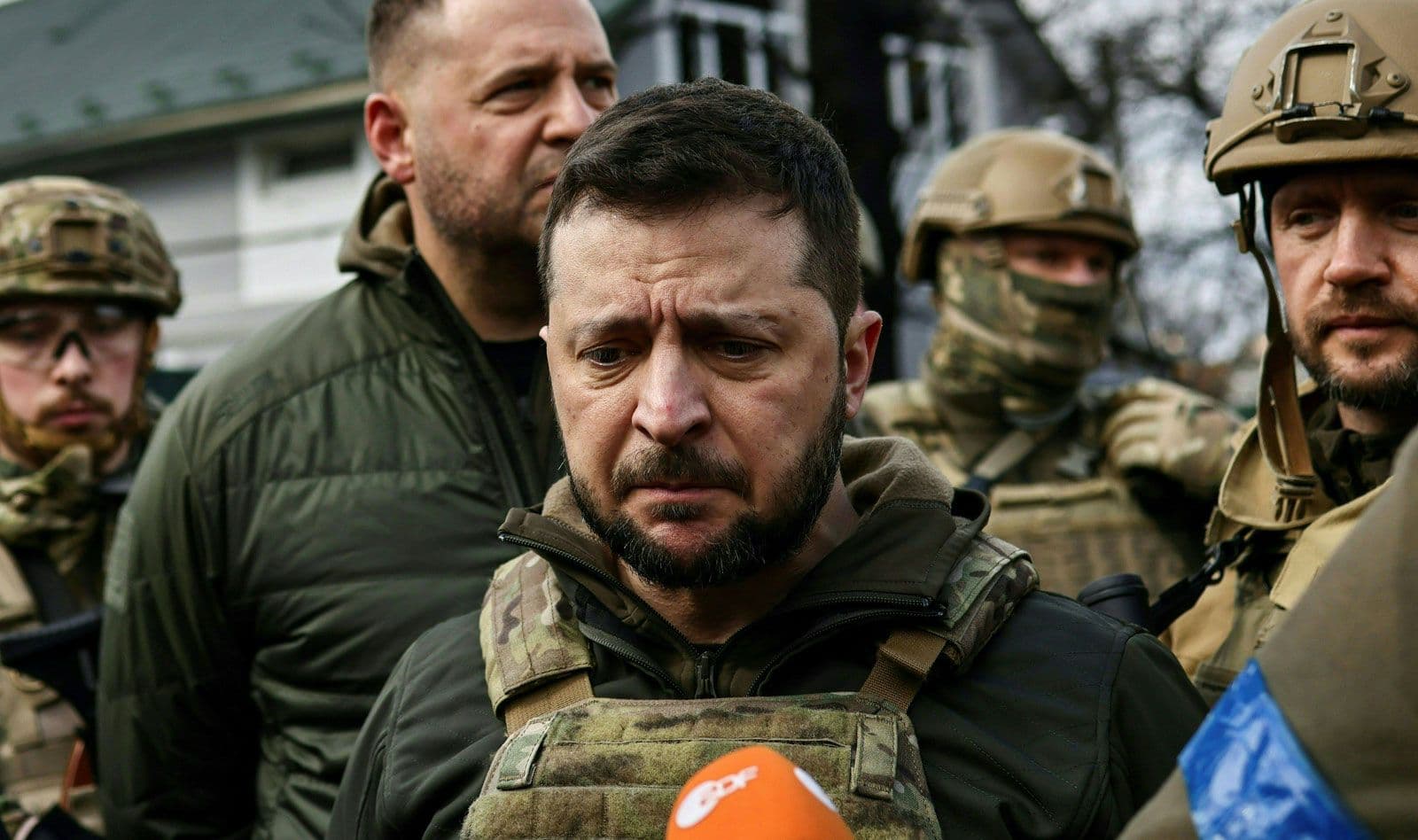
Volodymyr Zelensky's War Leadership Analysis: The Weight of Survival
There is a particular kind of exhaustion that settles into a wartime leader's face when the war they are fighting stops being simply about the enemy and starts also being about the allies. By mid-2026, Volodymyr Zelensky wears that exhaustion openly - not as defeat, but as the visible cost of managing, simultaneously, a Russian military machine that has spent four years trying to destroy his country, a Trump administration that has drifted between ally and unreliable mediator, a domestic political landscape cracked by corruption scandals and approval rating slippage, and a European security architecture he is trying to shape into something durable enough to survive whatever Washington decides to do next. That he has kept all of these plates spinning simultaneously, without breaking, is itself a form of strategic achievement that most Western commentary undervalues precisely because it looks, from the outside, more like endurance than mastery.
This report does not offer a simple verdict on Zelensky. He is not the wartime saint his 2022 global celebrity status constructed, and he is not the political survivor playing every card for personal power that his domestic critics accuse him of being. He is something more complex and more analytically interesting: a leader operating at the absolute outer limits of what any human being can sustain under conditions of existential national pressure, making consequential decisions with incomplete information, under external pressure from three directions simultaneously, and doing so without the institutional depth that more established democracies would provide. Understanding him correctly - his genuine strategic innovations, his calculated political manoeuvres, his mounting frustrations, and his structural vulnerabilities - is one of the most important analytical tasks for anyone trying to read where the Ukraine war goes next.
Executive Summary
Zelensky enters the second half of 2026 having executed a significant cabinet reshuffle designed explicitly to serve three simultaneous strategic purposes: neutralising domestic political rivals, restoring international credibility after a damaging corruption scandal, and creating the organisational architecture for a two-track approach to the war's next phase - a negotiation track and a military-technological track running in parallel, each calibrated for a different possible future. On 2 January, Ukrainian President Volodymyr Zelensky appointed General Kyrylo Budanov, the head of the country's military intelligence agency, as his new chief of staff. He also nominated Mykhailo Fedorov, head of the Ministry of Digital Transformation since 2019, as the new Defence Minister. These appointments are not routine bureaucratic rotations; they are a precisely calculated political manoeuvre that simultaneously pulls Ukraine's most popular and potentially most threatening political rival into the tent, signals technological modernity to Western partners, and positions Zelensky to deflect blame if peace talks fail while claiming credit if they succeed.
His relationship with Washington, which began 2026 with cautious, controlled public warmth while managing deep private frustration, has deteriorated visibly through the spring. In just two months, President Volodymyr Zelensky shifted from being the first world leader to back a U.S. military operation in the Middle East to openly criticising Washington's foreign policy. By April, he had publicly called Trump's envoys Steve Witkoff and Jared Kushner "disrespectful" for visiting Moscow without coming to Kyiv first - a deliberate, calculated break from the months of public restraint that represents Zelensky's own assessment that quiet diplomatic accommodation of Trump's erratic process is no longer yielding sufficient results to justify the political cost of appearing supine. His pivot toward European partners - the UK-France coalition of the willing military hub commitment, the sustained investment in bilateral security relationships with Poland, Germany, and the Nordic states - is the most consequential strategic shift in Ukrainian foreign policy since February 2022, and it reflects a sober assessment in Kyiv that Washington's reliability as a security guarantor cannot be taken for granted for the duration of a conflict with no clear end date.
The central analytical assessment: Zelensky has survived four years of existential military pressure with his strategic core intact, his political authority damaged but not broken, and his international positioning significantly diversified from dangerous over-dependence on a single American patron. What he has not yet done - and what 2026 has made clearer than any previous year - is convert battlefield resilience and diplomatic endurance into a durable political settlement that does not require Ukraine to either capitulate on its sovereignty principles or sustain this level of mobilisation indefinitely. That gap between battlefield survival and political resolution remains the defining strategic challenge of his leadership.
Background
Zelensky's leadership arc from February 2022 to mid-2026 is, in many ways, the most remarkable individual political transformation in recent history. A television comedian and political outsider who won Ukraine's 2019 presidential election on an anti-corruption, peace-with-Russia platform, he spent his first two years in office struggling to manage relations with an entrenched political establishment, a powerful oligarchic media class, and a Kremlin that had publicly dismissed him as an unserious interlocutor. His approval ratings before the invasion hovered in the low thirties.
The invasion transformed him. His decision to stay in Kyiv on the war's first night - captured in the now-famous selfie video from outside the Presidential Office - was a genuine inflection point in both the war's trajectory and his own political identity. It was a moment that could not have been calculated in advance, because no political consultant would have recommended it: staying meant accepting the very real possibility of capture or death, and the genuine courage involved in that choice is the foundation on which every subsequent dimension of his wartime leadership has been built. What followed - the extraordinary rhetorical campaign that rallied Western publics and governments to Ukraine's cause, the constant battlefield visits that sustained troop morale, the direct engagement with parliamentary audiences from London to Washington to Berlin and Jerusalem - represented a form of diplomatic mobilisation without modern precedent, converting Ukraine's existential vulnerability into a moral and strategic case that generated unprecedented levels of Western military and financial support.
But the global celebrity status of 2022-2023 created its own liabilities. The gap between Zelensky's carefully constructed global image and the messy realities of wartime governance - corruption inside his own administration, the accumulation of political power around his chief of staff Andriy Yermak, the July 2025 move to curb anti-corruption bodies that triggered mass protests, and the subsequent energy sector kickback scandal that led to Yermak's resignation - has progressively complicated the moral clarity that his international positioning depends on. By 2026, Zelensky is governing a country that has been at war for four years, under martial law that indefinitely postpones elections, with approval ratings significantly below their wartime peak, managing a public increasingly exhausted by mobilisation demands and economic hardship alongside the unrelenting physical threat from Russian aerial attacks.
Current Situation
The Cabinet Reshuffle: Calculation Dressed as Rotation
The January 2026 cabinet reshuffle is the most revealing single set of decisions Zelensky has made about his political strategy since the war began, and it deserves careful disaggregation. The shake-up was essential after corruption scandals. But the new appointments also aim to strengthen Ukraine amid aggressive US foreign policy and an intense Russian assault.
Budanov's appointment as chief of staff is the centrepiece. Budanov has earned a reputation as a skilful and pragmatic interlocutor. He oversaw audacious operations such as special forces landings in occupied Crimea, naval drone strikes on the Russian Black Sea Fleet, and targeted assassination and sabotage operations inside Russia. He has also been involved in negotiations over prisoner exchanges with Russia and has successfully navigated the different camps within the Trump administration. This is a figure who combines genuine military-intelligence credibility, existing relationships with American officials across the administration's competing camps, a track record of operations that resonate strongly with Ukrainian nationalist sentiment, and - crucially - recent opinion polls consistently placing him in the top three most popular and trusted figures in the country, with one survey suggesting he would likely defeat Zelensky in a hypothetical election runoff.
The political logic of the appointment is therefore as important as its diplomatic rationale. By bringing this significant potential political challenger into his administration, Zelensky can neutralise him as an outside rival in case elections - consistently pushed for by Washington - go ahead. Significantly, this appointment will also allow Zelensky to share, even shift blame onto Budanov for any failure in peace talks. This is sophisticated political management, not cynicism - every wartime leader consolidates power and manages rivals; the question is whether the resulting governance structure serves the war effort, and Budanov's appointment does improve Ukraine's actual negotiating and intelligence capacity even as it simultaneously serves Zelensky's political interests.
Fedorov's appointment as Defence Minister signals a different but equally deliberate strategic choice. A digital transformation specialist rather than a military figure, his elevation reflects a "two-track strategy" focused on strengthening Ukraine in peace negotiations whilst prioritising technological scaling should the war with Russia continue. The framing - peace track and technology track simultaneously - is the clearest public statement yet of Zelensky's actual 2026 strategic posture: he is genuinely pursuing a negotiated settlement through every available diplomatic channel while simultaneously building the drone, cyber, and electronic warfare industrial capacity for a war that could last significantly longer than any current peace timeline suggests.
Managing Trump: Restraint to Rupture
No dimension of Zelensky's 2026 leadership has required more precise calibration, or produced more visible strain, than his management of the Trump relationship. The strategic dilemma he faced entering 2026 was stark and binary: maintain the public restraint that kept Washington nominally engaged in Ukraine's cause at the cost of appearing to accept an increasingly problematic American mediation process, or break publicly with Washington at the cost of accelerating the very American disengagement that has been Kyiv's most persistent nightmare.
For months, restraint dominated. For months, that approach meant restraint. Standing shoulder to shoulder with Trump in December, after talks aimed at reviving negotiations with Russia, Zelensky offered little more than a controlled smile when the U.S. president declared that "Russia wants to see Ukraine succeed." "It sounds a little strange, but Putin was very generous in his feelings toward Ukraine succeeding," Trump said, even as Russia continued mass attacks targeting civilian infrastructure. The gap between that public warmth and Kyiv's private assessment is captured in the Brookings analysis of April 2026, which notes that a Ukrainian journalist commented that Ukraine now hopes for little more from the United States than intelligence support, Patriot missiles purchased for Ukraine by NATO members, and that Washington will not pressure Kyiv to agree to an unacceptable deal. A retired senior Ukrainian diplomat observed that Ukraine "is losing" the United States as a strategic partner.
The breaking point came gradually, then suddenly. Three specific American actions triggered Zelensky's visible shift from managed restraint to open criticism. First, Trump's envoys Witkoff and Kushner visited Moscow on January 22 without stopping in Kyiv - a protocol failure that Zelensky characterised bluntly and publicly: "It's disrespectful to come to Moscow and not Kyiv, it's just disrespectful." Second, the Iran war's outbreak in February consumed American diplomatic bandwidth and military resources, directly competing with Ukraine for Patriot missile ammunition and Washington's attention at a moment when Russian aerial attacks were intensifying. Zelensky warned that Patriot deliveries to Ukraine are falling dangerously short as the Iran war diverts U.S. stocks, writing: "For us - for a nation fighting for its survival - there is hardly anything more painful to see than Patriot batteries with no missiles loaded." Third, Trump's reported remarks to European leaders after the Anchorage summit - suggesting he supported Kyiv ceding all of Donetsk province to Moscow - became public knowledge in a way that made continued Ukrainian silence politically untenable. On March 25, Zelensky told the press that American officials had linked a bilateral U.S. security guarantee for Ukraine to Kyiv's agreement to cede all of Donetsk to Russian control. Rubio angrily denied that.
By April, Zelensky was directly criticising JD Vance for praising the halt of American military aid to Ukraine, openly questioning the entire American mediation process's fairness, and signalling through every available channel that Ukraine's strategic centre of gravity was shifting from Washington toward European partners. This is not a breakdown of relations; it is a deliberate recalibration of Kyiv's external dependency architecture - one that Zelensky has concluded, correctly in this report's assessment, is strategically necessary regardless of its short-term diplomatic costs.
The Military Situation: Resilience Through Innovation
The battlefield dimension of Zelensky's leadership in 2026 is characterised by a striking asymmetry: Ukraine faces a Russia with massive numerical superiority in personnel and artillery, yet continues extracting disproportionate costs through technological and tactical innovation. Ukraine has pounded Russian targets, especially oil facilities and manufacturing plants, with its domestically produced drones. Ukraine has raised its drone interception rate to more than 90%. The domestically produced long-range strike drone programme - which has hit Russian oil infrastructure, military bases, and strategic targets deep inside Russia - represents Zelensky's most important single investment in Ukraine's long-term military independence, reducing reliance on foreign-supplied weapons for offensive capability while sustaining the strategic pressure on Russia's war economy that remains one of the few available levers for forcing a genuine negotiation.
The Patriot missile shortage, however, is a critical vulnerability that no amount of domestic drone production can compensate for. Russia fired almost 90 missiles as well as hundreds of drones at Kyiv in a single weekend in an effort to overwhelm air defenses. Ukraine's air defence architecture has performed remarkably against this onslaught, but its continued effectiveness depends on Patriot PAC-3 interceptor resupply that the Iran war has materially disrupted. This is perhaps the most concrete and immediate way in which the Trump administration's Middle East military engagement directly threatens Ukrainian military survival - not through any policy decision, but through the physical competition for finite American air defence munitions between two simultaneous high-intensity conflicts.
The technological scaling strategy embedded in Fedorov's Defence Ministry appointment reflects a clear-eyed understanding of this vulnerability. Ukraine cannot indefinitely sustain its military effectiveness through imported foreign munitions subject to political decisions in Washington; it must build the domestic production capacity for the systems its forces depend on. Ukrainian specialists have helped countries in the Middle East - specifically the Gulf Arab region - strengthen air defenses, a remarkable development in which Ukraine's own hard-won expertise in defending against Russian aerial attack is becoming a tradeable capability, generating both revenue and diplomatic influence with Gulf states whose alignment matters in the Trump-era global calculus.
Diplomacy Diversified: The European Pivot
The most strategically consequential shift in Zelensky's approach through 2026 is the systematic, accelerating investment in bilateral European security relationships as the primary anchor of Ukraine's strategic positioning - supplementing rather than replacing the American relationship, but no longer treating Washington as the indispensable, irreplaceable centre of Ukraine's external support architecture. The UK-France coalition of the willing military hub commitment inside Ukraine, the detailed Paris negotiations that assembled European leaders around a security guarantee framework in January, the bilateral security cooperation agreements with Poland, Germany, and the Nordic states - all of these reflect a Zelensky who has concluded that European strategic autonomy and European security guarantees, however imperfect, are more durable than commitments from an American president whose interest in Ukraine fluctuates with his personal relationship with Putin and his domestic midterm calculus.
This European pivot also reflects a sophisticated reading of European strategic psychology. The UK and France's commitment to establishing military hubs inside Ukraine - unprecedented in its directness - was partly Zelensky's achievement, built through sustained personal diplomacy with Macron and Starmer that invested heavily in their individual political stakes in Ukraine's outcome. His understanding that European leaders need to feel personally invested rather than institutionally obligated to maintain support for Ukraine is one of the more underappreciated tactical sophistications of his diplomatic approach.
Strategic Analysis
The defining strategic tension in Zelensky's 2026 leadership is between two goals that are increasingly difficult to pursue simultaneously: maintaining the negotiating flexibility needed to reach any durable settlement with Russia, and maintaining the domestic political legitimacy needed to sustain a society at war indefinitely if no settlement emerges. Every concession that might accelerate a negotiated peace - territorial acknowledgement, delayed NATO membership aspirations, acceptance of an American-mediated framework that implicitly recognises Russian gains - carries domestic political costs in a country whose population has paid four years of extraordinary sacrifice for the principle that Russia's territorial seizures cannot simply be ratified through exhaustion.
Zelensky's two-track strategy - simultaneous pursuit of negotiation and military-technological investment - is his attempt to escape this tension by keeping both options genuinely available. But the strategy has its own structural tension: meaningful progress on the negotiation track requires signalling flexibility to Moscow through Washington, while meaningful progress on the military-technological track requires sustaining domestic mobilisation and sacrifice for a war that the negotiation track implies might end. Managing both simultaneously, without the domestic political legitimacy that regular elections would provide, is the governing challenge of 2026.
The corruption dimension cannot be separated from the strategic analysis. The president's approval ratings suffered after a contentious move in July to curb the independence of anti-corruption bodies, triggering widespread protests. They dipped again after the more recent kickback scandal in the energy sector. These are not peripheral governance problems - they are direct threats to the moral authority that has been Zelensky's primary source of international support. Every major Western democracy that has sustained Ukraine's cause has done so partly on the basis of a narrative about Ukraine as a democracy fighting for its survival; corruption scandals inside the Presidential Administration undermine that narrative with precisely the audiences - European parliamentary coalitions, American congressional committees, institutional donors - whose continued support depends on believing in the cause they are backing.
The Budanov appointment addresses this partly - his personal credibility is untainted by the scandals that damaged Yermak - but the structural incentives that produce corruption inside a wartime patronage economy have not been eliminated by any personnel change. Zelensky's long-term governing challenge is building institutional anti-corruption capacity rather than managing the political fallout of individual scandals, a task considerably harder than the personal diplomacy at which he excels.
Global Impact
Zelensky's war leadership carries consequences well beyond Ukraine's borders, and several are directly relevant to the Indo-Pacific and South Asian audiences Global Chanakya serves. The most significant is the model his leadership has created for smaller democracies facing existential pressure from authoritarian neighbours: the combination of determined military resistance, sophisticated diplomatic mobilisation across multiple great-power relationships, domestic drone and defence manufacturing investment as a sovereignty-preservation strategy, and the willingness to publicly criticise even essential partners when their conduct undermines the underlying cause - all of these are transferable lessons with direct relevance for Taiwan, for the Philippines, and for any state calculating how to sustain national resistance against a larger authoritarian power with nuclear cover.
Ukraine's drone warfare innovation is itself a global strategic development. The country that entered 2022 largely dependent on Western weapons for its military effectiveness has, by 2026, developed a domestic strike drone capability sufficient to hit targets deep inside Russia - oil facilities, military bases, airfields - and has begun transferring its expertise to Gulf state air defence operators. This trajectory toward technological military independence, driven by the political necessity of reducing dependence on externally supplied weapons, is one of the more remarkable defence-industrial transformations in the history of modern warfare, and it carries direct implications for how smaller states globally think about building indigenous military capability.
For Europe, Zelensky's diplomatic pivot toward bilateral security relationships over collective NATO-mediated engagement has accelerated the European strategic autonomy process in ways that will outlast his presidency. The UK-France military hub commitment inside Ukraine would have been unthinkable two years ago; it is now established policy. The German defence budget trajectory, the Polish military buildup, the Nordic states' accelerated defence cooperation - all of these have been shaped partly by Zelensky's sustained, direct diplomatic engagement with individual European leaders, investing in their personal political commitment to Ukraine's cause rather than simply lobbying institutional forums.
Risk Assessment
- Patriot missile shortage reaching critical threshold: Ukraine relies "almost exclusively on the United States" for Patriot anti-missile systems, and deliveries are "no longer keeping up with the reality of the threat we face." A sustained gap in Patriot PAC-3 resupply while Russian aerial attack intensity increases risks degrading Ukraine's air defence architecture in ways that could cause civilian and infrastructure casualties sufficient to force a premature ceasefire on Russian terms.
- Domestic legitimacy erosion: Martial law indefinitely postpones elections, making every major decision by Zelensky's government technically unaccountable to democratic mandate. Washington has repeatedly pushed for elections as a condition of continued support; if that pressure intensifies, the domestic political risks of holding elections during active war - and the risks of not holding them - both become acute.
- Settlement terms forcing sovereignty compromise: Trump reportedly told European leaders he supported Kyiv ceding all of Donetsk province to Moscow. Any American-mediated settlement framework that requires Zelensky to formally recognise or de facto accept Russian control over occupied Ukrainian territory risks triggering the very domestic political crisis that could destabilise his government - an outcome that would paradoxically undermine the settlement it was designed to produce.
- Budanov political trajectory: Pulling Ukraine's most popular potential rival into the chief of staff role contains him only as long as the relationship functions and the war continues. A peace settlement outcome that requires controversial concessions could fracture the Zelensky-Budanov partnership, producing exactly the high-profile political rupture that the appointment was designed to prevent.
- American aid unpredictability: Washington's public messaging, weapons uncertainty, and what Ukrainian officials describe as broken promises are fuelling frustration in Kyiv. An administration that diverts Patriot missiles to the Gulf and then cannot guarantee resupply timelines is an ally whose commitments cannot be operationally planned around - a fundamental problem for any military force trying to sustain air defence continuity.
- Russian energy infrastructure strikes on Ukraine: Russia's sustained campaign against Ukraine's energy grid - the driver behind moving Shmyhal from Defence to Energy - represents the slow-motion attrition strategy Putin has adopted as a substitute for battlefield breakthrough: not defeating Ukraine militarily, but making civilian life sufficiently painful that political will to continue the war eventually erodes.
Zelensky's most underappreciated strategic achievement is not any single military success or diplomatic breakthrough - it is keeping Ukraine's resistance coherent, its society mobilised, and its international support coalition sufficiently intact through four years of simultaneous military, economic, and political pressure without the institutional resources that any comparable task would normally require.
Future Scenarios
Scenario Analysis
The following scenarios are illustrative projections built from current trajectories, intended for strategic stress-testing rather than presented as confirmed predictions.
Scenario One: Managed Frozen Conflict With European Security Guarantees (40% probability)
A ceasefire arrangement is reached through a combination of American mediation and European security guarantee commitments that provides Ukraine with sufficient political cover to accept a temporary de facto territorial freeze without formally recognising Russian sovereignty over occupied regions. Zelensky frames this as a pause-not-surrender, backed by the UK-France military hub commitment and continued arms supply. Domestically, this outcome is manageable if Zelensky can credibly sustain the narrative that Ukraine's territorial integrity remains legally intact and that the security guarantees provide genuine protection against renewed Russian attack. Budanov's presence in the chief of staff role provides institutional credibility for the military track even as negotiations proceed.
Scenario Two: Prolonged War With Accelerated European Support (30% probability)
Peace negotiations fail to produce a durable ceasefire; Russia's unwillingness to compromise on territorial terms confirmed by the "After Victory" documents becomes operationally undeniable. Zelensky successfully redirects Ukrainian strategic posture toward the military-technology track embedded in Fedorov's Defence Ministry mandate, sustaining and deepening European bilateral security relationships while managing American engagement at the margins. Ukraine's domestic drone production capacity continues advancing, reducing but not eliminating dependence on Western supply chains. The conflict continues at current intensity or higher through 2027 without decisive territorial shifts.
Scenario Three: American Pressure Forces Unacceptable Settlement (20% probability)
The Trump administration, driven by midterm political considerations and frustration with the conflict's intractability, escalates pressure on Kyiv to accept settlement terms that formally or de facto recognise Russian territorial gains in Donbas. Zelensky faces the most consequential decision of his leadership: accept terms that could produce a domestic political crisis sufficient to destabilise his government, or refuse terms that risk American disengagement and the support collapse that follows. This scenario produces maximum internal Ukrainian political instability and maximum risk of the security architecture built around American backing fracturing permanently.
Scenario Four: Ukrainian Military Breakthrough Changes Terms (10% probability)
Continued Ukrainian deep strikes on Russian energy infrastructure, military bases, and supply lines - combined with Russian war economy strain confirmed by the leaked "After Victory" planning documents - produce sufficient Russian domestic political pressure to generate a genuine negotiating shift in Moscow's terms, opening the possibility of a settlement less disadvantageous to Ukraine than current proposals. This scenario is low probability but not negligible, given that Russia's own internal documents reveal more genuine elite anxiety about the war's costs than Putin's public posture suggests.
Intelligence Forecast
Global Chanakya's twelve-to-eighteen month assessment of Zelensky's leadership trajectory focuses on five converging dynamics. First, watch the Patriot missile resupply timeline as the single most consequential near-term indicator of whether Ukraine's air defence architecture can sustain the current threat level - a sustained shortfall creates both military and political consequences that could force premature negotiating concessions regardless of any other diplomatic development. Second, expect the Zelensky-Budanov relationship to be the key domestic political variable: as long as it functions coherently, Ukraine's two-track strategy retains credibility; if it fractures over a peace deal's terms, the resulting political crisis could be more destabilising than any Russian military action. Third, expect continued, visible public criticism of American mediation to escalate rather than moderate - Zelensky has concluded that strategic ambiguity about Washington no longer serves Ukraine's interests and that publicly naming the problem creates more useful pressure on the Trump administration than sustained, absorbed silence. Fourth, watch Ukraine's domestic drone production trajectory closely as the most important long-term indicator of whether Zelensky's military-technology track is actually building the capability it promises - every increase in Ukrainian independent strike capability reduces the strategic leverage Washington's aid decisions give the Trump administration. Fifth, and most broadly, expect European security relationships to continue deepening as Ukraine's primary strategic anchor, with the UK and France in particular investing politically in arrangements that will outlast both the Trump administration and the current phase of the conflict.
For India's strategic planners, Zelensky's experience carries a direct lesson relevant to the multialignment doctrine: over-dependence on any single great power's security commitment, however historically established, carries catastrophic vulnerability when that power's domestic political environment shifts in ways that its security partners cannot influence or predict. Ukraine's most consequential strategic error of the pre-2022 decade was not military under-investment - it was allowing its security architecture to remain dependent on American commitments whose durability was ultimately a function of American domestic politics over which Kyiv had no leverage. Building the redundancy of security relationships that Ukraine is now constructing under wartime pressure is considerably cheaper and less dangerous when done before the existential crisis arrives.
Final Strategic Takeaway
Volodymyr Zelensky's war leadership in 2026 is a masterclass in the most difficult form of statecraft: managing national survival under conditions of simultaneous external military threat, unreliable great-power partnership, domestic political erosion, and resource constraint without the institutional depth that established democracies would provide. He has not managed it perfectly - the corruption scandals, the anti-corruption body curbs, the accumulated tensions with Washington - but he has managed it with a strategic coherence and personal resilience that has repeatedly defied the predictions of analysts who did not account for the combination of genuine courage and sophisticated political calculation that defines his leadership. The two-track strategy of 2026 - peace negotiations and military-technological investment pursued simultaneously, European security relationships deepened as Washington's reliability declines, domestic political rivals absorbed rather than confronted - reflects a leader who has learned, through four years of the most intensive strategic education imaginable, to play every available hand at once because he cannot afford to wait for a better deal. Whether those hands are enough to produce a settlement that preserves Ukraine's essential sovereignty without requiring an indefinite state of war is the question that will define not just Zelensky's legacy, but the trajectory of European security for a generation.