
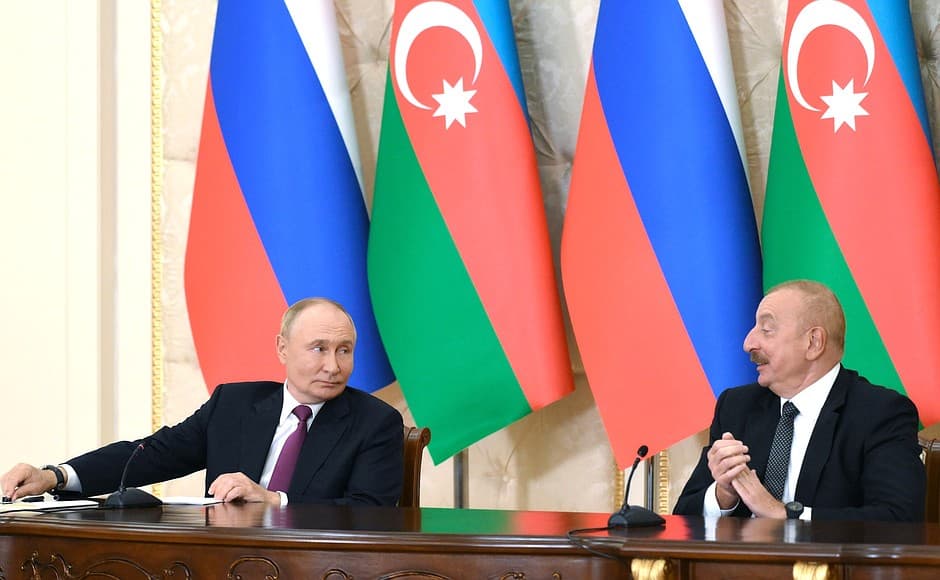
Azerbaijan's Quiet Leverage: Why the World's Smallest Big Player Matters to Putin
Executive Summary
Azerbaijan has roughly ten million people, no seat at any great-power table, and a military built primarily for one theater: Nagorno-Karabakh. And yet over the past five years it has become one of the more consequential swing states in Eurasian geopolitics, simultaneously hosting Russian energy and diplomatic engagement, deepening security cooperation with Turkey and Israel, anchoring the Western-aligned Middle Corridor, and now hosting a ninety-nine-year American development lease on the Zangezur transit corridor through the South Caucasus. This report examines how Baku has converted geography, energy assets, and calculated ambiguity into leverage disproportionate to its size, why Moscow continues to court President Ilham Aliyev even as the Kremlin's regional position erodes, and what Azerbaijan's balancing act signals about the broader contest for the South Caucasus.
The core finding is that Azerbaijan's value to outside powers, including Russia, is not military but transactional and infrastructural: it sits at the junction of every major corridor competing to move Central Asian and Caspian energy and trade around Russia and Iran, while remaining diplomatically unwilling to fully break with Moscow. That ambiguity is not indecision. It is Baku's central strategic asset.
Strategic Background
Azerbaijan's leverage rests on four pillars. First, hydrocarbons: Azerbaijan is a significant oil and gas exporter to Europe via the Baku-Tbilisi-Ceyhan pipeline and the Southern Gas Corridor, giving it a role in European energy diversification away from Russian supply that far exceeds its production volumes in absolute terms. Second, geography: Baku sits on the western shore of the Caspian, making it the essential Caucasus link for both the Russia-Iran-oriented International North-South Transport Corridor and the Western- and China-aligned Middle Corridor. Third, its 2020 and 2023 military victories over Armenia in Nagorno-Karabakh, achieved with decisive Turkish and Israeli military-technology support, reset the regional balance of power and ended Russia's post-Soviet role as the South Caucasus's uncontested security guarantor. Fourth, and most recently, the August 2025 US-brokered Armenia-Azerbaijan peace agreement and the associated Zangezur transit corridor, rebranded the Trump Route for International Peace and Prosperity, has given Washington a direct infrastructural stake in the region for the first time, with Baku as the indispensable counterparty.
Historical Context
Azerbaijan's post-Soviet foreign policy has been defined by a consistent refusal to fully align with any single patron. Baku joined neither the Russia-led Collective Security Treaty Organization nor NATO, instead cultivating parallel relationships with Moscow, Ankara, and, more discreetly, Jerusalem, which has supplied Azerbaijan with advanced drone and air-defense technology in exchange for Azerbaijani oil and a listening post near Iran's northern border. This multi-vector approach paid its largest dividend in the 2020 Second Nagorno-Karabakh War, when Azerbaijan, backed by Turkish military doctrine and Israeli-made loitering munitions, reversed nearly three decades of Armenian territorial control. Russia, Armenia's nominal treaty ally through the CSTO, did not intervene, a non-response Yerevan has never fully forgiven and one that fundamentally altered the region's threat perception of Moscow as a reliable guarantor. A follow-on Azerbaijani offensive in September 2023 completed the dissolution of the Nagorno-Karabakh separatist entity, ending Russia's peacekeeping mandate there entirely by 2024.
The relationship's most serious strain came in December 2024, when an Azerbaijan Airlines passenger jet was damaged by Russian air-defense fire near Grozny before crashing in Kazakhstan, killing dozens. Baku's public anger and demand for accountability marked the lowest point in bilateral relations in years. Yet within eighteen months, Aliyev and Putin were back to routine, warm diplomatic exchange, including a June 2026 letter from Aliyev marking Russia Day that referenced centuries of friendship and a two-year, 2026-2027 Azerbaijan-Russia foreign ministry consultations plan signed in Moscow. That pattern - visible friction followed by rapid normalization, with Baku declining to impose any lasting cost on Moscow - is itself the clearest evidence of how Azerbaijan operates: grievances are registered, not weaponized, because the relationship's transactional value outweighs the reputational cost of a public rupture.
Current Situation Assessment
As of mid-2026, Azerbaijan is simultaneously deepening ties with Russia and reducing its strategic dependence on the relationship. Aliyev and Putin have maintained frequent direct contact, including a late-July 2026 phone call in which the Kremlin described relations as constructive and dialogue as intensifying - notably occurring the day after a separate Putin call with Armenian Prime Minister Nikol Pashinyan, a sequencing Moscow appears to use deliberately to signal it retains leverage with both South Caucasus capitals simultaneously. At the same time, Baku has moved forward with construction on its portion of the Horadiz-Aghband railway, the Azerbaijani segment of the broader Zangezur Corridor, with a target of completing its side by the end of 2026 while Armenia and the United States break ground on the Armenian TRIPP segment.
Momentum on Middle Corridor development has continued independent of the Russia relationship, with Baku publicly framing corridor expansion as a priority following the Armenia peace agreement. Azerbaijan's parallel foreign ministry consultations with Moscow proceed on their own track, covering coordination in multilateral forums where Russia values Azerbaijani votes, abstentions, or resistance to isolation efforts - a low-cost form of support Baku can extend without materially undermining its Western and Turkish-aligned corridor ambitions.
Domestically, this balancing act is underwritten by an increasingly closed political system. The Parliamentary Assembly of the Council of Europe expressed alarm in mid-2026 over the treatment of critical voices in Azerbaijan, citing over three hundred reported political prisoners as of May 2026, including journalists, human rights defenders, and civil society figures. For a government insulated from meaningful domestic political constraint, maintaining warm relations with an increasingly authoritarian Russia carries little of the reputational cost it would impose on a more pluralistic system - if anything, continued Russian regional influence offers Baku a useful counterweight narrative against Western pressure on its human rights record.
Power Center Analysis
Five external powers now compete for influence in and through Azerbaijan, each with a distinct value proposition. Russia offers continuity, historical ties, and multilateral cover, but has lost its unilateral security veto over the South Caucasus and can no longer credibly threaten Baku with meaningful punishment. Turkey offers the deepest security and cultural partnership, rooted in a shared Turkic identity and Ankara's direct military role in Azerbaijan's Karabakh victories, and stands to gain the most from a completed Zangezur link, which would give Turkey unbroken overland connectivity to the Caspian and Central Asia for the first time since the early twentieth century. Israel offers advanced military technology and intelligence cooperation valuable specifically because of Azerbaijan's proximity to Iran, a relationship Baku manages carefully to avoid open confrontation with Tehran. The United States, through the Zangezur lease, has acquired its first direct infrastructural foothold in the South Caucasus, a foothold that both constrains Russian ambitions and gives Washington new leverage in unrelated negotiations, including its Ukraine diplomacy with Moscow. The European Union values Azerbaijan chiefly as a gas supplier and Middle Corridor node in its post-2022 effort to reduce Russian energy dependence, a relationship complicated by the same authoritarian governance concerns raised by the Council of Europe.
Aliyev's achievement has been to extract distinct forms of value from all five without being forced to choose decisively among them - a position sustainable only as long as none of these powers concludes that Azerbaijani alignment with a rival has become exclusive rather than parallel.
Military and Security Implications
Azerbaijan's decisive 2020 and 2023 military victories demonstrated that Turkish doctrine combined with Israeli-supplied drones and precision munitions could overwhelm a Russian-aligned adversary without triggering Russian intervention, a template other regional actors have studied closely. The Zangezur Corridor's development carries its own second-order security implication: while framed as a civilian transit and energy project under nominal Armenian sovereignty, the corridor's ninety-nine-year American development lease establishes a long-term US commercial and infrastructural presence a short distance from Iran's northern border, a fact Tehran and Moscow have both publicly criticized as encroachment. Should the corridor fully materialize, it would mark the first sustained Western infrastructural foothold directly abutting Iran's northern frontier, altering the security geometry of any future Iran-related contingency in ways that extend well beyond trade logistics.
Economic and Trade Impact
The Zangezur Corridor's core economic function is to close a long-standing gap in the Middle Corridor: once developed, it would allow goods moving from Central Asia across the Caspian to flow directly through Azerbaijan into Turkey and Europe without diversion through either Iran or Russia, materially increasing the route's reliability and throughput relative to current multimodal alternatives. That is a direct commercial threat to the Russia-Iran-backed International North-South Transport Corridor and, by extension, to Russia's ability to monetize transit fees and maintain economic relevance in Central Asia-to-Europe trade. Azerbaijan's own gas exports to Europe, meanwhile, continue to benefit from the EU's post-2022 push to diversify away from Russian supply, giving Baku a growing commercial relationship with Brussels that runs in parallel to, rather than in conflict with, its continued energy and diplomatic engagement with Moscow.
Diplomatic Positioning
Baku's diplomatic method is consistent: register objections to Russian actions that directly harm Azerbaijani interests, as it did after the December 2024 airliner incident, without allowing those objections to disrupt the underlying relationship for more than a matter of months. Simultaneously, Azerbaijan has positioned itself as indispensable to Turkey's pan-Turkic and corridor ambitions, to Israel's northern-Iran intelligence posture, and now to Washington's new South Caucasus foothold, while carefully avoiding formal bloc alignment with any of them. This is a deliberately maintained equilibrium rather than an accident of circumstance, and it explains why Moscow continues to invest diplomatic capital in Baku even as its practical leverage there diminishes: the alternative, an Azerbaijan fully captured by Turkish, American, or Israeli influence, would be a far worse outcome for Russian interests than an Azerbaijan that merely drifts.
Regional Fallout
Armenia is the most exposed party to Azerbaijan's rising leverage. Yerevan's decision to accept US management of the Zangezur Corridor reflects a broader post-2020 reassessment of Russia's reliability as a security guarantor, and Moscow has responded by reportedly encouraging nationalist and religious opposition to Pashinyan's government domestically, while publicly pressing Armenia to choose definitively between European Union and Eurasian Economic Union alignment - pressure Yerevan has so far resisted committing to outright. Georgia, as an alternative Middle Corridor route to Turkey, stands to see its relative transit importance somewhat diminished if the Zangezur route matures, even as continued Russian influence in Tbilisi complicates any straightforward Western tilt for the wider South Caucasus. Iran, watching a US-managed corridor develop along its northern border, has criticized the arrangement as an encroachment likely to harden Tehran's threat perception of both Washington and Baku.
Global Strategic Consequences
Azerbaijan's balancing act is a live test of whether small and mid-sized states can extract durable leverage from great-power competition without eventually being forced to choose sides. If Baku sustains its current position through 2027, it will stand as a template for how energy-endowed, geographically pivotal states can manage simultaneous relationships with Russia, Turkey, Israel, and the United States. If the arrangement collapses, whether through renewed Russia-Azerbaijan friction, a breakdown of the Zangezur project, or an Iran-related crisis triggered by the corridor's proximity to Tehran's border, it will demonstrate the limits of multi-vector diplomacy once a great power's core interests are directly threatened rather than merely inconvenienced.
Risk Matrix
High risk: continued low-intensity friction in the Russia-Azerbaijan relationship of the kind seen after the December 2024 airliner incident, unlikely to produce a lasting rupture given both sides' transactional incentives to normalize quickly.
Medium risk: Iranian countermeasures, diplomatic or otherwise, as the Zangezur Corridor's American-managed infrastructure matures along Iran's northern frontier; continued Russian pressure on Armenia to constrain the corridor's implementation or extract compensating concessions.
Lower probability but high consequence: a renewed Armenia-Azerbaijan military crisis that draws in Turkish and Russian competing interests simultaneously, or a decision by Washington to leverage its new Zangezur foothold in ways that force Baku into a more binary alignment choice than it has managed to avoid so far.
Scenario Analysis
Base Scenario (Medium-High probability): Azerbaijan continues its multi-vector balancing act largely unchanged through 2027, maintaining warm but circumscribed ties with Moscow while advancing Zangezur Corridor construction, deepening Turkish and Israeli security cooperation, and expanding European energy exports, with no single relationship becoming exclusive.
Bull Scenario (Low-Medium probability): The Zangezur Corridor is completed on schedule and becomes a genuinely transformative Middle Corridor artery, cementing Azerbaijan's role as an indispensable Eurasian transit hub, drawing further Western and Gulf investment, and durably reducing Russian and Iranian transit leverage in the South Caucasus.
Bear Scenario (Low but non-trivial probability): Renewed Russia-Azerbaijan friction, an Iranian response to the American-managed corridor's proximity to its border, or a stalling of Armenian domestic consensus disrupts Zangezur implementation, forcing Baku into a harder alignment choice and reviving the South Caucasus as an active flashpoint between Russian, Turkish, Iranian, and American interests.
Intelligence Forecast (6-24 Months)
Over the next six to twelve months, watch for the pace of Azerbaijani construction on the Horadiz-Aghband railway relative to Baku's stated end-2026 target, and for the tempo of Armenian-American groundbreaking on the TRIPP segment, as the clearest indicators of whether the corridor moves from agreement to physical reality. Over twelve to twenty-four months, the more consequential signal will be whether Moscow's continued diplomatic warmth toward Aliyev translates into any substantive Russian re-engagement in South Caucasus security architecture, or whether it remains, as it has been since 2020, primarily symbolic. This forecast reflects scenario-based analytical judgment rather than confirmed future developments and should be revisited as Zangezur construction milestones are reached or missed.
Final Strategic Takeaway
Azerbaijan's leverage does not come from military weight or economic scale; it comes from occupying a geographic and infrastructural chokepoint that every major power with interests in Eurasian trade and energy now needs simultaneously. Moscow's continued courtship of Aliyev, even after losing its security veto over the region, is a rational response to that reality: better a Baku that remains diplomatically ambiguous than one that tilts irreversibly toward Ankara, Washington, or Jerusalem. The durability of Azerbaijan's position through 2027 will be one of the clearer tests available of how far multi-vector diplomacy can be stretched before a great power forces a binary choice.
Global Chanakya Assessment
The conventional framing of Azerbaijan as a Turkish client state understates Baku's independent agency; Aliyev has been careful to ensure that no single patron, including Ankara, gains a veto over Azerbaijani decision-making, a distinction that will matter increasingly as Turkey's own regional ambitions expand alongside a completed Zangezur Corridor. A contrarian read worth weighing seriously: Russia's rapid, near-automatic normalization with Baku after the December 2024 airliner incident was not weakness but calculation - Moscow assessed, correctly, that Azerbaijan had no interest in a lasting rupture either, and that public anger could be absorbed without any change in the underlying transactional relationship. That calculus reveals more about the durability of small-state hedging strategies than most commentary on the incident acknowledged at the time. The most underreported risk in the current configuration is Iranian, not Russian: a US-managed transit corridor maturing along Iran's northern border, in a period when Tehran's threat perception of Washington is already at its highest point in years, is a slower-burning but potentially more destabilizing variable than continued Russia-Azerbaijan diplomatic contact. Key indicators to monitor for a shift in Baku's balancing position include any Azerbaijani vote or abstention pattern in multilateral forums that breaks from its historical support for Russian positions, the pace of Horadiz-Aghband railway construction against its end-2026 target, and any Iranian statement or action directly targeting Zangezur Corridor infrastructure or personnel.
Implications for India: Azerbaijan's rise as a Middle Corridor anchor is a double-edged development for New Delhi. India's own International North-South Transport Corridor investment, routed through Iran and Russia, faces growing competition from a Zangezur-completed Middle Corridor that explicitly bypasses both. India's opportunity lies in diversifying rather than choosing: deepening direct bilateral energy and defense ties with Baku, which already has a substantive defense-technology relationship with Israel that parallels India's own, while continuing to develop Chabahar and INSTC as a hedge rather than a singular bet. For Indian foreign policy, closer engagement with Azerbaijan offers a low-cost way to build South Caucasus relationships independent of Pakistan-aligned Turkey's growing regional weight. For Indian defense planning, Azerbaijan's 2020 and 2023 campaigns offer a closely studied template for drone-centric, technology-enabled conventional warfare. For Indian businesses, Baku's energy and transit infrastructure represents a growing, if still modest, market adjacent to both Gulf and Central Asian trade flows.
Implications for the Global South: Gulf states with growing defense-technology ties to Israel will watch Azerbaijan's model of parallel Israeli and Turkish security cooperation closely. Central Asian states, particularly Kazakhstan and Turkmenistan, have a direct commercial stake in Zangezur's completion as the missing link in Middle Corridor connectivity to Turkey and Europe.
Indicators to Monitor
- Pace of Azerbaijani construction on the Horadiz-Aghband railway against the end-2026 target
- Groundbreaking and construction progress on the Armenian TRIPP/Zangezur segment
- Frequency and substance of Aliyev-Putin contact, and any shift in tone following diplomatic friction
- Iranian statements or actions regarding the US-managed Zangezur Corridor
- Azerbaijani voting or abstention patterns in multilateral forums on Russia-related resolutions
- European Union gas import volumes from Azerbaijan and Southern Gas Corridor capacity expansions
- Council of Europe and PACE reporting on Azerbaijan's domestic political environment
- Israeli and Turkish defense-technology agreements with Baku
FAQ
Why does Russia keep courting Azerbaijan despite losing influence there? Because Moscow has concluded that a diplomatically ambiguous Azerbaijan, one that maintains warm ties with Russia alongside its Turkish, Israeli, and American relationships, is a far better outcome than an Azerbaijan that tilts irreversibly toward any single rival power.
What is the Zangezur Corridor and why does it matter? It is a transit route through southern Armenia connecting mainland Azerbaijan to its Nakhchivan exclave and onward to Turkey, now under a ninety-nine-year US development lease as the Trump Route for International Peace and Prosperity. It closes a key gap in the Middle Corridor, letting Central Asian and Caspian trade reach Turkey and Europe without passing through Russia or Iran.
Did the December 2024 airliner incident change the Russia-Azerbaijan relationship? It caused a genuine and public rupture in relations, but both governments moved to normalize ties within roughly a year and a half, reflecting the transactional durability of the relationship rather than any lasting realignment.
How does this affect India? A completed Middle Corridor anchored by Azerbaijan is a competitive threat to India's INSTC investment through Iran and Russia, arguing for New Delhi to diversify its Eurasian connectivity bets rather than rely on a single corridor.
Could Iran respond to the Zangezur Corridor militarily or diplomatically? Iran has already criticized the US role in the corridor as encroachment near its northern border. Whether this develops into more active countermeasures remains uncertain and depends heavily on the broader trajectory of US-Iran relations.