
Europe's Missile Gap: Why the Continent Can't Build Its Own Deep-Strike Force Yet
Executive Summary
In the summer of 2026, twelve European NATO members gathered in Ankara and pledged fifty billion dollars over ten years to build a sovereign deep-strike capability. The announcement was framed as historic, and in one narrow sense it was - the political will to act has rarely been more visible on the continent. But fifty billion dollars committed to systems that will not enter service until the early 2030s at the earliest, and in the most capable configurations not until the mid-2030s, does not solve the problem that the announcement was designed to address. It describes an intention to solve it, at a time when the threat environment that made the investment necessary has already arrived, the American bridging capability that was supposed to tide Europe over has just been cancelled, and the Russians have spent four years watching every Western deep-strike system perform in operational conditions and adapting their own doctrine accordingly.
This is Europe's missile gap. Not a rhetorical gap, not a budget-narrative gap, but a documented, measurable, operationally consequential absence of the capability to hold high-value targets deep inside an adversary's territory at risk from the ground, on a sustained basis, with adequate stockpiles, supporting intelligence infrastructure, electronic warfare suppression, and command integration. The wars in Ukraine and the Persian Gulf have demonstrated that this capability - the ability to continuously strike logistics, communications, energy infrastructure, and military production deep behind front lines - is now the central instrument through which modern state-on-state conflicts are decided. Europe collectively lacks it. Russia possesses it in abundance. And the timeline to close that gap does not meet the timeline of the threat.
Strategic Background
The roots of Europe's deep-strike deficit run directly and specifically to decisions made in the decade after the Cold War ended. When the Soviet Union collapsed and the Warsaw Pact dissolved, European NATO members made a collectively rational but strategically consequential choice: they outsourced existential deterrence to the United States and redirected defence spending toward expeditionary, crisis-management missions - peacekeeping in the Balkans, stabilisation in Afghanistan and Iraq, counterterrorism in the Sahel - that required manoeuvre forces, logistics, and light infantry but not the deep-strike missile systems that had defined NATO's Cold War deterrence posture. The intermediate-range nuclear forces that NATO had stationed in Europe as the backbone of its theatre deterrence - Pershing IIs, ground-launched cruise missiles - had already been eliminated under the 1987 INF Treaty. Their conventional replacements were never purchased, because in the post-Cold War security environment, nobody in European capitals believed they would ever be needed.
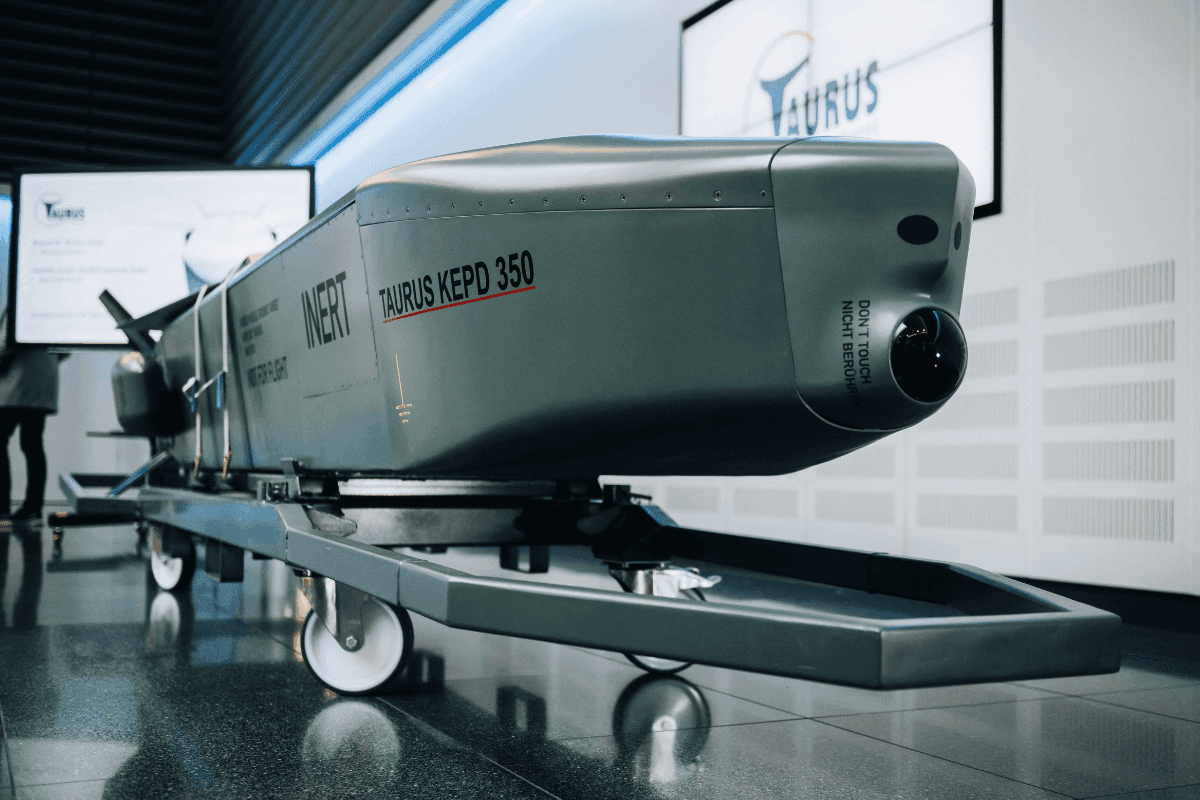
The result, accumulated over thirty years of progressive capability erosion, is the inventory picture that confronted European planners when Russia's full-scale invasion of Ukraine in February 2022 forced a genuine strategic reassessment. Among European NATO members, only Turkey fields conventional ground-launched ballistic missiles with ranges above 300 kilometres - the indigenously developed Bora and Tayfun Block I systems. No other European NATO state operates a ground-launched cruise or ballistic missile capable of reaching beyond that range. The continent does field air-launched cruise missiles - the Franco-British Storm Shadow and its French-designated SCALP variant, the German-Swedish Taurus KEPD 350, and American-supplied JASSM and JASSM-ER systems - but these require survivable aircraft to deliver them through contested air defence environments, and stockpiles have been heavily depleted by transfers to Ukraine. The Royal Navy's Tomahawk Block IV and V missiles, with ranges around 1,600 kilometres, represent the longest-range conventional missiles in service with any European NATO member, but the inventory has always been small and is configured for maritime strike rather than ground-based deterrence.
This is not a small gap in an otherwise capable force structure. It is the absence of an entire category of military capability that Russia possesses in multiple redundant variants - Iskander-M ground-launched ballistic missiles with ranges up to 500 kilometres, Kalibr cruise missiles launched from both sea and ground platforms, Kinzhal air-launched hypersonic missiles, and the Oreshnik intermediate-range ballistic missile deployed to Belarus in December 2025 and used operationally against a Ukrainian target near Lviv in early 2026. Russia has spent four years of operational use in Ukraine calibrating these systems, learning which combinations most effectively overwhelm integrated air defence architectures, and adapting logistics and targeting doctrine for high-tempo sustained strikes. Europe has spent those four years watching and concluding it needs to urgently build what Russia already has. The timeline asymmetry embedded in that observation is the strategic core of the missile gap problem.
Historical Context
Understanding why Europe arrived at this point requires tracing two parallel historical processes: the atrophying of European autonomous military capability that accelerated after 1991, and the strengthening of Russian long-range strike doctrine that accelerated after 2015.
The European side of this history is well-documented but rarely stated candidly enough. NATO's 2% GDP defence spending target was not a recently invented political performance metric - it was the formal commitment level established decades ago to sustain the alliance's deterrence posture. Most European members had met it through the Cold War. After 1991, they did not. Germany's defence spending fell to 1.2% of GDP at its lowest point. Italy's rarely exceeded 1.4%. Belgium, the Netherlands, Spain, Portugal - the pattern was consistent: defence budgets were raided to fund social spending as the peace dividend was collected by European electorates who had genuinely stopped believing in the Russian threat. The American subsidy was cheap, reliable, and politically convenient for all parties. European politicians could fund schools and hospitals; American defence contractors could sell weapons to NATO; and the alliance sustained its deterrence posture on paper while its European component progressively hollowed out in practice.
The Russian side of this history runs in the opposite direction. After the chaotic 1990s during which Russian conventional forces deteriorated dramatically, Vladimir Putin's return to the presidency and the systematic rebuilding of Russian military capability that followed produced, by 2015, a force structure explicitly designed to offset NATO's conventional superiority through long-range precision strike and the aggressive development of anti-access and area-denial systems. Russia's 2015 Syria intervention was, among other things, a live demonstration platform for the Kalibr cruise missile - a weapon fired from Caspian Sea ships against targets in Syria whose range, precision, and operational reliability exceeded most Western assessments of Russian cruise missile capability at the time. That demonstration was deliberate. Russia wanted NATO to update its threat assessments, and it succeeded.
The 2022 invasion and four subsequent years of Ukraine operations have served as the most detailed public display of integrated missile strike doctrine since the Gulf War. Russia's systematic campaign against Ukrainian power generation, transformer infrastructure, command nodes, rail logistics, and defence industrial facilities - executed through Iskander-M ballistic missiles, Kalibr and Kh-101 cruise missiles, Shahed derivative one-way attack drones, and the operationally significant introduction of the Oreshnik in November 2024 - has been simultaneously a military campaign and an intelligence windfall for Western planners trying to understand how Russian deep-strike doctrine actually operates rather than how it was theorised to operate. The lessons are not reassuring. Russia has demonstrated the capacity to sustain high-tempo mass strikes over extended periods, to adapt targeting in response to Ukrainian air defence innovation, and to combine ballistic missiles, cruise missiles, and drone saturation in sequenced packages specifically designed to overwhelm layered air defence systems by exhausting interceptors at different altitude and speed bands simultaneously.
Current Situation Assessment
The immediate trigger for the current crisis in European deep-strike planning was a decision taken by the Trump administration in early May 2026 that dramatically compressed the timeline of Europe's problem. Under a Biden-era agreement formalised at the July 2024 Washington NATO Summit, the United States had committed to deploying a ground-based long-range fires battalion to Germany beginning in 2026, equipped with Typhon launchers capable of firing Tomahawk cruise missiles with a range of 1,600 kilometres and SM-6 dual-capable missiles with a range exceeding 400 kilometres. Under the original framework, Dark Eagle hypersonic missiles with ranges between 2,000 and 2,800 kilometres were also planned for subsequent deployment. This was the bridging capability - the American system that would hold Russian territory at deep risk while European programmes developed indigenous alternatives that would eventually substitute for and supplement American firepower.
The Trump administration shelved that deployment. The announcement came alongside the cancellation of an armoured brigade rotation and more than 4,000 troops in a broader drawdown of American forward presence in Europe that reflected the administration's consistent position that European defence is primarily Europe's responsibility. German Defence Minister Boris Pistorius had told journalists in 2024 that he could not imagine any American president deviating from the deployment commitment. That statement aged poorly. The Typhon deployment is not coming in 2026 or 2027. The bridging capability Berlin had counted on while European systems came online has been removed, leaving a gap between the present and the 2028-2035 service entry window for European deep-strike programmes that contains no interim solution.
The European response to that cancellation was the Deep Precision Strike Capability Investment Initiative announced at the NATO Leaders' Summit in Ankara on July 8, 2026. Twelve member states - Denmark, Estonia, Finland, France, Germany, the Netherlands, Norway, Romania, Spain, Sweden, Turkey, and the United Kingdom - signed a joint commitment to invest fifty billion dollars over the next decade. The statement was explicitly framed as a response to American force adjustments, and the language was unusually direct for an alliance communiqué: recognising the need to increase deep precision strike capabilities specifically in response to recent US force adjustments, acknowledging that these capabilities form an integral part of NATO defence plans, and committing to demonstrate strength through credible capabilities.
Fifty billion dollars is, in absolute terms, serious money. But its strategic significance depends entirely on what it can deliver, when it can deliver it, and whether the systems being funded actually constitute the complete deep-strike chain that operational doctrine requires - or merely add platforms to an architecture that remains incomplete in the non-platform dimensions that determine whether platforms actually work.
Power Center Analysis
The United Kingdom
Britain leads the Ankara coalition and enters the deep-strike investment cycle with the most credible existing programme portfolio of any European state. The Trinity House Agreement concluded with Germany in October 2024 committed both nations to developing deep-strike capabilities with a range up to 2,000 kilometres, examining stealth-cruise and hypersonic missile technology. The Stratus programme, launched in 2017 as a trilateral UK-France-Italy effort through MBDA to develop a replacement family for Storm Shadow and Harpoon, now has a confirmed UK Ministry of Defence commitment of 1.4 billion pounds over four years. The Royal Navy's existing Tomahawk inventory provides the only European NATO ground-equivalent range capability today, though in a maritime rather than ground-launched configuration. Britain's position as both programme leader and the European state with the highest existing long-range strike inventory makes it the natural anchor of the coalition - but its own fiscal constraints, a defence budget stretched across nuclear deterrent renewal, carrier strike group sustainment, and land forces recapitalisation, means the UK cannot carry the coalition through political commitment alone.
France
France brings the deepest indigenous missile development industrial base of any European NATO member, through MBDA and the Naval Group's MdCN sea-launched cruise missile - Europe's one genuinely long-range domestically developed naval strike missile, used operationally in strikes on Syrian targets in 2018 with a range in the 1,000 kilometre class. The problem with French deep-strike capability is not technological capacity; it is production scale. The MdCN was designed for strategic signalling - the French equivalent of a shot across the bow to communicate political resolve - not for the high-volume, sustained attrition campaigns that Ukraine and the Iran war have demonstrated are the actual operational requirement. Mass production of such weapons is now necessary, and France's defence industrial system was not configured for it. Expanding MdCN production while simultaneously funding the Stratus programme and France's own hypersonic glide vehicle research under the ASN4G air-to-surface nuclear replacement programme requires fiscal choices that President Macron's government is managing in a constrained domestic budget environment with competing political priorities.
Germany
Germany's position is the most strategically significant and the most problematic simultaneously. As the largest economy in NATO Europe, Germany's deep-strike deficit has the most direct consequence for the alliance's ability to hold Russia's western military district at risk from the ground. Germany's 21 Tornado ECR airframes represent the continent's only dedicated suppression of enemy air defences fleet - the critical capability required to open corridors through Russian integrated air defence systems that any sustained deep-strike campaign would require. Those 21 aircraft are being replaced by 15 converted Eurofighters under the EK electronic combat programme, NATO-certified for 2030 - a capability reduction in absolute numbers occurring simultaneously with a requirement increase driven by Russia's expanded anti-access infrastructure. The Trinity House Agreement's exploration of hypersonic technology with the UK is the right strategic direction, but the delivery timeline of the 2030s means Germany's most consequential existing deep-strike contribution, the Taurus KEPD 350 air-launched cruise missile with a range of approximately 500 kilometres, remains its primary capability for the entire decade. Taurus stockpiles are limited. Germany declined, controversially, to provide Taurus missiles to Ukraine during the conflict, reducing the political cost of that decision by preserving stocks for potential future NATO use.
The Enablers Problem
The most important analytical observation about the Ankara commitment is one that the public announcement almost entirely obscures: deep-strike capability is not a weapon. It is a system. Purchasing missiles without the intelligence, surveillance and reconnaissance infrastructure to identify and locate targets in real time, the suppression of enemy air defences capacity to create corridors through Russian integrated air defence systems, the airborne command and control networks to assign strikes dynamically across rapidly changing target sets, and the battle damage assessment capability to determine whether a strike has achieved its objective and re-strike if it has not - purchasing missiles without all of those supporting systems produces very expensive metal that cannot reliably be put on target.
Europe's enablers gap is, by honest assessment, more serious than its missile inventory gap. The planned American long-range fires battalion was not just bringing missiles to Europe - it was bringing the targeting infrastructure, command systems, and intelligence networks that make those missiles effective. NATO's Multinational MRTT tanker fleet reached full operational capability in March 2026 with nine aircraft in service, with the eleventh and twelfth arriving in 2028 and 2029 - a fleet configured for air refuelling that provides some airborne enabler capacity but does not address the overland collection problem that a ground-attack deep-strike mission set requires. No European air force currently fields the extended-range AARGM-ER anti-radiation missile required to suppress the most modern Russian air defence radars. European airborne electronic warfare is configured for self-protection rather than for suppressing an adversary's radars at the scale a deep-strike campaign would demand. No European state holds the munitions stocks or the trained aircrew to run suppression of enemy air defences at scale for an extended conflict.
The ELSA programme - the European Long-Range Strike Approach that represents the institutional framework for coordinating deep-strike development - reflects a recognition that this dimension of defence can no longer be outsourced. Yet ELSA remains fundamentally platform-centric, focusing on missile acquisition without the system-level integration required to build a credible deterrent. A letter of intent signed by ELSA participants mentions progress in low-cost, one-way effector saturation weapons - the drone-equivalent layer of the deep-strike architecture - but says nothing about progress in the heavy-payload, precision deep-strike weapons that constitute the operationally decisive capability the programme exists to develop.
Military and Security Implications
The military consequence of Europe's missile gap is a deterrence architecture that depends on an asymmetric assumption: that Russia's strategic caution, residual fear of American escalatory response, and nuclear deterrence will prevent Moscow from translating its conventional deep-strike superiority into coercive political behaviour below the threshold of outright NATO Article 5 violation. That assumption may be correct. It may also be the most consequential strategic wager in European security since the Cold War ended, and the evidence from Russian behaviour in 2022 onward suggests it should not be made with confidence.
The operational gap matters in a specific and articulable way. In the opening days of a hypothetical Russian military action against a NATO eastern flank member, Russia's ability to hold at risk the infrastructure targets - fuel depots, ammunition storage, rail logistics, airbase hardened shelters, command centres - that European conventional forces would require for their own deep-strike operations gives Moscow a systematic advantage in degrading the conventional response before it can be mounted. NATO's deterrence in this scenario depends on America's extended deterrence - the implicit threat that American strategic nuclear forces backstop the conventional asymmetry. In a Trump administration context that has explicitly treated European defence as conditional rather than unconditional, that backstop carries a political uncertainty that Europe cannot afford to assume away.
The Ukraine war has added a particularly important operational lesson that European planners are absorbing but cannot yet act on: deep-strike systems work best not as decisive knockout blows but as a sustained, continuous campaign against an adversary's critical logistics, communications, and infrastructure. Russia's missile campaign against Ukraine's power generation took more than a year of repeated strikes to produce the infrastructure degradation that finally disrupted Ukrainian grid resilience at scale. Ukrainian long-range drone strikes against Russian oil refineries, depots, and airfields produced cumulative economic and operational effects that no single strike achieved. Europe collectively lacks the capacity to sustain deep strikes of this kind. Its air-launched cruise missile stockpiles, depleted by transfers to Ukraine, could execute a limited number of salvos. They could not execute the sustained, multi-month campaign that the Ukraine model demonstrates is the actual operational requirement for meaningful effect.
Economic and Trade Impact
The economic implications of the European deep-strike investment surge operate on two levels simultaneously: the direct industrial and fiscal dimension, and the second-order economic consequence of a security environment in which Russia's conventional deep-strike advantage enables coercive political behaviour that threatens European economic stability.
At the direct industrial level, the fifty billion dollar commitment over ten years represents an average of five billion dollars annually across twelve nations - significant in absolute terms but modest relative to the total investment required to build and sustain the complete deep-strike system, including sensors, command infrastructure, SEAD capability, and logistics, rather than missiles alone. The European defence industrial base, hollowed out by three decades of underinvestment, does not currently have the manufacturing scale to absorb large procurement orders rapidly. MBDA, the primary European missile manufacturer, has already expanded production capacity substantially since 2022 in response to Ukraine-related demand and accelerated national procurement. But the lead times for precision guidance components, advanced propulsion systems, and the secure communications hardware embedded in modern long-range strike weapons mean that funding commitments made in July 2026 will not translate into deliverable weapons at scale before 2028 at the earliest for the systems furthest along in development.
The second-order economic consequence is less visible but strategically more important. Europe's ability to sustain its economic model - open trade, integrated supply chains, energy import dependence now being rapidly restructured after the Russia gas rupture - depends on a security environment in which Russian coercive behaviour is deterred at conventional levels. If Russia's deep-strike advantage enables it to threaten or execute conventional attacks on European infrastructure with confidence that the conventional response will be insufficient and the nuclear escalation threshold too high to cross over a limited provocation, the insurance premium that European businesses and states pay against that contingency - in the form of supply chain shortening, energy infrastructure redundancy investment, and strategic reserve building - becomes a permanent structural drag on European economic competitiveness at exactly the moment the continent is also absorbing the costs of energy transition and American tariff pressure simultaneously.
Diplomatic Positioning
The Ankara deep-strike coalition's diplomatic significance extends well beyond the military capability it represents, because it marks the first time that a substantial coalition of European NATO members has explicitly named an American force reduction as a driver for a collective European defence investment initiative. The statement's language - "in response to recent US force adjustments" - is blunt by the standards of NATO communiqués, which typically paper over internal alliance disagreements rather than naming them. That directness was chosen deliberately, and its choice reflects a diplomatic judgement by the twelve signatory governments that the era of strategic ambiguity about European defence autonomy has ended.
The implications for the transatlantic relationship are significant and asymmetric. For the Trump administration, the European deep-strike coalition is simultaneously a vindication of its burden-sharing pressure - European allies are finally investing at scale - and a long-term erosion of American leverage over European strategic decision-making. An Europe that builds its own deep-strike capability does not need to ask Washington for Typhon deployments. It does not need to wait for American targeting data to execute deep strikes. It does not need to calibrate its own military operations around American political appetite for escalation management. The autonomy that the Trump administration's unreliability has forced Europe to build is, paradoxically, the autonomy that future American administrations seeking to maintain influence over European security decisions will wish Europe had never developed.
For Russia, the Ankara commitment represents the worst plausible medium-term outcome of its Ukraine strategy: a Europe that was gradually disarming has been galvanised into building exactly the capability category that poses the most direct conventional threat to Russian territory. An European deep-strike capability that can hold Russian logistics, infrastructure, and command nodes at risk from ground-launched systems based in Poland, Germany, the Baltic states, and Romania changes the deterrence calculation for any Russian military planner contemplating conventional aggression against a NATO member. Moscow's strategy of maintaining conventional deep-strike dominance over Europe as a tool of strategic coercion depended on Europe continuing to choose not to build the countervailing capability. The Ankara initiative suggests that strategic calculation is now changing.
Regional Fallout
The European missile gap and the political response to it carry consequences for every regional security architecture adjacent to European NATO, and several of those consequences are counterintuitive.
For the Baltic states - Estonia, Latvia, Lithuania - and Poland, the gap is not abstract. These are the states that would absorb the initial conventional pressure of any Russian military action against NATO's eastern flank, and their own investment in deep-strike capability has correspondingly outpaced larger Western European members. Estonia has invested in the acquisition of American-supplied HIMARS multiple rocket launchers and contributed politically to every European deep-strike initiative with a consistency that reflects genuine existential stakes. The Ankara initiative's inclusion of Finland and Estonia as founding signatories signals that the Baltic-Nordic security cluster is driving the deep-strike agenda as much as the larger Western European powers whose defence-industrial capacity will actually build the systems.
For Turkey, the Ankara Summit's hosting country and an Ankara initiative signatory, the deep-strike dimension carries a specific significance: Turkey is the only European NATO member that already fields ground-launched ballistic missiles above the 300-kilometre range threshold. Ankara's existing Bora and Tayfun systems give Turkey a unilateral deep-strike capability that no other European NATO member possesses, and Turkey has used its unique position as both a NATO member and an independent military power - supplying both sides of various regional conflicts with its Bayraktar TB2 drone platform - to maintain strategic ambiguity about its alliance commitments that Western European members find uncomfortable but cannot simply dismiss. Turkey's participation in the Ankara initiative brings its industrial capacity, its existing capability, and its geographic position at NATO's southeastern flank into the deep-strike architecture, while also raising questions about whether Turkish-developed deep-strike systems would be subject to the same political constraints as British or French equivalents in a genuine NATO Article 5 crisis.
For Ukraine, whose battlefield experience has been the primary empirical input for European deep-strike programme design, the Ankara initiative carries both encouragement and frustration. Encouragement because a Europe investing seriously in the capability to hold Russian territory at risk creates a future deterrence environment in which Russia's strategic calculations about Western Europe change materially. Frustration because the deep-strike systems being funded will not enter service until 2028-2035, and Ukraine's own requirement for exactly these systems in the current conflict - Taurus missiles that Germany declined to provide, long-range ground-launched cruise missiles that no European state could supply - has been unmet precisely because European stockpiles do not exist at meaningful scale.
Global Strategic Consequences
The European missile gap and the Ankara initiative's response to it carry three global consequences that extend well beyond the immediate NATO-Russia deterrence balance.
First, they validate a proposition that China, North Korea, and Iran have independently reached: that the combination of conventional deep-strike capability with nuclear deterrence as a backstop creates a strategic posture that allows a state to apply coercive military pressure below the threshold of conventional war termination, confident that adversaries will hesitate to escalate. Europe's gap has been exactly this kind of exploitable space. The speed with which European states are now moving to close it will be noted in Beijing, Pyongyang, and Tehran as confirmation that the gap-exploitation strategy carries a structural flaw: it eventually galvanises the target into building the countervailing capability, and the result is a more, not less, militarised security environment for everyone.
Second, the European deep-strike investment surge will reshape the global defence industrial market in ways that affect arms-importing nations across Asia, the Middle East, and Latin America. MBDA, BAE Systems, KNDS, and Rheinmetall expanding long-range missile production capacity creates alternative supply sources for conventional deep-strike systems that are currently dominated by American and Russian export programmes. India, which operates Storm Shadow-derived BrahMos cruise missiles through its joint venture with Russia and is simultaneously the world's largest arms importer exploring accelerated defence indigenisation, sits at the intersection of this market shift in ways that carry strategic opportunity.
Third, the most consequential long-term consequence of the European deep-strike gap - and its eventual closure - is what it does to the credibility of Article 5 as a deterrence instrument. An alliance in which the conventional deterrence architecture depends primarily on American capabilities that an American president has just demonstrably withdrawn cannot maintain credible deterrence through political declarations alone. The Ankara initiative is, at its core, a programme to restore the physical military substrate of deterrence credibility that three decades of underinvestment had eroded. Whether it succeeds in time - before the threat it is designed to deter becomes acute - is the most consequential open strategic question in European security.
Risk Matrix
- Capability-threat timeline mismatch: The highest-risk scenario is not that European deep-strike programmes fail - it is that they succeed, but on a timeline that leaves a five-to-ten year window in which Russian deep-strike superiority over Europe is demonstrably real and potentially exploitable below the nuclear threshold.
- Platform acquisition without system integration: Buying missiles without the targeting, SEAD, command, and battle damage assessment infrastructure that makes them effective produces very expensive deterrence theatre rather than genuine capability. The ELSA programme's platform-centric character, combined with the enablers gap that the cancellation of the American targeting support infrastructure has widened, makes this a live risk for the entire Ankara investment.
- Industrial base scaling failure: European defence industrial capacity, particularly for precision guidance components, advanced propulsion, and secure communications hardware, cannot be expanded faster than supply chains and skilled workforce development allow. Funding commitments that outrun industrial delivery capacity produce budget disbursement without capability delivery.
- Political fragmentation of the coalition: Twelve nations signed in Ankara, but national procurement traditions, divergent threat perceptions, and the ever-present pull of industrial policy competition - France protecting MBDA's position, Germany protecting domestic industrial participation, Turkey's ambiguous alliance posture - create centrifugal forces that have undermined previous European collaborative defence programmes. The Eurofighter, the A400M, the NH90 - the history of European collaborative defence acquisition is a history of cost overruns, schedule delays, and specification compromises produced by twelve different national requirements being forced into a single procurement framework.
- Intelligence architecture dependence: European deep-strike systems that depend on American satellite intelligence, targeting data, and communications infrastructure for precise target location are not genuinely sovereign capabilities - they are European platforms executing American targeting decisions. Building genuine deep-strike sovereignty requires the entire intelligence chain from collection to strike to assessment to be European-controlled, and that is a considerably more expensive and complex undertaking than building the missiles themselves.
Scenario Analysis
Base Scenario - Managed Capability Gap With Credibility Maintenance
Probability: High
The twelve-nation Ankara coalition sustains political cohesion through the first three years of implementation, with early Stratus programme milestones providing visible progress and domestic political validation for sustained defence spending. The ELSA framework produces its first generation of low-cost one-way attack systems - the saturation layer of the deep-strike architecture - by 2028, providing an interim capability that supplements but does not replace the precision heavy-strike requirement. Systems with ranges above 1,000 kilometres begin service entry across leading coalition members by 2030-2031, with full multi-member deployment extending through 2035. The capability gap is real for the entire decade but does not translate into Russian military action because the nuclear backstop and the momentum of the investment programme provide sufficient deterrent signal. Europe emerges from the 2030s with a genuinely sovereign deep-strike capability at the cost of a decade of strategic vulnerability managed through diplomatic deterrence rather than military hardware.
Bull Scenario - Accelerated Industrial Delivery and Coalition Coherence
Probability: Low
Sustained political pressure, the Ukraine war's continued demonstration of deep-strike operational relevance, and a breakthrough in European defence-industrial cooperation - possibly through a dedicated European Defence Fund mechanism specifically capitalised for deep-strike - produces accelerated programme timelines, with the UK-Germany Trinity House ground-launched capability entering service in 2029 and the Stratus replacement family achieving operational status by 2031. The coalition expands beyond the original twelve to include additional Central European members, increasing production scale and spreading development costs. American frustration at European autonomy eventually converts into a negotiated framework in which European deep-strike systems are integrated with American targeting architecture where European nations choose to allow it, producing a hybrid sovereignty model that is more capable than pure European independence would provide while more resilient than the pre-2026 pure American dependence structure.
Bear Scenario - Coalition Fragmentation and Russian Exploitation
Probability: Medium
National procurement competition, divergent specifications, cost overruns on the Stratus programme, and political pressure in multiple coalition members from economic austerity or right-wing governments hostile to defence spending fracture the Ankara coalition within three years. France pursues a national programme prioritising MdCN replacement; Germany's Trinity House commitment becomes a paper declaration as defence budgets are pressured by a CDU-led government focused on fiscal consolidation; the smaller coalition members lack industrial mass to sustain an autonomous programme and revert to dependence on American systems that the Trump administration has structurally reduced. By 2029-2030, Europe's deep-strike gap is wider than it was in 2026, the Ankara declaration has become an exhibit in a forensic study of European defence procurement failure, and Russia's strategic planners have updated their assessments to reflect that the gap will not be closed on any relevant timeline. The deterrence calculation in Moscow shifts accordingly.
Intelligence Forecast: 6-24 Months
Over the next six to twelve months, the critical indicators to watch are the ELSA programme's first concrete deliverable announcements - whether the "first projects seeing the light of day" referenced by its leadership in March 2026 produce publicly visible capability contracts or remain internal framework documents - and the domestic budget decisions of the three largest coalition economies: the United Kingdom, Germany, and France. The UK's defence review commitments, Germany's Bundeswehr modernisation funding allocations, and France's Loi de Programmation Militaire implementation will collectively determine whether the Ankara commitment has fiscal reality behind its political declaration.
Over twelve to twenty-four months, the most consequential development will be whether the Ground-Based Precision Strike Capabilities High Visibility Project launched at the NATO Defence Industry Forum in Ankara produces a specific, costed, timelines programme specification or remains a political framework without procurement reality. NATO's internal machinery for managing collaborative programmes - the NSPA, OCCAR, and bilateral industrial frameworks - will need to select a specific missile design philosophy: cruise, ballistic, or hypersonic glide vehicle, or a combination, with the range brackets, guidance systems, and launch platform integration that determine actual capability rather than headline commitment numbers.
Over twenty-four months, watch the French-British Summit of 2027 as the most significant bilateral event for deep-strike programme architecture. If London and Paris align their Stratus programme specifications and Trinity House hypersonic development into a coherent joint framework rather than pursuing parallel national programmes, the industrial and financial case for German participation becomes significantly more compelling. If they diverge, the risk of the three-programme fragmentation that has plagued every previous European collaborative defence initiative materialises at exactly the scale and cost level that the Ankara commitment was designed to prevent.
Final Strategic Takeaway
Europe's missile gap is not a procurement failure. It is the physical consequence of a thirty-year strategic choice to treat security as an American product rather than a European requirement. That choice made sense in the 1990s, made less sense in the 2000s, began producing visible risk in 2014, became a strategic liability in 2022, and became an urgent operational problem in May 2026 when the Trump administration cancelled the bridging capability that was supposed to cover the gap while European alternatives came online. The Ankara commitment is the political recognition that the era of choice - the luxury of deciding whether to invest in existential military capability - is over. What it cannot change is the timeline. Fifty billion dollars committed in July 2026 does not produce operational deep-strike missiles before 2028 for early systems and the mid-2030s for the most capable. The gap between the threat timeline and the delivery timeline is real, measured in years, and cannot be closed by political commitment alone, however sincere and however large the financial figure attached to it. Europe's strategic challenge for the rest of this decade is not building deep-strike capability. It is managing the deterrence vacuum that exists between now and when that capability is actually in service - and doing so against a Russian state that has spent four years demonstrating, in operational conditions, precisely what deep-strike capability can achieve against a country that lacks the means to respond in kind.
Global Chanakya Assessment
The standard analysis of Europe's missile gap focuses on what Europe does not have and when it might acquire it. Global Chanakya's assessment identifies a more consequential set of questions that this framing obscures.
The first hidden driver is the intelligence architecture problem that the Ankara initiative's platform-centric framing systematically understates. European deep-strike systems that can fire missiles but cannot independently locate targets at the precision required for effective strike - because that targeting depends on American satellite intelligence, signal intelligence, and communications infrastructure - are not autonomous capabilities. They are American-enabled capabilities wearing European uniforms. Building genuine deep-strike sovereignty requires the European Union and NATO to invest at comparable scale in satellite intelligence, airborne signals collection, space-based synthetic aperture radar, and secure European-controlled command networks. The five-point-three billion euros annually from the Ankara commitment that goes to missiles cannot also go to that infrastructure. The budget for genuine sovereignty is considerably higher than the announced commitment, and that gap is not being publicly discussed.
The second hidden driver is the domestic political sustainability problem. Defence spending commitments made in the post-Ukraine invasion environment of 2022-2026 have been made by governments facing populations whose day-to-day priorities are energy prices, housing costs, healthcare waiting lists, and industrial unemployment in regions affected by energy transition. The political coalitions that signed the Ankara commitment include governments in France, Germany, Spain, and the Netherlands that face electoral pressure from left-wing parties opposed to militarisation and right-wing populists sceptical of multilateral defence frameworks. Sustaining fifty billion dollars of commitment over ten years requires sustaining the political consensus that made it possible for ten consecutive budgetary cycles. The history of European multilateral defence commitments suggests that that is the hardest part of the entire enterprise.
The third underreported development is the role that co-development with Ukraine is quietly beginning to play. Ukrainian engineers who have spent four years operationally testing and improving long-range strike drone systems against Russian integrated air defence - optimising for evasion, accuracy, electronic countermeasures, and warhead penetration in the world's most demanding live-fire laboratory - represent a knowledge base that European defence firms are beginning to access through co-development arrangements that are not publicly announced with the same fanfare as the Ankara commitment. The Ukrainian technological contribution to European deep-strike development, if properly structured and resourced, could accelerate development timelines and improve system performance in ways that the European Long-Range Strike Approach's institutional framework alone cannot deliver. This is one of the most strategically significant underreported developments in European defence, and it is being deliberately understated to avoid Russian pressure on Ukraine to terminate the arrangements as a condition of any future peace negotiation.
The fourth contrarian observation is about the Ankara initiative's paradoxical effect on Russian strategic calculation. The conventional wisdom holds that Europe building deep-strike capability deters Russia. This is correct in the long run. In the short run - the five-to-seven year window before these systems actually enter service at meaningful scale - the announcement effect of the Ankara commitment changes Russian threat perceptions in a way that could accelerate rather than defer coercive behaviour. A Moscow that knows Europe will possess meaningful deep-strike capability in 2032 but does not have it in 2026 has a finite window in which conventional coercion below the nuclear threshold is possible without the risk of a credible conventional deep-strike response. Whether Russian strategic culture and current leadership assessment of political opportunity will lead to exploitation of that window is the most important intelligence question in European security, and it is one that cannot be answered with confidence from open-source analysis alone.
Strategic Opportunities for India
Europe's deep-strike capability gap and the industrial mobilisation required to close it presents India with several strategic opportunities that deserve direct analytical attention.
India operates the BrahMos supersonic cruise missile - developed jointly with Russia through the BrahMos Aerospace joint venture - which at approximately 300 kilometres range in its baseline configuration and growing to extended-range variants, occupies exactly the capability category that European NATO members are urgently trying to build. European interest in the BrahMos programme as a technology reference, and potentially as a procurement option for rapid interim capability before indigenous European systems are ready, is not an implausible development. The Philippines' acquisition of BrahMos as the first export customer demonstrates the system's credibility with security-serious purchasing governments. India's positioning as an alternative deep-strike technology source in a market that was previously dominated by American and Russian systems would carry strategic dividends well beyond the commercial value of any individual sale.
India's broader defence-industrial relationship with European firms - particularly through the MBDA partnership on advanced air defence systems and the ongoing conversations about Rafale additional purchases and defence technology transfer - positions New Delhi to engage with European deep-strike development as a co-development partner rather than merely a customer. As European firms expand production capacity for long-range missiles, establishing joint ventures and technology transfer arrangements that build Indian capacity in guidance systems, propulsion, and warhead technology serves both India's Defence Production Policy objectives and European firms' interest in distributing production costs across a larger procurement base.
Indicators to Monitor
- ELSA programme contract awards: Whether ELSA's first project announcements produce signed industrial contracts with specific delivery timelines or remain letters of intent and framework agreements.
- UK Stratus programme milestone announcements: The Ministry of Defence's 1.4 billion pound Stratus commitment should produce visible industrial contracting decisions by Q1 2027.
- German Bundeswehr long-range fires allocation: Whether Germany's defence budget for 2027 includes specific line-item funding for ground-launched long-range strike under the Trinity House framework or defers the decision to subsequent budgetary cycles.
- Russia's Oreshnik deployment posture: Additional Oreshnik deployments beyond Belarus - to Kaliningrad, the Kola Peninsula, or new positions in occupied Ukraine - would signal Russian assessment that the deployment's coercive signal has not been adequately received and that expansion is required.
- NATO ISR infrastructure investment: Whether European contributions to satellite intelligence, airborne collection, and space-based radar infrastructure increase at a pace proportional to the missile procurement commitments, or remain primarily an American-provided enabler layer.
- Ukraine co-development agreements: Formal or informal arrangements between European defence firms and Ukrainian engineering teams for long-range strike system co-development, which would be among the most consequential development accelerants available to the Ankara coalition.
- French-British Summit 2027 outcomes: Whether London and Paris align or diverge on Stratus programme specifications and Trinity House hypersonic development framework, determining whether the two largest European deep-strike industrial programmes pursue scale economies or independent duplication.
- Turkey's Tayfun development trajectory: Progress on extended-range variants of the Tayfun ground-launched ballistic missile that could position Ankara as a rapid supplier of interim deep-strike capability to Eastern European coalition members before Western European programmes deliver.
- American forward presence in Europe: Any additional US troop or capability drawdowns from European NATO beyond the May 2026 long-range fires battalion cancellation, which would expand the deterrence gap and accelerate European political pressure for faster autonomous capability development.
- Russian military spending trajectory: Whether Russia's war economy constraints - detailed in Global Chanakya's Russia intelligence coverage - force a slowdown in the Oreshnik and Iskander-M modernisation programme, or whether energy revenue and forced labour allocation sustain production at current rates through the period of European vulnerability.
FAQ
What exactly is a deep-strike capability, and why does Europe not have one?
Deep-strike capability refers to the ability to hold targets at significant depth behind an adversary's front lines at risk through precision strike systems - cruise missiles, ballistic missiles, or hypersonic glide vehicles - rather than only engaging targets within artillery or short-range rocket range. Europe lacks ground-launched systems in this category because three decades of post-Cold War defence spending prioritised expeditionary manoeuvre forces over the heavy deterrence systems that defined NATO's Cold War posture, and relied on American systems to cover the gap.
What was the Typhon deployment and why was it cancelled?
The Typhon Mid-Range Capability launcher is an American ground-launched system capable of firing Tomahawk cruise missiles at ranges up to 1,600 kilometres and SM-6 missiles at ranges exceeding 400 kilometres. The Biden administration committed to deploying Typhon to Germany from 2026 as a bridging capability while European systems developed. The Trump administration cancelled that deployment in May 2026 as part of a broader European military presence reduction, leaving Germany and NATO Europe without the interim deep-strike capability the 2024 Washington Summit agreement had promised.
Will the fifty billion dollar Ankara pledge actually close the gap?
The pledge represents genuine political commitment but cannot close the gap on the timeline the threat environment requires. The systems being funded will not enter service before 2028 for early programmes and the mid-2030s for the most capable, leaving a five-to-ten year window in which Europe's deep-strike deficit is real and potentially exploitable. Closing the gap requires not just missile procurement but investment in targeting infrastructure, SEAD capability, command architecture, and stockpile depth that the headline commitment does not fully encompass.
What role does Ukraine play in European deep-strike development?
Ukraine's four years of operational deep-strike experience - including long-range drone strikes on Russian energy infrastructure, the use of Storm Shadow missiles against Russian command nodes, and the continuous adaptation of strike packages to penetrate evolving Russian air defence - represents the world's most current and operationally relevant empirical database for deep-strike system design, targeting methodology, and penetration tactics. European firms beginning to co-develop with Ukrainian engineers are accessing that knowledge base in ways that could meaningfully accelerate programme timelines and improve system performance beyond what laboratory development alone could achieve.