
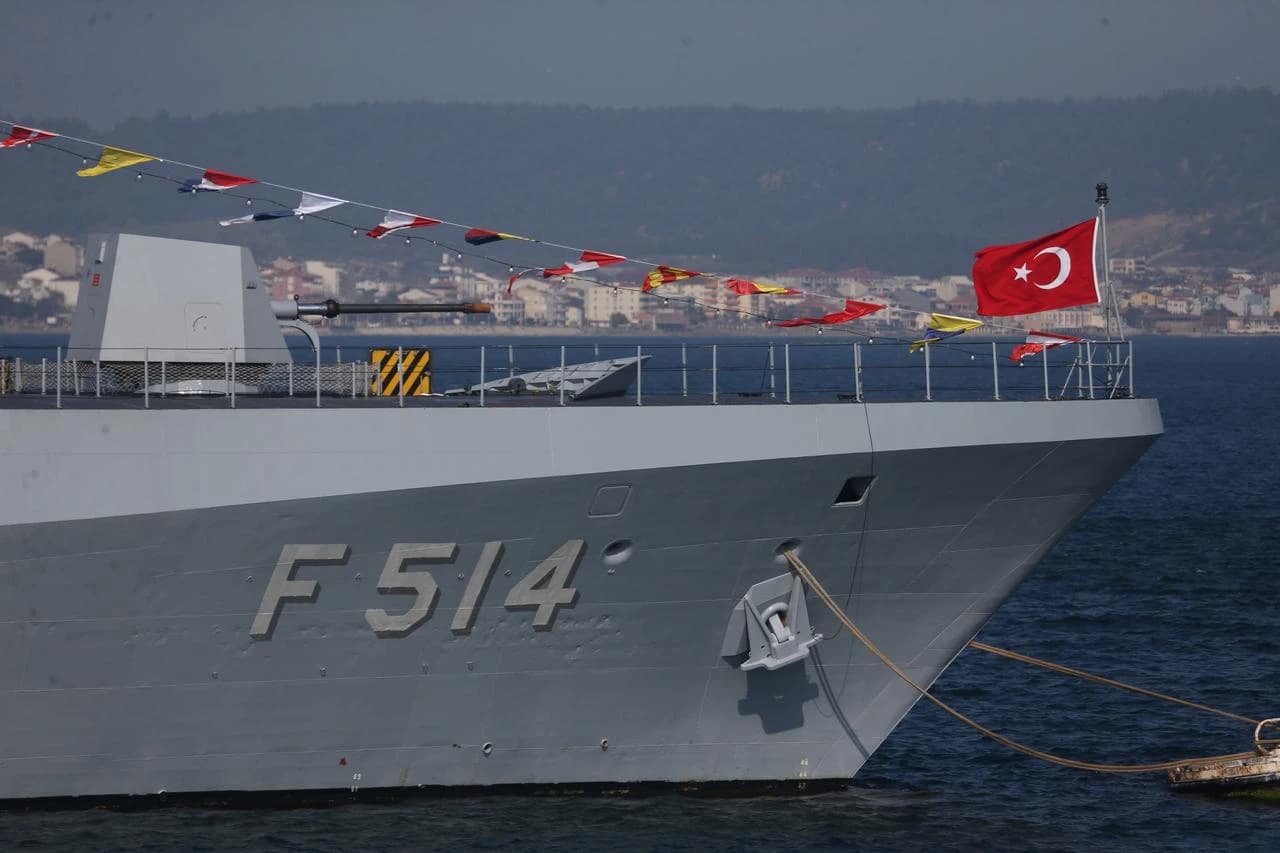
Turkey's Arms Export Boom: How Ankara Became the World's 11th-Largest Weapons Supplier
Executive Summary
Turkey has completed a two-decade transformation from a chronically import-dependent NATO member into one of the world's most consequential arms exporters. According to the Stockholm International Peace Research Institute, Turkey's share of global major arms exports rose from under one percent in the mid-2010s to 1.8 percent in the 2021-2025 period, an increase of 122 percent over the preceding five years, lifting Ankara to eleventh place among global suppliers. Turkish government figures put total defence and aerospace exports at a record 10.05 billion dollars for calendar year 2025, with early 2026 data showing continued double-digit growth. This is not simply an industrial success story. It is a deliberate instrument of Turkish statecraft that converts battlefield-proven, mid-cost weapons platforms into diplomatic leverage, alliance realignment, and strategic autonomy from both Washington and Moscow. For Global Chanakya, the most urgent dimension of this boom is its South Asian vector: Turkish drones, missiles, and now a prospective fifth-generation fighter jet are flowing into Pakistan's arsenal at a pace and depth that materially alters the India-Pakistan military balance and forces New Delhi to treat Ankara as a front-rank strategic problem rather than a peripheral nuisance.
Strategic Background
Turkey's rise as an arms exporter cannot be separated from President Recep Tayyip Erdogan's broader project of reducing Ankara's dependence on Western defence suppliers while converting Turkey's defence-industrial base into a tool of foreign policy. For most of the Cold War and the two decades after it, Turkey was a net arms importer, reliant on the United States and European partners for its air force, armour, and air-defence needs. That dependence became a strategic vulnerability whenever Ankara's foreign policy diverged from Washington's, most visibly during the 2019 acquisition of the Russian S-400 air-defence system, which triggered Turkey's expulsion from the F-35 Joint Strike Fighter programme and the imposition of American CAATSA sanctions on Turkey's procurement agency.
That rupture accelerated rather than slowed Turkish self-reliance. Denied continued access to top-tier Western platforms, Ankara doubled down on indigenous development across drones, precision munitions, armoured vehicles, naval systems, and now a fifth-generation fighter. The result is a defence-industrial base built around four national champions: Baykar in unmanned systems, Turkish Aerospace Industries in manned aircraft and helicopters, Aselsan in electronics, radar, and sensors, and Roketsan in missiles and munitions. All four now sit among SIPRI's ranking of the world's top 100 arms-producing companies, alongside firms such as the state ordnance group Machinery and Chemical Industry Corporation.
Historical Context
Turkish defence exports were negligible before the 2010s, hovering near 250 million dollars as recently as 2002 and only crossing the one-billion-dollar threshold in 2011. What changed was not a single event but the convergence of three trends: sustained state investment channelled through the Presidency of Defence Industries, the battlefield validation of Turkish drones in Libya, Syria, and the 2020 Nagorno-Karabakh war between Azerbaijan and Armenia, and the subsequent adoption of the Bayraktar TB2 by Ukraine, which turned an obscure Turkish UAV into a globally recognised brand almost overnight after Russia's 2022 invasion.
That reputational windfall coincided with a structural shift in global demand. European states, long accustomed to buying from American, French, or German suppliers, found themselves needing to rearm quickly and cheaply as they funnelled existing stockpiles to Ukraine. Turkey, as a NATO member with spare manufacturing capacity and platforms that were both combat-tested and priced well below Western equivalents, was positioned to absorb a meaningful share of that demand. SIPRI's data captures this arc precisely: Turkish exports rose 103 percent between the 2015-19 and 2020-24 windows, then a further 122 percent when measured across 2021-2025, a rate of compounding growth matched by almost no other exporter in the top twenty.
It is worth situating this trajectory against Turkey's own historical anxieties about defence dependency. The 1974 Cyprus intervention triggered a US arms embargo against Ankara that lasted several years, an episode that left a lasting institutional memory inside the Turkish state about the dangers of relying on a single foreign patron for critical military inputs. That memory shaped decades of subsequent policy, culminating in the creation of the modern Presidency of Defence Industries structure in the 1980s and its aggressive expansion under Erdogan since the 2000s. Viewed this way, the current export boom is less a sudden phenomenon than the payoff of a forty-year hedging strategy against exactly the kind of supplier leverage Turkey experienced with the F-35 exclusion after its 2019 purchase of the Russian S-400 system.
The Nagorno-Karabakh war of 2020 deserves particular emphasis as an inflection point, because it was the first conflict in which Turkish-supplied Bayraktar TB2 drones, operated by Azerbaijani forces, produced a decisive and widely studied military outcome against Armenian armour and air-defence systems. Military analysts around the world absorbed the lesson that a relatively low-cost, medium-altitude drone could neutralise far more expensive legacy air-defence and armoured systems when paired with adequate reconnaissance and command integration. That single conflict did more for Baykar's global marketing than any trade fair, and it directly preceded the surge of European interest that followed Russia's 2022 invasion of Ukraine.
Current Situation Assessment
The numbers as of mid-2026 confirm the boom has not plateaued. Turkey's defence and aerospace exports reached an all-time high of 10.05 billion dollars in 2025, following 8.5 billion dollars the prior year, and Ankara's own trade data shows exports of 1.9 billion dollars in the first quarter of 2026 alone, a twelve percent year-on-year increase. Baykar, the flagship drone maker controlled by the Bayraktar family, posted 2.2 billion dollars in exports for 2025, retaining its position as the world's largest armed drone exporter for a third consecutive year, with deals now covering 37 countries.
Geographically, the customer base has diversified well beyond the Middle Eastern and South Asian markets that anchored early growth. Pakistan remains Turkey's single largest arms buyer, absorbing 16 percent of total exports in the 2021-2025 period, followed by the United Arab Emirates at 12 percent and, notably, Ukraine at 8.4 percent, a reflection of Kyiv's wartime dependence on Turkish drones and munitions. Beyond these top three, Turkey has become the third-largest arms supplier to sub-Saharan Africa after China and Russia, and it has pushed into markets once considered the exclusive preserve of Western or Chinese suppliers, including Indonesia, which in 2026 became the first export customer for both the KAAN fifth-generation fighter programme and the Kizilelma unmanned combat aircraft. European NATO members including Poland, Romania, and Croatia have also purchased Turkish drones, an unusual reversal in which a traditionally import-dependent alliance member now sells hardware back into core Europe.
Power Center Analysis
Four institutions define Turkey's arms-export machine, and each answers to a different logic of power. Baykar, privately owned by the Bayraktar family, is the most visible face of the boom and doubles as a vehicle of family wealth and political proximity to the presidency; Selcuk Bayraktar, the company's chief technology officer, is married to Erdogan's daughter, and the firm's rapid rise has drawn scrutiny over the concentration of defence wealth around figures close to the ruling family. Turkish Aerospace Industries, majority state-owned, carries the flagship KAAN fighter programme and represents Ankara's bid for strategic depth in manned combat aviation, an area where Turkey still lacks a fully indigenous engine. Aselsan supplies the sensors, radars, and electronic warfare systems that increasingly differentiate Turkish platforms from cheaper Chinese competitors, while Roketsan anchors the missile and precision-munitions layer that gives Turkish drones and aircraft genuine strike lethality rather than mere surveillance value.
Above all four sits the Presidency of Defence Industries, the state body that has directed two decades of localisation policy, indigenous R&D subsidy, and export promotion. Its influence means Turkish arms sales are rarely purely commercial transactions; they are typically bundled with government-to-government diplomacy, training packages, and increasingly, offers of technology transfer and local co-production, a model that has proven especially attractive to middle powers such as Indonesia, Malaysia, and Pakistan that want not just weapons but the industrial capacity to eventually build their own.
This centralisation of authority around a presidency-linked institutional structure is itself a strategic choice with trade-offs. It allows Turkey to move quickly on major export decisions without the kind of multi-agency, congressionally scrutinised approval processes that slow American or European arms deals, a speed advantage that Turkish officials and buyers alike frequently cite as a differentiator. But it also means that Turkish arms-export policy is unusually personalised, tied closely to Erdogan's own foreign-policy priorities and relationships, with limited institutional buffering against abrupt shifts should the political leadership change. Buyers building long-term procurement relationships with Ankara, including Pakistan and Indonesia, are therefore making a wager not just on Turkish technology but on the continuity of the current governing coalition's foreign-policy orientation.
Military and Security Implications
The most consequential capability at the centre of Turkey's export boom is the Bayraktar family of drones, ranging from the medium-altitude, long-endurance TB2 to the heavier Akinci and the emerging jet-powered Kizilelma unmanned fighter, which is set to enter Turkish military inventory in 2026. These systems have proven their value across a striking range of conflicts, from Libya and Nagorno-Karabakh to Ukraine, and most consequentially for regional stability, in the May 2025 India-Pakistan conflict, when Pakistan's military employed Turkish-made Asisguard Songar drones in a large-scale swarm operation against Indian military infrastructure along the western border. Indian officials publicly attributed roughly 300 to 400 of the drones used in that operation to Turkish manufacture, and subsequent reporting indicated Turkish technical personnel had a role in planning support for Pakistan's drone operations during the crisis.
Beyond drones, Turkey's missile and precision-munitions ecosystem, led by Roketsan, is deepening integration with Pakistan's arsenal, including work on Kemankes cruise missiles and heavyweight AKYA torpedoes intended for Pakistan's Hangor-class submarines. The most significant emerging capability is the KAAN, Turkey's indigenously developed fifth-generation fighter, which Ankara is positioning as an export option for Pakistan alongside roughly 150 Pakistani engineers already embedded in the joint development effort. Should Pakistan field KAAN alongside its existing Chinese J-10C fleet and a possible future J-35 acquisition, Islamabad would possess a genuinely networked, multi-source fifth-generation air combat capability years ahead of what conventional wisdom in New Delhi has assumed.
The maritime dimension of this build-out is often underweighted in threat assessments that focus narrowly on airpower. Turkey's naval cooperation with Pakistan now extends to submarine-launched weapons, joint amphibious exercises conducted for the first time in August 2025, and reported Turkish interest in access to Pakistani ports to extend the reach of its own navy, which already operates a base in Somalia. A Turkish navy with logistical access spanning the Horn of Africa and potentially the Arabian Sea would materially extend Ankara's power-projection radius well beyond the Eastern Mediterranean that has traditionally defined Turkish naval strategy, giving it a persistent presence along one of India's most sensitive maritime approaches.
The Kizilelma programme adds a further layer of complexity to threat modelling. Unlike the propeller-driven TB2 and Akinci, Kizilelma is a genuinely jet-powered, low-observable unmanned combat aircraft designed to operate alongside manned fighters in contested airspace, and its November 2025 beyond-visual-range missile test, using Aselsan's indigenous radar and the domestically developed Gokdogan missile, demonstrated a level of sensor-to-shooter integration that few countries outside the top-tier defence powers have achieved with an uncrewed platform. Pakistan's anticipated early access to subsonic Kizilelma-A variants, with potential supersonic derivatives to follow, would give Islamabad an unmanned strike capability that complements rather than simply supplements its existing manned fleet, raising the technical burden on Indian air-defence and electronic-warfare planning considerably.
Economic and Trade Impact
Turkey's defence-industrial expansion is now a meaningful pillar of its broader export economy, with the sector employing roughly 100,000 people across more than 3,500 companies and generating export revenue that grew roughly five-fold between 2010 and 2022 and has continued compounding since. For Baykar specifically, exports account for the overwhelming majority of revenue, with company leadership citing figures as high as 88 to 90 percent of turnover derived from international sales, a structure that makes the firm acutely sensitive to sustained overseas demand and gives Ankara strong incentive to keep opening new markets through diplomatic channels.
The trade impact extends into technology transfer and co-production arrangements that function as a form of soft industrial diplomacy. Malaysia's naval shipbuilding programme, Indonesia's Kizilelma and KAAN deals, and Pakistan's prospective drone-assembly facility all bundle hardware sales with local manufacturing capacity, training pipelines, and maintenance infrastructure, a model that generates recurring revenue streams and deepens buyer dependency on the Turkish industrial ecosystem well beyond the initial transaction. This is a lower-margin but higher-loyalty export strategy than the pure hardware sales favoured by traditional top-five exporters, and it is a significant source of Ankara's growing diplomatic reach in the Global South.
There is also a domestic political economy dimension that deserves scrutiny. The scale of wealth generated by the export boom has concentrated disproportionately around a small number of firms and families, most visibly Baykar, whose leadership has entered the ranks of the world's wealthiest individuals as export revenues have compounded. This concentration mirrors a broader pattern in Erdogan-era Turkey in which strategically important sectors, from construction to energy to now defence, have produced outsized fortunes for a small circle of politically connected entrepreneurs. For international buyers, this raises a subtle but real due-diligence consideration: contracts negotiated with Turkish defence primes are, to a significant degree, contracts with entities whose commercial incentives and political access are closely intertwined with the presidency itself, a dynamic that can accelerate deal-making but also ties buyer relationships to the durability of the current political leadership.
On the macroeconomic side, defence exports are increasingly important to a Turkish economy that has struggled with currency depreciation and persistent inflation through much of the 2020s. Hard-currency export revenue from defence sales provides the Turkish central bank with a relatively stable and growing source of foreign exchange, insulated from the volatility that affects tourism and remittance flows, Turkey's other major hard-currency earners. This gives Ankara a structural incentive to keep expanding the export base even at the cost of selling increasingly advanced platforms to a wider and more geopolitically diverse set of buyers, since the fiscal payoff of sustained defence-export growth has become difficult for Turkish economic policymakers to substitute elsewhere in the economy.
Diplomatic Positioning
Arms exports have become one of Erdogan's most versatile diplomatic instruments, allowing Turkey to build influence simultaneously with states that are themselves at odds with one another. Ankara supplies drones to Ukraine while maintaining a working relationship with Moscow; it arms Azerbaijan while keeping channels open to Armenia; and it has become Pakistan's most consequential defence partner even as it periodically manages a delicate relationship with India built around trade and limited counter-terrorism cooperation. This balancing act is only sustainable because Turkish weapons, unlike top-tier American or French systems, rarely come attached to the kind of political conditionality that constrains buyers, making Ankara an attractive supplier for governments seeking capability without strings.
The Pakistan relationship is the clearest evidence of arms sales translating into hard diplomatic alignment. During the May 2025 India-Pakistan crisis, Turkey was widely reported to have sided openly with Islamabad, and the following year Pakistani Prime Minister Shehbaz Sharif's July 2026 visit to Ankara produced a fresh round of defence pacts, with Sharif publicly framing Turkish and Pakistani national success as intertwined. Both governments share an increasingly assertive posture on political Islam and a shared antagonism toward Israel, further cementing an axis that Indian strategic commentary has been slow to fully price in.
This diplomatic utility cuts both ways, however, and Turkey's willingness to arm all sides of a dispute periodically generates friction with existing NATO partners. Greece has repeatedly raised concerns within the alliance about Turkish military modernisation funded partly by export revenue, given the two countries' unresolved disputes over Aegean airspace and maritime boundaries. Washington, for its part, has had to balance its interest in Turkey as a rearmament partner for NATO's eastern flank against long-standing frustration over Ankara's S-400 purchase, its periodic threats against Kurdish forces in Syria that the United States has partnered with, and its expanding defence ties with Pakistan at a moment when the US-India defence relationship has become one of Washington's most prized strategic partnerships in Asia. Turkish officials have shown a consistent ability to compartmentalise these frictions, treating defence-export diplomacy as a largely separate track from broader alliance disputes, a compartmentalisation that has so far allowed Ankara to expand its NATO-market sales even as political disagreements with Washington and European capitals persist.
Regional Fallout
South Asia is where Turkey's export boom generates the sharpest second-order consequences. Turkish drones and missiles have moved from being a peripheral irritant to a core component of Pakistan's conventional deterrent and coercive toolkit against India, a shift starkly demonstrated in the May 2025 conflict. Turkey has also deepened engagement with Bangladesh under its "Asia Anew" strategy, and speculation around a possible Pakistan-Bangladesh defence pact ahead of Bangladesh's 2026 election raises the prospect of a wider Turkish-linked defence network across India's eastern and western flanks simultaneously, a scenario that would compound New Delhi's two-front strategic anxieties.
In the Gulf and Middle East, Turkish exports to the UAE and Qatar reflect a pragmatic normalisation of relations after years of rivalry rooted in the Muslim Brotherhood question, with Gulf states diversifying suppliers away from total dependence on the United States. In sub-Saharan Africa, Turkey's rise to third-largest supplier after China and Russia gives Ankara a foothold in fragile states such as Mali and Somalia, where it already operates a military base, extending Turkish strategic reach into the Horn of Africa and the Sahel at a moment when Western and Russian influence in the region is in flux.
In Southeast Asia, the Indonesian deals for both KAAN and Kizilelma mark a genuine inflection in Turkey's regional footprint, positioning Ankara as a credible alternative to the traditional US, Russian, and Chinese suppliers that have long dominated Indonesian procurement. Jakarta's willingness to become the launch customer for two unproven or newly fielded Turkish platforms simultaneously signals both confidence in Turkish technology and a deliberate Indonesian strategy of diversifying combat-aircraft sourcing to avoid overreliance on any single power, a hedging logic that mirrors India's own historical approach to defence procurement. Should the Indonesian KAAN and Kizilelma programmes deliver on schedule, other ASEAN states such as the Philippines and Vietnam, both wary of overdependence on Chinese or purely Western suppliers, could plausibly follow with their own Turkish procurement interest.
In the Caucasus, Turkey's role as Azerbaijan's principal military patron since the 2020 Nagorno-Karabakh war continues to shape the fragile post-conflict order with Armenia, with Ankara's continued arms flow to Baku reinforcing an already asymmetric balance of power that complicates any durable Armenian-Azerbaijani settlement. This dynamic also intersects with Turkey's broader competition with Iran and Russia for influence across the South Caucasus, a theatre where Ankara's defence-export relationships increasingly double as a vector for expanding its political and economic footprint along historic Ottoman-era spheres of interest.
Global Strategic Consequences
At the systemic level, Turkey's rise illustrates a broader fragmentation of the global arms market away from the Cold War-era dominance of a handful of Western and Russian suppliers. The top five exporters, the United States, France, Russia, China, and Germany, still account for roughly seventy percent of global arms exports, but that concentration is eroding as Russia's export base collapses under sanctions and mid-tier suppliers like Turkey and South Korea capture the resulting demand, particularly from price-sensitive buyers in the Global South who want capable, combat-proven systems without the political conditions attached to American or European hardware.
Europe's own rearmament, driven by the war in Ukraine and doubts about the durability of American security guarantees, has created an unusual opening for Turkey to sell into NATO's European core, a market historically closed to Turkish industry. If sustained, this trend positions Turkey not merely as a peripheral NATO member but as an increasingly indispensable node in the alliance's collective rearmament, a status that gives Ankara additional leverage in its long-running disputes with Washington and Brussels over Cyprus, the Aegean, migration, and its own democratic backsliding.
Risk Matrix
- Strategic risk to India: High. Turkish systems are now embedded in Pakistan's operational doctrine and are being layered with prospective fifth-generation aircraft.
- Escalation risk in South Asia: Medium-High. Cheap, attritable Turkish drones lower the threshold for limited cross-border strikes, as seen in May 2025.
- Turkey-West relations risk: Medium. Continued S-400 fallout and CAATSA exposure could resurface if Ankara pursues further Russian systems.
- Industrial dependency risk for Ankara: Medium. Baykar and TAI remain reliant on foreign engines, including Ukrainian-sourced powerplants, exposing Turkish platforms to supply-chain disruption.
- Reputational risk: Low-Medium. Pakistan's underwhelming operational performance in parts of the May 2025 exchange has drawn some Western commentary questioning the battlefield reputation Turkish systems built in Ukraine and Karabakh.
Scenario Analysis
Base Scenario: Turkey's arms exports continue compounding at a double-digit annual pace through 2027-2028, driven by expanding Baykar drone sales, growing KAAN export interest from Indonesia and potentially Pakistan, and sustained European demand tied to continued rearmament. Ankara consolidates its position as a top-ten global exporter without triggering a decisive rupture with Washington. Probability: High.
Bull Scenario: Turkey secures multiple KAAN export contracts, including a confirmed Pakistani order, successfully fields an indigenous jet engine reducing foreign dependency, and leverages its NATO membership to become a preferred alternative supplier for European states wary of over-reliance on the United States, propelling Turkey into the global top five exporters within a decade. Probability: Low-Medium.
Bear Scenario: A major operational failure of Turkish systems in a high-visibility conflict, combined with renewed US sanctions pressure over Ankara's Russia ties or a KAAN-Pakistan deal that provokes a serious Indian diplomatic and economic response, damages the "combat-proven" brand that underpins Turkish export marketing and slows growth sharply. Probability: Low.
Intelligence Forecast (6-24 Months)
Over the next six to twenty-four months, expect confirmation or denial of a formal Pakistani KAAN order to become the single most closely watched data point for South Asia specialists, alongside progress on the proposed Turkey-Pakistan drone assembly facility. Watch also for further European NATO procurement of Turkish drones and air-defence systems as the continent's rearmament cycle matures, additional Baykar export agreements in Southeast Asia following the Indonesian template, and continued diversification of Turkish sales into Africa. On the risk side, monitor any renewed Turkish procurement discussions with Russia, which would revive CAATSA exposure, and watch Indian defence-diplomatic responses, including possible countermeasures such as expanded Indian defence-export outreach to states within Turkey's traditional customer base.
Final Strategic Takeaway
Turkey's arms export boom is not a story about drones alone. It is the visible output of a two-decade Turkish strategy to convert defence-industrial self-reliance into geopolitical leverage that operates independently of, and at times in tension with, both the Western alliance system Ankara nominally belongs to and the regional rivalries it increasingly shapes. For every buyer state, Turkish weapons offer capability without the political price tags attached to American, European, or even Chinese systems, and that value proposition is precisely what has allowed Ankara to arm Ukraine and maintain ties with Moscow, to sell to NATO Europe while deepening a parallel axis with Pakistan, and to expand into Africa and Southeast Asia without triggering the kind of great-power backlash that has constrained Russian or Chinese export ambitions. The next inflection point is the KAAN fighter: if it secures serious export orders, Turkey moves from mid-tier disruptor to genuine peer competitor in the global arms hierarchy.
Global Chanakya Assessment
The conventional Indian strategic narrative has treated Turkey primarily as a diplomatic irritant over its rhetoric on Kashmir, an framing that understates the scale of the underlying shift. What has actually changed is structural: Pakistan now has a second serious defence-industrial patron beyond China, one that offers technology transfer, joint development, and increasingly frontline capability rather than legacy hand-me-downs. This diversification matters because it reduces Islamabad's total dependence on Beijing, giving Pakistan more room to hedge and complicating any Indian assumption that leverage over China automatically constrains Pakistani behaviour.
A contrarian but important point often missed in threat-inflated coverage of the May 2025 drone swarm is that the operational results were, by most independent accounts, underwhelming for Pakistan: the bulk of the Turkish-made drones were intercepted, and the episode arguably did more to validate Indian layered air defence than to demonstrate decisive Turkish-supplied capability. The deeper risk to India is not any single platform but the trajectory: a KAAN-equipped Pakistan Air Force, integrated with Chinese J-10C and possible J-35 fleets and backed by an increasingly confident Turkish defence-industrial complex eager for a marquee fifth-generation export win, would represent a materially different threat environment by the early 2030s than the one Indian planners have historically assumed.
An underreported dimension is the Bayraktar family's own political economy. The concentration of extraordinary personal wealth around a company with direct family ties to the Turkish presidency raises longer-term questions about the durability of Turkey's export machine beyond the current political leadership, and about how much of Baykar's diplomatic access is personality-dependent rather than institutionally embedded. Key indicators for India and the broader region to monitor include the pace of any Pakistan-Bangladesh defence coordination, the status of Turkish engine indigenisation efforts that currently rely on Ukrainian suppliers, and whether Gulf buyers such as the UAE begin reselling or transferring Turkish technology into conflict zones where Indian interests are directly engaged.
Strategic Opportunities and Risks for India
India's principal risk is the compounding integration of Turkish and Chinese systems within Pakistan's arsenal, which raises the technical complexity and diversity of threats New Delhi's air-defence and electronic-warfare planners must account for simultaneously. India's opportunity lies in accelerating its own defence-export diplomacy, particularly indigenous systems such as the Akash air-defence system and BrahMos missile, into markets where Turkey is currently expanding, offering an alternative to states wary of over-reliance on any single supplier. For Indian foreign policy, the priority is deepening defence-industrial partnerships with states that compete with Turkish influence, including Greece, Armenia, and Cyprus, where India has already begun limited outreach. For Indian defence planning, the clearest requirement is accelerated indigenous counter-drone and layered air-defence investment, validated by the operational lessons of May 2025. For Indian businesses, the opportunity lies in positioning Indian defence electronics and munitions manufacturers as credible mid-cost alternatives in the same price-sensitive Global South markets Turkey is currently capturing.
Strategic Opportunities for the Global South
For ASEAN states such as Indonesia and Malaysia, Turkey's offer of co-production and technology transfer provides a genuine third option beyond the traditional US-China supplier binary, though it also risks entangling Southeast Asian militaries in South Asian and Middle Eastern rivalries they would otherwise avoid. For African states, Turkish drones offer an affordable counter-insurgency capability, but the same low barriers to acquisition raise proliferation and accountability risks in fragile conflict zones such as the Sahel. For Middle Eastern buyers, deepening Turkish ties allow diversification away from total dependence on the United States without the geopolitical baggage attached to Chinese or Russian systems, reinforcing a broader multipolar trend in Gulf defence procurement.
Indicators to Monitor
- Confirmation or denial of a Pakistani KAAN fighter jet order and its delivery timeline
- Progress on the proposed Turkey-Pakistan drone assembly and co-production facility
- Further Turkish arms sales to European NATO members beyond Poland, Romania, and Croatia
- Status of indigenous Turkish jet-engine development for Akinci and Kizilelma platforms
- Any renewed Turkish defence procurement dialogue with Russia and associated CAATSA risk
- Outcomes of Bangladesh's 2026 election and any resulting Pakistan-Bangladesh defence coordination
- Indian countermeasures, including expanded defence-export diplomacy toward Turkey's customer base
- New SIPRI and Turkish Exporters' Assembly data releases tracking export volume and destination shifts
- Further export contracts for the Bayraktar Kizilelma and KAAN beyond Indonesia
- Developments at major Turkish defence fairs such as SAHA and IDEF signalling new buyer interest
FAQ
Why has Turkey's arms export growth accelerated so sharply since 2020? A combination of battlefield validation in Libya, Nagorno-Karabakh, and Ukraine, sustained state investment in indigenous production, and Europe's post-2022 rearmament cycle converged to create both supply capability and unprecedented demand for Turkish systems.
Is Turkey now a top-five global arms exporter? No. Turkey ranks eleventh, well behind the top five of the United States, France, Russia, China, and Germany, which together still account for roughly seventy percent of global arms exports.
What is Turkey's most significant export platform? The Baykar-made Bayraktar family of armed drones, particularly the TB2 and the emerging jet-powered Kizilelma, remains Turkey's signature export, though the indigenous KAAN fifth-generation fighter represents its most consequential future platform.
How does this affect India specifically? Turkish drones, missiles, and prospective fighter jets are increasingly embedded in Pakistan's arsenal, directly shaping the conventional and coercive military balance along India's western border, as demonstrated in the May 2025 conflict.
Could Western sanctions slow Turkey's export boom? Only if Ankara resumes major Russian defence procurement or a specific transaction triggers renewed CAATSA-style measures; current export growth is largely built on indigenous systems that fall outside existing sanctions frameworks.