
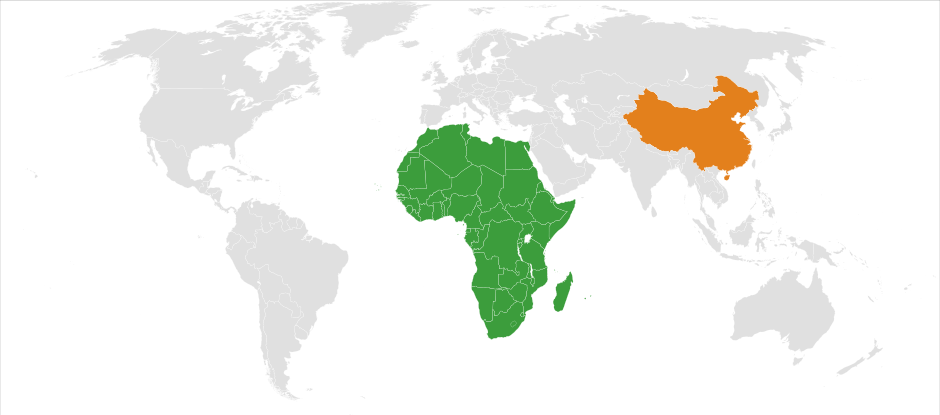
The Battle for Africa: Inside the New Scramble Between China and the West for the Continent That Will Define This Century
Executive Summary
Two multi-billion-dollar railway corridors, cutting across the mineral heartland of Central and Southern Africa in opposite directions, have become the clearest physical expression of the most consequential great power competition of the twenty-first century. One runs west: the Lobito Corridor, a 1,700-kilometer rail network backed by up to 6 billion dollars in American and European financing, carrying copper and cobalt from the Democratic Republic of Congo and Zambia to the Angolan Atlantic port of Lobito, engineered to deliver Central African minerals directly to Western manufacturers without touching a single Chinese-controlled node. The other runs east: the Tanzania-Zambia Railway, rehabilitated with 1.4 billion dollars in Chinese investment, moving the same copper belt's output toward the Indian Ocean port of Dar es Salaam and onward to the factories of Shenzhen, Shanghai, and Guangzhou. Both projects target the same mines. Both aim to ship the same minerals. Neither can succeed without the other losing ground. This is the new scramble for Africa, and unlike the colonial partition of the nineteenth century, it is being contested not through military conquest but through financing structures, infrastructure bundling, refining capacity, and the patient accumulation of two decades of relationship-building that China began and the West is now racing, with mixed success, to counter.
The stakes could not be higher for the industries that will define this century. The Democratic Republic of Congo alone holds over 70 percent of the world's cobalt reserves. Zambia's Copperbelt anchors global copper supply at the exact moment that electrification, artificial intelligence data centers, and defense manufacturing are driving copper demand to historic highs. Guinea's Simandou deposit, now producing 120 million tons of iron ore annually under Chinese investment and technical expertise, represents one of the most significant mining developments anywhere on earth in the past decade. Zimbabwe supplies roughly 15 percent of China's imported lithium concentrate. Tanzania's Ngualla project ranks among the world's largest undeveloped rare earth deposits. Whoever controls the flow of these materials - not merely the mining rights, but the roads, railways, ports, and processing facilities that transform ore into usable industrial input - will possess a decisive advantage in the clean energy transition, the artificial intelligence buildout, and the advanced weapons manufacturing that all depend on the same narrow list of critical minerals concentrated disproportionately beneath African soil.
China's position, built over two decades through a model combining infrastructure, financing flexibility, and risk tolerance that Western capital markets have historically been unable or unwilling to match, remains formidable. But 2025 and 2026 have produced the most significant Western counter-mobilization in a generation - the December 2025 US-DRC Strategic Asset Reserve agreement, the Trump administration's Development Finance Corporation expansion to over 140 billion dollars in lending capacity, the accelerating Lobito Corridor construction, and a broader recognition across Washington, Brussels, Tokyo, and New Delhi that ceding Africa's mineral wealth to Chinese-controlled supply chains carries strategic consequences that extend far beyond the continent itself. This report provides a doctrine-level assessment of that contest - its historical roots, its current battle lines, its military and economic dimensions, and the realistic trajectory of a competition whose outcome will shape the industrial capacity of great powers for decades to come.
Strategic Background
Africa's re-emergence as a central theater of great power competition reflects the convergence of three structural forces that have overtaken the continent's post-Cold War position as a secondary concern in the strategic calculations of major powers. The first is resource concentration: the specific minerals required for battery technology, renewable energy infrastructure, semiconductor manufacturing, and advanced weapons systems are geologically concentrated in African deposits to a degree that no diversification strategy can fully circumvent. Cobalt, essential for lithium-ion battery cathodes, is overwhelmingly concentrated in the Democratic Republic of Congo. Copper, whose demand trajectory is accelerating in parallel with electrification, artificial intelligence data center buildout, and grid expansion, finds its most significant untapped reserves across the Zambian and Congolese copperbelt. Rare earth elements, essential for permanent magnets in everything from electric vehicle motors to precision-guided munitions, are increasingly being identified in commercially significant African deposits from Tanzania to Angola to Malawi.
The second structural force is the demonstrated success of China's two-decade-long, deliberately integrated approach to African engagement - a model that Beijing began building well before Western capitals recognized its strategic significance. Rather than pursuing mineral acquisition through arm's-length commercial transactions, Chinese state-backed firms and development banks financed the roads, power infrastructure, concentrators, refineries, and export terminals that transformed isolated mineral deposits into commercially viable, fully integrated supply chains connecting African mines directly to Chinese processing and manufacturing capacity. This infrastructure bundling - mining investment paired with power generation, transport, and even hospital and community infrastructure - compressed project timelines and deepened political relationships with host governments in ways that transactional Western financing models structurally could not replicate, producing a positional advantage across the African mineral landscape that extends far beyond simple mine ownership into the financial, logistical, and processing architecture that determines whose factories ultimately receive the finished industrial material.
The third structural force is the belated but now accelerating Western recognition that this Chinese positional advantage carries direct consequences for the industrial and military capacity of the United States, the European Union, and their allies. The same critical minerals demand trajectory that is accelerating in parallel across the green energy transition, artificial intelligence infrastructure buildout, and advanced weapons manufacturing has made African mineral access a matter of first-order economic and national security concern in Washington, Brussels, Tokyo, and New Delhi - producing the most significant Western strategic re-engagement with the African continent since the end of colonial rule.
Historical Context
The historical roots of China's African engagement trace to the early 2000s, when Beijing began systematically extending aid and credit for what analysts now term transition minerals - the key inputs for renewable energy technologies whose strategic significance China's own industrial planners recognized years before Western counterparts. Between 2000 and 2021, Beijing provided approximately 57 billion dollars in aid and credit for these transition minerals across developing countries globally, with roughly 24 billion dollars directed to Africa specifically - a sustained financial commitment that made China Africa's largest financier of mineral projects and granted Beijing both resource access and political influence that compounded over successive years of continued investment.
This financial commitment was embedded within the broader architecture of China's Belt and Road Initiative and its associated infrastructure diplomacy across the continent, exemplified by landmark projects including the Addis Ababa-Djibouti railway that provided landlocked Ethiopia with access to the port of Djibouti, and the Standard Gauge Railway connecting Mombasa and Nairobi in Kenya. China's establishment of its first overseas military base in Djibouti - positioned at the strategic chokepoint connecting the Red Sea and Bab el-Mandeb Strait - represented the security dimension of a broader engagement strategy that combined infrastructure investment, resource access, and growing military presence into an integrated continental strategy that no Western power had pursued with comparable coherence or patience during the same period.
China's Digital Silk Road initiative extended this integrated approach into telecommunications infrastructure, with firms including Huawei and ZTE building 5G networks, smart city systems, and digital infrastructure across dozens of African nations - investment that has generated significant technological dependency even as it has raised persistent concerns regarding debt sustainability, cybersecurity, and sovereignty that crystallized most visibly in Zambia's debt crisis, a case study that Western critics have repeatedly invoked as evidence of the structural risks embedded in China's financing model even as African governments have continued to find Chinese capital more accessible and more flexible than Western alternatives for large-scale infrastructure development.
The Western response through the 2010s and early 2020s was comparatively fragmented and underfunded, reflecting a strategic complacency about Africa's importance that only began to shift decisively as the clean energy transition's mineral requirements became impossible to ignore. The 2022 launch of the Minerals Security Partnership under the Biden administration represented an early institutional acknowledgment of this shift, but it was the Trump administration's more aggressive, DFC-centered approach beginning in 2025 that has produced the most substantial acceleration of American capital deployment toward African mineral infrastructure in the modern era.
Current Situation Assessment
The state of the China-West contest for Africa as of mid-2026 is best captured by the parallel construction of two competing rail corridors that have become the emblematic infrastructure projects of the entire competition. The Lobito Corridor, stretching approximately 1,700 kilometers from Angola's Atlantic coast through the Democratic Republic of Congo to Zambia's mineral-rich Copperbelt, has become the most visible manifestation of Western strategic re-engagement, with total investment reaching up to 6 billion dollars and a target completion date of 2030. The corridor's Phase 2 construction, beginning in 2026, will create direct Atlantic export infrastructure that completely circumvents existing Chinese logistics networks - the clearest physical embodiment yet of the Trump administration's strategic thesis that containment of Chinese-controlled supply chains can be achieved through sustained infrastructure investment and targeted bilateral mineral agreements.
The competing Chinese response has been the rehabilitation of the Tanzania-Zambia Railway, known as TAZARA, backed by 1.4 billion dollars in Chinese investment and leveraging historical relationships dating to the railway's original 1970s construction under Chinese financing during the era of African liberation movements. TAZARA's modernization, involving long-term concession arrangements with Chinese state-backed firms, aims to expand freight capacity between Zambia's Copperbelt and the Indian Ocean port of Dar es Salaam, with Tanzania's finance ministry projecting the railway will eventually transport 3 million metric tons of minerals annually toward Asian markets - a direct and deliberate strategic counter to the westward-oriented Lobito investment.
The most significant single American policy action of the current period came in December 2025, when the United States signed a strategic partnership agreement with the Democratic Republic of Congo establishing a Strategic Asset Reserve - a framework designating priority mining zones for joint US-DRC development, under which American companies will receive preferential treatment for reserve projects. This agreement represents a direct challenge to China's existing dominance, given that Chinese firms currently control over 72 percent of Congolese copper and cobalt mines - a concentration so extensive that any meaningful American counter-position requires not merely new investment but a fundamental contestation of an already deeply entrenched Chinese commercial position.
This American re-engagement has been accompanied by a broader diplomatic and financial mobilization. The Trump administration's Development Finance Corporation, under CEO Ben Black, has received congressional approval to expand its financing capacity to over 140 billion dollars, with Africa now constituting the agency's second-largest portfolio at an outlay of approximately 10 billion dollars across the region. The DFC's December 2025 decision to grant Lobito Atlantic Railway a 550-million-dollar loan to maintain operations, even amid expanded foreign assistance reviews elsewhere in the administration's Africa policy, signals that mineral security has become the administration's highest continental priority - a prioritization that carries its own credibility complications, given that the same period saw a 20 percent reduction in broader Africa-focused development aid, including USAID programme terminations, that ran concurrent with the DFC's expanding infrastructure financing.
Power Center Analysis
China: The Entrenched Incumbent
China's structural position across African mineral supply chains reflects two decades of consistent, deliberately layered investment applied across multiple mineral categories, multiple jurisdictions, and multiple phases of project development. Beijing's approach has never been simply the acquisition of mineral deposits - Chinese firms have financed the complete surrounding ecosystem of roads, power projects, concentrators, refineries, and export infrastructure while accepting political and operational risks that many Western investors have historically avoided, producing integrated supply chains linking African mines directly to Chinese processing and manufacturing capacity in ways that transactional Western financing models structurally cannot replicate. The scale of this advantage is illustrated starkly in the Democratic Republic of Congo, where Chinese firms dominate the majority of copper and cobalt production, and in Zimbabwe, which by 2025 supplied roughly 15 percent of China's imported lithium concentrate with Chinese firms controlling many of the country's most important lithium projects, including major processing investments at Sandawana, Arcadia, and Bikita.
China's most underappreciated structural advantage lies not in mine ownership but in logistics control. By pairing mining investments with complementary transport and power infrastructure, Chinese operators ensure that extracted minerals flow through Chinese-controlled or Chinese-built trade networks regardless of who formally holds the mining concession - a pattern documented across Guinea's bauxite and Simandou iron ore corridor, the DRC-Zambia copper belt, Zimbabwe and Mali's lithium export routes, and Mozambique's graphite export networks. A Western company that secures a mining concession but lacks alternative export infrastructure remains effectively dependent on Chinese-built logistics to move its product to market - meaning that control of the route, rather than the resource itself, is frequently the decisive competitive variable in this contest, and one where China's structural head start remains largely intact despite the acceleration of Western counter-investment.
The United States: The Aggressive Late Entrant
Washington's African strategy under the Trump administration has undergone a deliberate recalibration, moving away from the combative rhetoric that characterized the administration's early approach toward a more transactional, investment-focused posture centered on the Development Finance Corporation's expanded lending authority. The December 2025 DRC Strategic Asset Reserve agreement, the parallel US-mediated DRC-Rwanda peace accord of June 2025, and the broader deployment of DFC capital toward the Lobito Corridor and associated projects collectively represent the most substantial American infrastructure commitment to African critical minerals in the modern era. The Trump administration's shift at the February 2026 Mining Indaba conference in Cape Town - where American officials abandoned combative rhetoric in favor of concrete offers to re-risk mining projects through offtake and price guarantees - reflects a tacit institutional acknowledgment that transactional bombast was undermining rather than advancing American commercial interests on the continent.
The structural weakness in the American approach remains its narrowness. China's strategy, encompassing infrastructure, development aid, and consumer market investment simultaneously, is considerably more holistic than an American approach that has concentrated overwhelmingly on minerals-specific infrastructure while simultaneously cutting broader development assistance. This minerals-oriented reorientation risks undermining American credibility as a development partner even as it succeeds in building specific competing infrastructure, creating a disparity between American rhetoric emphasizing partnership and the actual distribution of resources that remains heavily weighted toward extractive rather than developmental priorities.
The European Union: The ESG-Constrained Competitor
European engagement in the African minerals contest operates through a combination of bilateral national initiatives, European Development Bank financing, and participation in multilateral frameworks including the Lobito Corridor's broader financing structure. European capital brings genuine advantages in environmental, social, and governance standards that increasingly resonate with African civil society organizations and communities affected by mining operations - advantages illustrated by the contrast between DFC's ESG-prioritized lending model and the frequent criticism China faces in Africa for weak ESG compliance, particularly regarding the environmental incidents that have accompanied several major Chinese-backed mining operations. Japan's parallel engagement, exemplified by the 7-billion-dollar Nacala Corridor Development Project financed alongside the African Development Bank, Malawi, Mozambique, and Zambia under the Tokyo International Conference on African Development framework, demonstrates an alternative model emphasizing shared financing, civil society oversight, and strict certification standards that several African governments have identified as a template for more equitable mineral partnership arrangements than either the pure Chinese or pure American models currently offer.
Russia: The Security and Influence Specialist
Russia's African engagement operates on a fundamentally different axis than the Chinese and Western contest over mineral infrastructure, concentrating instead on military diplomacy, security cooperation, and political engagement in areas of instability where Western presence has weakened or withdrawn entirely. Moscow has become a key supplier of weapons and security services across the Sahel region, building relationships with governments in Mali and Burkina Faso that emerged partly from tensions with France following the French military withdrawal from former colonial security partnerships. Russia's approach - offering military aid, training, intelligence exchange, and counterterrorism cooperation with minimal governance conditionality - has proven particularly attractive to governments facing insurgencies or having undergone recent political transitions, positioning Moscow as a security patron whose influence, while smaller in economic scale than either Chinese or Western investment, carries outsized strategic significance in specific fragile states where it has established a presence.
African Governments: The Increasingly Sophisticated Negotiators
The most significant evolution in the African minerals contest is the growing sophistication with which resource-holding African governments are navigating the competition between external powers. Unlike historical colonial extraction patterns, current mineral competition involves genuine diplomatic and economic leverage exercised by African states, illustrated by Zambia's 2024 Minerals Regulation Commission Act and Tanzania's 2025 reforms strengthening domestic participation requirements - both explicit hedging strategies designed to allow mineral exports to flow through multiple corridors rather than accepting dependence on any single external partner. The DRC and Zambia's 2025 launch of a transboundary battery and electric vehicle special economic zone along their shared mining belt, supported by the Africa Export-Import Bank and the United Nations Economic Commission for Africa, reflects a deliberate African strategy of capturing value-added processing rather than remaining confined to raw material export - a strategy consistent with the long-standing African Mining Vision and African Commodities Strategy frameworks that call for transparent, equitable, and optimal resource use to drive sustainable continental development.
Military and Security Implications
The military and security dimensions of the Africa contest extend across a spectrum from direct great power military presence to the security implications of critical mineral supply chain control for defense manufacturing capacity in Washington, Beijing, Brussels, and Moscow alike. China's military base in Djibouti - its first and only overseas military installation - provides Beijing with a permanent security presence at one of the world's most consequential maritime chokepoints, positioned to protect Chinese commercial interests across the Red Sea and Bab el-Mandeb corridor while simultaneously projecting Chinese military reach into a region historically dominated by American, French, and other Western security presence. This base, combined with China's extensive infrastructure and economic relationships across the continent, provides Beijing with the kind of integrated economic-security architecture that Western powers, despite decades of individual military basing arrangements across the continent, have generally failed to coordinate into an equivalently coherent strategic posture.
Russia's security-focused African strategy carries distinct but equally significant military implications, particularly across the Sahel, where Moscow's military cooperation with governments in Mali and Burkina Faso has directly displaced French security partnerships that had defined the region's counterterrorism architecture for over a decade. This displacement reflects not merely a bilateral relationship shift but a broader reconfiguration of the security architecture governing one of the world's most active zones of jihadist insurgency, with implications for the stability of neighboring West African states and the broader international counterterrorism effort that extends well beyond the immediate bilateral relationships involved.
The defense-industrial implications of the minerals contest itself carry perhaps the most significant long-term military consequence. The same critical minerals - cobalt, rare earths, specific categories of copper and lithium - that power the clean energy transition and consumer electronics are equally essential inputs for advanced weapons manufacturing, precision-guided munitions, and the broader defense industrial base of every major military power. A United States or European defense industrial base that remains structurally dependent on Chinese-controlled mineral processing and logistics infrastructure, even when the underlying mineral deposits are located in Africa rather than China itself, faces a supply chain vulnerability directly analogous to the rare earth dependency that has already forced significant Western policy responses in other strategic contexts. This reality underlies the urgency behind the DRC Strategic Asset Reserve agreement and the broader Lobito Corridor investment - both explicitly designed to establish mineral supply architecture that bypasses Chinese logistics control entirely, providing the kind of supply chain security that defense planners increasingly regard as a first-order strategic requirement rather than a purely commercial consideration.
Economic and Trade Impact
The economic scale of the Africa minerals contest reflects the extraordinary demand trajectory driving competition across cobalt, copper, lithium, and rare earth categories simultaneously - a trajectory driven by the convergence of the green energy transition, artificial intelligence infrastructure buildout, and advanced weapons manufacturing all accelerating in parallel. The International Energy Agency's Global Critical Minerals Outlook has projected significant demand increases for copper, cobalt, and lithium as countries expand renewable energy capacity and electric vehicle production - a demand trajectory that both Chinese and Western strategic planners regard as compressing the decision-making timeline for infrastructure investment, since the corridors and processing facilities being built today will determine which manufacturing base captures the critical 2025-2030 development window when demand growth is projected to peak most sharply.
Guinea's Simandou iron ore project provides perhaps the clearest illustration of Chinese execution capability in this contest, having transformed a previously stalled Western development effort into an operational mining complex now producing 120 million tons annually through Chinese investment and technical expertise - a scale of achievement that Western competitors have struggled to match on comparable timelines even where they have held earlier or more established commercial positions. Ghana's Ewoyaa lithium project offers a similarly instructive case study in the opposite direction: when the American-linked Elevra Lithium withdrew from development funding obligations, China's Zhejiang Huayou Cobalt moved immediately to assume the funding role - illustrating how Chinese state-affiliated companies function as strategic backstops across African mineral development, absorbing commercial risk that Western publicly listed firms, operating under shareholder and regulatory pressure, frequently cannot sustain.
The processing and refining dimension of this contest represents China's most structurally entrenched defensive position. Even where Western firms succeed in securing mining concessions or building alternative export infrastructure, the downstream refining and processing capacity that transforms raw ore into battery-grade or industrial-grade finished material remains overwhelmingly concentrated in Chinese-controlled facilities, both within Africa and in China itself. This processing bottleneck means that a meaningful share of minerals extracted through nominally Western-controlled supply chains still flow, at some stage of the value chain, through facilities that Chinese firms own or control - a structural reality that no single infrastructure corridor, however well-financed, can fully resolve without parallel Western investment in the capital-intensive, technologically complex, and environmentally demanding refining capacity that China has spent two decades building.
Environmental and social governance failures have emerged as an increasingly consequential variable shaping this economic competition. The 2025 toxic spill at the Chinese-owned Sino-Metals Leach operation in Zambia's Kafue River, and the subsequent suspension of activities at a Huayou subsidiary in the DRC following an industrial discharge incident, have triggered significant environmental and political controversy, including a landmark High Court case launched by Kafue spill victims in September 2025. These incidents, alongside broader concerns regarding pollution, displacement, compensation, and labor practices at major Chinese-backed projects, are elevating social license to operate as a strategic variable that can meaningfully affect project viability - creating openings for Western and Japanese competitors whose ESG-prioritized financing models increasingly resonate with African governments and communities seeking more equitable and environmentally sustainable mineral development arrangements.
Diplomatic Positioning
The diplomatic architecture of the Africa contest has grown increasingly dense and multilateral through 2025 and 2026, reflecting the growing recognition among all major external powers that sustained continental engagement requires far more than transactional mineral agreements. The May 2026 Africa Forward Summit in Nairobi, bringing together French President Emmanuel Macron, Kenyan President William Ruto, and numerous other African heads of state, exemplifies the intensifying diplomatic attention that European powers are now directing toward the continent as part of a broader strategic recalibration prompted by China and Russia's expanding influence. This European re-engagement reflects a recognition that Africa's economic strength, rapidly growing population, mineral abundance, and geographical significance at the crossroads of the Indo-Pacific, Atlantic, Red Sea, and Mediterranean regions demand a fundamentally more serious strategic approach than the relatively limited attention European capitals directed toward the continent through the 2010s.
The United States has similarly escalated diplomatic engagement through mechanisms including the US-Africa Leaders Summit framework and sustained high-level attention to critical minerals partnerships, though the credibility of this diplomatic push remains complicated by the tension between rhetorical emphasis on partnership and the concurrent reduction in broader development assistance that the DFC's expanded mineral-focused lending has not offset. The US-mediated DRC-Rwanda peace accord of June 2025 represents a particularly significant diplomatic achievement in this context, addressing one of the most consequential regional conflicts affecting the DRC's mineral-rich eastern provinces while simultaneously serving Washington's broader strategic interest in stabilizing the security environment surrounding the mineral deposits that the Strategic Asset Reserve agreement targets for American development.
China's diplomatic response to this intensifying Western re-engagement has emphasized continuity and adaptation rather than confrontation, with Chinese companies increasingly investing in local processing facilities, power infrastructure, and industrial partnerships explicitly designed to align with African governments' development priorities rather than pure extraction. This adaptive strategy reflects Beijing's recognition that African governments' growing sophistication in demanding value-added processing - evident in Zimbabwe's lithium export restrictions, the DRC's promotion of local refining, and South Africa's push to move up the value chain - requires a more responsive Chinese engagement model than the primarily extractive approach that characterized earlier phases of Belt and Road investment across the continent.
Regional Fallout
In Central Africa, the Democratic Republic of Congo sits at the absolute center of the entire contest, given its dominant position in global cobalt production and its emergence as a critical copper supplier through projects including the Kamoa-Kakula mine, whose operational capacity of 437,061 tonnes annually carries potential to rise to 2 million tonnes by 2030. The combination of the December 2025 US-DRC Strategic Asset Reserve agreement and the June 2025 DRC-Rwanda peace accord illustrates how deeply American strategic interest in Congolese minerals has become intertwined with the broader security and political stability of a country whose eastern provinces have experienced recurring conflict for decades - conflict whose resolution or continuation carries direct implications for whether either American or Chinese mineral infrastructure investment can be executed and sustained at the scale both powers are now targeting.
In Southern Africa, Zambia occupies a similarly pivotal position as the shared terminus of both the westward Lobito Corridor and the eastward TAZARA railway, giving Lusaka substantial leverage to extract favorable terms from both American and Chinese infrastructure investment while simultaneously pursuing its own domestic value-addition strategy through copper refining and battery mineral processing initiatives. Zimbabwe's emergence as a major Chinese-linked lithium hub, alongside its periodic export restrictions designed to capture more domestic value from its lithium resources, illustrates the broader pattern of African governments across the region using their mineral leverage to negotiate increasingly favorable terms from external powers competing intensely for access.
In West Africa, Guinea's Simandou project and Ghana's lithium developments illustrate both the scale of Chinese execution capability and the vulnerability of Western commercial commitments to withdrawal under financial or political pressure, as the Ghana Ewoyaa case demonstrated when American-linked capital exited and Chinese state-affiliated financing immediately filled the gap. The broader West African security environment, particularly across the Sahel where Russian security cooperation has displaced traditional French partnerships in Mali and Burkina Faso, adds a further layer of great power competition that intersects with but operates somewhat independently from the minerals-focused contest playing out across Central and Southern Africa.
In East Africa, Tanzania's dual role - hosting both the TAZARA railway's Indian Ocean terminus and the Ngualla rare earth project that Chinese firm Shenghe Resources has moved to secure - positions Dar es Salaam as a critical node in China's eastward mineral export architecture, even as Tanzania's own 2025 regulatory reforms strengthening domestic participation requirements reflect the same hedging behavior that Zambia and other resource-rich states are increasingly deploying to preserve strategic flexibility rather than accepting exclusive dependence on any single external partner.
Global Strategic Consequences
The Africa minerals contest's global strategic consequences extend far beyond the continent itself, shaping the industrial and defense capacity of every major power engaged in the competition for the remainder of this decade and beyond. For China, continued dominance of African mineral supply chains provides the raw material foundation for its own clean energy manufacturing dominance, its electric vehicle industry's continued global market leadership, and increasingly its own defense industrial base's access to the rare earths and critical minerals that underpin advanced military technology development - reinforcing, through African supply chain control, precisely the kind of manufacturing and military-industrial advantage that Beijing's broader strategic competition with the United States requires.
For the United States and its allies, successful execution of the Lobito Corridor and the broader Strategic Asset Reserve framework would represent a genuine structural achievement in reducing Western dependence on Chinese-controlled mineral processing and logistics - a achievement whose strategic significance parallels, in the African context, the broader Western effort to reduce Chinese leverage over semiconductor manufacturing, rare earth processing, and other critical technology supply chains that has defined great power economic competition through the mid-2020s. The credibility gap between American rhetorical emphasis on partnership and the concurrent reduction in broader African development assistance, however, represents a genuine strategic vulnerability that Chinese diplomacy has proven adept at exploiting, positioning Beijing's more holistic if extractively-oriented engagement model as the more reliable and comprehensive partnership option for African governments weighing their strategic alignment choices.
For African nations themselves, the intensifying competition creates a genuine, if narrow, window of opportunity to extract more favorable development terms, greater value-added processing investment, and more sophisticated diplomatic leverage than existed during any previous period of external great power engagement with the continent - provided that African governments can sustain the institutional capacity and political coherence required to negotiate effectively across multiple competing partners simultaneously, and provided that the environmental, labor, and governance failures that have accompanied both Chinese and, to a lesser extent, Western mining operations do not undermine the social license that sustained mineral development ultimately requires.
Risk Matrix
- Risk Level: Critical - A major security deterioration in the Democratic Republic of Congo's eastern provinces, despite the June 2025 DRC-Rwanda peace accord, disrupts both the Strategic Asset Reserve development zones and broader Congolese cobalt and copper production, undermining the central pillar of American mineral supply chain diversification strategy at its most geologically critical node.
- Risk Level: High - Chinese processing and refining dominance persists regardless of Western mining and logistics investment, meaning that minerals extracted through Lobito Corridor infrastructure ultimately still flow through Chinese-controlled downstream processing facilities, limiting the strategic value of Western infrastructure investment to raw ore transport rather than genuine supply chain independence.
- Risk Level: High - The credibility gap between American rhetorical partnership emphasis and the concurrent reduction in broader African development assistance erodes Washington's competitive position relative to China's more holistic engagement model, prompting African governments to favor continued or deepened Chinese partnership despite growing American mineral-specific investment.
- Risk Level: High - Further environmental and governance failures at major Chinese-backed mining operations, following the pattern established by the Zambia Kafue River spill and the DRC Huayou subsidiary suspension, trigger broader African civil society and governmental backlash that meaningfully constrains Chinese operational latitude across the continent, accelerating the shift toward Western and Japanese ESG-prioritized alternatives.
- Risk Level: Medium - Russia's security-focused Sahel engagement expands into additional West African states experiencing political instability, further displacing traditional Western security partnerships and creating a parallel axis of great power competition that complicates the primarily minerals-focused contest playing out across Central and Southern Africa.
- Risk Level: Medium - African governments' growing sophistication in mineral resource negotiation, exemplified by Zambia's and Tanzania's 2024-2025 regulatory reforms, successfully extracts substantially improved development terms from both Chinese and Western partners, shifting the balance of the contest's economic benefits more decisively toward African fiscal revenue and value-added processing capacity than either external power currently anticipates.
- Risk Level: Medium - Chinese advances in alternative battery chemistry, including sodium-ion and lithium-iron-phosphate technologies that reduce dependence on cobalt, manganese, and nickel, diminish the strategic value of specific African mineral deposits currently at the center of the contest, potentially leaving certain resource-dependent African economies less strategically significant than current investment trajectories assume.
- Risk Level: Low (near-term) - The Lobito Corridor achieves full 2030 completion on schedule and at its projected 6-billion-dollar budget, delivering the complete Atlantic export capacity increase that would meaningfully rebalance Central African mineral flows away from Chinese-controlled logistics. Multi-country infrastructure coordination challenges, historical patterns of African infrastructure project delay, and the scale of remaining Phase 2 construction make on-schedule completion achievable but not assured.
Scenario Analysis
Scenario One: Parallel Corridor Coexistence and African Hedging (Most Probable, 5-Year Horizon)
The most probable near-term trajectory sees both the Lobito Corridor and the TAZARA railway reach substantial operational capacity by the early 2030s, with African mineral-producing states - particularly Zambia and the DRC - deliberately routing exports across both corridors to preserve maximum commercial and political flexibility rather than committing exclusively to either American or Chinese logistics networks. This outcome would represent neither a decisive American success in displacing Chinese dominance nor a Chinese victory in preventing Western infrastructure development, but rather the emergence of a genuinely multipolar mineral logistics architecture in which African governments successfully leverage competing external investment to their own strategic and fiscal advantage, while Chinese downstream processing dominance continues to capture a disproportionate share of the value chain regardless of which corridor initially transports the raw material.
Scenario Two: Accelerated Western Displacement of Chinese Logistics Dominance (Moderate Probability)
A more decisive Western outcome would see the Lobito Corridor's full completion, combined with parallel American and European investment in downstream processing and refining capacity that addresses the structural weakness in the current Western strategy, meaningfully displace Chinese logistics control across the Central African copperbelt within the coming decade. This scenario requires sustained American political commitment across multiple administrations, successful resolution of the credibility gap between mineral-focused investment and broader development partnership, and continued DRC-Rwanda security stability - a combination of conditions that current trends make plausible but not the most probable outcome given the historical pattern of American strategic attention to Africa proving less consistent across political transitions than China's sustained, multi-decade institutional commitment.
Scenario Three: Chinese Adaptive Consolidation Through Local Processing Investment (Moderate Probability)
China's demonstrated adaptive response to growing African demands for value-added processing - evident in the shift toward local processing facility investment, power infrastructure, and industrial partnerships aligned with African development priorities - could allow Beijing to consolidate its existing structural advantages even as Western logistics investment succeeds in building alternative transport corridors. In this scenario, Chinese firms maintain their processing and refining dominance while adapting their engagement model sufficiently to retain African governmental preference, using their willingness to invest in genuine industrialization and value-addition, capabilities that address African governments' explicit strategic priorities under frameworks like the African Mining Vision, to counter the specific credibility advantages that improved American and European engagement models currently offer.
Intelligence Forecast (6-24 Months)
The six-to-twelve-month horizon will be shaped substantially by the pace of Lobito Corridor Phase 2 construction beginning in 2026, whose progress toward the planned direct Atlantic export infrastructure will provide the clearest near-term indicator of whether American infrastructure commitment can translate into operational capacity on the timeline the Strategic Asset Reserve agreement's strategic logic requires. Continued DFC financing decisions, following the December 2025 550-million-dollar Lobito Atlantic Railway loan, will indicate whether the agency's expanded 140-billion-dollar lending capacity is being deployed at the pace and scale necessary to meaningfully compete with China's sustained two-decade investment pattern across the same mineral-producing regions.
The stability of the June 2025 DRC-Rwanda peace accord will remain the single most important security variable determining whether both the Strategic Asset Reserve development zones and broader Congolese mineral production can proceed without the kind of eastern provinces conflict disruption that has repeatedly affected DRC mining operations historically. Any deterioration in this peace framework would immediately jeopardize the central geological anchor of the entire American mineral diversification strategy, given the DRC's unmatched global significance for cobalt production specifically.
The twelve-to-twenty-four-month horizon will be shaped significantly by African governments' continued regulatory evolution following the pattern established by Zambia's Minerals Regulation Commission Act and Tanzania's 2025 domestic participation reforms, with additional resource-rich states likely to introduce comparable frameworks designed to extract greater value-added processing investment and preserve export routing flexibility across multiple competing corridors. The trajectory of environmental and governance controversy following incidents including the Zambia Kafue River spill will also be an important indicator, with the September 2025 High Court case's eventual resolution potentially establishing significant legal precedent for community and civil society accountability mechanisms that could meaningfully affect the operational latitude that both Chinese and Western mining operators currently enjoy across the continent.
Final Strategic Takeaway
The battle for Africa in 2026 bears little resemblance to the colonial partition that gave the term its historical resonance. There is no scramble for territorial conquest, no formal division of the continent into spheres of exclusive control, and no single power capable of imposing its will unilaterally against the growing sophistication of African governments determined to extract maximum value from the competition unfolding on their soil. What exists instead is a patient, infrastructure-driven contest for the logistics architecture, processing capacity, and political relationships that will determine whose factories, whose electric vehicles, whose data centers, and whose weapons systems receive the critical minerals that African deposits will supply for decades to come.
China's two-decade head start remains the single most consequential structural fact governing this contest. Beijing's willingness to bundle mining investment with the power infrastructure, transport networks, and processing capacity that transform isolated deposits into commercially viable, fully integrated supply chains has produced a positional advantage that no single Western infrastructure project, however well-financed, can fully reverse in the span of a few years. The Lobito Corridor represents genuine and significant American strategic commitment - but its success in truly displacing Chinese dominance depends on parallel investment in the downstream processing and refining capacity where Beijing's advantage remains most structurally entrenched, an investment that current Western strategy has not yet matched to the scale of its logistics and mining ambitions.
The deepest strategic lesson of the current contest is one that African governments have absorbed with increasing clarity even as external powers continue to debate its implications: geological wealth alone determines little in a competition where control of the route, the refinery, and the relationship matters more than control of the mine itself. The African nations that succeed most decisively in this new scramble will be those that leverage precisely this insight - using the genuine competition between Washington, Beijing, Brussels, Tokyo, and Moscow not to choose a single patron but to extract, from each competing power simultaneously, the value-added processing investment, the infrastructure development, and the fiscal terms that transform mineral wealth into genuine industrial capacity rather than another century of raw extraction serving factories built somewhere else.
The scramble for Africa once meant flags planted in unclaimed territory. The new scramble means railways built toward competing ports, and the real prize was never the ore in the ground - it was always the route the ore would travel, and who would own it.
Frequently Asked Questions
What is the Lobito Corridor and why is it strategically important?
The Lobito Corridor is a 1,700-kilometer rail network, backed by up to 6 billion dollars in American and European financing, connecting the copper and cobalt mines of the Democratic Republic of Congo and Zambia to the Atlantic port of Lobito in Angola. It is designed to give Western manufacturers direct access to Central African minerals without relying on Chinese-controlled logistics networks, with Phase 2 construction beginning in 2026 targeting completion by 2030.
How dominant is China in African critical minerals right now?
China's position remains extensive: Chinese firms control over 72 percent of Congolese copper and cobalt mines, and Beijing provided roughly 24 billion dollars in mineral-related aid and credit to Africa between 2000 and 2021, making it the continent's largest mineral project financier. China also maintains dominant downstream processing and refining capacity, meaning minerals often flow through Chinese-controlled facilities even when mined under other arrangements.
What is the US Strategic Asset Reserve agreement with the DRC?
Signed in December 2025, the agreement establishes priority mining zones in the Democratic Republic of Congo for joint US-DRC development, with American companies receiving preferential treatment for reserve projects. It represents Washington's most direct challenge yet to existing Chinese mineral dominance in the country.
Why does Russia's role in Africa differ from China's?
Russia focuses primarily on military diplomacy and security cooperation rather than mineral infrastructure, supplying weapons, training, and counterterrorism support to governments across the Sahel, including Mali and Burkina Faso, often filling security vacuums left by departing Western partners such as France.
Are African governments benefiting from this competition?
Increasingly, yes. Countries including Zambia and Tanzania have introduced regulatory reforms in 2024 and 2025 requiring greater domestic participation and value-added processing, while jointly developing special economic zones for battery and electric vehicle manufacturing, reflecting a more sophisticated negotiating posture than in earlier eras of external resource competition.
What role do environmental and governance issues play in the contest?
They are increasingly significant. Incidents such as the 2025 toxic spill at a Chinese-owned facility on Zambia's Kafue River have triggered legal action and public backlash, elevating environmental and social governance standards as a competitive factor that favors Western and Japanese financing models emphasizing stricter ESG compliance.