
The Caspian Convergence: How One Sea Became the Secret Hinge of the Ukraine and Iran Wars
Executive Summary
For three decades the Caspian Sea sat at the margins of Western strategic attention, a landlocked basin known mainly for caviar, offshore energy fields, and a slow-moving legal dispute over how to divide its waters among five littoral states. That era is over. Since Russia's full-scale invasion of Ukraine in 2022 and the eruption of the 2026 Iran war following the February 28 strikes that killed Iran's supreme leader, the Caspian has become something far more consequential: the connective tissue between two wars that Washington, Brussels, and Jerusalem had tried hard to keep separate. Russia's influence extends beyond Ukraine — for analysis of how Moscow is shaping the Balkans, see our report on Serbia-Kosovo tensions and Russia's role in 2026.
Russian vessels have used the Caspian to strike Ukrainian targets with cruise missiles, replicating a tactic first developed in the Syrian theater. Iran and Russia have used the same waters to move drone components, missile technology, and sanctioned cargo beyond the reach of Western satellites and inspection regimes. In March 2026, Israel extended its air campaign against Iran into this previously untouched space, striking Iran's Caspian naval command at Bandar Anzali and disabling a significant share of Tehran's northern naval assets. Ukraine has since followed with its own drone strikes on vessels in the Caspian, treating Russia-Iran cargo shipments as legitimate targets in its wider campaign against Moscow's war economy.
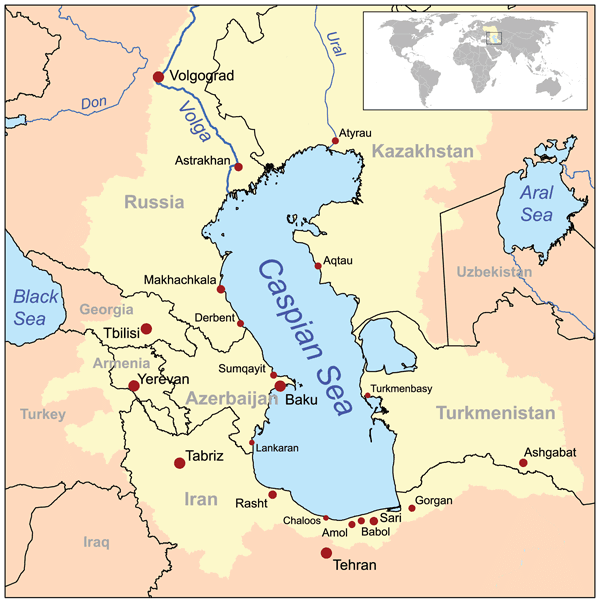
The result is a single, if still loosely bounded, strategic theater. A sea that five bordering states - Russia, Iran, Azerbaijan, Kazakhstan, and Turkmenistan - have historically kept insulated from outside navies and Western monitoring has become the shared vulnerability of the Moscow-Tehran axis, and simultaneously the shared opportunity of two competing trans-continental trade corridors: Russia and Iran's International North-South Transport Corridor (INSTC), and the Western-aligned Middle Corridor running through Kazakhstan, Azerbaijan, Georgia, and Turkey. This report assesses why the Caspian has become strategically load-bearing, who gains and loses from its transformation, and what the next eighteen months are likely to bring.
Strategic Background
The Caspian's importance rests on three overlapping functions that have converged only in the past four years. First, it is an energy basin, home to major Kazakh, Azerbaijani, and Turkmen offshore fields and the terminal points for pipelines that move Central Asian oil and gas toward European and Asian markets. Second, it is a transit corridor. The Trans-Caspian route and the wider Middle Corridor use Kazakh and Azerbaijani ports to move Chinese goods toward Europe while bypassing an increasingly sanctioned Russia, while the INSTC - championed by Russia, Iran, and India - moves cargo the opposite direction, linking Indian and Gulf ports through Iran and across the Caspian to Russia and onward to Europe. Third, and now most acutely, it is a military and sanctions-evasion corridor. Because no Western navy operates on the Caspian and because monitoring infrastructure there is thin compared with the Black Sea or the Persian Gulf, it has become what one Hudson Institute analyst has called a geopolitical black hole for American planners - split awkwardly between US European Command, which covers Russia and Azerbaijan, and US Central Command, which covers Iran, Kazakhstan, and Turkmenistan, with three separate State Department bureaus tracking the five littoral states.
That bureaucratic fragmentation is not an accident of org charts; it reflects decades of assumption that the Caspian was peripheral. The wars in Ukraine and Iran have exposed how wrong that assumption was.
Historical Context
The Caspian's legal status was unresolved for the first quarter-century after the Soviet collapse, as the five littoral states argued over whether it should be treated as a sea (implying maritime law) or a lake (implying different rules for resource division). The 2018 Convention on the Legal Status of the Caspian Sea, signed at Aktau, partially settled the question: it granted each state a nearshore zone while leaving much of the central waters as shared space between Russia and Iran, a provision that now takes on new significance as a determinant of naval risk and response thresholds. Crucially, the convention barred any non-littoral military presence on the Caspian, cementing it as a closed strategic space controlled by exactly the five states most invested in insulating it from Western scrutiny.
Russia's use of the Caspian Flotilla to fire Kalibr cruise missiles into Syria beginning in 2015 previewed what would later happen in Ukraine: naval platforms operating from an enclosed, unmonitored sea, launching long-range strikes into contested theaters far beyond the Caspian's shores. When Russia's 2022 invasion of Ukraine triggered sweeping Western sanctions, Moscow again turned to Caspian shipping, this time to fire missiles at Ukrainian targets and, more importantly, to build a trade and military-logistics lifeline with Iran, itself under sanction since long before 2022. The January 2025 Russia-Iran comprehensive strategic partnership treaty formalized what had been growing informally for years: deepened defense and technology cooperation routed substantially through Caspian shipping lanes connecting Russian ports to Iran's Bandar Anzali, the country's oldest and largest Caspian port.
Current Situation Assessment
The 2026 Iran war, which began with the February 28 Israeli and American strikes that killed Iran's supreme leader and a broad swath of its senior military leadership, has repeatedly spilled into Caspian waters. In late March 2026, Israeli airstrikes struck Iranian naval assets at Bandar Anzali, destroying missile boats, a corvette, a shipyard, and a command center - a strike Israel itself described as one of the most significant of the campaign. The attack punctured what had been treated by Moscow and Tehran as a secure, effectively closed logistics channel, forcing both governments to consider costlier and more exposed overland alternatives through Azerbaijan or Kazakhstan, and to invest more heavily in air defense and drone-monitoring capacity around Caspian ports.
Despite that disruption, trade volumes have continued to grow rather than collapse. Industry estimates suggest Russia-Iran cargo turnover across the Caspian could roughly double in 2026, reaching around 10 million tons, driven in part by both governments' hope that Washington will restrain further Israeli strikes on the northern Iranian coast. Analysts tracking the corridor describe extensive "dark ship" traffic - vessels disabling transponders to evade satellite tracking - as the primary method for moving Shahed-series drone components, ammunition, and industrial inputs between the two countries, alongside civilian trade tied to Russia's nuclear energy cooperation with Iran.
Ukraine has now formally entered this theater as well. In late July 2026, Ukrainian drones struck an Iranian merchant vessel in the Caspian Sea, an attack Iran's foreign ministry protested and which Kyiv frames as a legitimate extension of its campaign against the logistics chain sustaining Russia's war effort - a campaign that already treats Iranian drone and missile supplies to Russia as a direct threat to Ukrainian security. Tehran, for its part, has previously signaled it could treat Ukraine as a legitimate target given Kyiv's intelligence and material support to Israel during the Iran war. That reciprocal targeting logic is precisely what turns two ostensibly separate wars into a single contested theater.
Meanwhile, the broader Iran war itself remains in an unstable, unresolved state as of early August 2026. An April 8 US-Iran ceasefire, brokered with Pakistani mediation, has survived in modified form through a June memorandum of understanding meant to produce a comprehensive settlement, but conflict resumed in July after Iran struck three commercial vessels that had deviated from a pre-approved shipping route, and talks over reopening the Strait of Hormuz remain active and unresolved. Iranian officials say they have used the ceasefire window to rebuild missile production and reconstitute forces, while continuing to warn they are prepared to resume full hostilities if negotiations collapse again. This unresolved, on-again-off-again character of the wider war is itself a Caspian risk factor: every renewed round of strikes has a track record of extending into Caspian infrastructure.
Power Center Analysis
Four power centers now shape Caspian dynamics with distinct and partially incompatible objectives. Russia treats the sea as an irreplaceable wartime supply line to Iran and a secondary strike platform against Ukraine, and has the strongest incentive of any actor to keep the corridor insulated from Western monitoring and Israeli reach. Iran treats it as a rare sanctions-evasion route not dependent on the Strait of Hormuz, valuable precisely because it lies outside the naval chokepoints the United States and its partners can more easily police, even as that same isolation now makes it a target once Israeli intelligence identifies drone or missile production tied to the region. Kazakhstan and Azerbaijan occupy a harder position: both maintain historically balanced relations with Moscow while simultaneously hosting the Western-aligned Middle Corridor and Trans-Caspian International Route, positioning themselves as the primary beneficiaries of any diversification away from Russian and Iranian-controlled trade paths, but also as the parties most exposed if the Caspian becomes an active warzone. China, as the anchor demand-side economy for the Middle Corridor and a stakeholder in Belt and Road connectivity through Central Asia, has a strong interest in Caspian stability without wanting to be seen taking sides in either war.
The United States and Israel form a fifth pole whose posture is defined less by presence than by episodic reach: neither operates naval assets on the Caspian, but Israeli airpower has already demonstrated it can strike deep into the basin when intelligence justifies it, and American Central Command planners are increasingly forced to treat the Caspian as contiguous with the wider Iran theater rather than a separate regional file.
Military and Security Implications
The Bandar Anzali strikes and subsequent Ukrainian drone attacks establish a precedent with serious implications: the Caspian's forty-year status as a sanctuary space, protected less by hard defenses than by the assumption that no outside power would bother projecting force there, has been broken. Russia and Iran are now compelled to spend on multi-layer air defense, expanded drone and radar monitoring, and potentially the redeployment of additional military assets to a theater neither had prioritized for hard defense. That is a direct cost imposed on the Moscow-Tehran partnership, and a signal to both governments that dispersed, sanctioned supply chains are not immune from precision strikes simply because they sit outside conventional naval chokepoints.
At the same time, the shared-waters provision of the 2018 Caspian convention raises the risk that further Israeli or Ukrainian strikes on Iranian Caspian assets could be read by Moscow as encroaching on jointly administered space, potentially tightening Russia-Iran security cooperation and inviting retaliation outside the immediate region, including in the Black Sea theater where Russia and Ukraine are already in direct conflict. The Caspian's transformation from quiet energy basin to contested logistics corridor illustrates a broader pattern: sanctions-driven partnerships built for resilience can themselves become the vulnerability that welds together conflicts policymakers had hoped to keep compartmentalized.
Economic and Trade Impact
Two major trade corridors have Caspian shipping as a load-bearing dependency. The INSTC links India and Iran through the Persian Gulf to rail and cross-Caspian shipping routes running through Azerbaijan and Russia toward European markets - a project Moscow, Tehran, and New Delhi have all backed as an alternative to Suez-dependent trade. The Middle Corridor runs the opposite direction, tying China and Kazakhstan across Caspian waters to Azerbaijan, Georgia, and Turkey, explicitly designed to route around both Russia and Iran and gaining considerable momentum since 2022 as Western shippers sought alternatives to sanctioned Russian transit. Both corridors now face the same underlying problem: renewed insecurity in the Caspian undermines the reliability calculus that made either route attractive in the first place, regardless of which side of the Russia-Iran divide a given shipper sits on.
Turkey has used Caspian-linked fossil fuel transit projects through Azerbaijan to expand its role as a regional energy hub and consolidate influence across the Turkic world, a strategy that benefits from Middle Corridor growth but is vulnerable to any escalation that raises insurance costs or transit risk across the basin. China views the corridor as integral to Belt and Road connectivity and energy security, giving Beijing a quiet but real stake in keeping the Caspian from becoming a shooting-war theater even as it avoids public commentary on either the Ukraine or Iran conflicts.
Diplomatic Positioning
Washington's diplomatic posture toward the Caspian remains reactive rather than strategic, a function of the institutional split between European Command and Central Command and the absence of any single State Department office responsible for the basin as a whole. That gap has allowed Russia and Iran to treat the Caspian as a comparatively low-cost venue for sustaining their partnership, precisely because Western diplomatic and intelligence architecture has not caught up to the basin's new military significance. Kazakhstan and Azerbaijan, for their part, continue to hedge: both maintain economic and diplomatic engagement with Russia while courting Western and Chinese investment in Caspian-crossing infrastructure, a balancing act that becomes harder to sustain the more the basin is treated as an active front rather than a neutral trade corridor.
Regional Fallout
South Caucasus states, particularly Azerbaijan and Georgia, face rising exposure as Middle Corridor transit partners whose commercial proposition depends on the Caspian remaining calmer than the Black Sea or the Persian Gulf. Central Asian states, especially Kazakhstan and Turkmenistan, confront a harder version of the same dilemma: overland alternatives to Caspian shipping that Russia and Iran may increasingly rely on would route additional sanctioned and military-adjacent cargo through their territory, raising both commercial opportunity and secondary-sanctions exposure. Gulf states with a stake in Hormuz-dependent trade are watching the Caspian precedent closely, since a second theater absorbing Israeli and Ukrainian strikes changes Iran's overall calculus on how much risk it is willing to absorb in the south.
Global Strategic Consequences
The core global consequence is the erosion of compartmentalization. Western policy since 2022 has largely treated the Ukraine war and the post-February 2026 Iran war as related but distinct files, coordinated at the level of general sanctions policy but managed by separate military commands, separate diplomatic tracks, and separate publics. The Caspian's emergence as a shared logistics and now shared strike theater erodes that separation in practice, regardless of how policymakers prefer to categorize it. It also demonstrates a broader lesson about sanctions-evasion architecture: routes built for resilience against one form of pressure - economic sanctions - are not automatically resilient against a different form of pressure, in this case precision air and drone strikes, and the attempt to harden the Caspian corridor militarily will itself generate new frictions with the littoral states that host it.
Risk Matrix
High risk: further Israeli strikes on Iranian Caspian military and drone-production infrastructure if intelligence indicates renewed weapons transfers; continued Ukrainian drone strikes on Russia-Iran cargo vessels as Kyiv widens its economic-warfare campaign.
Medium risk: a Russia-Iran push to formalize joint Caspian air-defense and naval coordination, raising the diplomatic cost of any future Western or Israeli action in the basin; accelerated Kazakh and Azerbaijani investment in Middle Corridor capacity as insurance against Russian and Iranian route instability.
Lower probability but high consequence: a Caspian incident significant enough to be read by Moscow as a direct attack on shared Russia-Iran waters under the 2018 convention, triggering retaliation outside the basin, including against Ukrainian or Western-linked targets in the Black Sea.
Scenario Analysis
Base Scenario (Medium-High probability): The Caspian continues as a contested but not fully militarized corridor. Russia-Iran trade volumes keep growing despite periodic disruption, both governments invest incrementally in air defense and dark-shipping techniques, and Ukraine and Israel conduct occasional, intelligence-driven strikes rather than sustained campaigns. The Middle Corridor and INSTC both continue operating at reduced reliability, with shippers pricing in higher risk premiums rather than abandoning the routes outright.
Bull Scenario (Low-Medium probability): A durable Iran-US settlement over Hormuz and the broader war reduces Israeli incentive to strike Caspian targets, Russia-Ukraine negotiations gain traction, and Caspian shipping reverts toward a primarily commercial function, benefiting Kazakhstan and Azerbaijan as connectivity hubs and easing the corridor's centrality to conflict.
Bear Scenario (Low but rising probability): Renewed collapse of the Iran-US ceasefire triggers a fresh Israeli campaign that again targets Caspian infrastructure at scale, prompting overt Russia-Iran military coordination in the basin and a corresponding expansion of Ukrainian strikes on Caspian shipping as part of Kyiv's broader campaign against Russia's war economy. This scenario risks the Caspian becoming a semi-permanent secondary front linking both wars, with meaningful spillover into Black Sea operations and Central Asian security calculations.
Intelligence Forecast (6-24 Months)
Over the next six to twelve months, expect continued growth in Russia-Iran Caspian trade volumes even amid periodic strikes, continued Ukrainian willingness to treat Caspian shipping as a legitimate target set, and incremental but not yet decisive Kazakh and Azerbaijani efforts to insulate Middle Corridor operations from basin-wide instability. Over twelve to twenty-four months, the more consequential development to watch is institutional: whether Washington moves to consolidate Caspian policy under a single command and diplomatic authority, which would signal the basin has been formally reclassified from peripheral to central in US strategic planning. A failure to do so will likely mean continued reactive, strike-driven engagement rather than sustained deterrence architecture. This forecast should be read as a scenario-based analytical judgment rather than a prediction of confirmed future events.
Final Strategic Takeaway
The Caspian's transformation is not a side story to the Ukraine and Iran wars; it is one of the clearest illustrations available of how sanctions-driven partnerships generate their own strategic geography. Russia and Iran built a resilient logistics relationship specifically to route around Western economic pressure, and in doing so created a shared vulnerability that adversaries have now learned to exploit militarily. The basin's five littoral states, none of whom sought this outcome, are left absorbing the costs of a great-power and regional competition being fought partly on and around their shared waters.
Global Chanakya Assessment
Three underreported dynamics deserve closer attention. First, the institutional blind spot inside the US government - a Caspian file split across two military commands and three State Department bureaus - is not a minor bureaucratic curiosity but a structural reason Russia and Iran have been able to treat the basin as a comparative safe haven for as long as they have; any serious Western effort to raise the cost of Caspian trade will require fixing that fragmentation before it can produce coherent policy. Second, the contrarian read on Ukraine's entry into Caspian targeting is that it may do more to unify Russian and Iranian military planning than to deter either side individually - shared threats tend to accelerate shared defenses, and a jointly defended Caspian air-and-naval umbrella would represent a meaningful upgrade in both countries' strategic depth. Third, Central Asian states are the quiet strategic prize of this entire episode: Kazakhstan and Turkmenistan are being pulled simultaneously toward greater Middle Corridor integration with the West and China, and toward greater overland logistics dependency on Russia and Iran as Caspian shipping becomes riskier - a pull in two directions that will shape Central Asian alignment choices for a decade regardless of how either war resolves. Key indicators to monitor for shifts in this balance include Kazakh and Azerbaijani port-capacity investment announcements, any formal Russia-Iran joint Caspian defense arrangement, and the frequency of dark-shipping detections reported by maritime intelligence firms.
Implications for India: The Caspian's instability directly threatens the INSTC, a corridor India has backed for over two decades as an alternative to Suez-dependent trade with Russia and Europe. New Delhi's risk is a corridor that becomes less commercially viable precisely as India seeks to diversify trade routes; its opportunity lies in using Chabahar port and Gulf connectivity to hedge against Caspian disruption while continuing to engage both Central Asian states and Russia bilaterally rather than solely through a corridor now entangled in two active wars. For Indian foreign policy, this argues for deeper direct engagement with Kazakhstan, Turkmenistan, and Azerbaijan independent of the INSTC's fate. For Indian defense planning, it is a reminder that sanctions-evasion logistics networks - of the kind India itself must navigate carefully given its Russia ties - can become military targets with little warning. For Indian businesses using or considering INSTC routing, near-term risk premiums and insurance costs are likely to remain elevated.
Implications for the Global South: ASEAN economies with China-Europe trade exposure via the Middle Corridor face the same reliability questions as Turkey and the South Caucasus. Gulf and African states watching the Iran war's northern expansion should note that Tehran's willingness to absorb strikes on a second front may affect its posture in the Strait of Hormuz talks that matter more directly to their own trade flows.
Indicators to Monitor
- Further Israeli strikes on Iranian Caspian naval, drone, or missile-production infrastructure
- Ukrainian drone or missile strikes on vessels transiting the Caspian between Russian and Iranian ports
- Announcements of joint Russia-Iran Caspian air-defense or naval coordination
- Kazakh and Azerbaijani investment or capacity announcements tied to the Middle Corridor and Trans-Caspian International Route
- Status of US-Iran talks on reopening the Strait of Hormuz and the durability of the ceasefire
- Reported volumes of Russia-Iran Caspian cargo trade and detected "dark ship" traffic
- Any move by Washington to consolidate Caspian policy under a single military command or diplomatic authority
- INSTC and Chabahar-related trade and investment announcements involving India
FAQ
Why is the Caspian Sea suddenly strategically important? Because Russia and Iran have relied on it as a sanctions-evasion and military logistics corridor since 2022, and because Israel and Ukraine have both demonstrated in 2026 that they are willing to strike targets there, ending its decades-long status as an insulated, low-attention theater.
Is the Caspian Sea now a war zone? Not in a sustained sense. It has seen episodic strikes - an Israeli attack on Bandar Anzali in March 2026 and Ukrainian drone strikes on cargo vessels in July 2026 - rather than continuous combat, but the precedent for further strikes is now established.
What is the difference between the INSTC and the Middle Corridor? The INSTC is a Russia-Iran-India-backed corridor moving cargo from India through Iran and the Caspian to Russia and Europe. The Middle Corridor is a Western- and China-linked route moving cargo from China through Kazakhstan and Azerbaijan to Georgia, Turkey, and Europe, explicitly designed to bypass both Russia and Iran.
How does this affect India? India has backed the INSTC as an alternative trade route to Europe and Russia; renewed Caspian insecurity raises costs and reliability risks for that corridor, pushing New Delhi toward greater direct engagement with Central Asian states and continued reliance on Chabahar port as a hedge.
Could this escalate into a wider war? Analysts differ. Some argue further strikes are likely to remain narrowly operational - targeting specific drone or missile production sites rather than signaling a broader strategic shift - while others warn that repeated strikes on shared Russia-Iran waters could tighten bilateral security cooperation and raise the risk of retaliation beyond the region. This remains a genuinely contested and unresolved question.