
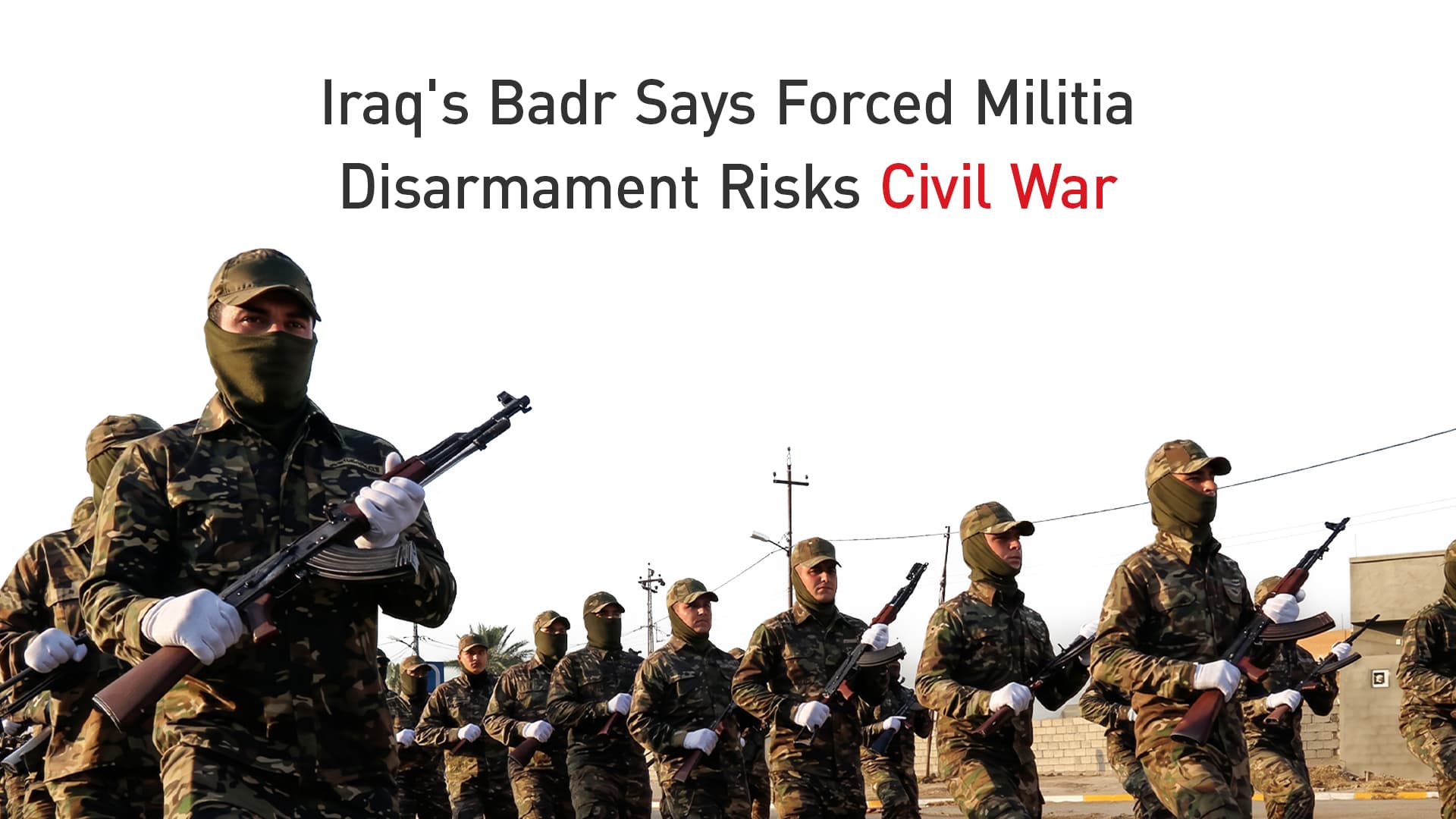
Iraq's Militia Crisis: Why September 30 Could Trigger Civil War
Executive Summary
Iraq is approaching a deadline unlike any it has faced since the defeat of the Islamic State's territorial caliphate. On September 30, 2026, two processes converge on the same date by design rather than coincidence: the completion of the US-led coalition's military withdrawal from Iraq, and the government's self-imposed deadline for all armed factions outside the state to surrender their weapons or face prosecution under counterterrorism law. Prime Minister Ali al-Zaidi, a political outsider elevated to office in May 2026 after Washington vetoed the Coordination Framework's initial choice of Nouri al-Maliki, has staked his young premiership on delivering both outcomes simultaneously. The Badr Organisation, one of the most powerful factions within Iraq's Iran-aligned militia ecosystem, has already warned publicly that forced disarmament before the deadline risks triggering internal strife, a diplomatic euphemism in Baghdad for civil conflict. Iran's Quds Force commander, Esmail Qaani, traveled to Baghdad this month seeking a negotiated settlement that would let militias retain their weapons in practice while avoiding open confrontation with the state.
This report assesses that Iraq is not necessarily heading toward civil war on September 30, but the structural preconditions for serious, possibly sustained, armed confrontation between elements of the Popular Mobilization Forces and the Iraqi state are now firmly in place, and the outcome hinges on a narrow set of variables: whether al-Zaidi's government pursues selective versus comprehensive enforcement, whether Iran instructs its most loyal factions to stand down or dig in, whether Washington maintains pressure after its own troops depart, and whether informal accommodation, quiet non-enforcement dressed up as compliance, becomes the face-saving off-ramp all sides may ultimately prefer to open conflict.
Strategic Background
The roots of this crisis trace directly to the aftermath of the February 2026 Iran war, in which the United States and Israel conducted a sustained air campaign against Iranian nuclear and military infrastructure that inevitably drew in Iran's regional proxy network, including armed factions operating under Iraq's Islamic Resistance and Popular Mobilization Forces umbrellas. American and Israeli strikes subsequently hit militia headquarters, checkpoints, and the private residences of senior commanders inside Iraqi territory, killing dozens of militiamen and exposing, in the starkest possible terms, that Iraq's sovereignty over its own security space had effectively been suspended for the duration of the regional war. That episode reshaped Washington's Iraq policy: the Trump administration emerged from the war determined that Iraq's continued tolerance of an armed, Iran-loyal paramilitary structure operating beyond state control was no longer an acceptable status quo, not merely a governance nicety to be managed indefinitely.
Into this environment stepped Ali al-Zaidi, a forty-year-old banker and businessman with no prior political experience, selected by the Coordination Framework as a consensus candidate only after President Trump personally intervened to block a prospective return to power by Nouri al-Maliki, whom Washington regards as unacceptably close to Tehran. Al-Zaidi's elevation was, by design, a compromise that satisfied competing veto powers inside Iraqi politics, including outgoing Prime Minister Mohammed Shia al-Sudani, al-Maliki himself, and Supreme Judicial Council Chief Justice Faiq Zidan, while also satisfying an external veto power in Washington. This dual dependency, a domestic coalition that needed a leader threatening to none of its factions, and a foreign patron that needed a leader credibly willing to confront Iran-aligned militias, is the structural tension now driving the September 30 crisis.
Historical Context
The Popular Mobilization Forces trace their origin to a 2014 religious edict calling on Iraqis to take up arms against the Islamic State's advance on Baghdad, a mobilization that saved the Iraqi state at a moment of near-collapse and, in the process, embedded a constellation of Iran-aligned armed factions, including Badr, Kataib Hezbollah, and Asaib Ahl al-Haq, permanently into Iraq's security architecture. The PMF was formally recognized as a state institution in 2016 and nominally placed under the authority of the prime minister as commander-in-chief, but in practice many of its most powerful factions have retained independent command structures, direct lines to Iran's Islamic Revolutionary Guard Corps Quds Force, and their own political wings represented in parliament. This dual-hatted status, part state institution, part Iran-aligned paramilitary, has been the central unresolved contradiction in Iraqi security policy for a decade.
Previous Iraqi governments, including al-Sudani's, made rhetorical commitments to reining in factions operating outside state control but consistently avoided forcing the issue, calculating that confrontation carried more immediate risk than continued ambiguity. What makes 2026 different is that the ambiguity itself became unsustainable after the Iran war exposed Iraqi territory as an active battlespace in a US-Israel-Iran conflict, and after Washington made continued economic and security support to Baghdad explicitly conditional on demonstrable militia disarmament, removing the option of indefinite deferral that previous governments relied upon.
Current Situation Assessment
As of mid-August 2026, the Iraqi government has drawn a firm public line. Al-Zaidi has directed parliament's Defence and Security Committee to draft legislation placing all weapons under state control, has warned that factions refusing to comply after September 30 will face terrorism charges, and has confirmed to US Central Command Commander General Brad Cooper that both militia disarmament and the departure of all coalition forces will be completed on schedule. Iraqi security forces, working alongside PMF elements that have already agreed to integrate into formal state structures, have launched preemptive operations against holdout factions' headquarters in Babil, Baghdad, and other southern provinces, seizing hundreds of drones and detaining militia members over the preceding week alone.
The response from resistant factions has been calibrated but unmistakably firm. The Badr Organisation, whose political and paramilitary influence spans decades and multiple governments, issued a direct warning that forced disarmament risks internal strife whose principal beneficiary would be the United States, a framing designed to cast the government's disarmament campaign as serving foreign rather than Iraqi interests. Badr has set three conditions for compliance: complete withdrawal of US forces, elimination of what it terms strategic threats to Iraq, and development of Iraq's national armed forces to a level capable of independently guaranteeing security, conditions that are sequenced to ensure disarmament never precedes, and can always be indefinitely deferred pending, the departure of American forces and satisfaction of security guarantees that are inherently difficult to verify as met.
Simultaneously, some factions, including Saraya al-Salam, the militia linked to influential Shia cleric Muqtada al-Sadr, along with Asaib Ahl al-Haq and Kataib al-Imam Ali, have signaled willingness to integrate into formal state armed forces, suggesting the crisis is not a uniform standoff between the government and a monolithic militia bloc but a more fragmented landscape in which political calculation, factional rivalry, and individual leaders' relationships with both Tehran and Baghdad are producing divergent responses.
Power Center Analysis
At least five power centers will determine how this crisis resolves. First is Prime Minister al-Zaidi himself, whose entire political capital, both domestically and with Washington, is now tied to visible progress on disarmament by September 30; failure to deliver would gut his credibility with the Trump administration that installed him and could revive the very Coordination Framework infighting that his consensus candidacy was designed to suppress. Second is the Coordination Framework as a bloc, which nominated al-Zaidi precisely because he lacked an independent political base and could be relied upon to implement Framework policy rather than pursue his own agenda; this means the Framework's internal consensus, or lack of it, on how hard to push disarmament will constrain al-Zaidi's room for maneuver regardless of his personal inclinations.
Third is the Badr Organisation and the harder-line PMF factions aligned with it, which retain independent command structures, direct patronage from Tehran, and enough coercive capacity to make a forced disarmament campaign costly in blood and political stability if pursued comprehensively rather than selectively. Fourth is Iran's Quds Force under Esmail Qaani, whose Baghdad visit signals Tehran's determination to manage this crisis through negotiated accommodation rather than allow it to spiral into a confrontation that could further weaken an already battered proxy network in the aftermath of the February war. Fifth is the Trump administration, whose conditionality on economic and security support gives it substantial leverage over al-Zaidi's incentives, but whose actual willingness to escalate, through renewed strikes, sanctions, or troop posture changes, in the event of incomplete compliance remains the single largest unresolved variable in this forecast.
Military and Security Implications
The military stakes of September 30 are twofold and mutually reinforcing. The completion of coalition withdrawal removes the direct American and allied military presence that has, for over two decades, functioned as both a stabilizing backstop and, more recently following the Iran war strikes, an active belligerent against Iran-aligned factions on Iraqi soil. Its departure changes the security calculus for every actor in Iraq: it removes an immediate target for militia hostility, but it also removes a deterrent factor that has constrained both the scale of Iraqi state action against militias and the scale of militia action against the state, since both sides have had to calculate American reaction.
Should the Iraqi government pursue comprehensive forced disarmament against resistant factions after September 30, the most probable military scenario is not conventional civil war in the sense of front lines and territorial control, but rather a return to the pattern of targeted assassinations, checkpoint clashes, headquarters raids, and factional violence that characterized earlier phases of PMF-state friction, escalating in frequency and lethality. The more dangerous scenario is horizontal escalation, in which hardline factions, facing existential pressure, calculate that demonstrating continued capability, through attacks on residual American diplomatic or economic personnel, strikes on Kurdish region energy infrastructure, or renewed confrontation with Israel, serves their interests better than acquiescence, dragging Iraq back into the kind of externally entangled violence the February war already demonstrated is possible.
Economic and Trade Impact
Iraq's economy, already under strain from a bloated state payroll, oil price dependency, and what regional analysts have described as an entrance into a phase of lean fiscal years, has limited capacity to absorb a prolonged security crisis. Al-Zaidi's Washington visit was explicitly framed around signing energy sector deals with US companies, investment that is contingent on a credible security environment and is highly sensitive to any perception that Iraq is sliding back toward factional violence. A disarmament crisis that curdles into sustained low-intensity conflict would almost certainly freeze the foreign investment pipeline al-Zaidi has staked his economic agenda on, compounding fiscal pressure at a moment when the government has limited room to expand social spending or public payroll as a stabilization tool. Trade routes through southern Iraq, already a corridor of concern given repeated militia activity in Basra and other provinces, would face elevated insurance and logistics costs in any escalation scenario, with knock-on effects for Gulf shipping and Iraqi oil export reliability.
Diplomatic Positioning
Washington's posture is one of calculated pressure rather than open-ended patience. The Trump administration's willingness to personally block al-Maliki's return to power, combined with its explicit conditioning of continued support on demonstrable militia disarmament, signals that the September 30 deadline is being treated in Washington as a genuine test of Iraqi government seriousness rather than a symbolic target. At the same time, the administration's parallel "Economic Fury" sanctions campaign against Iran and its regional financial networks suggests Washington's Iraq policy is now explicitly nested inside a broader effort to squeeze Tehran's regional proxy financing, meaning Iraqi militia disarmament is being read in Washington not purely as an Iraqi sovereignty issue but as one front in a wider regional pressure campaign against Iran.
Tehran's diplomacy, represented through Qaani's Baghdad visit, is oriented toward preserving the substance of its Iraqi proxy network while offering enough procedural flexibility, phased integration, symbolic disarmament of lesser factions, retention of political wings, to avoid a rupture that would hand Washington and Israel an uncontested strategic win in Iraq following the costly February war. Iran's calculation is almost certainly that a negotiated, face-saving settlement that preserves Badr's and Kataib Hezbollah's core capabilities under a nominal state umbrella is preferable to a confrontation that could further degrade its regional position at a moment when its broader proxy network, from Lebanon to Yemen, is already under sustained pressure.
Regional Fallout
Iraqi Kurdistan occupies a particularly exposed position in this crisis, given that the region hosts the last US coalition base scheduled for withdrawal and has historically served as a relatively insulated zone from PMF-related violence in central and southern Iraq. Kurdish regional leadership has signaled a preference for staying out of the broader regional conflict dynamics unfolding around Iran, a position that reflects both genuine caution and the region's structural vulnerability as a potential flashpoint if militia factions seek alternative targets or leverage points following coalition withdrawal. Saudi Arabia and the wider Gulf Cooperation Council states, which have invested significant diplomatic capital in stabilizing relations with a post-2022 Iraqi government less overtly dominated by Iranian influence, have a direct stake in avoiding a scenario that re-entrenches Iran-aligned militia power at the expense of state authority, since a weakened Baghdad center of gravity redounds directly to Tehran's regional advantage. Israel, having directly struck Iranian-backed factions inside Iraq during the February war, retains both the demonstrated capability and, on current form, the doctrinal willingness to resume strikes against any resurgent militia threat, meaning Iraqi domestic decisions on disarmament carry a live risk of externally triggered escalation regardless of Baghdad's own preferences.
Global Strategic Consequences
Iraq's outcome on September 30 will function as a bellwether for the broader post-February-war regional order in the Middle East. A relatively successful, even if imperfect, disarmament process would reinforce the narrative that Iran's regional proxy architecture has been structurally weakened by the events of 2026, encouraging further US and Israeli pressure on remaining Iran-aligned formations in Lebanon, Syria, and Yemen. A failed or reversed process, particularly one accompanied by significant violence, would demonstrate the limits of external pressure in dislodging deeply embedded proxy structures, and could embolden Tehran to calculate that its Iraqi position, despite the war's costs, remains fundamentally durable. Either outcome carries implications well beyond Iraq's borders for how Washington calibrates pressure campaigns against Iran-aligned non-state actors elsewhere in the region.
Risk Matrix
The risk of a full-scale, multi-front civil war on or immediately after September 30 is assessed as low, since neither the Iraqi state, the Coordination Framework, nor Iran currently has an interest in a scenario that risks total loss of control. The risk of sustained, elevated low-intensity violence, targeted clashes, assassinations, and localized confrontations between security forces and holdout factions, is assessed as medium to high, particularly in southern provinces with concentrated Badr and Kataib Hezbollah presence. The risk of a negotiated, partially cosmetic settlement that defers the substance of disarmament while satisfying the letter of the deadline is assessed as high, reflecting the strong incentives on all sides, Baghdad, Tehran, and even Washington to a degree, to avoid open conflict if a face-saving alternative is available. The risk of renewed US or Israeli strikes on holdout factions, independent of Iraqi government action, is assessed as medium, contingent on whether hardline factions are perceived to be rearming or reconstituting capability degraded during the February war.
Scenario Analysis
The following scenarios are forward-looking constructs and are explicitly labeled as scenario analysis rather than confirmed fact.
Base Scenario: September 30 arrives with partial, uneven compliance. Factions already signaling cooperation, Saraya al-Salam, Asaib Ahl al-Haq, Kataib al-Imam Ali, complete visible integration steps, while Badr and Kataib Hezbollah negotiate a face-saving arrangement, likely brokered indirectly through Iranian mediation, that formally acknowledges state authority while preserving core organizational and coercive capacity under a reconfigured legal status. Coalition withdrawal proceeds on schedule. Washington publicly credits al-Zaidi with progress while privately acknowledging incomplete implementation, sustaining conditional support. Sporadic, localized clashes occur but do not escalate into sustained conflict. Probability: High.
Bull Scenario: Iranian calculation, driven by a desire to avoid further weakening its regional position after the February war, leads Tehran to instruct even hardline factions toward substantive rather than cosmetic compliance, betting that preserving the broader Iraq relationship outweighs retaining maximal militia capability in the near term. Al-Zaidi's government, bolstered by this cooperation, achieves a genuinely credible disarmament milestone, strengthening his domestic standing, unlocking accelerated US investment commitments, and setting a precedent that reduces regional escalation risk. Probability: Low to Medium.
Bear Scenario: Badr, Kataib Hezbollah, and aligned factions, calculating that the conditions they have set are unmet, refuse substantive compliance and begin visibly repositioning forces and materiel ahead of the deadline. The Iraqi government, under sustained Washington pressure to demonstrate results, attempts a forced disarmament operation against one or more major factions. This triggers armed clashes in Baghdad and southern provinces, prompts Iranian-aligned political blocs to withdraw support from al-Zaidi's government, threatening its parliamentary survival, and raises the risk of renewed US or Israeli strikes if factions are perceived to be reconstituting threat capability. Regional oil markets and Gulf security planners register the escalation as a serious deterioration in Iraqi stability. Probability: Low, but rising if negotiated accommodation fails to materialize by mid-September.
Intelligence Forecast (6-24 Months)
Over the following six months, expect continued Iranian mediation efforts aimed at engineering a negotiated, substantively limited disarmament outcome that avoids open conflict while preserving core militia capability under revised legal cover, likely involving formal integration announcements that provide political cover without full operational subordination to state command. Expect continued US conditionality on economic and security support tied to visible, if imperfect, compliance benchmarks, and expect periodic US or Israeli strikes against specific holdout targets assessed as reconstituting threat capability, rather than a broad renewed campaign. Expect al-Zaidi's domestic political position to remain fragile, dependent on Coordination Framework cohesion that could fracture if disarmament enforcement is perceived as either too aggressive, alienating Iran-aligned parliamentary blocs, or too weak, alienating Washington.
Over twelve to twenty-four months, expect the underlying contradiction, a nominally sovereign Iraqi state coexisting with an only partially subordinated Iran-aligned paramilitary structure, to persist in modified form rather than be fully resolved, consistent with the pattern of Iraqi governance since 2016. Watch for a national sovereignty conference planned for later in 2026 as a potential venue for formalizing whatever accommodation emerges, and monitor whether Iraq's 2025-elected parliament, dominated by the Coordination Framework, moves to legislate a permanent legal status for integrated militia forces that could either strengthen or further complicate long-term state monopoly on arms.
Final Strategic Takeaway
September 30 is less likely to be Iraq's civil war trigger than its stress test, a date that will reveal, with unusual clarity, whether the post-February-war regional order has genuinely degraded Iran's capacity to sustain a parallel security structure inside Iraq, or whether that structure has simply adapted its outward form while preserving its substance. The Badr Organisation's warning of internal strife should be read less as a prediction of inevitable war and more as a calculated pressure tactic designed to shape the terms of a negotiated outcome that all principal actors, Baghdad, Tehran, and even Washington, likely prefer to open conflict. The greater long-term risk is not a dramatic collapse on a single date, but the entrenchment of a permanently ambiguous security order that leaves Iraq perpetually vulnerable to external triggers, whether renewed Iran-Israel confrontation, American policy shifts, or internal Coordination Framework fracture, capable of converting today's uneasy accommodation into tomorrow's crisis.
Global Chanakya Assessment
The dominant international framing of this crisis, a binary contest between an Iraqi state finally asserting sovereignty and Iran-aligned militias defending their turf, understates a more consequential dynamic: the extent to which this is also an intra-Shia contest for the future shape of Iraqi power, in which Muqtada al-Sadr's Saraya al-Salam faction's early cooperation with disarmament is as much a move against its Iran-aligned Shia rivals, Badr and Kataib Hezbollah, as it is a gesture of state loyalty. Sadr has long positioned himself as an Iraqi nationalist alternative to Tehran-aligned factions within the Shia political space, and his militia's willingness to integrate ahead of harder-line factions should be read as a bid to gain political advantage over rivals as much as compliance with Baghdad's disarmament timeline. This intra-Shia competitive dynamic, largely absent from Western coverage focused on the US-Iran-Iraq triangle, may prove more decisive to the crisis's actual resolution than pressure from Washington or Baghdad alone.
A contrarian judgment worth stating directly: Iran's Quds Force visit to Baghdad this month should be read not as evidence of Tehran's continued dominance over Iraqi security affairs, but as a sign of genuine Iranian anxiety about losing control of the disarmament narrative entirely. A Quds Force commander traveling personally to manage a crisis of this kind is not a routine diplomatic gesture; it reflects Tehran's assessment that its Iraqi proxy network, already battered by the February war and now facing a coordinated US-Iraqi push, requires direct high-level intervention to prevent fragmentation, not merely coordination of an already-secure position. Read correctly, Qaani's visit is a signal of relative Iranian weakness in Iraq, not strength.
An underreported risk deserving closer attention is the judiciary's role. Supreme Judicial Council Chief Justice Faiq Zidan's stance that all activity outside state authority constitutes terrorism gives the legal architecture for prosecution real teeth, but it also means the disarmament crisis is no longer purely an executive-militia negotiation; it now has an independent judicial actor capable of triggering prosecutions that could outpace or undercut whatever political accommodation al-Zaidi and Tehran ultimately negotiate, introducing a wildcard variable that neither Baghdad's executive nor Iran's Quds Force fully controls.
For India, three considerations follow directly. First, Iraq remains one of India's most important crude oil suppliers, and any escalation scenario affecting southern Iraqi export infrastructure or Gulf shipping lanes carries direct implications for Indian energy security planning and strategic petroleum reserve calculations; Indian refiners and the Ministry of Petroleum should treat the September 30 window as a discrete risk period warranting contingency sourcing plans. Second, the large Indian expatriate workforce and business community operating in Iraq, particularly around Basra's oil and infrastructure sector, represents a direct exposure that Indian missions in Baghdad and Basra should be actively monitoring, with contingency evacuation planning appropriate given the elevated, if not high-probability, risk of localized violence. Third, India's own experience navigating relationships with both Washington and Tehran simultaneously offers a template Indian diplomacy could quietly draw on in engaging Baghdad, positioning India as a credible economic partner unencumbered by the US-Iran rivalry shaping most other external engagement with Iraq, a genuine opening for expanded Indian trade, infrastructure, and energy investment if Iraq's political trajectory stabilizes.
For the wider Global South, particularly Gulf and Middle Eastern states with their own histories of managing state-paramilitary dual structures, Iraq's disarmament experiment, whether it succeeds, stalls, or collapses into violence, will function as a closely watched precedent for how postwar states attempt to reassert monopoly on force against deeply embedded, externally patronized armed factions, with direct relevance to ongoing debates in Lebanon over Hezbollah's arsenal and in Yemen over Houthi integration into any eventual political settlement.
Key intelligence indicators to monitor from this point include the specific compliance posture of Badr and Kataib Hezbollah as September 30 approaches, any further Quds Force or senior Iranian officials' visits to Baghdad, the pace and language of Iraqi parliamentary legislation on militia legal status, US Central Command posture and any announced adjustments to the withdrawal timeline, indications of intra-Shia political realignment involving Sadrist and Iran-aligned blocs, and any resumption of US or Israeli strike activity against Iraqi targets in the weeks surrounding the deadline.
Indicators to Monitor
- Compliance posture and public statements from Badr Organisation, Kataib Hezbollah, and other holdout PMF factions through late September 2026
- Further visits by Quds Force commander Esmail Qaani or other senior Iranian officials to Baghdad
- Progress and final language of Iraqi parliamentary legislation on state monopoly over weapons
- US Central Command statements and any changes to the coalition withdrawal timeline or residual presence arrangements
- Any resumption of US or Israeli airstrikes against Iraqi militia targets
- Movements and public positioning of Muqtada al-Sadr and Saraya al-Salam relative to rival Iran-aligned factions
- Judicial actions and prosecutions initiated under counterterrorism law against noncompliant factions
- Iraqi oil export volumes and security conditions in Basra and southern export infrastructure
- Coordination Framework parliamentary cohesion and any signs of fracture over disarmament enforcement
- Trump administration statements on continued economic and security support conditionality
- Planning and outcomes of the national sovereignty conference expected later in 2026
- Gulf state and Saudi diplomatic engagement with Baghdad in the run-up to and aftermath of the deadline
FAQ
What exactly happens on September 30, 2026? Two processes converge on that date: the US-led international coalition completes its full military withdrawal from Iraq, and the Iraqi government's deadline for all armed factions to surrender weapons to state control expires, after which noncompliant groups face prosecution under counterterrorism law.
Which militias are resisting disarmament? The Badr Organisation has issued the most direct public warning against forced disarmament, and Kataib Hezbollah is widely assessed as among the most resistant Iran-aligned factions, while groups including Saraya al-Salam, linked to Muqtada al-Sadr, Asaib Ahl al-Haq, and Kataib al-Imam Ali have signaled willingness to integrate into state structures.
Is Iran trying to prevent disarmament? Iran's approach, reflected in Quds Force commander Esmail Qaani's visit to Baghdad, appears oriented toward negotiating an accommodation that preserves core militia capability under a nominally compliant legal framework, rather than either fully blocking disarmament or allowing full compliance.
Does this mean Iraq is definitely heading toward civil war? Not necessarily. A full-scale civil war is assessed as a low-probability outcome, since no major actor, the Iraqi government, the Coordination Framework, or Iran, currently benefits from total loss of control. Sustained low-intensity clashes and a partially cosmetic negotiated settlement are considered more probable outcomes than either full compliance or full-scale war.
Why does the United States care about this deadline? The Trump administration has made continued economic and security support to Baghdad explicitly conditional on demonstrable militia disarmament, viewing it as a critical test of Iraq's sovereignty from Iranian influence following the direct US-Israeli military confrontation with Iran-aligned Iraqi factions during the February 2026 Iran war.