
Franco-German Nuclear Umbrella: Inside the Merz-Macron Deterrence Pact for Europe
Executive Summary
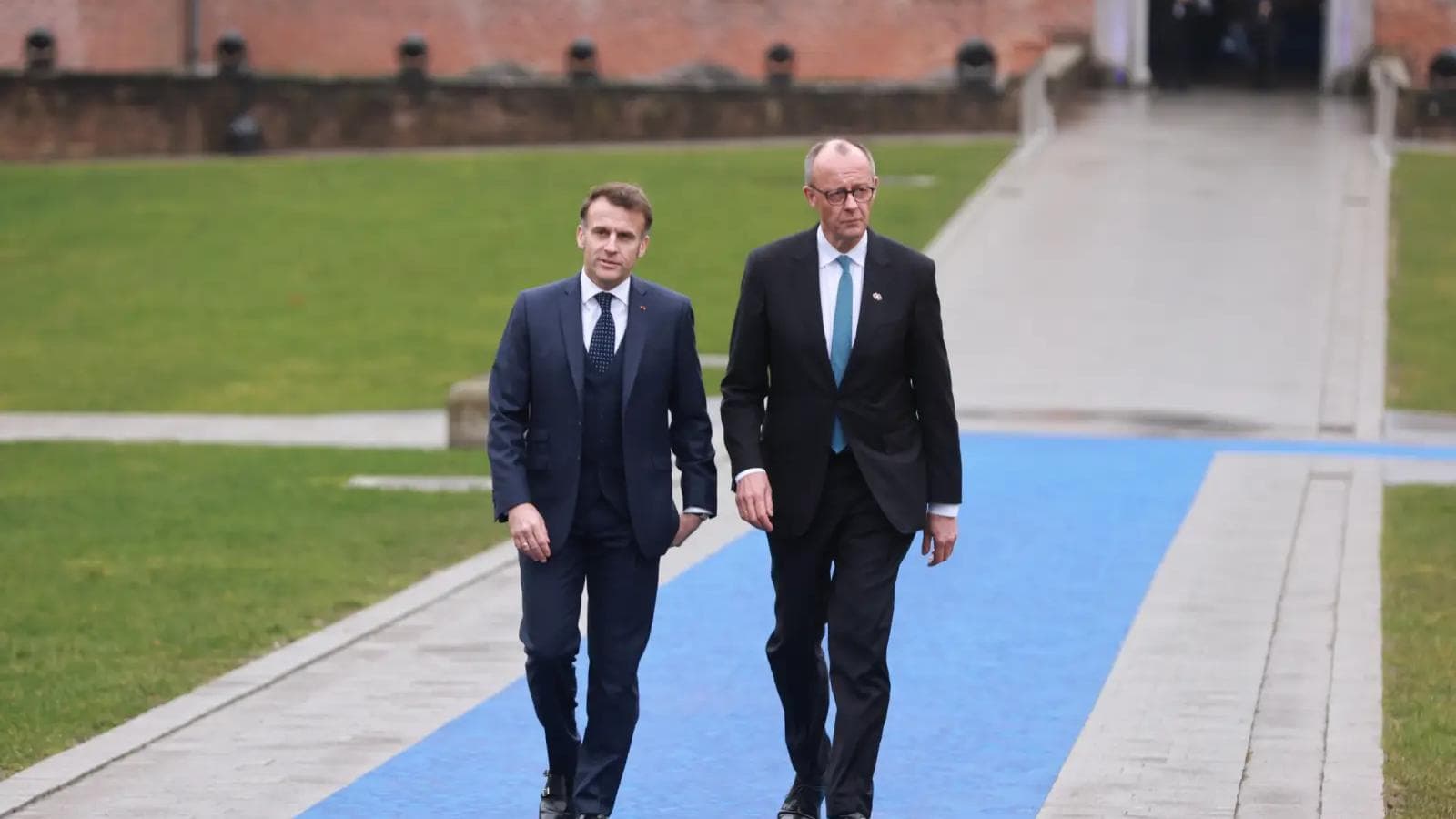
On July 17, 2026, at Schloss Augustusburg near Cologne, Chancellor Friedrich Merz and President Emmanuel Macron stood beside a French Rafale and a German Eurofighter and declared that Europe's two military heavyweights were, in Merz's words, embarking on a new joint path in deterrence. The imagery was deliberate. For the first time since the Second World War, a German government has agreed to place its conventional forces inside a French nuclear exercise, and a nuclear-capable French aircraft has visited German soil in an explicitly strategic, non-NATO framework. This is not a treaty. It is not a mutual defence guarantee in the legal sense of Article 5. It is, however, the most consequential shift in European nuclear architecture since France left NATO's integrated military command in 1966 and the most serious attempt in six decades to answer a question Paris has posed to Bonn and then Berlin since Charles de Gaulle: will Germany accept shelter under a nuclear umbrella that is not American. Global Chanakya's assessment is that the Merz-Macron framework is real, functioning, and expanding, but it remains deliberately incomplete by design, and that incompleteness is itself the story.
Strategic Background
The current framework did not emerge from a single summit. It is the product of a three-year erosion in European confidence about the durability of American extended deterrence, compounded by a French strategic culture that has argued since the 1960s that Europe's dependence on a single external guarantor is a structural vulnerability rather than a source of stability. The proximate trigger was the return of Donald Trump to the presidency in January 2025 and the subsequent recalibration of Washington's posture toward NATO burden-sharing, its freeze and resumption of military assistance to Ukraine, and open questioning within the administration of the automaticity of America's Article 5 commitments. Friedrich Merz, then chancellor-in-waiting after Germany's February 2025 election, broke six decades of German nuclear taboo by stating publicly that Berlin should be prepared to discuss shelter under French and British nuclear forces if Washington's commitment weakened. Macron, who had floated a European dialogue on French deterrence as far back as his 2020 Ecole Militaire address, seized the opening. What followed was a year of confidential talks, confirmed by Merz at the Munich Security Conference in February 2026, that culminated in the formal Franco-German joint declaration of March 2, 2026, and the operational first steps unveiled in Brühl this July.
Historical Context
Germany's nuclear abstinence is not incidental; it is treaty-bound and historically load-bearing. Under the 1954 Western European Union accords and its ratification of the Nuclear Non-Proliferation Treaty, Germany renounced the production of nuclear weapons on its own soil, a renunciation that remains legally untouched by the current framework. The idea of a European alternative to the American umbrella is, however, an old one. Helmut Schmidt discussed a French-financed extension of protection in the 1980s. In 1995, French Prime Minister Alain Juppe proposed "concerted deterrence," a dialogue-based model that explicitly avoided the word "extension" and went nowhere because Bonn showed no interest. Successive French presidents revived the offer in different forms and were met with German silence, rooted partly in a preference for the unambiguous, treaty-based certainty of NATO's nuclear sharing arrangement over the ambiguity of French sovereign discretion. What changed by 2025 was not French willingness, which had been constant for thirty years, but German risk perception. A Bundestag-commissioned legal review had already concluded, years earlier, that Germany could legally finance or host French or British weapons in exchange for protection. The obstacle had never been legal. It had been political trust, and it took the visible fraying of the American guarantee to dissolve it.
Current Situation Assessment
The framework today rests on two documents and one institution. The first document is the March 2, 2026 joint declaration, issued the same day Macron addressed the nation from the Ile Longue submarine base in Brittany and announced an increase in the size of France's nuclear arsenal alongside a new doctrine of "forward deterrence." The declaration, grounded explicitly in Article 4 of the 2019 Treaty of Aachen, established a Nuclear Steering Group co-chaired by the French president and the German chancellor, with foreign and defence ministries represented, tasked with doctrinal dialogue and coordinating the mix of conventional, missile-defence and nuclear capabilities available to the two countries. The second document is the July 17, 2026 conclusion of the Franco-German Defence and Security Council, which converted the March declaration's intentions into a calendar. Germany will contribute conventional forces to a French nuclear exercise before the end of 2026, a symbolic first that Merz was careful to frame as complementary to, not a substitute for, NATO's American-led nuclear sharing arrangement, under which Germany still hosts US B61 bombs and maintains dual-capable Eurofighters. The institution binding the two documents is the Nuclear Steering Group itself, which both sides now describe as working toward what could become a formal shared doctrine, though Merz was explicit that "it is far too early" to call this decided.
Beyond the bilateral track, France's March 2 announcement extended the same "forward deterrence" offer multilaterally. Eight countries beyond France, Germany, Poland, the Netherlands, Belgium, Greece, Sweden, Denmark and the United Kingdom, agreed in principle to host French strategic air forces on a temporary, rotational basis, and Norway joined as a ninth country in May 2026. This places the Franco-German bilateral arrangement inside a wider lattice of French-anchored deterrence relationships stretching from the Arctic to the eastern Mediterranean, with a separate and more advanced UK-France nuclear cooperation framework, agreed in July 2025, already running permanent strategic consultations and joint submarine patrols between Europe's only two independent nuclear powers.
Power Center Analysis
Four power centres now shape the trajectory of this framework, and each has a different stake. The Elysee Palace sees the initiative as the capstone of Macron's presidency and the fulfilment of a Gaullist ambition to make French power the organising centre of European strategic autonomy, a legacy consideration that matters given France's 2027 presidential election. The Bundeskanzleramt under Merz sees a narrower, more defensive rationale: hedging against American unpredictability without provoking a domestic backlash over nuclear weapons that remains real inside his own coalition and among a German public still shaped by post-war pacifism. The Nuclear Steering Group itself is emerging as a quiet but increasingly important bureaucratic actor, the venue where French reluctance to dilute presidential control over launch authority will collide with German appetite for something resembling NATO-style consultation rights. Finally, NATO's own structures in Brussels and at SHAPE are a background power centre whose interests are ambiguous: publicly supportive of anything that strengthens European capability, privately watchful of any arrangement that could, over a decade, normalise the idea that American nuclear guarantees are optional rather than foundational.
Inside Germany, the political ground for this shift was prepared by the broader Zeitenwende turn in defence policy and the 2025 reform of Germany's constitutional debt brake to exempt higher defence spending, which gave Merz's government the fiscal latitude to entertain new strategic commitments without an immediate budget confrontation in the Bundestag. That does not mean the nuclear dimension is politically costless. Opposition and coalition voices further from the political centre remain wary of anything that reads as normalising nuclear weapons on German soil, even in a purely conventional-support role, and Merz has visibly calibrated his language, always pairing the French track with reaffirmations of NATO loyalty, to manage that domestic sensitivity. On the French side, the Nuclear Steering Group operates under the Conseil de Defense and the French Ministry of Armed Forces' existing command chain for the force de frappe, structures that have never been subject to parliamentary ratification and are unlikely to become so now, reinforcing how much of this framework rests on executive discretion in both capitals rather than legislative entrenchment.
Military and Security Implications
Operationally, the Franco-German framework is intentionally modest at this stage and doctrinally conservative. France's nuclear posture, built around the independent force de frappe delivered by submarine-launched and air-launched systems, retains its Gaullist architecture: a single, non-renewable "final warning" strike concept rather than NATO's layered flexible-response doctrine, and sole presidential discretion over any decision to employ the weapon, with Macron explicitly rejecting joint planning or a shared trigger. What is changing is the conventional and infrastructural scaffolding around that doctrine. German participation will begin as conventional support to a French nuclear exercise, the rotational hosting of French strategic air assets such as nuclear-capable Rafale aircraft on German soil, symbolised by the aircraft's visit to the Noervenich air base, and confidential consultations on integrating conventional deep-precision-strike and missile-defence capabilities with nuclear deterrence to better manage escalation beneath the nuclear threshold. This last point is analytically significant: it signals that both governments see the credibility gap in extended deterrence not primarily as a warhead-numbers problem but as a sub-nuclear one, where Europe currently lacks the layered conventional and missile-defence architecture to make any deterrent, French or American, fully credible against grey-zone or limited aggression.
The collapse of the Future Combat Air System project in June 2026, after Dassault and Airbus failed to resolve a years-long dispute over design leadership and workshare, is directly relevant here and is being treated by both capitals as an accelerant rather than a setback. With the joint sixth-generation fighter dead, Paris and Berlin are redirecting political capital and defence-industrial energy toward areas where interests converge rather than compete, integrated air defence, long-range strike, and the armoured-vehicle manufacturer KNDS, and nuclear cooperation is emerging as the signature initiative that fills the strategic narrative vacuum FCAS leaves behind.
France's deterrent rests on two legs: a submarine-based Strategic Oceanic Force operating Triomphe-class boats armed with M51 ballistic missiles, which provides the guaranteed second-strike component and is not part of any cooperative discussion with Germany or other partners, and an airborne Strategic Air Force flying ASMPA-equipped Rafales, which is the component being partially "forward deployed" under the new doctrine. This distinction matters analytically: what is being shared with Europe is the visible, rotational, air-delivered layer of French deterrence, not the submerged and untouchable core that guarantees France's own second-strike survivability. Academic and think-tank debate, including recent work examining whether France could technically support a NATO-style "dual-key" arrangement in which a European partner would have a formal role in launch decisions, converges on the same conclusion Macron has stated politically: France's constitutional and doctrinal architecture, concentrating launch authority solely in the president, is not designed for shared triggers, and adapting it would require a doctrinal transformation well beyond anything currently on the table. Forward deterrence, in other words, extends presence and visibility, not decision-making power.
Economic and Trade Impact
The financial architecture of the arrangement remains genuinely unsettled and is a source of quiet friction. Macron has publicly stated that enhanced deterrence will not require German financing, preserving the French principle that the deterrent is a sovereign national asset, not a jointly-funded European one. Yet earlier reporting around the March announcement suggested Germany, Belgium and Poland had signalled willingness to contribute financially to elements of the forward-deterrence infrastructure, such as basing and exercise costs. That ambiguity has not been resolved in public, and Global Chanakya expects it to resurface as burden-sharing negotiations mature, particularly as Germany's own defence budget absorbs the costs of Bundeswehr modernisation, expanded conventional forces, and the industrial restructuring triggered by the FCAS collapse. On the industrial side, the two governments used the July summit to launch the Toulon Agenda, a joint competitiveness initiative aimed at insulating Franco-German defence and industrial cooperation from the kind of paralysis that killed the fighter programme, with KNDS positioned as the flagship vehicle for combining French and German land-systems manufacturing. For European defence markets, the practical effect of forward deterrence is to direct new investment toward dual-capable delivery platforms, air-defence systems, and precision-strike munitions rather than toward the warhead-production side of the nuclear enterprise, which remains a purely sovereign French domain.
The broader fiscal backdrop is favourable to sustaining this trajectory. Germany's 2025 exemption of defence spending from its constitutional debt brake, layered on top of the post-2022 Zeitenwende special fund for Bundeswehr modernisation, has removed the single biggest historical constraint on German willingness to fund expanded security commitments, even where, as with the French nuclear track, direct financing has been publicly disclaimed. France, for its part, faces a tighter fiscal picture and a persistent public-deficit challenge, which is one reason Macron has been careful to frame forward deterrence as adding relatively modest marginal cost, rotational deployments and exercises rather than new fixed infrastructure, while directing the larger increase in nuclear investment toward the warhead and delivery-system modernisation that remains nationally funded. For defence contractors and investors, the signal is that the growth opportunity in this cycle sits in conventional force-multiplier technology, air and missile defence, precision strike, secure command-and-control, rather than in the nuclear-industrial base itself, which France intends to keep tightly held.
Diplomatic Positioning
Reactions across Europe have split along a predictable but revealing axis. Poland and the Baltic states, most exposed to Russia and least confident in Washington's staying power, have been the most enthusiastic. Polish Prime Minister Donald Tusk called the French offer "very promising" and has previously gone so far as to float, in an unusually blunt aside, the idea of Poland developing an independent nuclear capability if extended deterrence proves insufficient, an indicator Global Chanakya flags as a genuine tail-risk for the nonproliferation order. Lithuania's president called the proposal "very interesting," and Nordic states, historically the most nuclear-averse constituency in Europe, gave the initiative a cautious welcome, with Denmark's prime minister stating plainly that "everything must be on the table now." Norway's accession to the forward-deterrence scheme in May 2026 extended this logic to NATO's Arctic flank. The United Kingdom occupies a distinct position: as Europe's other independent nuclear power, London is not a supplicant under the French umbrella but a parallel partner, with its own bilateral nuclear framework with Paris, agreed in July 2025, now running in tandem with the Franco-German track and raising longer-term questions about whether Europe is building one coordinated deterrent architecture or two overlapping ones.
It is also notable which established NATO nuclear-sharing hosts, Belgium, the Netherlands, Italy and Turkey, currently store American B61 bombs, overlap with the new French roster and which do not. Belgium and the Netherlands appear in both arrangements, suggesting a deliberate hedging strategy of layering French forward deterrence on top of, rather than instead of, their existing American commitments. Italy's absence from the initial nine and Turkey's absence entirely are analytically significant: Rome has historically been cautious about initiatives that could be read as diluting NATO cohesion, while Ankara's complex, transactional relationship with both Washington and Moscow makes it an unlikely candidate for deeper integration into a French-led framework in the near term. Greece's inclusion, despite its geographic distance from the Russian border, points to a Mediterranean and eastern-flank hedging logic distinct from the more obvious Baltic rationale, while Sweden and Finland's recent full NATO membership adds a Nordic dimension to forward deterrence that did not exist even three years ago, illustrating how quickly the assumptions underpinning European security architecture have moved.
Regional Fallout
Moscow's response has been uniformly hostile and rhetorically maximalist, a pattern consistent since Macron's original March 2025 opening. Kremlin spokesman Dmitry Peskov branded Macron's rhetoric "extremely confrontational" and accused Paris of nursing "nuclear leadership" ambitions in Europe, while Foreign Minister Sergei Lavrov characterised the initiative as a direct threat to Russia and, in one especially pointed exchange, invoked Napoleon and drew an implicit comparison to Hitler while mocking Macron's physical stature. President Putin's own comment, warning Macron to "remember the fate of Napoleon," was a calibrated reminder of Russia's preferred historical framing of any French military ambition on the continent. Beneath the theatre, the substantive Russian objection is strategic: an expanding, French-anchored forward-deterrence lattice stretching from Norway to Greece complicates Moscow's targeting calculus, dilutes the simplicity of a US-centric nuclear standoff, and forces Russian planners to account for a second, less predictable nuclear decision-maker in any European contingency. For Central and Eastern Europe, the practical fallout is a further hardening of the region's threat perception and a growing appetite, visible in Poland's rhetoric, for deterrence arrangements that go beyond what NATO's existing structure offers.
Global Strategic Consequences
The Franco-German framework matters globally for reasons that have little to do with the immediate Russia-Ukraine context. First, it establishes a precedent for regionalised, non-American extended deterrence at exactly the moment other American allies, from the Indo-Pacific to the Gulf, are independently reassessing the durability of Washington's guarantees. Second, it tests whether a nuclear umbrella built on sovereign discretion rather than treaty-bound automaticity, France explicitly rejects any binding trigger, can generate the same deterrent credibility as the American model, a question with direct relevance for any future discussion of extended deterrence arrangements elsewhere in the world. Third, it sits uneasily against the Non-Proliferation Treaty's Article VI disarmament commitments: an expanding, warhead-increasing French posture, even one framed as defensive and complementary to NATO, hands rhetorical ammunition to Global South NPT states, and to Russia and China, who already argue that Western nuclear powers preach restraint while practising expansion. ASEAN states and African NPT signatories, many of whom champion nuclear-weapon-free-zone norms, are likely to watch this precedent as a data point in broader disarmament diplomacy rather than as a European-only affair. Fourth, and most significantly for Asian security planners, the episode is a live case study in what happens when a great power's junior allies begin hedging against the credibility of its extended deterrence, a dynamic with unmistakable echoes for Washington's own alliance system in the Indo-Pacific.
Beijing has said little publicly, and that silence is itself informative. China has no direct stake in a European nuclear architecture built around Russia, but it has a considerable indirect one: every data point suggesting American allies are hedging against Washington's extended-deterrence credibility feeds Beijing's broader strategic narrative that US alliance commitments are negotiable rather than structural, a narrative China is equally invested in cultivating among Washington's Indo-Pacific partners. Chinese state commentary has historically been more measured on French nuclear moves than on American or NATO ones, consistent with Beijing's longer-term interest in encouraging European strategic autonomy away from Washington even while it has no sympathy for an arrangement aimed, ultimately, at deterring Russia, a partner Beijing continues to back diplomatically and economically.
The Global South's stake in this story is real, if indirect. ASEAN states, several of which champion the Southeast Asia Nuclear Weapon-Free Zone, are likely to view an expanding, warhead-increasing French posture as reinforcing scepticism about great-power disarmament sincerity, even as some, watching Japanese and South Korean debates over the credibility of American extended deterrence against China and North Korea, will study the Franco-German model as a possible template for regional hedging of their own. African states party to the Pelindaba Treaty and Latin American states operating under the long-standing Tlatelolco Treaty tradition have historically used exactly this kind of Western nuclear expansion as diplomatic leverage in NPT review conferences, arguing it undermines Article VI disarmament obligations, and Global Chanakya expects references to the Franco-German build-up to surface in exactly that context at the next review cycle. In the Middle East, where Iran's nuclear trajectory and latent Saudi hedging already strain the regional nonproliferation consensus, an emboldened European precedent for sovereign, non-alliance nuclear cooperation is unlikely to go unnoticed by capitals weighing their own extended-deterrence arithmetic.
Implications for India
For New Delhi, the Franco-German framework is less a European curiosity than a preview of arguments India will need to have with itself and with partners over the next decade. India's own doctrine of credible minimum deterrence and No First Use was built for a different problem, a two-front nuclear neighbourhood in China and Pakistan, but the European debate offers three transferable lessons. The first is a risk: any move to formalise extended-deterrence guarantees, whether in Europe or Asia, tends to increase pressure on states just outside the umbrella to hedge upward, visible already in Poland's nuclear musings, and India should watch closely whether an expanding French umbrella accelerates similar hedging conversations among non-nuclear Asian states uneasy about both Chinese and American reliability. The second is opportunity: France is now the world's most consequential example of a sovereign, non-alliance-bound nuclear power willing to offer conventional and strategic cooperation short of full extended guarantees, a model structurally closer to how India itself might one day engage partners than the American treaty-based template, and it strengthens the logic of deepening the India-France strategic partnership across the Indo-Pacific, from Rafale and submarine cooperation to joint operations in the western Indian Ocean. The third is diplomatic bandwidth: as France invests political capital in Europe's nuclear architecture, Indian planners should assess whether Paris's traditional emphasis on India as a pillar of its Indo-Pacific strategy dilutes or is reinforced, and Indian foreign policy should proactively seek reassurance and expanded defence-industrial commitments, including engine technology transfer and undersea capability cooperation, while France's attention is engaged but not yet consumed by the European nuclear file. For Indian businesses, the redirection of Franco-German defence-industrial energy toward KNDS, air defence and precision strike after the FCAS collapse opens space for Indian defence manufacturers to position as alternative or complementary partners in areas Dassault and Airbus are no longer prioritising jointly.
Risk Matrix
Scenario Analysis
Base Scenario
The Nuclear Steering Group deepens incrementally over the next eighteen months. Germany completes its first conventional participation in a French nuclear exercise before the end of 2026, further countries formalise participation in the forward-deterrence scheme, and doctrinal dialogue produces confidence-building measures, joint site visits, expanded early-warning integration, without a full shared doctrine or binding trigger. NATO's American-anchored nuclear sharing arrangement continues in parallel, and the Franco-German track remains explicitly supplementary. Probability: High.
Bull Scenario
Continued erosion of confidence in Washington's commitments, reinforced by developments in the Ukraine war or renewed transatlantic friction, accelerates the framework into a genuine shared doctrine within France's Nuclear Steering Group, with expanded German financing, permanent rather than rotational basing arrangements for French strategic aircraft, and additional European states seeking similarly deep bilateral arrangements with Paris beyond the current rotational hosting model. This scenario would mark a durable rebalancing of European deterrence away from single-guarantor dependence. Probability: Medium.
Bear Scenario
Domestic political change in Paris or Berlin, a National Rally presidency in 2027 with a more ambiguous stance on extending the deterrent, or a German coalition crisis, stalls the Nuclear Steering Group's work before it produces durable institutional commitments. Absent codification, the framework reverts to symbolic cooperation, credibility questions resurface among Central and Eastern European partners, and some, most plausibly Poland, intensify independent hedging behaviour that strains the broader nonproliferation order. Probability: Low, but rising if 2027 French election dynamics shift.
Intelligence Forecast (6-24 Months)
In the near term, expect Germany's promised conventional participation in a French nuclear exercise to be executed and publicised before year-end 2026 as a confidence marker for both governments. Watch for the Nuclear Steering Group to produce its first substantive doctrinal output, likely framed as principles rather than a full joint doctrine, within twelve months, alongside further rotational basing announcements as additional forward-deterrence partners operationalise their March 2026 commitments. Expect continued, cyclical Russian rhetorical escalation timed to coincide with each concrete step, without corresponding military escalation in the near term. Over eighteen to twenty-four months, the more consequential variable will be French domestic politics ahead of the 2027 presidential election; expect increased scrutiny of Marine Le Pen's and other National Rally figures' positions on the future of forward deterrence, since any ambiguity there will directly affect how far Berlin is willing to institutionalise dependence on a French guarantee that could outlast Macron by only months.
Final Strategic Takeaway
The Merz-Macron framework represents the most serious attempt in a generation to diversify Europe's nuclear guarantees beyond Washington, but it is a hedge, not a replacement, and both leaders have been unusually disciplined about saying so publicly. Its significance lies less in what it currently guarantees, which remains modest, sovereign, and reversible, than in what it signals: that Europe's two largest continental powers now consider American extended deterrence uncertain enough to warrant building a parallel, French-anchored alternative from scratch, in public, in real time.
Global Chanakya Assessment
Global Chanakya's independent judgment is that the framework's real value to Paris and Berlin is less military than political: it is a mechanism for both governments to demonstrate strategic agency to sceptical domestic audiences and anxious eastern neighbours without having to resolve the far harder question of whether France would truly extend its ultimate warning shot to defend Warsaw or Vilnius. The steering group's studied ambiguity on "vital interests" is not an oversight; it is the entire design, preserving French sovereignty while allowing partners to read into it what reassurance they need. The contrarian read that most coverage of the July 17 summit missed is that the FCAS collapse, not the nuclear announcement, may be the more structurally important event of 2026: it forces Paris and Berlin to prove that Franco-German defence cooperation can survive an industrial rupture, and the nuclear track is now carrying the symbolic weight that the fighter programme was supposed to carry. If the Nuclear Steering Group stalls the way FCAS did, over questions of who controls what, the credibility cost to European strategic autonomy will be significant. The underreported risk to monitor is not Russian rhetoric, which is priced in and largely performative, but Polish nuclear hedging, which is not. A serious Polish move toward independent capability, even preliminary, would do more to destabilise the nonproliferation order in Europe than anything Moscow says in response to Macron. Finally, Indian strategic planners should treat this as a live laboratory: the central European debate, alliance-guaranteed deterrence versus sovereign-discretion deterrence, versus No First Use, is a preview of arguments that will surface in Asia as regional states reassess American commitments there too.
Indicators to Monitor
FAQ
Is this a formal nuclear-sharing treaty like NATO's arrangement with the United States?
No. It is a bilateral political framework built around a joint declaration and a Nuclear Steering Group, not a ratified treaty, and France has explicitly preserved sole presidential authority over any decision to employ nuclear weapons.
Does this mean Germany will host French nuclear warheads on its soil?
Not at this stage. Current commitments involve conventional German participation in French nuclear exercises and the rotational hosting of French strategic aircraft, not the stationing of French nuclear warheads under German control.
Does this replace NATO's nuclear umbrella for Germany?
Both governments have repeatedly stated it does not. Germany continues to host US B-61 bombs under NATO's nuclear sharing arrangement and remains formally committed to that structure alongside the new French track.
Which other countries are involved?
Beyond France and Germany, the United Kingdom, Poland, the Netherlands, Belgium, Greece, Sweden, Denmark and Norway have agreed to participate in France's wider forward-deterrence scheme announced in March 2026.
Why did the collapse of the FCAS fighter jet project matter for this story?
FCAS was the flagship symbol of Franco-German defence cooperation, and its collapse in June 2026 over industrial disputes between Dassault and Airbus removed that symbol, increasing the political weight now placed on nuclear cooperation and industrial projects like KNDS to demonstrate the relationship still functions.
How has Russia responded?
With sustained hostility. Kremlin officials, including spokesman Dmitry Peskov and Foreign Minister Sergei Lavrov, have called the French initiative confrontational and threatening, while President Putin has invoked historical warnings about foreign military ambitions in Russia.
What is the Treaty of Aachen and why does it matter here?
Signed by Macron and then-Chancellor Angela Merkel in 2019, the Treaty of Aachen renewed and deepened the Elysee Treaty's framework for Franco-German cooperation. Article 4 of that treaty, which speaks to mutual assistance and security cooperation, is the specific legal basis both governments cite for extending their partnership into the nuclear domain.
Could this arrangement survive a change of government in Paris or Berlin?
That is precisely its structural weakness. Because the framework rests on a joint political declaration and an executive-level steering group rather than a ratified treaty, its durability depends heavily on continuity of political will in both capitals, making the 2027 French presidential election a genuine inflection point to monitor.