
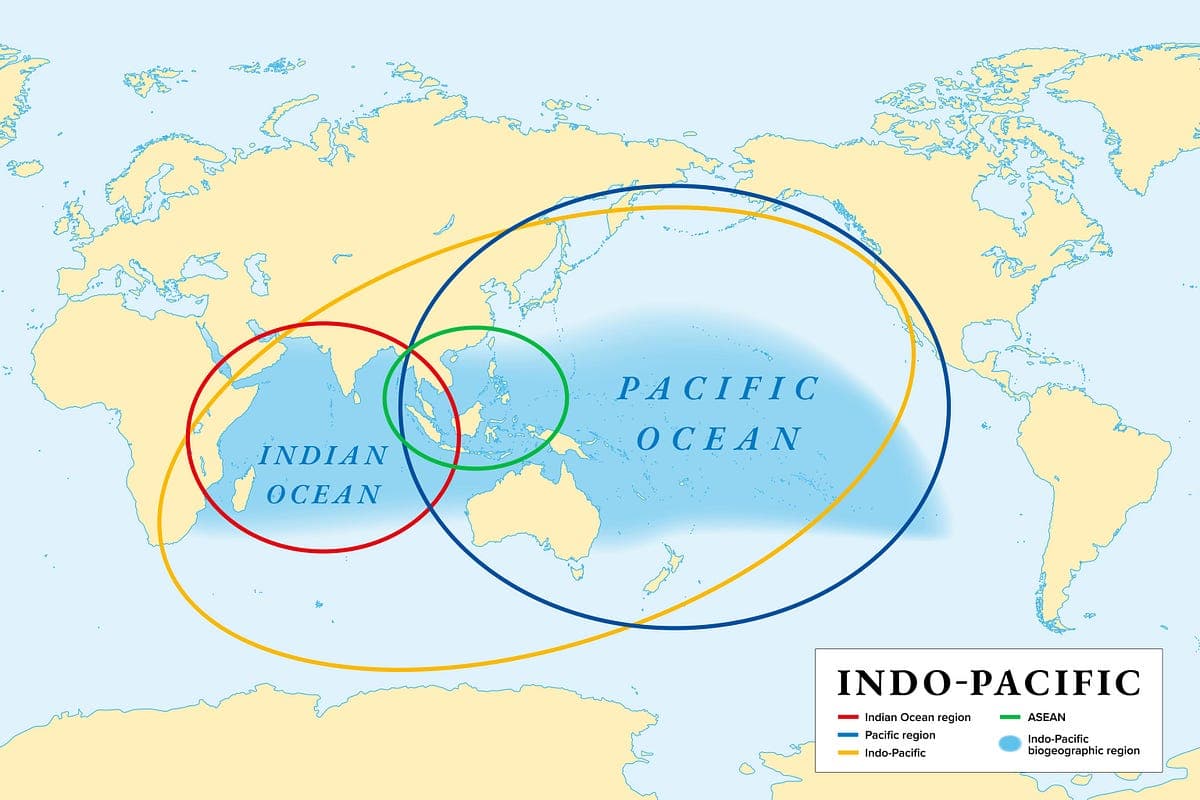
The Indo-Pacific Doctrine: How the World's Most Contested Strategic Theatre Is Being Fought, Shaped, and Contested for the Next Century
Executive Summary
There is no geographic space on the planet more consequential to the future of human civilization than the Indo-Pacific. Stretching from the eastern coast of Africa across the Indian Ocean, through the critical maritime chokepoints of the Malacca Strait, the Lombok Strait, and the Sunda Strait, across the South China Sea, through the Taiwan Strait and the East China Sea, and into the broader Western Pacific, the Indo-Pacific encompasses over half the world's population, two-thirds of its economic output, the majority of its fastest-growing economies, and the sea lanes through which approximately sixty percent of global maritime trade flows. It is the theater in which China's rise is most acutely felt, in which American strategic primacy is most directly contested, and in which the choices made by India, Japan, Australia, South Korea, the nations of Southeast Asia, and the small island states of the Pacific will determine whether the twenty-first century is governed by a rules-based order or by the logic of unchecked great power coercion.
The term Indo-Pacific itself represents a conceptual revolution. For most of the twentieth century, strategic analysts and policymakers divided what we now call the Indo-Pacific into two separate theatres: the Asia-Pacific, centred on the Western Pacific and anchored by American alliances with Japan, South Korea, Australia, and the Philippines; and the Indian Ocean region, centred on South Asia and the Persian Gulf and navigated primarily through bilateral relationships rather than a coherent multilateral security framework. The conceptual unification of these two theatres into a single strategic space reflects the recognition that China's expanding naval reach, India's growing maritime ambition, and the deepening economic and security integration across the entire region have made the traditional division analytically obsolete. What happens in the South China Sea affects the Indian Ocean. What happens in the Strait of Hormuz affects Pacific energy security. What India does on its western maritime flank affects the strategic calculus in the Taiwan Strait. The Indo-Pacific is a single strategic system, and its management requires a single strategic framework.
This report provides a doctrine-level assessment of Indo-Pacific strategy - its conceptual origins, its major competing visions, the military architectures being built to contest it, the economic corridors being constructed to shape it, the alliance networks being forged to influence it, and the risk scenarios that could determine whether the region's future is one of managed competition or catastrophic conflict. It is the most important strategic document any analyst, policymaker, or informed citizen of the Indo-Pacific age can read - because the choices being made in this theatre today will echo across generations.
Strategic Background
The concept of the Indo-Pacific as a unified strategic theatre emerged gradually from the convergence of several strategic trends that made the old Asia-Pacific and Indian Ocean regional distinctions increasingly inadequate for understanding the power dynamics reshaping the region.
The first and most fundamental trend is China's transformation from a regional continental power into a global maritime power. For the first three decades of its economic reform era, China's strategic posture was predominantly continental - focused on internal development, border security, and the management of its immediate periphery. The People's Liberation Army Navy, while growing, remained a predominantly coastal and near-seas force. That posture began to change fundamentally in the 2000s and accelerated dramatically in the 2010s as China's expanding economic interests - particularly its dependence on imported energy and commodity flows through the Indian Ocean and its growing global trade through Pacific shipping lanes - created the strategic imperative for naval capability that could protect those interests across increasingly distant waters.
Xi Jinping's articulation of the China Dream and his vision of a world-class military by 2049 gave institutional and ideological expression to a naval expansion that had been underway since the early 2000s. The People's Liberation Army Navy's ambition - articulated in Chinese naval doctrine through the concept of far seas operations and reflected in the construction of aircraft carriers, nuclear-powered submarines, advanced destroyers, and amphibious assault ships - is to project Chinese naval power across the Indian Ocean, through the Pacific, and eventually into a global blue-water presence that matches China's economic weight and political ambitions. The strategic consequence of this transformation is that the Indian Ocean and the Pacific Ocean have become a single theater of Chinese naval ambition, making the conceptual division between them analytically untenable.
The second trend is India's emergence as a genuine maritime power with pan-Indian Ocean strategic ambitions. Under Narendra Modi, India has invested substantially in expanding the Indian Navy's capability - including aircraft carrier development, nuclear submarine induction, and the construction of advanced destroyers and frigates - and has articulated a strategic vision of SAGAR, Security and Growth for All in the Region, that positions India as the security provider of first resort across the Indian Ocean littoral. India's geographic position - its long coastline, its island territories including the strategically positioned Andaman and Nicobar Islands at the entrance to the Malacca Strait, and its central location in the Indian Ocean - gives it a natural strategic dominance in the western Indo-Pacific that no other power can easily contest.
The third trend is the deepening integration of economic and security dynamics across the entire region. The supply chains through which the twenty-first century's most critical manufactured goods flow - semiconductors from Taiwan and South Korea, electronics from Vietnam and Malaysia, energy from the Persian Gulf to East Asian consumers - traverse the entire Indo-Pacific and create interdependencies that make the security of any single chokepoint a concern for nations across the entire region. The Malacca Strait, through which approximately eighty percent of China's oil imports flow and which handles over ninety thousand ships annually, is simultaneously the most strategically critical and most vulnerable single point in the global trading system. Its disruption - by conflict, piracy, or natural disaster - would have immediate economic consequences across the Indo-Pacific and beyond.
Historical Context
The Indo-Pacific as a strategic concept has historical antecedents that reach back further than its contemporary popularity might suggest, though the specific term and its contemporary policy meaning are products of the early twenty-first century.
The Indian Ocean's strategic significance was understood by every great maritime power that preceded the current era. The Portuguese Estado da India, established in the early sixteenth century, was built on control of the Indian Ocean's key trading ports and chokepoints - Hormuz, Goa, Malacca, and Mozambique - because their naval commanders understood that controlling the ocean's choke points meant controlling the trade that flowed through them. The British Empire's Indian Ocean dominance - expressed through the Royal Navy's uncontested supremacy from the Suez Canal to Singapore - was the material foundation of Britain's commercial dominance in Asia for over a century. The Japanese strategic vision of the Greater East Asia Co-Prosperity Sphere, which drove Japan's catastrophic Pacific War expansion, was built on the recognition that controlling the maritime resources and sea lanes of the western Pacific and Southeast Asia was the prerequisite for Japanese industrial and military power.
The post-World War II American order in the Pacific - built on the hub-and-spokes bilateral alliance network anchored by Japan, South Korea, Australia, and the Philippines, underpinned by American naval dominance from Hawaii to the Straits of Malacca, and extended through forward basing at Guam, Okinawa, Diego Garcia, and Singapore - provided the security architecture within which the Asian economic miracle occurred. This architecture was built on the assumption of American naval supremacy that was so complete it did not need to be contested - no power in the Asia-Pacific had either the capability or the ambition to challenge American maritime dominance, and the Indian Ocean was managed through a combination of British legacy relationships, American access to Diego Garcia, and the benign strategic posture of a rising but still continental China.
The term Indo-Pacific in its contemporary policy meaning gained traction through the work of Indian naval strategist Gurpreet Khurana, who used it in a 2007 paper to describe the maritime space connecting the Indian and Pacific Oceans as a single strategic system. Shinzo Abe gave the concept its most politically resonant formulation in his 2007 speech to the Indian Parliament, where he described the confluence of the two seas as the broadest possible framework for Asian prosperity and security. The concept was progressively adopted by Australian strategic documents beginning in 2013, by the American Indo-Pacific Command's rebranding from Pacific Command in 2018, and ultimately by the full spectrum of democratic middle and major powers in the region as the framework within which twenty-first century strategic competition would be understood and contested.
The Obama administration's strategic rebalance to Asia, announced in 2011, was the first formal American acknowledgment that the centre of gravity of global strategic competition was shifting from the Euro-Atlantic to the Asia-Pacific - a recognition that would have profound implications for American force posture, alliance management, and diplomatic investment across the region. While the rebalance's implementation fell short of its rhetorical ambition - the simultaneous management of crises in the Middle East and Eastern Europe constrained the resources available for genuine strategic rebalancing - it established the conceptual framework that subsequent administrations would build upon.
Current Situation Assessment
The Indo-Pacific's current strategic environment is defined by the most intense great power competition the region has experienced since the Cold War's end, playing out simultaneously across military, economic, technological, diplomatic, and normative dimensions with a speed and complexity that challenges every existing analytical framework.
China's strategic posture in the Indo-Pacific has entered a phase of active consolidation that goes beyond the incremental expansion of previous decades. In the South China Sea, the artificial island military installations in the Spratly and Paracel archipelagos have been operational for years and now constitute a forward military presence that extends Chinese power projection reach by hundreds of miles from the Chinese mainland. Chinese coast guard and People's Liberation Army Navy vessels operate with increasing assertiveness against Philippine, Vietnamese, Malaysian, and Indonesian vessels in waters those nations regard as their own exclusive economic zones, using a combination of physical harassment, water cannon, and laser dazzling that falls below the threshold of conventional military force but systematically erodes the practical maritime rights of smaller regional states.
The Taiwan Strait has become the most acute near-term flashpoint in the global strategic environment. China's military exercises around Taiwan - including the unprecedented encirclement exercises of August 2022 following Nancy Pelosi's visit and subsequent exercises that have progressively expanded their scale and geographic scope - are explicitly designed to normalize Chinese military presence in the waters and airspace surrounding Taiwan, to demonstrate the People's Liberation Army's capability to execute a blockade or invasion, and to probe the response thresholds of American and allied forces. The trajectory of Chinese military modernization - specifically the growth of amphibious assault capability, the development of precision ballistic missiles capable of targeting American carrier strike groups, and the expansion of Chinese submarine forces - is aimed at creating the military conditions under which a Taiwan operation could be executed faster than American and allied military response could be organized.
The American Indo-Pacific strategy under successive administrations has sought to maintain the rules-based regional order through a combination of military presence, alliance deepening, capability development, and normative advocacy. The Indo-Pacific Command, headquartered at Pearl Harbor, coordinates American military operations across an area of responsibility stretching from the west coast of North America to the eastern coast of Africa and from the Arctic to the Antarctic - the largest geographic military command in the world. The development of the Pacific Deterrence Initiative, the strengthening of the US Marine Corps's Expeditionary Advanced Base Operations concept, the development of long-range precision fires capable of threatening Chinese naval vessels from dispersed land-based positions across the first island chain, and the evolution of Air-Sea Battle into the Joint Concept for Access and Maneuver in the Global Commons all represent components of an American military adaptation designed to maintain deterrence credibility in the Western Pacific's increasingly contested operating environment.
India's Indo-Pacific posture has been the most consequential evolution among the regional middle and major powers. The transformation of India from a cautious observer of Indo-Pacific strategic competition into an active participant - through QUAD engagement, through expanding maritime cooperation with the United States, Japan, France, and Australia, through the development of the Andaman and Nicobar Islands as a forward military platform, and through the articulation of an Indian Maritime Security Strategy that claims a primary security role across the Indian Ocean - represents one of the most significant strategic developments of the past decade. India's SAGAR vision, its Act East policy deepening engagement with Southeast Asia, and its Indo-Pacific Ocean's Initiative providing a cooperative framework for Indian Ocean security management collectively define a strategic vision of Indian centrality in the western Indo-Pacific that is both a genuine security contribution and a claim for regional leadership.
Power Center Analysis
China: The Revisionist Architect
China's Indo-Pacific strategy under Xi Jinping is the most ambitious and most consequential strategic programme being executed by any power in the contemporary world. Its objectives are simultaneously territorial - recovering Taiwan, consolidating control of the South China Sea, resolving border disputes with India on terms favorable to Beijing - and systemic: replacing the American-led rules-based order with a Sino-centric regional order in which China's preferences define the rules of economic engagement, maritime navigation, diplomatic conduct, and technological governance.
The Belt and Road Initiative is China's primary instrument for reshaping the Indo-Pacific's economic geography. Its Maritime Silk Road component - investing in port infrastructure at Gwadar in Pakistan, Hambantota in Sri Lanka, Kyaukpyu in Myanmar, Djibouti on the Horn of Africa, and Piraeus in Greece - creates a string of commercial port investments that give Chinese state-connected entities access to strategic maritime infrastructure across the Indo-Pacific littoral. While Chinese officials consistently characterize these investments as purely commercial, the dual-use potential of port infrastructure - for both commercial shipping and naval access - gives the Maritime Silk Road a strategic dimension that regional security planners cannot responsibly ignore.
The China-Pakistan Economic Corridor - the most significant single BRI project - deserves particular strategic analysis. Connecting Xinjiang through Pakistan to the port of Gwadar on the Arabian Sea, CPEC provides China with a potential overland energy and trade corridor that bypasses the Malacca Strait chokepoint through which Beijing's maritime vulnerabilities are most acutely exposed. If fully operational, CPEC would give China an alternative supply route for energy imports from the Persian Gulf that would be significantly less vulnerable to the interdiction scenarios that American and Indian strategic planners regard as key leverage points in any Sino-American conflict. The corridor's completion depends on Pakistan's ability to maintain security across its territory - a dependency that exposes CPEC to the persistent instability of Pakistan's Balochistan province and its northwestern border regions.
China's digital and technological strategy in the Indo-Pacific is as consequential as its physical infrastructure investment. The Digital Silk Road - investing in submarine cable infrastructure, digital payment systems, smart city technology, and surveillance infrastructure across the region - creates technology dependencies that give Beijing access to data flows and infrastructure management capabilities with both commercial and intelligence value. Huawei's market penetration in telecommunications infrastructure across Southeast Asia, South Asia, and the Pacific Islands has created the physical infrastructure of Chinese digital influence in ways that are difficult to reverse once embedded in national telecommunications systems.
The United States: The Incumbent Order Defender
American Indo-Pacific strategy is the most comprehensive and best-resourced strategic programme in the region, but it operates under constraints - fiscal, political, alliance management, and geographic - that China's strategy does not face to the same degree. The United States must simultaneously maintain its European commitments, manage its Middle Eastern relationships, sustain its domestic political consensus for international engagement, and project military power across thirteen time zones to the Western Pacific - a geographic challenge that gives China significant home-field advantage in any conflict involving Chinese home waters and the first island chain.
The American military's Indo-Pacific adaptation has focused on developing concepts and capabilities that address the specific challenges of operating in the Chinese anti-access and area denial environment. The Expeditionary Advanced Base Operations concept - which envisions small, dispersed, highly mobile Marine Corps units operating from islands across the first and second island chains to provide targeting data, logistics support, and anti-ship missile fires - is designed to complicate Chinese operational planning by distributing the allied threat across a network of small, hard-to-target positions rather than concentrating it in large, easily located bases. The Long-Range Anti-Ship Missile, the Tomahawk anti-ship variant, the Precision Strike Missile, and the development of ground-based anti-ship capability under the Indo-Pacific Command's Pacific Multi-Domain Training and Experimentation Capability all represent investments in the distributed precision fires capability that American operational concepts identify as essential for maintaining deterrence in the first island chain environment.
The American diplomatic investment in Indo-Pacific alliance deepening has been the most sustained and most productive dimension of the strategic competition. The transformation of the US-India relationship through the QUAD and bilateral defence cooperation has been discussed extensively. The strengthening of the US-Japan alliance through Japan's historic strategic transformation - doubled defence spending, counterstrike capability, expanded geographic scope of alliance operations - has produced the most capable bilateral alliance in the Indo-Pacific. The US-Philippines alliance, significantly strained during the Duterte period, has been substantially restored under Marcos Jr., with access to four additional Philippine military bases under the Enhanced Defence Cooperation Agreement providing forward positions in the northern Philippines that are directly relevant to Taiwan contingency planning. The US-Australia alliance, deepened through AUKUS, provides the southern anchor of the allied network. And the Five Eyes intelligence relationship - connecting the United States, United Kingdom, Australia, Canada, and New Zealand - provides the intelligence integration backbone for the entire allied network across the Indo-Pacific.
India: The Indispensable Balancer
India's role in Indo-Pacific strategy is uniquely important because of the combination of factors that no other regional power brings simultaneously: geographic centrality in the Indian Ocean, a large and growing military capability, a democratic political system that creates natural alignment with other democratic powers on norms and governance, a deep suspicion of Chinese intentions rooted in its own direct territorial confrontations with the People's Liberation Army, and a strategic autonomy tradition that gives it credibility as an independent voice rather than merely an American proxy in regional affairs.
Modi's Indo-Pacific vision is simultaneously cooperative and competitive. Cooperative in its articulation of SAGAR as a framework for regional development, maritime safety, and humanitarian cooperation that benefits all Indian Ocean littoral states. Competitive in its systematic positioning of India as the primary counterweight to Chinese influence in the Indian Ocean, through the development of Indian naval capability, through access and basing arrangements with Oman, the Seychelles, Mauritius, and the Maldives, and through the development of the Andaman and Nicobar Islands Command as a joint services forward military platform capable of monitoring and if necessary interdicting the Malacca Strait approaches.
India's strategic challenge in the Indo-Pacific is managing the tension between its two most consequential bilateral relationships simultaneously: the deepening security partnership with the United States - expressed through the QUAD, through the Communications Compatibility and Security Agreement, the Basic Exchange and Cooperation Agreement, and the Logistics Exchange Memorandum of Agreement that together provide the legal framework for defence technology sharing, intelligence integration, and mutual logistics support - and the management of an increasingly adversarial relationship with China across the Himalayan border, the Indian Ocean's strategic competition, and the economic decoupling that India has progressively implemented in Chinese investment and technology domains.
Japan: The Strategic Transformer
Japan's strategic transformation is the most dramatic change in the Indo-Pacific's alliance architecture since the Cold War's end. The revision of Japan's National Security Strategy in December 2022, the commitment to doubling defence spending to two percent of GDP by 2027, the acquisition of counterstrike capability through the deployment of Tomahawk cruise missiles and the indigenous development of long-range precision missiles, and the expansion of the Japan Self-Defence Forces' geographic scope of operations beyond purely defensive missions within Japanese territory have collectively transformed Japan from a passively defended ally into an active strategic partner capable of contributing genuine offensive deterrence to the allied network in the northwestern Pacific.
Japan's geographic position in the Indo-Pacific cannot be overstated. The Japanese archipelago - stretching from Hokkaido in the north, through Honshu and the main islands, to the Ryukyu chain extending toward Taiwan - forms the northern segment of the first island chain that constrains Chinese naval access to the Western Pacific's open waters. Japanese territory at Yonaguni, less than one hundred kilometres from Taiwan, gives Japan a proximity to the Taiwan Strait that makes it the most directly affected American ally in any Taiwan military scenario. The East China Sea - with its contested Senkaku Islands administered by Japan but claimed by China - is itself a potential flashpoint whose management requires continuous diplomatic and military attention from Tokyo.
ASEAN: The Strategic Centre Ground
The ten nations of ASEAN - Brunei, Cambodia, Indonesia, Laos, Malaysia, Myanmar, the Philippines, Singapore, Thailand, and Vietnam - occupy the geographic heart of the Indo-Pacific and the economic centre of Southeast Asian development, and their collective strategic posture will significantly influence which vision of Indo-Pacific order prevails over the coming decades. ASEAN's strategic significance comes not from its military capability - which varies enormously among its members - but from its geographic position across the critical maritime chokepoints of the Malacca, Sunda, and Lombok Straits, from the economic dynamism that makes Southeast Asia one of the world's fastest-growing regions, and from the normative weight of ASEAN centrality as a principle of regional order that provides a framework within which great power competition can be partially managed.
ASEAN's consistent strategic choice - hedging between China and the United States rather than aligning explicitly with either - reflects a rational calculation of the costs and benefits of alignment in a region where both powers are deeply present economically and where the military balance between them is uncertain enough that premature alignment with either could prove catastrophic. Vietnam, which has the most acute territorial disputes with China in the South China Sea and the most direct experience of Chinese military coercion, has moved furthest toward practical security cooperation with the United States while maintaining formal non-alignment. The Philippines, after Duterte's oscillation toward Beijing, has returned decisively to deep American security alignment under Marcos Jr. Singapore, which hosts American naval logistics facilities at Changi and has the deepest practical defence cooperation with the United States of any ASEAN member, maintains its formal non-alignment while providing the physical infrastructure on which American regional presence partly depends. Indonesia, as ASEAN's largest economy and most populous nation, asserts a natural claim to regional leadership while carefully managing its relationships with both Beijing and Washington.
Military and Security Implications
The Indo-Pacific's military competition is the most consequential and most complex conventional military competition in the world today, encompassing naval, air, missile, cyber, space, and increasingly undersea warfare dimensions across an area of operations that stretches across half the globe.
The Naval Competition
The central military competition in the Indo-Pacific is the naval contest between the United States and China that will determine who controls the sea lanes and operating spaces of the Western Pacific and the Indian Ocean. China's People's Liberation Army Navy has grown from a coastal defence force in the 1990s into the world's largest navy by hull count, with a fleet that includes multiple aircraft carrier strike groups, a growing fleet of Type 055 large destroyers that are among the most capable surface combatants in the world, an expanding submarine force including both nuclear-powered attack submarines and advanced conventionally powered boats, and a coast guard that has become an instrument of maritime coercion that operates in a strategic gray zone between civilian maritime law enforcement and military assertiveness.
The American response has focused on maintaining qualitative superiority in the domains that matter most for high-end conflict in the Indo-Pacific - submarine warfare, long-range precision fires, integrated air and missile defence, and electronic warfare - while building the network of allied capabilities that distributes the allied deterrent across the first and second island chains. The Virginia-class nuclear submarine programme, the development of the SSN(X) next-generation attack submarine, the expansion of underwater surveillance infrastructure across the Pacific, and the development of unmanned undersea vehicles that can persist in contested areas at lower unit cost than crewed submarines all represent investments in the undersea warfare domain that American planners assess as most decisive in any high-intensity Indo-Pacific conflict.
The Missile Competition
China's missile forces - organized under the People's Liberation Army Rocket Force - represent the most consequential asymmetric military capability in the Indo-Pacific and the primary mechanism through which China has sought to erode American military advantage in the Western Pacific. The DF-21D and DF-26 anti-ship ballistic missiles - capable of targeting American carrier strike groups at ranges of over fifteen hundred kilometres - are specifically designed to deny American surface forces the ability to operate freely in the Western Pacific within the first island chain and increasingly within the second island chain. The DF-41 intercontinental ballistic missile, combined with China's growing arsenal of sea-launched ballistic missiles carried on Type 094 and Type 096 submarines, provides the nuclear deterrent that backstops China's conventional military assertiveness and complicates American escalation management in any conflict scenario.
The American response to China's missile capability has required fundamental rethinking of the role of carrier strike groups - the centrepiece of American naval power projection for eight decades - in contested environments. The development of the Distributed Maritime Operations concept, which envisions carrier strike groups dispersing into smaller tactical groups rather than concentrating in ways that present lucrative targets for massed missile attacks, and the concurrent development of long-range stand-off munitions that allow American aircraft to strike targets from outside Chinese air defence envelopes, represent adaptations to the missile threat environment that maintain deterrence credibility at the cost of significant operational complexity.
The Space and Cyber Domains
Space and cyber have become as consequential as kinetic military capabilities in the Indo-Pacific's strategic competition. Chinese anti-satellite capabilities - demonstrated through direct-ascent tests, electronic warfare jamming systems, directed energy weapons, and co-orbital attack satellites - target the satellite constellations on which American and allied military operations depend for communications, navigation, intelligence collection, and precision weapons guidance. The Indo-Pacific's vast distances make space-based communications and surveillance even more critical than in more compact operating theatres, and the degradation of space capabilities in a conflict scenario would impose disproportionate costs on the alliance network whose operational concepts are most dependent on space-enabled connectivity.
Cyber operations across the Indo-Pacific have become a constant feature of the strategic competition, operating below the threshold of conventional military conflict but progressively targeting critical infrastructure, defence industrial base systems, and government networks across the region. Chinese state-connected cyber actors - including APT groups attributed to the People's Liberation Army and the Ministry of State Security - have demonstrated sustained capability to penetrate the networks of American, Japanese, Australian, Indian, and other allied governments and defence contractors, extracting intellectual property, mapping critical infrastructure vulnerabilities, and pre-positioning for potential escalation in conflict scenarios.
Economic and Trade Impact
The Indo-Pacific's economic dimensions are inseparable from its security competition, and the interplay between economic interdependence, strategic competition, and supply chain reconfiguration is one of the defining dynamics of the contemporary strategic environment.
The semiconductor supply chain is the most strategically consequential economic geography in the Indo-Pacific. Taiwan Semiconductor Manufacturing Company produces approximately ninety percent of the world's most advanced semiconductors - the chips that power artificial intelligence systems, advanced weapons platforms, consumer electronics, and critical infrastructure across the global economy. The concentration of this capability in a single facility complex on a contested island creates a strategic vulnerability of extraordinary magnitude: a military conflict involving Taiwan that disrupted TSMC's operations would impose immediate economic costs across the entire global economy measured in trillions of dollars and would deprive both sides in any conflict of the advanced chips on which their most sophisticated weapons systems depend.
The restructuring of Indo-Pacific supply chains along geopolitical lines - the friend-shoring and near-shoring strategies that American, Japanese, and European industrial policy is promoting - is progressively reshaping the economic geography of the region. Vietnam has become the primary beneficiary of manufacturing diversification away from China, absorbing significant electronics assembly, textiles, and lower-end manufacturing that companies are relocating to reduce concentration risk. India's Production Linked Incentive schemes are attracting semiconductor assembly, electronics manufacturing, and pharmaceutical production investments that, if successful, will progressively integrate India into the high-technology supply chains from which its economic scale should make it a natural participant. The ASEAN Economic Community, the Regional Comprehensive Economic Partnership, and the Indo-Pacific Economic Framework for Prosperity are the multilateral economic architecture through which the Indo-Pacific's economic integration is being managed - with the significant absence of the United States from the most ambitious trade liberalization frameworks reflecting the domestic political constraints on American trade policy that have persisted across multiple administrations.
Energy security is the Indo-Pacific's most fundamental economic strategic dependency. Japan and South Korea import virtually all of their energy needs. China imports over seventy percent of its oil, the vast majority of which transits through the Indian Ocean and the Malacca Strait. India's growing energy consumption makes it increasingly dependent on Persian Gulf and African energy supplies that traverse its own maritime approaches. The convergence of these energy import dependencies on the same set of maritime chokepoints creates both shared interests in their security and competitive pressures in their management that are among the most structurally significant forces shaping Indo-Pacific strategic alignments.
Diplomatic Positioning
The diplomatic competition in the Indo-Pacific operates simultaneously across bilateral relationships, multilateral forums, normative discourse, and the management of an increasingly dense network of overlapping frameworks - the QUAD, AUKUS, the US bilateral alliance network, ASEAN, the East Asia Summit, the APEC forum, the Regional Comprehensive Economic Partnership, the Indo-Pacific Economic Framework, and numerous bilateral and minilateral arrangements - that together constitute the institutional landscape of Indo-Pacific governance.
The most consequential diplomatic contest in the Indo-Pacific is the competition for alignment among the region's swing states - nations whose strategic orientation is genuinely contested between the American-led and Chinese-led visions of regional order. Indonesia, Vietnam, the Philippines, Malaysia, Bangladesh, Sri Lanka, and the Pacific Island states are all subjects of active diplomatic competition between Washington and Beijing, with each side offering different combinations of security assurances, economic investment, development financing, and normative affirmation. The outcome of these individual bilateral contests - which will be determined by the domestic political evolution of each nation as much as by the quality of external great power engagement - will cumulatively determine the strategic orientation of the Indo-Pacific's middle tier in ways that significantly affect the overall balance of influence in the region.
France's role in Indo-Pacific diplomacy deserves specific attention as the European power with the greatest genuine Indo-Pacific presence. French territory in New Caledonia, French Polynesia, Reunion, and Mayotte gives France an actual territorial stake in the Indo-Pacific that no other European nation possesses, and French military capabilities in the region - including naval vessels, air force assets, and marine infantry forces based at its Pacific territories - provide a genuine military contribution to regional security rather than purely rhetorical solidarity. The AUKUS submarine announcement's diplomatic damage to the French relationship has been partially repaired, and France's Indo-Pacific strategy - including its bilateral security agreements with India, Australia, and Japan and its advocacy for European engagement in Indo-Pacific security - positions it as a meaningful secondary actor in the region's strategic architecture.
Regional Fallout
South Asia: India's Strategic Theatre
South Asia is simultaneously a component of the broader Indo-Pacific strategic theatre and a distinct strategic sub-system whose dynamics - the India-Pakistan nuclear competition, the China-India Himalayan border confrontation, Bangladesh's hedging between Chinese and Indian influence, Sri Lanka's debt crisis and Chinese port investments, Nepal's navigation between its two giant neighbors, and the Maldives' oscillating strategic orientation - require specific analysis. India's dominance of South Asia's political geography is not matched by equivalent security dominance: Pakistan's Chinese-supported nuclear arsenal, China's own expanding influence in Pakistan, Sri Lanka, and Nepal, and Bangladesh's economic dependence on both India and China create a strategic environment in which India must manage its immediate neighborhood while simultaneously engaging in the larger Indo-Pacific competition.
The China-Pakistan nexus - expressed through CPEC, through Chinese military equipment supply to the Pakistan Army, through Chinese diplomatic support for Pakistan on Kashmir in multilateral forums, and through the strategic logic of the two nations' shared interest in constraining Indian regional dominance - is the primary structural challenge to Indian security in South Asia. The relationship between Pakistan's nuclear weapons, Chinese strategic support, and Indian defence planning creates a three-way nuclear geometry in South Asia that is among the most complex and most dangerous strategic environments in the world.
The Pacific Islands: The Newest Front
The Pacific Island nations - a dispersed collection of small states spread across an ocean area larger than all of Asia - have emerged as an unexpected front in Indo-Pacific strategic competition. China's 2022 security cooperation agreement with the Solomon Islands - which provided for potential Chinese military presence in a nation less than two thousand kilometres from Australia's northeastern coast - demonstrated that Pacific Island states were not passive bystanders in the strategic competition but active subjects of Chinese diplomatic investment with direct consequences for the security of major allied nations. Australia, the United States, Japan, and New Zealand have all accelerated their diplomatic and development engagement with Pacific Island states following the Solomon Islands shock, offering climate financing, infrastructure investment, fisheries agreements, and security partnerships that compete directly with Chinese engagement for Pacific Island alignment.
The Indian Ocean Littoral
The Indian Ocean littoral - encompassing East Africa, the Arabian Peninsula, South Asia, and Southeast Asia's western coast - is the arena in which Indian and Chinese strategic competition is most directly expressed and in which the outcome of that competition will most significantly affect the broader Indo-Pacific balance. China's port investments from Djibouti through Gwadar to Hambantota to Kyaukpyu create a physical Chinese presence across the Indian Ocean's critical nodes that India regards as strategic encirclement. India's response - expanding its own access arrangements, positioning the Andaman and Nicobar Islands Command as a forward military platform, deepening defence relationships with Oman, the Seychelles, Mauritius, and the Maldives, and investing in undersea surveillance infrastructure across the northern Indian Ocean - represents a systematic effort to maintain Indian strategic primacy in the ocean that bears its name against Chinese encroachment that growing Chinese economic and military capability makes increasingly credible.
Global Strategic Consequences
The Indo-Pacific's strategic competition carries global consequences that extend far beyond the region itself and will shape the structure of the international order for the remainder of the twenty-first century.
The most consequential global implication is the determination of whether the rules-based international order - the framework of multilateral institutions, international law, treaty commitments, and normative standards that has governed global affairs since 1945 - can be maintained against the revisionist challenge of Chinese power. The Indo-Pacific is the primary theater in which that challenge is being mounted and in which the defense of the existing order is being organized. The outcome in the Indo-Pacific - whether Chinese revisionism is deterred, accommodated, or successful - will determine the credibility of international law and multilateral institutions across every other region and every other domain of global governance.
The technology competition embedded in the Indo-Pacific strategy has global consequences through the bifurcation of the world's technology infrastructure along geopolitical lines. The competition between Chinese and American telecommunications standards, between Chinese and democratic approaches to AI governance, between Chinese state capitalism and market democracy as models of technological development - all being contested most acutely in the Indo-Pacific - will determine the technological architecture of global civilization for generations. Nations that are integrated into Chinese technology systems will operate in a different information environment, with different data governance standards and different surveillance capabilities, than nations integrated into American and allied technology systems. This bifurcation is not yet complete or irreversible, but its trajectory is toward increasing separation that will be progressively difficult to bridge.
For Europe, the Indo-Pacific's strategic dynamics are increasingly impossible to treat as a distant regional concern. European energy security, European supply chain resilience, European defence industrial capacity, and European diplomatic credibility are all affected by what happens in the Taiwan Strait, the South China Sea, and the Indian Ocean. A Taiwan crisis that disrupted semiconductor supply would immediately affect European industrial production. A Chinese-dominated Indo-Pacific that reduced American strategic capacity for European commitments would immediately affect European security. The European Union's evolving Indo-Pacific strategy - published in 2021 and gradually being operationalized through maritime presence, diplomatic engagement, and defence industrial cooperation - reflects the recognition that Europe cannot be strategically insulated from what happens in the world's most consequential strategic theatre.
Risk Matrix
- Critical Risk - Taiwan Military Conflict: A Chinese military operation against Taiwan - whether a naval blockade, a missile and air campaign, or an amphibious invasion - is the scenario that most concentrates allied strategic planning attention and that carries the highest potential for global catastrophic consequences. A Taiwan conflict would immediately disrupt global semiconductor supply, would activate the US-Japan alliance and likely the US-Philippines Enhanced Defence Cooperation Agreement, would create an acute test of Indian strategic positioning, and would carry escalation risks up to and potentially including nuclear exchange that make it the most dangerous single scenario in the contemporary strategic environment. The probability of a deliberate Chinese military operation against Taiwan within a five-year planning horizon is contested among intelligence analysts, but the trend of Chinese military preparation and political signaling makes it a risk that cannot be responsibly discounted.
- Critical Risk - South China Sea Military Incident Escalation: The persistent pattern of Chinese military and coast guard assertiveness against Philippine vessels in the South China Sea has already produced multiple dangerous incidents involving water cannon, laser dazzling, and physical obstruction that have brought Chinese and Filipino vessels into direct physical contact. A Philippine vessel sinking, an aircrew fatality, or a direct armed exchange could trigger the US-Philippines Mutual Defence Treaty's consultation and potentially collective defence obligations in ways that neither Manila nor Washington may be fully prepared to manage. The escalation pathway from a gray zone incident to conventional military conflict in the South China Sea represents a genuine and underappreciated risk.
- High Risk - India-China Himalayan Military Escalation: The Line of Actual Control between India and China remains the world's longest contested military boundary and the site of the most recent lethal military clash between the two powers, in the Galwan Valley in June 2020. A recurrence of military violence at scale - triggered by Chinese infrastructure construction in disputed territories, by Indian military counter-moves, or by the domestic political pressures that drive both sides' commanders to demonstrate resolve - could rapidly escalate from a border confrontation into a broader military conflict between the two most populous nations on earth and the world's two largest nuclear arsenals outside the American-Russian dyad.
- High Risk - North Korean Provocation Triggering Peninsula Crisis: North Korea's advancing nuclear weapons and ballistic missile programme - including intercontinental ballistic missiles capable of reaching the continental United States and, increasingly, tactical nuclear weapons for battlefield use - creates a persistent escalation risk in the Korean Peninsula that intersects with the broader Indo-Pacific competition in complex ways. A North Korean nuclear test, a ballistic missile test that overflies Japan, or a conventional military provocation against South Korea could trigger crisis escalation that activates American military commitments, draws in Chinese involvement, and creates cascading effects across the Indo-Pacific's alliance networks.
- Moderate-High Risk - Malacca Strait Disruption: The Malacca Strait - through which approximately ninety thousand ships annually carry a significant share of global trade and the vast majority of East Asian energy imports - is the Indo-Pacific's single most critical chokepoint and its most acute single-point-of-failure vulnerability. A major maritime incident, a conflict that closes the Strait to commercial shipping, or a natural disaster affecting the Strait's navigability would impose immediate catastrophic costs on the global trading system. The Strait's navigability has historically been maintained by American naval presence and by Singapore's sophisticated maritime management - both of which could be disrupted in conflict scenarios.
Scenario Analysis
Scenario One - Managed Competition and Stable Deterrence
In this scenario, the combination of American military adaptation, allied capability development, and Chinese awareness of the catastrophic economic consequences of conflict in the Indo-Pacific produces a stable deterrence environment in which Chinese revisionism is constrained short of military conflict. The QUAD deepens its security cooperation and maritime surveillance architecture. AUKUS delivers nuclear submarines to Australia on approximately its announced timeline. Japan achieves genuine counterstrike capability. India deepens its maritime security posture across the Indian Ocean. Taiwan maintains its democratic government and de facto autonomous status through a combination of its own military capability, American security assurances, and the economic costs that a military operation would impose on China's development programme. ASEAN navigates between the competing powers with sufficient strategic space to maintain its centrality framework. The Indo-Pacific's economic dynamism continues, supply chains are progressively diversified but not fully decoupled, and the competition remains intense but manageable within a framework of guardrails that prevent miscalculation from spiraling into catastrophic conflict. This scenario is desirable but requires sustained allied investment, diplomatic management, and strategic coherence that will be tested by domestic political pressures in every democracy involved.
Scenario Two - Gradual Chinese Consolidation
In this scenario, Chinese economic leverage, diplomatic investment, and military modernization gradually shift the regional balance without triggering a direct military confrontation. Key ASEAN members are drawn progressively deeper into Chinese economic and political alignment through BRI infrastructure dependency, trade leverage, and political elite capture. Taiwan's economic integration with mainland China deepens to a point where its political independence becomes increasingly difficult to sustain. American domestic political dysfunction and fiscal pressures constrain the sustained investment in Indo-Pacific military presence and alliance management that maintaining the existing order requires. India's economic growth trajectory stalls due to governance challenges, reducing its capacity for the defence investment and strategic engagement that its Indo-Pacific role requires. The rules-based order does not collapse dramatically but gradually loses its operative content as the power that created and has sustained it becomes less willing and less able to bear the cost of its defence. This scenario is the most likely outcome if current trends continue without the strategic course corrections that allied governments are capable of but have not consistently demonstrated.
Scenario Three - Catalytic Conflict and Order Restructuring
In this scenario, a military conflict - most likely involving Taiwan but potentially triggered by a South China Sea incident or a Korean Peninsula crisis - restructures the Indo-Pacific's strategic order through the shock of actual combat rather than the gradual evolution of the balance of power. The conflict's outcome determines the regional order for a generation: a Chinese military success against Taiwan that the United States is unable to reverse would dramatically accelerate Chinese regional dominance and challenge American global credibility; an allied military success that defeats a Chinese operation against Taiwan while managing escalation would consolidate the democratic coalition and potentially accelerate Chinese domestic political change. Both outcomes carry catastrophic humanitarian and economic costs that would persist long after the immediate military conflict. This scenario is the one that all regional actors are theoretically most motivated to prevent - but which the logic of Chinese revisionism, American credibility commitments, and the miscalculation risks inherent in intense military competition makes less unthinkable than rational deterrence theory would prefer.
Intelligence Forecast: 6-24 Months
Over the six-to-twelve-month horizon, Indo-Pacific dynamics will be dominated by the continuing evolution of Chinese military exercises around Taiwan, the management of South China Sea incidents involving Philippine vessels, and the trajectory of the US-China relationship under the Trump administration's second term. The Trump administration's simultaneous pursuit of tariff leverage and strategic competition with China creates a complex and potentially contradictory dynamic in which economic confrontation and military deterrence operate in the same bilateral relationship without the coherent strategic integration that an effective policy requires. The risk that economic negotiations between Washington and Beijing create the impression of strategic accommodations that weaken allied confidence in American deterrence commitments - without actually producing strategic accommodations that change Chinese military behaviour - is among the most significant diplomatic risks of the near-term horizon.
The South China Sea will remain the most persistently active flashpoint over this horizon. Chinese coast guard assertiveness against Philippine supply missions to the BRP Sierra Madre at Second Thomas Shoal - the grounded vessel that serves as a de facto Philippine military outpost in disputed waters - has created a pattern of regular confrontations that carry escalation risk with each iteration. The Philippines' decision to publicize video footage of Chinese coast guard actions - a deliberate transparency strategy designed to build international awareness and pressure - has raised the diplomatic stakes of each incident and complicated Chinese efforts to conduct gray zone operations below the threshold of international attention. The management of this flashpoint will be a critical test of the US-Philippines alliance's operational credibility and of Chinese willingness to constrain its maritime assertiveness in response to allied deterrence signaling.
India's defence modernization trajectory over this horizon will include major procurement decisions - including fighter aircraft acquisitions, naval vessel orders, and potentially nuclear submarine expansion - that will significantly shape its contribution to Indo-Pacific security architecture over the following decade. The pace and direction of Indian defence investment, and the technology cooperation arrangements with the United States, France, and Israel that accompany it, will be among the most consequential variables in the Indo-Pacific military balance over the forecast horizon.
Over the twelve-to-twenty-four-month horizon, the most transformative potential development is Japan's achievement of initial counterstrike capability through the deployment of Tomahawk cruise missiles purchased from the United States and the domestic development of Type 12 extended-range missiles. A Japan equipped with long-range precision strike capability represents a fundamental change in the northwestern Pacific's military balance - one that Chinese military planners will be forced to account for in every operational scenario involving Taiwan, the Senkaku Islands, or the broader Western Pacific. The management of this capability development - ensuring that it contributes to deterrence without triggering Chinese escalatory responses - will be one of the alliance's most delicate operational diplomacy challenges over this horizon.
The ASEAN nations' collective response to the intensifying great power competition will crystallize further over this period, with Indonesia's development of its own defence industrial capacity, Vietnam's continued security relationship deepening with the United States, and the Philippines' ongoing strengthening of its American alliance providing the most consequential data points. The outcome of the competition for Pacific Island alignment - with Australia, the United States, and Japan intensifying their engagement with Pacific Island Forum members while China seeks to consolidate and expand the relationships it has built - will be visible in the diplomatic voting patterns of Pacific Island states in UN forums and in the infrastructure and security agreements they sign.
Final Strategic Takeaway
The Indo-Pacific strategy debate is ultimately a debate about the structure of world order in the twenty-first century - about whether the rules, norms, and power relationships that govern the most consequential geographic space on earth will be determined by the preferences of an authoritarian great power pursuing territorial revision and regional hegemony or by the collective will of democratic nations committed to sovereign equality, freedom of navigation, peaceful dispute resolution, and open economic exchange.
That framing is not merely rhetorical. The material stakes are real: Taiwan's democratic government and the freedom of twenty-three million Taiwanese people, the sovereignty of Vietnam and the Philippines over waters their peoples have fished for generations, the freedom of India's maritime approaches from Chinese strategic encirclement, the ability of Japan and South Korea to live without nuclear coercion, the right of Pacific Island nations to choose their own development partners without being coerced into exclusive dependency relationships. These are the specific human stakes embedded in the abstract language of regional order and strategic balance.
The Indo-Pacific strategy that will succeed - that will maintain the conditions for peace, prosperity, and sovereign dignity across the region - is one that is simultaneously firm in its deterrence, creative in its alliance management, generous in its development engagement, and disciplined in its escalation management. Firmness without creativity produces brittle confrontation. Creativity without firmness invites predatory probing. Generosity without firmness enables coercive leverage. Firmness without escalation discipline risks catastrophic conflict. The synthesis of these imperatives - maintaining a credible deterrent while building the positive vision of regional order that can attract broad support, managing competition without triggering miscalculation, and bearing the sustained costs of engagement without democratic political fatigue - is the defining strategic challenge of the Indo-Pacific age.
No nation can meet that challenge alone. The United States requires partners of genuine capability and commitment. India requires strategic relationships that respect its autonomy while enabling its ambition. Japan requires allies that support its strategic normalization without threatening its security. Australia requires a security architecture that its geography demands but its population alone cannot provide. ASEAN requires external partners that respect its centrality while providing the security framework that its own consensus-based architecture cannot deliver. The Indo-Pacific strategy that succeeds will be built on these complementarities - on the recognition that the region's security is a collective good that requires collective provision, and that the nations best positioned to provide it have more to gain from cooperation than from the competitive nationalism that China's strategy is designed to exploit. That recognition, and the political will to act on it consistently across the administrations, elections, and crises that democratic governance inevitably produces, is the ultimate variable on which the Indo-Pacific's future depends.