
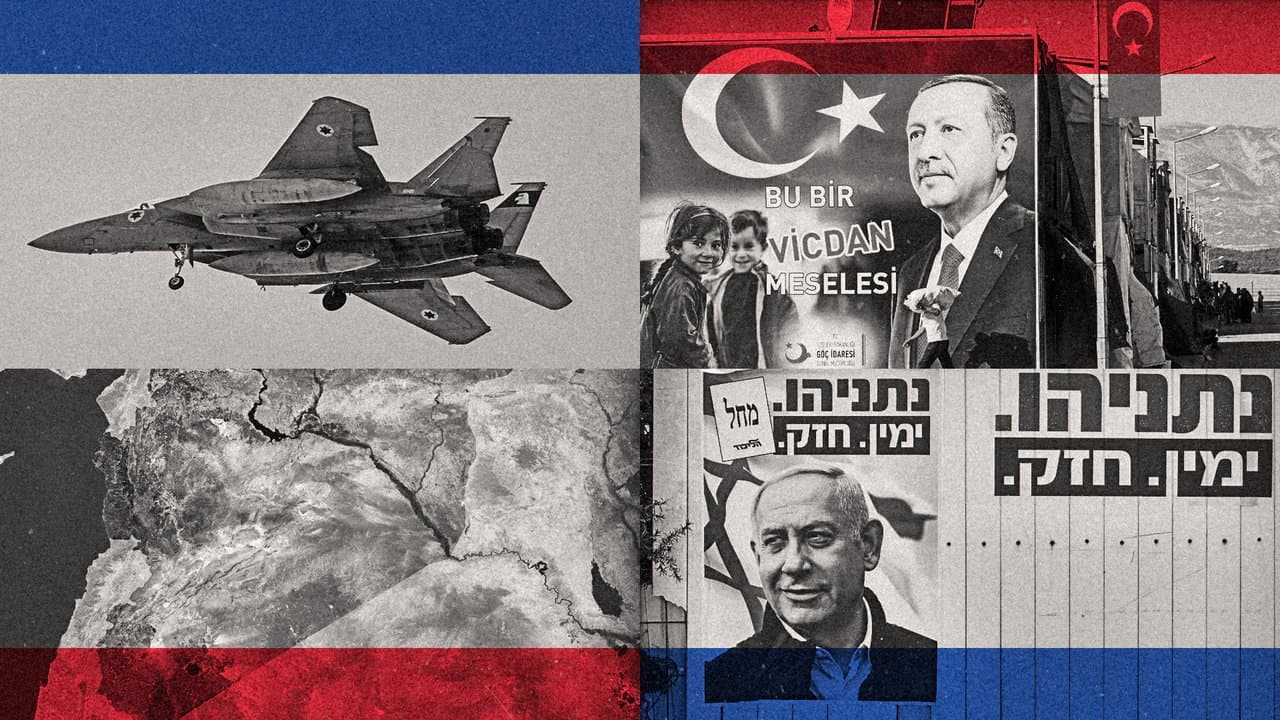
Israel vs Turkey's Shadow War Over Syria's Skies
Executive Summary
On the night of August 17 into 18, 2026, Israeli fighter jets struck the Abu al-Duhur military airfield in eastern Idlib province eight times, striking a facility Israel said was being prepared for Turkish forces, sixty kilometers from the Turkish border. The strike drew condemnation from the United States, the United Kingdom, the United Nations, Turkey, and Syria itself, and exposed something more consequential than a single bombing run: US Ambassador to Turkey and Special Envoy for Syria Tom Barrack disclosed that Washington had received Israel's intelligence on the alleged Turkish deployment six days before the strike, conducted its own independent assessment, and found no basis for the claim. Israel struck anyway, on intelligence its closest ally could not corroborate, against a NATO member's reported military plans, inside a third country neither Israel nor Turkey control.
This report assesses that Abu al-Duhur is not an isolated incident but the sharpest expression yet of a structural collision that has been building since the fall of the Assad regime: Turkey wants a stable, Ankara-aligned Syrian state capable of governing its own territory, including eventually its own airspace, while Israel wants to preserve exactly the freedom of unilateral military action over Syria that a stronger, Turkish-backed Syrian government would necessarily constrain. Neither side, by most available assessment, wants direct war with the other. But both have now drawn red lines, Israel's over any Turkish military infrastructure near its border, Turkey's over its right to support an allied Syrian government, that occupy the same physical space, and neither has yet shown a durable way to de-escalate rather than merely postpone the next confrontation.
Strategic Background
The immediate context for this crisis is the still-unfolding transition following the December 2024 collapse of the Assad regime, which brought Ahmed al-Sharaa's government to power in Damascus and left a genuine vacuum in Syrian air defense and territorial sovereignty that both Ankara and Jerusalem have moved, in different ways, to fill. Turkey has spent the intervening period building deep security, intelligence, and diplomatic ties with the new Syrian government, formalized through an August 6, 2026 meeting between Turkish Foreign Minister Hakan Fidan and Syrian Foreign Minister Asaad al-Shaibani that established a joint high-level strategic council, alongside a July 13 port call by the Turkish warship TCG Istanbul at Latakia and an August 5 meeting between Turkish intelligence chief İbrahim Kalın and al-Shaibani in Ankara covering bilateral cooperation and the integration of the Syrian Democratic Forces. Israel, meanwhile, has continued its own long-standing pattern of unilateral strikes against targets it deems threatening across Syrian territory, a pattern predating the Assad government's fall and continuing largely unconstrained since.
What triggered the immediate crisis was Israel's specific assessment, conveyed to Washington roughly a week in advance, that Turkey intended to deploy military forces to the Abu al-Duhur airbase, a facility already visible in December 2024 imagery showing decommissioned Syrian air force planes following its capture by opposition fighters. The Israeli Prime Minister's Office, in confirming the strike, characterized it as necessary to prevent a violation of what it described as an existing security status quo between Israel and Turkey regarding military infrastructure inside Syria, a status quo Damascus was allegedly on the verge of breaching by permitting the Turkish deployment.
Historical Context
Israel's insistence on unrestricted freedom of action over Syrian airspace has deep institutional roots, most directly in the deconfliction mechanism Israel established with Russia shortly after Moscow's September 2015 intervention in the Syrian civil war, an arrangement that allowed the Israeli Air Force to continue striking suspected Iranian assets inside Syria throughout nearly a decade of Russian military presence there. That precedent shapes Israel's current posture toward Turkey directly: having successfully negotiated freedom of action alongside a major power's military presence once before, Israeli planners appear to be applying the same logic, and the same red-line enforcement approach, to a prospective Turkish military footprint, except this time without an equivalent functioning deconfliction channel in place, a gap US Special Envoy Barrack has said Washington is now working to establish between Israel, Turkey, and Syria.
Turkey's own regional posture provides essential context for why Ankara is unlikely to simply defer to Israeli red lines. Turkey has maintained a substantial military and administrative presence across northern Syria for more than eight years, a footprint that, as of August 2026, is undergoing genuine reorganization rather than withdrawal, illustrated by the August 9 Turkish evacuation of a base in the village of Jalbara in Afrin after more than eight years of presence, even as Ankara simultaneously deepens its formal strategic partnership with the al-Sharaa government in Damascus. This combination, reducing some smaller legacy outposts while expanding formal state-to-state security cooperation, indicates Turkey is repositioning rather than retreating from its role as Syria's primary external security patron.
Current Situation Assessment
The August 18 strike has produced measurable, verified damage: satellite imagery confirmed four impact craters on the airfield's runways and taxiways along with damage to warehouses that were reportedly undergoing refurbishment by the Syrian military. The diplomatic fallout has been immediate and multilateral, with the Syrian Foreign Ministry and Turkish presidency both condemning the strike as an unlawful violation of Syrian sovereignty, and the United States, United Kingdom, and United Nations adding their own criticism, a breadth of international condemnation notable for including Israel's own closest ally among the critics. Reports indicate Mossad chief Roman Gofman held an urgent warning call with Syrian Foreign Minister al-Shaibani on August 14, four days before the strike, reiterating Israel's red lines regarding Turkish military presence, followed roughly a week after the strike by a further Gofman-al-Shaibani meeting aimed at de-escalation, indicating both direct pre-strike signaling and post-strike diplomatic damage control have been actively underway alongside the military action itself.
Despite the severity of the strike and the rhetorical escalation surrounding it, Damascus has signaled continued interest in pursuing security arrangements with Israel rather than abandoning the diplomatic track entirely, with al-Shaibani stating on August 23 that Syria expects security negotiations with Israel to resume soon despite the escalation, a statement that suggests the al-Sharaa government is attempting to preserve its relationships with both Ankara and Jerusalem simultaneously rather than being forced into an exclusive alignment with either.
Power Center Analysis
Israel's Prime Minister's Office has framed its position around a specific, narrowly defined red line, the deployment of Turkish military forces on Syrian soil, rather than a broader objection to Turkish political or economic influence in Damascus, a distinction Israeli analysts have emphasized reflects Jerusalem's actual core concern: the possibility that Turkish military infrastructure could eventually restrict Israeli freedom of action over Syrian airspace and along its northern security front, not Turkish diplomatic engagement with Syria as such. Turkey's position, articulated through Foreign Minister Fidan's formalized strategic council with Damascus and its broader multi-year investment in Syrian reconstruction and security sector integration, reflects Ankara's core interest in a stable, functional, and Turkish-aligned Syrian state, an objective that structurally requires exactly the kind of expanded Syrian military and air defense capability that Israel's red line is designed to prevent from having any Turkish component.
The al-Sharaa government in Damascus occupies the most exposed power center in this dynamic, caught between its evident need for Turkish security assistance to rebuild functional state institutions and armed forces, and its parallel interest, reflected in al-Shaibani's continued openness to resuming security talks with Israel, in avoiding becoming, in its own words as reported by regional analysts, a battlefield where regional powers settle their disputes. Washington's position, articulated through Special Envoy Barrack, has been notably critical of Israel's specific conduct in this episode, both for striking on intelligence US assessment could not corroborate and for what Barrack described as an unnecessary escalation, signaling limited American tolerance for Israeli strikes in Syria that lack clear, verifiable national security justification, even as the administration continues broader engagement with both Israel and Turkey as allies.
Military and Security Implications
The core military stakes for Israel center on maintaining what amounts to an unchallenged operational environment over Syrian airspace, a freedom of action Israel has exercised extensively throughout the post-Assad transition and considers essential to its ability to preempt threats along its northern border, including from Iran-aligned elements and any resurgent extremist groups. Turkish military infrastructure and air defense capability inside Syria, even if nominally under Syrian government control, would introduce a qualitatively different constraint on this freedom of action than Israel has faced from any actor since Assad's fall, given Turkey's status as a NATO member with substantially more capable air defense and air force assets than Syria's own severely degraded post-civil-war military.
The prospect of Turkish retaliation through non-kinetic or indirect means has become a specific point of Israeli security planning, with Israeli military analysts suggesting Ankara could pursue a maritime harassment policy in the eastern Mediterranean, potentially including Turkish warships shadowing Israeli vessels or Turkish aircraft intruding into Israeli air force operating areas over international waters, tactics one Israeli military commentator explicitly compared to Turkey's long-standing pressure campaign against Greece in the Aegean. A retired Israeli general has separately raised the more extreme possibility of a Turkish threat to blockade Israeli maritime trade, a genuinely serious scenario given that Israel conducts approximately ninety-eight percent of its international trade by sea, though this appears at present to be a worst-case contingency raised in strategic discourse rather than an imminent Turkish policy signal.
Economic and Trade Impact
The direct economic stakes of this specific standoff remain limited to date, but the maritime harassment and blockade scenarios raised by Israeli security analysts point toward a potential economic vulnerability of real consequence given Israel's near-total dependence on sea trade. Any sustained Turkish pressure campaign in the eastern Mediterranean, even well short of a full blockade, would introduce shipping insurance and routing uncertainty for vessels serving Israeli ports, a risk factor regional maritime insurers and logistics planners are likely already beginning to price into eastern Mediterranean shipping calculations given the public prominence these scenarios have received in Israeli strategic commentary. For Turkey, continued investment in Syrian reconstruction and security sector development represents a significant ongoing commitment that a sustained confrontation with Israel could complicate, particularly if Israeli strikes continue targeting infrastructure Ankara considers central to its Syria strategy.
Diplomatic Positioning
The most diplomatically significant fact to emerge from this episode is the confirmed gap between Israeli and American intelligence assessments: Barrack's disclosure that the US received Israel's warning six days in advance, conducted independent due diligence, and found no basis for the claimed Turkish deployment represents a rare and pointed public break between the two allies on a specific, verifiable intelligence question, rather than a more typical policy disagreement over strategy or emphasis. This is a materially different situation than prior instances of US-Israel friction over Syria policy, since it centers on a factual claim, whether Turkish forces were actually being deployed to Abu al-Duhur, that Washington has explicitly and publicly stated it could not verify, directly undermining the stated justification for the strike itself.
The United States is now attempting to construct a formal deconfliction mechanism between Israel, Turkey, and Syria modeled explicitly on the earlier Israel-Russia arrangement, an initiative that, if successful, would represent a significant new piece of regional security architecture, but one facing the immediate credibility challenge of being proposed in the direct aftermath of an episode where the existing informal channels, Gofman's direct warning call to al-Shaibani, evidently failed to prevent the strike it was meant to forestall.
Regional Fallout
Syria's own position, caught between its two most consequential external patrons, is arguably the most precarious in this entire dynamic. Al-Shaibani's continued public commitment to pursuing security negotiations with Israel even after the Abu al-Duhur strike suggests Damascus is calculating that maintaining both relationships, however difficult, serves Syria's reconstruction and stability interests better than aligning exclusively with either power, but this balancing act depends entirely on neither Ankara nor Jerusalem forcing an explicit choice, a condition that becomes harder to sustain with each further escalatory incident. Jordan's prior experience intercepting Iranian drones and missiles during the broader 2024 and 2026 regional conflict illustrates how neighboring states can be drawn into enforcement roles during periods of heightened regional military activity, a relevant precedent should the Israel-Turkey standoff over Syrian airspace generate similar cross-border security dynamics. Greece, given its own long-standing tensions with Turkey in the Aegean, is a notable indirect stakeholder, since any Turkish adoption of eastern Mediterranean harassment tactics against Israel would likely be read in Athens through the lens of Turkey's established regional playbook rather than as an isolated Israel-specific development.
Global Strategic Consequences
This standoff illustrates a broader recalibration underway in Middle Eastern security architecture following both the collapse of the Assad regime and the broader 2026 regional conflict involving Iran: with Russian influence in Syria diminished and Iran's regional network under sustained pressure, the vacuum is being contested not by a single dominant external power but by two US-aligned states, Israel and Turkey, whose respective security priorities in Syria are directly incompatible in a way that neither Washington's alliance with each, nor any existing bilateral framework between them, currently resolves. This has meaningful implications for how the broader post-2024 Syrian transition proceeds, since a Syria unable to develop coherent, sovereign control over its own airspace and territory because its two principal external patrons cannot agree on acceptable limits to their own respective military activity there risks prolonging exactly the kind of contested, externally managed sovereignty that has characterized Syria for much of the past decade and a half.
Risk Matrix
The risk of direct, intentional military confrontation between Israeli and Turkish forces is assessed as low in the near term, given neither government's evident interest in a war that would carry severe costs for both NATO cohesion and each country's broader strategic position, but the risk of an unintended escalatory incident, arising from further Israeli strikes on Syrian infrastructure Ankara considers within its sphere, or from Turkish harassment activity in the eastern Mediterranean misjudged by Israeli forces as a more serious threat, is assessed as medium and rising given the current trajectory. The risk that Turkey pursues at least limited eastern Mediterranean harassment tactics against Israeli shipping or aircraft is assessed as medium, consistent with Ankara's established behavioral pattern toward Greece and its stated frustration with the Abu al-Duhur strike. The risk that Syria's al-Sharaa government is ultimately forced into a more exclusive alignment with one patron at the expense of its relationship with the other is assessed as medium over a multi-year horizon, given the structural difficulty of sustaining balance between two powers with such directly competing Syria strategies.
Scenario Analysis
The following scenarios are forward-looking constructs and are explicitly labeled as scenario analysis rather than confirmed fact.
Base Scenario: The US succeeds in establishing at least a preliminary Israel-Turkey-Syria deconfliction mechanism, reducing but not eliminating the risk of further direct incidents, while both Israel and Turkey continue pursuing their respective Syria strategies, Israeli strikes against perceived threats and Turkish security-sector partnership with Damascus, in an uneasy parallel coexistence punctuated by periodic diplomatic friction rather than sustained crisis. Syrian security negotiations with Israel resume as al-Shaibani has indicated, proceeding alongside, rather than displacing, continued Turkish-Syrian strategic cooperation. Probability: High.
Bull Scenario: The deconfliction mechanism Barrack is developing proves more durable and comprehensive than the informal channels that failed to prevent the Abu al-Duhur strike, establishing genuine advance-notification protocols between Israel and Turkey regarding military activity in Syria that meaningfully reduce the risk of future strikes based on unverified intelligence, allowing both powers to pursue their respective interests with reduced friction. Probability: Low to Medium.
Bear Scenario: Turkey responds to continued Israeli strikes on Syrian infrastructure it considers within its strategic sphere by initiating the eastern Mediterranean harassment campaign Israeli analysts have anticipated, provoking a maritime incident that escalates beyond intended limits given the current absence of any functioning Israel-Turkey deconfliction channel, straining NATO cohesion and forcing a more direct US mediating role than the current light-touch envoy approach has provided. Probability: Low, but a genuine and rising tail risk absent successful establishment of the proposed deconfliction mechanism.
Intelligence Forecast (6-24 Months)
Over the next six months, expect continued US diplomatic effort to establish a functioning Israel-Turkey-Syria deconfliction mechanism, with its success or failure serving as the clearest available indicator of whether this standoff moves toward manageable parallel coexistence or continued escalatory risk. Expect continued Turkish investment in formal security and strategic cooperation with the al-Sharaa government, proceeding alongside continued reorganization, rather than withdrawal, of Turkey's legacy military footprint in northern Syria. Expect Israel to maintain its stated red line regarding Turkish military infrastructure inside Syria, with a meaningful probability of further strikes should Israeli intelligence, however contested by US assessment, indicate continued Turkish movement toward deployment at facilities near its border.
Over twelve to twenty-four months, watch for whether Syria's al-Sharaa government succeeds in maintaining its stated balance between Turkish and Israeli engagement, or whether accumulating pressure from one or both external patrons forces a more explicit strategic alignment, a development that would represent a significant shift in the broader post-Assad Syrian transition. Watch also for Israel's October 27, 2026 election as a domestic political variable potentially affecting Prime Minister Netanyahu's calculus on further Syria strikes, given regional analysts' assessment that Turkish President Erdoğan may factor Netanyahu's coalition vulnerabilities into his own strategic timing.
Final Strategic Takeaway
The Abu al-Duhur strike is best understood not as an isolated Israeli counterterrorism or preemption operation but as the sharpest expression yet of a structural contest between two regional powers whose respective visions for post-Assad Syria are fundamentally incompatible: Turkey's vision of a stable, capable, Ankara-aligned Syrian state necessarily requires expanded Syrian military and security capacity that Israel's red line against Turkish military infrastructure is specifically designed to prevent from materializing. That the strike proceeded on intelligence the United States itself could not independently verify adds a further, genuinely destabilizing dimension: Israel's willingness to act unilaterally against a NATO ally's reported plans, even over its closest ally's explicit doubts, signals a degree of strategic autonomy in Israeli Syria policy that neither Washington nor Ankara has yet found a reliable mechanism to constrain or channel into predictable, lower-risk patterns.
Global Chanakya Assessment
The conventional framing treats this as a bilateral Israel-Turkey dispute over Syrian territory. The more accurate strategic reading recognizes that Syria itself, specifically the al-Sharaa government's own strategic choices, is a third and genuinely consequential actor in this dynamic, not merely a passive battlefield. Al-Shaibani's continued public commitment to resuming Israeli security talks despite the Abu al-Duhur strike, and Damascus's parallel deepening of formal strategic cooperation with Ankara through the newly established joint strategic council, indicates a deliberate Syrian strategy of maintaining maximum external patron optionality rather than the more commonly assumed narrative of a Syria being passively fought over by outside powers. This is the underreported dimension: Damascus has genuine agency in this standoff, and its continued balancing act, however precarious, is itself an active strategic choice with real staying power so far.
A contrarian judgment worth stating directly: the US intelligence disclosure that it could not verify Israel's claimed basis for the strike deserves substantially more weight in assessing this episode than most coverage has given it. If Washington's independent assessment is accurate, the strike represents not a justified preemption of an actual imminent threat but a demonstration of Israeli willingness to act on a lower evidentiary threshold than its closest ally requires, specifically in a context, Turkish military activity, where Israel has a clear standing strategic interest in preventing any Turkish foothold regardless of the precise, verified state of Turkish plans at any given moment. This reframes the strike less as reactive threat response and more as proactive red-line enforcement conducted with a lower bar for justification than Israel's public statements suggest.
An underreported risk deserving closer attention is the specific maritime harassment scenario Israeli military commentators have raised, given Israel's near-total dependence on sea trade and Turkey's demonstrated, decades-long template for exactly this kind of pressure campaign against Greece. This scenario has received far less international attention than the more visually dramatic airstrike itself, but it represents a potentially more strategically significant vulnerability for Israel over a sustained timeframe than any single strike on Syrian territory, precisely because it targets an economic dependency, seaborne trade, that has no readily available substitute and would be genuinely difficult for Israel to counter through its conventional military advantages.
For India, this standoff carries relevant, if indirect, strategic lessons rather than immediate direct stakes. First, on foreign policy, India maintains substantive strategic and defence relationships with both Israel and Turkey, and any further deterioration in Israel-Turkey relations could create modest diplomatic friction for New Delhi in managing parallel engagement with both states, a dynamic India's Ministry of External Affairs should monitor for any signs of either country seeking explicit third-party alignment against the other. Second, on defence and technology implications, the demonstrated willingness of Israel to conduct significant unilateral military action based on intelligence its closest ally could not verify offers a relevant case study for Indian defence and intelligence planners regarding the risks and consequences of acting on lower-confidence intelligence in politically sensitive, multi-stakeholder security environments. Third, on maritime security, the specific scenario of a NATO member potentially using naval harassment or blockade tactics against a close US partner's shipping is a novel enough precedent that Indian naval strategists and maritime trade planners, given India's own extensive reliance on sea trade, may find it a useful reference point in broader thinking about maritime chokepoint and shipping-lane vulnerability to state-level harassment campaigns short of formal war.
Key intelligence indicators to monitor include progress or failure in establishing the US-proposed Israel-Turkey-Syria deconfliction mechanism, further Israeli strikes on Syrian military infrastructure near the Turkish border, any Turkish naval or air activity in the eastern Mediterranean consistent with the harassment scenarios Israeli analysts have raised, developments in the resumed Syria-Israel security negotiations al-Shaibani has referenced, and Turkish-Syrian strategic council implementation steps following the August 6 agreement.
Indicators to Monitor
- Progress or failure in establishing a formal US-brokered Israel-Turkey-Syria deconfliction mechanism
- Further Israeli airstrikes on Syrian military infrastructure, particularly near the Turkish border
- Turkish naval or air activity in the eastern Mediterranean consistent with reported harassment scenarios against Israel
- Developments and resumption timeline for Syria-Israel security negotiations referenced by Asaad al-Shaibani
- Implementation steps following the Turkey-Syria joint high-level strategic council agreement of August 6, 2026
- Further Turkish troop reorganization or withdrawal activity at legacy bases in northern Syria
- US Special Envoy Tom Barrack's public statements and diplomatic engagement with Israel, Turkey, and Syria
- Israeli domestic political developments ahead of the October 27, 2026 election affecting Syria policy calculus
- Statements or actions from Syrian President Ahmed al-Sharaa's government regarding its balancing strategy between Ankara and Jerusalem
- Greek government statements or defence posture shifts in response to any Turkish eastern Mediterranean activity
FAQ
Why did Israel strike the Abu al-Duhur airbase? Israel stated it struck the airfield to prevent what it assessed as an imminent Turkish military deployment there, characterizing any Turkish military presence at the base as a violation of an existing security status quo and a red line for Israeli security along its northern front.
Did the United States support the Israeli strike? No. US Special Envoy Tom Barrack disclosed that Washington received Israel's intelligence six days before the strike, conducted its own independent assessment, and found no basis for the claim that Turkish forces were being deployed to the base, indicating the US did not corroborate the stated justification for the strike.
Is Turkey planning to go to war with Israel over Syria? There is no indication either government seeks direct military conflict. Analysts have instead raised the possibility of Turkey pursuing lower-intensity pressure tactics, such as naval harassment in the eastern Mediterranean, drawing comparisons to Turkey's long-standing posture toward Greece in the Aegean, rather than open warfare.
What does Syria want from this situation? Syrian Foreign Minister Asaad al-Shaibani has indicated Damascus wants to maintain relationships with both Turkey and Israel, stating that security negotiations with Israel are expected to resume despite the Abu al-Duhur strike, even as Syria simultaneously deepens formal strategic cooperation with Turkey through a newly established joint council.
Could this affect global shipping or trade? Any escalation involving Turkish naval activity against Israeli shipping in the eastern Mediterranean could affect regional maritime insurance and routing given Israel's near-total dependence on sea trade, though as of the current assessment this remains a scenario raised in strategic analysis rather than an active development.