
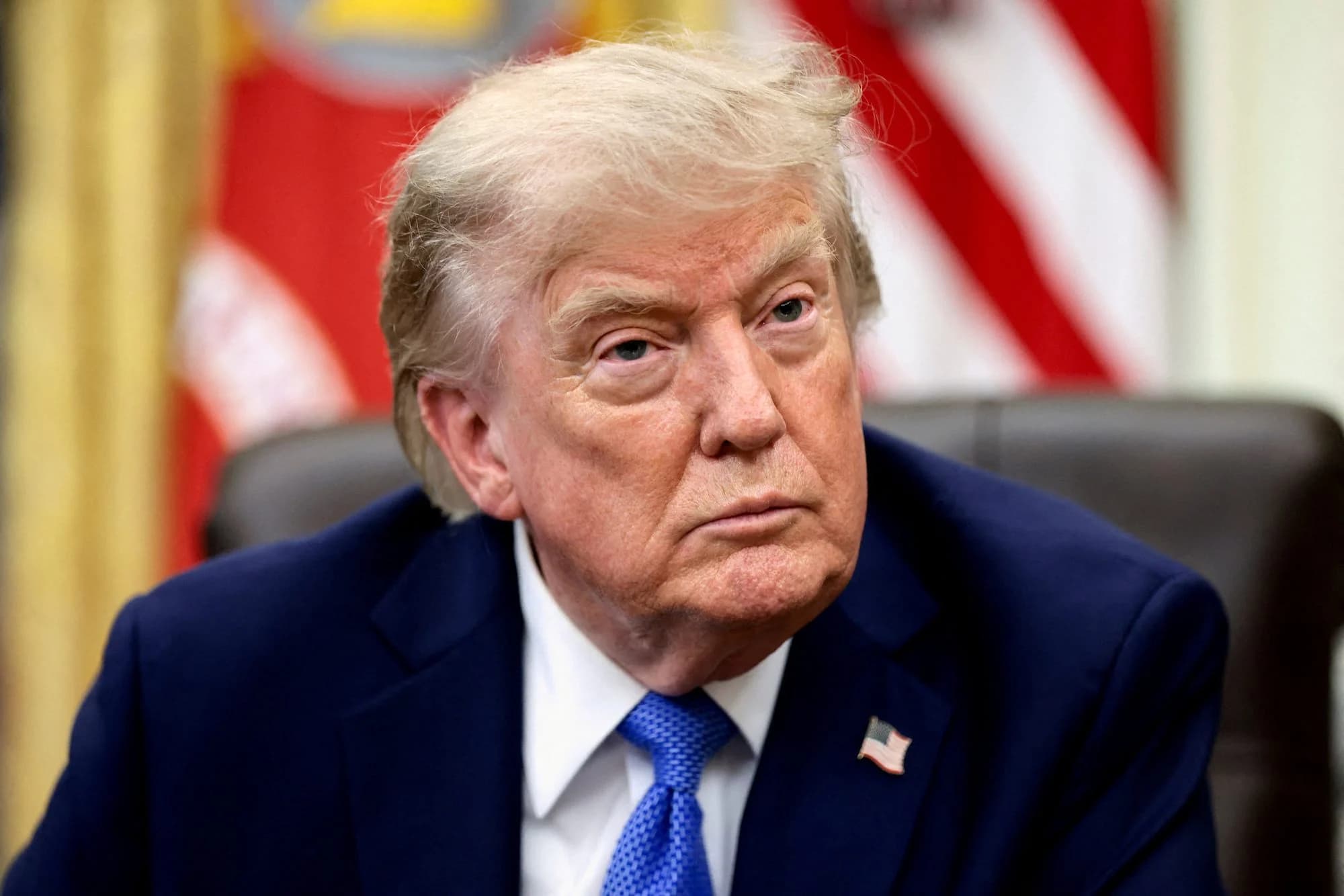
Trump Declares Hormuz "Mine-Free" Hours After a Tanker Gets Hit
Executive Summary
On the morning of August 25, 2026, President Trump posted on Truth Social that the US Navy had informed him all mines within the international waters of the Strait of Hormuz had been removed or detonated, declaring a "zero tolerance policy" under which any vessel attempting to lay new mines would be destroyed. Hours later, at 1730 UTC that same day, the tanker AL SALAM II was struck just above the waterline by an unidentified projectile while transiting the strait eastbound, catching fire before the blaze was extinguished with no reported casualties. The sequence, a presidential declaration of a cleared waterway followed within a single news cycle by a burning tanker in that same waterway, has become a defining illustration of the gap between the administration's public narrative on Hormuz and the more contested, still-dangerous reality documented by independent shipping trackers and UK maritime authorities.
This report assesses that Trump's mine-clearing announcement was substantively accurate but consequentially incomplete: US Central Command's confirmed clearance operation addressed sea mines specifically within the strait's main shipping lane, a genuine and verifiable military achievement, while leaving entirely unaddressed the separate and continuing threat of projectile strikes from drones, missiles, or shore-based systems, which is what actually struck the AL SALAM II and at least three further vessels in the days that followed. The presidency's rhetorical conflation of "mine-free" with "safe" has real consequences: it shapes market expectations, insurance pricing, and diplomatic narratives around a waterway that, by the numbers, remains one of the most dangerous stretches of commercial water on earth, with traffic still running at a small fraction of pre-war volumes even as the technical demining claim itself withstands scrutiny.
Strategic Background
The Strait of Hormuz crisis traces to February 28, 2026, when the United States and Israel launched Operation Epic Fury against Iranian nuclear sites and military infrastructure, prompting Iran to declare the strait closed and to deploy mines, drones, and speedboats specifically to deter commercial transit, a response that halted nearly all shipping and stranded more than 150 tankers in the Arabian Gulf at the crisis's height. The mine threat itself has a specific, escalatory origin point: US forces struck Iranian rocket launchers on Larak Island, a small but strategically critical island inside the strait that Iranian forces have long used to help control vessel traffic, after intelligence indicated Tehran intended to fire rockets carrying sea mines into the shipping lanes, an operation that reportedly killed three and became a direct trigger for further Iranian retaliation, including an attack on two American bases in Jordan.
Washington's mine-clearing effort, by US officials' own account, was a genuine, months-long, low-key military operation rather than a single dramatic action, with the clearance of the strait's median shipping lane following the earlier establishment of a southern route along the Omani coast that the US military had used to escort tankers even before the main lane was declared clear. Officials stated that more than 500 ships transited the southern channel in the preceding thirty days, with only around two percent struck by Iranian drones or missiles, a figure the administration has used to argue its escort and clearance strategy was working even as it simultaneously fell well short of describing a fully secure waterway.
Historical Context
Mine warfare in the Strait of Hormuz has a decades-long precedent, most notably during the 1980s Tanker War between Iran and Iraq, when naval mines damaged or sank numerous vessels and drew direct US Navy mine-clearing operations into the Gulf for the first time. The current campaign differs in one important respect: Iran's 2026 mining effort was explicitly conceived as a deterrent and denial tool tied to a specific, declared war objective, forcing US and Israeli forces to answer for the February airstrikes, rather than the more diffuse strategic signaling that characterized mining incidents in prior decades. Admiral Brad Cooper's confirmation, in his role as US Central Command Commander, that American forces had cleared Iranian-laid sea mines from internationally recognized shipping lanes represents a rare instance of a named, on-record military official validating a presidential claim with specific operational detail, lending the underlying demining claim itself more credibility than many of Trump's other, less corroborated statements on the war's progress.
Current Situation Assessment
The tanker strikes that followed Trump's declaration were neither isolated nor brief. The Joint Maritime Information Center identified the vessel struck on August 25 as the AL SALAM II, hit above the waterline while transiting eastbound; UK Maritime Trade Operations confirmed a further attack on August 26, with all crew reported safe and no environmental impact; a Liberian-flagged tanker's engine room was hit by a separate projectile earlier that same week; and by August 31, a tanker was struck by three unknown projectiles while sailing the southern lane close to the Omani coast, the same route the US has been using for escorted transits, an attack that came a day after Iran struck two American bases in Jordan in retaliation for a US strike on Larak Island. Kpler's tracking data captured the practical scale of the disruption starkly: only five ships made confirmed crossings on the Tuesday of Trump's mine-clearing announcement, down from seven the prior day and a collapse from the more than 130 vessels transiting daily before the war, with all five crossings using Iran's own unilaterally designated shipping route rather than any US-secured lane.
Diplomatically, the same week produced a notably different, more constructive track: Iran and Oman unveiled a phased proposal on August 26 including a temporary joint navigation corridor through Hormuz and a joint mine-clearing project, alongside continued technical negotiations toward a permanent navigation corridor and future administration of the strait, a framework that put into practice provisions from the US-Iran memorandum of understanding signed in June calling for Iran-Oman talks on the strait's future management. Qatar inserted itself into this diplomatic track directly, with Prime Minister Sheikh Mohammed bin Abdulrahman Al Thani traveling to Tehran on August 27 specifically to discuss the framework and press Iranian officials to respect freedom of navigation, following which Tehran reportedly agreed to draw up a list of conditions for restoring normal traffic.
Power Center Analysis
The Trump administration's messaging strategy on Hormuz reflects two distinct and not entirely reconciled tracks: US Central Command's technical, verifiable claims about mine clearance in specific shipping lanes, and the president's own broader, more sweeping rhetorical framing, "mission accomplished," "total control," "zero tolerance," language that consistently outpaces what the underlying military achievements actually establish. Treasury Secretary Scott Bessent's parallel announcement of intensified secondary sanctions under what reporting has referred to as both "Operation Economic Outcast" and the earlier "Economic D-Day" framing reflects a second administration power center pursuing economic coercion as a complement to, and increasingly a substitute for, further direct military escalation, particularly as the war approaches the politically sensitive midterm election period. United Against Nuclear Iran policy director Jason Brodsky's characterization of continued US strikes as "enforcing the blockade" while Washington simultaneously leans on economic coercion captures this dual-track strategy succinctly.
Iran's Supreme National Security Council has maintained a firm public position that the strait will not fully reopen until the United States "corrects its behavior," a formulation that ties any durable resolution of shipping access directly to the war's broader political settlement rather than treating Hormuz security as a separable technical or humanitarian question, meaning continued tanker strikes function simultaneously as military harassment and as leverage in the broader negotiation over the war's terms.
Military and Security Implications
The operational distinction between mine clearance and projectile defense is the central military fact this episode illustrates: mines are static, detectable, and clearable through dedicated naval operations, which is precisely what CENTCOM appears to have genuinely accomplished in the main shipping lane, while drone, missile, and speedboat-launched projectile attacks require a fundamentally different and more difficult-to-guarantee defensive posture, sustained escort coverage, air defense, and constant vigilance against an adversary that retains the capability to strike vessels regardless of whether the water beneath them has been swept for explosives. The pattern of continued strikes specifically targeting vessels using the southern Omani-coast route, the same corridor the US has designated for escorted transit, suggests Iranian forces are deliberately targeting the US-preferred shipping lane rather than merely opportunistic strikes, a targeting choice with direct implications for how much protective value US escort operations can actually provide.
Economic and Trade Impact
Global oil markets registered a measured, cautiously optimistic response to the Iran-Oman framework announcement rather than to Trump's mine-clearing claim specifically, with Brent crude falling three percent to near 86 dollars a barrel and West Texas Intermediate dropping 2.8 percent to 80 dollars across three consecutive days of decline, even as analysts characterized traders as remaining in a "wait-and-see mode" rather than pricing in a confident, durable resolution. This market reaction is instructive: prices moved on the diplomatic framework between Iran and Oman, not on the US demining announcement, suggesting sophisticated market participants are already discounting the administration's rhetorical claims relative to the more substantive, if still preliminary, bilateral negotiating track. The continued collapse in actual vessel throughput, five confirmed crossings against a pre-war daily average exceeding 130, indicates the practical economic normalization of Gulf shipping remains far more constrained than either the mine-clearing announcement or the modest oil price relief might suggest to a casual observer.
Diplomatic Positioning
The Iran-Oman framework's specific provisions, a temporary joint navigation corridor, a joint mine-clearing project, and continued talks toward a permanent corridor and future strait administration including information exchange and traffic management, represent a substantially more detailed and technically grounded diplomatic proposal than any unilateral American announcement has offered to date, and critically, one that Tehran has directly participated in shaping rather than merely responded to. Qatar's direct diplomatic intervention, sending its prime minister to Tehran specifically to press for respect of freedom of navigation, indicates Gulf state mediators are treating the strait's normalization as urgent enough to warrant head-of-government-level engagement, a level of diplomatic investment that exceeds what the Trump administration's own more rhetorically driven public statements have been matched with in comparable direct engagement with Tehran.
Regional Fallout
The continued targeting of vessels along the Omani coastal route places Oman in an increasingly exposed position: simultaneously the host of the shipping lane the US has designated for escorted transit, a central broker in the emerging Iran-Oman navigation framework, and now the proximate location of repeated attacks on vessels using its own coastal waters for passage. Qatar's proactive diplomatic role reflects Doha's broader pattern of positioning itself as a trusted interlocutor with Tehran throughout the conflict, a role that, if the current framework advances toward implementation, could meaningfully enhance Qatar's diplomatic standing as the actual venue through which Gulf shipping security is restored, distinct from and arguably more consequential than Washington's own bilateral channels with Iran.
Global Strategic Consequences
This episode illustrates a broader pattern worth naming precisely: in a prolonged, multi-front conflict where verified military achievements, mine clearance, exist alongside continued, unresolved threats, projectile strikes, a government's incentive to publicly conflate the two into a single triumphant narrative is strong, particularly ahead of a politically sensitive midterm election cycle. The gap between Trump's declared "mission accomplished" framing and gCaptain's own reporting explicitly noting the declaration came even as commercial shipping risks continued, is a useful case study in how wartime communications can create a durable public perception gap from ground-level operational reality, a gap that becomes strategically consequential when it shapes market pricing, allied confidence, and negotiating leverage independent of whether the underlying facts eventually align with the rhetoric.
Risk Matrix
The risk that further tanker strikes continue to occur despite the confirmed main-lane mine clearance is assessed as high, given the demonstrated pattern of at least four distinct projectile attacks across the week following Trump's announcement alone, and the clear indication that mines were never the sole or even primary threat to shipping. The risk that the Iran-Oman navigation framework stalls before reaching implementation is assessed as medium, given the technical complexity of establishing joint mine-clearing and future strait administration arrangements between two governments whose broader relationship with the US-led coalition remains adversarial in Iran's case. The risk of a significant further escalation, following the pattern of the US strike on Larak Island and Iran's retaliatory attack on US bases in Jordan, is assessed as medium and directly tied to the pace and visibility of continued US military action inside or near the strait. The risk that Trump's rhetorical overstatement of progress undermines the credibility of subsequent, potentially more substantive administration claims about the war's trajectory is assessed as medium to high, given the accumulating pattern of gaps between announcement and battlefield reality already documented across this and prior episodes.
Scenario Analysis
The following scenarios are forward-looking constructs and are explicitly labeled as scenario analysis rather than confirmed fact.
Base Scenario: The Iran-Oman navigation framework continues incremental implementation, including the proposed joint mine-clearing project and temporary corridor, while projectile attacks on vessels continue at a reduced but persistent frequency, keeping overall transit volumes well below pre-war levels for the foreseeable future. The Trump administration continues emphasizing verified military achievements, such as main-lane demining, in public messaging while downplaying continued attack risks, sustaining the current gap between official narrative and ground-level shipping conditions. Probability: High.
Bull Scenario: The Iran-Oman framework advances faster than expected, incorporating Qatari-mediated confidence-building measures, and Iran meaningfully reduces projectile attacks on vessels using the designated southern corridor as part of a broader de-escalatory signal tied to progress in the underlying US-Iran negotiating track, producing a genuine, verifiable improvement in both mine and projectile safety that allows transit volumes to recover substantially over the following months. Probability: Low to Medium.
Bear Scenario: Continued US military action against Iranian assets inside the strait, following the pattern of the Larak Island strike, triggers a further significant Iranian retaliatory escalation that derails the Iran-Oman diplomatic framework entirely, reverting the strait to a higher-intensity conflict zone with mine-laying resuming despite the current clearance and projectile attacks intensifying in frequency and lethality, compounding an already severe disruption to global oil markets. Probability: Low, but a genuine risk given the demonstrated pattern of tit-for-tat escalation already observed within the same week as the mine-clearing announcement.
Intelligence Forecast (6-24 Months)
Over the next six months, expect continued technical negotiation and likely phased implementation of the Iran-Oman navigation framework, alongside a persistent, if lower-frequency, pattern of projectile attacks on transiting vessels that will continue to complicate any US or Iranian claims of a fully secured waterway. Expect continued US Treasury sanctions escalation under its economic pressure campaign, timed and messaged with an eye toward the approaching midterm elections, alongside continued rhetorical emphasis from the administration on verified military successes such as mine clearance, likely without a corresponding rhetorical acknowledgment of the continued projectile threat.
Over twelve to twenty-four months, watch for whether the Iran-Oman framework's more ambitious long-term provisions, a permanent navigation corridor and formalized joint administration of the strait, actually materialize into an operational reality, since this would represent a far more durable resolution to the shipping security question than any US unilateral clearance or escort operation could achieve alone. Watch also for whether continued Gulf state mediation, particularly through Qatar, produces a broader de-escalation of the underlying US-Iran conflict that could reduce the incentive for continued Iranian projectile strikes as a negotiating leverage tool.
Final Strategic Takeaway
The tanker strike hours after Trump's mine-clearing declaration is not evidence that the announcement itself was false, CENTCOM's confirmed clearance of the main shipping lane appears to be a genuine, verifiable military achievement, but it is clear evidence that the announcement was incomplete in a way that mattered enormously to anyone trying to assess actual shipping risk in the strait. Mines and projectiles are different threats requiring different countermeasures, and conflating their resolution into a single triumphant declaration created a public narrative that the facts on the water immediately and repeatedly contradicted. The more consequential, substantive process for restoring normal Hormuz shipping appears to be running through the Iran-Oman-Qatar diplomatic track rather than through any unilateral American announcement, a distinction market participants have already priced in more accurately than much of the public commentary surrounding Trump's own statements.
Global Chanakya Assessment
The conventional framing treats this as an embarrassing communications misstep, a president caught overstating progress just before contradicting facts emerged. The more useful strategic reading recognizes a recurring pattern across this entire conflict: administration announcements consistently claim broader, more definitive victories than the specific, verifiable military achievement underlying them actually supports, a pattern visible not only in the mine-clearing declaration but in the earlier, subsequently retracted claim by Energy Secretary Chris Wright of a successful tanker escort, and in Trump's own repeated, unfulfilled predictions of an imminent negotiated Hormuz reopening. This is the underreported story: the gap between announcement and reality is not an isolated incident but a structural feature of how this administration has communicated the war's progress from its earliest weeks.
A contrarian judgment worth stating directly: the market's muted, cautious reaction to the mine-clearing announcement itself, oil prices moved instead on the separate Iran-Oman framework news, suggests sophisticated market participants have already adjusted their trust calibration for administration statements on this specific conflict, treating official US announcements as a weaker signal than genuinely independent developments like the Iran-Oman negotiating track. This is a meaningful, if quiet, market judgment on the credibility gap this report has identified, and it deserves more explicit acknowledgment in coverage of the war's economic dimension than it has generally received.
An underreported risk deserving closer attention is the specific targeting pattern of continued attacks on vessels using the Omani southern corridor, the same route the US has designated as its escorted, safer alternative to the main shipping lane. If Iranian forces are deliberately concentrating strikes on the specific corridor Washington has publicly endorsed as safe, rather than attacking vessels indiscriminately across all routes, this represents a targeted undermining of US credibility and escort capability specifically, a more strategically pointed message than a simple continuation of general harassment tactics, and one that should factor more heavily into assessments of how much protective value continued US escort operations can realistically provide going forward.
For India, the practical stakes remain substantial given New Delhi's heavy reliance on Gulf crude transiting this exact waterway. Indian refiners and shipping insurers should treat the demonstrated gap between official demining claims and continued projectile risk as the operative planning assumption, rather than adjusting risk models downward on the basis of Trump's broader "mission accomplished" framing, since Kpler's own tracking data confirms transit volumes remain a small fraction of pre-war levels regardless of the mine-clearing claim's technical accuracy. India's Ministry of Petroleum and maritime insurers should specifically monitor whether Indian-linked or Indian-bound tankers continue to receive the kind of Iranian-approved escorted passage referenced in earlier reporting on this conflict, since the demonstrated targeting pattern along the Omani corridor suggests general international backing for a specific route does not equate to guaranteed safety for vessels using it.
Key intelligence indicators to monitor include further UKMTO alerts on vessel strikes in the strait, implementation progress on the Iran-Oman joint mine-clearing and navigation corridor framework, Kpler and other independent tracking data on daily transit volumes disaggregated by shipping lane, further US military action against Iranian assets inside or near the strait, Qatari mediation developments and any further high-level diplomatic visits to Tehran, and continued US Treasury secondary sanctions announcements as an indicator of the administration's parallel economic pressure track.
Indicators to Monitor
- Further UK Maritime Trade Operations alerts on vessel strikes or incidents in the Strait of Hormuz
- Implementation progress on the Iran-Oman joint mine-clearing project and temporary navigation corridor
- Kpler and independent shipping data on daily transit volumes, disaggregated by shipping lane and route
- Further US military action against Iranian naval or mine-laying assets inside or near the strait
- Qatari mediation developments and further high-level diplomatic visits between Doha and Tehran
- US Treasury secondary sanctions announcements under the ongoing economic pressure campaign
- Statements from Iran's Supreme National Security Council regarding conditions for full strait reopening
- Admiral Brad Cooper and US Central Command statements on shipping lane security status
- Global oil price movements as a market-based indicator of confidence in the strait's normalization
- Any further incidents involving US strikes on Iranian territory or assets inside the strait, such as Larak Island
FAQ
Did Trump lie about the Strait of Hormuz being mine-free? Available evidence indicates the specific technical claim, that mines had been cleared from the strait's main international shipping lane, was corroborated by US Central Command Commander Admiral Brad Cooper. The issue is not that the mine-clearing claim was false, but that it did not address the separate, continuing threat of projectile attacks, which is what actually struck several tankers in the days immediately following the announcement.
What hit the tanker that was struck hours after Trump's announcement? The vessel, identified as the AL SALAM II, was struck by an unidentified projectile just above the waterline while transiting the strait eastbound. The projectile's specific origin and type were not confirmed in available reporting, though the broader pattern is consistent with drone, missile, or shore-based strikes rather than mines.
Is shipping through the Strait of Hormuz back to normal? No. Independent tracking data showed only five confirmed vessel crossings on the day of Trump's mine-clearing announcement, compared to a pre-war daily average exceeding 130 vessels, indicating shipping volumes remain severely depressed regardless of the demining claim's accuracy.
What is the Iran-Oman framework for the strait? Iran and Oman have proposed a phased plan including a temporary joint navigation corridor, a joint mine-clearing project, and continued technical negotiations toward a permanent navigation corridor and future joint administration of the strait, including traffic management and navigational security services.
Why do tanker attacks keep happening if the mines are cleared? Mines and projectile attacks, from drones, missiles, or shore-based systems, are distinct threats requiring different countermeasures. Clearing mines from a shipping lane does not prevent vessels from being struck by projectiles, which is the type of attack responsible for the tanker strikes reported after Trump's mine-clearing declaration.