
The Leipzig Drone: Inside the Intelligence Trail Linking a German Airport Attack to Moscow
Executive Summary
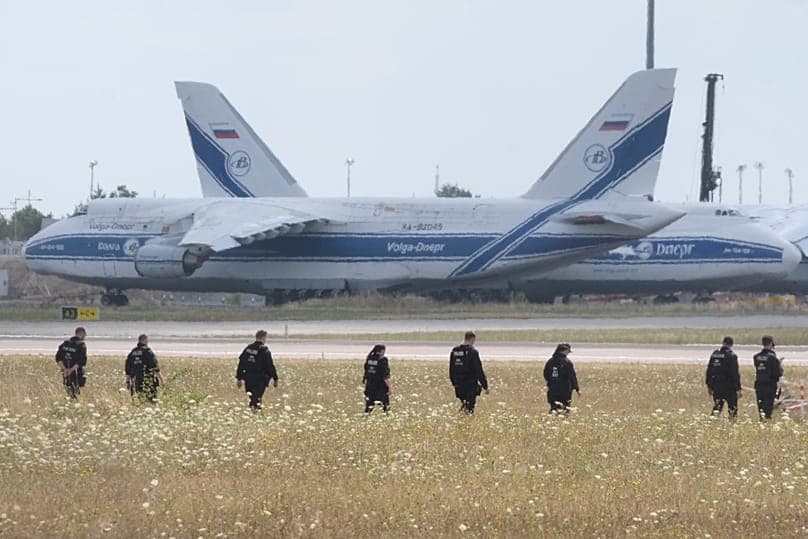
Late on August 4, 2026, airport workers at Leipzig/Halle Airport in Saxony found a drone carrying professional-grade explosives and a detonator in a restricted cargo area near a Ukrainian Antonov aircraft reportedly loaded with military ammunition. The device did not detonate. A second flying object forced a diverted passenger aircraft to collide with it after a landing attempt was aborted. German federal prosecutors opened a counterterrorism investigation. Within days, a German parliamentary intelligence committee member and unnamed US officials had directly accused Russia of orchestrating the operation, describing it as an attempt to sabotage NATO's primary military logistics artery into Ukraine and intimidate the alliance's eastern members. Chancellor Friedrich Merz convened the National Security Council. Germany announced it would double its federal anti-drone police unit. And the government explicitly ruled out seeking NATO Article 4 consultations, even as its own coalition partners publicly disagreed with that decision.
This report treats the Leipzig incident not as an isolated act of sabotage but as a diagnostic case study in the specific, calibrated logic of Russian hybrid warfare against NATO's rear: attacks precise enough to threaten real damage, ambiguous enough to deny formal attribution, and calculated to stay just below the threshold that would trigger a collective alliance response. What the Leipzig case reveals about that calculus, and about the visible gaps in Germany's own defenses that it exposed, matters well beyond German borders.
Strategic Background
Leipzig/Halle Airport is not an ordinary civilian facility. It serves as the main operational base for NATO's Strategic Airlift International Solution, SALIS, a program that uses Ukrainian-operated Antonov An-124 heavy transport aircraft to move armaments, ammunition, and military equipment to NATO's eastern flank and to Ukraine itself. That function made the airport a militarily significant node hiding in plain sight as a commercial cargo hub, a status Russian intelligence planners would have every incentive to understand and exploit. The Leipzig incident did not occur in isolation: it followed a pattern of drone incursions across European airports and military installations through 2025 and 2026, including sightings that grounded flights at Munich, drone activity over Danish airports and military bases, and Russian fighter jet violations of Estonian airspace, all of which Danish Prime Minister Mette Frederiksen and other officials had already characterized publicly as evidence of an active Russian hybrid war campaign against NATO territory.
Historical Context
The use of ambiguous, deniable sabotage against an adversary's rear logistics and infrastructure has deep roots in Russian and Soviet military doctrine, but its application against NATO territory specifically has accelerated sharply since 2022, growing more overt as the war in Ukraine has dragged on and as Western military support to Kyiv has scaled up. Germany's own security services had, prior to Leipzig, already accused Moscow of a pattern of hybrid attacks, incidents of aggression falling deliberately short of acts of war, a formulation German officials continued to use even as the tenor of accusations following Leipzig grew notably more direct. An October 2025 assessment from the International Institute for Strategic Studies had already documented roughly 144 suspected drone incidents near sensitive military and logistics sites across Germany, France, and the United Kingdom, with reporting further linking a portion of that campaign to Russia's so-called shadow fleet, commercial vessels allegedly used to stage or support drone operations from European coastal waters. Leipzig therefore represents not a novel tactic but an escalation in target selection, moving from surveillance-oriented overflights of airports and bases toward an attack involving live explosives directly adjacent to a military logistics aircraft.
Current Situation Assessment
As of mid-August 2026, the German government has confirmed the core facts while stopping short of formal state attribution to Russia. Federal prosecutors have opened and continue to pursue a counterterrorism investigation into what they have publicly described as a serious attack potentially affecting both domestic and foreign security. Interior Minister Alexander Dobrindt characterized the incident as representing "a new quality of danger." Bundestag member and parliamentary intelligence committee figure Roderich Kiesewetter went further, stating he assumed the incident was a targeted hybrid attack, an attempted act of terror, orchestrated from Russia, a characterization subsequently reinforced by unnamed US officials cited in reporting who indicated American intelligence assessments linked the explosive drone to the Russian government. Russia's embassy in Berlin did not respond to requests for comment, consistent with Moscow's standard posture of neither confirming nor substantively denying such accusations in ways that would resolve the ambiguity.
The German policy response has moved on two tracks simultaneously. On August 8, Chancellor Merz convened the National Security Council to coordinate a response. On August 9 and 10, the Interior Ministry announced concrete capability increases: a new research facility and a doubling of the federal police's specialized counter-drone unit from 150 to 300 personnel, alongside an expansion of operational bases for that unit from four to eight. Separately, the government has backed a broader intelligence reform effort to expand the powers of Germany's domestic (BfV) and foreign (BND) intelligence services specifically to counter espionage, sabotage, cyberattacks, and covert foreign influence operations, an initiative Kiesewetter has linked directly to the Leipzig incident and the broader pattern of Russian escalation following Russian battlefield setbacks in Ukraine.
The most politically revealing development, however, is what the German government has explicitly declined to do: formally initiate NATO Article 4 consultations, the alliance mechanism for members to raise concerns that their territorial integrity, political independence, or security is threatened. This is a deliberate, calculated restraint, not an oversight, and it has produced open coalition friction, with Kiesewetter's own CDU/CSU parliamentary group publicly supporting the idea of Article 4 consultations even as the government they nominally support has ruled the option out.
Power Center Analysis
Germany's response reveals a government navigating a genuinely difficult calibration problem shared across NATO's eastern and central-European members. The Chancellery under Merz has prioritized capability-building, doubling the anti-drone unit, backing intelligence-service reform, over formal escalatory diplomatic signaling, a choice consistent with a broader alliance-wide pattern of absorbing Russian hybrid provocations without triggering Article 4 or Article 5 mechanisms that could be read domestically or internationally as crossing into open confrontation. Within the German coalition, the CDU/CSU parliamentary wing represented by Kiesewetter has pushed for a more explicit, alliance-level response, including formal Article 4 consultations and accelerated delivery of longer-range capabilities like Taurus missiles to Ukraine, reflecting a familiar split between a cautious executive and a more hawkish legislative flank. NATO itself has maintained calculated distance, acknowledging awareness of the Leipzig incidents while explicitly referring further questions to German national authorities, a posture consistent with the alliance's broader reluctance to have individual member-state hybrid incidents automatically escalate to collective decision-making unless a member state itself formally requests it.
Military and Security Implications
The most operationally significant revelation from Leipzig is not the attack itself but the defensive gap it exposed: Leipzig/Halle Airport's existing anti-drone detection systems failed to identify the threat before it reached a restricted cargo area beside a military logistics aircraft. That failure, at a facility whose military significance was already well understood by German authorities, has driven the doubling of the federal counter-drone unit and the push for a dedicated research facility, but it also raises a harder unresolved question: whether the broader network of similarly sensitive logistics nodes across NATO's rear, airports, ports, rail junctions, feeding the alliance's Ukraine supply chain, possesses comparable detection gaps that have simply not yet been tested by an actual attack. The SALIS mission's dependence on a small number of high-value, difficult-to-replace An-124 heavy-lift aircraft makes any successful attack on this specific supply chain disproportionately consequential relative to the physical damage a single drone could inflict, a vulnerability Russian planners are highly likely to have factored into target selection.
Economic and Trade Impact
Leipzig/Halle's dual role as both a major European commercial freight hub and a NATO military logistics node means that any sustained disruption carries direct economic costs beyond the security dimension, a fact reflected in the temporary closure of both runways and the diversion of multiple flights, including passenger aircraft, following the incident. Sustained or escalating attacks against dual-use logistics infrastructure of this kind would raise insurance, security, and operational costs across the broader European air-cargo sector, a second-order economic consequence of hybrid warfare campaigns that rarely receives the same attention as their immediate security implications.
Diplomatic Positioning
Germany's calibrated public messaging, confirming a serious attack and an active counterterrorism investigation while stopping short of formal state-level attribution to Russia, reflects a now-familiar diplomatic pattern across NATO's hybrid-warfare response: acknowledging what officials privately and even semi-publicly believe to be true while withholding the kind of formal attribution that would create pressure for a more forceful collective response. This ambiguity-management approach mirrors Denmark's own posture after its drone incidents, in which officials described a clear hybrid war pattern rhetorically while stopping short of direct government-to-government attribution. The approach carries real diplomatic logic, avoiding a cycle of formal accusation and denial that neither resolves the security problem nor provides Russia with an opportunity to claim Western overreaction, but it also means that each individual incident, considered in isolation, tends to be diplomatically absorbed rather than met with a proportionate collective response, a pattern critics argue may itself be read by Moscow as an invitation to continue.
Regional Fallout
The Leipzig incident lands within a broader 2025-2026 pattern of drone and airspace incidents across Poland, Denmark, Belgium, Estonia, and Germany itself, a geographic spread that has pushed several NATO members toward explicit public "hybrid war" framing even where formal Article 4 or Article 5 action has not followed. Poland's prior experience with Russian drone incursions and Estonia's fighter-jet airspace violations mean the Leipzig case is likely to be read across NATO's eastern and central flank as further confirmation of a deliberate, sustained Russian campaign rather than an isolated event, reinforcing pressure within several capitals, though not yet Berlin's executive, for a more coordinated alliance-level response mechanism specifically calibrated to sub-threshold hybrid incidents that individually may not justify Article 4 or Article 5 invocation but that collectively describe a clear pattern.
Global Strategic Consequences
Leipzig is a test case for a genuinely unresolved problem in NATO's collective defense architecture: the alliance's core Article 5 mutual-defense guarantee, and even the lower-threshold Article 4 consultation mechanism, were designed primarily around conventional and clearly attributable threats, not the kind of deliberately ambiguous, individually sub-threshold sabotage campaign Russia appears to be conducting across multiple member states simultaneously. If Germany and other affected states continue to respond to each incident individually, through capability investment and quiet intelligence-service reform rather than collective alliance mechanisms, Moscow's calculus that hybrid sabotage carries limited strategic cost is likely to be reinforced. If, conversely, the accumulating pattern eventually triggers a coordinated alliance-level response, whether through a formal Article 4 consultation or some new dedicated hybrid-threat mechanism, it would mark a meaningful evolution in how NATO defines and responds to attacks that fall short of conventional war.
Risk Matrix
High risk: continued individual drone and sabotage incidents across NATO's rear logistics infrastructure, given the demonstrated detection gap at even a high-priority facility like Leipzig/Halle and the broader documented pattern of similar incidents across Germany, France, and the UK.
Medium risk: further coalition friction within the German government over how forcefully to respond, given the visible gap between the CDU/CSU's push for Article 4 consultations and the Chancellery's more cautious capability-focused approach; continued strain on the SALIS logistics chain if further incidents target the limited pool of An-124 aircraft or associated infrastructure directly.
Lower probability but high consequence: a future incident causing significant casualties or destroying a high-value logistics asset, which would create acute pressure for a formal Article 4 or even Article 5 response that the alliance's current sub-threshold-incident posture is not well designed to accommodate cleanly.
Scenario Analysis
Base Scenario (Medium-High probability): Germany and other affected NATO states continue responding to individual hybrid incidents through national capability investment, doubled counter-drone units, intelligence-service reform, expanded detection infrastructure, without formal collective alliance escalation, while the underlying pattern of Russian sub-threshold sabotage against NATO's Ukraine-supply logistics continues at a similar or gradually increasing tempo.
Bull Scenario (Low-Medium probability): The accumulating pattern of incidents across multiple NATO members prompts a coordinated, alliance-level hybrid-threat response framework, potentially including a lowered threshold for Article 4 consultations specifically calibrated to sabotage and infrastructure attacks, meaningfully raising the diplomatic and strategic cost to Russia of continuing the campaign.
Bear Scenario (Low but rising probability): A future attack succeeds in causing significant casualties, destroying a high-value logistics asset, or disrupting the SALIS supply chain in a militarily consequential way, forcing an urgent, less-controlled alliance response under crisis conditions rather than the calibrated capability-building approach currently in place, with unpredictable escalatory consequences.
Intelligence Forecast (6-24 Months)
Over the next six to twelve months, watch for the outcome of Germany's federal counterterrorism investigation, including whether it produces sufficient evidence for a formal state-level attribution to Russia that the government has so far avoided, and for the pace of implementation on the doubled counter-drone unit and proposed BfV/BND intelligence reforms. Also watch for whether similar incidents recur at other SALIS-linked or NATO-relevant logistics facilities across Germany or other member states, which would strengthen the case for a coordinated alliance response. Over twelve to twenty-four months, the more consequential signal will be whether NATO as an institution develops any dedicated framework for aggregating and responding to sub-threshold hybrid incidents across multiple member states collectively, rather than continuing to treat each incident as a national-level matter, a shift that would represent a genuine evolution in alliance doctrine. This forecast reflects scenario-based analytical judgment rather than confirmed future developments.
Final Strategic Takeaway
The Leipzig drone incident is less significant for what it destroyed, nothing detonated, than for what it revealed: a real, targetable gap in the defenses protecting NATO's Ukraine-supply logistics chain, a German government calibrating its response specifically to avoid triggering formal alliance escalation mechanisms, and a domestic political split over whether that calibration reflects prudent restraint or dangerous under-response. Whichever reading proves correct will depend substantially on whether this incident turns out to be an isolated near-miss or the first data point in an intensifying pattern, a question only the coming months of continued Russian hybrid activity, or its absence, can answer.
Global Chanakya Assessment
The dominant framing of the Leipzig incident in Western media has centered on attribution, whether officials will formally name Russia, and detection failure, why existing anti-drone systems missed the threat. Both are important but analytically secondary to the more consequential pattern: Germany's explicit, public decision not to pursue NATO Article 4 consultations is itself the more strategically significant data point in this episode, because it demonstrates in real time exactly the kind of calibrated non-response Russian hybrid-warfare doctrine is designed to elicit. A contrarian judgment worth taking seriously: Moscow's objective in operations of this kind may not be to succeed in causing significant physical damage at all, since a detonation with mass casualties would almost certainly force the very Article 4 or Article 5 response Germany is currently avoiding, but rather to probe precisely where that response threshold sits, refining a repeatable template for sabotage that inflicts just enough damage and uncertainty to be taken seriously without inflicting enough to force collective alliance action. If that reading is correct, the appropriate metric for assessing Russian hybrid-campaign success is not casualty counts or property damage but the accumulating list of incidents NATO members have individually absorbed without triggering Article 4, a tally that, by Leipzig, already includes Poland, Denmark, Estonia, Belgium, and now Germany. The most underreported risk is therefore institutional rather than tactical: NATO's collective-defense architecture was not built to aggregate a pattern of individually sub-threshold incidents into a single strategic picture, and absent a deliberate effort to build that aggregation capability, each member state will likely continue responding in isolation, precisely the outcome that maximizes the campaign's cumulative strategic value to Moscow while minimizing its cost. Key indicators to monitor include any future incident at a SALIS-linked or comparable NATO logistics facility, any shift in Germany's or another member state's willingness to invoke Article 4 specifically over a hybrid incident, and whether NATO's own institutional structures begin tracking hybrid incidents as an aggregated pattern rather than isolated national matters.
Implications for India: India's direct stakes in the Leipzig incident are limited, but the case offers a closely relevant template for Indian strategic planners given India's own exposure to hybrid and sub-conventional threats from both Pakistan and China. New Delhi's opportunity lies in studying NATO's institutional struggle to aggregate sub-threshold incidents into a coherent collective response, a challenge India faces domestically across its own critical infrastructure. For Indian foreign policy, the episode is a reminder that even well-resourced alliance structures like NATO face real gaps in responding to deliberately ambiguous sabotage, a caution against assuming any single security architecture, however robust on paper, closes this vulnerability automatically. For Indian defense planning, the demonstrated detection failure at a high-priority Western facility underscores the value of continued investment in counter-drone systems at Indian ports, airports, and military logistics nodes. For Indian businesses, particularly those in aviation, logistics, and critical infrastructure security, the European response, including Germany's counter-drone unit expansion, points to a growing global market for detection and interdiction technology.
Implications for the Global South: States across the Global South with limited counter-drone detection infrastructure, including in parts of Africa, the Middle East, and Latin America facing their own irregular and hybrid security threats, may draw useful lessons from Germany's rapid post-incident capability response, even as they lack the institutional and alliance backing NATO membership provides.
Indicators to Monitor
- Outcome and findings of Germany's federal counterterrorism investigation into the Leipzig incident
- Any formal German or NATO state-level attribution of the attack to Russia
- Further drone or sabotage incidents at SALIS-linked or other NATO logistics facilities
- Progress on Germany's doubled counter-drone unit and proposed BfV/BND intelligence reforms
- Any shift in German or allied government posture toward invoking NATO Article 4 over hybrid incidents
- NATO institutional statements or frameworks addressing aggregated, cross-member hybrid threat patterns
- Russian government or embassy statements responding to attribution accusations
- Continued reporting on Russia's shadow fleet and its alleged role in staging drone operations from European waters
FAQ
What actually happened at Leipzig/Halle Airport? On the night of August 4-5, 2026, an explosives-laden drone was found in a restricted cargo area near a Ukrainian military cargo aircraft, and a second flying object caused a diverted passenger plane to collide with it after an aborted landing. The explosive device did not detonate. German federal prosecutors opened a counterterrorism investigation.
Has Germany formally blamed Russia? Not at the formal government-to-government level. However, German parliamentary intelligence committee member Roderich Kiesewetter and unnamed US officials cited in reporting have directly stated the attack was orchestrated by Russia, while the German government itself has stopped short of that formal attribution.
Why is Leipzig/Halle Airport strategically significant? It is the main operational base for NATO's Strategic Airlift International Solution, SALIS, which uses Ukrainian-operated An-124 cargo aircraft to move military equipment to NATO's eastern flank and to Ukraine, making it a sensitive logistics target despite its civilian commercial function.
Why didn't Germany invoke NATO Article 4? The German government has explicitly ruled out seeking Article 4 consultations, even though its own CDU/CSU coalition partners have publicly supported the idea, reflecting a broader alliance-wide pattern of absorbing individual hybrid incidents through national capability responses rather than formal collective escalation mechanisms.
Is this part of a broader pattern? Yes. The Leipzig incident follows a documented pattern of drone incidents and airspace violations across Poland, Denmark, Belgium, Estonia, and other NATO states through 2025 and 2026, with independent assessments, including from the International Institute for Strategic Studies, tracking roughly 144 suspected drone incidents near sensitive sites in Germany, France, and the UK prior to Leipzig.