
The Phillips Channel Problem: Why the Strait of Malacca Is the World's Most Dangerous Trade Route
Executive Summary
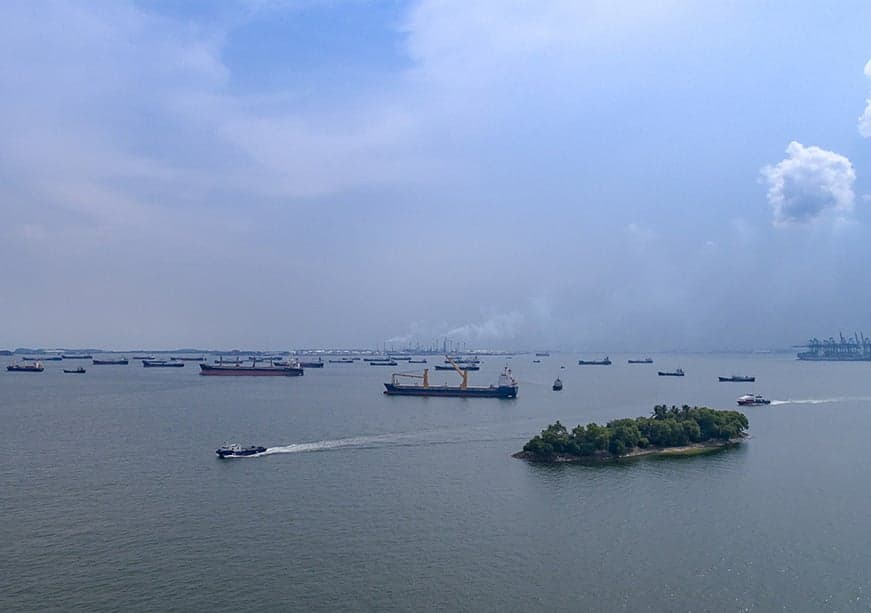
At its narrowest point, the Strait of Malacca compresses into the Phillips Channel - a corridor barely 2.8 kilometres wide through which more than 100,000 vessels now pass every year, carrying close to a quarter of all global seaborne trade, 29 percent of the world's maritime oil flows, and the economic lifeblood of the entire East Asian manufacturing system. No other maritime chokepoint on earth combines this level of traffic density, geographic narrowness, and geopolitical consequence into a single 550-mile passage between Sumatra and the Malay Peninsula. As of mid-2026, with the Strait of Hormuz having spent much of the year effectively closed by the Iran war and its aftermath, and with the Red Sea corridor still operating below pre-crisis capacity, the Strait of Malacca has absorbed a disproportionate share of the world's rerouted energy and container traffic - elevating a passage that strategists have quietly worried about for two decades into what Chatham House analysts now assess could produce disruption worse than Hormuz itself.
The strait's danger is threefold and compounding. First, it is physically dangerous: the Phillips Channel's extreme narrowness, combined with a 74 percent surge in piracy and armed robbery incidents in 2025 - the highest level recorded in nineteen years - has made the strait's waters more hazardous to individual vessels than at any point since the early 2000s. Second, it is strategically dangerous: China's near-total dependence on the strait for the crude oil that fuels its economy, a vulnerability that Hu Jintao named the Malacca dilemma in 2003, has become an increasingly explicit target of American chokepoint strategy under the Trump administration's April 2026 Major Defense Cooperation Partnership with Indonesia. Third, it is structurally dangerous: the strait's physical capacity is approaching limits that growing vessel sizes and cargo volumes will test through the remainder of this decade, with no scalable alternative route capable of absorbing the traffic that a Malacca disruption would displace.
This report provides a doctrine-level assessment of why the Strait of Malacca has become the most consequential and most vulnerable chokepoint in the global trading system - examining its piracy resurgence, its role in the deepening US-China contest for Indo-Pacific maritime dominance, China's decades-long but still incomplete effort to escape its structural dependence, and the realistic scenarios under which this narrow channel could become the next flashpoint in a world already reordered by chokepoint warfare in the Red Sea and the Persian Gulf.
Strategic Background
The Strait of Malacca occupies a geographic position that no engineering, diplomacy, or alternative infrastructure has ever fully replicated. Running between the Indonesian island of Sumatra and the Malay Peninsula, it is the shortest and most efficient sea route connecting the Indian Ocean to the South China Sea and the Pacific - the essential link between the oil-exporting Middle East and Africa and the energy-hungry, manufacturing-dependent economies of East Asia. Almost a quarter of global seaborne trade by volume transits the strait. It carries a share of global maritime oil flows that, through the first half of 2025, actually exceeded the Strait of Hormuz - 29 percent of worldwide seaborne oil trade compared to Hormuz's roughly one-fifth, making Malacca not merely important but the single busiest oil chokepoint on the planet, a fact that receives markedly less public attention than Hormuz despite its larger throughput.
The strait's danger begins with simple geometry. At its narrowest point, the Phillips Channel compresses shipping lanes to a corridor measuring just 2.8 kilometres across - a passage so tight that the largest crude carriers and container ships must navigate with minimal margin for error, at reduced speed, through waters shared with fishing fleets, ferries, and a dense concentration of smaller commercial vessels. This physical constraint creates mechanical vulnerabilities - collision risk, grounding hazards, environmental contamination potential - that exist entirely independent of any geopolitical or criminal threat, and that alone would justify Malacca's designation as one of the world's most hazardous stretches of water for commercial shipping.
Layered atop this physical vulnerability is the strait's unique strategic significance to China. Approximately 75 to 80 percent of China's imported crude oil transits Malacca, alongside two-thirds of the country's total maritime trade volume. No other major power on earth channels so large a share of its energy security through a single chokepoint it does not control, that is bordered by three separate sovereign states - Indonesia, Malaysia, and Singapore - and that lies within reach of the naval and air power of the United States and its allies. This is the structural reality that Chinese strategists have spent more than two decades trying, and largely failing, to escape.
Historical Context
The Strait of Malacca's role as a global trade artery predates modern statehood by more than a millennium, serving as the maritime backbone of the Srivijaya and Malacca Sultanate trading empires, and later becoming the contested prize of Portuguese, Dutch, and British colonial competition precisely because whoever controlled its narrows controlled the flow of spices, textiles, and later oil between Europe, the Middle East, and Asia. The strait's modern strategic significance crystallized with China's economic transformation following Deng Xiaoping's reform and opening policies of the late 1970s and 1980s. China transitioned from a net oil exporter to a net oil importer by 1993, and its accelerating demand for imported energy, unable to be met by domestic production, created the deep dependency on Middle Eastern and African crude that the Malacca Strait's geography now channels almost entirely.
The term Malacca dilemma was coined by Chinese Communist Party General Secretary Hu Jintao in 2003, in a moment of unusual public candor about a strategic vulnerability that Beijing's military and economic planners had been quietly wrestling with for years. Hu's framing was precise: an industrial power dependent on imported energy that must traverse a narrow passage it does not control faces a structural exposure that no amount of economic growth can eliminate on its own. The concern was not abstract. China observed, with particular attention, the United States' demonstrated willingness and capability to interdict maritime shipping lanes in contingencies ranging from the 1996 Taiwan Strait crisis to the post-9/11 maritime security operations that expanded American naval presence throughout Southeast Asian waters. The prospect that Washington could, in a future Taiwan conflict, use its naval dominance to blockade or selectively interdict oil shipments transiting Malacca represented, in Beijing's assessment, a chokepoint vulnerability comparable in strategic weight to Imperial Japan's oil dependency in the years preceding the Pacific War.
China's response over the subsequent two decades has been a sustained, expensive, and only partially successful campaign to diversify away from Malacca dependency. The China-Myanmar pipeline network, operational since 2013, allows oil to flow from the Bay of Bengal directly into Yunnan province, bypassing Malacca entirely for a portion of Middle Eastern and African crude. The Kazakhstan-China oil pipeline, operational since 2006, provides a Central Asian land route immune to any maritime chokepoint risk. The China-Pakistan Economic Corridor, anchored by the deep-water port at Gwadar, was explicitly conceived as part of this diversification strategy, offering a direct overland connection between the Arabian Sea and Xinjiang that would, if fully realized, provide China with a genuine alternative to the maritime route through Malacca. Two decades and hundreds of billions of dollars into this diversification effort, the structural dependence remains: the pipelines and overland corridors collectively handle a fraction of the volume that Malacca carries, and China's oil import bill continues to flow overwhelmingly through the strait that Hu Jintao identified as a dilemma more than twenty years ago.
Current Situation Assessment
The Strait of Malacca's current strategic salience cannot be separated from the broader chokepoint crisis that has engulfed global shipping since the outbreak of the 2026 Iran war. Since March 2026, Iran's closure of the Strait of Hormuz - first through mining and strikes, then compounded by an American naval blockade - has produced what the International Energy Agency has characterized as an oil and gas supply crisis more severe than the 1973, 1979, and 2022 disruptions combined. That crisis has forced global shipping, energy traders, and strategic planners to urgently reassess the vulnerability hierarchy of every other chokepoint in the system - and Malacca, given its scale and its centrality to Asian energy security, has risen to the very top of that reassessment.
Traffic data confirms the strait's surging importance. Malacca handled over 102,500 vessel transits in 2025, an 8.7 percent increase from 94,300 the previous year, reflecting both organic trade growth and the diversion of shipping that might otherwise have transited alternate routes now disrupted by the Red Sea and Hormuz crises. Oil flows through the strait reached 23.2 million barrels per day in the first half of 2025 alone - 29 percent of total global seaborne oil trade, a share that makes Malacca, in absolute throughput terms, the world's single busiest oil chokepoint, ahead even of Hormuz.
Against this backdrop of surging traffic, the strait's security environment has deteriorated sharply. Piracy and armed robbery incidents in the Malacca and Singapore Straits reached 108 recorded cases in 2025 - a 74 percent increase over 2024's 62 incidents, and the highest level recorded in nineteen years. Analysis of the pattern reveals a troubling evolution beyond opportunistic theft: organized criminal networks have begun systematically targeting engine spares and specialized maritime equipment, suggesting the emergence of black markets for stolen ship components that indicate a level of criminal sophistication and organization well beyond the random robbery that characterized earlier piracy waves. Most incidents concentrated on the strait's eastbound lane, precisely the corridor carrying the highest volume of the East Asia-bound cargo whose disruption would carry the greatest economic consequence.
The security picture is not uniformly deteriorating. Following coordinated arrests by Indonesian authorities in July and August 2025, piracy incidents declined significantly through the remainder of the year - demonstrating, as regional maritime security analysts have noted, that determined law enforcement cooperation among the three littoral states of Indonesia, Malaysia, and Singapore can meaningfully suppress the threat when political will and intelligence sharing align. This pattern of cyclical criminal activity - surging when enforcement attention lapses, declining when littoral states coordinate - has repeated through the first quarter of 2026, underscoring both the strait's persistent vulnerability and the demonstrated capacity of regional cooperation to manage it when sustained.
The most consequential development of 2026, however, is not criminal but geopolitical. On April 13, 2026, United States Secretary of War Pete Hegseth and Indonesian Defense Minister Prabowo Subianto announced the establishment of a Major Defense Cooperation Partnership - a framework explicitly encompassing expanded joint exercises, military education, modernization support, and cooperation in maritime, subsurface, and autonomous systems. The specific emphasis on subsurface and autonomous systems capability has drawn close attention from regional analysts, who read it as signaling a long-term American investment in the intelligence, surveillance, and reconnaissance infrastructure needed to monitor - and, in a crisis, potentially regulate - traffic not only through the Malacca Strait itself but across the broader belt of sea lanes connecting the Indian Ocean to the South China Sea. A United States warship transited the strait on April 18, 2026, days after the pact's announcement, in a deliberate demonstration of the operational visibility that the new partnership is designed to reinforce.
Power Center Analysis
China: The Structurally Exposed Power
China's position with respect to Malacca has not fundamentally changed since Hu Jintao named the dilemma in 2003 - it has merely become more consequential as China's economy, energy demand, and strategic rivalry with the United States have all expanded. Beijing's initial public reaction to the US-Indonesia Major Defense Cooperation Partnership was to downplay its significance while simultaneously warning against attempts to militarize the strait and encircle Chinese sea lanes - a rhetorical posture that reveals genuine strategic anxiety beneath the studied nonchalance. Chinese commercial and energy policy circles have revived active discussion of the Malacca dilemma in response, examining the potential for further diversifying import routes through Pakistan, Myanmar, and Russia - the same three diversification vectors China has pursued for two decades with only partial success. China's naval modernization, including its expanding submarine fleet and its investments in maritime domain awareness capability, reflects in part a determination to develop the capacity to protect its own shipping through the strait in a contingency, even as it continues to lack the basing infrastructure or littoral state alignment that would allow it to guarantee that protection unilaterally.
The United States: The Chokepoint Doctrine Architect
Washington's approach to Malacca in 2026 fits within what regional analysts increasingly describe as a multi-theater chokepoint doctrine - a strategic pattern visible simultaneously in the Trump administration's high-pressure engagement in the Persian Gulf, its confrontational posture toward Panama and the canal that handles 40 percent of US container traffic, and now its deepening defense relationship with Indonesia. The United States does not require direct confrontation to exert influence over maritime chokepoints; its demonstrated capability lies in leveraging presence, surveillance, and operational access to shape economic outcomes without requiring overt escalation. The Major Defense Cooperation Partnership's careful construction - expanding operational access and interoperability while explicitly avoiding provisions for permanent basing or binding mutual defense commitments - reflects Washington's calibrated approach to a region where Indonesia's strategic autonomy and non-aligned foreign policy tradition constrain how far Jakarta is willing to formalize security alignment with any single major power.
Indonesia: The Structurally Indispensable Gatekeeper
Indonesia occupies a position of extraordinary and arguably underappreciated leverage in the global maritime system. The Strait of Malacca runs along Indonesian territorial waters for much of its length, and the principal alternative routes - the Sunda and Lombok Straits - are themselves framed entirely by Indonesian geography, giving Jakarta a degree of control over Southeast Asian maritime chokepoints that few nations possess over infrastructure of comparable global significance. Indonesia's 2025 crackdown on piracy networks, and the measurable decline in incidents that followed, demonstrated Jakarta's genuine capability to manage the security environment within its own waters when it chooses to prioritize the effort. Indonesian officials' brief and quickly retracted suggestion that Jakarta could potentially toll traffic through the strait - a move that would be illegal under international law's guarantee of free passage through straits used for international navigation - nonetheless revealed an undercurrent of Indonesian frustration at bearing the security burden of a chokepoint whose economic benefits flow disproportionately to the great powers that depend on it rather than to the littoral state that polices it.
Singapore and Malaysia: The Commercial Anchors
Singapore's position as the world's leading transshipment and bunkering hub sits directly astride the strait's eastern terminus, giving the city-state an economic stake in Malacca's continued security and efficient operation that exceeds even China's. Singapore's sophisticated maritime domain awareness capability and its close security cooperation with both the United States and China simultaneously position it as the most important stabilizing actor in the strait's governance architecture - a role Singapore has cultivated deliberately, recognizing that its own prosperity depends on maintaining the delicate balance that allows it to host American naval visits and Chinese commercial investment without becoming a proxy battleground for great power competition. Malaysia's position, sharing the strait's eastern shore, is defined by similar commercial stakes combined with a more circumspect security posture that has generally avoided the kind of explicit defense partnership deepening that Indonesia has pursued with Washington in 2026.
Military and Security Implications
The military significance of the Strait of Malacca extends across a spectrum from the immediate and criminal to the theoretical and civilizational. At the immediate end, the 2025 piracy surge's evolution toward organized theft of engine spares and specialized maritime equipment represents a genuine and escalating threat to individual vessel safety and crew security, requiring sustained littoral state law enforcement cooperation that the demonstrated 2025 crackdown proved achievable but that requires continuous political commitment rather than episodic enforcement surges.
At the theoretical but strategically dominant end, the scenario that both Chinese and American military planners assess with the greatest seriousness is a Taiwan Strait contingency in which the United States, leveraging its naval dominance and its deepening operational access through the Major Defense Cooperation Partnership with Indonesia, moves to interdict or selectively restrict Chinese-bound shipping through Malacca as part of a broader campaign to impose economic costs on Beijing during a cross-strait conflict. This is not a new concern - American maritime strategy has for years included options for restricting China's access to key sea lanes through the deployment of attack submarines and surface combatants - but the explicit emphasis on subsurface and autonomous systems cooperation embedded in the April 2026 Indonesia partnership represents the clearest operational signal yet that Washington is building the specific intelligence, surveillance, and reconnaissance infrastructure that a Malacca interdiction campaign would require. Analysts describe this emerging capability as an ISR blanket - a layered surveillance architecture that remains partly aspirational today but whose direction of travel is unambiguous: in peacetime, framed as supporting counter-smuggling and anti-piracy cooperation; in wartime or acute crisis, forming the backbone of any effort to discriminate between shipping that would be protected, pressured, or interdicted.
China's military response to this emerging vulnerability operates on two tracks. The first is continued investment in the overland and pipeline diversification that reduces, without eliminating, the volume of energy imports exposed to Malacca interdiction risk. The second is the expansion of People's Liberation Army Navy capability specifically oriented toward protecting Chinese shipping and, if necessary, contesting American naval freedom of action in the waters surrounding the strait - an ambition that faces the structural constraint that China lacks basing access or the kind of littoral state security partnership in Southeast Asia that the United States has now formalized with Indonesia, leaving Beijing dependent on power projection from distant Chinese naval bases rather than the kind of forward-positioned access that effective strait denial or protection operations would require.
Economic and Trade Impact
The economic stakes riding on Malacca's continued secure operation are difficult to overstate. The strait handles cargo valued at approximately 3.5 trillion dollars annually across more than 82,000 to over 102,000 vessel transits depending on the measurement year and methodology - figures that place Malacca among the small handful of maritime corridors whose disruption would trigger cascading effects across the entire global economy rather than merely regional supply chain adjustment. Beyond crude oil, the strait carries over 25 percent of all internationally traded automobiles and 23 percent of dry bulk cargo including the grain and soybean shipments that feed food security calculations across Asia.
The structural capacity constraint compounds these stakes. Maritime industry projections indicate 15 to 20 percent increases in container vessel sizes and 25 percent growth in total cargo volumes between 2026 and 2030 - trends that place escalating pressure on physical infrastructure, particularly the strait's depth restrictions and channel width, which cannot be meaningfully expanded regardless of investment commitment. The growing prevalence of ultra-large container vessels and new-generation tankers means that alternative routing options become progressively less viable over time, concentrating an ever-larger share of Asia-bound and Asia-originating trade through Malacca precisely as the strait's absolute traffic volume and criminal security risk are both rising simultaneously.
The absence of scalable alternatives is the structural fact that gives Malacca its outsized strategic weight. Rerouting vessels through the Lombok or Sunda Straits imposes additional distances of 1,000 to 1,500 nautical miles and delays of up to fifteen days - a penalty severe enough to be commercially prohibitive for all but the most acute crisis conditions, and one that makes these alternatives genuine emergency backstops rather than credible substitutes for routine trade flow. The Sunda Strait's own physical limitations - strong tidal currents and a minimum depth of just twenty metres - further constrain its capacity to absorb diverted traffic at any meaningful scale. This absence of viable alternatives is precisely why the concept of a Kra Canal across the Thai isthmus, which would allow vessels to bypass Malacca entirely, has resurfaced periodically in regional infrastructure discussions for over a century without ever advancing to construction - the engineering cost, the geopolitical complications of any single nation controlling an alternative chokepoint, and Singapore's structural interest in Malacca's continued primacy have collectively prevented the project from ever overcoming the inertia of the existing route's dominance.
Diplomatic Positioning
The diplomatic landscape surrounding Malacca reflects the broader tension between the strait's formal legal status as an international waterway guaranteeing free passage and the increasingly explicit great power competition to shape the practical security and surveillance architecture that governs traffic through it. The three littoral states - Indonesia, Malaysia, and Singapore - have historically managed the strait's security through a cooperative framework dating to a 2006 anti-piracy cooperation agreement, supplemented by coordinated naval patrols and intelligence sharing that the 2025 piracy crackdown demonstrated remains functional when political will aligns.
The Major Defense Cooperation Partnership between the United States and Indonesia introduces a qualitatively new diplomatic variable into this established cooperative architecture. Indonesia's decision to deepen defense ties with Washington while explicitly avoiding permanent basing or binding mutual defense commitments reflects Jakarta's careful preservation of the non-aligned foreign policy tradition that has historically defined Indonesian strategic posture, even as the practical substance of the partnership - expanded joint exercises, subsurface and autonomous systems cooperation, maintenance and sustainment support - creates the operational infrastructure for a far deeper security relationship than its formal legal structure acknowledges. Regional media commentary has registered genuine unease at the prospect that Malacca could be drawn directly into US-China confrontation, alongside a countervailing view that a stronger American presence might usefully deter both piracy and Chinese assertiveness - a diplomatic ambivalence that mirrors the broader Southeast Asian balancing act between economic dependence on China and security partnership with the United States that defines ASEAN's collective strategic posture.
China's diplomatic response has emphasized restraint in public rhetoric while signaling clear displeasure at what Beijing characterizes as militarization of the strait and encirclement of Chinese sea lanes. This calibrated response reflects China's structural weakness in the diplomatic contest over Malacca: Beijing lacks the littoral state relationships, the historical naval presence, or the alliance architecture that would allow it to counter the deepening US-Indonesia partnership through equivalent means, leaving rhetorical objection and accelerated diversification investment as its principal available responses.
Regional Fallout
Across Southeast Asia, the growing great power attention to Malacca is forcing every regional state to navigate a more complicated strategic environment than the relatively low-key management of the strait that characterized the previous two decades. Singapore, whose economic model depends fundamentally on Malacca's continued efficient operation as the anchor of its transshipment and bunkering economy, has the strongest incentive of any regional actor to prevent the strait from becoming an active theater of great power confrontation, and its diplomatic energy is increasingly directed toward maintaining the delicate equidistance that has served its interests for decades.
Malaysia's position along the strait's eastern shore places it in a similar economic exposure to Singapore without the same degree of accumulated diplomatic leverage, leaving Kuala Lumpur watching the deepening US-Indonesia partnership with an attentiveness that reflects concern about being left as the least-aligned littoral state in an increasingly securitized strait environment.
Myanmar's role as the terminus of China's pipeline diversification network gives it an outsized strategic significance relative to its diminished international standing, positioning the country's internal political stability as an indirect but genuine variable in China's broader Malacca dilemma mitigation strategy - any disruption to the pipeline infrastructure running through Myanmar's territory would compound rather than relieve Beijing's chokepoint exposure.
Thailand's position astride the isthmus that any future Kra Canal project would traverse gives Bangkok a latent strategic significance that periodic revivals of the canal concept periodically activate, though the project's persistent failure to advance beyond discussion reflects both Thai domestic political caution about the environmental, social, and sovereignty implications of hosting an alternative global chokepoint and the broader structural inertia favoring Malacca's continued primacy that no single infrastructure project has yet overcome.
Global Strategic Consequences
The Strait of Malacca's rising strategic salience in 2026 must be understood as part of a broader global pattern in which maritime chokepoints - the Red Sea and Bab el-Mandeb, the Strait of Hormuz, and now Malacca - have simultaneously moved from background infrastructure to active instruments of geopolitical leverage within a span of roughly three years. This compounding chokepoint crisis reflects a structural transformation in how great powers conduct strategic competition: rather than direct military confrontation, the contest increasingly plays out through the capacity to disrupt, threaten, or credibly signal the ability to disrupt the narrow maritime arteries through which the modern global economy's most essential flows must pass.
For China specifically, the simultaneous stress on Hormuz and the deepening American security presence near Malacca represents a genuinely alarming convergence. A nation whose energy security depends on two chokepoints - one controlled by an adversarial Iran now embroiled in active conflict, the other increasingly monitored by an American-Indonesian security partnership explicitly oriented toward subsurface and autonomous surveillance capability - faces a compounding vulnerability that no single diversification strategy fully resolves. The Power of Siberia pipelines from Russia and the China-Myanmar and China-Pakistan overland corridors collectively provide meaningful but still partial relief, leaving the core structural reality that Hu Jintao identified in 2003 substantially unchanged more than two decades later: China's economic and military capacity remains hostage, in the most acute contingencies, to sea lanes it cannot unilaterally secure.
For the broader global trading system, Malacca's vulnerability - whether from piracy, capacity constraints, or great power confrontation - carries consequences that would dwarf even the substantial disruptions already inflicted by the Red Sea and Hormuz crises, given the strait's unmatched combination of traffic volume and absence of viable alternative routing. A world already absorbing the costs of Cape of Good Hope rerouting and Hormuz-driven energy price volatility would face a qualitatively more severe shock if Malacca's traffic were meaningfully disrupted, precisely because no comparable alternative exists to absorb displaced volume at anything resembling commercially viable cost or timeline.
Risk Matrix
- Risk Level: Critical - A Taiwan Strait military contingency triggers American interdiction or selective restriction of Chinese-bound shipping through Malacca, leveraging the intelligence and surveillance infrastructure being built under the Major Defense Cooperation Partnership with Indonesia, imposing severe and immediate economic costs on China precisely at the moment its military and economic resilience are under maximum strain.
- Risk Level: High - The 2025-2026 piracy surge resumes and intensifies following any lapse in littoral state enforcement cooperation, with the demonstrated evolution toward organized theft of engine spares and specialized equipment indicating a criminal sophistication that could escalate toward more serious vessel hijacking or crew endangerment incidents absent sustained security investment.
- Risk Level: High - Growing vessel sizes and cargo volumes between 2026 and 2030 outpace the strait's fixed physical capacity constraints, producing chronic congestion, elevated collision and grounding risk, and cascading delays that impose a persistent efficiency tax on Asia-bound and Asia-originating trade even absent any acute security incident.
- Risk Level: High - China's continued inability to meaningfully reduce its 75 to 80 percent crude oil dependence on Malacca despite two decades of pipeline and overland diversification investment leaves Beijing's core energy security exposed to a chokepoint vulnerability that accelerating US-Indonesia security cooperation is actively reinforcing rather than diminishing.
- Risk Level: Medium - Indonesia's careful balancing between deepening American security cooperation and its historical non-aligned foreign policy tradition becomes unsustainable under sustained pressure from either Washington or Beijing, forcing Jakarta toward a more explicit alignment that compromises its structurally advantageous position as an indispensable but neutral gatekeeper.
- Risk Level: Medium - A major environmental incident - oil spill, vessel grounding, or collision in the Phillips Channel's extreme narrows - produces significant ecological damage and extended channel closure, demonstrating the strait's physical vulnerability independent of any security or geopolitical dimension.
- Risk Level: Low (near-term) - A genuine alternative to Malacca, whether the long-discussed Kra Canal or dramatically expanded pipeline capacity through Myanmar and Pakistan, achieves sufficient scale to meaningfully reduce the strait's centrality to global and Chinese trade within the coming decade. The capital cost, engineering complexity, and geopolitical complications of any alternative route make continued Malacca primacy the overwhelmingly likely near-to-medium-term outcome.
Scenario Analysis
Scenario One: Managed Coexistence Under Growing Surveillance (Most Probable, 12-24 Month Horizon)
The most likely near-term trajectory is a continuation of the current pattern: the United States steadily builds out the intelligence, surveillance, and reconnaissance infrastructure envisioned under the Major Defense Cooperation Partnership with Indonesia, while stopping short of any action that would directly restrict or interdict commercial traffic during peacetime. China continues its rhetorical objection while accelerating pipeline and overland diversification investment that reduces its exposure only incrementally. Littoral states maintain cooperative anti-piracy enforcement that produces the same cyclical pattern of suppression and resurgence demonstrated in 2025 and early 2026. The strait's commercial operation continues largely uninterrupted, but the underlying strategic architecture for great power leverage over the corridor grows steadily more developed, creating a latent capability that would only become operationally significant in an acute crisis.
Scenario Two: Taiwan Contingency and Chokepoint Warfare (Lower Probability, Highest Consequence)
A Taiwan Strait military confrontation activates the full strategic significance of the surveillance and interdiction infrastructure being built through the US-Indonesia partnership, with American and allied naval forces moving to restrict or selectively interdict Chinese-bound shipping through Malacca as part of a broader economic pressure campaign. China's response would combine intensified reliance on its Myanmar and Pakistan overland alternatives, whatever residual capacity they provide, with likely PLA Navy attempts to protect or reroute critical shipping through the strait and its alternatives, creating a genuine risk of naval confrontation in waters far more constrained and commercially vital than the open Pacific expanses where most Taiwan contingency military planning has traditionally focused. This scenario would produce the most severe global trade disruption in modern history, exceeding even the combined impact of the Red Sea and Hormuz crises given Malacca's unmatched throughput and the absence of any commercially viable alternative route.
Scenario Three: Littoral State-Led Security Architecture Strengthens (Moderate Probability, Stabilizing)
Indonesia, Malaysia, and Singapore, wary of becoming a proxy theater for US-China confrontation, deepen their own trilateral security cooperation and jointly resist pressure to allow either great power's military presence to dominate the strait's governance architecture. Enhanced littoral state patrol capability, intelligence sharing, and coordinated enforcement sustainably suppress piracy below the 2025 surge levels, while ASEAN collectively asserts a stronger institutional voice in chokepoint governance that constrains unilateral great power action by either Washington or Beijing. This scenario represents the outcome most consistent with international law's guarantee of free passage and most protective of the commercial interests that depend on Malacca's continued open operation, though it requires a degree of sustained littoral state political cohesion that historical patterns suggest is achievable but not guaranteed.
Intelligence Forecast (6-24 Months)
The six-to-twelve-month horizon will be shaped substantially by the operational buildout of the Major Defense Cooperation Partnership's subsurface and autonomous systems components, whose pace and visibility will provide the clearest indicator of how quickly Washington intends to translate the April 2026 framework agreement into deployed intelligence, surveillance, and reconnaissance capability. Continued United States warship transits through the strait, following the April 18 precedent, should be expected as a routine demonstration of operational access rather than an escalatory signal in isolation, though their frequency and the accompanying diplomatic rhetoric from Beijing will indicate whether the relationship is stabilizing into routine competition or intensifying toward more acute confrontation.
Piracy trend data through the remainder of 2026 will be the most immediate and measurable indicator of regional security cooperation's effectiveness, with the first-quarter 2026 decline following the 2025 crackdown suggesting the cyclical pattern of enforcement-driven suppression is holding, but requiring sustained monitoring given the underlying criminal network sophistication that the organized engine-spare theft pattern revealed. Any resurgence toward 2025's 74 percent increase levels would signal either enforcement fatigue among littoral states or the adaptive resilience of the criminal networks involved.
China's diversification investment pace - particularly any acceleration of Pakistan-Gwadar corridor capacity, Myanmar pipeline throughput expansion, or new Russian pipeline capacity relevant to reducing maritime energy exposure - will be an important indicator of how seriously Beijing is responding to the compounding pressure of both the Hormuz crisis and the deepening American presence near Malacca. Given the two-decade track record of diversification efforts achieving only partial success, near-term dramatic reduction in China's core Malacca dependency is unlikely, but incremental progress combined with accelerated naval capability investment oriented toward strait protection scenarios would signal Beijing's assessment that the structural vulnerability requires more urgent mitigation than its historical pace of investment has provided.
The twelve-to-twenty-four-month horizon will be shaped significantly by the broader trajectory of US-China strategic competition and any developments in Taiwan Strait tensions, given that Malacca's most severe risk scenarios are directly contingent on that broader relationship's evolution rather than on any dynamic internal to the strait itself. Maritime industry capacity data - vessel size growth, cargo volume trends, and any concrete progress toward alternative infrastructure such as expanded Kra Isthmus discussions - will provide the clearest picture of whether the strait's structural capacity constraints are being meaningfully addressed or are continuing to compound alongside its geopolitical exposure.
Final Strategic Takeaway
The Strait of Malacca's claim to being the world's most dangerous trade route rests not on any single acute threat but on the unmatched convergence of vulnerabilities that no other chokepoint combines at comparable scale: extreme physical narrowness at the Phillips Channel, a piracy resurgence that has reached a nineteen-year high, an approaching capacity ceiling that growing vessel sizes will test through the remainder of this decade, and a great power strategic rivalry that is actively building the surveillance and interdiction infrastructure that would give any future confrontation a maritime chokepoint dimension of historic consequence. The 2026 Iran war's demonstration of what a major chokepoint disruption actually costs the global economy - an oil and gas crisis more severe than 1973, 1979, and 2022 combined - has transformed what was previously an academic strategic concern into an urgent, quantifiable risk that every government, shipping company, and energy trader with exposure to Asian trade flows must now factor into their planning with a seriousness that the pre-2026 period did not demand.
China's Malacca dilemma, named by Hu Jintao in 2003, has not been solved by two decades of pipeline diversification, port investment, and naval modernization - it has been managed, incompletely, while the underlying dependency has persisted and the strategic environment surrounding it has grown more contested rather than less. The Major Defense Cooperation Partnership between Washington and Jakarta represents the most concrete step yet toward the kind of American operational infrastructure near Malacca that Chinese strategists have feared since Hu's original warning, even as its careful diplomatic construction - avoiding permanent basing or binding alliance commitments - reflects Indonesia's determination to preserve its own strategic autonomy rather than become a formal instrument of American chokepoint doctrine.
The strategic imperative for the international community - for the littoral states whose waters and economies are most directly exposed, for the great powers whose rivalry is reshaping the strait's security architecture, and for every economy whose trade depends on Malacca's continued open operation - is to recognize that the strait's danger is not a distant contingency but a present and compounding reality. The piracy surge requires sustained enforcement investment, not episodic crackdowns. The capacity constraints require infrastructure planning that the current trajectory of vessel growth makes urgent rather than optional. And the great power competition requires a diplomatic architecture, whether through ASEAN, through direct US-China engagement, or through the kind of trusted-partner frameworks now being tested in the semiconductor and critical minerals domains, that can preserve the free and open passage that international law guarantees and that the global economy has depended upon for centuries - before the compounding vulnerabilities now converging on this narrow channel produce the kind of catastrophic disruption that the Strait of Hormuz has already demonstrated is possible when a chokepoint's strategic tensions finally break into open crisis.
A channel 2.8 kilometres wide carries the weight of the entire Asian economy on its waters. When a passage that narrow bears a burden that large, the question is never whether it will be tested - only when, and by whom.
Frequently Asked Questions
Why is the Strait of Malacca considered the world's most important maritime chokepoint?
The strait connects the Indian Ocean to the South China Sea and Pacific, carrying nearly a quarter of global seaborne trade by volume and 29 percent of the world's maritime oil flows, making it the busiest oil chokepoint on earth, ahead of the Strait of Hormuz. No alternative route offers comparable efficiency, and its narrowest point, the Phillips Channel, compresses this immense traffic into a corridor just 2.8 kilometres wide.
What is the Malacca dilemma?
The Malacca dilemma is a term coined by Chinese leader Hu Jintao in 2003 describing China's strategic vulnerability from depending on the strait for roughly 75 to 80 percent of its imported crude oil, despite not controlling the waterway itself. It reflects Beijing's concern that a hostile power, particularly the United States, could disrupt or interdict this vital energy artery during a conflict, most plausibly one involving Taiwan.
How serious is piracy in the Strait of Malacca right now?
Piracy surged sharply in 2025, with 108 recorded incidents of piracy and armed robbery, a 74 percent increase over 2024 and the highest level in nineteen years. Incidents included a troubling shift toward organized theft of engine spares and specialized equipment. Coordinated Indonesian law enforcement action in mid-2025 produced a significant decline through the rest of the year, demonstrating that regional cooperation can suppress the threat.
What is the US-Indonesia Major Defense Cooperation Partnership?
Announced on April 13, 2026, by US Secretary of War Pete Hegseth and Indonesian Defense Minister Prabowo Subianto, the partnership expands joint military exercises, education, modernization support, and cooperation in maritime, subsurface, and autonomous systems. It notably avoids permanent basing or binding mutual defense commitments, preserving Indonesia's strategic autonomy while deepening operational access for the United States near the strait.
Are there viable alternatives to the Strait of Malacca?
Alternatives such as the Sunda and Lombok Straits exist but carry major penalties: rerouting adds 1,000 to 1,500 nautical miles and up to fifteen days of transit time, and the Sunda Strait's shallow depth and strong currents limit its capacity for large vessels. China has invested in overland alternatives, including pipelines through Myanmar and Kazakhstan and the China-Pakistan Economic Corridor via Gwadar, but these collectively handle only a fraction of Malacca's volume.
Could a Taiwan conflict affect the Strait of Malacca?
Yes. Military analysts consider a Taiwan Strait contingency the gravest risk to Malacca's stability, since the United States could theoretically leverage its naval presence and the surveillance infrastructure being built through its Indonesia partnership to restrict Chinese-bound shipping, directly targeting the chokepoint that carries the vast majority of China's imported oil.