
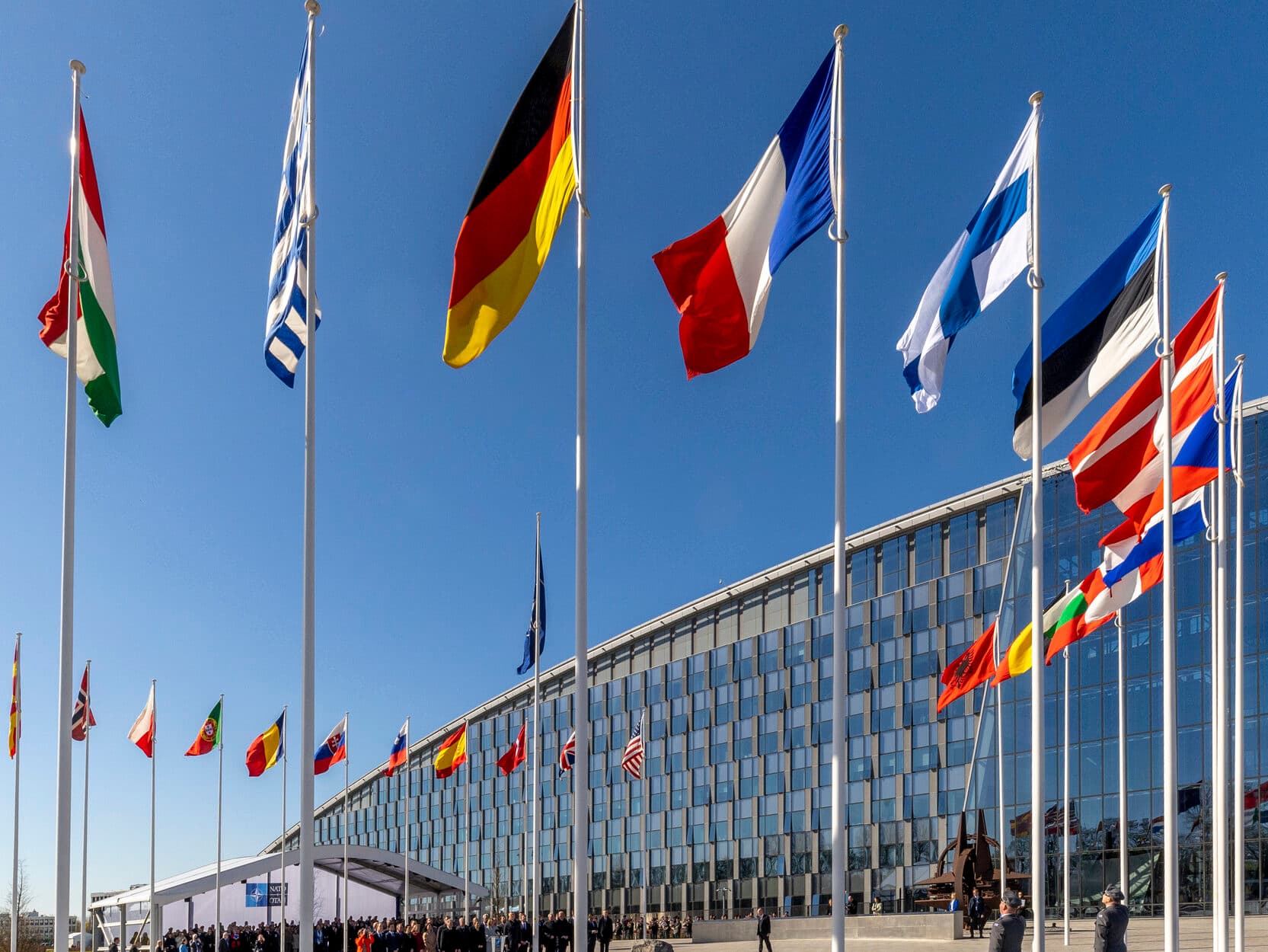
NATO's Future in an Unstable Europe: Alliance at the Breaking Point
Executive Summary
There is a strange contradiction sitting at the heart of the North Atlantic Treaty Organisation in 2026. By almost every measurable metric, the alliance has never been stronger. Combined allied defense spending has crossed $1.5 trillion for the first time in NATO's history. European members and Canada increased defense outlays by over 12% in real terms for the second consecutive year. Every member state has formally committed to a 5% of GDP defense and security spending target by 2035 - more than double the 2% benchmark that most European capitals routinely missed for over a decade. And yet, as alliance leaders prepare to gather in Ankara on July 7-8, 2026, the institutional anxiety inside NATO headquarters is arguably more acute than at any point since the immediate aftermath of the Cold War's end, when the alliance first had to justify its own continued existence.
The paradox is not difficult to explain once you separate capability from confidence. NATO's members are spending more, building more, and coordinating more closely on operational planning than they have in a generation - a transformation driven almost entirely by the trauma of Russia's full-scale invasion of Ukraine, now entering its fifth year. But the alliance's foundational assumption - that the United States will reliably honor its Article 5 commitments and maintain a credible, predictable force posture in Europe - has been placed under genuine strain by a second Trump administration whose rhetoric toward allies, treatment of burden-sharing, and ambiguous signals about long-term troop presence have forced even NATO's most committed members to seriously contemplate scenarios that were unthinkable as recently as 2020.
Compounding this uncertainty, the war Russia is waging against Ukraine has begun spilling, in increasingly literal terms, across NATO's own borders. Drone incursions into Baltic airspace throughout March and May 2026, combined with escalating Russian jamming incidents and direct accusations against Estonia and Latvia, have forced Secretary General Mark Rutte and the broader alliance leadership to confront a security environment that is, by NATO's own internal assessment, becoming more volatile and harder to contain with each passing month. The Ankara summit will not be a celebration of institutional resilience. It will be a test of whether an alliance built for the predictable bipolar logic of the Cold War can survive a genuinely unstable, multipolar Europe.
Background: From Atlantic Alliance to Continental Anchor
NATO's founding in 1949 was built on a deceptively simple strategic logic: a collective defense pact in which an attack against one member constitutes an attack against all, anchored by overwhelming American military and nuclear guarantees that no Soviet calculation could rationally challenge. For four decades, this logic held with remarkable consistency, providing the structural stability that allowed Western Europe to rebuild, integrate economically, and eventually expand its own democratic institutions without the existential anxiety that had defined the continent for centuries prior.
The Soviet collapse in 1991 should, by the logic of most alliance theory, have triggered NATO's gradual dissolution - alliances built against a specific adversary typically lose their organizing purpose once that adversary disappears. Instead, NATO did something unusual: it expanded. The 1999 accession of Poland, Hungary, and the Czech Republic, followed by the larger 2004 expansion bringing in the Baltic states and several other former Warsaw Pact and Soviet republics, transformed NATO from a Western European defensive alliance into a continental security architecture stretching to Russia's own borders - a development Moscow has never fully accepted as legitimate and has cited repeatedly, including by Vladimir Putin directly, as justification for its own revanchist behavior in Georgia, Crimea, and ultimately the full-scale invasion of Ukraine.
The post-Cold War decades were not kind to NATO's defense readiness in practical terms, even as its membership expanded. European governments, lulled by the absence of an immediate existential threat and facing competing fiscal priorities, allowed defense spending to drift well below the 2% of GDP benchmark formally adopted at the 2014 Wales Summit - itself a response to Russia's annexation of Crimea earlier that year. As recently as 2021, the majority of European NATO members were routinely missing even this relatively modest target, treating defense budgets as a residual line item rather than a core strategic priority, an approach that reflected genuine confidence that the post-Cold War peace, however imperfect, represented Europe's enduring condition rather than a temporary historical interlude.
Russia's full-scale invasion of Ukraine on February 24, 2022 shattered that complacency in a single catastrophic event. A nuclear-armed permanent UN Security Council member had launched the largest conventional land war in Europe since 1945, explicitly justified through revisionist historical claims about Ukrainian sovereignty that bore unmistakable echoes of the territorial logic European institutions had been built to prevent. The psychological and strategic shock of February 2022 has driven, by IISS's careful accounting, twelve consecutive years of real-terms defense spending growth across the alliance - a transformation that predates the invasion itself but has accelerated dramatically in its aftermath.
Current Situation: An Alliance Rearming Under Pressure
The Hague Summit and the 5% Commitment: A Genuine Strategic Pivot
The defining institutional achievement of NATO's recent transformation came at the June 2025 Hague Summit, where allied heads of state formally committed to a structured, two-tier defense spending framework: a minimum of 3.5% of GDP annually dedicated to core defense requirements - troops, equipment, and direct military capability - alongside an additional 1.5% of GDP allocated to broader security-related spending encompassing critical infrastructure protection, cyber defense, civil preparedness, and defense industrial base strengthening. The combined 5% target, to be achieved by 2035, represents more than double the previous 2014 Wales Summit benchmark and reflects what Atlantic Council analysts have correctly characterized as the speed at which Russia is reconstituting its armed forces amid the ongoing invasion, creating genuine alliance-wide urgency that the previous decade's modest spending targets never generated.
The Hague outcome required careful diplomatic management to secure unanimous agreement, with Spain's Prime Minister Pedro Sánchez writing directly to Rutte ahead of the summit characterizing the 5% pledge as unreasonable given Spain's existing debt levels and competing fiscal priorities. The eventual compromise - allowing Spain a degree of flexibility while maintaining the formal alliance-wide commitment - illustrated a broader pattern that has defined NATO's 2025-2026 institutional management: Secretary General Rutte's deliberate strategy of securing substantive policy outcomes while avoiding the kind of public confrontation with either Washington or individual reluctant allies that could fracture alliance unity at a moment when unity itself has become a primary strategic asset.
The crucial bridging mechanism that allowed the Hague agreement to function as both a genuine policy commitment and a diplomatically manageable outcome was the inclusion of military aid to Ukraine within the qualifying spending categories - allowing allies to count their contributions to Kyiv's defense industrial base toward their own 5% targets. This arrangement, as multiple defense analysts have noted, gave Trump a outcome he could credibly present as a personal negotiating victory while simultaneously preserving substantive allied support for Ukraine's continued defense, a genuinely skillful piece of alliance management that avoided forcing a binary choice between satisfying American demands and maintaining Ukraine support.
The Numbers Behind the Transformation
The scale of Europe's defense spending acceleration in 2025-2026 is genuinely without post-Cold War precedent. European defense spending now accounts for over 21% of the global total, up from just 17% as recently as 2022 - a remarkable shift in relative global military expenditure achieved in under four years. Germany, traditionally one of the alliance's most conspicuous underspenders relative to its economic weight, increased defense funding by 18% in real terms in 2025 alone, reaching €95 billion (approximately $107 billion), positioning Berlin as the primary engine of the broader European spending surge and a critical signal that Europe's largest economy has genuinely internalized the strategic urgency the Ukraine war has generated.
Belgium and Spain posted even more dramatic single-year increases - 59% and 50% respectively - though these figures partly reflect catch-up dynamics from historically low baseline spending levels rather than indicating these countries have necessarily achieved comparable absolute capability to larger, more consistently invested allies. Poland has emerged as the alliance's clearest leader in proportional defense commitment, having already exceeded 4% of GDP in defense spending even before the Hague target's formal adoption, reflecting Warsaw's acute, geographically-driven threat perception as a frontline state directly bordering both Russia's Kaliningrad exclave and Belarus.
The Credibility Gap: Spending Increases Without Operational Clarity
Despite these genuinely substantial spending increases, serious structural questions remain about whether allocated resources are translating into the deployable, interoperable military capability the alliance's strategic planning actually requires. The World Data analysis's warning about creative accounting within the broader spending framework deserves serious attention: the 1.5% security-related spending tier is defined broadly enough that, absent rigorous enforcement of qualifying criteria, governments could plausibly count civilian infrastructure spending, public health resilience programs, or other expenditures that would have occurred regardless of NATO commitments as qualifying defense-related investment. Italy's reported inclusion of a Sicily bridge construction project within its qualifying defense spending illustrates this risk concretely - infrastructure with civilian utility being creatively recategorized to satisfy alliance spending metrics without necessarily generating proportional military capability.
This concern about spending quality versus spending quantity connects to a deeper structural challenge NATO's leadership has been more candid about than is typical for an alliance communique: Rutte's own framing that the 5% commitment "is not just about numbers" but about building genuinely deployable, adaptable military capacity reflects institutional awareness that simply hitting budgetary targets does not automatically translate into the kind of integrated, rapidly mobilizable conventional deterrence the alliance's regional defense plans actually require against a reconstituting Russian military.
The Baltic Flashpoint: When Ukraine's War Crosses Into NATO Territory
The most operationally alarming development of 2026 has been the series of drone incursions into NATO member airspace across the Baltic region, occurring in two distinct waves during March and May 2026. These incidents, involving Ukrainian or suspected Ukrainian military drones crossing from Russian territory into Lithuanian, Latvian, Estonian, and Finnish airspace during Ukraine's own long-range strike campaign against Russian oil export infrastructure - including repeated attacks on the critical Ust-Luga and Primorsk port facilities - represent an entirely new category of risk for alliance crisis management.
The incidents themselves were not Russian attacks on NATO territory in any direct sense; they were spillover consequences of Ukraine's own offensive operations against Russian targets, with stray or off-course drones crossing into neighboring NATO airspace during transit. The May 7 incident in Latvia, in which a suspected stray Ukrainian drone exploded at an oil storage facility in Rēzekne, illustrated concretely how even unintentional incursions carry genuine physical risk to NATO territory and infrastructure. Baltic governments have treated these incidents as security concerns linked to the broader Russian war rather than attributing hostile intent to Kyiv, while simultaneously rejecting Russian framing efforts to characterize the incidents as evidence of NATO complicity in offensive operations against Russian territory.
Compounding this drone incursion risk, Secretary of State Marco Rubio's warning at the December 2025 Helsingborg ministerial meeting that Russian pressure on the Baltic states "could turn into a larger conflict" reflects genuine American intelligence assessment concern about escalation dynamics in the region, particularly given documented Russian jamming incidents and direct accusations leveled against Estonia and Latvia that alliance officials view as deliberate Russian probing of NATO's collective resolve and Article 5 credibility in a geographically vulnerable, historically contested region.
The Ankara Summit: Testing Alliance Cohesion at a Fragile Moment
NATO leaders will convene in Ankara on July 7-8, 2026 - the alliance's first summit hosted by Turkey since the country joined NATO in 1952, and a setting that itself carries symbolic significance given Turkey's complicated, often friction-laden relationship with core alliance consensus on issues ranging from its S-400 Russian air defense purchase to its periodic tensions with Greece over Aegean and Cypriot disputes, alongside the covert sanctions-related friction Turkey has experienced from fellow allies over various procurement decisions.
President Recep Tayyip Erdoğan's hosting role provides Ankara an opportunity to reassert its strategic relevance within an alliance where Turkey's membership has frequently generated more friction than straightforward solidarity, even as Turkey's geographic position controlling the Bosphorus and its substantial conventional military capability make it strategically indispensable to any coherent NATO posture toward both Russia's Black Sea operations and the broader Middle Eastern security environment.
Friends of Europe's pre-summit assessment captures the genuinely fragile institutional mood accurately: Trump's second term has revived longstanding concerns about Washington's fundamental commitment to NATO, compounded by unpredictable signals regarding US force posture in Europe and what the analysis terms inflammatory rhetoric toward allies - including, remarkably, Trump's repeatedly stated interest in acquiring Greenland from fellow NATO ally Denmark, a territorial ambition that sits awkwardly, to put it mildly, alongside America's formal alliance commitment to defend the sovereign territorial integrity of its NATO partners against external coercion.
Ukrainian President Volodymyr Zelensky's confirmed invitation to the Ankara summit - announced by Rutte with explicit reference to the ongoing Black Sea basin conflict - ensures Ukraine's war will remain the summit's central organizing concern, even as the alliance simultaneously navigates the parallel, often more uncomfortable conversation about its own internal cohesion and the durability of American security guarantees that have underwritten European defense planning for three-quarters of a century.
Strategic Analysis: The Structural Tensions Reshaping the Alliance
Burden-Sharing Achieved, Trust Deficit Unresolved
The most important analytical distinction for understanding NATO's current trajectory is recognizing that the alliance has substantially solved the burden-sharing problem that dominated transatlantic friction for over a decade, while simultaneously failing to resolve the deeper trust deficit regarding long-term American strategic commitment that burden-sharing complaints were always, in part, a proxy for. European allies have responded to Trump's demands with genuine, substantial spending increases - Germany's 18% real-terms increase alone exceeds what most previous American administrations managed to extract through years of diplomatic pressure. Yet this spending surge has not produced the kind of restored confidence in American reliability that burden-sharing advocates implicitly promised it would generate.
This disconnect reflects a deeper structural reality: European anxiety about American commitment was never purely about spending levels - it was about the underlying political and strategic logic governing Washington's approach to European security. A Trump administration that simultaneously demands increased European spending while expressing rhetorical hostility toward European institutions, threatening territorial coercion against a fellow NATO member over Greenland, and providing no operational clarity about US troop posture commitments, generates exactly the kind of structural uncertainty that no amount of European defense spending alone can resolve, because the underlying question allies are grappling with is not "are we spending enough" but "can we actually count on Washington when Article 5 is tested."
The Strategic Autonomy Paradox
NATO's current trajectory illustrates a genuine paradox that alliance theorists have long debated but which 2026 has made concretely visible: American pressure for increased European burden-sharing, pursued consistently across multiple administrations but accelerated dramatically under Trump, is simultaneously strengthening the alliance's aggregate military capability while creating the conditions for exactly the kind of European strategic autonomy that reduces long-term European dependence on American leadership - and that a genuinely autonomous, capable Europe might eventually choose to exercise in ways that diverge from Washington's preferences.
This is not a hypothetical concern. European defense industrial base strengthening, now formally incentivized within the 5% spending framework's security-related tier, is explicitly designed to reduce European dependence on American defense platforms and supply chains over the medium term. A Europe that has spent a decade building genuinely autonomous defense industrial capacity, partly in response to American pressure to spend more, may find itself with both the capability and the accumulated institutional confidence to pursue security policies less reliably aligned with American preferences than the historically dependent, American-anchored European defense posture that has prevailed since 1949.
Turkey's Complicated Centrality
Turkey's position within NATO's current strategic architecture deserves analytical attention disproportionate to its typical treatment in Western alliance commentary, precisely because Ankara's interests diverge from core alliance consensus on enough specific issues - Russia relations, Syria policy, Kurdish-related security concerns, and its own BRICS partner-track engagement - that Turkey functions simultaneously as an indispensable alliance member and a persistent source of internal friction that Ankara's own summit hosting role in 2026 cannot fully resolve.
Turkey's strategic value to NATO is genuinely difficult to overstate: its control of the Bosphorus and Dardanelles straits gives the alliance decisive influence over Black Sea naval access that directly shapes the broader Ukraine war's maritime dimension, its substantial conventional military represents one of the alliance's largest standing forces, and its geographic position provides critical depth for any coordinated response to instability across the broader Middle East. Yet Turkey's parallel engagement with BRICS, its periodic procurement decisions favoring Russian platforms over alliance-standard alternatives, and its independent foreign policy approach toward Syria and the broader Middle East mean that Ankara's centrality to NATO's functioning coexists uneasily with its frequent departures from alliance policy consensus.
Global Impact: Why NATO's Stability Matters Beyond Europe
The Indo-Pacific Connection
NATO's institutional health carries direct implications for the broader global multipolar transition, particularly regarding how China and other revisionist powers calibrate their own risk assessments. A NATO that successfully demonstrates sustained collective resolve against Russian aggression in Ukraine, backed by genuine spending increases and credible deterrence posture, sends an unmistakable signal to Beijing about the costs major powers will bear to resist territorial revisionism - a signal directly relevant to Chinese calculations regarding Taiwan. Conversely, visible NATO fracturing or demonstrated American unreliability regarding Article 5 commitments would meaningfully embolden exactly the kind of calculated risk-taking that Chinese, Russian, and other revisionist strategic planners are constantly assessing.
The Global Defense Industrial Base Realignment
NATO's spending surge is reshaping global defense industrial dynamics well beyond Europe itself. European defense firms - from Germany's Rheinmetall to France's Dassault and the broader continental defense industrial ecosystem - are experiencing unprecedented order books and capacity expansion, creating genuine competitive pressure for American defense contractors who have historically dominated alliance-wide procurement. This shift carries longer-term implications for transatlantic defense industrial interdependence, potentially reducing European reliance on American platforms in ways that further reinforce the broader strategic autonomy dynamics discussed above.
Risk Assessment
The Article 5 Credibility Risk
The single greatest systemic risk facing NATO in 2026 is the possibility that ambiguity regarding American commitment, combined with escalating Baltic incidents, eventually produces a genuine crisis that tests Article 5 in circumstances where the alliance's collective response proves slower, weaker, or less unified than its formal commitments promise. Each drone incursion, each Russian jamming incident, each instance of Baltic government concern about Russian probing represents an accumulating risk that some future incident crosses a threshold requiring formal Article 5 invocation under conditions of genuine American ambiguity about the scope and speed of its response.
The Spending Quality Risk
The creative accounting concerns surrounding the 1.5% security-related spending tier represent a genuine risk that NATO's headline spending achievements mask underlying capability gaps that would only become apparent during an actual crisis, when the difference between genuinely deployable military capacity and broadly defined security-adjacent spending becomes operationally decisive rather than merely an accounting controversy.
Future Scenarios
Scenario Analysis: NATO Through 2030
Scenario One: Successful Adaptation (Probability: 35%)
NATO successfully translates its substantial spending increases into genuine, interoperable military capability, with the Ankara summit producing renewed, more concrete American commitments regarding European force posture that restore meaningful allied confidence. European strategic autonomy develops in a manner that complements rather than undermines core alliance cohesion, and the Ukraine war reaches some form of negotiated settlement that, while imperfect, removes the most acute proximate driver of Baltic-region instability.
Scenario Two: Continued Fragile Equilibrium (Probability: 45%)
The most probable trajectory involves continued substantial European spending and capability building without full resolution of underlying American commitment uncertainty, producing a NATO that is materially stronger in aggregate capability but persistently anxious about its own foundational assumptions. Periodic Baltic incidents continue without triggering full Article 5 crises, and the Ukraine war continues in something resembling its current form without decisive resolution in either direction.
Scenario Three: Crisis-Driven Rupture or Renewal (Probability: 20%)
A genuine Article 5 test - whether through an escalated Baltic incident, a direct Russian provocation against alliance territory, or a dramatic American policy shift - forces a decisive moment that either fractures alliance cohesion through visible American hesitation or paradoxically renews and strengthens the alliance through demonstrated collective resolve, depending on how the crisis is managed and resolved.
Intelligence Forecast
- The Ankara summit will likely produce continued spending commitment reaffirmation without resolving the deeper American force posture ambiguity that has defined the alliance's 2025-2026 institutional anxiety, following the established Rutte pattern of securing substantive outcomes while avoiding direct confrontation with Washington.
- Baltic airspace incidents will likely continue periodically as Ukraine's long-range strike campaign against Russian energy infrastructure continues, requiring sustained alliance crisis management without necessarily triggering formal Article 5 invocation absent a more direct, unambiguous Russian attack on alliance territory.
- European defense industrial capacity will continue expanding substantially, gradually reducing dependence on American platforms in select capability areas while maintaining overall alliance interoperability standards.
- Turkey's relationship with core alliance consensus will remain persistently complicated despite its 2026 summit hosting role, with continued friction over Russia-related procurement and regional policy divergence.
- The Ukraine war will most likely continue without decisive resolution through 2026, with continued Western material support counting toward alliance spending targets, while genuine ceasefire or settlement negotiations remain possible but unlikely to achieve durable resolution within this timeframe.
Final Strategic Takeaway
NATO in 2026 is an alliance experiencing a peculiar and historically unusual condition: simultaneous strengthening and destabilization, occurring through the same underlying dynamics. The Russian invasion of Ukraine that shattered three decades of European defense complacency has produced genuine, substantial military capability growth across the alliance - more real defense spending, more serious operational planning, more urgent threat perception than at any point since the Cold War's final years. Yet that same period has coincided with an American political shift that has introduced exactly the kind of foundational uncertainty about alliance commitment that no amount of European spending alone can resolve.
What will determine NATO's actual trajectory over the coming years is not whether European allies continue increasing defense expenditure - that trend now has its own independent institutional and political momentum that will likely continue regardless of American policy fluctuation. The determining variable is whether the alliance's foundational assumption, that American Article 5 commitments remain genuinely, unconditionally credible regardless of which administration occupies the White House, can survive a period of demonstrated American unpredictability without being definitively tested and found wanting. Every Baltic drone incident, every ambiguous statement about US force posture, every instance of Trump rhetoric toward allies that sits uneasily alongside formal alliance commitments, represents both a genuine risk and, paradoxically, a test the alliance has so far managed to survive without triggering the kind of decisive rupture that would fundamentally alter the security architecture Europe has depended upon for seventy-five years.
The Ankara summit will not resolve this fundamental tension - no single summit communique can restore the kind of foundational trust that took decades to build and that recent years have measurably eroded. What Ankara can achieve, and what NATO's institutional leadership under Rutte has shown genuine skill in pursuing, is the continued management of this tension without allowing it to crystallize into open fracture, buying time for either American policy to stabilize in a more reliably alliance-supportive direction, or for European strategic autonomy to mature sufficiently that the alliance's core deterrent function no longer depends as completely on the kind of unconditional American commitment that increasingly cannot be assumed.
Global Chanakya Intelligence Assessment: NATO has solved its spending problem and inherited a trust problem instead. The alliance has never been better resourced and has rarely been more uncertain about whether that resourcing matters if the foundational guarantee behind it can no longer be assumed. Europe's defense future now depends on managing that uncertainty rather than resolving it.
2026 Strategic Update
Update (August 2026): Recent strategic adjustments by NATO have prioritized countering hybrid warfare tactics. According to NATO official communications from July 2026, the alliance has introduced an enhanced Baltic defense framework, focusing on securing critical undersea infrastructure and reinforcing the collective defense posture against unconventional threats.