
The New Energy Map: How the Red Sea Crisis and Hormuz Blockade Permanently Rewrote the Architecture of Global Trade
Executive Summary
The global energy and trade map that nations, corporations, and strategists built their assumptions upon for the past three decades no longer exists. Two simultaneous maritime chokepoint crises - the Houthi campaign against Red Sea shipping that began in November 2023 and the Iranian blockade of the Strait of Hormuz that followed the February 28, 2026 US-Israeli strikes on Iran - have together imposed the most comprehensive disruption to global maritime trade in the modern era. The combined effect of both crises operating simultaneously has not merely raised shipping costs or extended voyage times. It has fundamentally restructured the physical architecture of global commerce, permanently elevated the baseline risk pricing attached to every cargo that transits the eastern Mediterranean and Persian Gulf, and accelerated strategic investments in alternative corridors, overland routes, and energy production assets that would otherwise have taken decades to justify on commercial grounds.
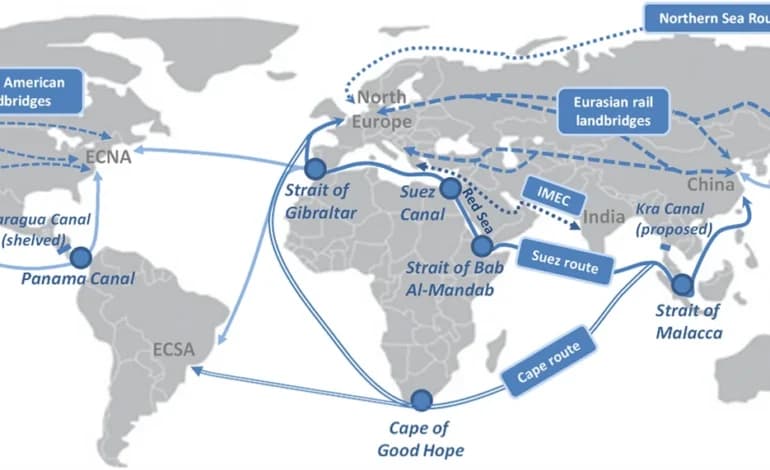
The numbers define the scale. The Suez Canal, which in its undisrupted state carries approximately 12 to 15 percent of total global trade and 30 percent of global container shipping between Asia and Europe, saw transits collapse from over 2,000 vessels per month in November 2023 to fewer than 900 by October 2024 - a reduction exceeding 57 percent. By early 2025, container traffic through the canal had fallen 90 percent compared to pre-crisis levels. Freight rates on Asia-Europe routes surged fivefold. The Cape of Good Hope, which adds 11,000 nautical miles, ten to fourteen days, and at least one million dollars in fuel costs per voyage compared to the Suez route, became the default routing assumption for the world's largest container carriers. Industry analysts, as of mid-2026, project Cape of Good Hope routing as the standard for Asia-Europe container traffic through at least 2027 - not a temporary workaround but an embedded structural reality now written into long-term charter agreements, bunkering strategies, and fleet deployment schedules that take months or years to unwind.
The Hormuz crisis compounded the Red Sea disruption with a qualitatively different and more severe threat. While container cargo can be rerouted around the Cape of Good Hope at significant cost, the Very Large Crude Carriers and LNG tankers that transit Hormuz carrying 25 percent of the world's seaborne oil and 20 percent of its LNG face no equivalent bypass option. Saudi Arabia's Petroline east-west pipeline can redirect some crude to Red Sea terminals, but its throughput capacity is substantially below total Gulf export volumes. Qatar's Ras Laffan LNG facilities, the UAE's Jebel Ali port, and Kuwait's Mina Al Ahmadi terminal are geographically locked to Hormuz transit. When the IRGC mined the strait, boarded merchant vessels, and issued navigation warnings closing the waterway on February 28, 2026, the global energy system entered a different category of supply shock - one for which no straightforward commercial bypass existed and whose resolution required diplomacy rather than merely larger fuel budgets.
What has emerged from these converging crises is a genuinely new energy map - one defined not merely by modified shipping routes but by a permanent recalibration of chokepoint risk, accelerated investment in alternative corridors and land bridges, new geopolitical significance accruing to states previously peripheral to global energy logistics, and a redefinition of what maritime security means for the energy transition, the global manufacturing system, and the strategic competition between great powers that increasingly uses infrastructure disruption as an instrument of coercion.
Strategic Background
Maritime chokepoints have always been the most consequential geographical features of the global energy system - places where the physical concentration of trade flows creates vulnerabilities that states, non-state actors, and asymmetric forces can exploit to exercise leverage far disproportionate to their conventional military capabilities. The strategic logic of chokepoint control was established in the age of sail, institutionalized in the age of steam, and became the foundation of modern energy geopolitics with the petroleum era's creation of irreversible dependencies on narrow waterways through which essential commodities could flow in abundance or not at all.
The Strait of Hormuz, the Bab el-Mandeb, and the Suez Canal together form what energy strategists call the critical arc - the maritime backbone of global energy commerce between the producing regions of the Persian Gulf and the consuming markets of Asia and Europe. Through this arc, in its undisrupted state, flows roughly 40 percent of the world's seaborne hydrocarbon trade, including approximately 21 million barrels per day of oil and LNG from Gulf producers whose shore-based infrastructure is geographically locked to these passages. Japan depends on Hormuz for roughly 70 percent of its crude oil imports. South Korea's energy exposure is comparable. China is the world's largest petroleum importer and routes a significant fraction of that supply through Gulf corridors. Europe's dependence on Red Sea-Suez transit for refined products, LNG, and manufactured goods from Asia embedded the corridor so deeply in the European industrial supply chain that its disruption produced immediate factory shutdowns, inventory crises, and inflationary pressure that monetary policy could not address.
The two crises that unfolded between 2023 and 2026 represent the stress-testing, at operational scale, of a global maritime architecture that had been allowed to develop extreme concentration without proportionate resilience investment. Decades of just-in-time logistics optimization, container shipping consolidation into mega-vessel fleets that require deep-water ports and specific routing assumptions, and energy procurement strategies built on stable, predictable access to narrow corridors created a system of extraordinary efficiency - and extraordinary fragility. The Houthi campaign and the Iranian Hormuz blockade did not create these vulnerabilities. They exposed and exploited them with a sophistication that has permanently altered how states, corporations, and logistics professionals assess the relationship between maritime geography and strategic risk.
Historical Context
The vulnerability of global energy flows to deliberate maritime disruption is not a new discovery. Egypt's nationalization of the Suez Canal in 1956 triggered a political and military crisis that demonstrated how decisively the physical control of a waterway could be leveraged against the energy-importing powers of the day. The 1967 closure of the Suez Canal following the Six-Day War kept the waterway shut for eight years, during which the global tanker fleet adapted - building larger vessels capable of sustaining the Cape of Good Hope route economically - and the strategic shipping order underwent a fundamental restructuring whose effects persisted long after the canal reopened in 1975. The 1973 Arab oil embargo, directed against states supporting Israel in the Yom Kippur War, demonstrated that supply denial applied to the critical arc could produce recession, inflation, and political realignment in the industrial economies of the West within months. The shock catalyzed the creation of the International Energy Agency, the establishment of strategic petroleum reserves, and the first systematic policy engagement with energy security as a national security concern rather than merely a commercial matter.
The Houthi campaign that began in November 2023 was unprecedented not in its intent - previous Houthi attacks on Saudi infrastructure had demonstrated the group's willingness to strike energy targets - but in its duration, tactical sophistication, and strategic effect. The Houthis deployed a hybrid arsenal of ballistic missiles, anti-ship cruise missiles, long-range attack drones, uncrewed naval surface vessels, and naval mines to threaten commercial shipping across the entire southern Red Sea and Gulf of Aden, establishing an effective maritime exclusion zone enforced not by naval vessels but by the persistent threat of asymmetric strike. Previous chokepoint disruptions had been resolved or circumvented within weeks. The Houthi campaign became the new normal over a period of years, compelling the global shipping industry to rebuild its operational architecture around the assumption of indefinite Red Sea exclusion. The Russell Group estimated that goods worth approximately one trillion dollars were disrupted by Houthi attacks between October 2023 and May 2024 alone - before the crisis had entered its structural phase.
The decision by Iran to close the Strait of Hormuz in retaliation for the February 2026 US-Israeli strikes represented the activation of a threat that Persian Gulf energy security planning had modeled for decades but never experienced at operational scale. Unlike the Houthi maritime exclusion, which applied to a route that cargo could bypass at cost, the Hormuz closure confronted the global energy system with a supply shock for which no commercially viable bypass existed. The activation of Saudi Arabia's Petroline pipeline to redirect crude through the Red Sea terminal at Yanbu, and the corresponding attempt to use Oman's ports at Sohar and Duqm on the Arabian Sea to bypass the tightest Hormuz transit segment, provided partial relief for some commodity flows but left the majority of Gulf hydrocarbon exports stranded in a manner that conventional logistics adaptation could not rapidly resolve.
Current Situation Assessment
As of July 2026, the global maritime trade map reflects a dual-crisis reality that has not been fully resolved even following the Islamabad Memorandum's nominal reopening of Hormuz. The Bab el-Mandeb and Suez Canal corridor - on which 30 percent of global container shipping and 12 percent of all global trade depended before November 2023 - remains operating at significantly below pre-crisis capacity. The Houthis' November 2025 halt to shipping attacks, which followed the October 2025 Gaza ceasefire, produced a partial recovery: some cautious Suez transits resumed in late 2025 and early 2026, with the Suez Canal Authority confirming passage of an ultra-large containership through the Red Sea as a signal of cautious normalisation. But the February 28, 2026 outbreak of the Iran war prompted the Houthis to resume attacks in direct solidarity with Tehran, erasing the partial recovery and driving most major carriers back to Cape of Good Hope routing. As of May 2026, daily Bab el-Mandeb traffic remained significantly below pre-war levels.
The Hormuz crisis evolved through a distinct operational trajectory. Following the February 28, 2026 IRGC closure, no ships appeared in the strait for the first two days of March. Major carriers suspended transits through both Hormuz and the Red Sea simultaneously. At least three tankers were struck near the strait. The IRGC declared the strait a vast operational area extending from Jask to Siri Island - a deliberate legal and operational redefinition designed to expand Iran's claimed enforcement authority beyond the narrowest transit segment. Between 13 April and 29 May 2026, the United States simultaneously maintained a naval blockade of Iranian ports, creating a dual blockade - Iranian mining and interdiction against the American naval exclusion of Iranian coastal shipping - that produced the most comprehensive disruption of Gulf hydrocarbon exports in modern petroleum history. By the Iran war ceasefire period, 230 loaded oil tankers were reported waiting inside the Gulf, unable to transit either the Iranian-controlled chokepoint or the US naval perimeter.
The Islamabad Memorandum of June 17, 2026 nominally reopened Hormuz to commercial shipping toll-free for 60 days - but the nominal reopening has not translated into a full operational recovery. Iranian state television, as of June 28, 2026, stated that passing through Hormuz still required coordination with Iran. Iranian parliamentary legislation was being drafted to restrict passage for vessels from hostile countries. US strikes on Iranian coastal sites on June 26, 2026, followed by Iranian retaliation against US bases in Kuwait and Bahrain on June 28, have created renewed uncertainty about the durability of Hormuz's reopening. The practical consequence is a strait that is nominally open but operationally unreliable - a category of ambiguous risk that insurers cannot easily price, that shippers cannot confidently schedule around, and that is producing persistent hedging behavior in the form of continued Cape of Good Hope routing even for cargo that does not face direct interdiction risk.
The Cape of Good Hope, by mid-2026, has become the default routing assumption for Asia-Europe commodity flows - what analysts have described as a fundamental rewriting of global logistics network architecture, not a temporary workaround. Carriers have restructured routing contracts, repositioned fleet assets, renegotiated bunkering arrangements at alternative ports from Mauritius to South Africa, and rebuilt scheduling frameworks around 30-day or longer ocean legs. Bunker fuel demand at Port Louis in Mauritius doubled to one million metric tons in 2024 as a direct consequence of rerouting. Industry consensus, across all major shipping analytics providers, holds that diversions will continue through at least 2027. Even under the most optimistic scenario of sustained Hormuz reopening and Houthi disarmament, carriers have indicated that returning to Suez routing would require four to eight weeks minimum for voyage reprogramming, with longer timelines for mega-vessels - and that insurer requirements for durable certainty, not merely improved security claims, would need to be satisfied before structural re-routing to the shorter corridor occurred.
Power Center Analysis
The Houthis: The Asymmetric Maritime Power
The most consequential single lesson of the Red Sea crisis for strategic analysts is the demonstration that a non-state actor with no conventional naval capacity whatsoever can exercise decisive, sustained influence over a maritime corridor carrying 12 percent of global trade through a combination of ballistic missiles, anti-ship cruise missiles, attack drones, uncrewed surface vessels, and naval mines. The Houthis do not control a single naval vessel in the conventional sense. They control a hybrid arsenal that proved sufficient to close the Bab el-Mandeb to the world's largest container carriers, impose one trillion dollars in disruption costs on global trade within months, and maintain that closure against the combined naval presence of Operation Prosperity Guardian, Operation Aspides, and sustained American and British airstrikes targeting Houthi missile and drone infrastructure for over two years. The asymmetric effectiveness ratio - the ratio between the Houthis' military investment and the economic disruption they imposed - is perhaps the most extreme ever achieved by a non-state maritime actor in modern history. This precedent will be studied by every non-state and state actor in the world that sits adjacent to a maritime chokepoint and possesses comparable or superior missile and drone capability.
Iran: The Chokepoint Sovereign
Iran's closure of the Strait of Hormuz in 2026 demonstrated the instrument that Persian Gulf security planners had always acknowledged but never experienced: that Iran's geographic position - its coastline bordering the entire northern shore of the Strait, its islands at the narrowest transit segment, and its IRGC Navy's capacity for mining, seizure, and strike operations across the 39-kilometer channel - gives Tehran an asymmetric chokepoint control capability that no conventional military force can fully negate without either comprehensive Iranian territorial defeat or Iranian political decision to reopen access. The US Navy's minesweeping operations, the mobilization of maritime coalitions, and the sustained aerial campaign that destroyed thousands of Iranian military targets all failed to reopen Hormuz without Iranian political consent. The chokepoint's eventual reopening was achieved through diplomacy - specifically the Islamabad Memorandum - not through military force. The lesson is one that will recalibrate Persian Gulf security doctrine for a generation: Iran's chokepoint capability is a genuine strategic deterrent that military power alone cannot reliably neutralize.
Saudi Arabia and the Gulf Producers: Structural Vulnerability Laid Bare
For the Gulf Arab states - Saudi Arabia, the UAE, Qatar, Kuwait, and Iraq - the 2026 Hormuz crisis exposed the structural fragility underlying their energy export revenues with a clarity that decades of notional security planning had obscured. Saudi Arabia's Petroline east-west pipeline, with a capacity of approximately five million barrels per day of crude, can redirect a portion of Saudi production to the Red Sea terminal at Yanbu - but total Saudi export capacity through the Arabian Gulf substantially exceeds this pipeline's throughput, meaning a sustained Hormuz closure strands the majority of Saudi crude production regardless of Petroline availability. Qatar's Ras Laffan LNG complex, the world's largest LNG export facility and the source of a significant fraction of Europe's post-Russian LNG supply, has no pipeline bypass option whatsoever: its entire output must transit Hormuz. QatarEnergy's force majeure declarations during the peak crisis period directly affected European energy security at exactly the moment that Europe was most dependent on Qatari supply to substitute for Russian pipeline gas - a compounding geopolitical vulnerability of extraordinary severity.
Egypt: The Revenue Casualty
Egypt has emerged as perhaps the most economically damaged state actor from the Red Sea crisis, absorbing losses that compound an already severe macroeconomic stress. The Suez Canal provides approximately seven percent of Egypt's GDP through toll revenues, associated port and logistics activity, and the broader employment and commercial ecosystem surrounding the canal corridor. The collapse of Suez transits from over 2,000 vessels per month to fewer than 900 - and subsequently to a fraction of that during the renewed 2026 crisis phase - has translated into billions of dollars in lost canal income at a moment when Egypt's economy faces acute foreign currency scarcity, persistent inflation, and mounting external debt obligations. Egypt has deployed SUMED pipeline capacity and lobbied aggressively for shipping security coalitions that might restore Red Sea transit, but the dependency of Suez traffic on the security of a maritime corridor that Egypt does not control places Egypt's most critical revenue source entirely at the mercy of geopolitical dynamics in which it has only marginal influence.
South Africa and the Cape Route Beneficiaries
The Cape of Good Hope's emergence as the world's default alternative maritime corridor has conferred unexpected strategic significance on South Africa and on the broader chain of ports, bunkering facilities, and logistics hubs that serve Cape routing. Cape Town, Durban, and Port Elizabeth have absorbed substantially increased vessel traffic and fuel demand. Mauritius, Djibouti, and the Mozambique Channel have experienced elevated bunkering activity and logistical importance. For South Africa specifically - a country whose strategic significance to the global economic order was previously limited - the Cape route's normalization represents an unprecedented opportunity to develop port infrastructure, maritime services, and logistics capacity that could sustain strategic relevance long after Middle Eastern chokepoints stabilize. This opportunity is already attracting investment interest that would not have materialized without the crisis.
Military and Security Implications
The military implications of the dual chokepoint crisis extend beyond the immediate operational challenge of reopening disrupted waterways. They constitute a fundamental reassessment of how maritime power, energy security, and strategic deterrence interact in an era of asymmetric weapons and great-power competition. The central military lesson of the Houthi campaign is that persistence matters more than capability thresholds: the Houthis were never more capable than the naval coalitions arrayed against them, but they demonstrated a capacity for sustained, low-cost disruption that proved more strategically effective than any proportionate military response. This asymmetric persistence model - exploiting the economics of drone and missile production against the far higher costs of defensive naval operations - is now the canonical case study for how non-state actors can exercise chokepoint leverage in the modern threat environment.
The NATO and partner-state response through Operations Prosperity Guardian and Aspides demonstrated both the coalition's capability to defend individual vessels and its fundamental inability to restore the confidence required for commercial shipping to return to threatened corridors at scale. Insurance markets, not naval capabilities, determine whether commercial vessels transit contested routes: a corridor that the US Navy can escort remains commercially unusable if war risk premiums make the voyage economically irrational. The gap between military capability and commercial confidence restoration is the strategic innovation space that the Houthi campaign exploited - and that every adversarial state and non-state actor with missile and drone access to a maritime chokepoint will seek to replicate.
The undersea infrastructure dimension of maritime security has received insufficient attention in the crisis's aftermath. The Red Sea and Arabian Sea seabed hosts multiple high-capacity submarine data cables that carry the majority of data traffic between Europe and Asia. The same geographic vulnerability that exposed surface shipping to Houthi strikes applies to these cable systems: a submarine cable cutting campaign in the same corridor, executed with far simpler tools than the Houthi arsenal, could inflict internet connectivity disruption of comparable strategic severity to the shipping disruption - targeting the digital logistics infrastructure that maritime trade depends upon with consequences that extend far beyond the energy sector into financial, communications, and command-and-control systems.
The strategic mineral dimension of the crisis compounds its military-industrial significance. The disruption of Red Sea and Hormuz shipping corridors affected not only hydrocarbon flows but the movement of lithium, cobalt, rare earth compounds, and other critical minerals that China exports to Europe through the Suez route and that are essential to European defense manufacturing, battery production, and clean energy deployment. The compounding of rare earth export controls with maritime route disruption created a dual supply shock for European defense and clean energy industries that no single mitigation strategy could address simultaneously. The lesson is one that NATO's logistics planners have absorbed into an intensified focus on strategic stockpiling, alternative routing, and dual-use infrastructure investment that goes substantially beyond previous emergency preparedness frameworks.
Economic and Trade Impact
The economic legacy of the dual chokepoint crisis is measurable across multiple dimensions, each of which has produced structural changes that will persist long after the immediate security environment stabilizes. The aggregate shipping cost increase - with Asia-Europe freight rates stabilizing at 25 to 35 percent above pre-crisis levels even after the initial fivefold spike moderated - represents a permanent structural inflation in global goods prices that feeds through to consumer goods, industrial inputs, and energy costs across every economy integrated into global trade. The estimated 15 to 20 billion dollar annual hit to global trade from elevated freight rates and insurance premiums, before accounting for the Hormuz crisis's separate and larger energy supply impact, represents a persistent tax on global economic efficiency that the Cape rerouting's normalization has institutionalized rather than resolved.
The Hormuz crisis imposed energy supply shocks of a different magnitude. The interruption of 25 percent of global seaborne oil and 20 percent of global LNG supply - even partially and temporarily - produced price spikes and demand destruction dynamics that the International Energy Agency assessed as structurally altering global oil demand through the second half of 2026. Japan, which routes 70 percent of its Middle Eastern crude through Hormuz, activated strategic petroleum reserves and engaged in emergency supply diversification discussions simultaneously. South Korea faced equivalent exposure. European energy markets, already stressed by the REPowerEU Russian gas phase-out and the partial loss of Qatari LNG due to QatarEnergy force majeure declarations, absorbed the Hormuz shock on top of a system already operating with thin resilience buffers. The combination drove European energy prices to levels that produced direct industrial production curtailments in aluminum smelting - the Bahrain aluminum complex reduced output due to energy supply constraints - automotive manufacturing, and chemical processing.
The nearshoring and supply chain restructuring acceleration catalyzed by the crisis represents perhaps its most enduring economic consequence. Companies that had been gradually reducing their dependence on just-in-time, single-corridor supply chains since the COVID-19 pandemic disruptions were confronted with a second, more severe shock that has accelerated these structural adjustments from gradual adaptation to urgent capital investment. Inventory buffer expansion, supplier diversification, regional manufacturing investment, and the building of strategic stockpiles across everything from semiconductors to pharmaceutical ingredients to food commodities have been materially advanced by the crisis. These investments represent a permanent increase in the capital intensity of global supply chain management - a structural cost that the global economy will carry for decades in exchange for the resilience that the crisis demonstrated was absent.
The crisis has also produced a profound restructuring of the maritime insurance market. War risk premium spikes during the peak crisis period - reaching 150,000 to 300,000 dollars per voyage for Red Sea transit - represented an effective commercial closure of the route independent of the physical security threat. Insurers have fundamentally reassessed their risk models for chokepoint-adjacent shipping, developing more granular geographic risk differentiation, incorporating non-state actor threat parameters that were previously treated as low-probability tail risks, and establishing durable uncertainty premiums that will persist even after the immediate security environment improves. The Lloyd's and international marine insurance market's pricing of chokepoint risk has been permanently reset upward - a structural legacy of the crisis that affects every cargo owner, shipowner, and financier in global maritime trade.
Diplomatic Positioning
The diplomatic response to the dual chokepoint crisis has produced a fragmented, multilateral landscape of partially overlapping initiatives that reflects both the genuine global interest in maritime corridor restoration and the deep political fractures that prevented coherent, unified action. Operation Prosperity Guardian, the US-led naval coalition assembled to defend Red Sea shipping, attracted participation from a broad coalition of states but was notable for the reluctance of major European allies to commit forces publicly, reflecting their unwillingness to be directly associated with American military operations in a context linked to the Gaza conflict. France, Spain, Italy, and several other EU members declined to join Prosperity Guardian while contributing to the EU's parallel Operation Aspides - a diplomatic distinction that signaled the political fragmentation of Western maritime security coordination even as the operational requirements of Red Sea security were broadly shared.
The multilateral response to the Hormuz closure was more diplomatically novel. Pakistan hosted a meeting with Egypt, Saudi Arabia, and Turkey to discuss reopening the strait - a configuration of states that would have been unthinkable as a maritime security coordination forum in any previous period and that reflected the fundamentally altered diplomatic landscape of the 2026 Iran war's aftermath. Zelensky offered Ukraine's expertise in creating safe maritime corridors - a remarkable statement from a wartime president that also reflected Ukraine's demonstrated competence in sustaining Black Sea shipping despite Russian naval interdiction, a case study whose lessons are being directly applied to the Hormuz challenge by navies across the region. China's position - publicly condemning the war while absorbing discounted Russian and Iranian energy at market-distorting prices - illustrated the characteristic hedging strategy that has allowed Beijing to benefit from Western-managed energy crisis without bearing any of the security cost.
India's response to the dual crisis reveals the acute strategic tension between its maritime trade dependence and its multi-alignment policy. India depends on the Red Sea-Suez corridor for 35 to 40 percent of its textile and apparel exports, 30 to 35 percent of its pharmaceutical exports, and substantial portions of its engineering goods and processed food trade. The maritime crisis imposed direct costs on Indian exporters of up to 60 percent in freight rates and 20-day delivery delays - costs concentrated in the small and medium enterprise sector that forms the backbone of India's export-oriented manufacturing. At the same time, India purchased discounted Russian oil through Hormuz-routed tankers and participated in BRICS financial frameworks that complicated its ability to join Western maritime security coalitions with full operational commitment. India has sought to leverage its position as an emerging maritime security provider, deploying naval escorts for merchant vessels, while avoiding the explicit political commitments that full Prosperity Guardian participation would have required.
Regional Fallout
The regional states along both disrupted corridors have experienced radically differentiated impacts - some catastrophically negative, some unexpectedly positive - that are reshaping their relative positions in the new energy and trade geography. Egypt faces the most severe negative impact, with Suez Canal revenue losses compounding an already critical macroeconomic situation. The canal's toll revenues, which had generated steady and growing income as one of Egypt's most reliable hard-currency sources, have been directly hit by the collapse of transits. Egypt's broader economic exposure is also acute through its dependence on Red Sea tourism, which collapsed as security perceptions of the region deteriorated. The Egyptian government has lobbied aggressively for maritime security restoration and has engaged both the United States and regional Arab states for financial support in managing the economic consequences of a crisis over which it has no leverage.
Djibouti, whose entire strategic value proposition rests on its position as the key bunkering, logistics, and transshipment hub for Bab el-Mandeb transit traffic, has experienced a severe economic shock as vessel traffic through the strait collapsed. The base hosting of multiple international naval forces - American, Chinese, French, and Japanese - provides some economic floor, but the collapse of commercial maritime activity through the Djibouti hub represents a strategic economic blow whose recovery timeline is directly dependent on the resolution of Yemeni conflict dynamics that extend far beyond Djibouti's ability to influence.
Oman has emerged as perhaps the most strategically elevated state from the dual crisis, for reasons both geographic and political. Its ports at Sohar and Duqm on the Gulf of Oman and Arabian Sea allow access to the broader Indian Ocean without transiting the tightest Hormuz segment - a geographic advantage that has attracted significant attention from Gulf producers seeking to reduce Hormuz dependency. Oman's role as a mediator between Iran and the United States, exercised repeatedly through the Houthi crisis and the Iran nuclear negotiations, has been further validated by its diplomatic utility in the Islamabad Memorandum framework. Qatar's engagement with Omani maritime routes as a partial alternative transit for some cargo flows during the peak Hormuz crisis reflected Oman's emerging status as the Persian Gulf's designated bypass node.
The Middle Corridor - the Trans-Caspian International Transport Route running from China through Kazakhstan, the Caspian Sea, Azerbaijan, Georgia, and Turkey to Europe - has experienced a significant surge in interest as a rail and multimodal alternative to both disrupted sea routes. Transit volumes through the corridor increased substantially during the crisis period, with China-Europe Railway Express services absorbing some of the Asia-Europe cargo that could not viably route through either the Red Sea or the Hormuz-Red Sea combination. The Middle Corridor's 15 to 18 day transit time - faster than Cape of Good Hope sea routing - positions it as a commercially meaningful alternative for time-sensitive cargo, though its throughput capacity remains constrained by bottlenecks at Caspian Sea crossing points and Georgia's port infrastructure.
Global Strategic Consequences
The most consequential global strategic consequence of the dual chokepoint crisis is the permanent elevation of maritime geography as a domain of active geopolitical competition rather than a passive background condition for global commerce. The pre-crisis assumption - shared by logistics professionals, policymakers, and financial markets alike - was that the post-Cold War era had produced a stable, effectively self-managing global maritime order in which chokepoints were potential risks but not active battlegrounds. The Houthi campaign and the Iranian Hormuz closure have definitively discredited that assumption, demonstrating that chokepoints are active instruments of geopolitical coercion rather than passive geographic features. The geopolitical risk pricing for all chokepoint-dependent trade has been permanently reset upward, not merely temporarily elevated.
The crisis has also demonstrated the strategic utility of asymmetric maritime disruption for actors whose conventional military capabilities are vastly inferior to the naval coalitions arrayed against them. The Houthis - a non-state actor whose total military budget represents a rounding error in comparison to the annual operating costs of the naval forces deployed against them - sustained a maritime exclusion zone over a major global trade corridor for over two years. The cost-exchange ratio in their favor was so extreme that it renders conventional naval deterrence of future non-state maritime campaigns deeply questionable. Every aspiring regional power, every non-state actor with access to anti-ship missile technology, and every revisionist state sitting adjacent to a maritime chokepoint has absorbed this lesson with strategic seriousness.
For China, the crisis has sharpened the strategic imperative of Belt and Road overland connectivity with a clarity that Beijing's long-term planners had always anticipated but whose urgency has now been operationally demonstrated. China's dependence on maritime chokepoints - Malacca, Hormuz, Bab el-Mandeb - for the raw material imports and export flows that sustain its manufacturing economy represents a structural vulnerability that American naval dominance and its allied coalition partners can, in principle, exploit in a Taiwan contingency or broader strategic confrontation. The crisis has accelerated Chinese investment in overland rail corridors, pipeline infrastructure, and port development across Eurasia and Africa that reduce, though cannot eliminate, this vulnerability. The China-Pakistan Economic Corridor, whose Gwadar port provides deep-water access to the Arabian Sea without Hormuz transit, has received renewed strategic attention in Beijing's infrastructure investment calculus as a consequence of the 2026 crisis.
The clean energy transition's intersection with the maritime crisis deserves particular attention for its long-term strategic implications. The transition to electric vehicles, renewable power, and hydrogen energy requires moving vast quantities of lithium, cobalt, nickel, rare earth elements, solar panels, wind turbine components, and battery packs across ocean routes that transit the same compromised chokepoints that disrupted hydrocarbon flows. The European Union's accelerated renewable deployment program - designed precisely to reduce dependence on hydrocarbon imports transiting Hormuz and the Red Sea - depends on supply chains that themselves transit those same routes for solar panels from Chinese manufacturers, battery materials from African and South American mines, and electrolysis equipment from Asian suppliers. The energy transition does not escape chokepoint dependency - it redistributes it from crude oil tankers to clean energy component carriers. This substitution may reduce geopolitical exposure over the long term, but the transition period's supply chains are at least as chokepoint-exposed as the fossil fuel system they are replacing.
Risk Matrix
- Risk Level: Critical - The Islamabad Memorandum's 60-day ceasefire framework fails to produce a permanent settlement, and renewed Iranian Hormuz closure combines with resumed Houthi Red Sea attacks to impose a sustained dual chokepoint crisis through 2027, permanently eliminating the Suez-Hormuz corridor as a reliable routing option for global energy and commodity trade.
- Risk Level: Critical - A South China Sea military confrontation triggers Chinese interdiction of Malacca Strait shipping as a counter-measure to American naval operations, creating a third simultaneous chokepoint disruption that combines with Red Sea and Hormuz instability to sever the maritime backbone of global trade across three of its most critical passages simultaneously.
- Risk Level: High - Submarine data cable attacks in the Red Sea or Arabian Sea compound surface shipping disruptions with digital connectivity disruption, simultaneously degrading the maritime tracking, financial clearing, and communications infrastructure that global trade logistics depends upon.
- Risk Level: High - War risk insurance markets price Red Sea and Hormuz risk at levels that make commercial shipping through both corridors economically irrational regardless of physical security conditions, permanently institutionalizing Cape of Good Hope routing as the commercial default even during periods of reduced military threat.
- Risk Level: High - The precedent established by the Houthi maritime campaign attracts replication by other non-state actors sitting adjacent to the Strait of Malacca, the Panama Canal, or other high-traffic maritime corridors, creating a global epidemic of chokepoint asymmetric disruption campaigns that no naval coalition has demonstrated the capacity to suppress.
- Risk Level: Medium - Egypt's economy destabilizes under the prolonged Suez revenue loss combined with its external debt obligations, creating a macroeconomic crisis in North Africa with significant migration and political instability consequences for Europe.
- Risk Level: Medium - The Middle Corridor achieves sufficient throughput capacity to absorb 15 to 20 percent of Asia-Europe container trade, establishing a durable overland alternative that reduces the strategic leverage that Red Sea and Hormuz chokepoint control provides to revisionist states and non-state actors.
- Risk Level: Low (near-term) - A full return to pre-crisis routing patterns occurs within the 2026-2027 timeframe. Carrier operational lock-in, sustained insurance premiums, and continued Houthi capability even under ceasefire conditions make a rapid, comprehensive return to Suez routing extremely unlikely absent a comprehensive Yemen peace settlement that remains far beyond current diplomatic reach.
Scenario Analysis
Scenario One: Permanent Bifurcation of the Global Maritime Order (Most Probable)
The most likely outcome across the five-to-ten-year horizon is a permanently bifurcated global maritime architecture, in which the Cape of Good Hope route serves as the default for the majority of Asia-Europe container traffic while the Suez Canal retains relevance for specific commodity categories and periods of confirmed corridor security. In this scenario, the Middle Corridor absorbs an increased share of time-sensitive cargo, Middle Eastern overland pipelines carry a larger fraction of Gulf hydrocarbon exports to reduce Hormuz exposure, and the global shipping fleet's deployment assumptions have been structurally rebuilt around Cape routing in a manner that cannot be fully reversed without years of operational restructuring. The energy transition proceeds on supply chains that are more expensive, more resilient, and more geographically diversified than their predecessors - but that retain significant chokepoint exposure in the battery materials and clean energy components flows that replace hydrocarbon transit. Maritime security coalitions become permanent features of global naval architecture rather than crisis-response formations, with Gulf, Indo-Pacific, and European naval forces committing to indefinite chokepoint protection missions that represent a permanent expansion of the military costs of global trade maintenance.
Scenario Two: Middle East Settlement and Corridor Restoration (Moderate Probability, Multi-Year)
A comprehensive diplomatic settlement of the Iran-US-Israel confrontation, combined with a Yemen peace agreement that addresses the political grievances underlying Houthi maritime operations, could enable a gradual restoration of both chokepoints to commercially reliable status within three to five years. In this scenario, Hormuz operates under a multilateral maritime security framework negotiated through the Islamabad Memorandum's successor agreement, with IRGC Navy activities constrained by monitoring mechanisms and Gulf littoral state coordination protocols. Houthi attacks on Red Sea shipping cease as part of a Yemen political settlement that addresses the group's territorial and political demands. Suez Canal transits recover toward pre-crisis volumes over a 12 to 18 month normalization period. The Cape of Good Hope route retains elevated but reduced traffic as carriers manage a portfolio of routing options rather than a single default. This scenario requires political breakthroughs across multiple simultaneous negotiations - Yemen, Iran, Israel-Lebanon - that are individually unlikely in the near term and collectively dependent on a convergence of diplomatic momentum that the current fragmented regional order does not readily generate.
Scenario Three: Multipolar Chokepoint Competition and Structural Deglobalization (Lower Probability, Higher Consequence)
A Taiwan Strait military confrontation, or a Chinese decision to leverage Malacca dependency as a strategic counter to American pressure, triggers a third simultaneous maritime chokepoint crisis that combines with the continued Red Sea and Hormuz instability to fragment global maritime trade into geopolitically segregated spheres. In this scenario, the efficient, integrated global maritime system that has characterized the post-Cold War era is replaced by a more expensive, less efficient set of regional and alliance-aligned supply chains that explicitly route around adversarial maritime domains. The cost of this structural deglobalization - permanently elevated goods prices, reduced economies of scale, duplicated logistics infrastructure across geopolitically aligned networks - is absorbed as a strategic necessity by states that have concluded that the efficiency gains of the integrated global maritime order are outweighed by the coercive vulnerability it creates. The energy transition accelerates within this framework as a strategic imperative to reduce hydrocarbon transit exposure, but its supply chain dependencies create new chokepoint vulnerabilities that the same fragmentation dynamic immediately exploits.
Intelligence Forecast (6-24 Months)
The immediate six-month horizon is dominated by the 60-day Islamabad Memorandum negotiation window and its implications for Hormuz's operational status. The June 28, 2026 Iranian missile and drone strikes against US bases in Kuwait and Bahrain - following US strikes on Iranian coastal sites on June 26 - represent the first significant ceasefire violations of the post-memorandum period, creating immediate uncertainty about whether the nominal Hormuz reopening will translate into the commercial confidence restoration that global energy markets require. If the violation cycle escalates rather than de-escalates, the practical consequence for shipping will be the maintenance of Cape of Good Hope routing even for cargo that nominally has Hormuz access, as insurers and carriers are unwilling to commit to Hormuz transits on the basis of a ceasefire that both parties appear to be violating within days of signing.
Suez Canal traffic recovery is contingent on Houthi restraint, which is itself contingent on continued Iranian compliance with the ceasefire framework and ongoing Gaza settlement stability. The October 2025 Gaza ceasefire that prompted the initial Houthi shipping attack pause was followed by Houthi resumption when the Iran war broke out in February 2026 - a clear demonstration that Houthi maritime operations are calibrated to the broader regional political environment rather than independently determined. Any deterioration in the Gaza ceasefire, any resumed Israeli-Lebanese hostilities at scale, or any renewed Iranian confrontation with the United States could trigger a Houthi resumption that eliminates whatever limited Suez recovery has occurred. The Suez Canal Authority's confirmation of some ultra-large containership transits in mid-2026 suggests cautious trial restoration, but major carrier return to systematic Suez routing will require a 90-day or longer period of confirmed security without significant incidents - a threshold that the volatile regional environment of mid-2026 makes difficult to sustain.
The Middle Corridor's throughput capacity expansion is the most important positive infrastructure development to monitor on the twelve-month horizon. Azerbaijan's Alat Free Economic Zone, Georgian port capacity at Poti and Batumi, and Turkish rail infrastructure connecting to European networks are all active investment targets whose progress will determine how much of the diverted Asia-Europe cargo can be absorbed by land-based alternatives rather than remaining dependent on the longer Cape sea route. China's investment in Middle Corridor infrastructure - diplomatically complex given its relationships with Russia, whose Trans-Siberian Railway competes for the same cargo - is an indicator of how seriously Beijing has internalized the strategic vulnerability its maritime chokepoint dependence demonstrated during the crisis.
On the energy production side, the crisis has already catalyzed responses from non-Gulf producers that will structurally alter global hydrocarbon supply geography over the 12 to 24-month horizon. Australian LNG's Chevron Wheatstone capacity restart, reflecting the demand signal created by the Hormuz-driven loss of Qatari LNG availability in European and Asian markets, represents the commercial logic of supply diversification away from Hormuz-dependent sources that energy importers are now actively pursuing as a security requirement. American LNG export capacity expansion - already accelerated by European demand driven by the Russian gas phase-out - has received additional demand signal from the Hormuz crisis's demonstration that Gulf LNG availability cannot be assumed even under nominal peace conditions. Norwegian North Sea production expansion, East African LNG development in Mozambique and Tanzania, and Guyanese offshore oil production are all benefiting from an investment climate in which non-Hormuz, non-Suez-dependent supply commands a structural security premium that justifies higher development costs.
Final Strategic Takeaway
The new energy map is not a temporary modification of the old one. It is a structural rewrite whose permanence is being embedded every day in the long-term contracts, fleet deployment decisions, infrastructure investments, and insurance pricing frameworks that together constitute the operational architecture of global maritime trade. The efficient, integrated, corridor-dependent global trading system that developed over the three decades following the Cold War was built on a set of assumptions about maritime security that have been comprehensively falsified. Those assumptions - that non-state actors could be deterred from sustained maritime disruption campaigns by naval coalitions, that the Strait of Hormuz was a theoretical risk rather than an operational vulnerability, that just-in-time logistics could be built on corridor concentration without resilience investment - have each been tested and failed.
What replaces them is a more expensive, more resilient, more geographically diversified but more politically complex global trade architecture. The Cape of Good Hope route carries more cargo than anyone would have planned to route through it, at costs that have imposed persistent inflationary pressure on global goods prices. The Middle Corridor carries more container freight than its infrastructure was designed to handle, creating pressure for the investment that will expand its capacity but also its strategic contestability. Gulf producers have invested in pipeline bypasses and alternative export terminals that reduce but cannot eliminate their Hormuz dependency. Energy importers have built larger strategic reserves, signed more geographically diversified supply contracts, and developed more sophisticated hedging strategies against corridor disruption. These are the rational adaptations of a global economic system that has learned, at significant cost, that the geography of its trade routes is not a stable given but an active variable in the strategic competition among states, non-state actors, and the competing interests that shape the geopolitical environment in which commerce operates.
The deeper lesson is one that the preeminent military and economic powers of every era have eventually absorbed: the architecture of global commerce is also the architecture of strategic vulnerability. Whoever can disrupt it - whether by closing a canal, mining a strait, or deploying drone swarms against container ships - exercises a form of power that does not depend on conventional military parity. The Houthis demonstrated this with a clarity that has rewritten the textbooks of asymmetric maritime strategy. Iran demonstrated it with a clarity that has rewritten the contingency plans of every major navy that depends on Persian Gulf access. The strategic imperative of the coming decade is to build a global maritime architecture resilient enough that no single actor - state, non-state, or hybrid - can exercise decisive chokepoint coercion. The crisis has made the cost of failing to build that resilience undeniable. Whether the investment follows is a political question, not a technical one.
The world's energy does not flow through pipelines alone. It flows through straits, canals, and the confidence of the ships that dare to sail them. When that confidence breaks, no amount of military power can fully restore what markets have already rerouted around.