
Xi's Cairo Return: Is China Filling the Vacuum America's Iran War Left Behind?
Executive Summary
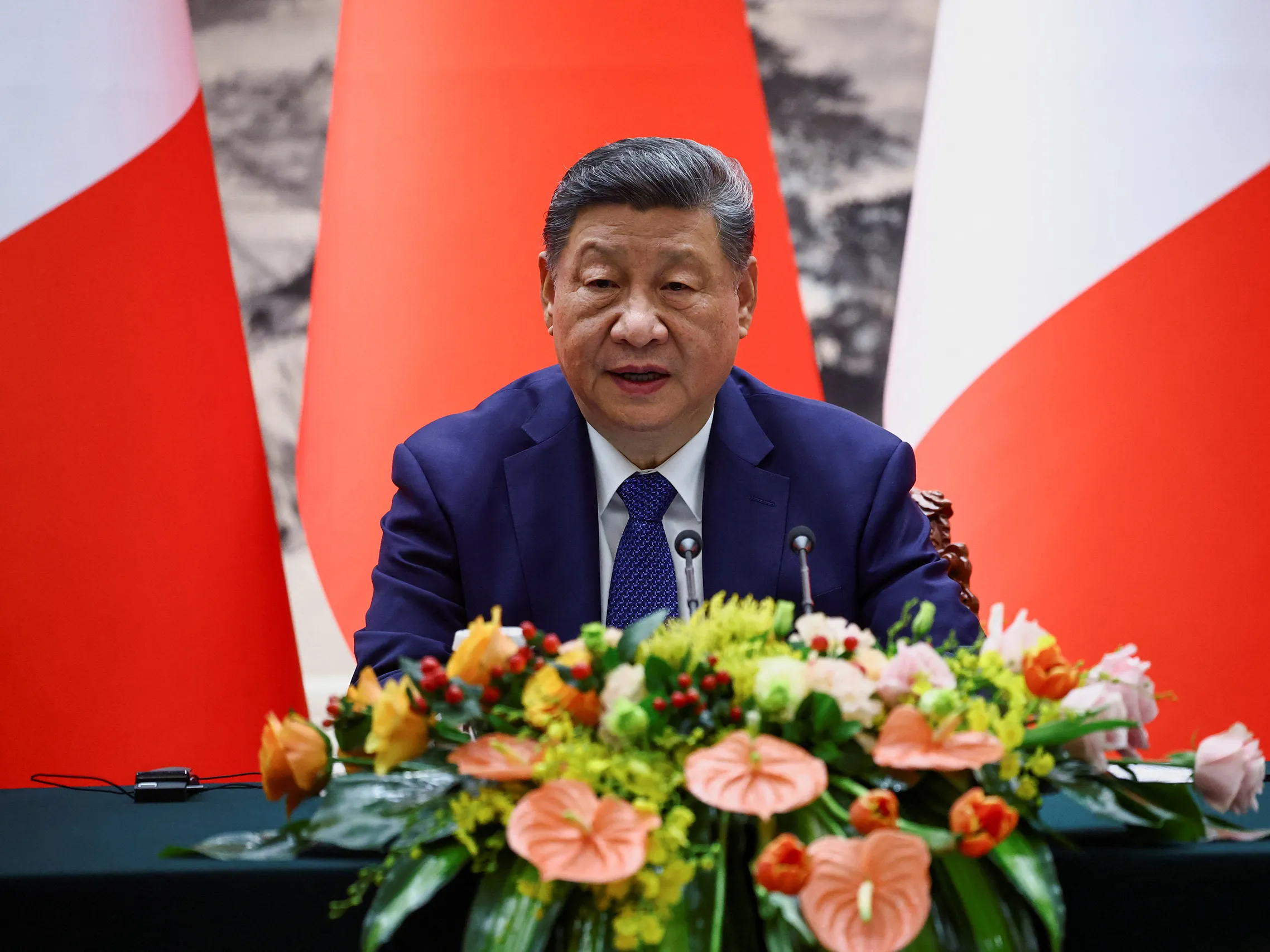
On September 1, 2026, Xi Jinping landed in Cairo for his first state visit to Egypt in a decade, arriving in the middle of an unresolved war between the United States, Israel and Iran that has been running since February 28 and has just entered its seventh month. Over two days, Chinese and Egyptian officials signed five formal agreements and more than twenty additional cooperation documents, anchored on a third expansion phase of the Suez Canal Economic Zone, a tyre-manufacturing letter of intent worth roughly 500 million dollars, and a joint air exercise between the two countries' air forces that had begun ten days earlier. Xi used the visit to call for a new Middle East security architecture built around what he described as regional states being masters of their own destiny, a formulation designed to contrast Chinese economic patience with American military entanglement.
The visit did not happen in isolation. It came days after Washington moved to cut Egypt's Banque Misr off from the US financial system over Iran-linked transactions, weeks after Jordan's King Abdullah II made his own trip to Beijing, and against the backdrop of a trilateral defence pact between Saudi Arabia, Turkiye and Pakistan signed in Mecca in early August. Iran, for its part, resumed large-scale missile and drone strikes against US-aligned Gulf states in the first days of September, and the Strait of Hormuz has been functionally closed to Western-allied shipping since early May.
The strategic question this report addresses is not whether China wants a larger footprint in the Middle East - it plainly does - but whether the September 2026 Cairo visit represents genuine displacement of American power or a more limited, opportunistic exploitation of American overextension. The assessment below concludes it is the latter: China is expanding rapidly along economic, industrial and technological lines while remaining conspicuously unwilling to assume the hard-security burdens - freedom-of-navigation enforcement, blockade-breaking, deterrence guarantees - that still anchor American primacy in the region, however strained that primacy currently looks.
Strategic Background
Egypt occupies a position in this story that is easy to understate. It controls the Suez Canal, a waterway that in a normal year carries roughly one-tenth of global maritime trade and that has become considerably more valuable to global energy logistics now that the Strait of Hormuz is effectively closed to non-Chinese, non-Russian shipping and the Bab el-Mandeb Strait remains hostage to intermittent Houthi activity. It is the most populous Arab state, a treaty partner of Israel since 1979, one of the largest recipients of US military financing in the world, and, since 2024, a member of the expanded BRICS grouping. It is also carrying a heavy fiscal burden, having leaned on International Monetary Fund-backed reform programmes through repeated currency and debt pressures over the past several years.
China-Egypt relations rest on a foundation laid in 1956, when Cairo became the first Arab and African state to establish diplomatic ties with the People's Republic. Xi's 2026 visit fell in the seventieth anniversary year of that relationship, and eleven years after Egypt and China elevated ties to a comprehensive strategic partnership in 2014. Since then, bilateral trade has grown to roughly 20.7 billion dollars by the end of 2025 - making China Egypt's largest non-petroleum trading partner - against 15.7 billion dollars in US-Egypt trade over the same year. Chinese direct investment, concentrated in a business hub east of Cairo and an electric freight rail line through the Nile Delta, has been estimated at more than 10 billion dollars.
What changed in 2026 is the environment around that relationship. The United States is not withdrawing from the Middle East by choice; it is consumed by a war it did not expect to still be fighting. That distinction matters for how the vacuum thesis should be read.
Historical Context
The chain of events that produced the current war did not begin on February 28, 2026. It runs back through the twelve-day Israel-Iran war of June 2025, which degraded Iranian air defences and nuclear infrastructure without resolving the underlying dispute over enrichment. In its aftermath, Iran's currency entered a sustained decline, worsened by a fresh round of international sanctions imposed that September. The economic contraction fed domestic unrest, and protests broke out in Iran on December 28, 2025, spreading through January 2026 with implicit American encouragement and an explicit warning from President Trump against a violent crackdown.
It was against this backdrop that the United States and Israel launched what the Pentagon called Operation Epic Fury on February 28, 2026 - a decapitation strike that killed Supreme Leader Ali Khamenei along with much of Iran's senior military and clerical leadership. Rather than causing regime collapse, the strike prompted a rapid consolidation of hardline authority under a new leadership circle, reportedly headed by Mojtaba Khamenei, while President Masoud Pezeshkian and Foreign Minister Abbas Araghchi remained the visible civilian face of Iranian diplomacy. Iran responded not with capitulation but with expansion: missile and drone attacks on American assets across the Gulf, a declared closure of the Strait of Hormuz, and a rekindling of the Hezbollah-Israel front in Lebanon that had been dormant since the 2025 Gaza ceasefire.
China's posture through this earlier phase was consistent with a pattern set well before 2026. Beijing brokered the 2023 normalisation between Saudi Arabia and Iran, a diplomatic coup that first demonstrated China's willingness to use its economic weight for political leverage in the region without deploying a single soldier. That achievement has since frayed: Iranian strikes on Saudi and other Gulf targets during the current war have reintroduced exactly the kind of Riyadh-Tehran friction the 2023 deal was meant to suppress. China also positioned itself early as a sponsor of Palestinian statehood, hosting President Mahmoud Abbas and announcing a strategic partnership with the Palestinian Authority shortly before the October 2023 Hamas attack on Israel - a relationship that continues to shape how Gulf and North African publics view Beijing relative to Washington.
Current Situation Assessment
The war entered a formal pause after forty days of active fighting, when Pakistan brokered a ceasefire on April 8, 2026, later extended indefinitely by President Trump. Islamabad went on to host two rounds of talks between American and Iranian delegations, and on June 17-18 the two sides signed the Islamabad Memorandum of Understanding - brokered by Pakistan and Qatar and formally executed in Versailles - which reopened the Strait of Hormuz, restated Iran's commitment against nuclear weaponisation, and opened a sixty-day window for a comprehensive settlement. President Trump described the deal on social media as complete; independent assessments at the time flagged it as a tactical pause rather than a resolved conflict, since it deferred the central dispute over Iran's enrichment infrastructure to technical-level talks and left Israeli operations against Hezbollah in Lebanon explicitly unaddressed.
That caution proved warranted. The ceasefire collapsed on July 8, and by early August low-intensity exchanges had escalated back into open warfare. On September 1 - the day Xi landed in Cairo - US forces struck an estimated one hundred Islamic Revolutionary Guard Corps targets, including air-defence sites, radar systems, maritime assets, mine-laying capability and communications infrastructure, under a stated policy of matching every Iranian tanker strike with a strike on an Iranian tanker. Iran answered with its largest barrage since the April ceasefire - more than fifty-nine missiles and drones over two nights aimed at Jordan, Bahrain, Kuwait and Iraq, followed by strikes on the Ahmad al-Jaber and Al Minhad air bases in Kuwait and the UAE. Two Filipino crew members were confirmed killed aboard a tanker on August 31, the first commercial shipping deaths since hostilities resumed, and Saudi Arabia has attributed that attack to Iran. As of the first week of September, US Central Command's naval blockade of Iranian shipping had intercepted eighty-seven vessels, cumulative American fatalities in the conflict stood at eighteen, and Brent crude was trading around ninety-five to ninety-seven dollars a barrel after a six-week high.
The Strait of Hormuz has not seen a Western-allied commercial transit since May 4, according to shipping-intelligence trackers, while Iran's Revolutionary Guard has instituted what amounts to a toll regime through the strait, charging vessels fees of up to two million dollars payable in Chinese yuan, Bitcoin or the USDT stablecoin - a small but telling signal of how far the conflict has already pushed regional commerce away from dollar-denominated, Western-insured shipping norms. It is inside this specific window of American military bandwidth being consumed by an open-ended war that Xi chose to make his first trip to Cairo since 2016.
Power Center Analysis
Four power centres define the current landscape. The United States retains unmatched hard-power reach - carrier strike groups, blockade enforcement, and the ability to strike Iranian military infrastructure at will - but is visibly war-weary. Congressional Republicans have grown anxious about the political cost of an unresolved war heading into midterm elections, and President Trump's own repeated predictions of imminent victory, first four to five weeks and now well past six months, have eroded the credibility of White House messaging on the conflict's endpoint.
China occupies a genuinely different kind of power: financial, industrial and infrastructural rather than kinetic. Its leverage runs through trade volumes, investment capital, and - increasingly - currency. It is Iran's largest oil customer even under blockade conditions, Egypt's largest non-oil trading partner, and a rising technology supplier competing directly with American firms for Gulf and North African markets. What China conspicuously lacks is a demonstrated willingness to protect that economic footprint with force; its naval role in the Red Sea has been limited to shielding its own commercial vessels rather than contesting the Houthi threat directly.
Egypt itself functions as a power centre in its own right, precisely because it is being courted rather than commanded. Cairo's leverage rests on geography - the Canal - and on its unusual position as a state that maintains peace with Israel, a security relationship with Washington, and now a deepening economic partnership with Beijing simultaneously. The fourth centre is the emergent Mecca Defence Alliance of Saudi Arabia, Turkiye and Pakistan, a genuinely new bloc that combines Gulf financial power, NATO's second-largest conventional army and the only nuclear arsenal in the Muslim world, formed explicitly in response to the sense that neither Washington nor any single regional actor can guarantee Gulf security unilaterally.
Iran, though weakened at the leadership level, retains disproportionate asymmetric leverage through its capacity to threaten the Strait of Hormuz and Gulf infrastructure, while Israel has emerged from the war with expanded operational reach in Lebanon that is unsettling to Cairo as much as it is to Tehran.
Military and Security Implications
The Egyptian-Chinese "Eagles of Civilisation" air exercise, launched on August 22 and featuring China's J-16 fighter, is symbolically significant and operationally modest. It signals Cairo's interest in diversifying defence partnerships beyond its traditional dependence on US-supplied platforms, but it falls well short of anything resembling a security guarantee. Analysts close to the visit noted that Sisi was likely to press Xi for more concrete Chinese help containing Iranian activity - particularly after an Egyptian gas facility was reportedly struck by a probable Iranian drone in July - and was likely to come away disappointed, since Beijing's regional security posture remains oriented around protecting its own shipping rather than underwriting anyone else's.
The more consequential security development of the summer was not Chinese but intra-regional: the August 7 Mecca Joint Deterrence Agreement between Saudi Arabia, Turkiye and Pakistan, which commits each signatory to treat an attack on any one of them as an attack on all three, explicitly modelled on Article 5 of the NATO treaty though without NATO's integrated command structure. By late August the three states had formalised a secretariat in Riyadh and begun institutionalising the pact under a Strategic Political and Defence Committee. This is the closest the region has come in years to a genuinely new collective-security architecture, and it emerged not because of Chinese initiative but because Gulf and South Asian states no longer feel confident that American security guarantees alone are sufficient in a period of open US-Iran warfare.
For Washington, the strain is visible in deployment fatigue: the USS Abraham Lincoln completed a 286-day deployment supporting Operation Epic Fury before finally returning to port in early September, illustrating how thinly stretched US naval assets in the theatre have become.
Economic and Trade Impact
The economic dimension is where China's activity has been most concrete. The third phase of the Egyptian-Chinese Suez Canal Economic Zone, agreed during the visit, builds on a zone that already hosts roughly two hundred companies and around four billion dollars in cumulative investment. A letter of intent from China's ZC Rubber for a tyre-manufacturing complex worth approximately 500 million dollars in the Sokhna area exemplifies the model: Chinese manufacturers gain a production base adjacent to the Canal with preferential access to African, Arab and European markets, while Egypt gains factories, jobs and export capacity aligned with its Vision 2030 development strategy. Notably, this expansion is occurring precisely as the Canal itself becomes strategically more valuable - Suez Canal Authority revenue rebounded to 4.67 billion dollars in fiscal year 2025-26, up 23 percent year-on-year, though still well below the 10.25-billion-dollar peak of 2023, as some shipping lines cautiously test a return to the route amid Hormuz's closure.
The unresolved item from the visit is technological rather than industrial: a Huawei tender to supply more than two thousand AI accelerator chips, including its top-tier Ascend 950-series processors, for Egyptian data-centre infrastructure, reportedly bundled with a partnership involving iFlytek, a company blacklisted by the US since 2019 over its role in surveillance technology used against Muslim minorities in Xinjiang. The bid went publicly unmentioned in the visit's official documentation, and Washington is understood to be assembling a counteroffer involving Microsoft, Nvidia and AMD. Egypt's silence on the matter looks less like a decision made than a decision deferred, and it is arguably the single clearest test of how far Cairo is willing to go in aligning with Beijing on a technology where Washington still holds real capability advantages.
Beneath both stories sits a currency story. China remains Iran's dominant oil customer even under a US naval blockade, though volumes have fallen sharply - from roughly 1.4 million barrels per day before the war to around 534,000 barrels per day in August, a decline of nearly half. The trade now runs almost entirely through independent Shandong refineries rather than state oil majors, settled substantially in yuan through China's Cross-Border Interbank Payment System, and increasingly routed around rather than through the Strait of Hormuz, with major Chinese shippers keeping over one hundred very large crude carriers clear of both Hormuz and Bab el-Mandeb since late July. The Revolutionary Guard's own toll system for the Strait, priced in yuan, Bitcoin and USDT, is a small but real data point in a broader pattern: dollar-based, Western-insured maritime commerce is losing ground to alternative settlement and shipping arrangements precisely in the corridor the US Navy is supposed to guarantee.
Diplomatic Positioning
Xi's public framing in Cairo was carefully calibrated. Rather than proposing a Chinese-led security bloc, he called on regional states to be masters of their own destiny and pledged Chinese support for safeguarding international shipping lanes and eliminating what he called the breeding grounds of conflict - language designed to read as an implicit critique of decades of American military intervention without committing China to replace it. This is consistent with Beijing's Global Security Initiative framing since 2022 and its earlier four-point proposal for Palestinian-Israeli peace, both of which emphasise sovereignty and non-interference over alliance commitments.
The credibility of that pitch is genuinely mixed. China's 2023 Saudi-Iran mediation success gave it real standing as an honest broker; the fact that Iran has since struck Saudi and Gulf targets during the current war undercuts the durability of that achievement, even if it does not erase it entirely. Beijing has tried to rebuild mediator credibility through a joint five-point peace initiative with Pakistan in March 2026 and through what several trackers describe as an emerging, still-junior Beijing mediation track alongside Pakistan's more central role in the Islamabad process. Egypt's own diplomatic alignment with China on Nile water rights, the Palestinian question and Taiwan - issued as a joint position after the Cairo talks - shows Cairo is willing to give Beijing rhetorical wins on sensitive issues even while withholding a decision on the more consequential Huawei technology question.
Washington's diplomatic response has so far been reactive rather than structural: financial pressure on Banque Misr, informal signalling that US aid to Egypt could be linked to curbing Chinese technology access, and quiet lobbying of American firms to produce a competing AI infrastructure offer. None of this amounts to a comprehensive counter-strategy, and that gap is precisely what Beijing is exploiting.
Regional Fallout
The clearest regional consequence of sustained US-Iran warfare has been the emergence of independent middle-power hedging that has nothing directly to do with China. The Mecca Defence Alliance is the most concrete expression of this: Saudi Arabia, Turkiye and Pakistan have built a collective-defence framework precisely because they no longer assume Washington's security umbrella is sufficient on its own, and precisely because none of them wants to be structurally dependent on Beijing for hard security either. Jordan's outreach to Beijing ahead of Xi's Egypt trip reflects the same anxiety among smaller states directly exposed to spillover from the war - missile and drone traffic, economic disruption, and the risk of being drawn into direct confrontation with Iran or its proxies.
Lebanon remains the most volatile secondary theatre, with Israeli forces holding the Ali al-Taher ridge in the south and only a fragile, repeatedly tested truce with Hezbollah in place since April. For Cairo specifically, the deeper anxiety may not be American retrenchment at all but Israeli expansion: with Iran degraded, Israel's freedom of action across Lebanon and the wider region has visibly grown, and Egyptian officials are wary of a regional order in which US and Israeli power become effectively fused with no meaningful counterweight. That, as much as any admiration for Chinese development finance, may explain why Cairo is diversifying its partnerships rather than simply choosing a side.
India's Strategic Calculus
India has no direct stake in the Xi-Sisi relationship, but it has been one of the most exposed bystanders to the war that made that relationship strategically interesting. As the world's third-largest crude importer, dependent on imports for roughly 88 percent of its oil needs, India saw the Strait of Hormuz closure translate almost immediately into a domestic energy shock: the Indian crude basket price jumped from a 62-70 dollar range to above 113 dollars a barrel by mid-March 2026, LPG supply - 60 percent imported, with roughly 90 percent of that historically transiting Hormuz - came under acute pressure, and fertiliser plants faced a roughly 30 percent shortfall in urea production before government intervention restored supply closer to normal levels by April.
New Delhi's response has been a mix of diversification and infrastructure hedging rather than any geopolitical alignment with either Washington or Beijing. By March 2026 the Petroleum Ministry reported that 70 percent of India's crude imports were being sourced from outside the Strait of Hormuz, drawing on a widened base of roughly forty supplier countries, while the government accelerated piped natural gas connections - 580,000 new household connections in March alone - to reduce long-term LPG import dependency. India's roughly 550-million-dollar investment in Iran's Chabahar Port, and its ten-year operating contract for the Shahid Beheshti terminal, has taken on renewed strategic weight as a potential Hormuz-independent link to Afghanistan and Central Asia through the International North-South Transport Corridor, even though the war itself has constrained the port's normal operations during the most acute phases of fighting. Washington's clarification in October 2025 that Chabahar-related activity would not be exposed to sanctions gave India some room to keep investing in the corridor despite broader US pressure on Iran.
The broader implication for Indian strategic planning is less about China's Cairo visit specifically and more about the pattern it exemplifies: a Middle East in which chokepoint security can no longer be assumed, and in which India's energy security increasingly depends on redundancy - diversified suppliers, alternative corridors, and a strategic petroleum reserve currently covering only nine to ten days of net imports against the ninety-day benchmark recommended by the International Energy Agency. Egypt's Suez Canal is one of the beneficiaries of Hormuz's closure, and to the extent Chinese investment strengthens Suez as a more reliable alternate route, that indirectly serves Indian interests too, independent of the broader US-China competition playing out around it.
Global Strategic Consequences
Three global-level shifts are visible in this episode. First, the erosion of dollar-denominated, Western-insured shipping and settlement norms in a critical global chokepoint - visible in the Revolutionary Guard's yuan-and-crypto toll regime and in the scale of yuan-settled Chinese-Iranian oil trade - is a genuine, if still marginal, data point in the broader de-dollarisation conversation, not merely a wartime anomaly. Second, American alliance credibility in the region is being tested less by any single Chinese initiative than by the cumulative effect of an open-ended war whose endpoint keeps receding; that erosion creates opportunity for any well-capitalised outside actor, and China simply happens to be the best-positioned one. Third, the emergence of the Mecca Defence Alliance suggests the post-war Middle East security order may end up more genuinely multipolar than either a US-centred or China-centred framework would suggest - with regional middle powers building their own hedges rather than simply rotating from one external patron to another.
Risk Matrix
The following risks are assessed as most consequential over the near-to-medium term, distinguishing likelihood from severity where the evidence allows.
- Further escalation between the US and Iran spilling into direct strikes on Gulf oil infrastructure - moderate likelihood, high severity, given the pattern of tanker-for-tanker retaliation already established.
- Collapse of the Lebanon truce into renewed large-scale Israel-Hezbollah fighting - moderate likelihood, high regional severity, given Israel's current operational posture on the Ali al-Taher ridge.
- A Chinese commercial vessel or facility being directly hit in the conflict, forcing Beijing to reconsider its hands-off security posture - low-to-moderate likelihood, high strategic significance if it occurs.
- Expanding US secondary sanctions on Chinese teapot refineries and shipping intermediaries triggering broader US-China financial friction ahead of the anticipated Trump-Xi summit - moderate likelihood, moderate-to-high severity.
- A sudden Suez Canal disruption - security, technical or otherwise - that removes the one clear alternative route left to global shippers amid Hormuz's closure - low likelihood, very high severity given the absence of a viable backup.
- Egypt's fiscal position deteriorating faster than new Chinese and Gulf investment can offset, reviving currency and debt pressure - moderate likelihood, moderate severity.
- First invocation of the Mecca Defence Alliance's mutual-defence clause, testing whether the pact is substantive or symbolic - low likelihood in the near term, very high signalling value if it happens.
Scenario Analysis
Base Scenario: The war continues in its current grinding, intermittent form - periods of tanker-for-tanker exchanges punctuated by fragile, Pakistan- or Beijing-brokered ceasefire attempts that do not hold beyond a few months. China continues to deepen economic and industrial ties with Egypt and other regional states without assuming security commitments, and the Mecca Defence Alliance continues to institutionalise gradually. Probability: High. Assumption: neither Washington nor Tehran concludes that a decisive military or diplomatic resolution is currently achievable, and both continue to manage rather than end the conflict.
Bull Scenario: A durable settlement emerges from renewed Islamabad-track or Beijing-assisted negotiations, the Strait of Hormuz reopens to Western-allied shipping on a sustained basis, and Suez Canal traffic normalises alongside it. Egypt benefits from both a reopened Hormuz-Suez trade balance and continued Chinese investment, while the Mecca Defence Alliance matures into a genuine regional stabiliser rather than a hedge against instability. Probability: Low-to-moderate. Assumption: Iran's post-decapitation leadership calculates that further escalation risks regime survival more than negotiated de-escalation does, and Israel is persuaded or pressured to accept a genuine Lebanon ceasefire.
Bear Scenario: The war escalates into a broader regional conflagration - sustained strikes on Gulf energy infrastructure, a serious incident involving Chinese commercial assets, and a first test of the Mecca Defence Alliance's mutual-defence clause. Oil prices spike well beyond the ninety-five-to-ninety-seven-dollar range currently seen, with disproportionate damage to import-dependent economies including India and much of the Global South. Probability: Low-to-moderate but rising if the current tanker-for-tanker pattern continues without a diplomatic circuit-breaker. Assumption: one side - most plausibly Iran, given its weakened conventional position and reliance on asymmetric escalation - judges that broadening the conflict serves its interests better than continued attrition.
Intelligence Forecast (6-24 Months)
The most consequential near-term event to monitor is the Trump-Xi summit reportedly planned for the White House in September 2026, which is expected to address the Iran war alongside trade, technology and Taiwan; its outcome will shape whether Washington treats Chinese Middle East activity as a bargaining chip in the broader US-China relationship or as a separate front requiring independent countermeasures. Over the following twelve to eighteen months, expect continued, incremental expansion of Chinese economic and technological engagement across Egypt and other Gulf-adjacent states, without a formal Chinese security alliance materialising - Beijing's institutional caution on hard-security commitments in the region has been consistent for over a decade and shows no sign of changing. The Mecca Defence Alliance is likely to continue institution-building, potentially inviting additional signatories, though its true test will come only if a member state faces direct attack. Suez Canal revenue is likely to continue a gradual, uneven recovery contingent on the durability of any future Hormuz reopening and continued suppression of Houthi activity in the Red Sea. On the nuclear file, expect continued deferral rather than resolution - technical-level talks under IAEA supervision are likely to continue intermittently without producing the comprehensive settlement the Islamabad Memorandum promised but did not deliver. Egypt's decision on the Huawei AI infrastructure bid, whenever it is finalised, will be one of the clearest available signals of how far Cairo is prepared to lean toward Beijing on strategically sensitive technology.
Final Strategic Takeaway
China is not filling the vacuum left by America's Iran war in the way the term is usually meant. It is not deploying forces, offering deterrence guarantees, or positioning itself to manage the war's resolution. What it is doing is capitalising, with considerable discipline, on the erosion of confidence in American crisis management to deepen an economic and technological anchor at exactly the geographic point - the Suez Canal - that is becoming more, not less, valuable as the war disrupts Hormuz. The more accurate description of what is happening in the Middle East right now is not a single vacuum being filled by a single rising power, but a genuinely multipolar scramble, in which Gulf states are building their own defence pact, Egypt is hedging between two great powers without committing to either, India is quietly re-engineering its energy security around chokepoint uncertainty, and China is expanding everywhere it can do so cheaply while carefully avoiding anywhere it might have to fight.
Global Chanakya Assessment
The dominant framing in Western commentary - that China is "filling" an American vacuum - risks overstating both the coherence of Chinese strategy and the completeness of American withdrawal. Washington has not left the Middle East; it has become consumed by it, in a war that is degrading its bandwidth and credibility without reducing its physical presence. That distinction matters because it means the opportunity available to China is real but narrower than the vacuum thesis implies: Beijing can win economic and infrastructural ground, and it can certainly win a rhetorical contest by presenting itself as the non-military alternative, but it cannot yet offer Egypt, Saudi Arabia or any Gulf state the one thing only Washington currently provides at scale - the physical capacity to keep a blockade in place, strike an adversary's military infrastructure, or guarantee a shipping lane by force.
The contest underway in Cairo is not yet a contest for who provides Middle East security. It is a contest for who profits most from everyone else's insecurity - and on that narrower question, China is currently winning.
An overlooked variable in most coverage of the visit is that Egypt's hedging is not purely a function of American overextension; it is also a hedge against Israel. With Iran's conventional deterrent badly degraded, Israeli freedom of action across Lebanon and potentially beyond has visibly expanded, and Cairo's discomfort with a regional order in which US and Israeli power operate with no meaningful check is arguably as significant a driver of its outreach to Beijing as any assessment of American reliability. This suggests China's opening in Egypt may prove more durable than a simple reading of wartime opportunism would predict, because it is rooted in a structural Egyptian anxiety that predates and will likely outlast the current war.
The clearest indicator that would require revising this assessment upward - toward a genuine Chinese security role - would be Beijing agreeing to any concrete Egyptian request for help containing Iranian activity, something it has so far avoided. The clearest indicator that would require revising it downward - toward reading this as pure economic opportunism with limited staying power - would be Egypt rejecting the Huawei bid outright in favour of an American counteroffer, which would confirm that Washington's technology and market advantages still outweigh Chinese financing terms when Cairo is forced to choose rather than hedge.
Indicators to Monitor
- Outcome and agenda of the reported September 2026 Trump-Xi summit at the White House, specifically any language on the Iran war and Chinese Middle East activity.
- Egypt's decision on the Huawei AI infrastructure bid versus any US-backed Microsoft, Nvidia or AMD counteroffer.
- Any resumption of formal US-Iran negotiations, or collapse into a new phase of open warfare, following the September strikes.
- Strait of Hormuz transit data from shipping-intelligence trackers, watching specifically for any Western-allied commercial return.
- Further institutionalisation steps by the Mecca Defence Alliance, including new signatories or a first invocation of its mutual-defence clause.
- US Treasury sanctions actions against Chinese teapot refineries, shipping intermediaries or payment channels tied to Iranian oil.
- Suez Canal Authority monthly revenue and transit-volume data as an indicator of durable route substitution away from Hormuz.
- Any direct Iranian or Houthi action affecting Chinese-flagged or Chinese-linked commercial vessels.
- India's crude sourcing mix and Strategic Petroleum Reserve build-out as an indicator of regional energy-security adaptation.
FAQ
Did Egypt choose China over the United States during Xi's visit? No formal choice was made. Egypt signed a substantial economic and industrial package with China while leaving its most sensitive pending decision - the Huawei AI infrastructure bid - unresolved, consistent with a deliberate hedging strategy rather than a realignment.
Is the 2026 Iran war actually over? No. The Islamabad Memorandum of June 2026 produced a temporary, incomplete de-escalation that collapsed on July 8. Hostilities resumed and intensified through August and into September 2026, including large-scale Iranian strikes on Jordan, Kuwait, Bahrain and the UAE and continued US strikes on Iranian military targets.
Does China's investment in Egypt mean it is replacing the US as Cairo's main security partner? Not on current evidence. China's role remains overwhelmingly economic, industrial and technological. Its limited military engagement, such as the joint air exercise with Egypt, falls well short of a security guarantee, and Beijing has so far avoided direct involvement in containing Iranian or Houthi threats to Egyptian and Red Sea interests.
How does this affect India? India has no direct role in the China-Egypt relationship but has been heavily exposed to the war's disruption of the Strait of Hormuz, which historically carried a large share of its crude, LNG and LPG imports. New Delhi has responded by diversifying crude sources, accelerating piped gas infrastructure, and reinforcing its Chabahar Port investment as a Hormuz-independent connectivity option.
What is the Mecca Defence Alliance and why does it matter here? It is a mutual-defence pact between Saudi Arabia, Turkiye and Pakistan, signed in August 2026, that treats an attack on any member as an attack on all three. It matters because it shows Gulf and South Asian states responding to the current crisis by building their own collective-security arrangements rather than simply choosing between American and Chinese patronage.