
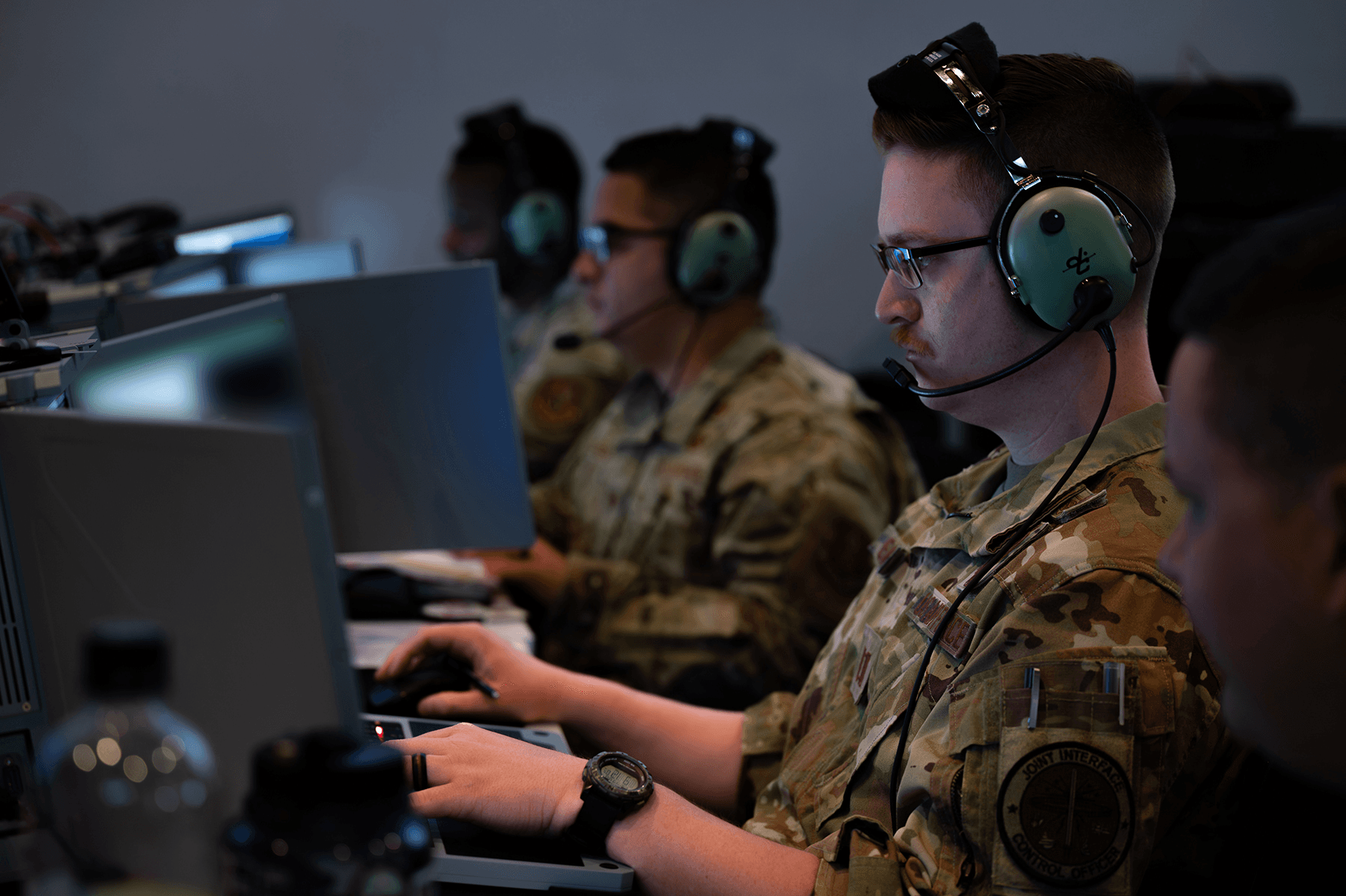
AI in Modern Warfare Explained: How Algorithms Are Shortening the Kill Chain
Executive Summary
In the first twenty-four hours of the US-Iran war that began on February 28, 2026, the Pentagon's Project Maven artificial intelligence system identified and facilitated the striking of more than 1,000 targets. Before Maven's integration with large language models, that same system processed fewer than 100 targets per day. After the LLM integration phase, that number climbed to 5,000 targets per day - a fifty-fold increase in lethal throughput achieved not by deploying more soldiers, more aircraft, or more missiles, but by accelerating the cognitive process that connects a sensor reading to a kinetic decision with an algorithm running at speeds no human committee, no intelligence cell, and no targeting board could ever match.
That fifty-fold increase is the clearest single number available for understanding what AI has actually done to warfare in 2026. Not autonomous robots making their own kill decisions - that threshold, while approaching, has not yet been formally crossed by any major power. Not science fiction superintelligences directing armies. Rather, the systematic acceleration of every cognitive task that precedes the human decision to strike: surveillance data processing, target identification, pattern recognition, intelligence fusion, threat prioritization, and kill chain management - all of it converted from work that human analysts once performed in hours and days into work that algorithms complete in seconds and minutes. Project Maven, the Pentagon's flagship AI warfare program established in 2017 as a narrow drone footage analysis experiment, has become, as TechXplore's April 2026 analysis characterizes it, "both the air traffic control of battle and its cockpit."
The implications extend far beyond any single conflict or system. Every major military power in the world - the United States, China, Russia, Israel, the United Kingdom, India, France - is simultaneously developing, deploying, and iterating AI warfare systems whose combined effect is a fundamental transformation in the character of military competition itself. The arms race is no longer primarily about who has more tanks, more missiles, or more aircraft. It is about who processes information faster, makes targeting decisions more accurately, and can translate sensor data into kinetic effect at machine rather than human speed. This is the strategic reality that the Iran war has made visible, and that every defense establishment in the world is now racing to respond to.
Background: From Drowning in Data to Algorithmic Warfare
The problem Project Maven was originally built to solve tells the essential origin story of AI in warfare. By 2016, United States military operations had achieved a paradox: unprecedented surveillance capability combined with near-total inability to process the intelligence that surveillance generated. Drone platforms alone produced millions of hours of full-motion video and continuous intelligence, surveillance, and reconnaissance streams across multiple theaters simultaneously. Human analysts could review less than 5% of the collected intelligence - meaning the vast majority of potentially actionable information about adversary positions, movements, and activities was collected, stored, and never seen by any human analyst before it became operationally irrelevant.
This was not a shortage of sensors or firepower. It was a cognitive bottleneck - the human intelligence processing capacity failing to keep pace with the sensor capacity generating data for it to analyze. Project Maven, established by a Pentagon memo in April 2017, was the institutional response: apply machine learning algorithms specifically to drone footage analysis, training models to automatically identify objects of interest - vehicles, weapons, personnel, structures - and flag them for human review, converting what had been an impossible manual task into a tractable human-AI collaboration.
The program's early trajectory exposed the fault lines that now define the entire AI-warfare debate in 2026. Google's initial involvement ended in 2018 when a significant fraction of its engineering workforce staged walkouts protesting involvement in what employees characterized as weapons development work that violated their ethical principles - a corporate crisis that established the template for Silicon Valley's persistent internal struggle between defense contract revenue and employee moral objection. Palantir, founded in part with CIA seed funding and built from its inception around government intelligence work, stepped into the space Google vacated, eventually becoming Maven's primary technology contractor with its AI forming what multiple analyses characterize as the program's operational backbone.
By 2025, the program had been deployed at what Palantir itself described as "production-level" across every unified American combatant command except Special Operations Command - meaning Project Maven's AI targeting and intelligence analysis infrastructure was embedded in the operational planning and execution of every major American military operation on earth. The conversion from experiment to operational standard, achieved in roughly eight years, represents the fastest institutional transformation in the history of American defense AI adoption.
Current Situation: AI Warfare at Operational Scale
Project Maven in Iran: The Kill Chain at Machine Speed
The Iran war that began in February 2026 following the US-Israeli strikes that killed Ayatollah Khamenei, documented extensively in parallel Global Chanakya analysis, has provided the clearest available demonstration of AI-assisted targeting at full operational scale. Project Maven's computer vision system increased the rate of target identification from fewer than 100 per day before the LLM integration phase to 1,000 per day - and with the large language model integration specifically conducted by Booz Allen Hamilton as the prime contractor for that phase, the projected processing rate has reached 5,000 identified targets per day, with future planning anticipating the capacity to facilitate 1,000 strikes per hour as the system matures further.
The NGA director confirmed in September 2025 that by June 2026, Maven would begin transmitting "100 percent machine-generated" intelligence to combatant commanders using LLM technology - a threshold that represents a qualitative shift in the human-machine relationship within military decision-making. Machine-generated intelligence does not mean human-free targeting decisions; official Pentagon policy has consistently maintained that humans remain in the decision loop for actual lethal authorization. But the practical compression this creates - intelligence generated by AI, analyzed by AI, and presented to a human commander who must make a kill decision within a compressed operational timeline - raises genuine questions about whether the human role in the loop constitutes genuine moral agency or increasingly resembles a consent layer superimposed on an algorithmic process operating too quickly for the human to meaningfully evaluate.
The public fracture between the Pentagon and AI companies over these questions became unmistakably visible during the Iran war. Anthropic, which had integrated its Claude AI into the Maven-related Military Support System for intelligence translation and battle scenario simulation, refused to permit its models to be used for mass domestic surveillance or fully autonomous weapons systems without meaningful human oversight, leading to the Pentagon blacklisting Anthropic as a national security supply chain risk in March 2026 and ordering its phased removal from defense systems. Google, meanwhile, removed its own AI policy restrictions and announced it was "leaning further into national security work," with xAI and OpenAI also identified as candidates to fill the role Anthropic vacated - illustrating the degree to which AI companies' strategic commercial calculation has shifted toward rather than away from military contracts since the original 2018 Google walkouts.
NATO's AI Command-and-Control Integration
Project Maven's transformation from an American program into an alliance-wide operational infrastructure has been one of the most significant, least-publicized developments in NATO's recent institutional evolution. By August 2025, NATO's Joint Warfare Centre confirmed that the Maven Support System had been deployed across Allied Command Operations, that staff were being trained on it, and that it had been incorporated into multiple NATO exercises including STEADFAST DETERRENCE 2025 and STEADFAST DUEL 2025 - with the JWC explicitly characterizing it as "NATO's first AI-enabled warfighting command-and-control system."
In March 2026, Steve Feinberg - the Secretary of Defense - formally stated that Project Maven would become an official program of record by September 2026, transferring from the National Geospatial-Intelligence Agency to the Chief Digital and Artificial Intelligence Office within thirty days. The US Army Combined Arms Command confirmed integration of Maven into its training programs in the same month. What began as a drone footage analysis tool has become the operational nervous system of American and allied military decision-making - embedded in training, exercised in alliance operations, and deployed in active combat simultaneously.
Ukraine: AI-Assisted Decision-Making in Attritional War
Ukraine's battlefield has served, as the ORF analysis documents, as a real-time laboratory for AI warfare applications that goes beyond simple targeting assistance into the broader question of how AI can generate a genuine "digital model of the battlefield." Project Maven's connection to the Security Assistance Group-Ukraine (SAG-U) under General Christopher Donahue's XVIII Airborne Corps evolved from logistical and materiel support into direct battlefield targeting assistance - AI models identifying and communicating potential targets that provided Ukrainian commanders with what the analysis characterizes as dynamic, AI-generated battlefield situational awareness that enabled counterattacks at speed and precision that would have been operationally impossible with purely human intelligence processing.
Ukraine's domestically developed Delta situational awareness platform represents a parallel, indigenously built AI warfare system that is worth examining alongside Project Maven precisely because it illustrates a different development pathway. Where Maven is a centralized, contractor-built system designed for the American military's specific technological architecture, Delta emerged from Ukraine's distributed, startup-driven defense technology ecosystem under active wartime pressure - integrating data from multiple sources including drone reconnaissance, ground sensors, and human reporting into a software-defined common operating picture that Ukrainian commanders use in real time at the tactical level. Delta's success has made it a model that NATO members are studying and, through the EU's LEAP initiative, beginning to incorporate into European defense capability development frameworks.
China's AI Military Ambition: The Competitor Palantir Fears
When Palantir CEO Alex Karp frames the AI warfare competition as a "have, have-not world" and argues that the West must achieve capabilities others lack, he is speaking primarily about China - whose AI military development program is estimated by the ORF analysis as "comparable" to the American FY2026 AI autonomous systems budget of $13.4 billion, even as Beijing has not released equivalent public figures. China's AI military development trajectory is visible through specific, documented programs and public demonstrations: the October 2024 Zhuhai Airshow display of a full brigade of armored vehicles and drones controlled by AI, the AI pilot that defeated a human pilot in an F-16 simulated dogfight in 2023, and the PLA's explicitly documented interest in autonomous targeting, ISR data fusion, and manned-unmanned teaming concepts directly analogous to the Project Maven architecture.
Vladimir Putin's 2017 declaration that "whoever becomes the leader in AI will become the leader in the world" - now being operationalized in Russia's battlefield deployment of AI-assisted drone targeting systems, fiber-optic guided munitions, and the explicitly stated intention to develop autonomous swarm capability per Russia's own published unmanned aviation strategy - illustrates that the AI warfare competition extends across three major competing powers simultaneously, with the development dynamics in each reflecting different institutional pathways toward the same operational objective: algorithms that enable faster, more accurate military decisions than adversaries can execute.
The Accountability Crisis: When Algorithms Kill at Scale
The single most philosophically and legally consequential aspect of AI's integration into warfare is the accountability crisis it creates - what the Medium documentary analysis characterizes as the fundamental redefinition of "military professionalism and command responsibility" when AI systems process intelligence, identify targets, and present prioritized strike recommendations faster than human commanders can independently verify the underlying determinations.
The formal position maintained by the Pentagon - that humans remain "in the decision loop" for targeting decisions - accurately describes the formal protocol while increasingly misrepresenting the practical reality. When Maven facilitates 1,000 strikes per day, with the LLM-integration pipeline projected to handle 5,000, and future planning targeting 1,000 per hour, the human commander authorizing each strike is making decisions at a pace that genuine individual scrutiny of each AI-generated recommendation cannot possibly sustain. The human role shifts, as the Medium analysis correctly identifies, "from decision-maker to system supervisor" - a role that retains legal responsibility while functionally ceding cognitive authority to the algorithm that generated the recommendation being approved.
This is not a hypothetical concern. The Iran war has already generated controversies regarding civilian casualty assessments, hospital strikes, and the difficulty of verifying AI-generated target classifications that human analysts would previously have spent hours validating. The gap between the legal framework - which assigns individual human responsibility for targeting decisions - and the operational reality - in which those decisions are made at machine speed based on AI recommendations that no individual human can fully independently verify - represents a structural accountability gap that the international laws of armed conflict were not written to address and that no existing governance framework adequately resolves.
Strategic Analysis: The Architecture of Algorithmic Warfare
The Kill Chain Acceleration Imperative
The core military logic driving AI integration into warfare is the kill chain acceleration imperative - the competitive pressure to reduce the time between detecting a target and destroying it, because adversaries who can compress their own kill chain faster can exploit fleeting tactical opportunities, adapt to battlefield changes before opponents can respond, and achieve force multiplication effects that numerical superiority alone cannot match. Project Maven's technical architecture - combining machine learning computer vision with satellite imagery, geolocation data, communications intercepts, infrared sensors, and synthetic aperture radar into a continuously updated battlefield operating picture - addresses every stage of the kill chain simultaneously: find faster, fix faster, finish faster.
The progression from less than 100 to 1,000 to 5,000 targets per day is not merely a quantitative improvement - it represents a qualitative shift in what military operations can accomplish within a given operational window, changing the fundamental economics of strike campaigns in ways that cascade through every dimension of military strategy. A force that can accurately identify and strike 5,000 targets per day is not simply five hundred times more effective than one that can handle 100 - it can pursue strategic objectives that would be operationally impossible at lower processing speeds, compress adversary adaptation cycles below the threshold of effective response, and maintain operational tempo that exhausts an adversary's ability to reconstitute before the next strike cycle.
Automation Bias: The AI Warfare's Most Dangerous Pathology
The Medium documentary analysis and the TechPolicy Press assessment both identify what may be AI warfare's most dangerous near-term pathology: automation bias - the human tendency to defer to algorithmic recommendations, particularly under the time pressure and cognitive overload that combat operations generate, in ways that progressively reduce the genuinely independent human judgment that formal "human-in-the-loop" policies are supposed to preserve.
Automation bias is well-documented outside warfare: pilots have crashed aircraft while autopilot systems malfunctioned because the automation's recommendations overrode their own accurate situational awareness; medical professionals have made incorrect treatment decisions because algorithmic diagnostic tools produced confident-seeming wrong answers. In warfare, where decision timelines are shorter, cognitive stress is higher, and the consequences of error are immediate and irreversible, automation bias represents a genuinely structural risk - one that policy frameworks requiring "human oversight" cannot simply engineer away by formal protocol. The human who approves an AI targeting recommendation in a high-tempo strike campaign is not, psychologically, making the same quality of independent judgment as the human who would have reached the same conclusion through the traditional, unhurried intelligence analysis process.
The Competitor Convergence Problem
The strategic reality that makes AI warfare's governance challenge so intractable is what the Medium analysis terms "competitor convergence" - the dynamic in which any power that restrains its own AI warfare capability, for ethical or legal reasons, faces the structural risk of capability disadvantage against adversaries that impose no equivalent self-restraint. This is the logic that drove Google's removal of its own AI policy restrictions after Anthropic's principled resistance to autonomous weapons use led to the Pentagon contract termination - the commercial pressure of a $13.4 billion annual AI defense market creates powerful incentive for AI companies to compete for contracts by removing the ethical guardrails that would exclude them, regardless of what individual engineers or executives might prefer.
This competitor convergence dynamic explains why international governance frameworks for AI warfare have made so little progress despite widespread stated agreement on their necessity: every major power has an independent incentive to develop AI warfare capability as rapidly as possible while its adversaries theoretically restrain themselves, a classic prisoner's dilemma structure that produces arms race outcomes regardless of stated cooperative preferences.
Global Impact: The Strategic Balance Rewritten by Algorithms
The Intelligence Revolution's Second-Order Effects
AI's transformation of intelligence analysis - converting what was previously a human bottleneck into a machine-speed processing capability - carries second-order strategic effects that extend well beyond the direct targeting applications that typically dominate public discussion. When intelligence analysis becomes dramatically faster and more comprehensive, the "fog of war" that has historically constrained military decision-making at every level begins to clear in ways that fundamentally alter the strategic landscape. Commanders who can see the battlefield more clearly and update their understanding more rapidly than adversaries can respond gain decision-making advantages that compound across an entire operation's duration, converting tactical intelligence superiority into operational and strategic outcomes.
This intelligence revolution has specific implications for the extended deterrence architecture documented extensively in parallel Global Chanakya analysis of American alliance commitments in the Indo-Pacific and Europe. A military AI system capable of identifying 5,000 targets per day can plan and execute strike campaigns of a scale and speed that would previously have required weeks of intelligence preparation, compressing the temporal window available for diplomatic de-escalation between crisis onset and kinetic action. This compression effect - reduced time for diplomacy before warfare - is identified by the Medium analysis as one of AI warfare's most dangerous structural properties, and represents a genuine governance challenge that no amount of rhetorical commitment to "human oversight" adequately addresses.
The Asymmetric AI Access Problem
The military AI competition is not occurring on a level playing field - it is a "have, have-not world" in Alex Karp's framing, and that asymmetry carries genuine consequences for global stability. Advanced AI warfare systems require sustained access to cloud computing infrastructure, high-quality training data, advanced semiconductor chips, and the engineering talent to build and maintain complex machine learning systems - requirements that favor wealthy, technologically advanced states and increasingly disadvantage those without equivalent technical foundations.
This creates a new dimension of military stratification: states with advanced AI capabilities gain targeting, ISR, and decision-making advantages that cannot be offset by numerical superiority in conventional platforms. A smaller force with superior AI-enabled situational awareness, faster kill chains, and AI-optimized logistics can effectively outfight a larger force operating on purely human cognitive speed. This asymmetry favors exactly the states - primarily the United States, China, Israel, and increasingly the European powers building on Ukrainian battlefield expertise - that have invested most heavily in AI warfare infrastructure, while raising serious concerns about the escalatory behavior that capability-inferior powers might pursue to compensate for their disadvantage.
Risk Assessment
The Structural Accountability Gap
The most acute institutional risk of AI warfare is the growing gap between formal accountability frameworks and operational reality. International humanitarian law assigns targeting accountability to individual human decision-makers. AI warfare systems that process thousands of targets per day and present machine-generated recommendations at machine speed make that individual accountability framework increasingly fictional - not because humans are removed from the loop, but because the "loop" operates at speeds that preclude the genuine independent judgment that accountability frameworks presuppose. When errors become "structural outcomes rather than isolated accidents," as the Medium analysis characterizes the endpoint of this trajectory, existing legal and ethical frameworks collapse entirely.
The Escalation Compression Risk
AI systems that compress the kill chain from days to hours to minutes simultaneously compress the diplomatic window between crisis onset and kinetic action. A geopolitical crisis that would historically have allowed days of diplomatic exchange before military options exhausted may now produce irreversible military outcomes before diplomatic channels have achieved any meaningful engagement, generating escalation dynamics that the technology's speed makes structurally more probable regardless of human intentions at the political level.
Future Scenarios
Scenario Analysis: AI Warfare Through 2030
Scenario One: Institutionalized AI-Assisted Warfare With Maintained Human Oversight (Probability: 45%)
AI warfare systems continue expanding in capability and deployment scope while formal human-in-the-loop requirements are maintained through policy and institutional practice, producing an AI-augmented but not AI-autonomous warfare environment in which the speed and accuracy advantages are real but the ethical and accountability frameworks remain functionally intact, however strained. This represents the most optimistic trajectory consistent with current official policy in all major Western military establishments.
Scenario Two: De Facto Autonomous Targeting Through Accountability Erosion (Probability: 40%)
The most probable trajectory, given automation bias, competitive pressure to compress kill chains, and the practical impossibility of genuine individual scrutiny at 5,000-target-per-day processing speeds, involves de facto autonomous targeting achieved not through explicit policy change but through the accumulated erosion of meaningful human judgment in an oversight loop operating at machine rather than human cognitive speed. Formal policy maintains "human in the loop" while operational reality converts that human to a system supervisor approving algorithmic recommendations under conditions that preclude genuine independent judgment.
Scenario Three: International Governance Breakthrough (Probability: 15%)
A catastrophic AI warfare incident - a mass civilian casualty event demonstrably caused by algorithmic misclassification, or an escalation crisis directly attributable to automated targeting - produces the political shock sufficient to drive meaningful international governance agreement, establishing binding constraints on autonomous targeting, AI weapons deployment thresholds, and accountability frameworks that the current environment has completely failed to produce through deliberative process alone.
Intelligence Forecast
- Project Maven will achieve official program of record status by September 2026, transitioning from a special initiative to permanent Pentagon infrastructure, with the US Army Combined Arms Command integration cementing AI-assisted targeting as standard doctrine across the force.
- Google, xAI, and OpenAI will likely compete for the Anthropic replacement contract in Maven's LLM integration layer, with Google's removal of its own AI policy restrictions signaling willingness to compete on the most ethically contested dimensions of the contract that Anthropic refused to fulfill.
- China will likely demonstrate advanced AI-assisted military systems at a major public defense event in 2026-2027, signaling capability parity or potential advantage in specific AI warfare domains - potentially including swarm coordination and manned-unmanned teaming at operational scale.
- NATO's AI command-and-control integration will likely deepen further through 2026, with Maven's deployment across all unified combatant commands providing the technical foundation for AI-assisted planning across the full alliance operational spectrum.
- International governance proposals will likely advance rhetorically without achieving binding frameworks, maintaining the structural accountability gap that accelerating AI warfare deployment continues to widen.
Final Strategic Takeaway
AI in modern warfare is not a future technology being cautiously evaluated. It is the operational infrastructure of the most powerful military on earth, deployed across every combatant command, exercised in every major NATO operation, and battle-tested in live warfare from Ukraine to Gaza to Iran. Project Maven's evolution from a drone footage analysis experiment to a system facilitating 5,000 targets per day - with future planning targeting 1,000 per hour - traces the trajectory of a transformation that has already fundamentally altered the character of military conflict in ways that most public discourse, most governance frameworks, and most international law has not yet absorbed.
The strategic implications are severe and deserving of serious, sustained engagement rather than the episodic alarm that attends each new operational deployment. When AI compresses the kill chain from hours to minutes to seconds, it simultaneously compresses every other process that war is embedded in: the diplomatic process that might prevent it, the intelligence process that should validate its necessity, and the legal process that should establish its proportionality. What is emerging, whether any individual government or technology company intends it or not, is a warfare architecture in which algorithms make the decisions that determine who lives and dies faster than any human ethical framework was designed to evaluate.
Palantir CEO Alex Karp's warning that this is a "have, have-not world" contains a genuine strategic truth that cuts in a more uncomfortable direction than he likely intends: the have-nots who lack AI warfare capability face a military disadvantage that may drive exactly the kind of compensatory escalation - nuclear posturing, unconventional warfare, asymmetric attacks on AI infrastructure - that the responsible deployment of powerful military AI should be designed to deter rather than invite. Building AI warfare systems faster than the governance frameworks to constrain their use does not produce a more stable world. It produces a faster path to exactly the catastrophic accident that would force the governance reckoning everyone who studies this domain knows is necessary but none of the competing states are currently willing to accept as a strategic cost.
Global Chanakya Intelligence Assessment: Project Maven has made the United States the world's most capable AI-assisted military power by a substantial margin. Whether that capability advantage produces the deterrence stability its architects intend, or accelerates the very conflicts it is designed to prevent by compressing every decision timeline below the threshold of meaningful diplomatic intervention, is the defining strategic question of the algorithmic warfare era - and nobody in a position of authority has yet given it an honest answer.