
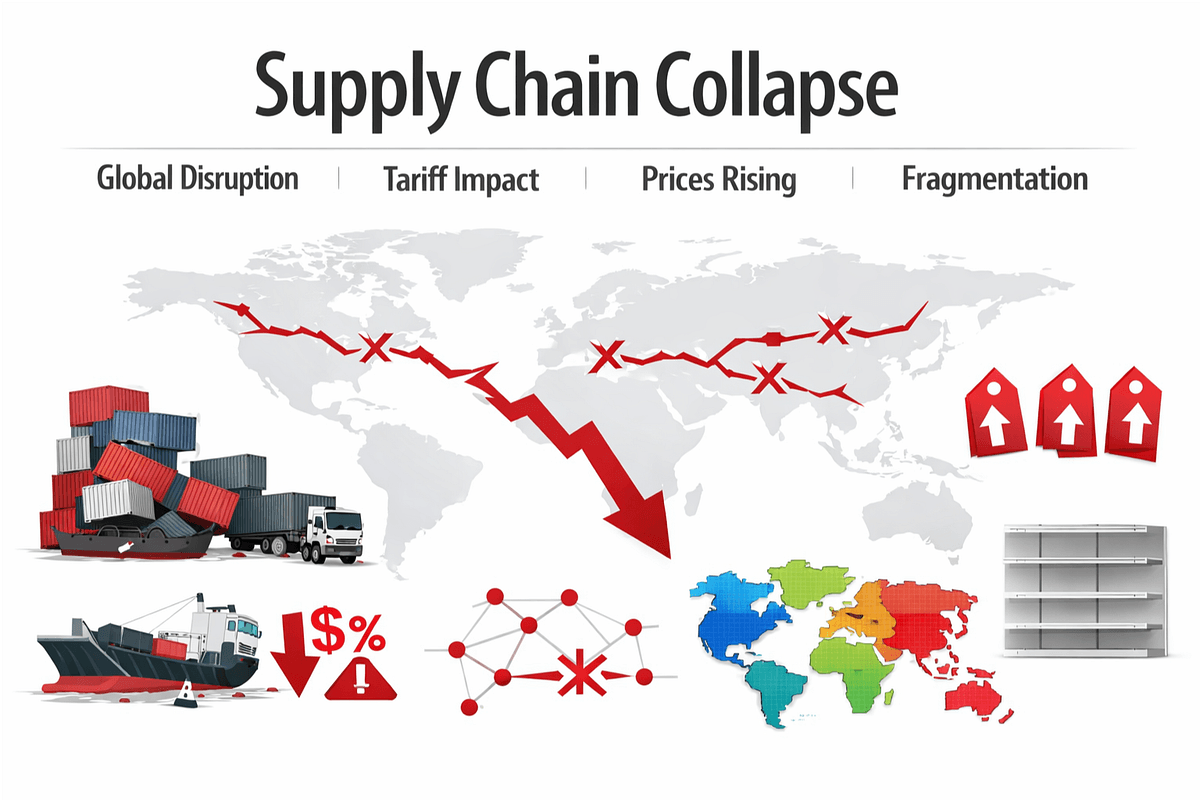
Global Supply Chain Risks in 2026: The Fracturing of the World's Economic Nervous System
Executive Summary
The global supply chain - the intricate, interconnected web of production, logistics, finance, and information that moves raw materials from the earth's crust to finished goods on billions of consumers' shelves - is under assault from multiple directions simultaneously in 2026. What was once treated as a technical domain managed by logistics professionals and procurement specialists has become the central arena of geopolitical competition, strategic coercion, and great power conflict. The disruptions are no longer episodic shocks from which recovery is swift. They are structural, accumulating, and in many dimensions, self-reinforcing.
The year 2026 finds the world's supply architecture confronting a genuinely unprecedented convergence of stress vectors. The war in Ukraine grinds into its fifth year, continuing to distort global energy markets, grain flows, and European industrial economics. The Red Sea remains a contested maritime corridor, with Houthi forces backed by Iran sustaining attacks on commercial shipping that have rerouted thousands of vessels around Africa's Cape of Good Hope. The technological decoupling between the United States and China has accelerated dramatically, fracturing global semiconductor, pharmaceutical, and critical mineral supply chains along geopolitical fault lines. Climate disruption is delivering supply shocks with increasing frequency and severity across agriculture, water-intensive manufacturing, and port logistics. And the global financial architecture - the dollar-denominated payment rails, correspondent banking networks, and multilateral trade institutions - is under sustained challenge from the BRICS-led alternative economic framework that Russia and China are assembling with growing momentum.
The strategic implications extend far beyond corporate balance sheets and consumer price indices. Supply chains are instruments of geopolitical power. The nation or bloc that controls the production of critical inputs - semiconductors, rare earth elements, active pharmaceutical ingredients, military-grade materials - holds leverage over every nation that depends on those inputs. The nation that controls maritime chokepoints, satellite navigation systems, and undersea cable networks controls the arteries through which the modern economy breathes. In 2026, the competition for that control is intensifying across every dimension, and the risks of miscalculation, cascading failure, and deliberate weaponization of economic interdependence are higher than at any point in the post-Cold War era.
This report provides a comprehensive, doctrine-level assessment of the principal supply chain risk vectors in 2026 - their origins, their current operational dynamics, their strategic implications for major powers, and their likely trajectory across multiple future scenarios.
Background: How the World Arrived at This Juncture
The architecture of the modern global supply chain was built on a set of foundational assumptions that have proven, over the past decade, to be dangerously optimistic. The first and most consequential of these assumptions was the belief that economic interdependence creates political stability - that nations embedded in complex webs of mutual commercial dependency would find armed conflict and aggressive coercion too costly to contemplate. This thesis, articulated most influentially in the liberal internationalist tradition from the late Cold War period through the early 2000s, undergirded the entire project of integrating China into the World Trade Organization, expanding NATO and the European Union into Eastern Europe, and building the multilateral institutions of global economic governance.
The second foundational assumption was operational: that just-in-time production principles, combined with global sourcing and lean inventory management, would maximize efficiency and returns for firms embedded in global value chains. This was economically rational in a stable, rule-governed, and predictable operating environment. It proved catastrophically fragile when that environment deteriorated.
The chain of disruptions that has exposed these flawed foundations runs through several decisive moments. The COVID-19 pandemic of 2020 and 2021 was the first comprehensive stress test of the just-in-time global supply architecture, and the system failed visibly and at enormous cost. Semiconductor shortages paralyzed automotive manufacturing worldwide. Personal protective equipment production, concentrated almost entirely in China, was unavailable when demand surged globally. Port congestion, container imbalances, and air freight saturation combined to extend delivery times and raise costs across virtually every product category. The system recovered, but it did not reform fast enough to prevent subsequent shocks from proving equally damaging.
Vladimir Putin's decision to launch the full-scale invasion of Ukraine in February 2022 delivered the second major shock, disrupting European energy architecture, blocking Black Sea grain exports, and triggering the most comprehensive Western sanctions regime ever imposed on a major economy. The energy price spike of 2022 cascaded through European industrial supply chains with devastating force, forcing production shutdowns in energy-intensive sectors - chemicals, aluminum, glass, ceramics - that feed into dozens of downstream value chains. The grain price shock affected food security across the Middle East, Sub-Saharan Africa, and South Asia, creating the political instability conditions that feed into further economic disruption.
The US-China technology war, formalized through successive rounds of semiconductor export controls beginning in 2022 and escalating significantly thereafter, introduced a third structural disruption. The deliberate fragmentation of the world's most technologically sophisticated industry - semiconductors, which sit at the foundation of every modern manufactured good from automobiles to aircraft to consumer electronics to weapons systems - along geopolitical lines has created two increasingly separate technology supply chains whose bifurcation imposes costs on virtually every participant in the global economy.
By 2026, these disruptions are not recovering toward a previous normal. They are consolidating into a new structural reality in which supply chain fragility is the baseline condition rather than the exceptional state.
Current Situation: The Principal Risk Vectors of 2026
Geopolitical Conflict and Maritime Insecurity
The geopolitical conflict dimension of supply chain risk in 2026 operates across multiple theaters simultaneously, each with its own dynamics but collectively creating a systemic elevation of risk that affects all forms of maritime and overland trade.
The Red Sea corridor remains the most acute active maritime security crisis. Houthi forces, operating under Iranian strategic guidance and equipped with Iranian-supplied drones, anti-ship missiles, and naval mines, have sustained a campaign against commercial shipping that began in late 2023 and has not been decisively suppressed despite significant American and allied military operations against Houthi infrastructure inside Yemen. The persistence of this campaign into 2026 has transformed what was initially treated as a temporary security disruption into a durable structural feature of the global shipping environment. Insurance markets, shipping company operational planning, and port logistics across the Indian Ocean basin have adapted to reflect this new reality, but the adaptation itself carries costs - elevated premiums, longer routes, higher fuel consumption, and extended delivery times that have been absorbed into the structural cost base of global trade.
The South China Sea presents a distinct but equally consequential maritime risk. China's increasingly assertive military posture in these waters - expanding artificial island military installations, intensifying coast guard and naval operations against Philippine vessels in contested areas, conducting regular air and sea incursions into Taiwan's air defense identification zone - has elevated the perceived risk of military confrontation in a waterway through which approximately three trillion dollars of trade passes annually. Xi Jinping's government has demonstrated consistent willingness to accept economic friction costs in pursuit of territorial and strategic objectives, and the trajectory of Chinese assertiveness in the South China Sea has been consistently upward across multiple years despite diplomatic protests and legal rulings.
Taiwan represents the single highest-consequence supply chain risk in the global system. The Taiwan Semiconductor Manufacturing Company and Taiwan's broader semiconductor ecosystem produce a disproportionate share of the world's most advanced chips - the foundational components of artificial intelligence systems, advanced defense platforms, consumer electronics, automotive controls, and virtually every other technology-intensive application. Any military action against Taiwan - whether a Chinese naval blockade, missile strikes on industrial facilities, or a full-scale amphibious invasion - would remove a critical fraction of global semiconductor supply at a moment of already severe global chip shortage, triggering supply chain cascades across dozens of interconnected industries. The United States, Japan, South Korea, the Netherlands, and their AUKUS and QUAD partners have all intensified contingency planning for this scenario, but no combination of reshoring and allied capacity development currently available can substitute for TSMC's advanced node production capacity on any meaningful timeframe.
The Ukraine war's supply chain effects have evolved from the acute energy and grain price shocks of 2022 into more diffuse but persistent structural damage. Ukraine's agricultural export capacity, critical for global grain and sunflower oil markets, operates under sustained Russian aerial and naval attack. The reconstruction economics of Ukraine have created demand for construction materials, heavy equipment, and skilled labor that competes with other European priorities. Russian energy supplies, while substantially replaced in European markets by LNG and renewable development, continue to be purchased by India, China, and other non-aligned economies at discounts that reshape global energy trade flows and create secondary commercial tensions with Western partners.
The Technology Decoupling Crisis
The accelerating decoupling of Chinese and Western technology supply chains constitutes what many senior analysts now regard as the most structurally significant supply chain development of the decade. The semiconductor export control regime imposed by the United States and progressively extended to include Japan, the Netherlands, South Korea, and other key technology producers has attempted to prevent China from acquiring or domestically producing advanced semiconductor manufacturing equipment and chips above specified performance thresholds. China has responded with an enormous state-directed investment program in domestic semiconductor development, with the stated objective of technological self-sufficiency across the full semiconductor value chain.
The consequences of this decoupling dynamic are playing out across multiple dimensions simultaneously. For global technology companies, the bifurcation of the supply chain means designing and manufacturing products compatible with two increasingly separate technology ecosystems - one built around American, Japanese, Dutch, and South Korean components and standards, and one built around Chinese domestic alternatives. The cost and complexity of maintaining dual supply chains, dual product designs, and dual regulatory compliance regimes imposes a significant overhead on multinational technology firms operating in both markets.
For the broader global economy, the semiconductor decoupling carries implications that extend far beyond the technology sector itself. Modern manufacturing across virtually every industrial sector - automotive, aerospace, medical devices, telecommunications, energy systems, agricultural equipment - depends on semiconductors of various specifications. When the supply chain for these foundational components fractures along geopolitical lines, the fragmentation propagates into every downstream sector. Nations and firms that find themselves on the wrong side of the technology divide - unable to access advanced chips from either supply chain at competitive prices and in reliable volumes - face fundamental competitive disadvantages in every technology-intensive industry.
China's domestic semiconductor development program, while absorbing enormous investment from the Chinese state and state-aligned capital, has not succeeded in closing the most critical technology gaps at the advanced node level. However, China has made meaningful progress in mature node semiconductor production - chips used in automotive, industrial, and consumer applications that do not require cutting-edge miniaturization. This creates a scenario in which the global semiconductor supply chain in 2026 is characterized by Chinese oversupply and price competition in mature node categories, combined with Chinese deficit and strategic vulnerability at the advanced node level. The resulting market dynamics are genuinely complex, creating competitive pressure on non-Chinese mature node producers while the advanced node market remains dominated by TSMC, Samsung, and Intel.
Critical Minerals and the Resource Dependency Trap
The energy transition - the global shift away from fossil fuels toward electric vehicles, renewable power generation, and electrified industrial processes - was supposed to reduce the geopolitical vulnerability inherent in hydrocarbon dependency. In practice, the energy transition has created new and in some respects more concentrated resource dependencies centered on the critical minerals required for batteries, permanent magnets, solar panels, wind turbines, and power electronics. The supply chain geography of these critical minerals is, for the Western world, significantly more vulnerable than the oil and gas supply chain it is replacing.
China dominates the processing of virtually every critical mineral relevant to the energy transition. This dominance is not merely a function of Chinese domestic mineral reserves - though China holds significant reserves of some materials, including rare earth elements. It is primarily a function of decades of deliberate investment in processing infrastructure, technical expertise, and market positioning that has given Chinese firms control over the refining, processing, and alloying stages of critical mineral supply chains even where primary mining occurs in Africa, Australia, South America, or elsewhere. Cobalt mined in the Democratic Republic of Congo, lithium extracted in Chile and Australia, and nickel produced in Indonesia all flow predominantly through Chinese processing facilities before reaching battery manufacturers worldwide.
China has demonstrated willingness to weaponize this processing dominance as a geopolitical instrument. Export restrictions on gallium and germanium, implemented by Beijing in response to Western semiconductor export controls, sent immediate signals to global technology industries about the vulnerability of their material supply chains to Chinese administrative action. Further restrictions on graphite exports, critical for lithium-ion battery anodes, amplified that signal. In 2026, the pattern of selective and escalatory Chinese critical mineral export controls is well established, and the Western response - accelerated investment in alternative processing facilities in Australia, Canada, the European Union, and the United States - has made meaningful but still insufficient progress toward supply chain resilience in these materials.
The rare earth element situation deserves particular attention. Rare earth elements - a group of seventeen metallic elements with unique electromagnetic and catalytic properties - are essential inputs for permanent magnets used in electric vehicle motors, wind turbine generators, precision-guided munitions, radar systems, and a wide range of defense electronics. China produces and processes an overwhelming majority of global rare earth supply. The strategic implications of this concentration for both economic competitiveness and military capability are profound. The United States, European Union, Japan, Australia, and India have all launched initiatives to develop alternative rare earth supply chains, but the capital intensity of mining and processing infrastructure, combined with the environmental challenges of rare earth processing, ensures that meaningful supply chain diversification in this sector will require a decade or more of sustained investment.
Climate Disruption and Physical Supply Chain Risks
The physical impacts of climate change are now a direct and material supply chain risk that corporate risk managers, trade finance providers, and government planners must incorporate into their assessments with the same rigor applied to geopolitical and financial risks. This is not a projection or a future scenario - it is an observable reality in 2026, documented in disruptions to agricultural production, water-dependent manufacturing, port operations, and overland transportation infrastructure across multiple continents.
Agricultural supply chains are experiencing increasing volatility from climate-driven production shocks. Extreme heat events have damaged grain harvests in South Asia, the Sahel, and parts of Europe with increasing frequency. Drought conditions have stressed wheat and corn production across the American Midwest, Argentina, and Australia in successive seasons. Flooding has disrupted rice production across Southeast Asia, affecting food security across the region and global rice price stability. The compounding effect of multiple simultaneous climate-driven agricultural shocks is more severe than the sum of individual disruptions, because global grain markets have limited buffer capacity - reserves that can absorb one major production shortfall may be inadequate when two or three coincide across different staple crops and different geographies.
Water scarcity is an underappreciated supply chain risk with potentially severe consequences for semiconductor manufacturing, pharmaceutical production, and textile manufacturing - all of which are water-intensive processes. The semiconductor fabrication process requires enormous volumes of ultrapure water for wafer washing and cooling. Major semiconductor manufacturing clusters in Taiwan, South Korea, and Arizona have all experienced water supply stress events that have raised concerns about the long-term sustainability of locating water-intensive manufacturing in areas facing increasing drought risk.
Extreme weather events are disrupting port operations and overland logistics infrastructure with increasing frequency. Typhoons and cyclones are intensifying in the Pacific and Indian Oceans, causing temporary closures of major container ports in China, Vietnam, the Philippines, and India. Flooding disrupts road and rail links in production and transit zones. Wildfire-related air quality emergencies force outdoor production suspensions in multiple industrial regions. The aggregate effect of these individually manageable but collectively overwhelming physical disruptions is a permanent elevation in the uncertainty and cost of operating global supply chains across their geographic extent.
Financial Architecture Fragmentation
The financial infrastructure underlying global trade - the dollar-denominated payment systems, SWIFT messaging network, correspondent banking relationships, trade finance instruments, and multilateral lending facilities - is experiencing fragmentation along geopolitical lines that carries significant supply chain implications. When trade finance becomes politicized, when payment systems become instruments of sanctions enforcement, and when alternative financial architectures are developed to route around Western-controlled financial infrastructure, the reliable, low-cost flow of goods and payments through global supply chains is disrupted.
The weaponization of financial sanctions, most dramatically demonstrated in the exclusion of Russian banks from SWIFT and the freezing of Russian central bank assets following the 2022 Ukraine invasion, has sent a clear strategic signal to every nation that perceives itself as a potential target of Western financial pressure: holding dollar-denominated reserves, depending on Western-controlled payment infrastructure, and integrating deeply with the dollar-based financial system creates strategic vulnerability. The response, led by China and Russia and supported by other BRICS members, has been to accelerate the development of alternative payment mechanisms, bilateral currency swap arrangements, and commodity pricing in non-dollar currencies.
China has expanded the Cross-Border Interbank Payment System as an alternative to SWIFT for renminbi-denominated transactions. Russia has developed its own financial messaging system for domestic and bilateral international transactions. The BRICS grouping, which expanded significantly in 2024 to include Saudi Arabia, the UAE, Egypt, Iran, Ethiopia, and other members, has been exploring mechanisms for bilateral and multilateral trade settlement outside the dollar system. These alternatives remain incomplete and in many respects less efficient than the dollar-based system they seek to supplement, but their development trajectory is clearly toward greater functionality and broader adoption.
The practical supply chain implication of financial fragmentation is that trade flows that previously operated through seamless, low-cost global financial infrastructure increasingly require navigation of multiple, partially incompatible financial systems with higher transaction costs, greater compliance complexity, and greater uncertainty. For firms operating supply chains that cross geopolitical fault lines - sourcing in China while selling in the United States, or operating in both sanctioned and non-sanctioned markets - the financial infrastructure fragmentation adds meaningful overhead and risk.
Strategic Analysis: The Great Bifurcation and Its Consequences
Friend-Shoring and Its Limits
The dominant strategic response of the United States and its allies to supply chain vulnerability has been the doctrine of friend-shoring - the deliberate restructuring of supply chains to concentrate production and sourcing within trusted partner nations rather than potential adversaries. The practical implementation of this doctrine encompasses the CHIPS Act and its subsidies for domestic semiconductor manufacturing in the United States, the EU Chips Act in Europe, the India-US Initiative on Critical and Emerging Technologies, the QUAD supply chain resilience working groups, and bilateral agreements between the United States, Japan, South Korea, Australia, and other partners for critical mineral supply chain development.
Friend-shoring is strategically rational but economically costly, and its implementation faces several fundamental tensions. The first is the efficiency penalty - supply chains optimized for geopolitical resilience are not optimized for cost, and the consumer price implications of systematically reshoring or friend-shoring production that was previously located in China or other low-cost jurisdictions are substantial. At a moment of already elevated inflation across Western economies, the additional cost pressure from supply chain restructuring creates political headwinds that constrain the pace and ambition of the policy.
The second tension is the geographic reality that many of the world's critical mineral deposits are not located in Western ally nations. Cobalt is predominantly in the Democratic Republic of Congo, a country with deeply complex governance challenges. Lithium is concentrated in Argentina, Chile, and Bolivia - the so-called Lithium Triangle - whose governments have varying degrees of alignment with Western economic preferences and some of which have pursued resource nationalism policies that complicate Western investment. Nickel of the quality required for battery applications is concentrated in Indonesia, which has pursued an active industrial policy designed to capture more of the processing value chain domestically rather than exporting raw ore. Friend-shoring works best when allies control the resources - a condition that does not always obtain.
The third tension is time. Building semiconductor fabrication plants, rare earth processing facilities, battery gigafactories, and the associated supply chain ecosystems required to sustain them takes years to decades, requires massive capital investment, and depends on the availability of a skilled workforce that does not currently exist at the required scale in many Western nations. The supply chain vulnerabilities being addressed are present and acute; the remedies being developed are future and gradual.
India's Emerging Role as the Alternative Manufacturing Hub
India, under Narendra Modi's government, has positioned itself as the most significant alternative to China as a global manufacturing hub - a positioning that carries profound supply chain implications for the world economy. India's advantages in this role are genuine and substantial: a large and young labor force, a growing technical and engineering talent base, improving physical infrastructure, an English-language business environment compatible with Western corporate governance, a democratic political system that Western governments find more strategically comfortable than China's authoritarian capitalism, and a government committed to manufacturing growth through production-linked incentive schemes across priority sectors.
India has attracted significant investment in electronics assembly, particularly in smartphones and related consumer electronics, with Apple's supply chain diversification to India - centered on Foxconn and Tata Group assembly operations in Tamil Nadu and elsewhere - representing the most high-profile instance of a fundamental shift in the geographic distribution of advanced electronics manufacturing. The semiconductor packaging and testing sector has received major investments from companies responding to Indian government incentives. Pharmaceutical manufacturing, where India was already a global leader, has expanded further as Western governments have sought to reduce dependence on Chinese active pharmaceutical ingredient production.
India's rise as a manufacturing alternative to China is strategically significant not merely for its economic dimensions but for its geopolitical implications. As India absorbs manufacturing investment that might previously have flowed to China, it builds the economic capabilities, technological depth, and infrastructure that will support its long-term strategic ambitions. The deepening integration of Indian manufacturing into global supply chains also strengthens India's stake in the rules-based international trading order and creates additional economic weight supporting India's growing diplomatic and strategic influence - a dynamic that Narendra Modi's government has skillfully cultivated.
China's Supply Chain Weaponization Strategy
Xi Jinping's China has developed supply chain dependency as a deliberate instrument of strategic competition with a sophistication that exceeds any previous practitioner of economic statecraft. The strategy operates at multiple levels simultaneously. At the macro level, China's Belt and Road Initiative has built deep infrastructure and financial dependencies among dozens of developing nations across Asia, Africa, Latin America, and the Pacific, creating a web of relationships in which China is the central node and recipient nations depend on Chinese financing, construction capacity, and market access. At the sectoral level, China's deliberate investment in controlling the processing stages of critical mineral supply chains has given it leverage over the energy transition in every industrialized nation. At the product level, China's manufacturing dominance in consumer electronics, solar panels, wind turbine components, electric vehicles, and industrial machinery means that any disruption of Chinese supply chains - whether through Chinese export controls, political tensions, or military contingencies - reverberates through global production systems immediately and severely.
The selective use of export controls on critical materials - gallium, germanium, graphite, rare earth processing materials - has demonstrated that China views its supply chain dominance as a coercive instrument in its competition with the United States and its allies. This weaponization is calibrated carefully: targeted enough to signal capability and willingness, moderate enough to avoid triggering responses so severe as to accelerate Western supply chain independence. The calibration reflects a strategic understanding that the dependency being leveraged is a wasting asset - that Western friend-shoring and supply chain diversification efforts, if sustained, will gradually reduce Chinese leverage - and that the window of maximum coercive utility is finite.
China's own supply chain vulnerability must also be acknowledged in any balanced strategic assessment. China is a massive net importer of food commodities, iron ore, copper, and many other raw materials. It depends heavily on maritime shipping routes that it does not control for these imports - a dependence that Donald Trump's trade policies and broader US strategic competition have sought to exploit. China's technology supply chain remains dependent on Western-designed advanced chips and chip manufacturing equipment at the most sophisticated levels, a dependency that the American export control regime targets precisely. Xi Jinping's concept of the dual circulation economy - which seeks to make China's vast domestic market the primary driver of economic dynamism rather than export dependence - is, at its strategic core, an effort to reduce Chinese vulnerability to supply chain coercion from outside.
Global Impact: Sector-by-Sector Assessment
Automotive and Electric Vehicles
The global automotive sector is navigating a supply chain transformation of historical scale - the transition from internal combustion engine production to electric vehicle manufacturing - against a backdrop of elevated geopolitical risk, trade policy uncertainty, and technological disruption. The supply chains for electric vehicles are fundamentally different from those for internal combustion engine vehicles, drawing on battery materials, power electronics, and electric motor components rather than conventional drivetrain parts. Many of these new supply chain inputs are concentrated in China or in Chinese-processed material flows, creating strategic vulnerabilities for Western automakers committed to EV transitions.
The imposition of substantial tariffs on Chinese electric vehicles by the United States and European Union - responding to evidence of massive Chinese state subsidies enabling Chinese EV manufacturers like BYD to sell vehicles at prices that European and American producers cannot match without equivalent subsidy - has created a trade policy conflict with significant supply chain implications. Chinese retaliatory measures targeting European agricultural products and luxury goods have begun to impose costs on European economies, creating pressure on the EU's trade policy position. The overall effect is a fragmentation of the global automotive supply chain along geopolitical lines, with Chinese manufacturers operating within a China-centered ecosystem and Western manufacturers attempting to build supply chains that minimize critical dependencies on Chinese-controlled materials and components.
Pharmaceuticals and Healthcare
The pharmaceutical supply chain risk landscape in 2026 reflects the accumulated legacy of several decades of production consolidation in China and India, combined with the strategic vulnerabilities that consolidation has created. China dominates global production of active pharmaceutical ingredients - the chemically active compounds that form the basis of most finished pharmaceutical products - including the APIs for many antibiotics, analgesics, cardiovascular drugs, and other medicines widely used across Western healthcare systems. This concentration was driven by cost economics over decades and is not rapidly reversible, despite significant policy attention and investment directed at diversifying API production.
India is the world's largest generic drug producer by volume and a critical supplier of finished pharmaceutical products to the United States, Europe, and developing world health programs. India's pharmaceutical manufacturing sector, while generally high-quality, itself depends significantly on Chinese API imports - creating a two-level supply chain vulnerability where the Indian processing layer depends on Chinese raw material supply. The India-China geopolitical tensions, which have remained elevated since the 2020 Galwan Valley clash and the subsequent trade diversification policies that both countries have pursued, create a persistent risk that supply chain disruptions could propagate through this two-level dependency structure with consequences for global drug availability.
Defense Industrial Base
The defense industrial supply chain has emerged as a priority concern across all major NATO member states and US allies in the Indo-Pacific, driven by the brutal lessons of the Ukraine war, which has consumed ammunition, weapons systems, and military equipment at rates that exposed the inadequacy of post-Cold War defense industrial capacity in virtually every Western nation. The war in Ukraine has demonstrated that modern high-intensity conventional warfare consumes 155mm artillery shells at rates of thousands per day, that anti-tank and anti-aircraft missile inventories can be depleted in weeks rather than years, and that the assumption of rapid, decisive warfare that had guided Western defense planning and procurement for two decades was dangerously wrong.
The defense industrial supply chain challenge is compounded by the critical mineral dependencies described above. Advanced weapons systems - precision-guided munitions, radar systems, electronic warfare equipment, armored vehicles, naval vessels - depend on rare earth elements, specialty metals, and advanced semiconductor components whose supply chains are partially or substantially controlled by China, which is simultaneously the primary strategic adversary driving the demand for these weapons. This creates a supply chain paradox in which the materials required to defend against China must be sourced, processed, or manufactured with at least partial exposure to Chinese-controlled supply chains. NATO members have launched multiple initiatives to address this paradox, but progress is slow relative to the urgency of the strategic situation.
Risk Assessment: Probability and Impact Matrix
Highest Probability, Highest Impact Risks
The risk that carries both the highest probability of materialization and the highest potential impact on global supply chains in the 2026 assessment horizon is an escalation of US-China trade and technology tensions that triggers a more comprehensive bifurcation of global supply chains than has yet occurred. The trajectory of bilateral policy on both sides - American escalation of export controls, tariffs, and investment restrictions; Chinese escalation of export controls, market access restrictions, and technology nationalism - points consistently toward further decoupling. A significant triggering event - a Taiwan Strait military incident, a major Chinese cyber attack on American infrastructure, or a significant Chinese escalation in the South China Sea against Philippine or other partner forces - could accelerate this trajectory dramatically, forcing corporations and governments to make binary choices about their supply chain alignments that they have so far managed to defer.
Climate-driven agricultural supply disruptions are also assessed at high probability and high impact for the 2026 period. The statistical frequency of extreme weather events affecting major agricultural production regions has increased measurably, and the global grain buffer stock situation - the ratio of global grain reserves to annual consumption - has not returned to comfortable levels following multiple consecutive seasons of production stress. A severe simultaneous adverse weather event affecting two or three major producing regions for a key staple crop could trigger a food price shock of comparable or greater severity to those seen in 2008 and 2022, with downstream destabilization effects in import-dependent nations.
Medium Probability, Catastrophic Impact Risks
A Taiwan military contingency - whether a Chinese naval blockade, missile strikes on Taiwanese infrastructure, or a full amphibious operation - is assessed at medium probability over a five-year horizon but would have catastrophic supply chain consequences that dwarf any disruption scenario considered in this report or any previous supply chain analysis. The removal of Taiwan's semiconductor production capacity - even temporarily, even partially - would trigger a global technology production crisis with no historical parallel. Every sector that depends on advanced chips - which in 2026 encompasses virtually every sector of the modern economy - would face immediate supply disruption. The military and diplomatic responses of the United States, Japan, Australia, South Korea, and other partners under QUAD and AUKUS frameworks would add sanctions and trade flow disruptions on top of the direct production shock, creating a cascading global economic event of the first order.
A significant escalation in the Middle East - whether a direct US-Iran military confrontation, an Israeli strike on Iranian nuclear facilities triggering comprehensive Iranian retaliation, or a broader regional war involving multiple state actors - carries a lower base probability but would deliver a supply chain shock through the simultaneous closure of both the Red Sea corridor and the Strait of Hormuz, removing the two most critical maritime energy trade routes from operational availability at the same time. The energy price consequences of such a dual closure would be severe across all importing nations, but would be most devastating for nations with limited energy reserves and high import dependence - including most of Europe, much of South and Southeast Asia, and Japan and South Korea.
Emerging and Underappreciated Risks
Undersea cable infrastructure represents a critically underappreciated supply chain risk. Approximately 95 percent of international data traffic - including the financial transactions, logistics management systems, just-in-time inventory communications, and real-time market data that coordinate the global supply chain - flows through a network of undersea fiber optic cables. These cables are physically vulnerable to sabotage, as demonstrated by deliberate cable cuts in the Baltic Sea attributed to Russian naval vessels in late 2023 and 2024, and in the Red Sea, where Houthi operations have damaged cables passing through the zone of conflict. A coordinated campaign of undersea cable sabotage in multiple theaters simultaneously could create communications disruptions that would paralyze the information infrastructure on which real-time supply chain management depends.
Artificial intelligence supply chain risks represent another emerging vulnerability. The concentration of AI computing capacity in a small number of hyperscale data centers, dependent on NVIDIA-designed graphics processing units that are themselves produced by TSMC in Taiwan, creates a single-point-of-failure structure in the AI supply chain that parallels the broader semiconductor concentration risk. As AI systems become more deeply integrated into supply chain management, logistics optimization, demand forecasting, and production scheduling, disruptions to the AI infrastructure layer would propagate into operational disruptions across the physical supply chains it coordinates - a second-order effect that has not yet been fully incorporated into mainstream supply chain risk assessment frameworks.
Future Scenarios
Scenario Analysis: Managed Multipolar Trade Architecture
In the most constructive scenario for global supply chain stability, the world's major economic powers - the United States and its allies on one hand, China and its partners on the other - reach a managed accommodation on supply chain architecture that avoids the worst consequences of complete bifurcation while acknowledging the reality of strategic competition. This scenario would involve implicit or explicit agreements on sectors where mutual economic interest outweighs strategic competition - climate technology, public health supplies, agricultural trade - combined with explicit separation in sectors where the strategic stakes are deemed too high for interdependence to be acceptable - advanced semiconductors, defense-critical materials, critical communications infrastructure.
This scenario does not require trust or genuine strategic alignment between Washington and Beijing. It requires only a shared rational interest in avoiding the economic catastrophe of complete decoupling while managing the security risks of unconstrained interdependence. The scenario is plausible but requires sustained diplomatic engagement and mutual strategic restraint that current political dynamics in both Washington and Beijing make difficult to sustain consistently. The Donald Trump administration's transactional approach to trade policy introduces additional uncertainty about whether the United States will maintain the consistent strategic posture required for managed multipolar architecture to function.
Scenario Analysis: Accelerated Bloc-ification
In a more adversarial scenario, the competitive pressures between the US-led Western bloc and the China-Russia-Iran axis accelerate into a near-complete fragmentation of the global supply chain into two separate, largely non-interoperating systems. This scenario is driven by a triggering event - a Taiwan military crisis, a major Chinese cyber attack, a significant escalation in the Ukraine war - that forces binary alignment choices on previously non-aligned nations and corporations. In this scenario, the economic costs of complete bifurcation fall disproportionately on developing nations - particularly in South and Southeast Asia, Africa, and Latin America - that depend on access to both supply chain ecosystems and whose economies cannot absorb the costs of having to choose between them.
India faces particularly complex choices in this scenario. Narendra Modi's government has carefully maintained strategic autonomy, deepening defense and technology ties with the United States and its partners through QUAD while maintaining substantial economic relationships with Russia and avoiding full alignment with Western sanctions regimes. A forced bifurcation that requires India to make explicit bloc choices would impose significant economic costs and would test the limits of Indian strategic autonomy doctrine. India's response to this pressure would be one of the most consequential decisions in the global supply chain architecture of the latter part of this decade.
Scenario Analysis: Technology-Driven Supply Chain Resilience
A third scenario envisions technology development - artificial intelligence-driven supply chain optimization, advanced manufacturing automation, distributed manufacturing through additive manufacturing technologies, and renewable energy autonomy - enabling a significant increase in supply chain resilience without requiring the geopolitical accommodations or trade-offs of the other scenarios. In this scenario, AI-powered supply chain management systems dramatically reduce the cost and complexity of supply chain diversification by enabling real-time rerouting, substitute sourcing, and inventory optimization in response to disruptions. Additive manufacturing matures to the point where many industrial components can be produced on demand in proximity to end users rather than sourced from distant centralized production facilities. Renewable energy autonomy reduces the energy security dependencies that currently make nations vulnerable to energy supply chain disruptions.
This scenario is directionally plausible over a decade-long horizon and reflects genuine technological trends. Its limitation is timing - the technological developments required to deliver meaningful supply chain resilience are not available at the scale and cost required in the 2026 to 2028 timeframe where the principal risks assessed in this report are most acute. Technology is a long-term solution to what are immediate and medium-term risks.
Intelligence Forecast
Assessed with high confidence: Global supply chain costs will remain structurally elevated above pre-2020 baselines through at least 2028, regardless of the resolution of any individual crisis component. The combination of friend-shoring overhead, maritime security costs, technology bifurcation compliance costs, and climate adaptation investments represents a permanent increase in the cost base of global manufacturing and trade that will not be reversed by diplomatic normalization in any single bilateral relationship or resolution of any single conflict.
Assessed with high confidence: The critical mineral supply chain will remain China's most powerful economic coercive instrument through the medium term, and China will use this leverage selectively and strategically in its ongoing competition with the United States and its allies. Western critical mineral supply chain diversification efforts will make meaningful but insufficient progress in the 2026 to 2030 period, leaving residual vulnerability that China will be aware of and will factor into its strategic calculations.
Assessed with medium confidence: India will emerge as the most significant net beneficiary of global supply chain restructuring over the 2026 to 2035 decade. The combination of manufacturing investment inflows, deepening integration into Western technology supply chains, and growing domestic market scale positions India to absorb a substantial portion of the production capacity shifting away from China. The realization of this potential depends on India's ability to sustain infrastructure development, regulatory improvement, and skill development at the pace that investment inflows require - not a certainty but a plausible and improving probability.
Assessed with medium confidence: The semiconductor supply chain will experience at least one significant acute disruption in the 2026 to 2030 period, driven either by a Taiwan military contingency, a major natural disaster affecting key manufacturing clusters, or an escalatory technology war action. The severity and duration of this disruption will determine whether it serves as a catalyst for accelerated supply chain diversification investment or triggers a managed geopolitical de-escalation. Either outcome will reshape the global technology supply chain in ways that persist for decades.
Assessed with lower confidence but strategically significant: The financial architecture of global trade will experience a more significant fragmentation than currently anticipated, driven by the continued expansion of non-dollar trade settlement mechanisms among BRICS and associated nations, the increasing use of bilateral currency arrangements for commodity trade, and the gradual erosion of dollar dominance in global reserve management. This financial fragmentation will interact with physical supply chain fragmentation to create a more complex, less efficient, and more expensive global trading system by the end of the decade.
Final Strategic Takeaway
The global supply chain in 2026 is not merely stressed - it is structurally transforming under forces of a magnitude and complexity that the international economic system has not confronted since the reconstruction of global trade in the aftermath of the Second World War. The transformation is driven simultaneously by geopolitical competition of historical significance, by technological disruption that is reshaping the foundational inputs of every major industry, by climate change that is altering the physical geography of production and transit, and by financial architecture fragmentation that is eroding the seamless flow of payments and credit that lubricates global commerce.
The nations and institutions that will navigate this transformation most successfully will be those that combine strategic clarity about their core vulnerabilities with the political will and economic capacity to address them systematically rather than reactively. For the United States, this means sustaining the strategic coherence of its supply chain resilience agenda - CHIPS Act, critical mineral partnerships, friend-shoring frameworks - through the political volatility of a domestic environment that creates pressure to subordinate strategic supply chain investments to short-term fiscal and trade policy considerations. For the European Union, it means translating the strategic understanding of supply chain vulnerability that the Ukraine war and Red Sea crisis have generated into the kind of industrial policy investment and regulatory action that can meaningfully reduce European dependence on single-source critical inputs within a timeframe that matters.
For India, the current moment represents a generational strategic opportunity. The convergence of Western desire for manufacturing diversification away from China, Indian manufacturing capability development, Indian government incentive programs, and Indian demographic advantage creates conditions for an economic transformation that could elevate India into the ranks of the world's top three economies within a decade. Realizing this opportunity requires infrastructure investment at a pace that has historically been difficult to sustain, regulatory reform that overcomes entrenched bureaucratic resistance, and workforce development that equips India's enormous working-age population with the technical skills that advanced manufacturing demands.
For the world as a whole, the most important strategic insight from the supply chain risk landscape of 2026 is this: the era of frictionless global economic integration, in which geography and geopolitics were treated as irrelevant to the efficient allocation of production across the planet, is definitively over. The world is not deglobalizing - trade volumes remain enormous, and the economic case for international specialization and exchange remains as powerful as Adam Smith and David Ricardo demonstrated it to be. But the world is re-politicizing. Geography is reasserting its strategic authority. Chokepoints - physical, technological, and financial - are once again recognized as the decisive nodes of global power. And the competition to control, secure, or circumvent those chokepoints is the central organizing logic of international relations in the decade ahead.
The supply chain is no longer a logistics problem. It is the map of 21st-century geopolitical power.
Global Chanakya Assessment: In 2026, supply chain security is national security. Every critical dependency is a potential weapon in the hands of an adversary and a vulnerability in the hands of a statesman who has not yet acted to address it. The nations that understand this earliest and act most decisively will shape the next order. Those that do not will find the next order shaped for them - and shaped at their expense.