
The Indispensable Balancer: Is India Becoming the World's Ultimate Swing Power in a Fracturing Global Order?
Executive Summary
No major power on earth occupies a stranger or more strategically privileged position than India does today. It is simultaneously a core member of the QUAD, the American-anchored security partnership explicitly designed to balance Chinese power in the Indo-Pacific, and the largest remaining purchaser of discounted Russian crude oil, sustaining a defence relationship with Moscow that spans seven decades and remains the backbone of its military inventory. It is locked in an unresolved and periodically lethal border confrontation with China along the Line of Actual Control, while simultaneously participating alongside Beijing in BRICS, the Shanghai Cooperation Organisation, and the G20 - coordinating positions with its principal regional rival on questions of global governance reform even as its army prepares for renewed Himalayan confrontation. It receives red-carpet treatment in Washington, Paris, Tokyo, and Canberra, while maintaining an active and growing relationship with Tehran centred on the Chabahar port. It is courted as the indispensable voice of the Global South at the United Nations while its own per capita income remains a fraction of the wealthy nations whose strategic favour it commands.
This is not incoherence. It is the most sophisticated exercise of strategic autonomy practiced by any major power in the contemporary international system, and it has earned India a label that increasingly defines how the world's chancelleries think about New Delhi: the ultimate swing power. Where most nations are compelled by alliance structures, economic dependency, or ideological commitment to align consistently with one pole of great power competition, India has constructed - through a combination of historical doctrine, deliberate diplomatic calibration, and the sheer gravitational pull of its demographic and economic scale - a position in which every major power needs India more than India needs any single one of them.
This report provides a doctrine-level assessment of India's emergence as the international system's most consequential swing power: the historical and ideological foundations of its non-alignment and strategic autonomy doctrine, the specific mechanisms through which it manages simultaneous relationships with mutually adversarial powers, the leverage this multi-alignment posture generates, the limits and risks inherent in the strategy, and what India's continued rise as a swing power implies for the architecture of a genuinely multipolar world order. The central finding is that India's swing power status is not an accident of geography or a temporary tactical posture but the deliberate and increasingly confident strategic doctrine of a civilizational power that has concluded the twenty-first century rewards flexibility over fidelity, and that has the scale, the institutions, and the diplomatic sophistication to make that doctrine work where smaller and less capable nations could not sustain it.
Strategic Background
To understand India's contemporary swing power status, it is essential to understand that India's foreign policy is not improvising a new doctrine in response to current great power competition - it is applying, refining, and scaling up a strategic tradition that has been continuous, with adaptations, since the nation's independence in 1947. Indian strategic autonomy is not opportunism dressed in philosophical language. It is a coherent worldview rooted in India's colonial experience, its civilizational self-conception, and a hard-headed assessment of how a large, poor, but rapidly developing nation maximizes its options in an international system dominated by powers whose interests it cannot fully trust.
India's geographic and demographic endowments provide the structural foundation on which its swing power strategy is built. It is the world's most populous nation, having surpassed China in population in 2023. It possesses the world's fifth-largest economy by nominal GDP and the third-largest by purchasing power parity, with a growth trajectory that, despite periodic volatility, remains among the fastest of any major economy. Its geographic position - astride the Indian Ocean's most critical trade routes, bordering both Pakistan and China in the most militarily sensitive terrain on earth, and possessing a coastline and island territories that command the approaches to the Malacca Strait - gives it a strategic centrality that no amount of diplomatic skill alone could manufacture. It possesses nuclear weapons, a substantial conventional military, a sophisticated indigenous defence industrial base that is rapidly expanding, and one of the world's most capable space and nuclear technology programmes. These are not the endowments of a nation that must choose a patron. They are the endowments of a nation that can choose its relationships.
What distinguishes India from other large, capable nations that might theoretically pursue similar strategic flexibility is the depth and continuity of the doctrinal framework that legitimizes and operationalizes this flexibility domestically. Strategic autonomy is not merely a foreign ministry talking point in India - it commands genuine cross-party political consensus, reflects deep historical memory, and resonates with an Indian public that broadly supports the principle of an India that does not subordinate its judgment to any external power, however friendly. This domestic political durability is what allows Indian governments of different ideological orientations - from the Congress-led coalitions of the twentieth century to Narendra Modi's Bharatiya Janata Party government today - to maintain fundamental continuity in the country's strategic posture even as specific tactical emphases shift.
Historical Context
The intellectual architecture of Indian strategic autonomy traces directly to Jawaharlal Nehru, India's first prime minister, who articulated and institutionalized the doctrine of non-alignment in the earliest years of independence. Nehru's non-alignment was not passive neutrality or indifference to the Cold War's ideological stakes - it was an active assertion that a newly independent India, emerging from two centuries of colonial subjugation, would not simply substitute one set of external patrons for another. Nehru's vision found its most consequential institutional expression at the 1955 Bandung Conference, where India joined Indonesia, Egypt, Yugoslavia, and other post-colonial states in articulating a framework for international relations that rejected the binary Cold War choice between Washington and Moscow.
The formal establishment of the Non-Aligned Movement at Belgrade in 1961 gave institutional permanence to this doctrine, and India remained one of its most consistent and influential members throughout the Cold War, even as the practical application of non-alignment proved more complicated than its founding rhetoric suggested. India's 1971 Treaty of Peace, Friendship and Cooperation with the Soviet Union - signed in the context of the looming war with Pakistan that would result in the creation of Bangladesh - demonstrated that Indian non-alignment was never absolute neutrality but rather a doctrine that permitted close strategic partnership when Indian core security interests demanded it, while preserving the formal posture and rhetorical commitment to independent judgment that distinguished India from a genuine Soviet ally or satellite.
The end of the Cold War and the collapse of the Soviet Union, India's most important strategic partner for two decades, created a genuine crisis for Indian strategic doctrine. The loss of Soviet patronage, combined with the 1991 balance of payments crisis that forced India's economic liberalization, drove a fundamental reassessment of Indian foreign policy that ultimately produced a more pragmatic and economically oriented approach to international relations under Prime Minister P.V. Narasimha Rao and his successors. The gradual warming of US-India relations through the 1990s and 2000s, culminating in the landmark 2005 US-India Civil Nuclear Agreement that effectively recognized India's nuclear weapons status outside the Nuclear Non-Proliferation Treaty framework, represented a fundamental recalibration of Indian strategic relationships that nonetheless preserved the underlying doctrine of strategic autonomy rather than abandoning it for a formal alliance relationship with Washington.
The contemporary articulation of this doctrine - increasingly termed multi-alignment rather than non-alignment, reflecting the shift from Cold War-era neutrality to an active twenty-first century strategy of simultaneous engagement with multiple powers - has been most clearly and confidently articulated by India's External Affairs Minister Subrahmanyam Jaishankar, whose writings and public statements have provided the intellectual framework for understanding contemporary Indian foreign policy as an active strategy of maximizing options rather than a passive avoidance of choice. Jaishankar's formulation that India should engage America, manage China, cultivate Europe, reassure Russia, and bring Japan into play, woo various constituencies, and expand traditional friendships captures the active, multi-directional character of contemporary Indian strategic engagement in ways that distinguish it sharply from the more reactive non-alignment of the Cold War era.
Current Situation Assessment
India's swing power status in 2026 is best understood through the specific architecture of its simultaneous engagement with every major pole of contemporary great power competition, a pattern of engagement that has deepened and become more sophisticated across Narendra Modi's tenure as prime minister.
The US-India relationship has reached a depth and operational substance that would have been difficult to imagine even fifteen years ago. India's QUAD membership, its deepening defence technology cooperation through frameworks including the Initiative on Critical and Emerging Technology, its expanding defence trade that has made it one of the largest purchasers of American military equipment, and the foundational agreements - the Communications Compatibility and Security Agreement, the Basic Exchange and Cooperation Agreement, and the Logistics Exchange Memorandum of Agreement - that provide the legal architecture for intelligence sharing, geospatial cooperation, and mutual logistics support collectively represent a strategic partnership of genuine substance. Yet India has consistently resisted American pressure to characterize this relationship as alliance-equivalent, declining to join formal collective defence frameworks and maintaining the rhetorical and practical distinction between deep partnership and binding alliance commitment that its strategic autonomy doctrine requires.
Simultaneously, India's relationship with Russia has demonstrated remarkable resilience despite the strain that the Ukraine war has placed on it. India has consistently declined to join Western sanctions against Russia, has dramatically expanded its purchases of discounted Russian crude oil - becoming one of the largest buyers of Russian oil exports and a critical source of the revenue that has sustained Russia's war economy under Western sanctions pressure - and has maintained its decades-long defence procurement relationship with Moscow even as it has diversified toward American, French, and Israeli suppliers for specific capability needs. India's abstention from UN General Assembly resolutions condemning the Russian invasion, repeated across multiple votes since February 2022, has been a consistent and diplomatically costly demonstration of its determination to maintain the Russia relationship despite sustained Western pressure to align more clearly with the Ukraine-supporting coalition.
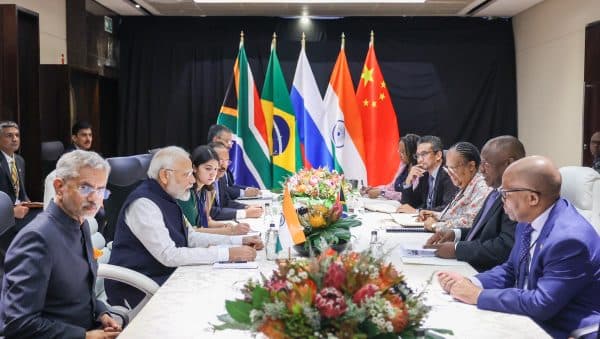
India's relationship with China remains the most structurally adversarial element of its great power engagement, defined by the unresolved Himalayan border dispute that produced the lethal Galwan Valley clash of June 2020 and that continues to generate periodic friction along the Line of Actual Control despite subsequent disengagement agreements at several friction points. Indian economic policy toward China has progressively hardened since Galwan, including restrictions on Chinese investment, the banning of numerous Chinese mobile applications, and increased scrutiny of Chinese participation in critical infrastructure and technology sectors. Yet India simultaneously participates alongside China in BRICS, the Shanghai Cooperation Organisation, and the G20, coordinating positions on questions of international institutional reform, development finance, and Global South representation even as the bilateral security relationship remains tense and the border dispute remains unresolved.
India's engagement with the broader Global South has become an increasingly central pillar of its international identity, most visibly expressed through its 2023 G20 presidency, during which New Delhi successfully pushed for the African Union's admission as a permanent G20 member and positioned itself as the principal voice articulating developing world concerns about debt sustainability, climate finance, and reformed international institutional governance. This Global South leadership role provides India with a distinctive diplomatic identity that neither the United States nor China can fully replicate - Washington because of its association with the existing Western-dominated order that Global South nations frequently experience as extractive, and Beijing because of growing developing world concerns about debt sustainability and governance practices associated with Belt and Road Initiative lending.
Power Center Analysis
The United States: The Eager Suitor
American strategic planners across the Obama, Trump first term, Biden, and Trump second term administrations have consistently identified India as the most consequential potential partner for sustaining a favourable Indo-Pacific balance of power against Chinese revisionism, reflecting a bipartisan American strategic consensus that transcends the otherwise sharp partisan divisions in American foreign policy debates. This consistency reflects a clear-eyed American assessment that no other nation combines India's demographic scale, economic trajectory, military capability, and democratic political system in ways that make it irreplaceable as a partner for balancing Chinese power in the world's most consequential strategic theatre.
This American strategic necessity has produced a distinctive pattern in the bilateral relationship: Washington has consistently prioritized the broader strategic partnership over specific points of friction that would, in relationships with less strategically essential partners, generate more severe diplomatic consequences. American tolerance for India's continued Russian defence procurement, its sanctions-circumventing oil purchases, and its consistent refusal to condemn Russian actions in Ukraine all reflect a calculation that the strategic value of Indian QUAD participation and Indo-Pacific partnership outweighs the costs of accepting Indian positions on Russia that would, applied to a less essential partner, likely trigger more severe American diplomatic and economic pressure.
The Trump administration's second term has maintained this fundamental strategic calculation while introducing characteristic transactional elements into specific dimensions of the relationship, including trade negotiations and defence procurement terms. The fundamental strategic logic of American investment in the India relationship remains intact across this administration transition, reflecting the depth of bipartisan consensus regarding India's irreplaceable role in American Indo-Pacific strategy.
Russia: The Indispensable Legacy Partner
Russia's relationship with India, while structurally asymmetric given Russia's growing dependency on China following the Ukraine invasion, retains genuine strategic value for Moscow that extends beyond the immediate economic benefits of oil sales. India represents one of the few major powers that has maintained normal diplomatic and economic relations with Russia throughout the post-2022 period, providing Vladimir Putin's government with diplomatic legitimacy and economic relationships that partially offset its broader international isolation. The continuation of Russian arms sales to India, including the S-400 air defence system that has generated friction with Washington under the Countering America's Adversaries Through Sanctions Act framework, represents both a genuine revenue source for Russia's defence industrial base and a demonstration that Russian strategic partnerships can survive Western pressure.
For India, the Russia relationship serves several distinct strategic purposes that extend beyond simple economic opportunism in discounted energy purchases. The decades-long defence procurement relationship means that a substantial proportion of India's existing military inventory, particularly in critical categories including fighter aircraft, air defence systems, and naval vessels, depends on continued Russian supply chains for spare parts, maintenance, and upgrades, creating genuine operational dependency that cannot be rapidly unwound regardless of strategic preference. Russia's permanent UN Security Council seat and its historical willingness to support Indian positions on issues including Kashmir provide diplomatic value that India's other partnerships do not fully replicate. And the maintenance of the Russia relationship serves India's broader strategic autonomy doctrine by demonstrating that its deepening partnership with the United States does not constitute the kind of exclusive alignment that would compromise its independent strategic judgment.
China: The Necessary Rival
India's relationship with China is the most analytically complex element of its swing power positioning, combining genuine strategic rivalry and security competition with continued economic interdependence and multilateral institutional cooperation that together create one of the most paradoxical great power relationships in the contemporary international system. China remains one of India's largest trading partners despite the post-Galwan political chill, reflecting deep supply chain interdependencies, particularly in pharmaceutical ingredients, electronics components, and solar energy equipment, that India has found difficult to rapidly diversify away from despite explicit policy efforts to reduce this dependency.
The military dimension of the India-China relationship remains the most acute and potentially dangerous aspect of Indian strategic planning, with both nations maintaining substantial military deployments along the Line of Actual Control and continuing infrastructure development in contested border regions that periodically generates renewed friction despite the disengagement agreements reached at several specific friction points since the 2020 Galwan crisis. India's broader Indo-Pacific strategic posture, including its QUAD participation, its expanding defence relationships with Japan, Australia, and Vietnam, and its development of the Andaman and Nicobar Islands as a forward military platform, is substantially shaped by the imperative of balancing Chinese power, even as New Delhi has consistently avoided explicit characterization of these efforts as a containment strategy directed at Beijing.
The European Union and Key European Powers
India's relationship with the European Union and major European powers, particularly France, has deepened substantially as part of New Delhi's broader strategy of diversifying its strategic partnerships beyond the American and Russian relationships that have historically dominated Indian great power engagement. France's position as a reliable defence technology supplier, exemplified by the Rafale fighter aircraft acquisition and continued submarine technology cooperation, provides India with an alternative to excessive dependency on either American or Russian defence suppliers, while France's own emphasis on European strategic autonomy creates a degree of natural philosophical sympathy between Paris and New Delhi's broader approach to great power relationships.
The European Union's approach to India has been shaped by a recognition that India represents one of the most significant potential partners for diversifying European economic and strategic relationships away from excessive dependency on both American and Chinese relationships, though the practical depth of EU-India cooperation continues to be constrained by long-running and unresolved free trade agreement negotiations that have persisted for over a decade without final resolution, reflecting the genuine economic complexity of integrating India's developing economy with European market access frameworks.
Military and Security Implications
India's military posture reflects and reinforces its swing power strategic doctrine, characterized by a deliberate diversification of defence suppliers and an increasingly ambitious indigenous defence industrial development programme that together reduce its dependency on any single external power for its core military capabilities.
The diversification of Indian defence procurement away from its historical near-total dependency on Russian and Soviet-legacy equipment represents one of the most significant transformations in Indian military policy over the past two decades. While Russian-origin equipment, including Sukhoi fighter aircraft, T-90 tanks, and the S-400 air defence system, remains central to current Indian military capability, recent and pending procurement decisions have increasingly favoured American, French, and Israeli suppliers, alongside an expanding emphasis on indigenous production through the Make in India defence initiative. This diversification serves multiple strategic purposes: reducing vulnerability to potential disruption of Russian supply chains given Moscow's own wartime production constraints, building relationships with American and European defence industrial bases that generate broader strategic partnership value, and developing indigenous capability that ultimately reduces dependency on any external supplier.
India's nuclear and missile capabilities provide an independent strategic deterrent that underpins its broader swing power positioning by ensuring that its strategic autonomy does not depend on external security guarantees from any partner. India's nuclear triad, including land-based ballistic missiles, the Arihant-class ballistic missile submarines providing sea-based deterrent capability, and air-delivered nuclear weapons, gives New Delhi an independent deterrent against both Pakistani and Chinese nuclear threats that does not require reliance on American extended deterrence or any other external security guarantee, distinguishing India fundamentally from formal American allies including Japan and South Korea whose security calculations depend substantially on American nuclear umbrella commitments.
The expansion of Indian military cooperation across multiple partnerships simultaneously - QUAD-framework exercises including the Malabar naval exercise, bilateral exercises with France including Varuna and Garuda, continued defence cooperation with Russia, and growing security relationships with Japan, Australia, and Vietnam - collectively provides India with operational experience and interoperability across a far broader range of partners than any formal alliance member typically develops, reflecting the practical military dimension of its multi-alignment doctrine.
Economic and Trade Impact
India's economic relationships mirror and reinforce its strategic swing power positioning, characterized by deliberate diversification across multiple major economic partners that collectively provide India with negotiating leverage and reduced vulnerability to dependency on any single economic relationship.
India's energy security strategy exemplifies this diversification logic with particular clarity. Indian Russian oil imports surged dramatically following the 2022 Ukraine invasion, as New Delhi capitalized on steep discounts that Moscow offered to compensate for the loss of traditional European markets, transforming India from a marginal purchaser of Russian crude into one of its largest global customers. This relationship has generated substantial economic benefits for India, providing discounted energy supplies that have helped moderate domestic inflation pressures while simultaneously generating diplomatic friction with Western partners who have characterized Indian Russian oil purchases as undermining the effectiveness of the sanctions regime designed to constrain Russian war financing capacity. India has consistently defended these purchases as a legitimate exercise of national economic interest and energy security policy, rejecting characterizations that frame the relationship as providing meaningful support for Russian war objectives.
India's technology and manufacturing relationships demonstrate similar diversification logic. The Production Linked Incentive schemes designed to attract semiconductor, electronics, and pharmaceutical manufacturing investment have attracted interest from American, Taiwanese, Japanese, and South Korean companies seeking to diversify their own supply chains away from excessive Chinese concentration, positioning India as a beneficiary of the broader friend-shoring trend reshaping global manufacturing geography. Simultaneously, India maintains substantial continued economic interdependency with China across pharmaceutical ingredients, electronics components, and renewable energy equipment supply chains, reflecting the genuine difficulty of rapidly decoupling from China's manufacturing scale and cost advantages even as strategic and security considerations push toward diversification.
India's engagement with multiple multilateral economic frameworks simultaneously - its BRICS membership and active participation in discussions regarding de-dollarization and alternative payment systems, alongside its QUAD-framework participation in initiatives including the Indo-Pacific Economic Framework and supply chain resilience cooperation, and its continued engagement with G20 processes - provides India with simultaneous access to and influence within economic governance frameworks that other major powers regard as mutually exclusive or competitive, reflecting the broader pattern of multi-institutional engagement that characterizes its swing power strategy.
Diplomatic Positioning
India's diplomatic strategy reflects a sophisticated and deliberate cultivation of relationships across every major axis of contemporary international competition, executed with a consistency and discipline that distinguishes it from the more reactive or crisis-driven hedging strategies that characterize many other middle and regional powers attempting similar multi-alignment approaches.
India's voting patterns and diplomatic positioning at the United Nations exemplify this careful calibration. Its consistent abstention from resolutions condemning Russian actions in Ukraine, while simultaneously supporting humanitarian assistance mechanisms and declining to provide direct material support for Russian war objectives, reflects a deliberate effort to maintain its relationship with Moscow without becoming associated with Russian aggression in ways that would damage its broader international standing or its deepening partnerships with Western nations. This calibrated positioning has proven remarkably durable across more than four years of sustained Western pressure, reflecting both the depth of Indian strategic commitment to maintaining the Russia relationship and Western recognition of the limits of pressure that can be productively applied to a partner as strategically essential as India.
India's engagement with Middle Eastern powers, particularly Saudi Arabia, the United Arab Emirates, and Israel, alongside its continued relationship with Iran centred substantially on Chabahar port development, reflects a similar pattern of simultaneous engagement with regional powers that maintain complex and sometimes adversarial relationships with each other. India's deepening defence and technology cooperation with Israel, including significant defence equipment purchases and counter-terrorism cooperation, has proceeded alongside continued Iranian engagement, demonstrating India's capacity to maintain productive relationships with regional rivals that few other major powers attempt simultaneously.
India's Global South diplomatic leadership, most visibly expressed through its 2023 G20 presidency and its continued advocacy for reformed international institutional governance, including long-standing Indian aspirations for permanent UN Security Council membership, provides New Delhi with a distinctive diplomatic platform that reinforces its broader swing power positioning by establishing India as a credible representative of developing world interests that neither Washington nor Beijing can fully replicate given their respective associations with existing power structures or debt-generating investment practices.
Regional Fallout
South Asia: The Contested Neighbourhood
India's regional position within South Asia itself reflects significant complexity that complicates its broader swing power positioning, as its relationships with immediate neighbours including Pakistan, Bangladesh, Sri Lanka, Nepal, and the Maldives are shaped by a combination of historical grievance, contemporary strategic competition with China for regional influence, and the inherent power asymmetries that characterize India's relationship with substantially smaller neighbouring states. Pakistan's nuclear-armed military, supported substantially by Chinese defence technology and diplomatic backing, represents the most acute and persistent security challenge in India's immediate neighbourhood, while Chinese economic and infrastructure investment across Sri Lanka, Bangladesh, Nepal, and the Maldives has created genuine competition for regional influence that India has not always managed successfully.
India's relationship with Bangladesh has experienced significant volatility following the 2024 political transition that removed Sheikh Hasina's government, with the subsequent administration's foreign policy orientation creating new uncertainty regarding India's traditional regional influence. Sri Lanka's debt crisis and its complex navigation between Indian and Chinese investment and influence, the Maldives' periodically oscillating strategic orientation between New Delhi and Beijing, and Nepal's continued balancing between its two giant neighbours collectively illustrate that India's swing power status at the global level coexists with genuine and persistent challenges to its regional primacy within South Asia itself.
The Indo-Pacific and Quad Dynamics
India's role within the broader Indo-Pacific security architecture, discussed extensively in prior intelligence analysis regarding the QUAD framework, represents the dimension of its swing power strategy that has generated the most sustained international attention and the most significant deepening of substantive security cooperation. India's calibrated QUAD participation, balancing genuine security cooperation against China with continued resistance to formal alliance characterization, exemplifies its broader approach to managing simultaneous relationships with competing great powers while preserving maximum strategic flexibility.
Global Strategic Consequences
India's emergence as the international system's most consequential swing power carries global strategic consequences that extend well beyond its immediate bilateral relationships, fundamentally shaping the broader architecture of contemporary great power competition and the prospects for a genuinely multipolar international order.
The most significant global implication is the demonstration that genuine strategic autonomy remains viable for sufficiently large and capable nations even amid intensifying great power competition that has pushed many smaller and middle powers toward clearer alignment choices. India's success in maintaining simultaneous productive relationships with the United States, Russia, and to a more limited extent China, while avoiding the costs that more binary alignment choices would impose, provides a template that other large developing nations, including potentially Indonesia, Brazil, and South Africa, may seek to emulate, though few possess India's combination of scale, military capability, and diplomatic sophistication necessary to sustain such a complex multi-alignment strategy.
For the United States, India's swing power status represents both a strategic asset and a persistent source of frustration, as American policymakers must accept that the partnership's value in balancing Chinese power comes with the cost of accepting Indian positions on Russia and other issues that diverge from American preferences in ways that would be unacceptable from a formal treaty ally. This dynamic illustrates a broader pattern in contemporary American alliance management, in which the most strategically essential partnerships increasingly require accepting greater partner autonomy than the more hierarchical alliance relationships that characterized American strategic partnerships during the Cold War and immediate post-Cold War periods.
For the broader prospects of a multipolar international order, India's swing power success provides important evidence that the emerging system need not collapse into a rigid bipolar competition between American-led and Chinese-led blocs, instead potentially evolving toward a more genuinely multipolar architecture in which several major powers, including India, maintain sufficient independence and capability to prevent the kind of binary alignment dynamics that characterized Cold War-era international relations. This possibility carries significant implications for how the international system manages the multiple simultaneous challenges of climate change, technological governance, and economic development that require broader coalition-building than purely bipolar competition would permit.
Risk Matrix
- Critical Risk - India-China Military Escalation: A significant escalation of the unresolved Himalayan border dispute, whether through deliberate Chinese pressure, Indian counter-moves, or miscalculation during routine military patrol interactions, represents the most acute risk to India's broader strategic positioning, as a major conflict with China would force India toward closer alignment with the United States and its allies in ways that would fundamentally compromise the strategic autonomy doctrine underlying its swing power status.
- High Risk - US Pressure Escalation on Russia Relationship: Continued American pressure regarding India's Russian oil purchases and defence procurement relationship, particularly if American domestic political dynamics or broader Ukraine conflict developments generate demands for more severe secondary sanctions enforcement against India, risks creating a genuine crisis in the bilateral relationship that could force India toward uncomfortable choices regarding the depth of its QUAD and broader American partnership commitment.
- High Risk - Domestic Economic Underperformance: India's swing power status depends substantially on its demographic and economic scale and trajectory, meaning that significant underperformance relative to growth expectations, whether due to structural economic challenges, political instability, or external economic shocks, would progressively undermine the structural foundations that make its strategic autonomy doctrine viable, potentially forcing greater dependency on specific external partners as economic leverage diminishes.
- Moderate-High Risk - Regional South Asian Influence Erosion: Continued Chinese economic and diplomatic inroads across India's immediate South Asian neighbourhood, combined with persistent challenges in managing relationships with Pakistan, Bangladesh, Sri Lanka, Nepal, and the Maldives, risks progressively eroding India's regional primacy in ways that would undermine the broader credibility of its claims to major power and Global South leadership status.
- Moderate Risk - Pakistan-China Coordinated Pressure: The deepening Pakistan-China strategic relationship, including continued Chinese defence technology transfer and diplomatic support for Pakistan on issues including Kashmir, creates persistent risk of coordinated two-front pressure on Indian security planning that could strain Indian military resources and complicate its broader strategic positioning across multiple simultaneous theatres.
Scenario Analysis
Scenario One - Consolidated Swing Power Status
In this scenario, India successfully navigates the various pressures and risks outlined above, maintaining its sustained economic growth trajectory, managing its China relationship to avoid major military escalation while continuing necessary border infrastructure and military modernization, and preserving sufficient diplomatic flexibility to maintain productive relationships with the United States, Russia, and the broader Global South simultaneously. In this scenario, India's economy continues its trajectory toward becoming the world's third-largest by the early 2030s, its defence industrial base achieves greater self-sufficiency that further reduces dependency on any external supplier, and its diplomatic influence across multiple international forums solidifies its position as the indispensable voice of a genuinely multipolar international order. This scenario represents the continuation and consolidation of currently observable trends and is the most likely trajectory absent major disruptive shocks.
Scenario Two - Forced Alignment Under Crisis Pressure
In this scenario, a major crisis event, whether a significant India-China military escalation, an intensification of American pressure regarding Russia that creates an unsustainable diplomatic and economic cost, or a combination of simultaneous pressures, forces India toward clearer alignment with one pole of great power competition in ways that compromise its strategic autonomy doctrine. The most likely version of this scenario would involve a major China crisis pushing India toward substantially deeper American alignment, given the structural logic of shared adversarial interests regarding Chinese power, though this would carry significant costs to India's Global South leadership credibility and its relationships with Russia and other partners that value its independent positioning.
Scenario Three - Diminished Relevance Through Economic Underperformance
In this scenario, India's swing power status gradually erodes not through a dramatic crisis but through the more mundane mechanism of economic underperformance relative to expectations, whether due to structural reform failures, demographic dividend mismanagement, or external economic shocks that disproportionately affect Indian growth prospects. In this scenario, India's relative bargaining leverage with major powers diminishes as its economic and military capability growth trajectory flattens relative to continued Chinese expansion and American technological leadership, potentially forcing India toward greater dependency on specific external partnerships as its independent strategic weight diminishes relative to the scale of contemporary great power competition.
Intelligence Forecast: 6-24 Months
Over the six-to-twelve-month horizon, India's swing power positioning will be significantly shaped by the trajectory of ongoing trade negotiations with the United States under the Trump administration, by the continued management of India-China border tensions including the implementation and durability of recent disengagement agreements at key friction points, and by the evolution of India's Russian oil purchase patterns amid continued Western pressure and the broader trajectory of any Ukraine conflict resolution discussions. The outcome of these parallel negotiations and management challenges will provide important signals regarding the sustainability of India's multi-alignment strategy under continued external pressure.
India's defence procurement decisions over this horizon, including pending fighter aircraft acquisition decisions and continued development of indigenous defence production capability, will significantly shape the trajectory of its diversification away from Russian defence dependency while testing the depth of American and European willingness to provide the technology transfer terms that Indian strategic planners regard as essential for these partnerships to deliver genuine strategic value beyond simple equipment purchases.
India's continued engagement with BRICS, including its participation in ongoing discussions regarding de-dollarization initiatives and alternative payment systems, will require careful diplomatic management to avoid positions that would create unnecessary friction with its deepening QUAD and broader Western partnerships, reflecting the persistent challenge of maintaining simultaneous engagement with frameworks that other major powers increasingly characterize as mutually exclusive or competitive.
Over the twelve-to-twenty-four-month horizon, the most consequential potential development is the trajectory of India-China relations following the recent disengagement agreements, with the durability of reduced border tensions and the possibility of broader bilateral relationship normalization representing a significant variable that would substantially affect India's broader strategic calculations and its relative emphasis on QUAD-framework security cooperation versus continued engagement with China through BRICS, the Shanghai Cooperation Organisation, and bilateral channels.
India's continued economic growth trajectory and its success in attracting manufacturing investment diversifying away from China will significantly shape the structural foundations underlying its swing power status over this horizon, with particular attention warranted to the implementation and results of major semiconductor and electronics manufacturing investment commitments that will provide important evidence regarding India's capacity to translate its demographic and market scale advantages into genuine manufacturing and technological capability that reduces dependency on both Chinese supply chains and Western technology transfer terms.
Final Strategic Takeaway
India's emergence as the world's ultimate swing power represents one of the most significant and underappreciated developments in contemporary international relations, reflecting a sophisticated and historically rooted strategic doctrine that has proven remarkably effective at maximizing Indian strategic options and international leverage even as the broader international system has experienced intensifying great power competition that has pushed most other nations toward clearer alignment choices.
The sustainability of this swing power status depends fundamentally on India's continued ability to maintain the structural foundations - sustained economic growth, military capability development, and diplomatic sophistication - that make its strategic autonomy doctrine viable rather than merely aspirational. Smaller and less capable nations attempting similar multi-alignment strategies typically find themselves forced toward clearer choices when major powers apply sufficient pressure, but India's scale and growing capability have thus far allowed it to absorb and deflect pressure from Washington regarding Russia, from Beijing regarding its Western partnerships, and from Moscow regarding its deepening American security cooperation, in ways that smaller nations attempting similar strategies could not sustain.
The strategic question that will define India's trajectory over the coming decade is whether this swing power status represents a stable equilibrium that India can maintain indefinitely, or whether it constitutes a transitional phase that will eventually require India to make clearer strategic choices as great power competition intensifies further, particularly regarding the China relationship that remains the most acute and potentially destabilizing element of its broader strategic positioning. The evidence to date suggests that India's leadership, across multiple political administrations, has concluded that the benefits of maintaining maximum strategic flexibility outweigh the costs of the diplomatic friction this approach periodically generates with each of its major partners.
What is clear is that India's swing power status has already fundamentally reshaped how every major power approaches its own strategic calculations. Washington has learned to accept greater partner autonomy than its traditional alliance management practices would typically permit. Moscow has learned to value a relationship that provides crucial economic and diplomatic support without requiring the kind of ideological alignment that characterizes its relationship with China. Beijing has learned that economic interdependence with India persists even amid serious security competition, demonstrating that the bifurcation of the global economy along strict geopolitical lines remains incomplete. And the broader Global South has found in India a credible advocate that neither Washington nor Beijing can fully replicate. This is the genuine measure of India's swing power achievement: not merely that it has avoided having to choose, but that its refusal to choose has become, itself, one of the most consequential strategic facts of the contemporary international system.