
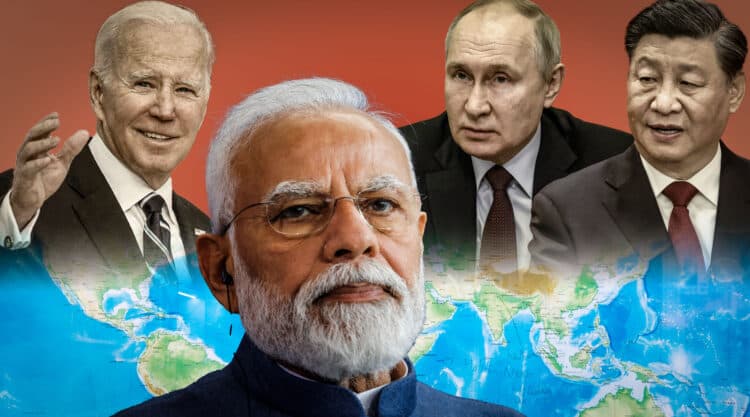
The Third Pole: India's Bid to Shape the Emerging Multipolar World Order
Executive Summary
In 2026, India assumed the rotating chairmanship of BRICS under the banner Building for Resilience, Innovation, Cooperation and Sustainability, taking the baton from Brazil's 2025 Rio de Janeiro presidency at precisely the moment the bloc's founding rationale - offering the Global South an alternative to a Western-dominated international order - has never carried more practical weight. The same year, Indian and American naval forces conducted the Malabar exercise alongside Japan and Australia, reaffirming the Quad's operational relevance in the Indo-Pacific, even as New Delhi continued receiving deliveries of Russia's S-400 air defense system and sat, weeks later, at the Shanghai Cooperation Organisation's 25th summit in Tianjin alongside Xi Jinping and Vladimir Putin. No other major power on earth maintains simultaneous, active, substantive participation in as many mutually distrustful multilateral architectures as India does - the Quad, explicitly conceived by Washington as a counterweight to China; BRICS, whose founding logic explicitly challenges Western financial and institutional dominance; and the SCO, a Beijing-anchored security forum in which India sits alongside both its principal strategic rival, China, and its principal military adversary, Pakistan.
This is the defining and most consequential experiment of contemporary Indian foreign policy: the wager that strategic autonomy, the doctrine articulated most systematically by External Affairs Minister S. Jaishankar as multi-alignment rather than the equidistant non-alignment of the Cold War era, can be converted from a mere survival tactic into genuine global leverage - that a state which commits to no single bloc can, precisely because of that refusal, become indispensable to all of them simultaneously. The events of 2025 tested this wager more severely than any year since India's economic liberalization. President Trump's tariffs targeting countries that continued purchasing discounted Russian oil struck directly at India's own energy procurement strategy. A brief but intense military conflict with Pakistan in May 2025 exposed the limits of India's deterrent posture even as it demonstrated the proxy-adjacent character that broader US-China arms competition has assumed in South Asia. Political instability in Bangladesh and Nepal complicated India's immediate neighborhood management at the very moment its global ambitions required regional stability as a credibility precondition. Each of these shocks tested whether strategic autonomy, as currently practiced, represents a sustainable long-term doctrine or merely a sophisticated form of indecision whose limits a genuinely multipolar and increasingly unforgiving international system is now exposing.
This report provides a doctrine-level assessment of India's position within the emerging multipolar order - the historical evolution of its strategic autonomy doctrine, the specific and often contradictory multilateral commitments through which it currently operates, the 2025 shocks that tested its balancing strategy to its limits, and the genuinely open question of whether New Delhi can transform its current balancing posture into the proactive, order-shaping role that its own most ambitious strategic thinkers now argue the moment demands.
Strategic Background
India's pursuit of strategic autonomy in the current multipolar era represents both continuity with and a genuine departure from the non-alignment doctrine that defined Indian foreign policy from independence through the end of the Cold War. Cold War-era non-alignment, associated with Jawaharlal Nehru's founding role in the Non-Aligned Movement, was fundamentally a doctrine of equidistance - a deliberate refusal to align with either the American or Soviet bloc, motivated by both genuine ideological commitment to post-colonial solidarity and the practical recognition that a newly independent, developmentally constrained India could not afford the entanglements that formal alliance membership would impose. Contemporary strategic autonomy, by contrast, explicitly abandons equidistance in favor of what Jaishankar has termed multi-alignment - engaging selectively and often simultaneously with competing and even mutually hostile powers, extracting distinct benefits from each relationship, and deliberately avoiding the kind of binding alliance commitment that would constrain India's freedom of action in any single relationship.
The structural logic underlying this shift reflects India's transformed position within the international system. A India possessing the world's fourth-largest economy, a rapidly modernizing military, nuclear weapons capability, and an increasingly consequential manufacturing and technology sector occupies a fundamentally different strategic position than the newly independent, economically fragile state that first articulated non-alignment in the 1950s. Where Cold War non-alignment reflected weakness - the practical necessity of a state too underdeveloped to risk alienating either superpower - contemporary multi-alignment reflects a calculated assessment of genuine strength: that India's economic scale, demographic weight, and strategic geography make it valuable enough to every major power that it can extract meaningful concessions and partnerships from each without accepting the costs of formal alliance commitment to any.
This strategic posture operates against the backdrop of what virtually every serious analysis of contemporary international relations now characterizes as a genuine and accelerating transition away from the unipolar, American-led order that characterized the three decades following the Cold War's end, toward a considerably more fragmented, multipolar system in which China's economic and military rise, Russia's willingness to challenge the post-Cold War European security architecture through direct military force, and the emergence of middle powers including India, Brazil, Saudi Arabia, and Indonesia as genuinely consequential independent actors have collectively eroded the kind of clear bipolar or unipolar structure around which earlier generations of Indian foreign policy doctrine were built.
Historical Context
India's post-Cold War foreign policy evolution proceeded through several distinct phases before arriving at its current multi-alignment doctrine. The immediate post-Cold War period, following the Soviet Union's collapse and the corresponding loss of India's most significant strategic partnership, forced a fundamental reassessment of Indian foreign policy that culminated in the 1991 economic liberalization and a gradual, initially tentative warming of relations with the United States that would eventually produce the landmark 2005 US-India Civil Nuclear Agreement - an accord that effectively normalized India's status as a nuclear weapons state outside the Nuclear Non-Proliferation Treaty framework and established the foundation for the deepening strategic partnership that has continued, with periodic friction, through successive American and Indian governments since.
The Quadrilateral Security Dialogue's origins trace to informal consultations following the 2004 Indian Ocean tsunami, when the United States, Japan, India, and Australia coordinated humanitarian relief efforts in a manner that demonstrated the practical value of quadrilateral coordination among Indo-Pacific democracies. The forum's subsequent institutional development proceeded unevenly, effectively dormant through much of the following decade before its 2017 revival, driven substantially by shared concern regarding China's assertive maritime posture in the South China Sea and its Belt and Road Initiative's expanding regional footprint, and its subsequent elevation to leader-level summitry beginning in 2021, reflecting the Quad's transformation from an informal consultative mechanism into what Washington, Tokyo, Canberra, and increasingly New Delhi itself regard as a central pillar of Indo-Pacific strategic architecture.
India's parallel and simultaneous deepening engagement with BRICS, founded in 2009 as an acronym-turned-institution bringing together Brazil, Russia, India, China, and subsequently South Africa, reflected a distinct but complementary strategic logic - the recognition that India's interests as a large, developing, non-Western economy were not fully served by exclusive alignment with the American-led liberal international order, and that a platform explicitly organized around reforming rather than replacing existing global governance institutions, including persistent advocacy for expanded developing-world representation at the International Monetary Fund, World Bank, and United Nations Security Council, offered India a complementary rather than contradictory avenue for pursuing its broader strategic objectives. India's establishment, alongside its BRICS partners, of the New Development Bank in 2014 represented a concrete institutional expression of this parallel-track strategy, providing an alternative development financing mechanism whose governance structure explicitly avoided the weighted voting arrangements that critics have long identified as privileging Western interests within the World Bank and International Monetary Fund.
Current Situation Assessment
The state of India's multipolar positioning as of mid-2026 reflects both the doctrine's continued practical utility and the mounting strain that 2025's accumulated shocks have placed on its underlying assumptions. India's assumption of the BRICS chairmanship in 2026, succeeding Brazil's 2025 Rio de Janeiro presidency, represents the most institutionally significant recent milestone in New Delhi's multipolar strategy, with the chairmanship's declared theme explicitly emphasizing resilience, innovation, cooperation, and sustainability in language that closely tracks Prime Minister Modi's broader people-centric and humanity-first diplomatic framing. This chairmanship provides India with genuine institutional leverage to shape the bloc's agenda at a moment when BRICS's practical significance - as this publication's earlier coverage of the bloc's currency ambitions and de-dollarization debates has extensively documented - has grown considerably more consequential than the largely symbolic institutional presence BRICS represented during its founding years.
India's parallel Quad engagement has demonstrated continued operational substance through 2025 and into 2026, most visibly through the Malabar naval exercise conducted alongside the United States, Japan, and Australia, reaffirming the kind of practical military coordination that distinguishes the Quad from a purely consultative diplomatic forum. Discussion of a potential revived Quad leaders' summit in 2026 represents a further test of whether the grouping can sustain the kind of sustained, high-level political attention that its founding members' shared concern regarding Chinese assertiveness initially generated, particularly given the periodic uncertainty that American foreign policy priorities under the Trump administration have introduced into what allies across multiple regions have characterized as a less predictable and less consistently prioritized American commitment to established multilateral security architecture.
The genuine strain that 2025's accumulated shocks placed on India's balancing strategy deserves particular emphasis, given how directly each episode tested the specific assumptions underlying strategic autonomy doctrine. President Trump's imposition of tariffs targeting countries that continued purchasing discounted Russian crude oil struck directly at one of the most concrete and economically significant expressions of India's multi-alignment strategy - New Delhi's continued, substantial purchase of Russian oil at discounted prices following Western sanctions on Russian energy exports, a policy India had defended explicitly on strategic autonomy grounds as serving Indian energy security and consumer price interests without requiring India to accept Western characterization of the underlying Russia-Ukraine conflict. The American tariff response demonstrated, with unusual directness, that strategic autonomy's practical exercise carries genuine and escalating costs when it conflicts with the priorities of India's other major strategic partner.
The May 2025 India-Pakistan conflict, brief but genuinely intense, exposed a further dimension of strain, illustrating both the persistent volatility of India's immediate security environment and, as this publication's broader coverage of proxy warfare dynamics has documented, the increasingly explicit arms-competition dimension that American and Chinese defense industrial rivalry has introduced into what remains, at its core, a bilateral and historically rooted South Asian security dispute. Political instability in Bangladesh and Nepal through the same period compounded these regional security concerns, illustrating that India's global multipolar ambitions cannot be fully insulated from the immediate neighborhood management challenges that persistent instability among India's smaller South Asian neighbors continues to generate.
Power Center Analysis
India: The Deliberate Balancer Seeking to Become an Order-Shaper
New Delhi's foreign policy establishment, under Prime Minister Modi and External Affairs Minister Jaishankar, has articulated an increasingly explicit ambition to transition India's role from a purely reactive balancing power, absorbing and managing pressure from competing great powers, toward what Indian strategic commentary increasingly terms a proactive, order-shaping role - actively defining the terms of an emerging multipolar governance architecture rather than merely navigating between the architectures that other powers construct. This ambition finds institutional expression through India's simultaneous leadership positioning within BRICS's 2026 chairmanship, its continued advocacy for United Nations Security Council reform explicitly including India's own permanent membership, and its cultivation of what analysts increasingly describe as a bridge-builder role connecting the Global South's developmental and governance-reform priorities with the Western-aligned security architecture that the Quad represents. The credibility of this more ambitious order-shaping aspiration, however, depends substantially on India's demonstrated capacity to manage exactly the kind of simultaneous, cross-cutting pressure that 2025's tariff dispute, Pakistan conflict, and neighborhood instability collectively imposed - a test whose outcome remains genuinely unresolved as of this report's publication.
The United States: The Ambivalent but Necessary Indo-Pacific Partner
Washington's relationship with India's multi-alignment strategy reflects a persistent and unresolved tension between genuine strategic interest in India as the most consequential democratic counterweight to Chinese regional dominance and recurring frustration with India's continued substantive engagement with Russia and China through BRICS and the SCO respectively. The Trump administration's willingness to impose tariff pressure specifically targeting India's Russian oil purchases illustrates the limits of American tolerance for India's multi-alignment doctrine when it conflicts directly with broader American sanctions policy objectives, even as the same administration's continued investment in Quad coordination, exemplified by the Malabar exercise and discussion of a potential 2026 leaders' summit, illustrates the enduring strategic value Washington places on the broader Indo-Pacific partnership despite these periodic frictions. This ambivalence reflects a structural reality that neither Washington nor New Delhi has fully resolved: American strategic planners recognize India's indispensability to any credible Indo-Pacific counterbalancing strategy against China, while simultaneously finding India's continued engagement with Russia and China through BRICS and the SCO a persistent source of policy friction that periodic tariff or diplomatic pressure has not eliminated.
China: The Rival Whose Institutions India Still Joins
Beijing's relationship with India's multipolar positioning reflects a similarly complex duality - genuine and persistent strategic rivalry, reflected in the unresolved Himalayan border disputes and China's deepening strategic partnership with Pakistan, coexisting with substantive Indian participation in Chinese-anchored institutional architecture including the Shanghai Cooperation Organisation, whose 25th summit in Tianjin during 2025 brought Modi into direct engagement with Xi Jinping and Putin simultaneously, and BRICS, an institution whose founding logic explicitly serves China's broader interest in constructing alternative governance architecture to counterbalance Western-dominated institutions. China's calculated tolerance of India's substantial Quad engagement, despite the grouping's explicit origins as a counterweight to Chinese regional assertiveness, reflects Beijing's own assessment that India's continued participation in Chinese-anchored multilateral forums provides sufficient strategic value to outweigh the costs of India's parallel American-aligned security engagement - a calculation whose durability depends substantially on whether India's BRICS and SCO participation continues delivering genuine institutional and economic benefit to Beijing's broader strategic objectives.
Russia: The Enduring Defense and Energy Partner Testing India's Western Relationships
Moscow's relationship with India represents perhaps the most institutionally durable and strategically distinct element of India's broader multi-alignment architecture, anchored in decades of defense procurement relationships, including the continued S-400 air defense system deliveries that have proceeded despite American sanctions pressure under the Countering America's Adversaries Through Sanctions Act framework, and the substantial discounted Russian oil purchases that have become an increasingly significant and increasingly contested element of India's broader energy security strategy since Western sanctions on Russian energy exports began following the 2022 Ukraine invasion. India's continued defense and energy engagement with Russia, sustained despite mounting Western pressure and periodic tariff retaliation, illustrates the genuine strategic depth of the India-Russia relationship and India's calculated assessment that this relationship's benefits, spanning defense technology access, energy security, and diplomatic flexibility, continue to outweigh the costs that Western pressure periodically imposes.
Military and Security Implications
The military implications of India's multipolar positioning extend directly into the credibility and coherence of the Quad's broader Indo-Pacific security architecture, given that India's continued substantial defense relationship with Russia - including the S-400 system and broader legacy Soviet and Russian-origin equipment that remains foundational to Indian military capability - creates genuine interoperability and strategic coordination challenges with the Quad's other three members, each of whose defense architecture is built substantially around American and allied Western systems. This equipment diversity, while reflecting India's deliberate strategic hedging rather than any structural incapacity, nonetheless complicates the kind of seamless multinational military coordination that a genuinely integrated Quad security architecture would require, illustrating one of the concrete, operational costs that India's multi-alignment strategy imposes on its Western security partnerships even as it preserves India's broader strategic flexibility.
The May 2025 India-Pakistan conflict's characterization by multiple analysts as a proxy-adjacent contest between American and Chinese defense industrial competition, examined extensively in this publication's broader coverage of contemporary proxy warfare dynamics, carries direct implications for how India's own defense procurement decisions increasingly intersect with its broader multipolar strategic positioning. India's substantial defense relationships with the United States, France, and Israel, alongside its continued Russian defense ties, position New Delhi as a genuinely diversified defense procurement actor whose weapons platform choices carry commercial and strategic signaling value that extends well beyond India's own immediate security requirements into the broader global competition over whose defense industrial base and whose weapons systems demonstrate superior real-world performance - a competition in which India's own military performance and procurement choices increasingly function as a genuinely consequential data point for defense planners and arms exporters across multiple competing great powers.
India's continued Line of Actual Control tensions with China, despite periodic diplomatic de-escalation efforts, represent the most persistent and structurally embedded security constraint on India's broader multipolar ambitions, given that any genuine order-shaping role India seeks to play globally must be exercised while simultaneously managing an unresolved and periodically volatile border dispute with the same power whose SCO and BRICS institutional architecture India continues to substantively engage. This dual-track relationship with China - genuine strategic rivalry and border tension coexisting with substantive institutional cooperation - represents perhaps the most sophisticated and most difficult-to-sustain element of India's entire multi-alignment doctrine, requiring a level of compartmentalization between security competition and institutional cooperation that few other major power relationships attempt to sustain simultaneously.
Economic and Trade Impact
The economic dimensions of India's multipolar strategy reflect a similarly complex pattern of simultaneous, cross-cutting engagement whose net strategic benefit remains genuinely contested among Indian policy analysts. India's continued, substantial purchase of discounted Russian crude oil, sustained despite the Trump administration's targeted tariff pressure, has delivered genuine and measurable benefit to Indian energy security and consumer price stability, with Indian refiners capturing meaningful discount margins on Russian crude that domestic pricing has only partially passed through to Indian energy prices - illustrating the concrete economic logic underlying India's willingness to absorb diplomatic friction with Washington in exchange for the energy security and cost benefits that continued Russian oil access provides.
India's parallel deepening economic engagement with BRICS, particularly regarding local currency trade settlement and broader financial cooperation mechanisms that this publication's earlier coverage of BRICS currency ambitions has extensively examined, reflects India's calculated but notably cautious approach to the bloc's more ambitious de-dollarization agenda. India has consistently signaled reluctance to embrace full-scale de-dollarization even while participating actively in BRICS discussions regarding reduced dollar dependence - a position that illustrates India's characteristic pattern of engaging substantively with multilateral initiatives whose broader strategic logic serves Indian interests, while carefully avoiding the kind of binding commitment that would constrain India's continued deep economic integration with Western markets and the dollar-denominated international financial system that remains foundational to India's broader economic development strategy.
The broader economic stakes of India's multipolar positioning extend into its deepening engagement with the Middle East, exemplified by the India-Arab Foreign Ministers' Meeting hosted in New Delhi after a decade-long gap, reflecting India's calculated cultivation of economic and energy relationships across a region whose own strategic autonomy pursuits, balancing relationships with the United States, China, and Russia simultaneously, closely parallel India's own multi-alignment doctrine, creating a natural diplomatic affinity between India and Gulf states each pursuing comparable strategic hedging strategies within the broader multipolar transition.
Diplomatic Positioning
The diplomatic architecture through which India pursues its multipolar strategy has grown increasingly dense and institutionally sophisticated, reflecting New Delhi's calculated investment in maintaining substantive rather than merely symbolic participation across each of its major multilateral commitments simultaneously. India's 2026 BRICS chairmanship provides the most immediate and consequential diplomatic platform for demonstrating whether New Delhi can translate its accumulated strategic autonomy credibility into genuine agenda-setting influence within a bloc whose other major members, China and Russia, each pursue distinct and at times competing strategic objectives that India's chairmanship must navigate without appearing to simply validate either power's broader anti-Western strategic agenda.
India's continued advocacy for United Nations Security Council reform, explicitly including its own permanent membership aspiration, represents a diplomatic objective that spans and unites virtually every element of India's broader multipolar strategy - a reform agenda that BRICS partners including Brazil and South Africa broadly support, that Quad partners including the United States and Japan have offered varying degrees of rhetorical support toward, and that China's own more ambivalent position toward Indian Security Council membership illustrates the genuine limits of institutional cooperation even among states that share broader interest in reforming existing global governance architecture away from its current Western-dominated configuration.
The Shanghai Cooperation Organisation's 25th summit in Tianjin during 2025 provided a particularly vivid diplomatic illustration of India's multi-alignment doctrine's practical operation, with Modi's direct engagement alongside both Xi Jinping and Putin occurring within weeks of the Malabar naval exercise's demonstration of continued Quad operational substance - a sequencing that Indian diplomatic strategists have characterized as demonstrating precisely the kind of simultaneous, non-exclusive engagement that strategic autonomy doctrine is designed to sustain, even as critics both within India and among its Western partners have questioned whether this rapid diplomatic oscillation between mutually distrustful power blocs ultimately advances India's strategic interests or merely generates the appearance of indecision that undermines India's credibility as a genuinely reliable partner to any single relationship.
Regional Fallout
In South Asia, India's immediate neighborhood presents the most persistent and structurally challenging constraint on its broader global multipolar ambitions, given that political instability in Bangladesh and Nepal through 2025, combined with the unresolved and periodically volatile Pakistan relationship that the May 2025 conflict most recently illustrated, collectively demonstrate that India's regional security environment remains considerably less stable and less fully under New Delhi's own strategic influence than its global order-shaping ambitions would ideally require. China's deepening strategic and economic engagement across South Asia, including its continued close partnership with Pakistan and its expanding Belt and Road-linked infrastructure investment across Bangladesh, Nepal, and Sri Lanka, further complicates India's regional position, creating a genuine competitive dynamic in India's own immediate neighborhood that constrains the diplomatic and strategic resources New Delhi can devote to its more ambitious global multipolar positioning.
In the Indo-Pacific more broadly, India's Quad engagement operates within a security architecture whose other three members maintain considerably more formal and comprehensive alliance commitments to the United States than India's own strategic partnership status provides, creating a persistent asymmetry in the Quad's internal coherence that India's continued Russia relationship and non-allied status only partially explains. This asymmetry means that India's Quad participation, while operationally substantive as the Malabar exercise demonstrates, remains structurally distinct from the kind of formal collective defense commitment that binds Japan and Australia to the United States, requiring the Quad's continued institutional development to accommodate India's genuinely different strategic posture within what nonetheless functions as a coordinated four-party security architecture.
In the Middle East, India's deepening engagement, exemplified by the revived India-Arab Foreign Ministers' Meeting and India's broader energy and economic relationships across the Gulf states, reflects New Delhi's calculated cultivation of a region whose own multipolar hedging strategies, examined extensively in this publication's coverage of the Iran war's regional diplomatic dynamics, offer India both economic opportunity and a natural community of strategic interest among states pursuing comparable non-exclusive great power engagement strategies.
Global Strategic Consequences
The global strategic consequence of India's multipolar positioning, should New Delhi successfully navigate the accumulated strain that 2025's shocks exposed, extends to the fundamental question of whether the emerging multipolar order will be organized around rigid, mutually exclusive blocs resembling a renewed Cold War bipolarity, or a more genuinely fluid and multi-dimensional architecture in which states including India, Brazil, Saudi Arabia, and Indonesia successfully sustain substantive relationships across multiple, mutually distrustful power centers simultaneously. India's continued demonstrated capacity to maintain Quad, BRICS, and SCO engagement simultaneously, despite the accumulated pressure that 2025 imposed, provides the most consequential existing test case for whether this more fluid, multi-aligned model of multipolar order can prove durable, or whether the structural pressures that a genuinely bipolar US-China strategic competition generates will eventually force even the most committed practitioners of strategic autonomy toward more exclusive alignment choices.
For the broader Global South, India's cultivated bridge-builder role, connecting developing-world governance-reform priorities with Western-aligned security architecture while simultaneously engaging China and Russia through parallel institutional channels, offers a template that other middle powers navigating the current multipolar transition, from Brazil and South Africa to Indonesia and Saudi Arabia, are closely observing as a potential model for their own strategic positioning. India's success or failure in converting its 2026 BRICS chairmanship and broader multipolar engagement into genuine agenda-setting influence, rather than merely reactive balancing, will provide the most consequential available evidence regarding whether middle-power strategic autonomy represents a genuinely sustainable long-term foreign policy doctrine for the emerging multipolar era, or a transitional strategy whose practical limits the accumulated pressures of a genuinely bipolar great-power competition will eventually expose.
Risk Matrix
- Risk Level: High - Continued American tariff and sanctions pressure targeting India's Russian energy and defense procurement relationships escalates beyond current levels, forcing New Delhi toward a more explicit strategic choice between its Western security partnerships and its long-standing Russia relationship that strategic autonomy doctrine has historically been designed to avoid.
- Risk Level: High - Renewed India-Pakistan military confrontation, building on the pattern the May 2025 conflict established, escalates to a scale that further exposes the proxy-adjacent US-China defense industrial competition dynamic in South Asia, complicating India's broader multipolar positioning by forcing more explicit alignment choices regarding defense procurement and diplomatic support.
- Risk Level: High - Continued political instability across Bangladesh, Nepal, and other South Asian neighbors persists or deepens, consuming diplomatic and strategic resources that constrain India's capacity to pursue its more ambitious global order-shaping ambitions while simultaneously providing China expanded opportunity for regional influence expansion.
- Risk Level: Medium - India's 2026 BRICS chairmanship fails to produce genuine agenda-setting outcomes distinct from China and Russia's own competing strategic priorities within the bloc, undermining New Delhi's broader claim to bridge-builder credibility between the Global South and Western-aligned institutions.
- Risk Level: Medium - The Quad's internal coherence continues eroding due to India's structurally distinct non-allied status relative to Japan and Australia's formal American alliance commitments, complicating the grouping's capacity to sustain the kind of integrated security architecture that a genuinely coordinated Indo-Pacific counterbalancing strategy against China would require.
- Risk Level: Medium - China's continued willingness to tolerate India's substantial Quad engagement despite the SCO and BRICS relationship erodes as broader US-China strategic competition intensifies, forcing Beijing toward more explicit pressure on India to constrain its Western security partnerships as a condition of continued Chinese-anchored institutional cooperation.
- Risk Level: Medium - India's continued Line of Actual Control tensions with China escalate beyond current periodic friction levels, forcing New Delhi to redirect strategic attention and resources toward direct bilateral security management in a manner that constrains its broader global multipolar ambitions.
- Risk Level: Low (near-term) - India successfully transitions from a reactive balancing power to a genuinely proactive, order-shaping global actor within the coming several years, achieving the kind of UN Security Council reform, BRICS agenda-setting influence, and Quad institutional deepening that its most ambitious strategic thinkers envision. The accumulated 2025 shocks and persistent regional security constraints make this fuller transformation a longer-term rather than near-term achievable outcome, though continued incremental progress remains a credible expectation.
Scenario Analysis
Scenario One: Continued Multi-Alignment Under Mounting Strain (Most Probable, 3-5 Year Horizon)
The most probable near-term trajectory sees India continue its current multi-alignment doctrine across the Quad, BRICS, and SCO simultaneously, absorbing periodic friction from each relationship, including continued American tariff pressure regarding Russian energy purchases and periodic Chinese pressure regarding Quad engagement, without abandoning the fundamental strategic autonomy framework that has governed Indian foreign policy since the doctrine's contemporary articulation. In this scenario, India's 2026 BRICS chairmanship produces meaningful but not transformative agenda-setting outcomes, the Quad continues functioning as an operationally substantive but structurally asymmetric security architecture, and India's regional South Asian security management continues consuming significant strategic attention without fully derailing New Delhi's broader global positioning ambitions.
Scenario Two: Successful Transition Toward Genuine Order-Shaping Influence (Moderate Probability)
A more strategically successful trajectory sees India successfully convert its 2026 BRICS chairmanship and continued Quad engagement into genuine, sustained agenda-setting influence, achieving meaningful progress toward United Nations Security Council reform advocacy, establishing itself as the credible bridge-builder between Global South governance-reform priorities and Western-aligned security architecture that its most ambitious strategic thinkers envision, and successfully managing its immediate South Asian neighborhood with sufficient stability to free strategic resources for sustained global engagement. This scenario would require sustained diplomatic sophistication, continued economic growth sufficient to sustain India's rising global weight, and a degree of insulation from the kind of simultaneous multi-front pressure that 2025 demonstrated remains a persistent risk to India's balancing strategy.
Scenario Three: Forced Alignment Under Intensifying Bipolar Pressure (Lower Probability, Higher Consequence)
Intensifying US-China strategic competition, potentially triggered by a Taiwan Strait contingency or comparable major crisis examined extensively elsewhere in this publication's broader coverage, forces India toward a more explicit strategic alignment choice that strategic autonomy doctrine has historically been designed to avoid, with Washington's demand for clearer Indo-Pacific security commitment conflicting directly with India's continued Russia and China-linked institutional engagement in a manner that current multi-alignment practice cannot sustainably reconcile. This scenario would represent a genuine and consequential test of whether India's strategic autonomy doctrine can survive a genuinely binary great-power crisis, or whether, as skeptics of the doctrine's long-term sustainability have argued, multipolar hedging ultimately proves viable only during periods of relatively contained great-power competition rather than the kind of acute crisis that a Taiwan contingency or comparable confrontation would represent.
Intelligence Forecast (6-24 Months)
The six-to-twelve-month horizon will be shaped substantially by the concrete outcomes India's 2026 BRICS chairmanship produces, with particular attention warranted regarding whether New Delhi succeeds in advancing its declared resilience, innovation, cooperation, and sustainability agenda in ways that demonstrate genuine independent agenda-setting capacity distinct from China and Russia's own competing priorities within the bloc, or whether the chairmanship's practical outcomes remain constrained by the same great-power tensions that have historically limited BRICS's institutional coherence. Continued monitoring of the potential 2026 Quad leaders' summit will provide an important parallel indicator of whether the grouping's institutional development continues advancing at the pace its founding members' shared strategic concerns regarding China would suggest is warranted, or whether American foreign policy attention, divided across multiple simultaneous global crises this publication has extensively documented, constrains the sustained high-level engagement that Quad institutional deepening requires.
The trajectory of American tariff and sanctions pressure regarding India's Russian energy and defense procurement relationships will remain an important indicator of whether Washington's approach toward India's multi-alignment doctrine grows more accommodating or more confrontational, with direct implications for whether India can continue sustaining its current balanced Russia-US relationship or faces mounting pressure toward more explicit strategic choice. Continued India-Pakistan relationship management, alongside the trajectory of political stability in Bangladesh and Nepal, will provide important evidence regarding whether India's immediate neighborhood security environment stabilizes sufficiently to support New Delhi's broader global ambitions, or continues consuming the kind of sustained strategic attention that constrained India's global positioning through 2025.
The twelve-to-twenty-four-month horizon will be significantly shaped by the broader trajectory of US-China strategic competition and whether any major crisis, particularly regarding Taiwan, forces the kind of binary alignment pressure that would most severely test India's strategic autonomy doctrine's long-term sustainability. India's continued advocacy for United Nations Security Council reform and its broader Global South bridge-builder positioning will similarly warrant continued monitoring as indicators of whether New Delhi's more ambitious order-shaping aspirations are translating into genuine diplomatic achievement or remaining largely rhetorical amid the persistent structural constraints that both India's immediate regional environment and the broader multipolar transition's inherent volatility continue to impose.
Final Strategic Takeaway
India's bid to shape the emerging multipolar world order represents one of the most consequential and most closely watched experiments in contemporary international relations - a wager that a middle power of genuine but not yet fully great-power scale can sustain simultaneous, substantive engagement with mutually distrustful power blocs, extracting the benefits of each relationship without accepting the constraints that exclusive alignment would impose, and ultimately convert this balancing position into genuine agenda-setting influence over the international order's future architecture. The doctrine's continued practical operation through 2025's accumulated shocks - American tariff pressure, a brief but intense Pakistan conflict, regional neighborhood instability, and the persistent management of an unresolved China border dispute occurring simultaneously with substantive Chinese-anchored institutional engagement - demonstrates genuine and impressive diplomatic sophistication, even as the cumulative strain these simultaneous pressures generated illustrates that strategic autonomy's practical costs are rising in step with the intensifying great-power competition that the doctrine is specifically designed to navigate.
What remains genuinely unresolved, and what India's 2026 BRICS chairmanship and continued Quad engagement will provide the most consequential near-term evidence toward answering, is whether New Delhi can complete the transition its own most ambitious strategic thinkers now argue the moment demands: from a fundamentally reactive balancing power, absorbing and managing pressure from competing great powers as it arrives, toward a genuinely proactive order-shaping actor capable of defining rather than merely navigating the terms of the emerging multipolar governance architecture. The distinction matters enormously for how the broader international system evolves over the coming decade. A world in which India and comparable middle powers successfully sustain genuine multi-alignment, extracting benefit from and exercising influence over multiple competing power centers simultaneously, points toward a considerably more fluid, multi-dimensional multipolar order than the rigid, binary bloc competition that a Cold War-style bipolar framework would impose.
Whether India ultimately proves this more fluid model's viability, or instead discovers, as the accumulated pressures of 2025 have already begun to suggest, that strategic autonomy's practical costs eventually force even its most sophisticated practitioners toward more explicit alignment choices, will be determined not by the doctrine's theoretical elegance but by New Delhi's demonstrated capacity to manage exactly the kind of simultaneous, cross-cutting pressure that a genuinely multipolar and increasingly contested international system appears likely to generate with growing rather than diminishing frequency in the years ahead.
A nation that commits to every table risks being trusted fully at none - unless it can prove, meeting after meeting, crisis after crisis, that its seat at each table is earned by what it brings rather than merely tolerated because it refuses to leave. India's entire multipolar strategy now rests on proving, in the years just ahead, that it is the former rather than the latter.
Frequently Asked Questions
What is India's strategic autonomy doctrine?
Strategic autonomy, as articulated by External Affairs Minister S. Jaishankar, describes India's contemporary foreign policy approach of multi-alignment - engaging selectively and simultaneously with competing and even hostile powers to extract distinct benefits from each relationship, while avoiding binding alliance commitments that would constrain India's freedom of action. It represents a departure from Cold War-era non-alignment's equidistance toward a more calculated, benefit-maximizing engagement strategy.
How does India participate in both the Quad and BRICS simultaneously?
India treats the Quad, involving the United States, Japan, and Australia, and BRICS, involving Brazil, Russia, China, and South Africa, as complementary rather than contradictory platforms, using the Quad to strengthen Indo-Pacific security coordination while using BRICS to advance Global South governance reform and economic diversification, without formally committing to either bloc's broader strategic agenda against the other.
What shocks tested India's balancing strategy in 2025?
Three major shocks tested India's strategy: President Trump's tariffs targeting countries purchasing discounted Russian oil, a brief but intense India-Pakistan military conflict in May 2025, and political instability in neighboring Bangladesh and Nepal, each exposing different vulnerabilities in India's multi-alignment approach.
What is India's role in BRICS in 2026?
India assumed the BRICS chairmanship in 2026, succeeding Brazil's 2025 Rio de Janeiro presidency, under the theme Building for Resilience, Innovation, Cooperation and Sustainability, providing New Delhi with institutional leverage to shape the bloc's agenda during its tenure.
Why does India continue buying Russian oil and weapons despite Western pressure?
India defends its continued Russian energy purchases and defense procurement, including S-400 air defense systems, on strategic autonomy grounds, citing energy security, cost savings for Indian consumers, and decades-long defense relationship depth, even as this policy has drawn targeted American tariff pressure.
Can India become a genuine pole in a multipolar world order?
India possesses significant economic scale, demographic weight, and strategic geography, but analysts note its ambition to transition from reactive balancing toward proactive order-shaping remains a work in progress, constrained by persistent regional security challenges, an unresolved China border dispute, and the structural costs of maintaining simultaneous engagement with mutually distrustful power blocs.