
The Algorithm of Power: How the Military AI Arms Race Will Determine the Fate of Nations in the 21st Century
Executive Summary
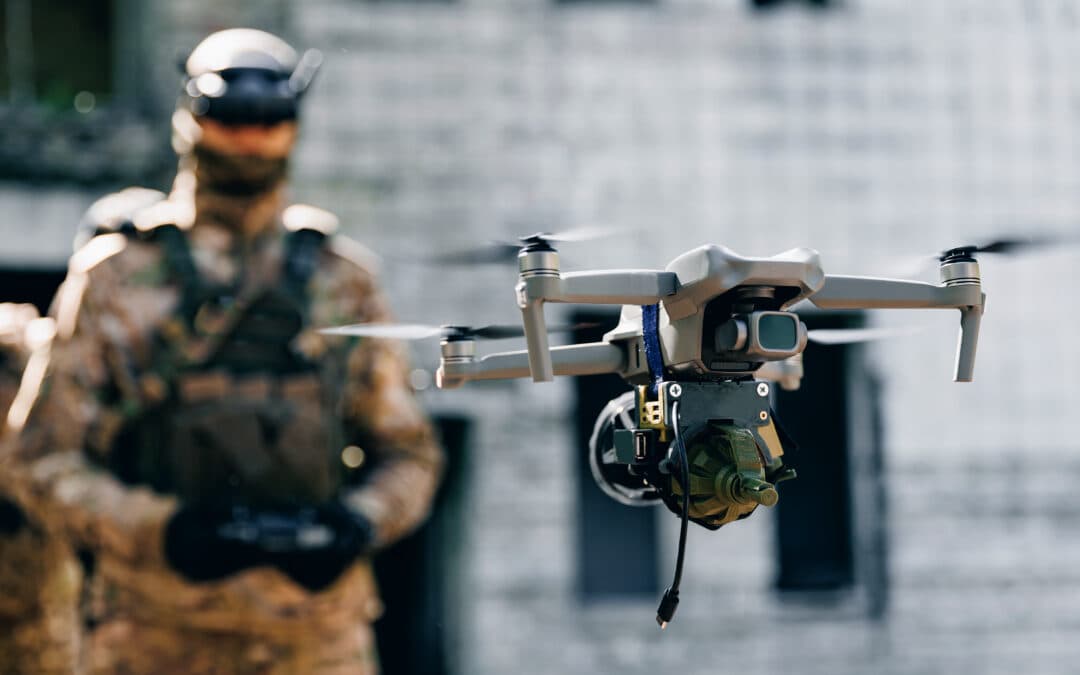
The question of who controls military artificial intelligence is not a technology policy question. It is the defining strategic question of this century - the one variable that will determine which nations can project power, defend their sovereignty, and shape the global order over the next fifty years more than any other factor in the competition among states. In the span of five years, artificial intelligence has migrated from the margins of defense procurement debate into the operational center of actual warfare, demonstrated with brutal clarity on Ukrainian battlefields where AI-assisted drone targeting improved accuracy from 30 to 50 percent up to approximately 80 percent, where one soldier commanding a formation of 200 autonomous drones became operationally feasible in January 2026, and where drones accounted for 96 percent of Russia's 35,551 battlefield casualties in a single month of March 2026. The experiment is no longer theoretical. The future of war arrived without announcement, and it looks like swarms of inexpensive autonomous machines guided by algorithms that think faster, tire less, and calculate kill chains with a precision that no human operator can match at operational scale.
The United States and China are engaged in the most consequential military technology competition since the nuclear arms race - and this one differs from its predecessor in a fundamental dimension. Nuclear weapons created deterrence through the threat of mutual annihilation: the logic of Mutually Assured Destruction was structurally stabilizing because neither side could use the weapon without destroying itself. Military AI does not work this way. Autonomous systems are not deterrents - they are operational advantages that compound through deployment. The side that fields superior AI-enabled weapons first gains tactical advantages that generate battlefield data, that data trains better models, better models produce more lethal systems, and the cycle accelerates in a self-reinforcing trajectory that strategists are beginning to call the battlefield singularity - the point at which AI replaces humans in much of the military decision cycle at speeds and scales that human judgment can no longer keep pace with.
As of mid-2026, the United States maintains significant structural advantages in foundational AI research, chip design and computational infrastructure, frontier model capability, and the live combat experience that no amount of simulation can substitute for. China maintains significant advantages in manufacturing scale, deployment speed, absence of ethical constraints on autonomous kill chains, domestic chip ecosystem development that insulates it from American semiconductor controls, and a centralized national mobilization capacity that can direct resources toward military AI with a coherence that America's more fragmented civil-military technology ecosystem cannot easily replicate. Russia has demonstrated that even a severely economically constrained military can deploy AI drone warfare at scale when tactical necessity demands it. And Ukraine has provided the world's most important live laboratory for what military AI actually does when it meets a real adversary in real conditions - a laboratory whose lessons both the United States and China are absorbing with intense strategic seriousness and applying toward entirely different contingencies.
This report provides a doctrine-level analysis of the military AI arms race as it stands in mid-2026 - its technological dimensions, its operational realities, its institutional and ethical fault lines, its geopolitical consequences, and the realistic trajectories of a competition whose outcome will be measured not in decades but in the decisions made in the next two to five years of program commitments, deployment choices, and governance frameworks that will either constrain or unleash AI's full military potential.
Strategic Background
Military artificial intelligence encompasses a domain far broader than the autonomous weapons and drone swarms that dominate public discourse. At its most fundamental level, military AI is the application of machine learning, computer vision, natural language processing, predictive analytics, and autonomous decision systems to every function of national defense - from logistics optimization and predictive maintenance to intelligence fusion, signals analysis, cyber operations, electronic warfare, targeting, and ultimately the execution of lethal force. The military utility of AI is not located primarily in any single dramatic capability. It is distributed across an entire chain of military functions, each of which AI can accelerate, optimize, or enable at speeds and scales that human cognition cannot match.
The strategic significance of this acceleration is the compression of the decision cycle. The observe-orient-decide-act loop - the OODA loop articulated by military theorist John Boyd as the fundamental rhythm of combat - is the mechanism through which military advantage is generated and sustained in conflict. The side that can complete its OODA cycle faster than its adversary gains the ability to act inside the adversary's decision process, creating confusion, disrupting coordination, and imposing compounding disadvantages that cascade through the entire engagement. Human cognitive limits define a floor below which unaided decision cycles cannot be compressed. AI does not share those limits. Machine-speed targeting, machine-speed cyber operations, machine-speed electronic warfare jamming, and machine-speed logistics adjustment all operate at timescales that remove human operators from meaningful decision roles unless specifically designed to retain them. The question of whether to retain meaningful human judgment in military AI decision chains is therefore not merely an ethical question - it is a strategic question about how to design systems that can operate at machine speed while preserving the legal accountability, political controllability, and strategic wisdom that human judgment provides and that machines cannot yet reliably replicate.
The nuclear analogy, invoked frequently in discussions of military AI governance, is instructive but ultimately misleading. Nuclear weapons created deterrence because their effects are catastrophic, indiscriminate, and irreversible in ways that make their use politically unacceptable even to the most aggressive states. Military AI does not share these properties. Autonomous systems produce targeted, precise, deniable, and scalable effects. They lower the threshold of military action rather than raising it, making conflict more attractive to initiate because the human cost to the initiating side is dramatically reduced. The Cold War nuclear logic that constrained the superpowers' competition within certain bounds does not apply to the military AI competition - a reality whose arms control implications have barely been absorbed by the international community.
Historical Context
The origins of military AI lie not in Silicon Valley but in the Cold War laboratories where the United States and Soviet Union raced to automate the response to nuclear attack faster than any human could authorize it. The Semi-Automatic Ground Environment, known as SAGE, deployed in 1958, was the first large-scale computer network built specifically to detect Soviet bombers and coordinate air defense responses - a system in which human operators were physically present but whose decision cycles were already being compressed toward machine speed by the logic of intercontinental ballistic missile warning times. The cruise missile guidance systems of the 1970s incorporated early pattern recognition capabilities that were, in foundational terms, the ancestors of the computer vision systems that guide autonomous strike platforms today. The Patriot air defense system's autonomous engagement modes, which produced tragic friendly fire incidents in the 1991 Gulf War, demonstrated both the operational utility and the lethal failure modes of AI-enabled autonomous engagement as early as three decades ago.
The transformation accelerated dramatically with the proliferation of unmanned aerial vehicles. The Predator drone, first deployed in the Balkans in 1995 and weaponized for strike missions following the September 11 attacks, established the conceptual and operational foundation for remotely operated lethal force that AI has progressively been automating from human-in-the-loop toward human-on-the-loop and ultimately toward fully autonomous execution. The campaign of drone strikes that the United States conducted across Afghanistan, Pakistan, Yemen, Somalia, and Syria between 2001 and 2022 represented a two-decade live experiment in AI-assisted targeting at scale - an experiment whose data, institutional knowledge, and technological infrastructure form the foundation on which current American military AI programs are built.
China's military AI program traces its public institutional origin to Xi Jinping's 2017 directive to the People's Liberation Army to accelerate intelligentized warfare - the Chinese strategic concept for the integration of AI, cloud computing, big data, quantum computing, and autonomous systems across all military domains. China's National AI Development Plan of the same year established the goal of becoming the world's leading AI power by 2030, with explicit provisions for the civil-military fusion strategy that systematically bridges commercial AI development and PLA application. The military-civil fusion framework, which reduces the legal and institutional barriers between China's civilian technology sector and its defense establishment, gives the PLA access to the output of Huawei, Baidu, DJI, and China's entire commercial AI ecosystem in ways that have no direct American equivalent and that represent one of China's most structurally significant advantages in the military AI competition.
Russia's military AI program, less well-resourced than those of the primary competitors but operationally significant, has been shaped most decisively by the Ukraine war. The war's drone attrition dynamics - in which both sides have deployed AI-guided FPV drones in quantities measured in hundreds of thousands annually - have driven Russian military AI development toward practical, low-cost applications in electronic warfare, drone guidance, and counter-drone defense rather than the frontier model capabilities that American and Chinese programs emphasize. Russia's Marker unmanned ground robot, its AI-guided Lancet loitering munition, and its development of AI systems to coordinate drone swarms represent the adaptation of a military with constrained resources to the practical demands of high-intensity AI-enabled warfare at industrial scale.
Current Situation Assessment
The state of the military AI arms race as of mid-2026 reflects three simultaneously occurring processes: the live operational validation of military AI concepts in Ukraine and in the 2026 Iran war, the divergent institutional responses of the United States and China to the competitive challenge each faces, and the emergence of a new private-sector defense technology ecosystem that is reshaping both the industrial base and the governance framework for military AI development.
Ukraine's war has provided the world's most operationally significant AI warfare laboratory. Ukrainian drones killed or seriously injured more than 240,000 Russian soldiers in 2025 alone according to the Ukrainian defense minister's assessment. Drone accounts for 96 percent of Russian battlefield casualties in March 2026 - a statistic that is not merely a reflection of drone proliferation but of AI-assisted targeting systems that have dramatically improved the accuracy and lethality of comparatively cheap platforms. AI-assisted drone guidance went from approximately 30 to 50 percent accuracy to around 80 percent as targeting algorithms were refined through combat experience and iterative model improvement. Ukraine aims to produce 4.5 million drones domestically in 2025, supported by AI development partnerships with Helsing AI and other European defense technology companies. The economic mathematics of this warfare have been definitively established: a 500-dollar commercial drone guided by AI defeats systems costing orders of magnitude more when deployed at scale and when the targeting algorithm is better than the adversary's countermeasures.
The Iran war of 2026 provided a second, different operational data point for military AI systems. The Pentagon's deployment of Claude - Anthropic's AI model - through its Palantir contract for intelligence analysis and targeting during Operation Epic Fury established that frontier commercial AI models were operationally integrated into classified military networks at the highest levels of military action. The subsequent public breakdown between the Pentagon and Anthropic, which drew two explicit lines that Anthropic refused to cross - no fully autonomous weapons, and no mass domestic surveillance - created both an operational disruption and a strategic clarification. The Pentagon immediately switched to alternative AI providers, demonstrating both the operational dependency it had already developed on commercial AI infrastructure and the institutional determination to proceed without ethical constraints that commercial AI companies refused to lift. The episode revealed the extent to which the United States military's AI integration has advanced beyond the point where any single commercial partner's governance standards can constrain its operational ambitions.
China's military AI development has simultaneously produced demonstrable capability advances and unresolved operational unknowns. The January 2026 PLA National University of Defence Technology broadcast of a single soldier commanding a formation of 200 autonomous drones was a deliberate strategic communication as much as a capability demonstration - Beijing signaling to Washington, Taipei, and allied capitals that PLA drone swarm capability is not theoretical but operational. At the 2024 Zhuhai Airshow, Norinco debuted an entire AI-controlled brigade of armored vehicles and drones, demonstrating an autonomous combined arms concept that has no direct American equivalent in demonstrated operational form. PLA procurement notices referencing DeepSeek models accelerated throughout 2025, validating Beijing's strategy of developing domestic AI capability on domestically produced Huawei chips as a form of algorithmic sovereignty insulated from American export control pressure. A March 2025 paper from PLA-linked researchers described fully autonomous execution of combat decisions in urban environments, including the decision to engage, as a straightforward development goal - with zero ethical debate of the kind that is structurally embedded in every American military AI procurement decision.
The Pentagon's Replicator initiative - renamed the Defense Autonomous Working Group but continuing under the same strategic logic - revealed both America's ambition and its institutional constraints. Replicator aimed to field thousands of autonomous systems by August 2025; Congressional Research Service analysis found only hundreds had been fielded by that date. Technical issues including systems unreliability, integration failures with existing command structures, rudder failures on autonomous boats, software problems preventing collaborative drone swarming, and the purchase of unfinished concepts that existed only as prototypes when selected for the program all demonstrated the gap between the procurement speed that the strategic challenge demands and the institutional capacity of a defense acquisition system designed for a different era. The program has restructured under Defense Secretary Hegseth's Drone Dominance initiative, with Replicator's successor programs focusing on larger Pacific-range systems while the Drone Dominance campaign addresses small FPV drones for unit-level deployment. Defense Autonomous Working Group now conducts wargames oriented specifically toward Taiwan scenarios, with China's potential invasion timeline assessed at 2027 creating urgency that all involved parties have explicitly stated.
Power Center Analysis
The United States: Superior Capability, Constrained Deployment
America's structural advantages in the military AI competition are real and significant. American firms hold dominant positions in frontier AI model capability - the large language models, computer vision systems, and reinforcement learning architectures that define the leading edge of AI development globally. NVIDIA's chips power the overwhelming majority of the world's AI training workloads, giving Washington an indirect but powerful lever over the computational substrate of any AI capability that requires access to American semiconductor technology. DARPA's research programs - the ACE autonomous fighter project that demonstrated AI control of an F-16 in tactical intercepts, the OFFSET swarm program targeting coordination of 250 or more autonomous systems in urban environments, and the Ghost Shark and Orca Extra Large Unmanned Undersea Vessels for extended autonomous submarine operations - represent the frontier of what American military AI research is developing. The private sector ecosystem surrounding Pentagon AI has attracted over 15 billion dollars in venture capital investment in 2025 alone, producing companies like Anduril at a 28-billion-dollar valuation, Shield AI at 5 billion dollars, and Saronic building autonomous warships, all operating with a development speed that traditional defense contractors cannot match and that has created an entirely new structural relationship between Silicon Valley innovation and Pentagon procurement.
The structural constraint on American military AI is the institutional and ethical architecture that slows deployment. The Pentagon's own AI Ethical Principles, established in 2020 and embedded into procurement requirements, mandate that autonomous weapons must be lawful, accountable, traceable, reliable, and governable - properties that require validation processes adding months or years to deployment timelines that China does not impose on its own programs. The Anthropic-Pentagon breakdown over autonomous kill chains illustrated this constraint with operational consequences: when a commercial partner that builds the best available AI model sets non-negotiable governance limits on its military application, the military can switch providers but cannot easily replicate the capability elsewhere. The Congressional Research Service's scrutiny of Replicator, the cost and schedule challenges at every program milestone, and the bureaucratic inertia that military analysts have repeatedly identified as the primary constraint on American autonomous systems deployment all reflect a defense acquisition system that was designed for a different threat environment and has not been adequately reformed to operate at the speed that AI-era competition requires.
China: Manufacturing Scale, Algorithmic Sovereignty, Zero Ethical Friction
China's position in the military AI competition rests on three interlocking advantages that are individually significant and collectively formidable. The first is manufacturing scale. China's defense industrial base has achieved a production capacity for drone systems, autonomous vehicles, and the sensors and electronics they require that the Pentagon has explicitly stated it cannot match at current American manufacturing rates. The economic mathematics of attritable autonomous warfare - in which systems are expected to be lost and replaced at high rates - favor the side with the larger industrial base, lower unit costs, and faster production cycles. China's dominance of global drone manufacturing through DJI and its commercial-to-military conversion ecosystem means that the PLA can field autonomous systems at a cost-per-unit and production-per-unit-time that creates asymmetric advantages in sustained conflict scenarios.
The second advantage is algorithmic sovereignty. DeepSeek's January 2025 demonstration that a frontier-class AI model could be built with dramatically less compute than Western frontier labs require - and that the resulting model runs on domestically produced Huawei Ascend chips rather than NVIDIA hardware subject to American export controls - provided Beijing's military AI program with exactly the independence from American semiconductor leverage that its long-term strategy required. PLA procurement notices referencing DeepSeek accelerated throughout 2025 because the combination of a capable, efficient model and domestic chip hardware represents the full algorithmic sovereignty that Beijing has sought since the first American chip export controls signaled the strategic direction of the US-China technology competition. Edge-deployed military AI systems - drones, autonomous vehicles, and autonomous naval vessels operating far from cloud infrastructure - require models that can run on hardware with constrained computational resources and without continuous connectivity to data centers. DeepSeek's efficiency advantage directly addresses this constraint in ways that make the export control strategy less decisive for military AI than for AI model training at frontier scale.
The third advantage, and the most strategically significant over a long time horizon, is the complete absence of ethical constraints on autonomous kill chain development within China's military AI program. While American military AI procurement embeds lawfulness, accountability, and human oversight requirements that create genuine friction in autonomous weapons deployment, PLA-linked researchers describe fully autonomous urban engagement decisions as a straightforward development goal. There is no Chinese equivalent of the Anthropic red lines. There is no Chinese equivalent of the 2025 UN General Assembly resolution that China's own government co-sponsored on autonomous weapons governance. The disconnect between China's diplomatic posture on autonomous weapons - supporting international norms - and its operational military AI development trajectory - advancing toward fully autonomous engagement without the institutional constraints those norms imply - is the central contradiction of Beijing's military AI strategy.
Russia: The Tactical Adapter
Russia's military AI program has been shaped entirely by the operational demands of the Ukraine war. The PLA has not fought a war since 1979 and its AI systems have been validated only in simulations and procurement benchmarks. Russia's systems have been validated, tested, and adapted under continuous live fire in conditions that produce a quality of operational learning unavailable through any laboratory or wargame. The Lancet loitering munition's AI-assisted target recognition, Russia's electronic warfare AI that adapts to Ukrainian drone countermeasures in near-real time, and the AI-guided drone production expansion to meet wartime attrition demand have collectively produced a Russian military AI ecosystem whose practical battlefield capability exceeds what its resource constraints would suggest. The lesson Russia's program offers to the United States is both sobering and instructive: operational necessity drives deployment speed, integration quality, and iterative improvement at rates that peacetime procurement programs cannot approach.
India: The Emerging Contender
India's position in the military AI competition reflects its broader multi-alignment strategy - developing independent capability while engaging with multiple technology partners and preserving strategic optionality. The DRDO's AI Incubation Center, the Indian Army AI applications program, the Indian Navy's commissioning of INS Surat with AI-enabled systems, and the government's explicit commitment to leveraging India's substantial private sector AI workforce for defense applications by 2026 collectively signal a defense AI program that is advancing beyond the exploratory phase into operational integration. India's position as a Quad member - and the Quad's emerging focus on AI governance, semiconductor supply chains, and defense technology sharing - positions New Delhi to benefit from American and Japanese military AI expertise while maintaining the strategic independence that prevents full commitment to any single power's military AI architecture. The India-specific constraint is the gap between an advanced civilian AI ecosystem and the defense-specific applications, data, and procurement frameworks that translate civilian AI capability into operational military advantage.
Military and Security Implications
The military implications of the AI arms race are transforming every domain of warfare simultaneously - not sequentially, and not in ways that follow the progression of previous military revolutions in which a single new capability defined the era's strategic logic. AI's military impact is domain-agnostic, applying to air combat, naval operations, ground warfare, cyber operations, electronic warfare, intelligence collection, logistics, and nuclear command-and-control all at once, creating a compounding transformation whose aggregate effect exceeds the sum of its domain-specific parts.
In the air domain, AI has fundamentally altered the balance between offensive and defensive air operations. DARPA's ACE program demonstrated that an AI-piloted F-16 can defeat human pilots in simulated air combat scenarios through superior reaction time, g-force tolerance, and decision consistency - advantages that compound over the duration of an engagement. The Replicator and Drone Dominance programs' focus on attritable autonomous systems for Pacific operations reflects the recognition that the air combat paradigm has shifted from expensive crewed platforms toward masses of cheap autonomous systems that overwhelm defense by quantity rather than defeating it by quality. China's shark swarm concept - autonomous drone formations designed to overwhelm US carrier strike group defenses in a Taiwan Strait scenario through sheer numbers - operationalizes this logic at the strategic level.
In the maritime domain, autonomous undersea warfare represents the most strategically consequential developing capability. The US Navy's Ghost Shark and Orca Extra Large Unmanned Undersea Vessels are designed to operate for extended periods in denied areas, carrying payloads for intelligence collection, mine laying, and potentially strike operations without crewed vessel risk. China's Liaowangzhe II unmanned patrol vessel with AI navigation represents an equivalent development in the surface domain. The combination of autonomous surface, subsurface, and aerial systems operating in coordinated formations - what AUKUS-focused analysts describe as the autonomous maritime stack - creates a surveillance, denial, and strike capability for the South China Sea and Taiwan Strait that dramatically complicates both Chinese anti-access/area-denial planning and American power projection assumptions.
The cyber-AI nexus deserves specific analytical attention for its near-term strategic impact. AI-assisted cyber operations - in which machine learning systems identify vulnerabilities, generate novel malware, adapt penetration techniques in response to defensive measures, and execute attacks at speeds no human team can match - represent the military AI application that is already most operationally deployed and least publicly discussed. Both the United States and China have integrated AI into their cyber warfare organizations in ways that make the attribution, escalation management, and arms control challenges of previous cyber competition substantially more complex. AI-generated deepfake operations, AI-powered disinformation campaigns, and AI-assisted signals intelligence that can decrypt communications or synthesize pattern-of-life intelligence from massive data streams have already entered operational use across multiple state actors.
The nuclear command-and-control dimension of military AI is the one that concerns strategic stability analysts most deeply. As AI systems are integrated into the intelligence and warning systems that inform nuclear command authorities, the risk of false alerts, misinterpreted signals, and compressed decision timelines that leave no time for the kind of human judgment that averted nuclear war during the Cold War becomes structurally embedded in the architecture of nuclear deterrence. The 1983 incident in which Soviet early warning officer Stanislav Petrov correctly judged a satellite malfunction as a false alarm and declined to report it as a genuine American launch - preventing a nuclear response that would have triggered global catastrophe - is the canonical case study for why human judgment in nuclear warning systems is irreplaceable. AI systems operating in early warning roles would not have had Petrov's intuitive judgment about system reliability. Whether they would have prevented the launch that he prevented is the question that no military AI developer has credibly answered.
Economic and Trade Impact
The military AI competition is simultaneously the largest single driver of technology investment in the global economy and the most significant structural force reshaping the defense industry worldwide. Defense venture capital investment topped 15 billion dollars in 2025 alone - making defense technology the fastest-growing category in venture capital, ahead of consumer AI and clean energy. The US FY2026 defense budget request exceeded 900 billion dollars with an increasing share directed toward autonomous systems, AI, and commercial technology. Defense tech startups led by Anduril, Shield AI, Saronic, Hermeus, Epirus, Scale AI, and Palantir are winning contracts at rates that were previously structurally impossible through traditional defense procurement channels, as Other Transaction Authority contract vehicles and Defense Innovation Unit partnership mechanisms have created pathways for startup technology to enter service years faster than conventional prime contractor programs.
The economic disruption to traditional defense prime contractors - Lockheed Martin, Raytheon, Northrop Grumman, and Boeing - is becoming structurally significant. Programs built around expensive, crewed platforms with multi-decade development timelines and multi-billion dollar per unit costs are facing strategic competition from autonomous system concepts that deliver comparable or superior operational effects at a fraction of the cost and timeline. The F-35 program, at over 85 million dollars per unit, faces a future in which the tactical missions it performs can be contested or replaced by autonomous systems at unit costs three to four orders of magnitude lower. This is not a near-term displacement - the F-35's multi-role manned capability retains irreplaceable functions for the foreseeable future - but it represents a trajectory of industrial disruption that will reshape the defense industrial base substantially over the coming decade.
China's integration of civilian AI investment into military capability through the military-civil fusion framework creates an economic model for military AI development with no direct Western equivalent. When Huawei's Ascend chip ecosystem is validated by DeepSeek's efficiency-optimized AI models for commercial applications and simultaneously adopted by PLA procurement notices for military AI applications, the investment required to develop and sustain that capability is effectively divided between commercial and military budgets. The resulting cost efficiency for Chinese military AI development exceeds what a pure defense procurement investment model could achieve, and it is structurally insulated from the civil-military separation that American law maintains between commercial technology development and defense application - a separation that creates friction costs that the Chinese model avoids.
The Stargate Project - the joint venture announced in 2025 by OpenAI, SoftBank, and Oracle with five hundred billion dollars in committed AI infrastructure investment, and subsequently extended with parallel Stargate commitments from the UAE and other US-aligned nations - represents the American industrial response to China's civil-military AI integration. By building the world's largest AI computing infrastructure in American-aligned territory, Stargate establishes a computational foundation for American AI development that maintains the quantitative lead in frontier model training even as China's algorithmic efficiency improvements reduce the compute advantage that American models have historically commanded. The geopolitical dimension of Stargate - its extension to UAE Stargate with NVIDIA, Cisco, and Oracle involvement - reflects the recognition that AI infrastructure investment is simultaneously a commercial venture, a national security asset, and a diplomatic instrument for binding partner states into the American AI ecosystem.
Diplomatic Positioning
The international governance of military AI represents one of the most consequential unsolved problems in contemporary international security law, and the diplomatic landscape surrounding it is characterized by a combination of genuine multilateral concern and systematic state reluctance to accept constraints that might disadvantage their own military programs. The 2025 UN General Assembly resolution co-sponsored by Austria and thirty states - calling for international norms on autonomous weapons that ensure human control over the use of force - attracted broad rhetorical support including from China, whose own military AI program is simultaneously advancing toward the autonomous kill chain capabilities the resolution's sponsors sought to constrain. The disconnect between diplomatic positioning and operational program content is the defining characteristic of military AI governance diplomacy.
The Convention on Certain Conventional Weapons framework, which has hosted the primary multilateral discussion of lethal autonomous weapons systems since 2014, has produced extensive deliberation without binding outcome. The structural obstacle is the prisoner's dilemma that military AI competition creates: any state that accepts binding constraints on autonomous weapons development takes on a unilateral disadvantage if its adversaries decline or nominally accept but operationally circumvent those constraints. The same dynamic that prevented effective arms control for every previous military technology - from poison gas to nuclear weapons, from antisatellite systems to cyber weapons - applies to autonomous weapons with equal force, and the precedents from those domains are not encouraging about the near-term probability of an effective international governance regime.
NATO's engagement with military AI has been more institutionally substantive. The 2021 NATO AI Principles - establishing standards of lawfulness, accountability, explainability, reliability, and human oversight for allied military AI deployment - represent the most comprehensive multilateral military AI governance framework yet established, and they embed standards that create meaningful common baseline expectations across the alliance. NATO's AI governance framework and the Quad's discussions on AI standards and semiconductor supply chains represent the emerging architecture of allied military AI coordination - not a comprehensive governance regime, but a set of shared standards and supply chain commitments that differentiate the allied technology ecosystem from its strategic competitors and that provide a foundation for eventual more formal coordination.
The AUKUS framework's Pillar II programs - focused on autonomous underwater vehicles, AI-enabled electronic warfare, cybersecurity, and quantum sensing - represent the most advanced trilateral military AI cooperation framework currently operational among US-aligned states. AUKUS creates a streamlined export channel for defense AI technology between the US, UK, and Australia that bypasses the traditional foreign military sales bureaucracy, enabling companies like Anduril and Saronic to deploy autonomous systems to allied partners with a speed that matches the competitive timeline the PLA's development pace demands.
Regional Fallout
The military AI arms race's regional effects are most acutely felt in the Indo-Pacific, where the Taiwan Strait scenario defines the operational planning assumption for every advanced autonomous system program in both Washington and Beijing. The PLA's shark swarm concept - autonomous drone formations designed to overwhelm US carrier defenses through mass - is specifically calibrated for the Taiwan Strait's geographic constraints and the carrier strike group's air defense architecture. The Pentagon's DAWG wargames are explicitly oriented toward Taiwan scenarios with a 2027 Chinese invasion timeline assessment. Every Replicator successor program capability target - operating without GPS or radio links, crossing vast Pacific distances, overwhelming defenses at scale - is written around the Taiwan contingency. The Indo-Pacific is simultaneously the most consequential theater for military AI development and the one where autonomous systems have the most direct deterrence implications, because a Chinese invasion calculation that includes the certainty of overwhelming autonomous attritable resistance from the outset is a materially different calculation than one that discounts that resistance as unproven capability.
In South Asia, India's military AI development and its participation in Quad AI cooperation create a defense technology dimension to the Indo-Pacific security architecture that extends the autonomous systems competition into China's southwestern strategic flank. The Sino-Indian border dispute, periodically activated in high-altitude confrontations, has been a driver of Indian military AI investment in surveillance drones, autonomous logistical systems for high-altitude operations, and AI-assisted border monitoring that presents China with an autonomous systems challenge on a second front simultaneously with the Taiwan Strait focus.
In Europe, the Ukraine war has produced the most intensive live military AI development environment in the world, with Ukrainian domestic drone production, AI targeting systems, and autonomous ground vehicle programs advancing faster than any peacetime procurement program could achieve. Germany's Helsing AI partnership - delivering 4,000 AI-equipped HX-2 Karma drones to Ukraine - represents a European defense AI ecosystem that has been galvanized by the operational demonstration that AI-enabled autonomous systems are the primary determinant of battlefield effectiveness in high-intensity peer conflict. The European defense AI landscape, previously characterized by capability fragmentation and procurement nationalism, is under pressure from the Ukraine war's lessons to consolidate, standardize, and accelerate in ways that will reshape the European defense industrial base over the coming decade.
Global Strategic Consequences
The most consequential global strategic consequence of the military AI arms race is the permanent lowering of the threshold for initiating armed conflict that autonomous systems create when they reach sufficient scale and reliability. The political restraint that historically has moderated state decisions to use military force is partly a function of the human cost that decision imposes on the initiating power. Autonomous systems do not die in the political sense. An army of drones can be committed to combat and lost without the domestic political consequences that equal losses in human soldiers would impose. This structural shift in the political cost accounting of military action does not guarantee more conflict - but it fundamentally alters the deterrence calculus in ways that favor offense over defense, aggression over restraint, and states willing to absorb material attrition over states whose domestic politics constrain the expenditure of autonomous systems as freely as they constrain the expenditure of human lives.
The proliferation of autonomous weapons technology follows the same trajectory as every previous military technology whose production unit cost has fallen to the point of non-state actor accessibility. In 2010, ten non-state armed groups had access to drone weaponry; by 2025, 469 groups deployed drones across 17 countries with 58 doing so for the first time. The democratization of AI-enabled drone warfare to terrorist, insurgent, and criminal organizations is not a future risk - it is a present operational reality that the 2023 Syria bombing attack with explosive-laden AI-guided drones demonstrated with lethal effect. The same trajectory will apply to more capable autonomous weapons systems as their production costs decline and their design knowledge propagates through commercial and open-source channels.
For the international legal order, autonomous weapons create enforcement and accountability challenges that existing frameworks of international humanitarian law were not designed to address. The laws of armed conflict require that individuals who use force be capable of distinguishing combatants from civilians, be subject to human command authority, and be legally accountable for violations. Fully autonomous weapons systems challenge all three requirements simultaneously. The Anthropic CEO's statement that frontier AI systems are simply not reliable enough to power fully autonomous weapons and that the regulatory mechanisms to ensure compliance with international law do not yet exist was not merely a commercial position - it was an accurate assessment of the legal and technical gap between current autonomous systems capability and the standards that international law of armed conflict demands.
Risk Matrix
- Risk Level: Critical - China fields fully autonomous lethal drone swarms capable of overwhelming Taiwan's air defenses and US carrier strike group protection in a Taiwan Strait contingency by 2027-2028, before American Replicator successor programs and AUKUS autonomous maritime systems achieve comparable operational scale, creating a window of military AI advantage that Beijing might judge sufficient to initiate the Taiwan operation the Pentagon's wargames consistently assess as China's primary strategic objective.
- Risk Level: Critical - Autonomous weapons systems from any state actor malfunction in a high-stakes confrontation, initiating an escalation sequence that human operators cannot interrupt before it reaches a threshold of violence that triggers retaliatory responses - the AI equivalent of the Petrov incident, but without a human who can override the system's false conclusion.
- Risk Level: High - AI integration into nuclear early warning systems creates a false alert scenario whose compressed timeline, measured in seconds rather than the minutes that allowed Petrov to exercise judgment, produces an autonomous recommendation for nuclear launch that policymakers cannot countermand before it is acted upon.
- Risk Level: High - The proliferation of autonomous weapons technology to non-state actors accelerates beyond the pace at which counter-drone and counter-autonomous systems can be deployed, enabling terrorist and insurgent organizations to conduct sustained attrition campaigns against civilian infrastructure, democratic political processes, or military installations at a scale and persistence that previously required state-level resources.
- Risk Level: High - Pentagon AI procurement failures - including Replicator's shortfall from thousands to hundreds of deployed systems, integration failures, and the loss of Anthropic's frontier model capability without an equivalent replacement - create a deployment gap against China's autonomously scaling military AI ecosystem that cannot be closed within the Taiwan contingency timeline.
- Risk Level: Medium - AI-enabled cyber operations by Chinese state actors achieve compromise of American critical infrastructure - power grids, financial systems, logistics networks - sufficient to degrade American military mobilization capacity in the early stages of a Taiwan Strait contingency, achieving the anti-access effect that physical anti-ship missiles alone cannot guarantee.
- Risk Level: Medium - An effective international governance framework for autonomous weapons is established through Convention on Certain Conventional Weapons negotiations, creating binding constraints on fully autonomous kill chains that are accepted by both the US and China as genuinely verifiable and that establish a minimal human-in-the-loop standard for lethal autonomous systems globally.
- Risk Level: Low (near-term) - A comprehensive bilateral US-China military AI arms control regime modeled on Cold War nuclear arms control treaties is negotiated and ratified within five years. The verification challenges, the lack of established mutual trust, the rapid rate of capability development, and the structural incentives each side faces to maintain autonomous systems advantages make formal bilateral AI arms control an outcome measured in decades rather than years.
Scenario Analysis
Scenario One: Competitive Stabilization Through Mutual Deterrence (Moderate Probability)
The most strategically optimistic near-term scenario is one in which the mutual development of autonomous defensive capabilities - counter-drone systems, AI-enabled electronic warfare, autonomous naval defensive layers - creates a deterrent dynamic that constrains offensive autonomous weapons deployment in the way that mutual nuclear vulnerability constrained nuclear first strikes. If both the United States and China develop sufficient autonomous defensive capacity that neither side can achieve rapid dominance through an autonomous offensive swarm, the competitive dynamic stabilizes into a costly and technologically intensive equilibrium rather than a race to first-strike autonomy. This scenario requires that defensive AI capabilities advance at comparable rates to offensive ones - a historical rarity in military technology competition, but one that Ukraine's war has arguably illustrated: defense in that conflict has proven more robust than early assessments anticipated precisely because electronic warfare and counter-drone AI adapted to offensive capability advances at roughly comparable speed. The Pentagon's explicit reorientation toward anti-access and area-denial concepts - using autonomous systems defensively to deny Chinese power projection rather than offensively to project American power - reflects a strategic assessment that the balance of autonomous military advantage may favor defense in the Taiwan Strait context.
Scenario Two: Chinese Autonomous Dominance and Strategic Fait Accompli (Moderate-High Probability if Current Trajectories Continue)
If China's manufacturing scale, algorithmic sovereignty, and absence of ethical deployment constraints allow it to field operationally superior autonomous swarm capabilities before American procurement reforms and AUKUS partner deployments achieve comparable scale, Beijing will possess a window of relative autonomous military advantage that creates genuine incentive for the Taiwan contingency the Pentagon's wargames most seriously assess. This scenario does not require Chinese autonomous systems to be technically superior to American ones in model performance or sensor capability - only that they be deployable in sufficient quantity, with sufficient reliability, with sufficient electronic warfare hardening, and operating from a domestic logistics base immune to the extended supply chains that American Pacific operations depend on. A Taiwan Strait scenario in which PLA autonomous swarms can saturate American carrier air defense faster than American autonomous countermeasures and crewed aircraft can respond is not a scenario that requires Chinese technological supremacy - it requires Chinese manufacturing and deployment scale advantages that current trajectories are building toward.
Scenario Three: Battlefield Singularity and the Uncontrolled Escalation (Lower Probability, Existential Consequence)
The scenario that arms control analysts and AI safety researchers most fear is the battlefield singularity: the point at which autonomous systems on both sides are operating at machine speed, their decision cycles operating inside any human oversight loop, and an escalation sequence begins that no human authority can interrupt before it reaches a threshold whose consequences are irreversible. This scenario does not require malicious intent from either side - only the competitive deployment of autonomous systems that individually appear safe and controllable but whose interaction produces emergent escalation dynamics that were not anticipated in any training environment or wargame. The combination of autonomous cyber operations, autonomous electronic warfare, autonomous strike systems, and AI-integrated nuclear early warning creates an escalation environment of unprecedented complexity. The scenario is low probability in any given confrontation but rises toward near-certainty over a long enough timeline of autonomous systems proliferation without adequate governance frameworks - the nuclear analogy where a technology's long-term interaction with human decision-making eventually produces an outcome that the individual actors involved would never have chosen deliberately.
Intelligence Forecast (6-24 Months)
The six-to-twelve-month horizon will be defined primarily by three developments: the operational lessons being drawn from the 2026 Iran war for military AI applications, the progress of Chinese autonomous drone swarm programs toward the operational scale the January 2026 PLA demonstration signaled, and the institutional response within the Pentagon to the Anthropic breakdown and its implications for commercial AI integration into classified military networks.
The Iran war's operational AI lessons are being processed at speed across every major military's AI development program. The demonstrated use of AI targeting for 900 strikes in 12 hours, the operational dependency on commercial frontier AI models for intelligence fusion and targeting support, and the Anthropic fallout's demonstration that commercial AI governance limits can interrupt operational capability at the worst possible moment are each shaping doctrine, procurement, and governance decisions across American, Israeli, Chinese, Russian, and Indian defense establishments simultaneously. The primary institutional response in Washington will be the acceleration of military-specific AI model development that does not depend on commercial partners' governance constraints - either through classified equivalents of frontier commercial models or through the modification of existing open-source models for military-specific applications that commercial developers cannot constrain.
On China's side, the twelve-month horizon will see PLA autonomous systems programs advance along the trajectory that the January 2026 swarm demonstration established as its public benchmark. The integration of DeepSeek-class efficient models into Huawei Ascend-based edge AI hardware for autonomous drone guidance is the most strategically significant Chinese military AI development to monitor - not because any single capability milestone will be decisive, but because the combination of model efficiency, domestic hardware independence, and manufacturing scale is building a military AI ecosystem that becomes more difficult to address through export controls or diplomatic pressure with each production cycle completed.
The twelve-to-twenty-four-month horizon will be shaped significantly by the Taiwan contingency planning timeline. With multiple intelligence and defense community assessments pointing to 2027 as a potential PLA operational window for Taiwan, the 2026-2027 period is the last realistic window in which American autonomous systems deployment decisions can meaningfully affect the operational balance in the scenario that all Pentagon AI programs are ultimately designed to address. The DAWG's wargaming conclusions, the pace of Drone Dominance program fielding, and the AUKUS autonomous maritime system deployment schedule will each be critical indicators of whether the autonomous systems gap identified in Replicator's shortfalls is closing on a timeline relevant to the assessed contingency. The alternative - that the gap does not close and that American policymakers must address the Taiwan contingency with autonomous systems inventory substantially below the strategic requirement - will force a reassessment of both the military strategy and the diplomatic framework for managing cross-strait stability.
The global governance trajectory will see increased pressure on the Convention on Certain Conventional Weapons process following the operational AI warfare demonstrated in Ukraine and Iran, with Austria's coalition of thirty co-sponsoring states pushing for a binding legal instrument on fully autonomous weapons. The probability of achieving a binding instrument within twenty-four months is low - but the political momentum for some form of minimum standard on human oversight in lethal autonomous systems decisions is growing in response to operational realities that make the abstract governance debate concrete and urgent in ways that laboratory hypotheticals never achieved.
Final Strategic Takeaway
The military AI arms race is not a future competition. It is the present reality of warfare, demonstrated with lethal clarity in Ukraine's drone attrition campaigns, validated by the Pentagon's operational deployment of frontier AI models for targeting and intelligence in actual combat operations, and being built toward decisive scale by China's manufacturing capacity and algorithmic sovereignty strategy. The question of who controls military AI is not a question about technological supremacy in the abstract. It is a question about which states will be able to use force effectively, deter adversaries credibly, and defend their sovereignty and their allies' sovereignty against autonomous systems threats that no previous era of military planning adequately anticipated.
The United States retains real and substantial advantages - in frontier AI model capability, in chip design and computational infrastructure, in combat experience that has refined AI targeting systems through operational use, and in the private sector ecosystem whose 15-billion-dollar annual investment is building autonomous systems capabilities at speeds the traditional defense industrial base cannot approach. These advantages are not sufficient guarantees of military AI dominance if they cannot be translated into deployed operational capability at the scale and speed that the Taiwan contingency timeline demands. The Replicator program's shortfall from thousands to hundreds, its technical integration failures, and the Anthropic breakdown's demonstration that commercial AI governance limits can interrupt operational capability at critical moments are warnings that the gap between American AI capability and American AI deployment is large, consequential, and not self-correcting without institutional reform that the defense acquisition system has historically proven reluctant to accept.
China's advantages - manufacturing scale, algorithmic sovereignty, civil-military fusion efficiency, and the absence of ethical friction in autonomous kill chain development - are equally real. The PLA's autonomous swarm demonstrations, its DeepSeek-on-Ascend military AI integration, and its intelligentized warfare doctrine's ambition to achieve decision cycle dominance at machine speed are not rhetorical postures. They are program realities advancing along a trajectory that the Pentagon's own assessments acknowledge is closing the capability gap faster than previous assessments projected. The critical variable that American strategic planning cannot fully model is operational validity - the PLA has not fought a war since 1979, and its autonomous systems have not been tested against a peer adversary's electronic warfare, countermeasures, and adaptive tactics in live-fire conditions. Ukraine's war has given American and allied military AI developers an operational refinement advantage that China's programs, however technically sophisticated, cannot replicate through simulation.
The deepest strategic challenge of the military AI arms race is one that neither technical advantage nor procurement reform can fully address: the governance of a technology that, at its most capable, operates faster than human judgment can intervene, in domains where the consequences of failure are irreversible, and under competitive pressures that make safety constraints feel like strategic disadvantages that no state can afford to accept unilaterally. The nuclear arms race produced the closest thing to a successful governance framework that a world of competitive sovereign states has ever achieved - and it took forty years, multiple near-catastrophes, and the terrifying clarity of mutual assured destruction to motivate the political will for that framework. Military AI will not wait forty years for its governance moment. The next ten years of program decisions, deployment choices, and diplomatic initiatives will determine whether military AI becomes the most consequential military revolution in human history - or the last one.
The nation that controls military AI will not merely win the next war. It will define which wars are possible, which are deterred, and which states retain the sovereignty to choose. That is not a technological question. It is the oldest question of power, translated into silicon.