
Midnight Hammer: How One Night Over Iran Rewrote the Rules of Global Deterrence
Executive Summary
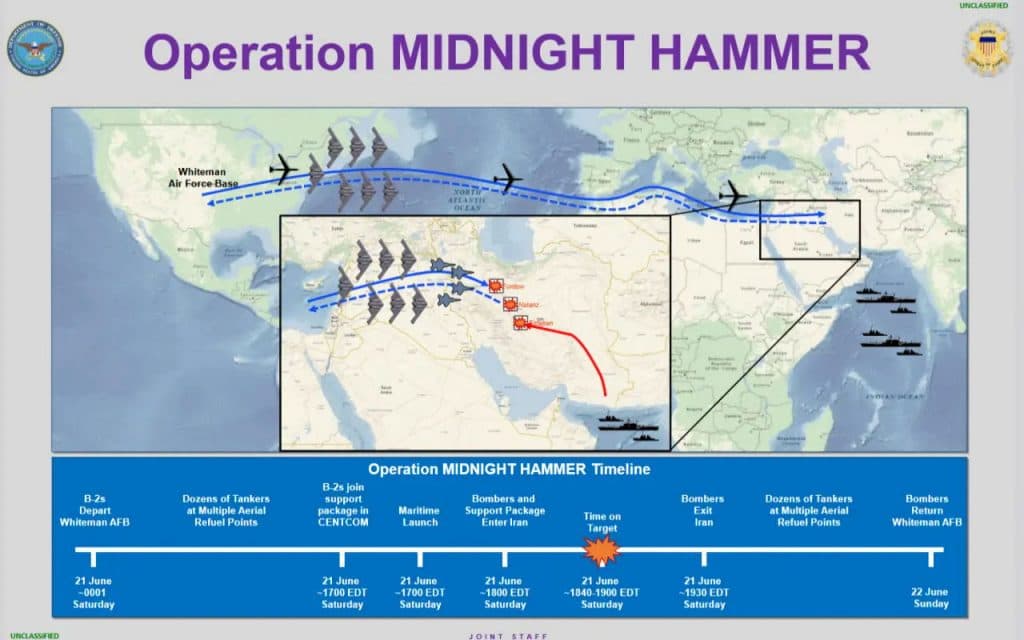
On the night of June 21 into June 22, 2025, seven B-2 Spirit stealth bombers lifted off from Whiteman Air Force Base in Missouri and flew a 36-hour round-trip mission to Iran, carrying a payload that had spent more than fifteen years in classified development and had never been used in combat. Fourteen GBU-57 Massive Ordnance Penetrators - 30,000-pound bunker-busting bombs designed for exactly one purpose, to hold at risk the kind of deeply buried, hardened facility that Iran's Fordow enrichment site represented - struck Fordow and Natanz, while more than two dozen Tomahawk cruise missiles launched from an Ohio-class submarine hit surface infrastructure at Isfahan. Operation Midnight Hammer, as the Pentagon named it, was, in the words of the Joint Chiefs of Staff chairman who oversaw its execution, a complex timed maneuver requiring exact synchronization across multiple platforms in a narrow piece of contested airspace. It succeeded operationally in every technical respect its planners intended. Its consequences for the global architecture of nuclear deterrence, a full year later, remain the single most significant and most contested legacy of the entire 2025-2026 Iran conflict.
Midnight Hammer did not merely damage a nuclear facility. It answered, for the first time in the nuclear age, a question that deterrence theorists had debated for decades without empirical resolution: could a state's most hardened, deeply buried nuclear infrastructure be held at genuine risk by a conventional, non-nuclear weapon, executed by a state acting outside any formal declaration of war, without triggering the kind of retaliatory or escalatory response that such an attack on a nuclear program's core infrastructure might reasonably have been expected to provoke? The answer the strike delivered - yes, at least in this specific case, against this specific target set, executed by this specific combination of capability and political will - has reshaped the strategic calculus of every state currently weighing whether to pursue, accelerate, or abandon a latent or active nuclear weapons capability, every alliance partner reassessing the credibility of American extended deterrence guarantees, and every defense planning staff in Washington, Moscow, Beijing, Pyongyang, and beyond now racing to understand what the strike's success, and its limits, mean for the future of underground fortification and conventional deep-strike capability alike.
This report provides a doctrine-level assessment of Operation Midnight Hammer's transformation of global deterrence - its technical achievement and its genuine limits, the proliferation incentives it has paradoxically strengthened rather than weakened, the extended deterrence credibility questions it has opened for American allies worldwide, and the arms race in deep-target strike and deep-underground fortification technology that its demonstrated success has now set in motion.
Strategic Background
Deterrence theory, in its classical Cold War formulation, rested on the premise that a state's most valuable strategic assets - its nuclear weapons, its command-and-control infrastructure, its leadership continuity mechanisms - could be rendered survivable against a first strike through hardening, dispersal, and concealment, thereby guaranteeing the second-strike retaliatory capability that made mutual assured destruction a stabilizing rather than destabilizing dynamic. States seeking nuclear weapons capability, or seeking to protect existing capability from preventive attack, adopted a parallel logic at a smaller scale: burying critical nuclear infrastructure deep enough underground, and hardening it with enough reinforced rock and concrete, that no adversary's conventional weapons could credibly threaten it, leaving nuclear retaliation as the only theoretically available means of destruction - a threshold so escalatory that it functioned, in practice, as its own form of protection.
Iran's Fordow enrichment facility was constructed explicitly according to this logic. Built into a mountainside near Qom and buried under what defense analysts estimate as 80 to 90 meters of limestone and rock overburden, Fordow was designed from its inception to be invulnerable to any conventional weapon in any state's known arsenal - a deliberate engineering response to the demonstrated Israeli and American capability, refined over decades of prior strikes against shallower nuclear infrastructure in Iraq and Syria, to destroy less deeply buried facilities. The Massive Ordnance Penetrator program that would eventually produce the GBU-57 was itself initiated specifically in response to Fordow's construction, reflecting a classified engineering effort the Pentagon has stated began more than a decade before the weapon's first operational use - an arms race conducted entirely beneath the surface of public awareness between Iranian tunnel engineers and American penetrator-weapon designers, each iterating against the other's presumed capabilities for over a decade before either side's true performance was empirically tested.
The strategic stakes riding on this untested contest were immense. If Fordow's depth and hardening proved sufficient to defeat any available conventional weapon, Iran would possess something approaching an assured sanctuary for weapons-relevant nuclear activity - a facility whose destruction would require either an extraordinarily costly ground invasion or the kind of nuclear strike that no state had employed in combat since 1945 and that using against Iran would carry consequences of a magnitude no American or Israeli leadership was prepared to contemplate. If, conversely, a conventional weapon could reliably penetrate to Fordow's depth, the entire strategic logic of deep burial as a proliferation-enabling sanctuary would be called into fundamental question - with implications extending far beyond Iran to every other state whose nuclear or nuclear-adjacent infrastructure relied on comparable underground fortification.
Historical Context
The lineage of American deep-strike bunker-busting capability traces to earlier and less powerful predecessor weapons, including the GBU-28 developed hastily during the 1991 Gulf War to address Iraqi hardened command bunkers, and successive generations of penetrating munitions developed through the 1990s and 2000s in response to the global proliferation of underground military and nuclear infrastructure that state and non-state actors increasingly adopted specifically to defeat American conventional precision-strike dominance. North Korea's extensive tunnel-based nuclear and missile infrastructure, Iran's own progressive deepening of its enrichment facilities following earlier, shallower installations, and comparable underground fortification efforts across multiple other states all reflected a consistent strategic logic: burial as the most reliable available defense against an American conventional military advantage that no state could hope to match in the open field or the open sky.
The GBU-57 program specifically emerged from Pentagon recognition, formalized in classified assessments reportedly dating to the mid-2010s, that Fordow's specific construction represented a capability gap that existing American bunker-busting munitions, including the GBU-28 and its successors, could not close. The resulting fifteen-year development program, encompassing extensive testing against representative geological formations and a purpose-built design optimized specifically for the kind of limestone overburden that characterizes Fordow's mountainside construction, represented one of the most narrowly targeted and long-gestating weapons development efforts in recent American military history - a program built, from its inception, around the specific strategic objective of eventually holding Fordow itself at genuine risk, whenever political circumstances made that objective necessary to pursue.
Israel's own military campaign against Iran, beginning with Operation Rising Lion on June 13, 2025, provided both the immediate strategic context and the operational precursor for the American strike that would follow nine days later. Israeli strikes had already significantly damaged Natanz's centrifuge halls, power infrastructure, and support buildings, alongside striking Isfahan's uranium conversion facility and killing a senior Islamic Revolutionary Guard Corps commander - establishing air superiority over significant portions of Iranian airspace and degrading Iranian air defense capability sufficiently that the subsequent American operation, penetrating deep into Iranian territory with manned bomber aircraft, could proceed with a level of confidence in mission survivability that would have been considerably riskier absent Israel's preceding campaign.
Current Situation Assessment
Nearly a year after Operation Midnight Hammer's execution, the operation's actual achievement against its declared objectives remains genuinely contested even among the technical and intelligence communities most closely engaged in assessing it - a contestation whose resolution carries direct implications for how the strike's deterrence legacy should ultimately be understood. Satellite imagery analysis has confirmed that strikes at Fordow and Natanz penetrated the surface installations and sealed key underground access points, with at least six distinct craters visible on the ridge above Fordow's buried centrifuge halls and debris patterns consistent with the bombs continuing through the protective rock layer before detonating within or adjacent to the underground facility itself. The initial White House characterization that the strikes had obliterated Iran's nuclear program proved, on more careful subsequent assessment, considerably overstated - later intelligence reporting suggested the facilities had survived the most severe worst-case damage scenarios and that the bombing had set the program back by months rather than achieving the kind of permanent, irreversible destruction the administration's initial public messaging implied.
This gap between initial claim and subsequent, more measured technical assessment matters enormously for the strike's broader deterrence legacy, because it establishes the actual empirical baseline against which every other state now calculating its own nuclear infrastructure's vulnerability to comparable strikes must measure its own protective architecture. The strike demonstrated that even the specifically engineered GBU-57, employed against precisely the target it was designed to defeat, achieved meaningful but not total destruction - degrading rather than eliminating Fordow's operational capability, and doing so through a strike package that required seven of America's entire operational fleet of twenty B-2 bombers and consumed fourteen of a limited GBU-57 inventory that defense analysts now describe as critically depleted following the operation, raising genuine questions about whether the United States retains the magazine depth to repeat a comparable strike against a second hardened target without a multi-year weapons production surge.
Iran's own strategic response to the strike has proven, according to multiple intelligence assessments published in its aftermath, to run directly counter to the deterrent and proliferation-prevention logic that justified the operation in the first place. Rather than accepting the strike as a decisive deterrent and abandoning further weapons-relevant activity, Iran's parliament passed legislation on June 25, 2025, just three days after the strike, formally suspending cooperation with the International Atomic Energy Agency and conditioning any future inspector access on approval by Iran's Supreme National Security Council - a direct and immediate erosion of the international verification architecture that had provided whatever transparency into Iran's program existed prior to the strike. Intelligence assessments published by the Soufan Center and other institutions in the strike's aftermath concluded that Midnight Hammer had likely altered Iran's strategic calculus in a specifically counterproductive direction: incentivizing a shift from the latent, threshold nuclear capability Iran had maintained for years toward actual completed weaponization, understood by Tehran's leadership as the only reliable means of ensuring regime survival and reestablishing deterrence against exactly the kind of strike it had just experienced.
Power Center Analysis
The United States: Demonstrated Capability, Depleted Inventory
Washington's achievement in Operation Midnight Hammer represents, by any technical measure, an extraordinary demonstration of precision strike capability against one of the most hardened targets ever attempted by a conventional weapon in combat - a genuine expansion of the boundary between what nuclear and conventional weapons can each achieve against deeply buried infrastructure. Chairman of the Joint Chiefs of Staff General Dan Caine's characterization of the operation as a complex timed maneuver requiring exact synchronization across multiple platforms reflects the genuine operational sophistication the mission demanded, coordinating stealth bomber penetration, submarine-launched cruise missile strikes, and the broader air campaign infrastructure Israel's preceding operations had established, into a single, tightly sequenced strike package executed across a 36-hour round-trip mission from the continental United States. The strategic cost of this achievement, however, is proving as consequential as its tactical success: the GBU-57 inventory Midnight Hammer expended represents a substantial fraction of America's total stockpile of a weapon whose production cannot be rapidly surged, creating a genuine capability gap that leaves Washington with materially reduced capacity to repeat a comparable strike against a second hardened target - whether in Iran, North Korea, or elsewhere - without a multi-year replenishment program that current defense budget and industrial base constraints have not yet clearly resolved.
Iran: Adaptation Through Deeper Burial Rather Than Capitulation
Iran's response to Midnight Hammer has proceeded along exactly the trajectory that deterrence skeptics warned preventive strikes against proliferation-threshold states most commonly produce: not abandonment of the underlying program, but adaptation and hardening against the specific vulnerability the strike exposed. Open-source intelligence and satellite imagery analysis through May 2026 reveal a program that is rebuilding, burrowing deeper, and racing to restore capability before any future diplomatic window or subsequent strike closes - with Iran's nuclear infrastructure now understood to be distributed across a wider geographic arc and, at newer or expanded sites, buried under overburden analysts describe as potentially 80 to 100 meters of granite, a harder and denser geological medium than Fordow's limestone that would require a successor weapon system beyond the GBU-57's current demonstrated capability to hold at comparable risk. Iran's parliamentary suspension of IAEA cooperation, its accelerated construction of a third enrichment facility whose existence Tehran acknowledged just before the June 2025 strikes began, and its broader strategic pivot toward the kind of completed weaponization capability that provides deterrence Fordow's compromised sanctuary evidently could not, collectively illustrate a state responding to preventive attack not through the negotiated capitulation such strikes are ostensibly designed to produce, but through exactly the kind of accelerated, less transparent proliferation trajectory that nonproliferation architecture is specifically designed to prevent.
Israel: The Preceding Campaign That Enabled American Success
Israel's Operation Rising Lion, launched nine days before Midnight Hammer, established both the immediate strategic momentum and the practical operational conditions - degraded Iranian air defenses, established regional air superiority, and a demonstrated Israeli willingness to escalate against Iranian nuclear infrastructure directly - without which the American strike's relatively low-risk execution would have been considerably more operationally hazardous. This sequencing illustrates a broader pattern in the Israel-US relationship regarding Iran that the Iran war's subsequent phases, including the February 2026 escalation that killed Khamenei himself, have continued to demonstrate: Israeli operations frequently establish the operational preconditions and political momentum that American strikes subsequently build upon, a division of strategic labor whose durability and replicability against other proliferation-threshold states lacking Israel's geographic proximity and operational access remains a genuinely open question for defense planners.
Allied States: The Extended Deterrence Credibility Question
The broader implications of Midnight Hammer for American extended deterrence guarantees - the security assurances Washington provides to allies including Japan, South Korea, and NATO members that substitute for those states' own independent nuclear weapons development - have generated genuine anxiety among the very allies these guarantees are designed to reassure. The demonstrated American willingness to conduct a unilateral preventive strike against a sovereign state's nuclear infrastructure, executed outside any formal declaration of war and justified through contested intelligence assessments, has prompted precisely the kind of credibility questioning that extended deterrence theory identifies as its most persistent vulnerability: if Washington's security guarantees can be activated so aggressively against a proliferation-threshold adversary, what does that imply about the reliability and predictability of the same guarantees when an allied state's own security is directly at stake, and does the demonstrated willingness to act unilaterally against Iran increase or decrease allied confidence that American commitments will hold under comparable pressure elsewhere.
Military and Security Implications
The military implications of Midnight Hammer's demonstrated capability extend directly into an emerging arms race between deep-target conventional strike weapons and deep-underground fortification technology that the strike's partial but incomplete success has now accelerated on both sides simultaneously. The Defense Threat Reduction Agency has confirmed it is actively using battle damage assessment data collected from Midnight Hammer to inform the design of a next-generation deep-penetrating munition specifically intended to address the harder, denser geological materials - granite rather than limestone, buried at depths of 80 to 100 meters rather than Fordow's 80 to 90 - that Iran's rebuilding program and comparable facilities elsewhere are now understood to be migrating toward. This creates what defense analysts characterize as a genuine doctrinal problem for Western planners: the boundary between what conventional weapons can defeat and what requires nuclear-yield destruction has moved substantially since Fordow's original design, but Iran's demonstrated adaptive response - burying deeper, in harder rock, across a more geographically distributed set of facilities - suggests that boundary continues shifting in the defender's favor even as American penetrator technology continues advancing in pursuit of it.
The tactical nuclear weapons debate that Midnight Hammer's partial success has reopened deserves particular analytical attention, given its direct implications for broader nuclear force posture and arms control considerations. The analytical conclusion that settled over much of the strategic community following the strike - that conventional precision strikes can now achieve what once required nuclear weapons, rendering tactical nuclear weapons strategically redundant in at least this operationally critical category - has been directly challenged by subsequent, more rigorous analysis examining what Midnight Hammer actually achieved against Iran's own geological and engineering realities. The evidence undermining the redundancy thesis comes not from academic theory but from the Pentagon's own procurement decisions regarding successor deep-strike weapons, from Iran's demonstrated geological adaptation toward harder and deeper burial, and from the arithmetic of a GBU-57 inventory that Midnight Hammer left critically depleted relative to what a sustained campaign against multiple comparable targets would require - collectively suggesting that tactical nuclear weapons retain genuine strategic relevance for exactly the category of extremely hardened, deeply buried target that conventional penetrator technology, even at its current state of the art, cannot reliably guarantee to defeat.
The broader nonproliferation architecture implications carry perhaps the most consequential long-term military and security significance of the entire episode. Multiple intelligence and policy assessments published in Midnight Hammer's aftermath converge on a genuinely troubling conclusion: the strike risks establishing a durable precedent wherein nuclear-armed powers justify preventive military strikes against existing and aspiring nuclear powers as a routine instrument of nonproliferation policy, rather than the exceptional, last-resort measure that classical deterrence and arms control theory had generally treated preventive strikes as representing. This precedent, once established and demonstrated to carry manageable political and military cost for the executing power, becomes available in principle to any nuclear-armed or nuclear-capable state assessing its own proliferation-threshold adversaries - with implications extending well beyond the Iran case into how India and Pakistan, the United States and North Korea, or any other pair of states locked in proliferation-related tension might calculate the strategic utility of comparable preventive action.
Economic and Trade Impact
The economic consequences of Operation Midnight Hammer and the broader conflict trajectory it initiated proved, as subsequent events through the February 2026 escalation would confirm at even greater scale, dramatically disproportionate to the strike's narrow tactical objective of degrading three specific nuclear facilities. The immediate market reaction to the June 2025 strikes reflected genuine uncertainty regarding Iranian retaliation options, particularly the specter of Strait of Hormuz disruption that would eventually materialize at catastrophic scale during the conflict's 2026 phase, with oil markets pricing in meaningful geopolitical risk premium even during the initial, more contained June 2025 strike window before the broader war's later and more severe economic disruption fully materialized.
The weapons procurement and defense industrial base economic implications of Midnight Hammer's demonstrated GBU-57 employment carry their own significant economic dimension, given the substantial capital investment now required to replenish a strategically depleted munition inventory and to fund the next-generation deep-penetrating weapon that the Defense Threat Reduction Agency's post-strike battle damage assessment work is actively informing. This represents a meaningful and likely sustained increase in the defense procurement resources directed toward the specific and narrow capability category of deep-target penetrating munitions - a category whose strategic salience Midnight Hammer's demonstrated but incomplete success has elevated considerably above its pre-2025 procurement priority, with corresponding budgetary implications for the broader defense industrial base contractors positioned to compete for this expanding and increasingly prioritized weapons category.
Diplomatic Positioning
The diplomatic architecture surrounding Midnight Hammer's legacy reflects a genuine and unresolved tension between the operation's demonstrated tactical achievement and the international nonproliferation and arms control community's mounting concern regarding its broader precedential implications. The International Atomic Energy Agency, whose verification mission Iran's parliamentary suspension of cooperation directly undermined within days of the strike, faces a genuinely diminished capacity to provide the kind of transparent, internationally credible assessment of Iran's post-strike nuclear trajectory that both diplomatic de-escalation and any future negotiated settlement would require - with IAEA Director General Rafael Grossi's own public statements in the strike's immediate aftermath reflecting the agency's acute awareness that its verification architecture had been directly compromised by the very conflict its inspections were meant to help prevent.
The Carnegie Endowment's analysis of the strike's most significant long-term consequence identifies precisely this diplomatic and institutional dimension as the central unresolved question determining whether Midnight Hammer ultimately proves to have curbed or accelerated the underlying proliferation threat it was designed to address: whether Tehran's domestic political resolve trends toward genuinely curbing further weapons-development trajectory, and whether diplomatic efforts can successfully reestablish the rigorous IAEA-backed safeguards that Iran's post-strike parliamentary action specifically undermined. Absent both conditions being met, the analysis concludes, the strike's tactical effectiveness will prove to have delivered little more than a temporary pause - delaying rather than preventing the next confrontation over Iran's nuclear ambitions, a assessment whose accuracy the subsequent February 2026 escalation, culminating in Khamenei's assassination and a considerably more severe and comprehensive military confrontation, has now empirically confirmed.
Regional Fallout
In the Middle East, Midnight Hammer's demonstrated precedent of unilateral preventive strikes against nuclear infrastructure has reshaped how every regional state assesses both its own potential vulnerability to comparable action and the strategic calculus of pursuing nuclear latency or weaponization as either a deterrent against such strikes or, paradoxically, as the specific outcome such strikes are intended to prevent. Saudi Arabia and other Gulf states' own periodic signaling regarding potential nuclear program development, calibrated explicitly against Iranian capability, must now factor in the demonstrated American and Israeli willingness to conduct preventive strikes against exactly this category of program - a consideration that could cut in either direction, either deterring Gulf nuclear ambitions through demonstrated consequence, or accelerating them through the same logic that appears to have driven Iran's own post-strike pivot toward accelerated rather than abandoned weaponization.
In East Asia, North Korea's extensive tunnel-based nuclear and missile infrastructure, developed and hardened over decades specifically to defeat American conventional precision-strike capability, now sits under direct and heightened scrutiny given Midnight Hammer's demonstrated, if partial, capability against comparable hardened targets. Pyongyang's own strategic response, closely watched by American and allied intelligence assessments, will provide an important comparative data point regarding whether North Korea's considerably more extensive and mature underground fortification program, built over a longer period and with greater strategic investment than Iran's comparatively younger Fordow facility, would prove more resilient against a comparable strike - a question whose empirical answer no state currently possesses with confidence, given the absence of any operational test against North Korean infrastructure specifically.
In South Asia, the India-Pakistan nuclear dynamic carries its own distinct implications from the Midnight Hammer precedent, given both states' reliance on hardened and dispersed nuclear infrastructure and the demonstrated American willingness to conduct preventive strikes against comparable facilities elsewhere. Neither state's strategic planning community has publicly signaled significant reassessment of their own nuclear posture specifically attributable to the Iran precedent, but the broader South Asian nuclear stability architecture, already subject to periodic crisis including the documented 2025 India-Pakistan conflict, now operates within a global strategic environment in which preventive strikes against nuclear infrastructure have been demonstrated as operationally achievable and politically survivable for at least one pair of capable states.
Global Strategic Consequences
The most consequential global strategic implication of Operation Midnight Hammer is the empirical demonstration, for the first time in the nuclear age, that a conventional weapon can hold at genuine if incomplete risk the kind of deeply buried, hardened nuclear infrastructure that deterrence theory had long assumed provided near-assured sanctuary against anything short of nuclear-yield destruction. This demonstration fundamentally alters the strategic calculus facing every state currently relying on or contemplating underground fortification as a proliferation-enabling or proliferation-protecting strategy, establishing a new and considerably less favorable baseline for the defender than existed before June 22, 2025 - even as Iran's own demonstrated adaptive response, burying deeper and hardening further, illustrates that this new baseline is itself immediately subject to renewed erosion as defenders adapt to the newly demonstrated threat.
The paradoxical proliferation consequence that multiple intelligence assessments have identified - that preventive strikes intended to halt proliferation instead accelerated Iran's strategic pivot toward completed weaponization as the only reliable deterrent against future comparable strikes - represents perhaps the single most important and most troubling lesson for the broader architecture of nonproliferation policy that Midnight Hammer's year-long aftermath has now delivered. If the empirical pattern the Iran case establishes generalizes to other proliferation-threshold states facing comparable preventive strike pressure, the strategic logic underlying preventive counter-proliferation strikes as a policy instrument requires fundamental reassessment: rather than reliably halting or reversing weapons development trajectories, such strikes may instead reliably accelerate them, converting latent, hedged capability into the kind of completed, weaponized capability that provides the only deterrent a targeted state's leadership assesses as genuinely reliable against future attack.
Risk Matrix
- Risk Level: Critical - Iran's demonstrated post-strike pivot toward accelerated weaponization succeeds in producing an actual, tested nuclear device before diplomatic or further military intervention can prevent it, transforming Midnight Hammer's legacy from a delayed proliferation threat into a directly accelerated one.
- Risk Level: High - North Korea, Pakistan, or another state possessing extensive underground nuclear and missile infrastructure draws the specific engineering lesson from Iran's Fordow experience and accelerates its own deeper-burial, harder-rock fortification program, restoring the underground sanctuary advantage that Midnight Hammer's demonstrated capability had partially eroded.
- Risk Level: High - The precedent Midnight Hammer establishes for unilateral preventive strikes against nuclear infrastructure is invoked by another nuclear-armed or nuclear-capable state against its own proliferation-threshold adversary, potentially in a South Asian, East Asian, or Middle Eastern context where escalation management infrastructure is less developed than existed between the United States, Israel, and Iran.
- Risk Level: High - America's depleted GBU-57 inventory, combined with the multi-year timeline required for next-generation deep-penetrating munition development, leaves the United States without credible near-term capability to repeat a comparable strike against a second hardened proliferation target, undermining the deterrent value the demonstrated Iran strike was intended to establish more broadly.
- Risk Level: Medium - Allied states' extended deterrence confidence continues eroding as the demonstrated pattern of unilateral American preventive action against Iran is weighed against the reliability of comparable American security guarantees in East Asian or European contingencies, incrementally increasing allied interest in independent or regionally coordinated nuclear deterrent options.
- Risk Level: Medium - The IAEA's verification architecture, directly undermined by Iran's post-strike parliamentary suspension of cooperation, fails to achieve meaningful restoration through subsequent diplomatic efforts, leaving the international community without credible independent assessment of Iran's ongoing nuclear trajectory for an extended period.
- Risk Level: Medium - The Defense Threat Reduction Agency's next-generation deep-penetrating munition program successfully closes the capability gap that Iran's deeper, harder-rock rebuilding program has opened, restoring American conventional capability to hold at risk even the hardened facilities Iran is currently constructing, though on a multi-year rather than near-term timeline.
- Risk Level: Low (near-term) - A comprehensive international framework restricting preventive strikes against nuclear infrastructure, or restoring robust multilateral verification sufficient to prevent the proliferation acceleration that Iran's post-strike trajectory has demonstrated, is established within the coming several years. The demonstrated strategic utility that at least some states have derived from the Midnight Hammer precedent, combined with the absence of consensus among major nuclear powers regarding preventive strikes' legality and wisdom, make near-term restoration of a robust preventive-strike restraint norm unlikely.
Scenario Analysis
Scenario One: Continued Proliferation Acceleration Despite Strike Pressure (Most Probable, 2-4 Year Horizon)
The most probable trajectory, consistent with the pattern already documented through Iran's demonstrated post-strike response, sees continued proliferation-threshold state adaptation toward deeper, harder, more distributed underground infrastructure specifically engineered to defeat the demonstrated GBU-57 capability, combined with accelerated rather than abandoned weapons-development timelines driven by the same deterrence-restoration logic that appears to have shaped Iran's own strategic pivot. In this scenario, American and allied deep-strike weapons development continues its own parallel acceleration in direct response to observed adversary hardening, producing a sustained and mutually reinforcing arms race between penetrator technology and underground fortification that neither side achieves decisive and durable advantage within the coming several years, while the underlying proliferation dynamics that preventive strikes were intended to arrest continue advancing, if on a delayed and more costly timeline than would have obtained absent the strike.
Scenario Two: Diplomatic Restoration Achieves Genuine Nonproliferation Progress (Moderate Probability)
A more diplomatically successful trajectory would see sustained international pressure, combined with Iran's own internal political calculus following the additional and more severe costs the February 2026 escalation subsequently imposed, produce genuine restoration of IAEA verification access and a negotiated settlement that credibly constrains Iran's weapons-development trajectory in exchange for sanctions relief and security guarantees - the outcome the Islamabad Memorandum framework, discussed extensively in this publication's broader Iran war coverage, at least nominally aims toward achieving. This scenario would require the kind of sustained diplomatic engagement and mutual trust-building that the accumulated mistrust from both the June 2025 and February 2026 strike phases makes considerably more difficult to achieve than would have been the case absent Midnight Hammer's initial precedent-setting action.
Scenario Three: Precedent Replication Produces a Wider Preventive-Strike Norm (Lower Probability, Highest Consequence)
The demonstrated tactical and political viability of Midnight Hammer's preventive strike model is explicitly invoked and replicated by another nuclear-armed or nuclear-capable state against a proliferation-threshold adversary in a different regional context, potentially South Asia, the Korean Peninsula, or another theater where the escalation management infrastructure and diplomatic relationships that ultimately, if imperfectly, contained the US-Israel-Iran confrontation's worst potential outcomes do not exist to the same degree. This scenario represents the realization of the specific risk that nonproliferation analysts have most explicitly warned Midnight Hammer's precedent establishes - the normalization of preventive military strikes against nuclear infrastructure as a routine rather than exceptional instrument of state policy, with correspondingly higher and less predictable escalation risk in contexts lacking the specific bilateral relationships and intelligence-sharing arrangements that shaped the Iran case's particular trajectory.
Intelligence Forecast (6-24 Months)
The six-to-twelve-month horizon will be shaped substantially by continued satellite imagery and open-source intelligence monitoring of Iran's rebuilding and deeper-burial program, with particular attention warranted regarding whether the harder, denser geological materials and greater depths that current assessments describe as Iran's adaptive response prove genuinely resistant to existing GBU-57 capability, or whether Iran's engineering response has itself been calibrated based on incomplete understanding of the weapon's actual demonstrated performance. The Defense Threat Reduction Agency's next-generation deep-penetrating munition development program, actively informed by Midnight Hammer battle damage assessment data, will provide an important indicator of the pace at which American capability is likely to close whatever gap Iran's adaptive hardening has opened.
Continued monitoring of the broader Islamabad Memorandum diplomatic framework's implementation, examined extensively elsewhere in this publication's Iran conflict coverage, will remain directly relevant to assessing whether Midnight Hammer's stated nonproliferation objective can still be achieved through negotiated settlement despite the strike's demonstrated failure to produce that outcome through military pressure alone. The trajectory of IAEA access restoration specifically, given the agency's central role in providing the kind of credible independent verification any durable settlement would require, deserves particular attention as an early indicator of whether the broader diplomatic track can overcome the institutional damage Iran's post-strike parliamentary action inflicted.
The twelve-to-twenty-four-month horizon will be significantly shaped by whether other proliferation-threshold states, observing both Midnight Hammer's demonstrated capability and Iran's documented adaptive and arguably counterproductive response, draw lessons that accelerate their own underground hardening programs, their own weapons-development timelines, or both. Continued American GBU-57 inventory replenishment and next-generation weapon development funding trajectories, tracked through defense budget and procurement disclosures, will provide important quantitative evidence regarding whether Washington is successfully rebuilding the capability depth that a repeat strike against a comparably hardened target, whether in Iran or elsewhere, would require.
Final Strategic Takeaway
Operation Midnight Hammer answered, with empirical finality, a question that deterrence theorists had debated in the abstract for decades: yes, a conventional weapon, employed with sufficient precision, platform survivability, and political will, can penetrate even the most hardened, deeply buried nuclear infrastructure that a proliferation-threshold state can construct. That answer alone represents a genuine and durable transformation of the strategic landscape governing nuclear proliferation and counter-proliferation policy, establishing a new baseline against which every state's underground fortification strategy must now be measured and, inevitably, adapted.
What Midnight Hammer did not answer, and what its year-long aftermath has instead delivered as a genuinely troubling empirical lesson, is whether demonstrating this capability actually advances the nonproliferation objective it was ostensibly designed to serve. Iran's documented pivot toward accelerated rather than abandoned weaponization, its parliamentary suspension of the international verification architecture that provided whatever transparency previously existed, and its demonstrated engineering adaptation toward deeper, harder-rock fortification collectively suggest that the strike's tactical achievement purchased, at best, a temporary delay in Iran's proliferation trajectory - and quite possibly accelerated the very outcome, a nuclear-armed or nuclear-threshold Iran operating with reduced international transparency, that the strike was intended to prevent.
The deepest and most consequential legacy Midnight Hammer leaves for the broader architecture of global deterrence is neither its genuine technical achievement nor its contested strategic wisdom in the Iran case specifically, but the precedent it establishes for every other state now weighing whether preventive strikes against nuclear infrastructure represent a viable, survivable instrument of nonproliferation policy. That precedent, once demonstrated to carry manageable political and military cost for at least one capable state, does not remain contained to the specific circumstances of its first use. It becomes, like every other capability whose employment the international system has witnessed and absorbed without decisive consequence, a template available for study, adaptation, and eventual replication by any other state possessing comparable capability and comparable political calculation that its own proliferation-threshold adversary's underground sanctuary has, at last, become vulnerable to exactly the kind of attack that Fordow's mountain was built to make impossible.
A weapon fifteen years in development answered, in thirty-six hours, a question the nuclear age had left unresolved for eighty years: that no mountain is deep enough to guarantee sanctuary forever. What it could not answer is whether removing that sanctuary makes the world safer, or simply teaches every state relying on one to dig deeper, faster, and with considerably less patience for the diplomacy that might have made the digging unnecessary.
Frequently Asked Questions
What was Operation Midnight Hammer?
Operation Midnight Hammer was the codename for a US military strike on June 21-22, 2025, in which seven B-2 Spirit stealth bombers flew from Whiteman Air Force Base to drop fourteen GBU-57 Massive Ordnance Penetrator bunker-buster bombs on Iran's Fordow and Natanz nuclear enrichment facilities, while submarine-launched Tomahawk cruise missiles struck Isfahan, marking the weapon's first-ever combat use.
Did Operation Midnight Hammer destroy Iran's nuclear program?
No. While satellite imagery confirms the strikes penetrated Fordow's and Natanz's underground facilities and sealed key access points, subsequent intelligence assessments concluded the program was set back by months rather than permanently destroyed, contradicting the White House's initial claim that the program had been obliterated.
How did Iran respond to the strike?
Iran's parliament suspended cooperation with the IAEA just three days after the strike, and intelligence assessments concluded Iran shifted its strategic posture toward accelerated weaponization rather than abandoning its nuclear ambitions, viewing completed nuclear capability as the only reliable deterrent against future strikes.
What does Midnight Hammer mean for tactical nuclear weapons?
While some analysts initially concluded the strike made tactical nuclear weapons redundant for defeating hardened targets, more rigorous subsequent analysis found this premature, citing Iran's adaptation toward deeper, harder-rock fortification and America's depleted GBU-57 inventory as evidence that tactical nuclear weapons retain relevance against the most extreme hardened targets.
How has the strike affected global nonproliferation efforts?
The strike has established a contested precedent that nuclear-armed states may justify preventive strikes against proliferation-threshold states, while simultaneously demonstrating a pattern in which such strikes may accelerate rather than deter weapons development, complicating broader nonproliferation strategy globally.
What is the connection between Midnight Hammer and the later 2026 Iran war?
Midnight Hammer represented the first phase of the broader US-Israel-Iran conflict. The strike's failure to durably resolve the underlying proliferation dispute, combined with Iran's accelerated weaponization response, contributed to the far more severe February 2026 escalation, including the assassination of Supreme Leader Ali Khamenei.