
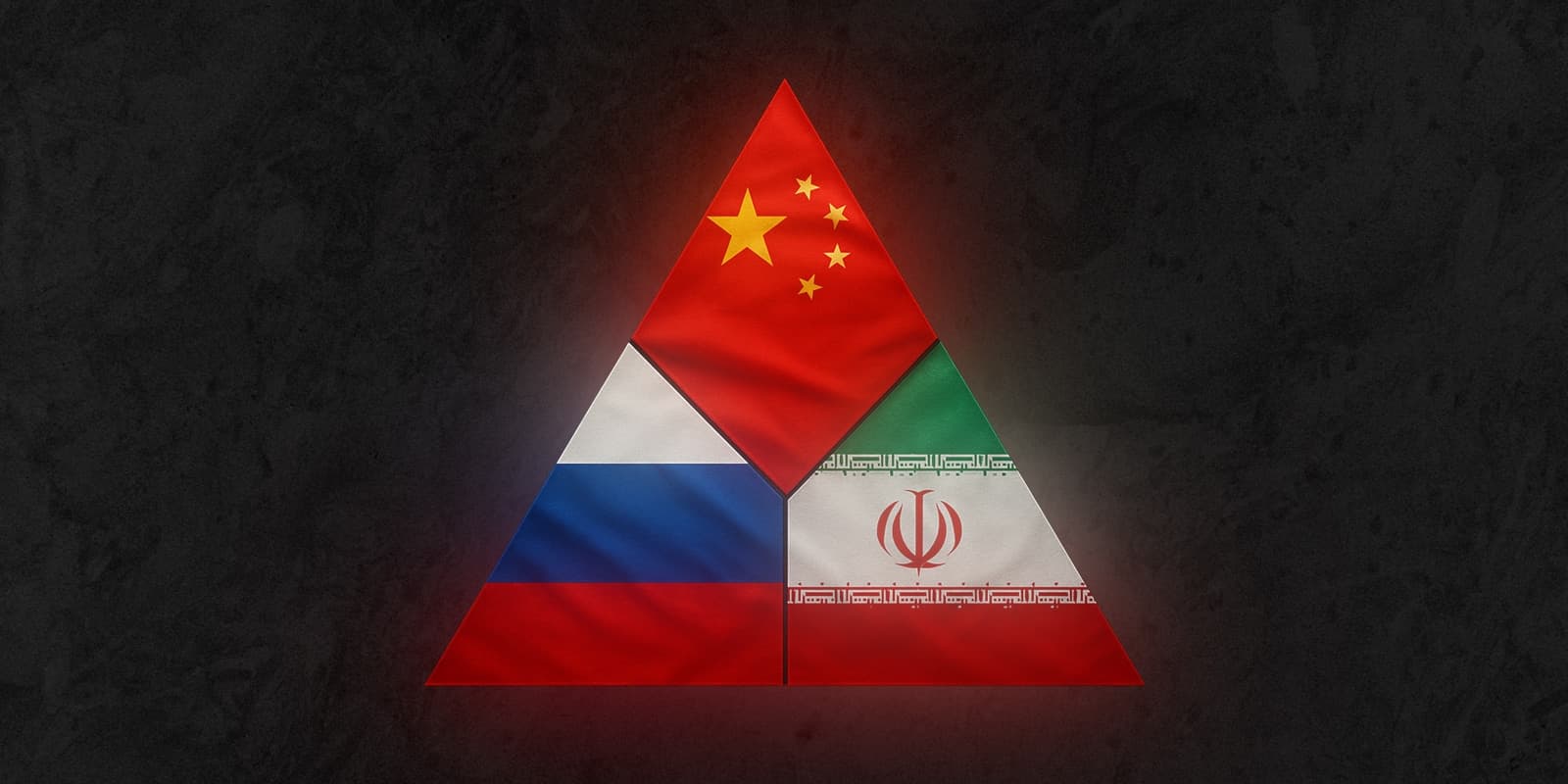
The New Axis: How Russia, China, and Iran Are Forging a Strategic Bloc to Challenge the American-Led Order
Executive Summary
A new axis has formed across Eurasia, and it has been built not in the shadows but in plain diplomatic view, through summit declarations, defence cooperation agreements, energy contracts, and a sustained pattern of mutual support that has hardened from tactical convenience into something approaching strategic partnership. Russia, China, and Iran - three states with profoundly different histories, political systems, economic structures, and regional ambitions - have converged around a shared determination to challenge the American-led international order, to blunt the effectiveness of Western sanctions regimes, and to construct alternative frameworks for security, trade, and technology that reduce their collective vulnerability to Western economic and diplomatic pressure.
This convergence did not emerge from natural affinity. Russia and China carry centuries of mutual suspicion rooted in their shared and contested Central Asian and Far Eastern frontiers. Iran's Shia theocracy has little ideological common ground with the Chinese Communist Party's authoritarian state capitalism or with Vladimir Putin's Orthodox-nationalist conservatism. What binds the three powers is not shared values but shared adversaries and shared vulnerabilities: each faces a Western-led sanctions architecture designed to constrain its strategic ambitions, each has concluded that the existing international order under American leadership offers it diminishing returns, and each has determined that mutual support - economic, military, diplomatic, and technological - improves its individual capacity to resist Western pressure and pursue its regional and global objectives.
This report provides a doctrine-level assessment of the Russia-China-Iran axis - its historical formation, the specific mechanisms through which cooperation operates across military, economic, and diplomatic domains, the internal tensions and limits that constrain its cohesion, and the profound implications it carries for sanctions effectiveness, regional conflict dynamics in Ukraine and the Middle East, nuclear proliferation, and the broader architecture of twenty-first century great power competition. The central finding is that this axis, while genuinely consequential and rapidly deepening, remains fundamentally an alignment of convenience rather than an alliance of conviction - bound together by the gravitational pull of American and Western pressure rather than by a coherent shared vision of the order that should replace the one they are jointly contesting. That distinction matters enormously for how durable, how coordinated, and how dangerous the axis will prove to be.
Strategic Background
The emergence of the Russia-China-Iran axis must be understood as the product of three separate but increasingly intersecting strategic trajectories, each driven by its own distinct logic before converging into a recognizable pattern of mutual reinforcement.
Russia's trajectory toward strategic partnership with China and Iran accelerated dramatically following the annexation of Crimea in 2014 and reached a qualitatively new level following the full-scale invasion of Ukraine in February 2022. The comprehensive Western sanctions regime imposed on Russia - covering its financial system, energy exports, technology imports, and the personal assets of its political and economic elite - created an existential economic challenge that Russia could not navigate through Western-oriented trade and financial relationships. Moscow's pivot toward China and Iran was not a matter of ideological preference but of strategic necessity: these were the major powers willing to maintain and in some cases expand economic relationships with Russia despite Western pressure, providing the markets, the technology workarounds, and the diplomatic cover that Russian economic survival under sanctions required.
China's trajectory toward deepening partnership with Russia and Iran reflects a different but complementary logic. Xi Jinping's government has watched the trajectory of Western sanctions against Russia with the specific calculation that similar measures could be applied against China in a future Taiwan crisis scenario, and has used the Russia relationship as a live laboratory for understanding sanctions evasion mechanisms, alternative payment systems, and supply chain resilience strategies that would be directly applicable to China's own potential future under comprehensive Western economic pressure. China's relationship with Iran serves complementary objectives: securing discounted energy supplies that reduce Chinese vulnerability to Middle Eastern supply disruption, building influence in a strategically positioned Gulf state that controls access to the Strait of Hormuz, and demonstrating to other potentially sanctioned states that China offers a reliable alternative to Western-dominated international economic relationships.
Iran's trajectory toward partnership with Russia and China is the most existentially driven of the three. Decades of American and international sanctions - intensified dramatically following the Trump administration's 2018 withdrawal from the Joint Comprehensive Plan of Action nuclear agreement and the subsequent maximum pressure campaign - have severely constrained Iran's economic development, its access to international financial systems, and its ability to modernize its military and civilian infrastructure. Tehran's strategic calculation is straightforward: Western-led sanctions cannot be defeated through negotiation alone, and partnership with major powers willing to circumvent or ignore those sanctions provides the only viable pathway to economic resilience and continued regional influence projection through its network of armed proxies across the Middle East.
Historical Context
The historical relationships among Russia, China, and Iran provide essential context for understanding both the foundations and the limits of their contemporary strategic convergence.
The Sino-Soviet relationship during the Cold War was characterized by ideological solidarity that masked deep strategic rivalry, culminating in the Sino-Soviet split of the early 1960s and the 1969 border clashes along the Ussuri River that brought the two communist powers to the brink of war. The historical memory of this rivalry - rooted in territorial disputes along their shared Central Asian and Far Eastern frontiers, in competition for leadership of the global communist movement, and in fundamentally different strategic cultures - has not entirely dissipated, even as the contemporary Russia-China relationship has reached unprecedented depth. The 2001 Sino-Russian Treaty of Good-Neighborliness and Friendly Cooperation, and the subsequent resolution of the two nations' remaining border disputes in 2004, removed the most acute historical friction point and created the foundation for the deepening partnership that has followed.
Russia-Iran relations carry their own complex historical legacy, including the nineteenth-century Great Game rivalry between Imperial Russia and Britain for influence over Persia, the Soviet occupation of northern Iran during World War II, and decades of Cold War-era Iranian wariness toward Soviet communist influence given the Islamic Republic's explicitly religious ideological foundation following the 1979 revolution. Despite this complicated history, pragmatic cooperation between Moscow and Tehran developed steadily from the 1990s onward, anchored initially in Russian construction of Iran's Bushehr nuclear power plant and gradually expanding into broader strategic cooperation as both nations found themselves increasingly isolated by Western sanctions regimes.
China-Iran relations have historically been the least developed of the three bilateral relationships, constrained by geographic distance and by China's traditional reluctance to become deeply entangled in Middle Eastern political dynamics that carried little direct relevance to Chinese core interests. This changed substantially as Chinese energy import dependency grew and as Belt and Road Initiative ambitions extended Chinese economic interests into the Persian Gulf region. The 2021 China-Iran 25-Year Comprehensive Strategic Partnership Agreement - reportedly worth up to four hundred billion dollars in Chinese investment commitments across Iranian energy, infrastructure, and technology sectors in exchange for discounted and secure long-term oil supplies - represented the most significant formalization of the bilateral relationship in its history and signaled Chinese willingness to deepen economic engagement with Iran despite the sanctions risk this carried for Chinese companies and financial institutions.
The Shanghai Cooperation Organisation, established in 2001 by China, Russia, and four Central Asian states, has provided an important institutional framework within which the broader Eurasian strategic convergence has developed. Iran's accession to full SCO membership in 2023 - following years as an observer state whose full membership application had been blocked by Western-aligned sanctions concerns - represented a significant institutional milestone, formally incorporating Iran into the primary multilateral security and economic framework that Russia and China have built across Eurasia and providing Tehran with a degree of multilateral institutional legitimacy that bilateral relationships alone could not supply.
Current Situation Assessment
The Russia-China-Iran axis as it exists in 2026 operates through a dense network of bilateral and trilateral mechanisms that span military cooperation, economic interdependence, technology sharing, and diplomatic coordination, while notably stopping short of the formal collective defence commitments that would constitute a genuine military alliance comparable to NATO's Article 5 architecture.
The Russia-China relationship has reached what both governments describe as a partnership without limits - a phrase first used in the joint statement issued by Vladimir Putin and Xi Jinping at the Beijing Winter Olympics in February 2022, just weeks before Russia's invasion of Ukraine. The relationship's depth is reflected in bilateral trade that has grown dramatically since 2022, reaching record levels as Chinese exports of machinery, electronics, vehicles, and dual-use components have filled the gap left by departing Western companies in the Russian market, while Russian energy exports to China - including pipeline natural gas through the Power of Siberia pipeline and seaborne crude oil shipments - have provided Beijing with discounted energy supplies and provided Moscow with the revenue critical to sustaining its war economy under Western sanctions.
The military dimension of the China-Russia relationship, while stopping short of formal alliance, has deepened substantially through joint military exercises including the Vostok and Tsentr strategic exercises that have incorporated Chinese forces, joint naval patrols including bomber flights near Japanese and South Korean airspace that have required allied fighter intercepts, and - most consequentially - Chinese provision of dual-use technology including machine tools, microelectronics, and optical components that have been essential to sustaining Russian military production through the Ukraine war despite Western sanctions and export controls targeting these exact technology categories. Western intelligence assessments have consistently identified Chinese component supply as a critical factor enabling Russia to sustain its war economy at the production levels the conflict has required, even as Beijing has avoided the direct provision of lethal weapons systems that would trigger the most severe secondary sanctions exposure for Chinese financial institutions and companies.
Iran's contribution to Russia's war effort in Ukraine has been more direct and more consequential than China's. Iranian Shahed-136 drones, supplied to Russia in substantial numbers beginning in 2022 and subsequently produced under license at a Russian manufacturing facility in Tatarstan, have become one of the defining weapons systems of the Ukraine conflict, used extensively in Russian strikes against Ukrainian infrastructure, particularly energy systems, throughout the harsh winter months. Iranian ballistic missile transfers to Russia, reported by Western intelligence agencies beginning in 2024, represented a further escalation of direct Iranian military support, providing Russia with additional precision strike capability at a moment when its own missile production was struggling to keep pace with wartime consumption rates. In exchange, Russia has reportedly provided Iran with advanced air defence systems, fighter aircraft technology, and satellite capabilities that enhance Tehran's own military modernization and its ability to monitor and potentially target adversaries including Israel.
The economic dimension of axis cooperation has focused heavily on the construction of sanctions evasion infrastructure that benefits all three powers and that other sanctioned or potentially sanctioned states have increasingly sought to access. The development of alternative payment mechanisms that bypass the SWIFT international banking messaging system, the expansion of bilateral currency settlement arrangements that reduce dollar dependency, the use of shadow fleet tanker operations to circumvent oil export sanctions, and the establishment of complex intermediary trading networks through third countries including the United Arab Emirates, Turkey, and various Central Asian states have collectively created a parallel economic infrastructure that has substantially blunted the effectiveness of Western sanctions regimes against all three nations.
Power Center Analysis
China: The Senior Partner and Strategic Beneficiary
China occupies the position of dominant power within the axis, possessing an economy, military capability, and global diplomatic reach that vastly exceeds either Russia or Iran individually or combined. Xi Jinping's government approaches the relationship with Russia and Iran through a careful calculation that maximizes the strategic benefits of association while minimizing the direct exposure to Western secondary sanctions and the reputational costs of being seen as a direct enabler of Russian aggression in Ukraine or Iranian support for armed proxies across the Middle East.
China's approach is characterized by what analysts term calibrated ambiguity - providing substantial economic and dual-use technological support to both Russia and Iran while maintaining sufficient deniability and distance to avoid the most severe forms of Western secondary sanctions that could be applied to Chinese financial institutions with significant exposure to the international dollar-based financial system. This calibration reflects China's fundamental strategic position: unlike Russia and Iran, which have already absorbed the most severe forms of Western economic isolation and have correspondingly less to lose from further escalation, China remains deeply integrated into the global economy in ways that make it acutely vulnerable to comprehensive Western financial sanctions of the kind applied to Russia, and Beijing's strategic planners are determined to avoid triggering that scenario before they have completed the sanctions-resilience infrastructure - alternative payment systems, expanded gold reserves, diversified trade relationships, domestic technology self-sufficiency - that would allow China to weather such sanctions if they were ever applied in a Taiwan crisis scenario.
China's relationship with the axis serves multiple Chinese strategic interests simultaneously. It provides discounted energy supplies from both Russia and Iran that enhance Chinese energy security and reduce vulnerability to potential disruption of Middle Eastern supply routes through the Strait of Hormuz, a chokepoint that remains vulnerable to interdiction in a conflict scenario. It provides a live laboratory for testing and refining sanctions evasion mechanisms that China's own strategic planners assess could become directly relevant to Chinese economic security in a future Taiwan contingency. It extends Chinese influence into Central Asia, the Middle East, and Eastern Europe through economic and diplomatic channels that complement and reinforce the Belt and Road Initiative's broader global ambitions. And it provides China with leverage over American and European strategic attention and resources, as Washington and Brussels are forced to simultaneously manage the Russian threat in Europe, the Iranian threat in the Middle East, and the Chinese challenge in the Indo-Pacific - a three-front strategic burden that exceeds what American resources, even at maximum mobilization, can comfortably sustain.
Russia: The Indispensable but Diminished Partner
Russia's position within the axis has been transformed by the Ukraine war from a roughly co-equal partnership with China into a relationship of growing asymmetric dependency. Vladimir Putin's government requires Chinese economic support - markets for energy exports, supply of sanctioned technology components, and general economic lifeline functions - at a scale and on terms that increasingly reflect Russia's weakened negotiating position rather than the partnership of equals that official rhetoric continues to project. Chinese pricing for Russian energy exports has reportedly included substantial discounts that reflect Beijing's awareness of Moscow's limited alternative markets, and the bilateral trade relationship, while beneficial to Russia in absolute terms, has created a degree of economic dependency on China that Russian strategic planners would have regarded as unacceptable in the pre-2022 era.
Despite this asymmetry, Russia retains genuine strategic value to the broader axis that extends beyond its economic dependency. Russian military technology - including advanced air defence systems, fighter aircraft, and submarine technology - remains attractive to both China and Iran as a complement to indigenous development programmes. Russian energy resources, including both the hydrocarbon reserves that provide revenue and the nuclear technology expertise that Rosatom has exported to multiple nations including Iran, Egypt, and Turkey, provide genuine capabilities that neither China nor Iran can fully replicate domestically in the near term. Russia's permanent UN Security Council seat provides diplomatic veto protection that has repeatedly shielded both Iran and, to a lesser extent, Chinese interests from international censure and sanctions efforts that would otherwise have proceeded through Security Council mechanisms.
Iran: The Regional Proxy Network and Energy Supplier
Iran's position within the axis is defined by its role as both a beneficiary of Russian and Chinese support and a contributor of specific capabilities - particularly drone and missile technology, and its extensive network of regional proxy forces - that serve broader axis strategic interests. Iran's Axis of Resistance, encompassing Hezbollah in Lebanon, various militia groups in Iraq and Syria, the Houthi movement in Yemen, and historically Hamas in Gaza, provides Tehran with the capacity to project influence and impose costs on American and Israeli interests across the Middle East without direct Iranian military engagement, creating a deniable forward defence capability that has proven its disruptive potential through Houthi attacks on Red Sea shipping and through the broader regional escalation that followed the October 2023 Hamas attack on Israel.
Iran's nuclear programme remains the most internationally consequential and most diplomatically fraught dimension of its strategic posture, and its relationship to the broader Russia-China-Iran axis is complex. Both Russia and China have historically provided diplomatic cover for Iran's nuclear ambitions within international forums, using their Security Council positions to moderate the severity of sanctions and resolutions directed at Iranian nuclear activities. However, neither Moscow nor Beijing has provided Iran with direct nuclear weapons technology, reflecting both genuine non-proliferation concerns and calculated strategic interests in maintaining Iran as a capable but non-nuclear partner whose regional disruptive potential serves axis interests without crossing the threshold that would trigger the most severe international response and potentially destabilizing nuclear proliferation cascades across the Middle East, including in Saudi Arabia and other Gulf states that have indicated they would pursue their own nuclear programmes in response to a nuclear-armed Iran.
Military and Security Implications
The military and security implications of the Russia-China-Iran axis operate through several distinct mechanisms that, while falling short of formal collective defence, create meaningful operational and strategic coupling among the three powers' military activities.
The most immediately consequential military dimension has been Iranian drone and missile technology transfer to Russia, which has fundamentally altered the character of the Ukraine conflict's strike campaigns. The Shahed-136 drone - a relatively low-cost, long-range loitering munition originally developed with significant input from reverse-engineered American and Israeli drone technology captured or acquired by Iran over the preceding decade - has provided Russia with a mass-produced strike capability that has proven effective against Ukrainian air defence systems through sheer volume of attacks, even as its individual unit cost and effectiveness remain inferior to more sophisticated precision munitions. The establishment of licensed Shahed production within Russia itself, reducing dependency on direct Iranian shipment and the sanctions risks this created, represents a significant deepening of the military-industrial cooperation between the two nations.
China's military-technical relationship with Russia has been characterized by what Western intelligence assessments describe as comprehensive support for Russia's defence industrial base through the supply of dual-use components - machine tools, microelectronics, optical systems, and navigation equipment - that have proven essential to sustaining Russian weapons production at wartime tempo despite the comprehensive export control regime that Western nations have imposed on technology transfers to Russia's defence sector. This support has allowed Russia to substantially increase its production of artillery shells, missiles, and armoured vehicles beyond what Western intelligence initially assessed as achievable under sanctions conditions, directly contributing to Russia's capacity to sustain the Ukraine war at current intensity levels.
Joint military exercises among the three powers, while not rising to the level of integrated combined operations, have grown in frequency and sophistication. Naval exercises in the Gulf of Oman involving Russian, Chinese, and Iranian vessels, conducted periodically since 2019, signal a degree of operational familiarity and political solidarity that, while limited in actual military substance, carries significant symbolic and signaling value regarding the three powers' shared interest in challenging American naval dominance in critical maritime chokepoints including the Strait of Hormuz, through which approximately twenty percent of global oil consumption transits.
The nuclear dimension of axis security cooperation remains the most consequential and most carefully managed aspect of the relationship. Russia's provision of advanced air defence systems to Iran, including reported transfers of S-400 system components, enhances Tehran's ability to defend its nuclear facilities and other strategic infrastructure against the Israeli and potentially American air strikes that have remained a persistent threat throughout the prolonged diplomatic standoff over Iran's nuclear programme. China's continued purchase of Iranian oil, conducted through complex intermediary arrangements designed to circumvent American sanctions, provides Iran with crucial revenue that sustains both its civilian economy and its military modernization programmes, including the nuclear and missile development activities that remain the central international security concern regarding Iranian capabilities.
Economic and Trade Impact
The economic dimensions of the Russia-China-Iran axis represent its most structurally significant and most broadly consequential aspect, creating a parallel economic infrastructure that has measurably reduced the effectiveness of Western sanctions regimes while simultaneously accelerating the broader fragmentation of the global trading and financial system along geopolitical lines.
China has emerged as the indispensable economic lifeline for both Russia and Iran, absorbing energy exports, providing manufactured goods and technology components, and offering financial intermediation services that substitute for the Western banking relationships that sanctions have foreclosed. Chinese imports of Russian crude oil reached record levels following the 2022 invasion, with much of this trade conducted through a shadow fleet of tankers operating outside conventional insurance and registration frameworks specifically designed to circumvent the price cap mechanisms that Western nations imposed on Russian oil exports. Similarly, Chinese imports of Iranian crude oil, conducted through complex intermediary arrangements often involving Malaysian or other third-country relabeling to obscure the oil's actual Iranian origin, have provided Tehran with crucial revenue despite decades of American sanctions specifically targeting Iranian oil exports.
The development of alternative financial infrastructure represents the axis's most ambitious long-term economic project. China's Cross-Border Interbank Payment System, designed as an alternative to the SWIFT messaging system that underpins international dollar-denominated transactions, has grown substantially in transaction volume since 2022, though it remains far smaller in scale than SWIFT and continues to face significant technical and adoption challenges that limit its near-term capacity to provide a comprehensive alternative. Bilateral currency settlement arrangements - Russia and China conducting an increasing share of their bilateral trade in rubles and yuan rather than dollars, and similar arrangements developing between China and Iran - represent incremental but measurable progress toward reduced dollar dependency among the three powers, even as the practical challenges of currency convertibility, capital controls, and the relatively limited international use of the ruble and rial continue to constrain the depth of this de-dollarization.
The sanctions evasion infrastructure that has developed around the axis extends well beyond bilateral trade between the three core powers to encompass a broader network of intermediary states and entities. The United Arab Emirates has emerged as a critical hub for trade, financial intermediation, and the relabeling of sanctioned goods moving between Russia, Iran, and global markets, leveraging its sophisticated financial infrastructure and its historical position as a regional trading and re-export centre. Turkey has played a similarly important intermediary role, maintaining economic relationships with Russia despite its NATO membership and providing a channel through which sanctioned goods and technologies have continued to flow despite Western export control efforts. This intermediary network represents one of the most significant practical challenges to Western sanctions effectiveness, as it requires coordinated diplomatic and enforcement action against numerous third countries with their own complex strategic calculations regarding the costs and benefits of sanctions compliance.
Diplomatic Positioning
The diplomatic architecture through which the Russia-China-Iran axis operates is characterized by a deliberate avoidance of the formal treaty commitments that would constitute a genuine military alliance, instead relying on a combination of bilateral strategic partnership agreements, participation in shared multilateral institutions, and coordinated positioning within international forums that collectively achieve significant strategic coordination without the binding commitments that formal alliance would require.
The Shanghai Cooperation Organisation has become an increasingly important institutional vehicle for axis coordination, particularly following Iran's full membership accession in 2023. The SCO's expanding membership, which now includes India and Pakistan alongside the founding members and Iran, creates a complex multilateral framework that serves multiple and sometimes contradictory strategic purposes for its various members, but that nonetheless provides Russia, China, and Iran with a shared institutional platform for coordinating positions on regional security, economic cooperation, and counter-terrorism that complements their bilateral relationships.
BRICS expansion, discussed extensively in prior intelligence analysis, has provided another significant multilateral platform for axis diplomatic coordination, with Iran's 2024 BRICS membership accession placing it alongside Russia and China within a framework that, while encompassing a far broader range of member interests and strategic orientations, provides additional diplomatic legitimacy and economic cooperation mechanisms that reinforce the bilateral axis relationships.
At the United Nations Security Council, Russian and Chinese coordination on issues affecting Iranian interests has been consistent and effective, with both powers using their veto authority and procedural influence to moderate the severity of international responses to Iranian nuclear activities, regional proxy operations, and human rights concerns. This diplomatic protection has been a crucial component of Iran's strategic calculation in deepening its relationships with Moscow and Beijing, providing a degree of insulation from the most severe potential international consequences of its regional and nuclear policies that would otherwise be available through the Security Council mechanism.
The axis's diplomatic coordination extends to broader efforts to construct alternative international narratives that challenge Western framing of global events. Russian, Chinese, and Iranian state media and diplomatic communications have increasingly converged around shared themes - characterizing Western sanctions as illegitimate unilateral coercion outside international law, framing American global leadership as declining and illegitimate hegemony, and presenting the three powers' resistance to Western pressure as part of a broader multipolar transition that serves the interests of the wider developing world rather than merely their own national interests.
Regional Fallout
The Middle East
The Middle East has experienced the most direct and consequential regional fallout from deepening Russia-China-Iran cooperation, as the military and economic support that Tehran receives from its axis partners has enhanced its capacity to sustain its regional proxy network despite significant setbacks, including the substantial degradation of Hezbollah's capabilities following its 2024 conflict with Israel and the collapse of the Assad regime in Syria in December 2024, which eliminated a crucial logistical link in Iran's supply chain to Hezbollah and broader regional proxy forces. Iran's continued ability to supply and support the Houthi movement in Yemen, whose attacks on Red Sea shipping have imposed substantial costs on global maritime trade, reflects the resilience that axis support has provided even as direct Iranian regional influence has faced significant challenges.
Israel's strategic calculations have been directly shaped by the deepening Russia-Iran military relationship, particularly regarding Russian provision of advanced air defence systems and other military technology that complicates Israeli operational planning for potential strikes against Iranian nuclear facilities or other strategic targets. The direct Israeli-Iranian military exchanges of 2024, including unprecedented direct missile strikes between the two nations, occurred against the backdrop of this deepening axis relationship, with Iranian confidence in its air defence and missile capabilities at least partially reflecting the military technology and diplomatic support its Russian and Chinese partnerships have provided.
Saudi Arabia and other Gulf states have navigated this evolving regional dynamic through a pragmatic hedging strategy that includes maintaining security relationships with the United States while simultaneously deepening economic and diplomatic engagement with China, exemplified by the 2023 Beijing-brokered restoration of Saudi-Iranian diplomatic relations. This Gulf hedging reflects the broader regional recognition that American strategic attention and commitment, while still substantial, can no longer be assumed as exclusively reliable, creating space for the axis powers to expand their regional influence and economic engagement even among states that maintain formal security relationships with Washington.
Central Asia and the Former Soviet Space
Central Asia represents a region of potential friction within the axis, as China's expanding economic influence through Belt and Road infrastructure investment and growing security cooperation has gradually encroached on territory that Russia has traditionally regarded as its exclusive sphere of influence. The Central Asian states - Kazakhstan, Uzbekistan, Turkmenistan, Kyrgyzstan, and Tajikistan - have pursued careful multi-vector foreign policies that maintain relationships with Russia, China, and the West simultaneously, but the relative weight of these relationships has shifted measurably toward China as Russian economic capacity has been strained by the costs of the Ukraine war and as Chinese investment has continued to flow into regional infrastructure, energy, and security cooperation projects.
South Asia
India's complex position relative to the Russia-China-Iran axis reflects the broader strategic balancing that characterizes New Delhi's approach to great power competition. India maintains a longstanding and strategically important defence relationship with Russia, continuing substantial arms purchases and military technology cooperation despite Western pressure following the Ukraine invasion. Simultaneously, India's relationship with China remains adversarial following the Galwan Valley clash and the unresolved Himalayan border dispute, creating an unusual dynamic in which India maintains close ties with one axis member while regarding another as its primary strategic threat. India's relationship with Iran, centred substantially on the development of Chabahar port as an alternative trade route to Afghanistan and Central Asia that bypasses Pakistan, has continued despite American sanctions pressure, reflecting New Delhi's determination to maintain strategic autonomy in its regional relationships even where this creates friction with Washington's broader sanctions objectives.
Global Strategic Consequences
The Russia-China-Iran axis carries global strategic consequences that extend across multiple dimensions of the international system and that will likely define significant aspects of great power competition through the remainder of the current decade and beyond.
The most fundamental consequence is the demonstrated erosion of Western sanctions effectiveness as a primary tool of international coercion and conflict resolution. The sustained capacity of Russia to continue funding and supplying its war effort in Ukraine despite the most comprehensive sanctions regime ever imposed on a major economy, and Iran's continued ability to fund its regional proxy network and pursue its nuclear programme despite decades of sanctions pressure, both reflect the practical limits of economic coercion when target states can access alternative markets, financial systems, and technology sources through willing partners. This erosion has significant implications for how Western policymakers approach future crises, as the assumption that sanctions alone can compel behavioural change in adversarial states has been substantially undermined by the axis's demonstrated resilience.
The axis's deepening cooperation has accelerated the broader fragmentation of the global economic and technological order into competing geopolitical blocs, a trend that extends well beyond the three core axis members to encompass the broader question of whether nations across the developing world will align with Western-led economic and technological systems or with the alternative infrastructure that China, in particular, is constructing in partnership with Russia and Iran. This fragmentation carries substantial costs for global economic efficiency and for the multilateral institutional architecture that has governed international trade and finance since 1945, even as it creates new opportunities and alignments for nations seeking to reduce their dependency on Western-dominated systems.
For nuclear proliferation dynamics, the axis's evolution carries genuinely dangerous implications. Iran's continued nuclear programme development, conducted with the diplomatic protection that Russian and Chinese Security Council positions provide, raises the prospect of either Iranian nuclear weapons acquisition or a cascading regional proliferation response from Saudi Arabia and other Gulf states determined not to accept Iranian nuclear superiority. North Korea's relationship with this broader axis dynamic, while not formally incorporated into the Russia-China-Iran framework, reflects similar patterns of mutual support among sanctioned and adversarial states, with North Korean troops deployed to support Russian operations in Ukraine and North Korean missile technology cooperation with Iran representing additional dimensions of the broader phenomenon that some analysts have termed an axis of upheaval encompassing all four states.
Risk Matrix
- Critical Risk - Iranian Nuclear Weapons Breakout: Continued Iranian nuclear programme advancement, conducted with the diplomatic protection and potentially technical support that axis partnerships provide, carries the risk of Iranian nuclear weapons acquisition that would fundamentally transform Middle Eastern security dynamics, likely trigger Saudi Arabian and potentially Turkish and Egyptian nuclear programmes, and create a multipolar nuclear competition in the world's most unstable region. The probability and timeline of Iranian nuclear breakout remain contested among intelligence assessments, but the trend of axis diplomatic protection reducing the international leverage available to prevent this outcome is a significant and growing concern.
- Critical Risk - Expanded Chinese Military Support to Russia: While China has thus far avoided direct provision of lethal weapons systems to Russia, the trajectory of deepening bilateral military-technical cooperation creates risk that this restraint could erode, particularly if Chinese strategic calculations shift regarding the costs and benefits of more direct support for Russian war objectives in Ukraine. Any Chinese decision to provide direct lethal military assistance would represent a major escalation with significant implications for Western sanctions policy toward China and for the broader trajectory of the Ukraine conflict.
- High Risk - Strait of Hormuz Disruption: Iran's demonstrated willingness to threaten and periodically interfere with shipping in the Strait of Hormuz, combined with the enhanced military capabilities that Russian technology transfers have provided, creates persistent risk of disruption to a chokepoint through which approximately twenty percent of global oil consumption transits. A significant disruption event, whether deliberate Iranian action or escalatory miscalculation during a crisis, would impose severe global economic costs and could trigger direct American or allied military response.
- High Risk - Sanctions Evasion Network Expansion: The continued development and expansion of the sanctions evasion infrastructure that the axis has constructed, including shadow fleet operations, alternative payment systems, and intermediary trading networks through third countries, risks progressively undermining the broader Western sanctions architecture that has been a primary tool for responding to a wide range of international security challenges, from nuclear proliferation to territorial aggression to human rights violations.
- Moderate-High Risk - Axis Internal Fracture Under Pressure: Despite the deepening cooperation analyzed throughout this report, the fundamental absence of shared values or formal alliance commitments among Russia, China, and Iran creates genuine risk that the axis could fracture under sufficient pressure, particularly if Chinese strategic calculations shift toward prioritizing its broader international economic relationships over the benefits of continued close association with Russia and Iran, or if specific crisis events create irreconcilable conflicts of interest among the three powers.
Scenario Analysis
Scenario One - Deepening Institutional Convergence
In this scenario, the Russia-China-Iran axis continues its trajectory of deepening institutional cooperation without crossing the threshold into formal collective defence commitments. Bilateral trade and technology cooperation continue expanding, sanctions evasion infrastructure becomes increasingly sophisticated and resistant to Western enforcement efforts, and diplomatic coordination within the SCO, BRICS, and UN Security Council becomes increasingly seamless and effective. This scenario represents the continuation of currently observable trends and would result in a substantially more resilient and capable axis by the end of the decade, with correspondingly reduced Western leverage over all three powers' strategic behaviour.
Scenario Two - Crisis-Driven Acceleration
In this scenario, a major crisis event - potentially a significant escalation in Ukraine, a Taiwan contingency, an Iranian nuclear breakout triggering Israeli or American military action, or a combination of simultaneous crises across multiple theatres - accelerates axis cooperation beyond its current trajectory, potentially including Chinese provision of direct lethal military support to Russia, formalized mutual defence commitments among some or all axis members, or coordinated military action across multiple theatres designed to overwhelm American and allied capacity to respond effectively to simultaneous challenges. This scenario represents the most dangerous potential trajectory and would likely trigger the most severe Western response, including potentially comprehensive secondary sanctions against China that could trigger broader global economic disruption.
Scenario Three - Internal Fracture and Realignment
In this scenario, accumulating tensions among the three axis powers - potentially including Chinese reluctance to fully back Russian objectives in Ukraine, Iranian frustration with the pace and scope of Chinese and Russian support for its regional ambitions, or Central Asian friction between Russian and Chinese spheres of influence - produce a significant fracturing of axis cohesion that reduces the coordinated strategic challenge the three powers currently present. This scenario would likely require either a substantial improvement in the relationship between one or more axis members and the West, or a significant Western diplomatic initiative designed to exploit and accelerate latent tensions within the axis relationship.
Intelligence Forecast: 6-24 Months
Over the six-to-twelve-month horizon, axis dynamics will be significantly shaped by the trajectory of the Ukraine conflict and the pace of any negotiated settlement discussions, by continued Iranian nuclear programme developments and the international response to them, and by the evolution of Chinese strategic calculations regarding the costs and benefits of continued deep association with both Russia and Iran given the secondary sanctions risks this creates for Chinese economic interests. The Trump administration's approach to all three relationships - including its direct diplomatic engagement with Russia regarding Ukraine, its maximum pressure approach toward Iran, and its complex simultaneous economic competition and negotiation with China - will significantly influence whether axis cooperation continues deepening or faces new pressures toward fragmentation.
Iranian nuclear programme developments will remain a critical near-term variable, with the pace of uranium enrichment activities, the status of International Atomic Energy Agency monitoring access, and the diplomatic protection that Russia and China continue providing within the UN Security Council all shaping the trajectory toward either renewed diplomatic engagement or escalating military confrontation. Israeli strategic calculations regarding the acceptability of continued Iranian nuclear advancement, informed by Tehran's enhanced air defence capabilities resulting from Russian technology transfers, will be a critical determinant of whether this dimension of axis cooperation produces a major regional crisis within the forecast horizon.
Chinese economic engagement with both Russia and Iran will likely continue its current trajectory of calibrated expansion, with Beijing maintaining its careful balance between extracting strategic and economic benefits from these relationships while avoiding the most severe forms of Western secondary sanctions exposure. Any significant shift in this Chinese calculation, whether toward greater caution due to Western pressure or toward greater boldness due to confidence in sanctions-resilience infrastructure, would represent a significant signal regarding the axis's likely trajectory over the following years.
Over the twelve-to-twenty-four-month horizon, the most consequential potential development is the trajectory of any Ukraine conflict resolution and its implications for Russia's subsequent strategic orientation. A negotiated settlement that reduces Western sanctions pressure on Russia could create space for Moscow to recalibrate its relationship with the West while maintaining its deepened ties with China and Iran, potentially creating a more complex and less binary strategic environment than the current crisis-driven axis consolidation has produced. Conversely, continued conflict or a settlement that maintains substantial Western sanctions would likely continue driving deeper Russian dependency on and integration with its axis partners.
Final Strategic Takeaway
The Russia-China-Iran axis represents one of the most consequential developments in contemporary international relations, fundamentally challenging the assumption that Western economic and diplomatic pressure can effectively constrain adversarial state behaviour in an interconnected global system where alternative partners, markets, and technology sources remain available. The axis's demonstrated capacity to sustain Russia's war effort in Ukraine, to maintain Iran's regional proxy network and nuclear programme development despite decades of sanctions pressure, and to construct increasingly sophisticated alternative economic and financial infrastructure collectively represents a genuine and growing challenge to the American-led international order that has prevailed since 1945.
Yet the fundamental character of this axis as an alignment of convenience rather than an alliance of conviction remains its most significant analytical and strategic feature. Russia, China, and Iran share no common ideology, no shared vision of the international order they seek to construct, and no formal mutual defence commitments that would constitute genuine collective security architecture. Their cooperation is bound together by the gravitational pull of shared adversarial relationships with the West rather than by positive shared interests in a specific alternative global order, creating inherent limits to the depth and durability of their strategic coordination that distinguish this axis fundamentally from genuine alliance structures like NATO or even the more loosely structured but values-aligned QUAD partnership.
This distinction carries significant strategic implications for how Western policymakers should approach the challenge the axis presents. A purely confrontational approach that treats Russia, China, and Iran as a monolithic unified bloc risks reinforcing the very cohesion it seeks to counter, pushing the three powers toward deeper integration as a defensive response to perceived Western hostility. A more sophisticated approach would recognize and seek to exploit the genuine tensions and divergent interests that exist beneath the surface of axis cooperation - Chinese caution about the risks of full association with Russian and Iranian objectives, Russian unease about its growing economic dependency on China, and Iranian frustration with the limits of the support its partners are willing to provide for its most ambitious regional objectives.
The ultimate trajectory of this axis - whether it continues deepening toward something approaching genuine strategic alliance, or whether internal tensions and shifting strategic calculations produce fracturing and realignment - will be among the most consequential variables determining the structure of international order through the remainder of this decade. Western strategic planning must account for both possibilities, building resilience against continued axis cooperation while remaining alert to and prepared to exploit opportunities for productive engagement with individual axis members where genuine divergent interests create openings for diplomatic progress. The axis is not inevitable destiny but contingent strategic choice, shaped by the actions and responses of every major power navigating this increasingly complex and multipolar international environment.