
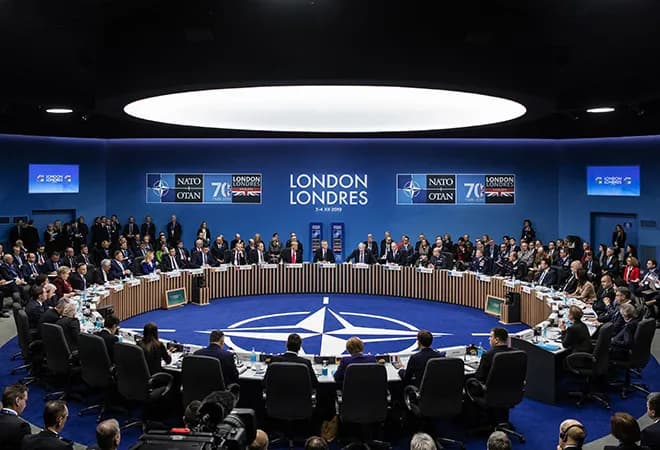
The Alliance at the Crossroads: What NATO Is, What It Has Become, and Whether It Can Survive the Age of Great Power Competition
Executive Summary
The North Atlantic Treaty Organization is the most consequential military alliance in human history. For seventy-five years it has anchored the security architecture of the Western world, prevented a third European war, extended a nuclear umbrella over thirty-two nations, and served as the institutional expression of a transatlantic community bound by shared values, collective defense commitments, and interlocking military structures of a depth and integration that no other alliance has ever matched. It has survived the Cuban Missile Crisis, the Vietnam fracture, the collapse of the Soviet Union that rendered its original purpose obsolete, the 9/11 transformation that sent it into Afghanistan, the Libya intervention that exposed its internal divisions, and the 2014 Ukraine crisis that reminded it why collective defense was invented in the first place.
Now NATO faces a convergence of pressures unlike any it has previously navigated simultaneously. Russia's full-scale invasion of Ukraine in February 2022 confirmed every warning about Kremlin revisionism that the alliance's eastern members had been issuing for a decade and triggered the largest expansion of European defense spending since the Cold War. Finland and Sweden's accession - bringing the alliance to thirty-two members and closing the Baltic Sea to Russian naval freedom of action - represented NATO's most strategically significant enlargement in a generation. Yet at precisely the moment when Russian aggression has validated NATO's core purpose, the alliance's foundational pillar - the United States - is governed by an administration that has publicly questioned whether America would honor Article 5 commitments to allies it regards as inadequate defense spenders, has disrupted intelligence sharing with European partners, and has opened diplomatic channels with Moscow that bypassed Kyiv and Brussels simultaneously.
This report provides a doctrine-level assessment of NATO - its foundational architecture, its Cold War evolution, its post-Cold War identity crisis, its reinvention in the face of Russian aggression, and the profound strategic uncertainty that surrounds its future in an era of American strategic ambivalence, Chinese systemic challenge, and European strategic awakening. The central finding is that NATO's institutional resilience is real but not unconditional, and that the combination of external threat escalation and internal political fracture has created a stress test for which the alliance's existing mechanisms are inadequately designed.
Strategic Background
NATO was born from the specific trauma of April 4, 1949, when twelve nations signed the Washington Treaty in the aftermath of the Berlin Blockade, the communist coup in Czechoslovakia, and the dawning recognition that the wartime alliance with the Soviet Union had dissolved into a structural adversarial relationship that American nuclear monopoly alone could not manage. The treaty's core logic was elegantly simple and deliberately ambiguous: an attack on one member would be considered an attack on all, with each member responding as it deemed necessary. Article 5 did not mandate a specific military response - it mandated a collective political determination that an act of war against any member was an act of war against all. The ambiguity was intentional, preserving American constitutional authority over war decisions while extending a credible deterrent umbrella over Western Europe.
The alliance's integrated military command structure - unprecedented in peacetime history - was the mechanism through which this political commitment was translated into operational credibility. Supreme Allied Commander Europe, a position held continuously by an American four-star general, commanded multinational forces organized into a coherent deterrence posture across the Central European front. The Nuclear Planning Group, established in 1966, provided the institutional framework through which non-nuclear members participated in alliance nuclear policy without possessing nuclear weapons themselves. Forward deployment of American forces in West Germany, the United Kingdom, Italy, and eventually throughout Central Europe embodied the American commitment in a way that no political declaration alone could replicate - American soldiers were the tripwire whose potential casualties ensured that any Soviet attack on Europe would immediately become an attack that killed Americans and therefore guaranteed American military response.
This architecture produced something genuinely remarkable: seventy-five years of peace among nations that had fought two catastrophic world wars within thirty years. The long peace of the Cold War was not the result of moral transformation among European nations or the resolution of underlying political conflicts - it was the product of a deterrence architecture so credible, so deeply institutionalized, and so mutually reinforcing that the cost-benefit calculation of aggression never reached a threshold that any rational actor was willing to cross. NATO's success was, in the truest strategic sense, its invisibility: the wars it prevented left no visible record, only the counterfactual absence of catastrophe.
Historical Context
Understanding NATO's current predicament requires tracing the arc of its evolution through three distinct historical phases, each of which bequeathed both institutional achievements and unresolved tensions to its successor.
The Cold War phase, from 1949 to 1991, was defined by clarity of purpose and the structural discipline that clarity imposed. The Soviet threat was existential, unambiguous, and shared. The threat created political cohesion that papered over significant internal disagreements - about nuclear strategy, about burden-sharing, about out-of-area operations, about détente. France's 1966 withdrawal from the integrated military command under Charles de Gaulle - the most dramatic internal rupture of the Cold War era - did not destabilize the alliance because the Soviet threat maintained the fundamental coherence of allied purpose even amid structural French dissent. The Cold War era also produced the burden-sharing debate in embryonic form: American complaints about European free-riding on American defense spending were a consistent feature of alliance politics from the Kennedy administration onward, but they remained within a framework in which the American commitment to European defense was never genuinely questioned.
The post-Cold War phase, from 1991 to 2014, was defined by strategic drift and the search for a new purpose. With the Soviet Union dissolved and the Warsaw Pact disbanded, NATO's original rationale had been comprehensively fulfilled - and its continued existence required justification. The alliance found that justification in three directions simultaneously: enlargement eastward, incorporating former Warsaw Pact members and eventually former Soviet republics into the Western security community; out-of-area operations, conducting the Balkans interventions of the 1990s and the Afghanistan campaign after 2001 that stretched the alliance far beyond its original geographic and functional scope; and partnership programs that extended cooperative security relationships to nations across the former Soviet space and the broader Mediterranean region.
Each of these directions created new tensions and unresolved strategic questions. Enlargement - specifically the 2008 Bucharest Summit declaration that Ukraine and Georgia would eventually become NATO members - created the most consequential and still-unresolved tension with Russia, which Vladimir Putin's government treated as a red line whose crossing justified escalating responses. The out-of-area missions revealed fundamental disagreements about alliance governance, rules of engagement, and burden-sharing in expeditionary operations. The Afghanistan campaign in particular exposed the depth of the gap between American and European military capabilities and political will for sustained combat operations. The Libya intervention of 2011, conducted under a NATO framework that France and the United Kingdom drove while Germany abstained and the United States played a supporting role, illustrated how far the alliance had drifted from the integrated command coherence of its Cold War architecture.
The third phase began in 2014 with Russia's annexation of Crimea and its support for separatist forces in eastern Ukraine's Donbas region. The Crimea annexation shattered the post-Cold War assumption that the European security architecture was settled and that territorial revisionism was a relic of a superseded era. NATO's response was substantive but calibrated: the Wales Summit of 2014 established the Readiness Action Plan, created the Very High Readiness Joint Task Force, and agreed the pledge that members would move toward spending two percent of GDP on defense. The Enhanced Forward Presence - four multinational battalion-sized battle groups deployed in Estonia, Latvia, Lithuania, and Poland - provided a visible forward defense posture in the most exposed allied territory.
Russia's full-scale invasion of Ukraine in February 2022 transformed the third phase into something qualitatively different. The invasion was not a further incremental deterioration of European security - it was a civilizational rupture. It confirmed that Russia was willing to use massive conventional military force to achieve territorial revision in Europe. It demonstrated that the deterrence framework that had kept the peace since 1945 had failed to prevent war on European soil at a scale not seen since 1945. And it raised, with urgent clarity, the question of whether the NATO framework was adequately configured to deter and if necessary defeat a Russian military that had demonstrated both its willingness and, through the grinding attritional warfare of the Donbas, its capacity for sustained large-scale combat operations.
Current Situation Assessment
NATO's current strategic environment is defined by an unprecedented combination of external validation and internal fracture that creates a paradox at the heart of the alliance's identity. The Russian threat has never been more clearly demonstrated since the Cold War's end. European defense spending has increased at a pace and scale that would have seemed politically impossible before February 2022. The alliance has expanded to its most strategically advantageous configuration in decades, with Finnish and Swedish accession closing the Baltic Sea gap and adding two highly capable military forces with modern equipment and strong defensive territorial traditions. The alliance's deterrence posture in Eastern Europe has been substantially reinforced, moving from the tripwire battalion-level Enhanced Forward Presence toward a more robust brigade-level configuration across the most exposed frontage.
Yet simultaneously, the Donald Trump administration's second term has introduced a level of uncertainty about American commitment to Article 5 that no previous American administration has permitted to surface in public discourse. Trump's repeated statements during the 2024 election campaign about encouraging Russia to attack NATO members that did not meet defense spending targets were unprecedented in their direct challenge to the credibility of the American guarantee. The administration's disruption of intelligence sharing with European allies, its pressure on European governments over unrelated trade issues in ways that have complicated bilateral security relationships, and its direct diplomatic outreach to Vladimir Putin's government without European participation have collectively created a crisis of alliance confidence that the subsequent qualification of Trump statements by other senior officials has not fully resolved.
The European response to this American uncertainty has been the most significant shift in European strategic culture since German rearmament in the 1950s. Germany's announcement of a one hundred billion euro special defense fund following the February 2022 invasion - the Zeitenwende moment that Chancellor Olaf Scholz described as a fundamental turning point - was followed by sustained increases in German defense spending that have moved the Bundeswehr from chronic underfunding toward NATO's two percent target. Poland has embarked on what is proportionally the most ambitious military expansion in NATO, with defense spending at four percent of GDP and major acquisitions of American, South Korean, and domestically produced weapons systems that will give the Polish armed forces the largest land warfare capability in Central Europe within a decade. The United Kingdom has maintained its position as NATO's second-largest defense spender and most capable non-American military contributor, though domestic fiscal pressures are beginning to constrain the pace of capability investment.
France under Emmanuel Macron has pursued a distinctive strategic course that simultaneously deepens French commitment to European defense and articulates a vision of European strategic autonomy that implicitly questions the permanence of the American guarantee. Macron's controversial statement that NATO was experiencing brain death, made in 2019, has been partially vindicated by subsequent events - not because the alliance lacks coherence but because the American political foundations on which it rests have proven less durable than the institutional architecture suggests. French advocacy for European strategic autonomy - its own nuclear deterrent, its defense industrial base, its expeditionary military capabilities - represents both a genuine strategic vision and a hedging strategy against the scenario in which American commitment to European defense is conditionally or permanently reduced.
Power Center Analysis
The United States: The Indispensable but Ambivalent Anchor
The United States remains NATO's foundational pillar in ways that no amount of European defense investment can yet replace. American nuclear deterrence - the extended deterrence guarantee that commits US strategic forces to the defense of allied territory - is the ultimate guarantee that no adversary can rationally contemplate nuclear coercion of NATO members. American conventional military capabilities, intelligence assets, logistics infrastructure, airlift and sealift capacity, precision strike capabilities, and command and control architecture represent contributions to alliance warfighting that European members collectively cannot replicate on any plausible investment timeline.
The American domestic political transformation represented by Trumpism - the shift toward a transactional, burden-sharing-centric view of alliance commitments that treats Article 5 as conditional rather than unconditional - represents the most serious internal challenge NATO has faced. The strategic logic of unconditional collective defense commitments is that their credibility derives precisely from their unconditional character: an adversary that believes the commitment might not be honored under some circumstances will probe those circumstances. The introduction of conditionality - even rhetorical conditionality - into American commitment to Article 5 has forced European governments to accelerate defense investment not merely to meet legitimate burden-sharing objectives but to purchase the continued credibility of the American guarantee through demonstrated spending compliance.
The deeper structural question is whether the Trumpian critique of NATO - that it represents European free-riding on American military power and taxpayer resources - reflects a durable shift in American political culture or a cyclical political phenomenon that will be reversed by subsequent administrations. The evidence suggests that elements of the burden-sharing critique have bipartisan support in American politics that will outlast any particular administration, and that future American commitment to European defense will be more conditional on European defense investment than the unconditional posture of the Cold War era. European governments that plan on the basis of restored American commitment without structural European defense strengthening are making a strategic planning error of potentially catastrophic consequence.
The United Kingdom: The Bridge Under Stress
The United Kingdom occupies a uniquely important but structurally anomalous position within NATO in the post-Brexit era. As the alliance's second-largest conventional military contributor, a nuclear power, a permanent UN Security Council member, and the host of critical American intelligence infrastructure including GCHQ's partnership with the NSA, the UK brings capabilities and institutional relationships that no other European ally can replicate. The AUKUS partnership - connecting the United States, United Kingdom, and Australia in a technology-sharing arrangement centered on nuclear-powered submarine provision to Australia - is the most significant defense industrial agreement of the post-Cold War era and positions the UK as a key node in the Indo-Pacific security architecture that increasingly concerns NATO planning as China's global ambitions expand.
However, the UK's post-Brexit exclusion from EU defense cooperation frameworks, its defense industrial base under fiscal pressure, and the domestic political volatility of recent years have created uncertainties about whether British capability commitments can be sustained at the levels that NATO operational planning requires. The UK's ability to serve as the transatlantic bridge between American and European strategic perspectives - a role it has performed since NATO's founding - is complicated by its simultaneous exclusion from EU institutional frameworks and its deepening bilateral alignment with Washington under security partnerships that bypass European multilateral channels.
Germany: The Awakened Giant
Germany's Zeitenwende is the most consequential shift in European strategic culture since the end of the Cold War, and its full implications will take a decade to become visible in operational military capability. The combination of the one hundred billion euro special fund, sustained above-two-percent GDP defense spending commitments, and the political consensus across German mainstream parties that the post-Cold War peace dividend era is definitively over represents a genuine transformation in the country that - by virtue of its central position, its economic weight, and its historical legacy - has more capacity to reshape European security than any other Continental power.
The Bundeswehr's reconstitution from its post-Cold War nadir of chronic underfunding, equipment shortfalls, and capability gaps to a NATO-leading force will require sustained political will through multiple electoral cycles and investment of a scale that German public finances will find challenging. The political commitment is currently present - demonstrated by the constitutional amendment that removed defense spending from Germany's debt brake constraints - but its durability through economic downturns and political cycles will be the critical variable determining whether the Zeitenwende produces lasting strategic transformation or a temporary spending surge followed by retrenchment.
Poland: The Eastern Anchor
Poland has emerged as NATO's most strategically significant Continental member in the current threat environment. Its geographic position on the alliance's eastern flank, its direct experience of Russian aggression as a neighbor of both Ukraine and the Kaliningrad exclave, its historical memory of Soviet occupation, and its current political determination to build the most capable land military force in Central Europe make Poland the nation whose strategic interests are most directly at stake in the Ukraine conflict and whose defense investments are most directly calibrated to the Russian threat. Polish defense spending at four percent of GDP, combined with major capability acquisitions - including M1A2 Abrams tanks from the United States, K2 Black Panther tanks and K9 Thunder self-propelled howitzers from South Korea, and significant domestic defense industrial expansion - will produce a Polish military within a decade capable of providing a genuine continental defense anchor independent of American forward presence at current levels.
France: The Strategic Visionary
France remains NATO's most intellectually ambitious member - the nation most willing to articulate a strategic vision for European security that does not take American commitment as a permanent given. Macron's consistent advocacy for European strategic autonomy, for a genuine European defense capability independent of NATO command structures, and for a political settlement framework for Ukraine that does not permanently exclude Russian participation in European security architecture has created tension with Eastern European allies whose threat perceptions are more acute and whose historical experience with Russian security guarantees is more traumatic. French strategic culture - shaped by de Gaulle's vision of an independent French role in world affairs, anchored by an independent nuclear deterrent, and resistant to subordination within any framework that constrains French freedom of action - will continue to produce a distinctive French voice within the alliance that simultaneously strengthens European defense ambition and complicates allied consensus formation.
Military and Security Implications
The military implications of NATO's current strategic environment are being worked through a fundamental reassessment of alliance defense planning that has not occurred at this depth since the Cold War's end.
The Russia threat reassessment is the most urgent. The Ukraine war has produced a comprehensive empirical dataset on Russian military capabilities, doctrine, and operational effectiveness that is reshaping NATO force planning across every domain. The early performance of Russian forces in 2022 - characterized by command failures, logistics breakdowns, equipment problems, and operational incoherence that exceeded most Western intelligence assessments of Russian military dysfunction - initially suggested a reduced conventional threat. The subsequent Russian adaptation to attritional warfare, the mobilization of substantial additional manpower, the expansion of defense industrial production to sustain high-intensity conflict, and the demonstrated willingness to absorb enormous casualties to achieve territorial objectives has produced a more sobering assessment: Russia has learned from its early failures, has demonstrated genuine resilience in sustained conflict, and will emerge from the Ukraine war - whatever its outcome - with a military that has been hardened by combat experience in ways that peacetime training cannot replicate.
NATO's force planning response has been the most substantive adaptation since the Cold War. The 2022 Madrid Summit's adoption of a new Strategic Concept - the first since 2010 - explicitly reidentified Russia as the most significant and direct threat to allied security. The New Force Model, adopted at the same summit, committed the alliance to increasing high-readiness forces from forty thousand to over three hundred thousand, with a restructured command model capable of mounting a credible defense of all allied territory from the first day of any conflict rather than relying on reinforcement timelines that assume sufficient warning time for force generation. The shift from the Enhanced Forward Presence battalion battle groups to brigade-level forces - with full divisions designated to support them rapidly - represents a substantive upward revision of the alliance's forward defense posture.
The nuclear dimension has acquired new urgency following Russian nuclear signaling throughout the Ukraine conflict. Vladimir Putin's repeated references to Russia's nuclear arsenal, the modification of Russian nuclear doctrine announced in November 2024 to lower thresholds for nuclear use, and the deployment of tactical nuclear weapons to Belarus have all required NATO to reassess the credibility of its nuclear deterrence posture and the readiness of its nuclear sharing arrangements. The B61-12 nuclear gravity bomb, which NATO allies equipped with dual-capable aircraft are certified to deliver, has been upgraded and deployed to enhance the alliance's nuclear deterrence posture. The political consultations required to maintain alliance cohesion on nuclear policy - ensuring that member states with varying degrees of nuclear risk tolerance maintain a unified posture under escalation pressure - represent one of the alliance's most sensitive ongoing challenges.
The China dimension has introduced a genuinely new complexity into NATO strategic planning. The 2022 Strategic Concept identified China for the first time as presenting systemic challenges to allied security - not as a direct military threat comparable to Russia but as a power whose military modernization, coercive economic practices, technology competition, and support for Russia's war economy create challenges that the alliance must address. The involvement of Indo-Pacific partners - Australia, Japan, South Korea, and New Zealand - in NATO summits since 2022 reflects the recognition that the Euro-Atlantic and Indo-Pacific security theaters are becoming structurally connected through Chinese and Russian strategic coordination. The challenge for NATO is to develop a coherent China policy without fracturing the internal alliance consensus: European members whose economic relationships with China are deeper and whose geographic distance from Indo-Pacific conflict scenarios is greater are more cautious about framing China as a NATO adversary than the United States or the alliance's Pacific-facing members.
Economic and Trade Impact
The economic dimensions of NATO's current predicament are as consequential as the military ones, and in some respects more structurally determining of the alliance's long-term trajectory.
Defense spending is the most visible economic dimension. The two percent GDP target - established as a political commitment at the 2014 Wales Summit and regularly reaffirmed since - has gained new political traction following the Ukraine invasion. By 2024, twenty-three of NATO's thirty-two members had either reached or were credibly committed to reaching the two percent threshold - a dramatic improvement from the eight members that met the target in 2014. But the two percent figure, while politically significant, is an imperfect measure of actual defense capability contribution. Defense spending quality - what the money buys, how well integrated it is with allied capabilities, whether it produces combat-credible forces or sustains garrison militaries with outdated equipment - matters as much as the headline spending level.
The defense industrial base presents a structural challenge that spending levels alone cannot resolve in the short term. The post-Cold War defense industrial consolidation in both the United States and Europe - driven by the assumption that high-intensity peer conflict was a relic of the Cold War - has produced an industrial base with insufficient production capacity for the sustained munitions consumption rates demonstrated in Ukraine. The Ukraine war has consumed artillery ammunition at rates that European and American defense industries were not configured to sustain: the 155mm artillery shell consumption of Ukrainian forces in peak combat has exceeded NATO member stockpiles in ways that expose a structural under-investment in production capacity that will require years and substantial capital investment to remedy.
The European defense industrial challenge is compounded by fragmentation: thirty-two nations with thirty-two national defense procurement systems, partially overlapping capability requirements, and domestically driven industrial policy preferences that frequently prioritize national content over alliance interoperability or cost efficiency. The European Defense Agency has made incremental progress on defense industrial cooperation, but the fundamental political economy of European defense procurement - in which governments use defense contracts as industrial policy instruments for domestic employment and technology development - resists the rationalization and specialization that would maximize collective alliance capability per euro spent.
The economic coercion dimension of China's relationship with NATO members adds a further complexity. Several major NATO economies - Germany, Italy, the Netherlands, and others - have significant trade and investment dependencies on China that create vulnerability to economic pressure in scenarios where NATO policy moves toward more explicit opposition to Chinese strategic interests. The Trump administration's tariff policies, while primarily directed at economic rather than security objectives, have simultaneously complicated European trade relationships with the United States, reducing the economic coherence of the transatlantic community at precisely the moment when strategic coherence is most urgently required.
Diplomatic Positioning
NATO's diplomatic positioning in the current environment requires managing a set of fundamentally contradictory imperatives simultaneously: maintaining unity among thirty-two members with significantly different threat perceptions and strategic cultures, preserving the credibility of the American commitment while managing American political unpredictability, engaging diplomatically with Russia to prevent conflict escalation while maintaining deterrence credibility, and developing a coherent China policy without fracturing the internal consensus or alienating members with deep China economic dependencies.
The Ukraine dimension is NATO's most acute diplomatic challenge. The question of Ukraine's NATO membership - deferred at the Bucharest Summit in 2008 with the declaration of eventual membership that satisfied neither Kyiv's desire for a Membership Action Plan nor Russia's demand for permanent exclusion - has become the central unresolved issue of European security. The alliance's current position - that Ukraine will become a NATO member when conditions are met, without specifying what those conditions are or providing a MAP - is diplomatically unsustainable as a long-term posture. Every passing month without a credible membership pathway increases Ukrainian vulnerability to the calculation that Western security guarantees are ultimately not forthcoming, while every step toward membership increases Russian escalation risk.
The management of relations with Turkey has become more complex since Recep Tayyip Erdogan's government combined alliance membership with cultivation of Russian economic relationships, procurement of the S-400 air defense system that resulted in Turkish exclusion from the F-35 program, and the leveraging of NATO enlargement votes - particularly the prolonged blocking of Finnish and Swedish accession - as bargaining chips for Turkish national interests. Turkey's position illustrates the structural tension in a consensus-based alliance between the collective security benefits of maintaining a geographically critical member with a large military and the costs of accommodating a member whose political trajectory has moved toward authoritarian consolidation and strategic promiscuity.
The Hungary factor similarly illustrates alliance governance challenges. Viktor Orban's government has maintained economic and political relationships with Russia that are inconsistent with alliance solidarity, has blocked various Ukraine support measures within EU frameworks, and has articulated a distinctive Hungarian national interest that explicitly diverges from NATO consensus positions on multiple issues. The alliance lacks effective mechanisms for disciplining members whose behavior falls short of solidarity expectations short of expulsion - a step so consequential that it functions as no real constraint at all.
Regional Fallout
Eastern Europe: The New Front Line
The nations of NATO's eastern flank - Poland, the Baltic states, Romania, and Bulgaria - are experiencing NATO's current evolution as existential rather than institutional. For Estonia, Latvia, and Lithuania, the Ukraine war is not a distant conflict of strategic interest but a preview of the threat they face themselves. These nations have been the most consistent advocates within the alliance for a more robust deterrence posture, for a clear Ukrainian victory outcome, and for the fastest possible movement toward Ukrainian NATO membership. Their geographic exposure - Estonia shares a border with Russia, Latvia has a significant Russian-speaking minority that Russian information operations have historically targeted, and Lithuania's Suwalki Gap corridor connecting Poland to Lithuania represents one of NATO's most significant defensive vulnerabilities - gives them a clarity of threat perception that shapes their diplomacy with a directness that sometimes strains alliance consensus.
The Nordic Dimension
Finland and Sweden's NATO accession has transformed the strategic geometry of the Baltic region in ways that continue to reverberate through alliance planning and Russian threat assessment. Finland's one thousand three hundred kilometer border with Russia - the longest of any NATO member - and the Swedish island of Gotland's strategic position in the Baltic Sea collectively give the alliance a fundamentally more robust defensive posture in a region that NATO planners had previously assessed as potentially indefensible in a rapid Russian assault scenario. The Nordic states bring capable, well-funded, technologically sophisticated militaries with strong conscription bases and genuine territorial defense traditions that complement the alliance's capability portfolio in ways that extend beyond their individual defense budgets.
The Southern Flank
NATO's southern flank - encompassing the Mediterranean, the Sahel's security vacuum, the Middle East's instability, and the migration pressures that originate from both - presents a threat environment that is structurally different from the eastern flank's conventional military threat but equally consequential for alliance cohesion. The collapse of security in Libya following the NATO-backed intervention that removed Muammar Gaddafi created a failed state that has served as a transit point for migration flows, a theater for Russian Wagner Group operations, and a demonstration of the limits of NATO's out-of-area capability when political will for sustained follow-through is absent. Turkey's geographic position on the southern flank gives it leverage over migration management that Ankara has not hesitated to use as a diplomatic instrument within alliance relationships.
Global Strategic Consequences
NATO's trajectory carries global strategic consequences that extend far beyond the Euro-Atlantic theater and that are reshaping the calculations of every major power and middle power in the international system.
For China, NATO's revitalization under Russian threat has produced an uncomfortable strategic lesson: alliance systems built around credible commitments and genuine shared interests are more resilient than their most vocal critics - including Beijing - anticipated. The speed with which European defense spending increased, the coherence of the alliance's response to Russian aggression, and the expansion to include Finland and Sweden have demonstrated that the Western alliance system retains a capacity for self-renewal that Chinese strategic planning should not discount. At the same time, the fractures exposed by Trump's presidency, the internal disagreements over burden-sharing and strategic direction, and the limitations of allied support for Ukraine all provide Beijing with evidence that the alliance's cohesion has exploitable limits.
For Russia, NATO's response to the Ukraine invasion has produced a strategic paradox. The invasion that Putin justified in part by the need to prevent Ukrainian NATO membership has produced a NATO that is larger, better funded, more forward deployed, and more strategically focused on the Russian threat than at any point since the Cold War's end. The closure of the Baltic Sea to Russian naval freedom of action, the strengthening of NATO's eastern flank, and the acceleration of European defense industrial expansion will collectively produce a more powerful NATO in 2030 than existed in 2022 - the opposite of Putin's strategic objective. This does not mean the invasion failed in all its objectives - Russia has achieved significant territorial gains in Ukraine - but it has comprehensively failed in its objective of reducing the NATO threat to Russian interests.
For India, NATO's evolution is relevant primarily through the lens of its implications for American strategic attention and resource allocation. An American strategic community deeply engaged in European security commitments - reinforcing NATO deterrence, supporting Ukraine, managing the Russia relationship - has less bandwidth and fewer resources for the Indo-Pacific competition that India's strategic interests require Washington to prioritize. India's relationship with NATO is non-alliance but increasingly engaged through partnership frameworks, and New Delhi watches the alliance's internal debates about burden-sharing and strategic priorities with the calculation that any reduction in American European commitment creates both opportunities and risks for Indian strategic positioning.
Risk Matrix
- Critical Risk - American Commitment Rupture: A formal or effective American withdrawal from Article 5 commitments - whether through explicit policy declaration, failure to respond to a probing Russian action against a Baltic state, or a negotiated arrangement with Russia that accepts territorial changes inconsistent with the UN Charter - would constitute a civilizational rupture of the post-1945 security order. The probability of this scenario is currently assessed as low but not negligible, and its consequences would be so catastrophic that even low probability demands serious planning attention. European defense capabilities are not yet at a level where they could compensate for the loss of American nuclear deterrence and conventional military superiority within any near-term planning horizon.
- Critical Risk - Russian Military Action Against NATO Territory: A deliberate or miscalculated Russian military action against NATO territory - most likely in the Baltic states or against logistics infrastructure supporting Ukraine - would trigger Article 5 consultations and potentially the alliance's first collective defense response in history. The management of escalation in such a scenario - particularly the nuclear dimension - would represent the most dangerous moment in European security since the Cuban Missile Crisis. Russian willingness to probe NATO's red lines depends critically on its assessment of allied resolve, which in turn depends on the credibility of the American commitment discussed above.
- High Risk - European Defense Investment Fatigue: The political and fiscal sustainability of the defense spending increases committed since 2022 is not guaranteed through economic downturns, political cycles, and the competing demands of social spending, climate investment, and debt service. A premature reduction in European defense investment - before the capabilities that spending is intended to build are fully operational - would create a dangerous gap between declared NATO deterrence ambition and actual military capability that adversaries could exploit.
- High Risk - Turkey-NATO Structural Fracture: A further deterioration of Turkey's alignment with NATO consensus positions, or a Turkish decision to leverage its geographic position and Black Sea access authority for bilateral arrangements with Russia that undermine alliance operations, could create a functional rupture in the southern flank that compromises alliance coherence without a formal Turkish exit. The management of Turkey requires a level of political investment and tolerance for transactional behavior that strains alliance normative cohesion.
- Moderate-High Risk - China-NATO Collision on Technology: The expansion of NATO's China policy beyond systemic challenge language toward more explicit military preparedness requirements - for instance, requirements to restrict Chinese technology from critical defense infrastructure - could fracture the internal alliance consensus, particularly among members with deep Chinese economic dependencies and less acute Chinese security threat perceptions.
Scenario Analysis
Scenario One - Resilient Adaptation
In this scenario, NATO successfully navigates its current crisis through a combination of sustained European defense investment, gradual American political recalibration toward reliable alliance commitment, and the management of Ukrainian conflict toward an outcome that is consistent with the alliance's core interests in a sovereign Ukraine and a deterred Russia. European defense spending reaches and sustains levels that provide genuine conventional deterrence of Russian aggression even with somewhat reduced American forward presence. The NATOization of European defense - the development of genuinely interoperable, capability-rich European forces operating within the alliance's command framework - proceeds at a pace that compensates for the reduced American political reliability without requiring a formal structural separation. This scenario is plausible but requires sustained political will across multiple democratic electoral cycles in multiple allied nations simultaneously.
Scenario Two - Managed Decoupling
In this scenario, American political conditions produce a formal restructuring of the NATO relationship - not an American exit from the alliance but a reorganization in which American strategic focus shifts decisively toward the Indo-Pacific, American force presence in Europe is substantially reduced, and European members are expected to provide the primary conventional defense of allied territory with American strategic nuclear extended deterrence maintained but American conventional military contribution substantially reduced. This scenario accelerates European strategic autonomy development, potentially including a French nuclear umbrella extended to European partners, and a genuinely capable European defense force under EU or NATO-EU hybrid command arrangements. It is deeply disruptive and carries significant transition risks but may represent the most realistic adaptation to American political trajectory.
Scenario Three - Alliance Fracture Under Pressure
In this scenario, a combination of events - a Russian military action against NATO territory, an American failure to respond with the full force of Article 5, and the subsequent collapse of deterrence credibility in the Baltic states - triggers a cascade of alliance defections. Nations closest to the Russian threat make bilateral security accommodations rather than rely on an alliance whose core commitment has been demonstrated to be conditional. Nations further from the immediate threat reduce their alliance commitments as the political costs of solidarity increase and the credibility of collective protection decreases. This scenario does not necessarily produce a formal NATO dissolution but generates a hollowing out of the alliance's institutional substance while its formal structure is maintained - a NATO without strategic coherence, reduced to a diplomatic forum rather than an operational military alliance. This scenario is a tail risk but is no longer as unthinkable as it would have been five years ago.
Intelligence Forecast: 6-24 Months
Over the six-to-twelve-month horizon, NATO dynamics will be shaped most directly by the trajectory of the Ukraine conflict and the evolution of American domestic politics as the Trump administration's second term develops. The most consequential near-term NATO variable is whether the United States maintains or reduces its military support to Ukraine - a decision that will be read by every NATO member and by Moscow as the most reliable indicator of American commitment to the alliance's broader collective defense purposes. Any significant reduction in American Ukraine support will embolden Russian probing of NATO resolve and will accelerate European planning for strategic autonomy scenarios that assume reduced American reliability.
The 2025 NATO Summit in the Hague represents the most consequential alliance summit since the 2022 Madrid meeting, with the agenda dominated by the defense spending target debate - with the United States pushing for a five percent GDP target that most European members regard as fiscally impossible - and the management of the Ukraine membership question. The summit's outcomes on these two issues will set the parameters for alliance planning through the remainder of the Trump administration's second term.
European defense industrial expansion will continue at an accelerating pace over this horizon, driven by the combination of genuine threat perception increases and the transatlantic supply chain concerns generated by American political uncertainty. The EU's defence industrial initiatives - including the European Defence Industry Programme and the Security Action for Europe fund - will provide additional institutional frameworks for European defence cooperation that progressively reduce dependence on American defence industrial supply chains, though the capabilities produced will take years to materialize in operational units.
Over the twelve-to-twenty-four-month horizon, the defining NATO dynamic will be the management of whatever outcome emerges in Ukraine. A ceasefire or negotiated settlement that leaves significant Ukrainian territory under Russian control will create profound questions about the post-conflict European security architecture - questions about how Ukraine is secured, how Russian compliance with any settlement terms is monitored and enforced, and how NATO deters renewed Russian aggression once the immediate conflict subsides. These questions do not have agreed answers within the alliance and their management will test the political cohesion of a grouping whose members have significantly different assessments of what constitutes an acceptable Ukraine outcome.
China's deepening engagement with Russian defense industrial production - providing microelectronics, machine tools, and dual-use technologies that have sustained Russian military production through Western sanctions - will increasingly require NATO to develop a coherent response that goes beyond the current language of systemic challenge. The alliance will be pressed toward more explicit China policy positions that risk fracturing internal European consensus, requiring careful diplomatic management to maintain both the alliance's China policy and its internal cohesion simultaneously.
Final Strategic Takeaway
NATO enters its eighth decade facing a paradox that its architects could not have anticipated: it is simultaneously more necessary and more politically fragile than at any point since its founding. The Russian threat that it was created to deter has been comprehensively validated by the Ukraine invasion. The alliance has responded with unprecedented expansion, substantial defense spending increases, and a genuine reinvigoration of its collective defense purpose. And yet the political foundations on which it rests - particularly the American commitment that has always been its ultimate guarantor - have been rendered uncertain in ways that no previous internal alliance crisis had approached.
The fundamental strategic lesson of NATO's seventy-five year history is that deterrence is not a static achievement - it is a continuous political and military performance that must be credibly maintained to prevent the testing it is designed to preclude. The moment deterrence credibility is questioned - by adversaries who probe its limits, by allies who doubt its reliability, or by domestic political actors who treat alliance commitments as negotiating chips rather than foundational strategic investments - the architecture that has maintained European peace becomes vulnerable in ways that can deteriorate rapidly and non-linearly.
Europe's response to this moment - the Zeitenwende in Germany, the Polish military expansion, the Nordic enlargement, the broader acceleration of European defense investment - represents the most significant reassertion of European strategic agency since the Cold War's end. It is a reassertion driven not by confidence in the future but by the recognition that the American guarantee cannot be taken as permanent and that European security must ultimately rest on European capability and political will rather than indefinite American strategic patronage.
The states and governments that understand this moment most clearly are not those that advocate loudly for alliance solidarity while contributing minimally to collective defense - they are those that recognize that solidarity without capability is rhetoric, and that the most effective contribution any ally can make to the alliance's future is the investment in their own military strength that transforms collective defense from a political formula into an operational reality. NATO's survival in the coming decade will depend less on its institutional framework and more on whether its most capable members - individually and collectively - build the military power that makes the alliance's collective defense commitment credible regardless of who sits in the White House. That is the hard lesson of the current moment, and the most important strategic truth that NATO's eighth decade has forced to the surface.