
Israel’s Iron Dome Defence System Explained: Capabilities, Limits and Strategic Impact
Executive Summary
Iron Dome is the world’s most combat-tested defence system against short-range rockets, artillery shells, mortar bombs and selected unmanned aerial threats. Developed by Israel after years of rocket attacks from Lebanon and Gaza, it combines radar, automated trajectory analysis, command software and the Tamir interceptor missile to defend populated areas and critical infrastructure.
The system entered operational service in 2011 and recorded its first combat interception on 7 April of that year, destroying a Grad rocket launched from Gaza toward Ashkelon. Since then, Iron Dome has participated in repeated conflicts involving Hamas, Palestinian Islamic Jihad, Hezbollah and other armed groups. Its operational record has influenced defence planning from the United States and Europe to India and East Asia.
Iron Dome is frequently described as an invisible shield covering Israel. That description is compelling and misleading. The system does not attempt to intercept every incoming rocket. Its battle-management software calculates the projected trajectory of a detected threat and decides whether it is likely to strike a populated area, military facility or protected asset. Rockets expected to fall in open ground can be ignored.
This selective-engagement logic is the system’s most consequential innovation. It conserves expensive interceptors, reduces unnecessary launches and allows a limited number of batteries to defend priority zones. Publicly reported interception rates commonly refer to rockets assessed as threats, not the total number launched.
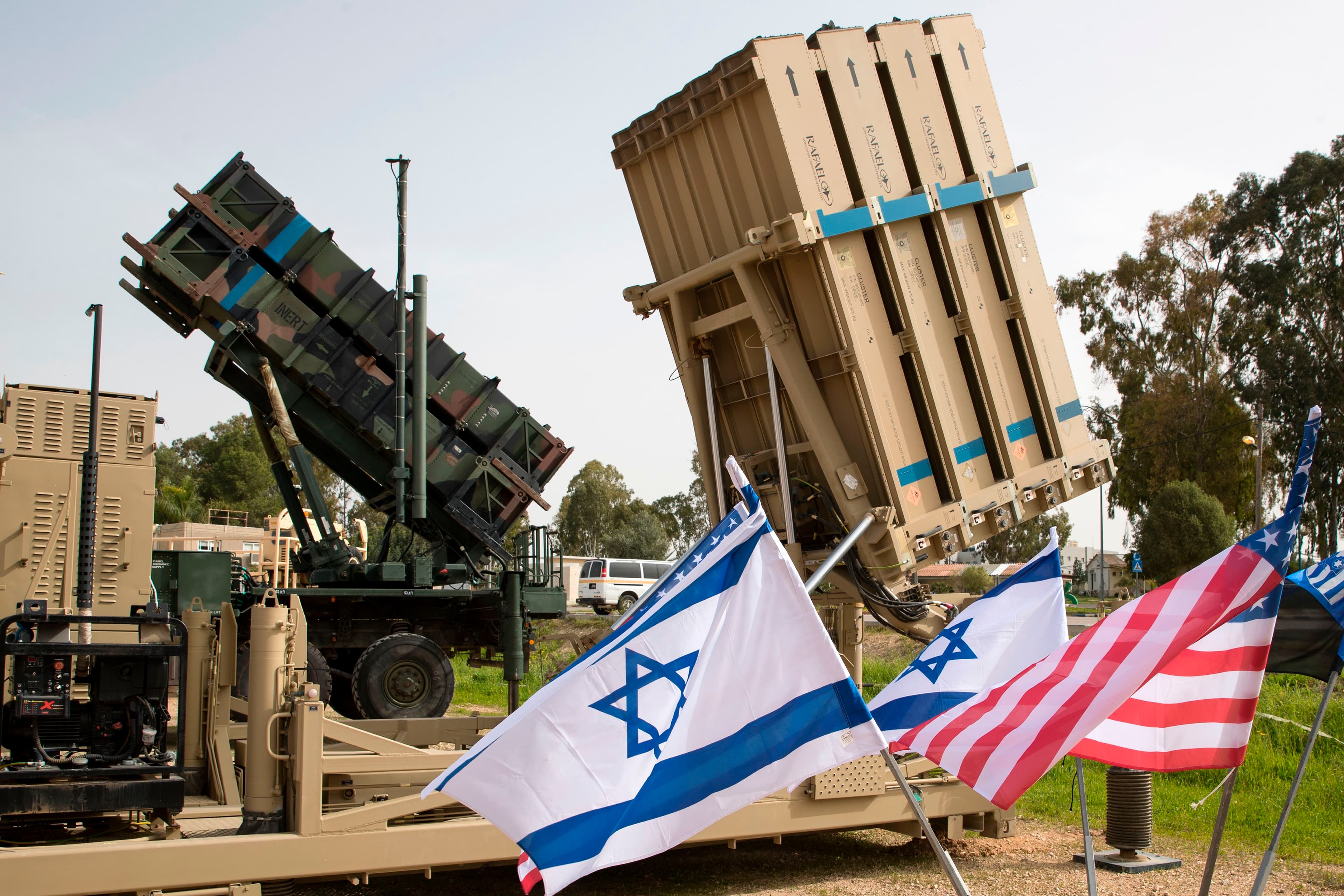
A standard Iron Dome battery includes an EL/M-2084 multi-mission radar produced by Israel Aerospace Industries’ ELTA division, a battle-management and weapon-control centre developed with mPrest Systems, and launchers carrying Tamir interceptors. A launcher is commonly configured with 20 interceptor canisters, while a battery may employ several launchers depending on operational requirements.
When the radar detects a launch, the command system calculates speed, direction and predicted impact. If the threat is classified for engagement, a Tamir missile is launched toward an interception point. The interceptor uses onboard guidance and a proximity-fused warhead to destroy or destabilise the target before impact.
Iron Dome occupies the lower tier of Israel’s national missile-defence architecture. It is primarily designed for shorter-range threats. David’s Sling addresses heavier rockets, cruise missiles and some short- to medium-range ballistic missiles. Arrow 2 and Arrow 3 defend against higher-altitude ballistic threats. American Patriot and Terminal High Altitude Area Defense systems can reinforce the network. Fighter aircraft, naval systems, electronic warfare and offensive operations add additional layers.
This distinction matters. Iron Dome was not the principal system intercepting Iranian medium-range ballistic missiles during the direct Iran-Israel exchanges. Those threats fall mainly within the mission sets of Arrow, David’s Sling, American systems and allied assets. Calling every Israeli interception “Iron Dome” obscures how layered defence actually works.
Iron Dome’s reported performance has been impressive, but precise success rates are difficult to verify independently during war. Israeli authorities and Rafael have often cited interception rates exceeding 90 percent against threats selected for engagement. Such figures should be read with three qualifications:
- They exclude projectiles predicted to land in unprotected or unpopulated areas.
- The definition of a successful interception may vary by operation and threat type.
- Military data concerning launches, engagements, malfunctions and damage are not fully public.
The system has clear limitations. It can be pressured by concentrated salvos, mixed attacks, very short flight times, low-flying drones, electronic interference and interceptor shortages. Debris from a successful interception can still cause casualties or damage. No battery can protect every settlement, military position and infrastructure site simultaneously.
Economics create another vulnerability. A crude rocket may cost hundreds or thousands of dollars, while estimates for a Tamir interceptor commonly range from tens of thousands to more than $100,000 depending on configuration, contract and accounting method. The attacker can therefore impose financial and inventory pressure even when the interceptor works.
Israel’s Iron Beam laser system is intended to alter this equation. The Ministry of Defence and Rafael delivered the first operational high-power Iron Beam system to the Israel Defense Forces in December 2025. Lasers promise a very low marginal cost per engagement, provided electricity is available and weather permits a stable beam. They will complement rather than replace Iron Dome because clouds, dust, humidity, range and line-of-sight conditions constrain laser performance.
Iron Dome’s greatest strategic contribution is not technical. It buys decision time. By reducing casualties and damage, it gives Israeli leaders more room to determine how and when to retaliate. It reduces pressure for immediate large-scale ground action after every rocket barrage.
The same protection creates political and ethical complications. Defensive success may make prolonged conflict appear manageable, weakening incentives for diplomacy. It can also create a false belief that Israeli society can remain insulated from the political consequences of occupation, blockade, regional rivalry and asymmetric warfare.
Iron Dome is exceptionally effective at managing a threat. It cannot remove the political and strategic conditions that generate the threat.
The system should therefore be understood as part of a larger Israeli doctrine combining intelligence, active defence, civil defence, offensive strike and deterrence. It is a highly capable shield, but it cannot substitute for secure borders, sustainable strategy or political settlement.
Background
The Rocket Threat to Israel
Israel’s geography creates unusual vulnerability. The country is narrow, densely populated and surrounded by territories from which rockets and missiles can reach major cities within minutes. Tel Aviv, Haifa, Jerusalem, Ashkelon, Ashdod and numerous military facilities lie within range of different regional arsenals.
Iraq’s Scud attacks during the 1991 Gulf War demonstrated Israel’s exposure to ballistic missiles. The attacks caused limited direct casualties but produced major psychological and political effects. Israel refrained from retaliation under American pressure because Washington feared that Israeli intervention would fracture the coalition fighting Saddam Hussein.
The threat evolved after Israel withdrew from southern Lebanon in 2000 and from Gaza in 2005. Hezbollah and Palestinian armed groups accumulated large rocket inventories. Many early projectiles were inaccurate, but accuracy was not necessary to disrupt civilian life. The ability to launch repeatedly toward urban areas forced schools and businesses to close, triggered evacuations and placed continuous pressure on political leaders.
During the 2006 Lebanon War, Hezbollah fired approximately 4,000 rockets into northern Israel. Dozens of civilians were killed, hundreds were injured and large areas of the north were disrupted. Israel possessed systems intended for longer-range ballistic missiles but lacked an operational defence against the shorter-range rockets threatening towns and cities.
Gaza presented a similar problem. Hamas, Palestinian Islamic Jihad and smaller groups launched Qassam rockets, Grad rockets and mortars toward southern Israeli communities. The short distance between launch areas and Israeli towns left residents with seconds to reach shelter.
Offensive military action could destroy launchers, weapons depots and commanders, but mobile launch teams were difficult to eliminate completely. Many rockets were stored underground, concealed in civilian areas or launched through improvised mechanisms. Even intensive ground operations could not guarantee an end to fire.
Israel therefore needed an active-defence system capable of detecting small projectiles, predicting their impact and intercepting them only when necessary.
Political Debate Over Iron Dome
Iron Dome was not universally accepted when proposed. Critics questioned whether expensive interceptors should be used against crude rockets. Some senior military figures argued that offensive operations, deterrence and civil shelters offered better returns.
There were also competing technical concepts. Systems based on guns, lasers or other missile designs were examined. A laser promised lower engagement costs but faced concerns about weather, power and technological maturity.
Defence Minister Amir Peretz became an influential political supporter of the Iron Dome concept after the 2006 war. Rafael Advanced Defense Systems took the lead in development, working with the Ministry of Defence’s Israel Missile Defense Organization, ELTA and mPrest.
Development moved quickly by the standards of major air-defence programmes. The urgency of continuing rocket attacks created political support, operational feedback and a clear mission.
Iron Dome became operational in 2011. Its first successful combat interception quickly transformed the debate. A system once criticised as expensive and uncertain became a symbol of Israeli technological ingenuity.
American Financial and Industrial Support
Iron Dome is Israeli in origin, but the United States became essential to its expansion. Washington provided billions of dollars for Israeli missile-defence programmes, including Iron Dome, David’s Sling and Arrow.
Following major conflicts, the U.S. Congress approved emergency funding to replenish Tamir interceptors and expand production. The relationship went beyond financial assistance. American companies, particularly RTX subsidiary Raytheon, became involved in co-production.
U.S. participation gave American industry access to technology and created production capacity outside Israel. It also made the system part of the wider strategic relationship between the two countries.
The U.S. Army acquired two Iron Dome batteries as an interim cruise-missile defence capability. Questions emerged about integrating Iron Dome with American command networks, highlighting a recurring lesson: an air-defence battery is most effective when it can exchange data with the wider force.
The U.S. Marine Corps later selected a system using Tamir-derived SkyHunter interceptors integrated with American radar and command components. This modular approach demonstrated that the interceptor could be adapted beyond the original Israeli battery architecture.
From Point Defence to National Strategy
Iron Dome initially addressed a narrow operational problem: short-range rockets threatening southern Israel. Its role expanded as adversaries improved their weapons and conflicts involved larger geographic areas.
Hamas and Palestinian Islamic Jihad increased rocket range, warhead size and salvo coordination. Hezbollah developed a vastly larger inventory and pursued precision-guided capabilities. Iran and the Houthis introduced ballistic missiles, cruise missiles and long-range drones.
Israel responded by building a national layered network rather than relying on a single interceptor. Sensors, command systems and weapons increasingly share data, allowing decision-makers to assign the most suitable interceptor to each threat.
Iron Dome’s success therefore cannot be separated from Israel’s wider investments in intelligence, warning, civil defence and offensive operations.
Current Situation
Iron Dome’s Core Components
Iron Dome is a system of systems. The visible launcher and interceptor represent only one part of the architecture. Its effectiveness depends on the speed and reliability of the entire detection-to-interception chain.
The primary components are:
- Detection and tracking radar: The EL/M-2084 multi-mission radar detects launches, tracks projectiles and supplies trajectory data.
- Battle-management and weapon-control system: Software calculates impact points, evaluates threats and assigns interceptors.
- Launch units: Mobile launchers carry Tamir missiles and can be dispersed from the radar and command centre.
- Tamir interceptor: A manoeuvrable missile equipped with sensors, datalinks and a proximity-fused warhead.
- Communications network: Secure links connect sensors, command nodes, launchers and wider air-defence assets.
The battery’s elements do not need to sit beside one another. Dispersal increases survivability and allows launchers to cover different approaches. Networked operation also means that sensors outside the battery may contribute warning and tracking data.
Detection and Trajectory Calculation
The interception sequence begins immediately after launch. The radar detects a projectile and tracks its movement. Because unguided rockets follow broadly predictable ballistic paths, the system can estimate where they will land.
This calculation occurs within seconds. The battle-management system compares the projected impact area with a database of defended zones. If the projectile is expected to fall in open terrain, the system may recommend no engagement.
If a rocket threatens a populated area or protected facility, the command system determines whether a Tamir interceptor can reach a suitable engagement point. It then assigns a launcher and calculates the optimal launch time.
The process demonstrates why Iron Dome’s software is as important as its missile. A system that launched against every detected object would exhaust its inventory rapidly. Discrimination transforms limited interceptor stocks into a sustainable defence.
The Tamir Interceptor
Tamir is designed for rapid manoeuvre against small, relatively fast targets. After launch, it receives guidance updates and uses its onboard seeker during the final phase.
The missile does not always require a direct physical collision. Its proximity fuse triggers a warhead close enough to disrupt or destroy the incoming projectile. The preferred geometry seeks to damage the rocket’s warhead and reduce the danger to the target area.
A successful interception can still produce falling debris. Fragments from the target and interceptor may land on buildings, vehicles or people. Civil-defence instructions remain essential even when interception is expected.
Exact performance characteristics are classified. Public figures concerning range and engagement altitude should be treated as approximate because the system has received repeated upgrades and different configurations may have different capabilities.
Selective Engagement
Selective engagement is often misunderstood as a limitation. It is a deliberate operational choice. An interceptor should not be spent on a rocket headed toward empty land unless that rocket presents another risk.
This means that the number of Iron Dome launches is lower than the number of enemy projectiles. When Israeli authorities cite an interception rate, they generally refer to threats that the system attempted to intercept.
A hypothetical example illustrates the distinction. If 1,000 rockets are launched, the system may predict that 700 will land in unpopulated areas. If it engages 300 and intercepts 270, the reported success rate would be 90 percent against engaged threats, not 27 percent of all rockets launched.
This method is militarily rational, but it complicates independent assessment. Researchers require reliable data on projected impact zones, engagement decisions, successful intercepts and damage. Much of that information remains classified or contested.
Mobility and Deployment
Iron Dome is mobile, allowing batteries to reposition according to intelligence and operational priorities. Mobility complicates enemy targeting and helps Israel reinforce sectors facing increased threat.
Movement is not instantaneous. Batteries require prepared locations, communications, power, security and logistical support. Relocation can also temporarily reduce coverage.
Israel does not publish complete, current deployment information. Revealing battery locations and interceptor stocks would assist adversary planning.
The number of available batteries must be considered against the scale of Israel’s protection requirement. Urban centres, military bases, power plants, ports, airports and border communities all compete for coverage. Commanders must prioritise assets according to threat and strategic value.
Combat Record in Gaza
Iron Dome has been used extensively during conflicts with Hamas and Palestinian Islamic Jihad. Major escalations in 2012, 2014, 2021, 2022 and 2023 generated thousands of rocket launches.
During Operation Pillar of Defense in 2012, Iron Dome received broad recognition for intercepting rockets headed toward populated areas. The system reduced casualties and demonstrated that active defence could operate under real combat pressure.
The 2014 Gaza war imposed a longer test. Hamas expanded the geographic reach of its attacks, targeting Tel Aviv, Jerusalem and northern Israel. Iron Dome batteries were repositioned as the conflict developed.
The May 2021 conflict involved intensive salvos intended to stress the system. Hamas launched large numbers of rockets within short periods, including barrages toward central Israel. Some rockets penetrated or landed before interception was possible.
On 7 October 2023, Hamas opened its assault with a massive rocket barrage designed partly to overwhelm warning and defence systems while fighters breached the border. Iron Dome intercepted many rockets, but the size and timing of the attack demonstrated that active defence could not prevent a combined operation involving rockets, drones, explosives and ground infiltration.
This was a profound strategic lesson. Iron Dome could defend the airspace above communities, but it could not compensate for failures in intelligence, border surveillance, force posture and command readiness.
The Northern Front
Hezbollah represents a more difficult challenge than Hamas. Its inventory has included short-range rockets, heavier systems, anti-tank missiles, drones and guided weapons. Before the wars that degraded its leadership and infrastructure, public assessments commonly attributed approximately 150,000 rockets and missiles to the organisation.
Northern Israel’s mountainous terrain creates radar and line-of-sight complications. Hezbollah can launch from concealed positions at short range, reducing warning time.
Iron Dome is useful against selected Hezbollah rockets and drones, but it cannot independently defeat a full-scale northern campaign. Such a conflict requires David’s Sling, fighter aircraft, offensive strikes, civil defence and ground operations.
Israel’s operations against Hezbollah commanders, launchers and weapons infrastructure after October 2023 reduced the organisation’s capacity. The threat nevertheless remains strategically significant because even a degraded arsenal can launch dangerous salvos.
Iran, the Houthis and Long-Range Threats
Iran and Yemen’s Houthis expanded the threat spectrum beyond the original Iron Dome mission. They possess long-range drones, cruise missiles and ballistic missiles capable of reaching Israel.
Arrow 2 and Arrow 3 are central to defence against Iranian ballistic missiles. David’s Sling addresses selected lower-tier and manoeuvring threats. Israeli fighter aircraft, American Aegis warships, THAAD, Patriot systems and allied aircraft can contribute additional interceptions.
Iron Dome may engage some drones, cruise missiles or terminal threats depending on trajectory and geometry, but it should not be described as Israel’s primary defence against every Iranian weapon.
The direct Iran-Israel conflicts of 2024, 2025 and 2026 demonstrated the importance of layered defence. No single system could manage hundreds of weapons travelling at different speeds, altitudes and trajectories.
Iron Beam Enters the Network
Israel’s Ministry of Defence and Rafael delivered the first operational Iron Beam high-power laser system to the IDF in December 2025. The development represents the most significant addition to Israel’s lower-tier defence since Iron Dome entered service.
Iron Beam uses concentrated laser energy to heat and damage a target. It can engage rockets, mortar bombs, drones and other aerial threats under suitable conditions.
The primary advantage is engagement cost. Once the system is deployed and powered, each shot consumes electricity rather than a complete interceptor missile. The marginal cost can be only a small fraction of a Tamir launch.
Lasers also possess a deep magazine in principle. They can continue firing as long as power, cooling and target-tracking capacity remain available.
There are significant constraints. Atmospheric moisture, cloud, smoke, dust and turbulence can weaken or scatter the beam. The laser must maintain contact with the target for enough time to cause structural failure. One beam director can engage only a limited number of targets in sequence.
Iron Beam will therefore complement Iron Dome. Lasers can handle suitable low-cost threats, preserving Tamir interceptors for targets, weather conditions and engagement geometries where missiles remain more reliable.
Strategic Analysis
Iron Dome as a Decision-Time Machine
The most valuable resource Iron Dome creates is political time. Before active defence, every successful rocket attack increased pressure for immediate retaliation or ground invasion. Civilian deaths could force leaders to escalate before intelligence and mobilisation were complete.
By reducing the probability of mass casualties, Iron Dome gives the Israeli cabinet and military greater freedom to select a response. It can mobilise forces, consult allies and evaluate intelligence while the population remains partially protected.
This contribution cannot be measured only through intercepted rockets. The system alters crisis behaviour and national morale.
Decision time can also create complacency. Leaders may tolerate repeated rocket attacks because casualties remain limited. This can turn a temporary defensive measure into a framework for managing indefinite conflict.
Deterrence by Denial
Deterrence can operate through punishment or denial. Punishment threatens unacceptable retaliation. Denial convinces an adversary that an attack will fail to achieve its objective.
Iron Dome contributes to deterrence by denial. If rockets cannot generate mass casualties, infrastructure damage or sustained panic, their strategic value declines.
Denial is incomplete because rocket campaigns have objectives beyond physical destruction. They can demonstrate resistance, interrupt daily life, trigger evacuations and influence political narratives. For armed groups, merely continuing to fire may constitute symbolic success.
Iron Dome therefore reduces the effectiveness of rocket warfare without eliminating its political utility.
The Saturation Problem
Every air-defence system has finite capacity. Radar can track many objects, but launchers contain limited interceptors and engagement channels are constrained.
An adversary can attempt to saturate Iron Dome by firing large salvos toward the same defended area. Mixed attacks may combine rockets, drones and other weapons from different directions.
Saturation does not mean that the system suddenly becomes useless. It means the probability of leakage rises as target numbers exceed available interceptors, launch opportunities or command capacity.
Adversaries also seek to exhaust magazines over time. A prolonged campaign may be more effective than a single barrage if Israel cannot replenish Tamir missiles at the rate they are consumed.
Israel counters saturation through additional batteries, distributed launchers, stockpiles, rapid production, offensive strikes and layered engagement. Iron Beam adds another magazine, though its own engagement rate remains finite.
The Cost-Exchange Problem
Air defence protects assets worth far more than the interceptor. A Tamir missile may cost tens of thousands of dollars, but preventing a rocket from striking an apartment building, power station or military base can justify the expenditure.
The challenge appears during sustained low-cost attacks. An adversary may launch crude rockets or drones worth a fraction of the interceptor’s cost. Even unsuccessful attacks force the defender to maintain crews, move batteries and replenish stocks.
Selective engagement improves the exchange ratio by ignoring non-threatening trajectories. Iron Beam could improve it further. Offensive attacks on launchers and production facilities reduce the number of engagements required.
Cost analysis should also include the economic benefit of keeping businesses, airports and infrastructure operating. Iron Dome may be expensive to fire, but the absence of defence can impose far greater national costs.
Interception Rate Controversies
Israeli authorities and Rafael have reported high success rates, often above 90 percent against engaged threats. Independent analysts have debated methodology, radar data, warhead destruction and the difference between interception and complete neutralisation.
Some early critics argued that visual footage did not always demonstrate successful warhead destruction. Others questioned whether casualty reductions resulted partly from shelters and warning systems.
The strongest evidence for Iron Dome’s effectiveness is not a single percentage. It is the repeated operational decision to expand the system, the visible reduction of impacts in defended areas and continued investment by Israel and the United States.
A responsible assessment should accept that Iron Dome is highly effective while rejecting claims of perfect protection. Defence systems can perform strongly in aggregate and still fail in individual engagements.
Why Civil Defence Still Matters
Israel’s protection model combines interception with sirens, shelters, reinforced rooms, public instructions and emergency response. The Home Front Command provides location-specific alerts based on predicted impact zones.
Civilians are instructed to seek shelter because an interceptor may miss, malfunction or produce dangerous debris. Short-range launches can provide only seconds of warning.
Communities close to Gaza or Lebanon face a different reality from Tel Aviv. Extremely short flight times reduce defensive options and increase dependence on shelters and physical fortification.
Iron Dome should therefore be viewed as one component of civil resilience, not a replacement for it.
Offensive and Defensive Integration
Israel does not rely on interception alone. Radar tracks can help locate launch areas. Intelligence identifies storage facilities, commanders and production networks. Aircraft and artillery strike launchers before and after firing.
This offensive-defensive relationship is central to Israeli doctrine. Active defence limits damage while offensive operations reduce the volume and duration of attack.
There is a legal and ethical challenge when weapons are launched from densely populated areas. Israel argues that armed groups deliberately embed military infrastructure among civilians. Critics argue that Israeli responses have caused excessive civilian harm.
Iron Dome can reduce pressure for immediate offensive action, but it does not remove the need for distinction, proportionality and civilian protection in military operations.
The Psychological Shield
The sight of interceptors rising above Israeli cities carries psychological significance. Residents can watch the state actively defending them. This strengthens trust during repeated attacks.
Psychological reliance can become dangerous if the public interprets high success rates as immunity. A single successful strike on a school, hospital or strategic facility can then create disproportionate shock.
Authorities must communicate both confidence and limitation. A population that understands the system is more resilient than one protected by myth.
Global Impact
The United States
Iron Dome became a model for American discussions about homeland and expeditionary missile defence. The United States funded procurement, co-production and replenishment while studying integration of Tamir-derived interceptors into American systems.
President Donald Trump’s Golden Dome initiative uses the language of Israel’s system but addresses a far broader mission, including ballistic, cruise, hypersonic and potentially space-based threats against the continental United States.
The analogy has limits. Israel is geographically small and defends against many short-range regional threats. The United States spans a continent and faces intercontinental missiles travelling through space at vastly higher speeds.
Iron Dome offers useful lessons about layered defence, sensor integration and selective engagement. It cannot be scaled directly into a complete American homeland shield.
India
India studies Israel’s layered defence because it faces rockets, drones, cruise missiles and ballistic missiles from Pakistan and China. New Delhi has acquired Israeli radars, missiles and unmanned systems while developing the indigenous Akash family, ballistic-missile defence and Project Kusha.
Iron Dome itself is not necessarily the best answer to every Indian requirement. India’s geography, border length and threat density differ sharply from Israel’s. Protecting New Delhi, Mumbai, air bases and military formations requires a mixture of systems.
The most transferable lesson is the command architecture: detect, classify, predict impact and assign the cheapest suitable interceptor. Global Chanakya’s India, China and Pakistan intelligence pages should be connected to this wider regional missile competition.
Europe and NATO
Russia’s missile and drone campaign against Ukraine created urgent European interest in layered air defence. NATO members are purchasing Patriot, IRIS-T, SAMP/T, NASAMS and other systems.
Iron Dome or related technologies may be relevant to selected European short-range requirements, but continental defence requires far greater geographic coverage. NATO must also address ballistic missiles, cruise missiles, glide bombs and massed drones.
The European Sky Shield Initiative reflects the same layered logic used by Israel. Global Chanakya’s NATO, Russia, Vladimir Putin and Ukraine pages provide the strategic context.
Ukraine
Ukrainian officials expressed interest in Iron Dome after Russia’s invasion. The system’s suitability was debated because many Russian threats differ from Gaza-launched rockets.
Iron Dome would not independently solve Ukraine’s defence problem. Russian cruise missiles, ballistic missiles, glide bombs and Shahed drones require different interceptors and extensive coverage across a much larger country.
Ukraine’s experience reinforces the principle that air defence must be layered and connected to civil protection, dispersal and offensive action.
South Korea and East Asia
South Korea faces a massive North Korean artillery, rocket and missile threat. Seoul’s proximity to the Demilitarised Zone creates very short warning times and a scale beyond the original Iron Dome mission.
Israeli technology offers useful design lessons, but no missile system can intercept every artillery shell fired during a major Korean conflict. Hardened infrastructure, counter-battery fire, evacuation and deterrence remain essential.
Defence Industry
Iron Dome strengthened Israel’s position as a global air-defence innovator. Rafael, IAI, ELTA and mPrest gained experience that can be applied to other systems and markets.
American co-production created deeper industrial interdependence. The model combines Israeli rapid innovation with American manufacturing scale and finance.
Demand for air defence has increased globally, but exports remain politically sensitive. Buyers require access to software, integration support, interceptors and long-term maintenance. No battery remains effective without a sustained supply ecosystem.
Risk Assessment
Risk One: Saturation Attack
A coordinated adversary could launch large salvos from several directions, increasing the number of threats beyond local engagement capacity.
Probability: High during major war.
Impact: High.
Risk Two: Interceptor Depletion
A prolonged conflict could consume Tamir stocks faster than domestic and American production replaces them.
Probability: Medium to high.
Impact: Very high.
Risk Three: Short-Range Leakage
Rockets or mortars launched close to the border may have flight times too short for reliable interception.
Probability: High in border communities.
Impact: Medium to high.
Risk Four: Mixed-Threat Attack
Rockets, drones and missiles arriving at different speeds and altitudes could complicate classification and interceptor allocation.
Probability: High.
Impact: High.
Risk Five: Cyber or Electronic Disruption
Adversaries may attempt to jam radar, disrupt communications, corrupt data or attack supporting infrastructure.
Probability: Medium.
Impact: High.
Risk Six: False Sense of Security
Political leaders and civilians may assume that high interception rates remove the need for shelters, diplomacy or strategic reform.
Probability: High.
Impact: High over time.
Risk Seven: Economic Attrition
Adversaries may use inexpensive weapons to force repeated expenditure on costly interceptors and mobilisation.
Probability: High.
Impact: Medium to high.
Risk Eight: Laser Overconfidence
Iron Beam may be presented as a complete solution despite weather, line-of-sight and engagement-rate limitations.
Probability: Medium.
Impact: Medium.
Future Scenarios
Scenario Analysis One: Integrated Iron Dome-Iron Beam Defence
Israel deploys Iron Beam batteries alongside Iron Dome. Lasers engage inexpensive drones, mortar bombs and suitable rockets, preserving Tamir missiles for more difficult targets.
Command software assigns threats according to weather, geometry, urgency and cost. The result is a more sustainable lower-tier shield.
Scenario Analysis Two: Northern Saturation War
A rebuilt Hezbollah launches sustained rocket, missile and drone salvos from Lebanon while Iranian-aligned groups attack from additional directions.
Iron Dome protects selected communities but cannot prevent all impacts. David’s Sling, Arrow, aircraft and offensive operations become decisive. Interceptor replenishment from the United States is required.
Scenario Analysis Three: Precision-Rocket Challenge
Adversaries improve accuracy and target air bases, power stations, ports and command facilities. The system can no longer ignore as many trajectories because a higher proportion threaten strategic assets.
Interceptor consumption rises even if the number of launches remains stable. Israel invests in hardening, deception and distributed infrastructure.
Scenario Analysis Four: Drone-Dominated Attack
Armed groups deploy autonomous, low-flying and swarming drones that approach through difficult terrain. Iron Dome receives upgraded sensors and software, while lasers and electronic warfare handle suitable targets.
The contest becomes a rapid cycle of software adaptation rather than a fixed comparison between missiles.
Scenario Analysis Five: Regional Missile Coalition
Iran, Hezbollah, Iraqi militias and the Houthis coordinate attacks across several fronts. Israel’s national systems integrate with American and regional sensors.
The operation validates layered coalition defence but consumes large interceptor inventories. Diplomacy becomes necessary before matériel exhaustion creates dangerous gaps.
Intelligence Forecast
Iron Dome will remain the foundation of Israel’s short-range active defence through the 2030s. It will receive upgrades rather than be replaced by a single new system.
Iron Beam will expand gradually. Missile interceptors will remain necessary during poor weather, long-range engagements and high-speed attacks.
Israel and the United States will increase Tamir production and preserve multiple manufacturing sources. Wartime replenishment will remain a strategic priority.
Future Iron Dome upgrades will place greater emphasis on drones, cruise missiles, electronic protection and integration with external sensors.
Adversaries will pursue saturation, manoeuvring threats, low-altitude flight and precision targeting rather than attempting only to increase rocket range.
Israel will invest more heavily in hardened infrastructure, distributed command, rapid runway repair and protected energy systems. Interception alone cannot secure national continuity.
Publicly stated success rates will remain politically contested because complete engagement data will stay classified.
Iron Dome’s international influence will grow through components, software concepts and Tamir-derived interceptors rather than simple export of identical Israeli batteries.
The defence system will continue giving Israeli governments decision time, but it will not resolve the underlying conflicts with Hamas, Hezbollah, Iran or Palestinian political aspirations.
Final Strategic Takeaway
Iron Dome deserves its reputation as a technological and operational success. It solved a problem many experts once considered economically or technically impractical: intercepting large numbers of short-range rockets without firing at every projectile.
Its achievement rests on discrimination. The EL/M-2084 radar detects and tracks. Battle-management software predicts impact. Tamir interceptors engage only threats that endanger protected areas. The system conserves its magazine by accepting that many rockets will fall harmlessly.
This is why simplistic interception percentages mislead. Iron Dome is not attempting to destroy every rocket in the sky. It is attempting to prevent threatening rockets from causing unacceptable harm.
The system has saved lives, protected infrastructure and reduced the coercive value of rocket arsenals. It has also given Israeli leaders time to make decisions without the immediate pressure created by mass civilian casualties.
It remains vulnerable to saturation, short warning times, mixed attacks, debris and interceptor depletion. It cannot provide complete territorial coverage. It is not the primary answer to long-range Iranian ballistic missiles. It cannot prevent armed infiltration, destroy launch networks or end a war.
Iron Beam will improve the economics of defence, but lasers will not make missile interceptors obsolete. Weather and engagement geometry guarantee that Israel will continue relying on a layered architecture.
The deeper strategic lesson is uncomfortable. Iron Dome makes recurring conflict more survivable, but survivability is not resolution. A society can live beneath a highly effective shield while the threat beyond that shield becomes larger, more precise and more politically entrenched.
Israel’s security will continue to depend on intelligence, civil preparedness, offensive capability, American support and regional diplomacy. Technology can prevent a rocket from reaching a city. It cannot determine what follows the interception.
Iron Dome is therefore best understood not as an invincible roof over Israel, but as a sophisticated instrument for buying time. Whether that time produces stronger deterrence, another military campaign or a sustainable political strategy lies beyond the capability of any radar and interceptor.